lock CHEVROLET SS 2017 1.G Owners Manual
[x] Cancel search | Manufacturer: CHEVROLET, Model Year: 2017, Model line: SS, Model: CHEVROLET SS 2017 1.GPages: 400, PDF Size: 7.31 MB
Page 327 of 400

Chevrolet SS Sedan Owner Manual (GMNA-Localizing-U.S.-10122752) -2017 - crc - 8/31/16
326 Vehicle Care
Caution
If the recommended pressure
cannot be reached after
approximately 25 minutes, the
vehicle should not be driven
farther. The tire is too severely
damaged and the tire sealant and
compressor kit cannot inflate the
tire. Remove the power plug from
the accessory power outlet and
unscrew the inflating hose from
the tire valve. SeeRoadside
Assistance Program0368.
12. Switch the on/off switch (1) tothe O position.
The tire is not sealed and willcontinue to leak air until thevehicle is driven and thesealant is distributed in the tire.Therefore, Steps 13–19 mustbe done immediately afterStep 12.
Be careful while handling thetire sealant and compressor kitas it could be warm afterusage.
13. Unplug the power plug (6) fromthe accessory power outlet inthe vehicle.
14. Turn the sealant/air hose (5)counterclockwise to remove itfrom the tire valve stem.
15. Replace the tire valvestem cap.
16. Replace the sealant/airhose (5), and the power plug (6back in their original location.
17. If the flat tire was able to inflateto the recommended inflationpressure, remove themaximum speed label from thetire sealant canister (3) andplace it in a highly visiblelocation.
Do not exceed the speed onthis label until the damaged tireis repaired or replaced.
18. Return the equipment to itsoriginal storage location in thevehicle.
19. Immediately drive the vehicle8km(5mi)todistributethesealant in the tire.
20. Stop at a safe location andcheck the tire pressure. Referto Steps 1–10 under“Using theTire Sealant and CompressorKit without Sealant to Inflate aTire (Not Punctured).”
If the tire pressure has fallenmore than 68 kPa (10 psi)below the recommendedinflation pressure, stop drivingthe vehicle. The tire is tooseverely damaged and the tiresealant cannot seal the tire.SeeRoadside AssistanceProgram0368.
If the tire pressure has notdropped more than 68 kPa(10 psi) from the recommendedinflation pressure, inflate thetire to the recommendedinflation pressure.
Page 328 of 400
Chevrolet SS Sedan Owner Manual (GMNA-Localizing-U.S.-10122752) -2017 - crc - 8/31/16
Vehicle Care 327
21. Wipe off any sealant from thewheel, tire or vehicle.
22. Dispose of the used tiresealant canister (3) andsealant/air hose (5) assemblyat a local dealer or inaccordance with local statecodes and practices.
23. Replace it with a new canisteravailable from your dealer.
24. After temporarily sealing a tireusing the tire sealant andcompressor kit, take thevehicle to an authorized dealerwithin 161 km (100 mi) ofdriving to have the tire repairedor replaced.
Using the Tire Sealant andCompressor Kit without Sealant toInflate a Tire (Not Punctured)
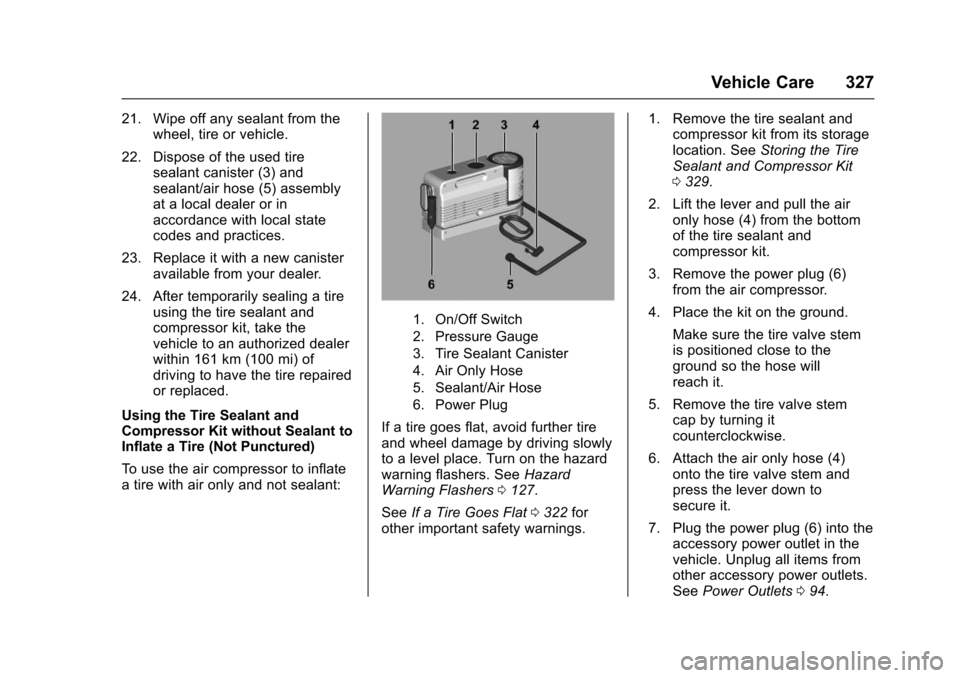
To u s e t h e a i r c o m p r e s s o r t o i n f l a t eatirewithaironlyandnotsealant:
1. On/Off Switch
2. Pressure Gauge
3. Tire Sealant Canister
4. Air Only Hose
5. Sealant/Air Hose
6. Power Plug
If a tire goes flat, avoid further tireand wheel damage by driving slowlyto a level place. Turn on the hazardwarning flashers. SeeHazardWarning Flashers0127.
SeeIf a Tire Goes Flat0322forother important safety warnings.
1. Remove the tire sealant andcompressor kit from its storagelocation. SeeStoring the TireSealant and Compressor Kit0329.
2. Lift the lever and pull the aironly hose (4) from the bottomof the tire sealant andcompressor kit.
3. Remove the power plug (6)from the air compressor.
4. Place the kit on the ground.
Make sure the tire valve stemis positioned close to theground so the hose willreach it.
5. Remove the tire valve stemcap by turning itcounterclockwise.
6. Attach the air only hose (4)onto the tire valve stem andpress the lever down tosecure it.
7. Plug the power plug (6) into theaccessory power outlet in thevehicle. Unplug all items fromother accessory power outlets.SeePower Outlets094.
Page 329 of 400
Chevrolet SS Sedan Owner Manual (GMNA-Localizing-U.S.-10122752) -2017 - crc - 8/31/16
328 Vehicle Care
If the vehicle has an accessorypower outlet, do not use thecigarette lighter.
If the vehicle only has acigarette lighter, use thecigarette lighter.
Do not pinch the power plugcord in the door or window.
8. Start the vehicle. The vehiclemust be running while usingthe air compressor.
9. Switch the on/off switch (1) tothe I position.
The compressor will inflate thetire with air only.
10. Inflate the tire to therecommended inflationpressure using the pressuregauge (2). The recommendedinflation pressure can be foundon the Tire and LoadingInformation label. SeeTirePressure0309.
The pressure gauge (2) mayread higher than the actual tirepressure while the compressoris on. Turn the compressor offto get an accurate reading. The
compressor may be turned on/off until the correct pressure isreached.
11 . S w i t c h t h e o n / o f f s w i t c h ( 1 ) t othe O position.
Be careful while handling thetire sealant and compressor kitas it could be warm afterusage.
12. Unplug the power plug (6) andthe air only hose (4).
13. Replace the tire valvestem cap.
14. Place the equipment in theoriginal storage location in thevehicle.
Removal and Installation of theSealant Canister
After repairing a tire, replace the tiresealant canister.
To r e m o v e t h e s e a l a n t c a n i s t e r :
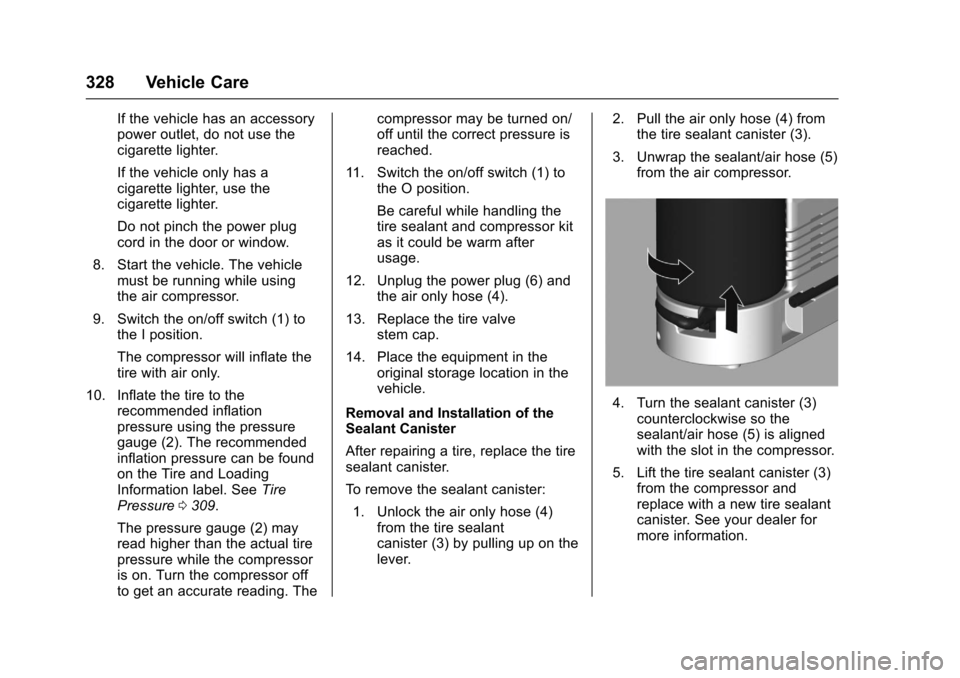
1. Unlock the air only hose (4)from the tire sealantcanister (3) by pulling up on thelever.
2. Pull the air only hose (4) fromthe tire sealant canister (3).
3. Unwrap the sealant/air hose (5)from the air compressor.
4. Turn the sealant canister (3)counterclockwise so thesealant/air hose (5) is alignedwith the slot in the compressor.
5. Lift the tire sealant canister (3)from the compressor andreplace with a new tire sealantcanister. See your dealer formore information.
Page 330 of 400
Chevrolet SS Sedan Owner Manual (GMNA-Localizing-U.S.-10122752) -2017 - crc - 8/31/16
Vehicle Care 329
6. Dispose of the tire sealantcanister at your dealer or inaccordance with local or Statecodes and practices.
To i n s t a l l a n e w s e a l a n t c a n i s t e r :
1. Align the sealant/air hose (5)with the slot in the compressor.
2. Push the tire sealantcanister (3) down and turn itclockwise.
3. Wrap the sealant/air hose (5)around the air compressorchannel to stow it in its originallocation.
4. Push the air only hose (4) ontothe tire sealant canister (3) inletand push the lever down.
Storing the Tire Sealant
and Compressor Kit
To a c c e s s t h e t i r e s e a l a n t a n dcompressor kit:
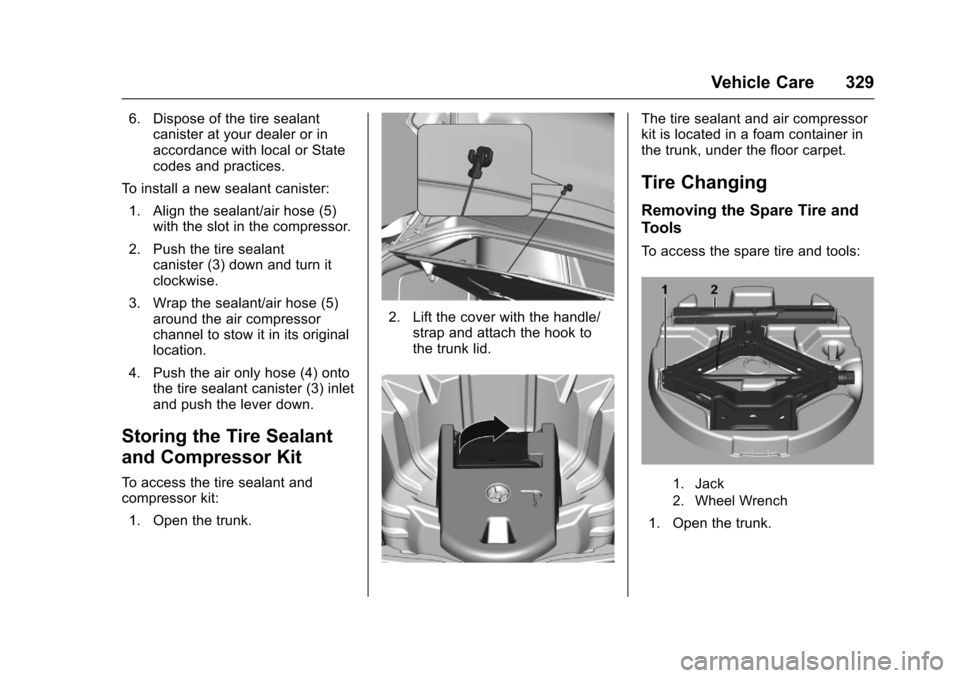
1. Open the trunk.
2. Lift the cover with the handle/strap and attach the hook tothe trunk lid.
The tire sealant and air compressorkit is located in a foam container inthe trunk, under the floor carpet.
Tire Changing
Removing the Spare Tire and
Tools
To a c c e s s t h e s p a r e t i r e a n d t o o l s :
1. Jack
2. Wheel Wrench
1. Open the trunk.
Page 331 of 400
Chevrolet SS Sedan Owner Manual (GMNA-Localizing-U.S.-10122752) -2017 - crc - 8/31/16
330 Vehicle Care
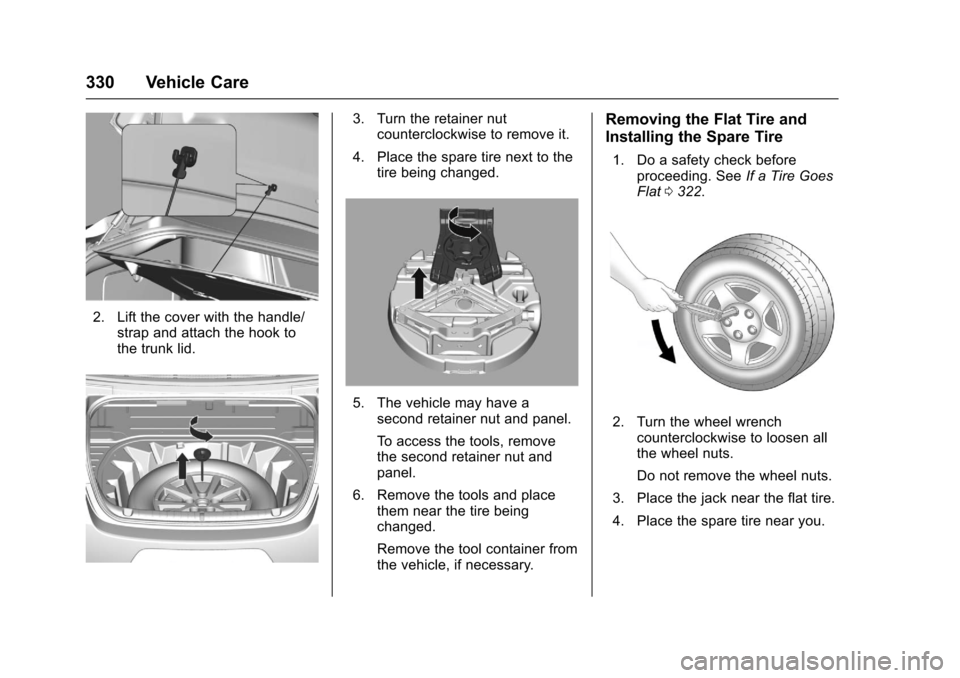
2. Lift the cover with the handle/strap and attach the hook tothe trunk lid.
3. Turn the retainer nutcounterclockwise to remove it.
4. Place the spare tire next to thetire being changed.
5. The vehicle may have asecond retainer nut and panel.
To a c c e s s t h e t o o l s , r e m o v ethe second retainer nut andpanel.
6. Remove the tools and placethem near the tire beingchanged.
Remove the tool container fromthe vehicle, if necessary.
Removing the Flat Tire and
Installing the Spare Tire
1. Do a safety check beforeproceeding. SeeIf a Tire GoesFlat0322.
2. Turn the wheel wrenchcounterclockwise to loosen allthe wheel nuts.
Do not remove the wheel nuts.
3. Place the jack near the flat tire.
4. Place the spare tire near you.
Page 333 of 400
Chevrolet SS Sedan Owner Manual (GMNA-Localizing-U.S.-10122752) -2017 - crc - 8/31/16
332 Vehicle Care
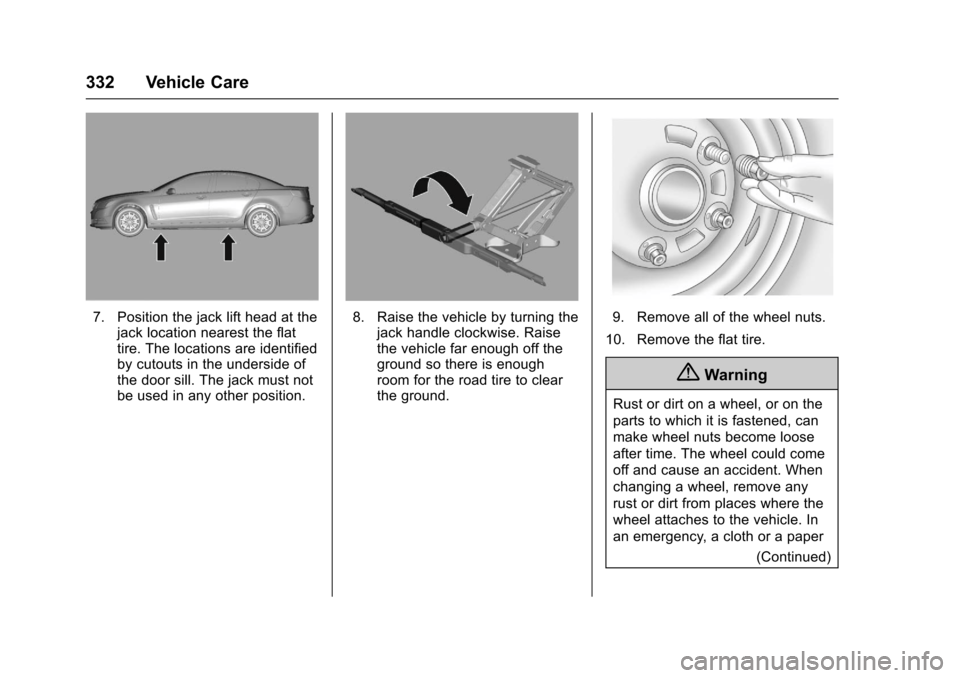
7. Position the jack lift head at thejack location nearest the flattire. The locations are identifiedby cutouts in the underside ofthe door sill. The jack must notbe used in any other position.
8. Raise the vehicle by turning thejack handle clockwise. Raisethe vehicle far enough off theground so there is enoughroom for the road tire to clearthe ground.
9. Remove all of the wheel nuts.
10. Remove the flat tire.
{Warning
Rust or dirt on a wheel, or on the
parts to which it is fastened, can
make wheel nuts become loose
after time. The wheel could come
off and cause an accident. When
changing a wheel, remove any
rust or dirt from places where the
wheel attaches to the vehicle. In
an emergency, a cloth or a paper
(Continued)
Page 334 of 400
Chevrolet SS Sedan Owner Manual (GMNA-Localizing-U.S.-10122752) -2017 - crc - 8/31/16
Vehicle Care 333
Warning (Continued)
towel can be used; however, use
ascraperorwirebrushlaterto
remove all rust or dirt.
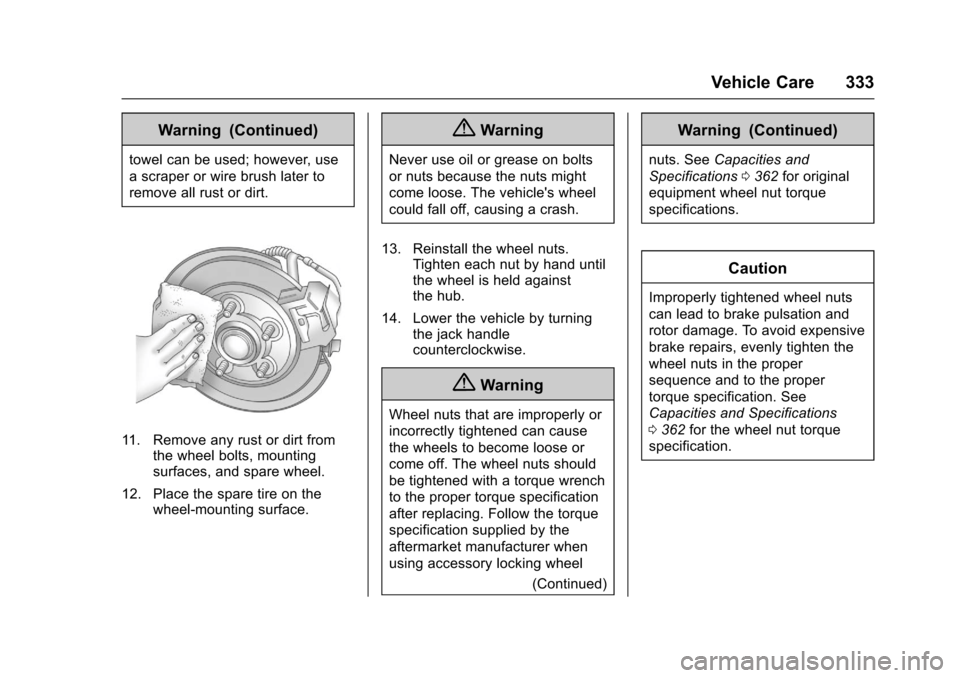
11 . R e m o v e a n y r u s t o r d i r t f r o mthe wheel bolts, mountingsurfaces, and spare wheel.
12. Place the spare tire on thewheel-mounting surface.
{Warning
Never use oil or grease on bolts
or nuts because the nuts might
come loose. The vehicle's wheel
could fall off, causing a crash.
13. Reinstall the wheel nuts.Tighten each nut by hand untilthe wheel is held againstthe hub.
14. Lower the vehicle by turningthe jack handlecounterclockwise.
{Warning
Wheel nuts that are improperly or
incorrectly tightened can cause
the wheels to become loose or
come off. The wheel nuts should
be tightened with a torque wrench
to the proper torque specification
after replacing. Follow the torque
specification supplied by the
aftermarket manufacturer when
using accessory locking wheel
(Continued)
Warning (Continued)
nuts. SeeCapacities and
Specifications0362for original
equipment wheel nut torque
specifications.
Caution
Improperly tightened wheel nuts
can lead to brake pulsation and
rotor damage. To avoid expensive
brake repairs, evenly tighten the
wheel nuts in the proper
sequence and to the proper
torque specification. See
Capacities and Specifications
0362for the wheel nut torque
specification.
Page 337 of 400
Chevrolet SS Sedan Owner Manual (GMNA-Localizing-U.S.-10122752) -2017 - crc - 8/31/16
336 Vehicle Care
The jump start positive (1) andnegative (2) posts are in the enginecompartment on the driver side ofthe vehicle.
These posts are used instead of adirect connection to the battery.
The positive jump start connectionis covered by a red cap. Remove toexpose the terminal.
1. Check the other vehicle.It must have a 12-volt batterywith a negative ground system.
Caution
If the other vehicle does not have
a12-voltsystemwithanegative
ground, both vehicles can be
damaged. Only use a vehicle that
has a 12-volt system with a
negative ground for jump starting.
2. Position the two vehicles sothat they are not touching.
3. Set the parking brake firmlyand put the shift lever inP(Park)withanautomatictransmission. SeeShifting IntoPark (Automatic Transmission)0232.Vehicleswithamanualtransmission should be inNeutral. SeeParking0234.
Caution
If any accessories are left on or
plugged in during the jump
starting procedure, they could be
damaged. The repairs would not
be covered by the vehicle
warranty. Whenever possible, turn
off or unplug all accessories on
either vehicle when jump starting.
4. Turn the ignition to LOCK/OFFand switch off all lights andaccessories in both vehicles,except the hazard warningflashers if needed.
{Warning
An electric fan can start up even
when the engine is not running
and can injure you. Keep hands,
clothing, and tools away from any
underhood electric fan.
{Warning
Using a match near a battery can
cause battery gas to explode.
People have been hurt doing this,
and some have been blinded.
Use a flashlight if you need more
light.
Battery fluid contains acid that
can burn you. Do not get it on
you. If you accidentally get it in
your eyes or on your skin, flush
the place with water and get
medical help immediately.
Page 339 of 400
Chevrolet SS Sedan Owner Manual (GMNA-Localizing-U.S.-10122752) -2017 - crc - 8/31/16
338 Vehicle Care
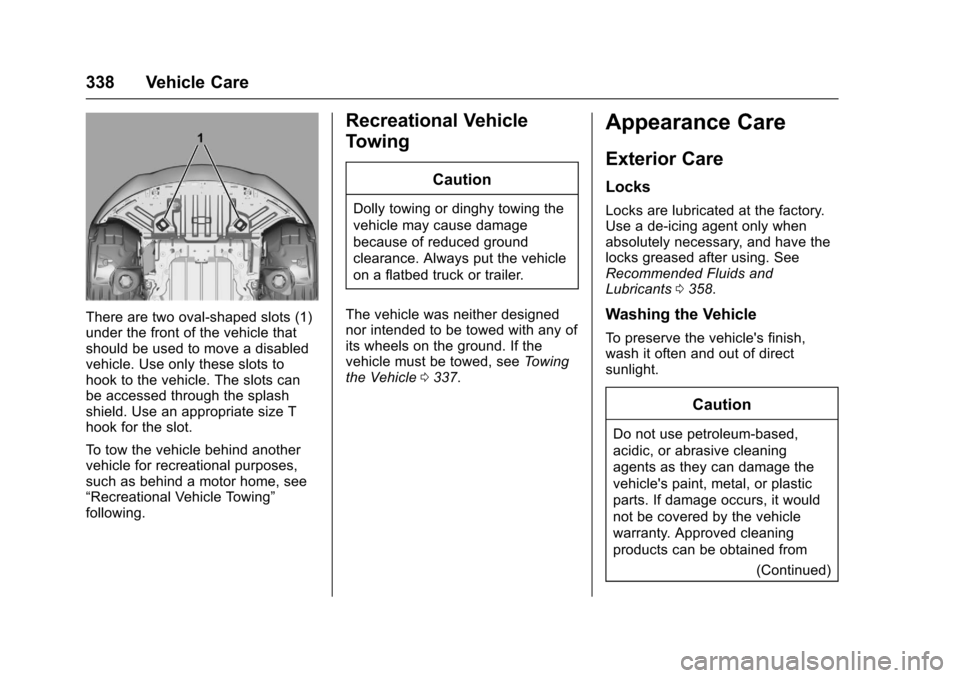
There are two oval-shaped slots (1)under the front of the vehicle thatshould be used to move a disabledvehicle. Use only these slots tohook to the vehicle. The slots canbe accessed through the splashshield. Use an appropriate size Thook for the slot.
To t o w t h e v e h i c l e b e h i n d a n o t h e rvehicle for recreational purposes,such as behind a motor home, see“Recreational Vehicle Towing”following.
Recreational Vehicle
Towing
Caution
Dolly towing or dinghy towing the
vehicle may cause damage
because of reduced ground
clearance. Always put the vehicle
on a flatbed truck or trailer.
The vehicle was neither designednor intended to be towed with any ofits wheels on the ground. If thevehicle must be towed, seeTo w i n gthe Vehicle0337.
Appearance Care
Exterior Care
Locks
Locks are lubricated at the factory.Use a de-icing agent only whenabsolutely necessary, and have thelocks greased after using. SeeRecommended Fluids andLubricants0358.
Washing the Vehicle
To p r e s e r v e t h e v e h i c l e ' s f i n i s h ,wash it often and out of directsunlight.
Caution
Do not use petroleum-based,
acidic, or abrasive cleaning
agents as they can damage the
vehicle's paint, metal, or plastic
parts. If damage occurs, it would
not be covered by the vehicle
warranty. Approved cleaning
products can be obtained from
(Continued)
Page 343 of 400
Chevrolet SS Sedan Owner Manual (GMNA-Localizing-U.S.-10122752) -2017 - crc - 8/31/16
342 Vehicle Care
Caution (Continued)
brushes. Damage could occur
and the repairs would not be
covered by the vehicle warranty.
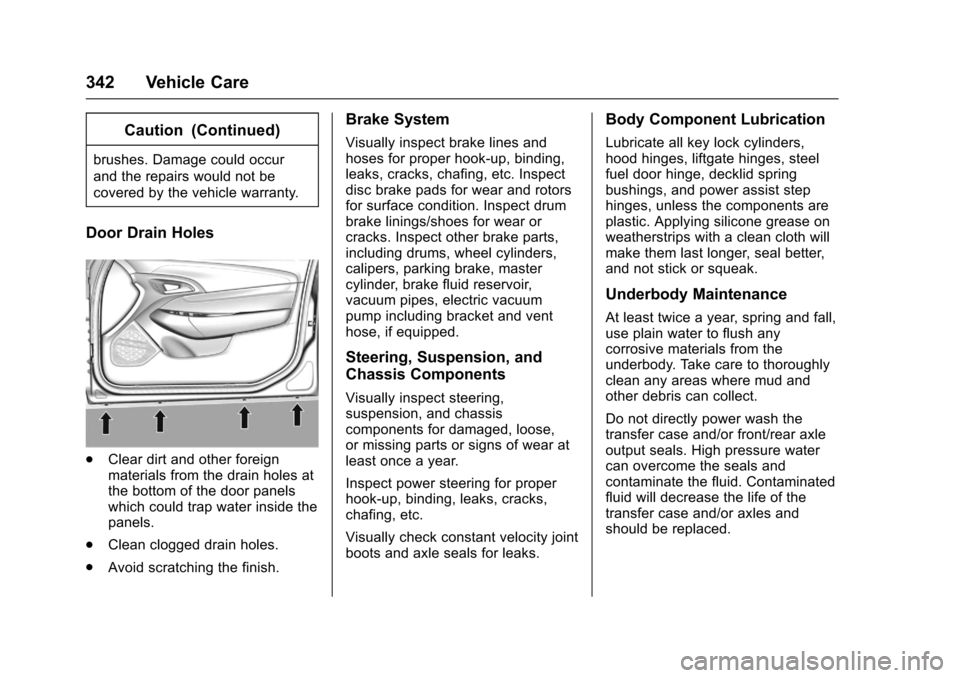
Door Drain Holes
.Clear dirt and other foreignmaterials from the drain holes atthe bottom of the door panelswhich could trap water inside thepanels.
.Clean clogged drain holes.
.Avoid scratching the finish.
Brake System
Visually inspect brake lines andhoses for proper hook-up, binding,leaks, cracks, chafing, etc. Inspectdisc brake pads for wear and rotorsfor surface condition. Inspect drumbrake linings/shoes for wear orcracks. Inspect other brake parts,including drums, wheel cylinders,calipers, parking brake, mastercylinder, brake fluid reservoir,vacuum pipes, electric vacuumpump including bracket and venthose, if equipped.
Steering, Suspension, and
Chassis Components
Visually inspect steering,suspension, and chassiscomponents for damaged, loose,or missing parts or signs of wear atleast once a year.
Inspect power steering for properhook-up, binding, leaks, cracks,chafing, etc.
Visually check constant velocity jointboots and axle seals for leaks.
Body Component Lubrication
Lubricate all key lock cylinders,hood hinges, liftgate hinges, steelfuel door hinge, decklid springbushings, and power assist stephinges, unless the components areplastic. Applying silicone grease onweatherstrips with a clean cloth willmake them last longer, seal better,and not stick or squeak.
Underbody Maintenance
At least twice a year, spring and fall,use plain water to flush anycorrosive materials from theunderbody. Take care to thoroughlyclean any areas where mud andother debris can collect.
Do not directly power wash thetransfer case and/or front/rear axleoutput seals. High pressure watercan overcome the seals andcontaminate the fluid. Contaminatedfluid will decrease the life of thetransfer case and/or axles andshould be replaced.