tire size CHEVROLET SS 2017 1.G User Guide
[x] Cancel search | Manufacturer: CHEVROLET, Model Year: 2017, Model line: SS, Model: CHEVROLET SS 2017 1.GPages: 400, PDF Size: 7.31 MB
Page 313 of 400
Chevrolet SS Sedan Owner Manual (GMNA-Localizing-U.S.-10122752) -2017 - crc - 8/31/16
312 Vehicle Care
of reasons, including the installationof replacement or alternate tires orwheels on the vehicle that preventthe TPMS from functioning properly.Always check the TPMS malfunctiontelltale after replacing one or moretires or wheels on your vehicle toensure that the replacement oralternate tires and wheels allow theTPMS to continue to functionproperly.
SeeTire Pressure MonitorOperation0312.
SeeRadio Frequency Statement0374.
Tire Pressure Monitor
Operation
This vehicle may have a TirePressure Monitor System (TPMS).The TPMS is designed to warn thedriver when a low tire pressurecondition exists. TPMS sensors aremounted onto each tire and wheelassembly, including the spare tireand wheel assembly. The TPMSsensors monitor the air pressure in
the tires and transmit the tirepressure readings to a receiverlocated in the vehicle.
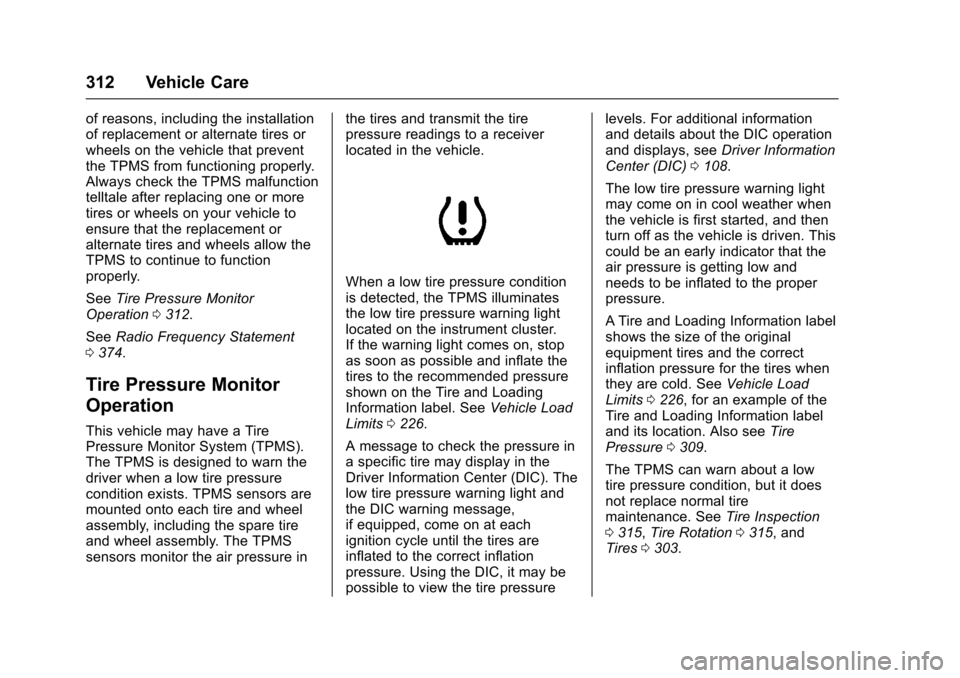
When a low tire pressure conditionis detected, the TPMS illuminatesthe low tire pressure warning lightlocated on the instrument cluster.If the warning light comes on, stopas soon as possible and inflate thetires to the recommended pressureshown on the Tire and LoadingInformation label. SeeVehicle LoadLimits0226.
AmessagetocheckthepressureinaspecifictiremaydisplayintheDriver Information Center (DIC). Thelow tire pressure warning light andthe DIC warning message,if equipped, come on at eachignition cycle until the tires areinflated to the correct inflationpressure. Using the DIC, it may bepossible to view the tire pressure
levels. For additional informationand details about the DIC operationand displays, seeDriver InformationCenter (DIC)0108.
The low tire pressure warning lightmay come on in cool weather whenthe vehicle is first started, and thenturn off as the vehicle is driven. Thiscould be an early indicator that theair pressure is getting low andneeds to be inflated to the properpressure.
ATire and Loading Information labelshows the size of the originalequipment tires and the correctinflation pressure for the tires whenthey are cold. SeeVehicle LoadLimits0226,foranexampleoftheTire and Loading Information labeland its location. Also seeTirePressure0309.
The TPMS can warn about a lowtire pressure condition, but it doesnot replace normal tiremaintenance. SeeTire Inspection0315,Tire Rotation0315,andTires0303.
Page 316 of 400
Chevrolet SS Sedan Owner Manual (GMNA-Localizing-U.S.-10122752) -2017 - crc - 8/31/16
Vehicle Care 315
11 . P r o c e e d t o t h e l e f t r e a r t i r e ,and repeat the procedure inStep 8. The horn sounds twotimes to indicate the sensoridentification code has beenmatched to the left rear tire,and the TPMS sensor matchingprocess is no longer active.The TIRE LEARN or TIRELEARNING ACTIVE messageon the infotainment displaygoes off.
12. Turn the vehicle off.
13. Set all four tires to therecommended air pressurelevel as indicated on the Tireand Loading Information label.
Tire Inspection
We recommend that the tires,
including the spare tire, if the
vehicle has one, be inspected
for signs of wear or damage at
least once a month.
Replace the tire if:
.The indicators at three or
more places around the tire
can be seen.
.There is cord or fabric
showing through the tire's
rubber.
.The tread or sidewall is
cracked, cut, or snagged
deep enough to show cord or
fabric.
.The tire has a bump, bulge,
or split.
.The tire has a puncture, cut,
or other damage that cannot
be repaired well because of
the size or location of the
damage.
Tire Rotation
The tires should be rotated
every 12 000 km/7,500 mi. See
Maintenance Schedule0349.
Tires are rotated to achieve
uniform wear for all tires. The
first rotation is the most
important.
Anytime unusual wear is
noticed, rotate the tires as soon
as possible, check for proper tire
inflation pressure, and check for
damaged tires or wheels. If the
unusual wear continues after the
rotation, check the wheel
alignment. SeeWhen It Is Time
for New Tires0316andWheel
Replacement0320.
Different tire sizes should not be
rotated front to rear.
Page 317 of 400
Chevrolet SS Sedan Owner Manual (GMNA-Localizing-U.S.-10122752) -2017 - crc - 8/31/16
316 Vehicle Care
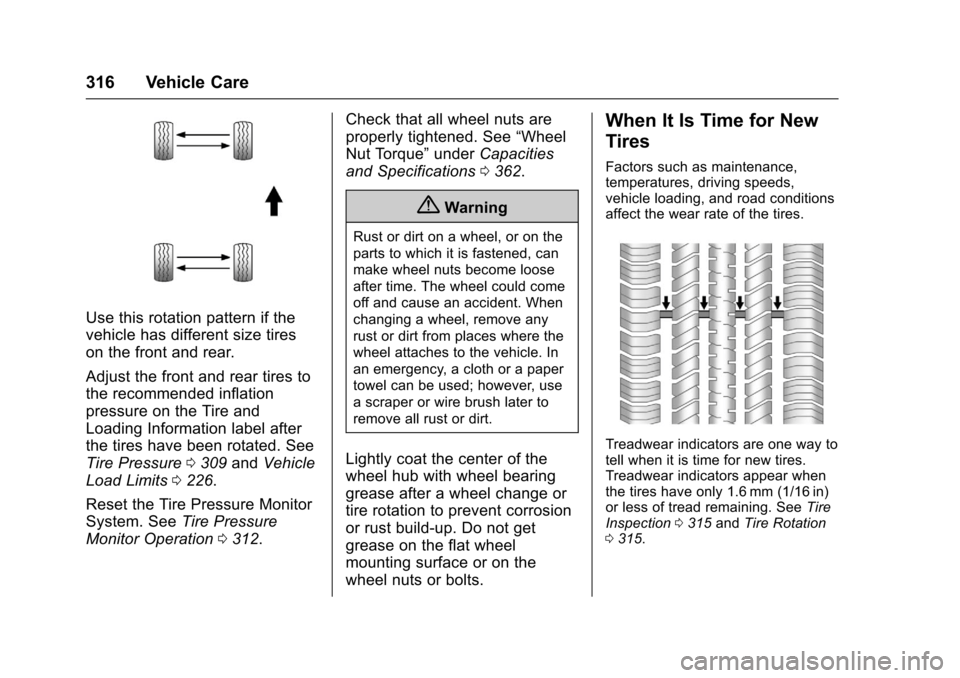
Use this rotation pattern if the
vehicle has different size tires
on the front and rear.
Adjust the front and rear tires to
the recommended inflation
pressure on the Tire and
Loading Information label after
the tires have been rotated. See
Tire Pressure0309andVehicle
Load Limits0226.
Reset the Tire Pressure Monitor
System. SeeTire Pressure
Monitor Operation0312.
Check that all wheel nuts are
properly tightened. See“Wheel
Nut Torque”underCapacities
and Specifications0362.
{Warning
Rust or dirt on a wheel, or on the
parts to which it is fastened, can
make wheel nuts become loose
after time. The wheel could come
off and cause an accident. When
changing a wheel, remove any
rust or dirt from places where the
wheel attaches to the vehicle. In
an emergency, a cloth or a paper
towel can be used; however, use
ascraperorwirebrushlaterto
remove all rust or dirt.
Lightly coat the center of the
wheel hub with wheel bearing
grease after a wheel change or
tire rotation to prevent corrosion
or rust build-up. Do not get
grease on the flat wheel
mounting surface or on the
wheel nuts or bolts.
When It Is Time for New
Tires
Factors such as maintenance,temperatures, driving speeds,vehicle loading, and road conditionsaffect the wear rate of the tires.
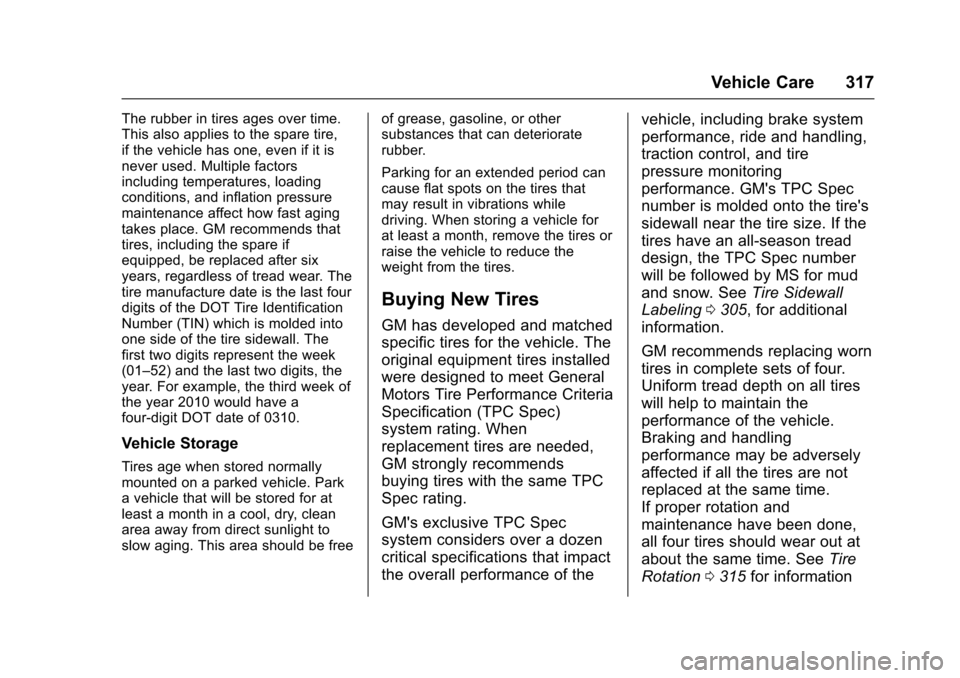
Treadwear indicators are one way totell when it is time for new tires.Treadwear indicators appear whenthe tires have only 1.6 mm (1/16 in)or less of tread remaining. SeeTireInspection0315andTire Rotation0315.
Page 318 of 400
Chevrolet SS Sedan Owner Manual (GMNA-Localizing-U.S.-10122752) -2017 - crc - 8/31/16
Vehicle Care 317
The rubber in tires ages over time.This also applies to the spare tire,if the vehicle has one, even if it isnever used. Multiple factorsincluding temperatures, loadingconditions, and inflation pressuremaintenance affect how fast agingtakes place. GM recommends thattires, including the spare ifequipped, be replaced after sixyears, regardless of tread wear. Thetire manufacture date is the last fourdigits of the DOT Tire IdentificationNumber (TIN) which is molded intoone side of the tire sidewall. Thefirst two digits represent the week(01–52) and the last two digits, theyear. For example, the third week ofthe year 2010 would have afour-digit DOT date of 0310.
Vehicle Storage
Tires age when stored normallymounted on a parked vehicle. Parkavehiclethatwillbestoredforatleast a month in a cool, dry, cleanarea away from direct sunlight toslow aging. This area should be free
of grease, gasoline, or othersubstances that can deterioraterubber.
Parking for an extended period cancause flat spots on the tires thatmay result in vibrations whiledriving. When storing a vehicle forat least a month, remove the tires orraise the vehicle to reduce theweight from the tires.
Buying New Tires
GM has developed and matched
specific tires for the vehicle. The
original equipment tires installed
were designed to meet General
Motors Tire Performance Criteria
Specification (TPC Spec)
system rating. When
replacement tires are needed,
GM strongly recommends
buying tires with the same TPC
Spec rating.
GM's exclusive TPC Spec
system considers over a dozen
critical specifications that impact
the overall performance of the
vehicle, including brake system
performance, ride and handling,
traction control, and tire
pressure monitoring
performance. GM's TPC Spec
number is molded onto the tire's
sidewall near the tire size. If the
tires have an all-season tread
design, the TPC Spec number
will be followed by MS for mud
and snow. SeeTire Sidewall
Labeling0305,foradditional
information.
GM recommends replacing worn
tires in complete sets of four.
Uniform tread depth on all tires
will help to maintain the
performance of the vehicle.
Braking and handling
performance may be adversely
affected if all the tires are not
replaced at the same time.
If proper rotation and
maintenance have been done,
all four tires should wear out at
about the same time. SeeTire
Rotation0315for information
Page 319 of 400
Chevrolet SS Sedan Owner Manual (GMNA-Localizing-U.S.-10122752) -2017 - crc - 8/31/16
318 Vehicle Care
on proper tire rotation. However,
if it is necessary to replace only
one axle set of worn tires, place
the new tires on the rear axle.
Winter tires with the same speed
rating as the original equipment
tires may not be available for H,
V, W, a n d Z R s p e e d r a t e d t i r e s .
Never exceed the winter tire's
maximum speed capability when
using winter tires with a lower
speed rating.
{Warning
Tires could explode during
improper service. Attempting
to mount or dismount a tire
could cause injury or death.
Only your dealer or authorized
tire service center should
mount or dismount the tires.
{Warning
Mixing tires of different sizes
(other than those originally
installed on the vehicle), brands,
or types may cause loss of
control of the vehicle, resulting in
acrashorothervehicledamage.
Use the correct size, brand, and
type of tire on all four wheels.
{Warning
Using bias-ply tires on the
vehicle may cause the wheel
rim flanges to develop cracks
after many miles of driving.
Atireand/orwheelcouldfail
suddenly and cause a crash.
Use only radial-ply tires with
the wheels on the vehicle.
If the vehicle tires must be
replaced with a tire that does not
have a TPC Spec number, make
sure they are the same size,
load range, speed rating, and
construction (radial) as the
original tires.
Vehicles that have a tire
pressure monitoring system
could give an inaccurate
low-pressure warning if non-TPC
Spec rated tires are installed.
SeeTire Pressure Monitor
Operation0312.
The Tire and Loading
Information label indicates the
original equipment tires on the
vehicle. SeeVehicle Load Limits
0226.
Different Size Tires and
Wheels
If wheels or tires are installed thatare a different size than the originalequipment wheels and tires, vehicleperformance, including its braking,ride and handling characteristics,stability, and resistance to rollovermay be affected. If the vehicle haselectronic systems such as antilockbrakes, rollover airbags, traction
Page 320 of 400
Chevrolet SS Sedan Owner Manual (GMNA-Localizing-U.S.-10122752) -2017 - crc - 8/31/16
Vehicle Care 319
control, electronic stability control,or All-Wheel Drive, the performanceof these systems can also beaffected.
{Warning
If different sized wheels are used,
there may not be an acceptable
level of performance and safety if
tires not recommended for those
wheels are selected. This
increases the chance of a crash
and serious injury. Only use GM
specific wheel and tire systems
developed for the vehicle, and
have them properly installed by a
GM certified technician.
SeeBuying New Tires0317andAccessories and Modifications0272.
Uniform Tire Quality
Grading
The following information relates
to the system developed by the
United States National Highway
Traffic Safety Administration
(NHTSA), which grades tires by
treadwear, traction, and
temperature performance. This
applies only to vehicles sold in
the United States. The grades
are molded on the sidewalls of
most passenger car tires. The
Uniform Tire Quality Grading
(UTQG) system does not apply
to deep tread, winter tires,
compact spare tires, tires with
nominal rim diameters of
10 to 12 inches (25 to 30 cm),
or to some limited-production
tires.
While the tires available on
General Motors passenger cars
and light trucks may vary with
respect to these grades, they
must also conform to federal
safety requirements and
additional General Motors Tire
Performance Criteria (TPC)
standards.
Quality grades can be found
where applicable on the tire
sidewall between tread shoulder
and maximum section width. For
example:
Treadwear 200 Traction AATemperature A
All Passenger Car Tires Must
Conform to Federal Safety
Requirements In Addition To
These Grades.
Treadwear
The treadwear grade is a
comparative rating based on the
wear rate of the tire when tested
under controlled conditions on a
specified government test
course. For example, a tire
graded 150 would wear one and
one-half (1Ω) times as well on
the government course as a tire
graded 100. The relative
performance of tires depends
upon the actual conditions of
their use, however, and may
depart significantly from the
Page 322 of 400
Chevrolet SS Sedan Owner Manual (GMNA-Localizing-U.S.-10122752) -2017 - crc - 8/31/16
Vehicle Care 321
Some aluminum wheels can berepaired. See your dealer if any ofthese conditions exist.
Yo u r d e a l e r w i l l k n o w t h e k i n d o fwheel that is needed.
Each new wheel should have thesame load-carrying capacity,diameter, width, offset, and bemounted the same way as the one itreplaces.
Replace wheels, wheel bolts, wheelnuts, or Tire Pressure MonitorSystem (TPMS) sensors with newGM original equipment parts.
{Warning
Using the wrong replacement
wheels, wheel bolts, or wheel
nuts can be dangerous. It could
affect the braking and handling of
the vehicle. Tires can lose air,
and cause loss of control, causing
acrash.Alwaysusethecorrect
wheel, wheel bolts, and wheel
nuts for replacement.
Caution
The wrong wheel can also cause
problems with bearing life, brake
cooling, speedometer or
odometer calibration, headlamp
aim, bumper height, vehicle
ground clearance, and tire or tire
chain clearance to the body and
chassis.
Used Replacement Wheels
{Warning
Replacing a wheel with a used
one is dangerous. How it has
been used or how far it has been
driven may be unknown. It could
fail suddenly and cause a crash.
When replacing wheels, use a
new GM original equipment
wheel.
Tire Chains
{Warning
Do not use tire chains. There is
not enough clearance. Tire chains
used on a vehicle without the
proper amount of clearance can
cause damage to the brakes,
suspension, or other vehicle
parts. The area damaged by the
tire chains could cause loss of
control and a crash. Use another
type of traction device only if its
manufacturer recommends it for
the vehicle's tire size combination
and road conditions. Follow that
manufacturer's instructions. To
avoid vehicle damage, drive
slowly and readjust or remove the
traction device if it contacts the
vehicle. Do not spin the wheels.
If traction devices are used, install
them on the rear tires.
Page 335 of 400
Chevrolet SS Sedan Owner Manual (GMNA-Localizing-U.S.-10122752) -2017 - crc - 8/31/16
334 Vehicle Care
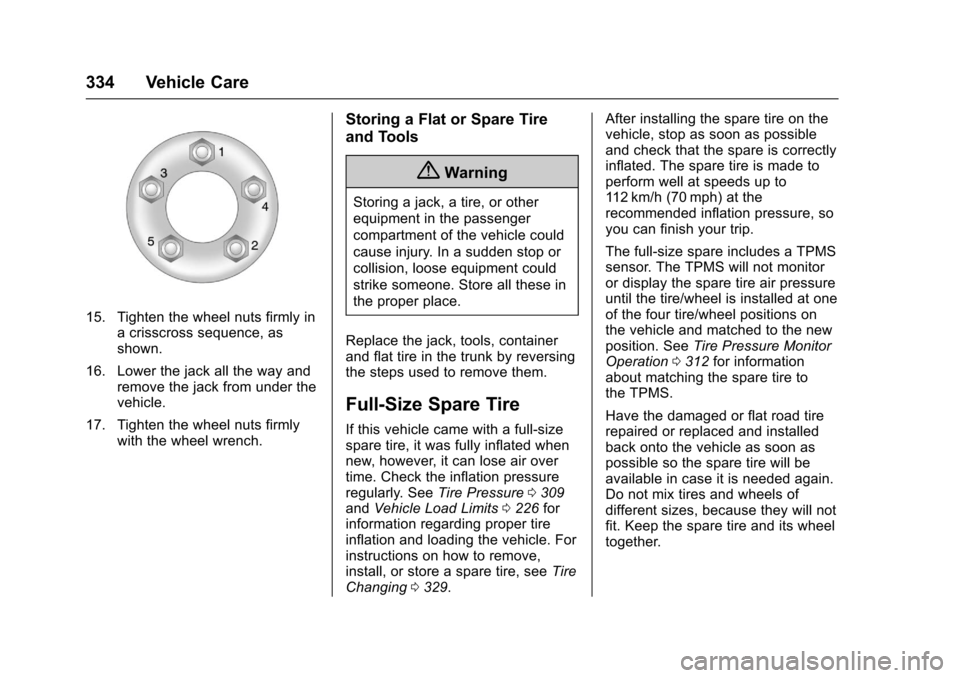
15. Tighten the wheel nuts firmly inacrisscrosssequence,asshown.
16. Lower the jack all the way andremove the jack from under thevehicle.
17. Tighten the wheel nuts firmlywith the wheel wrench.
Storing a Flat or Spare Tire
and Tools
{Warning
Storing a jack, a tire, or other
equipment in the passenger
compartment of the vehicle could
cause injury. In a sudden stop or
collision, loose equipment could
strike someone. Store all these in
the proper place.
Replace the jack, tools, containerand flat tire in the trunk by reversingthe steps used to remove them.
Full-Size Spare Tire
If this vehicle came with a full-sizespare tire, it was fully inflated whennew, however, it can lose air overtime. Check the inflation pressureregularly. SeeTire Pressure0309andVehicle Load Limits0226forinformation regarding proper tireinflation and loading the vehicle. Forinstructions on how to remove,install, or store a spare tire, seeTireChanging0329.
After installing the spare tire on thevehicle, stop as soon as possibleand check that the spare is correctlyinflated. The spare tire is made toperform well at speeds up to11 2 k m / h ( 7 0 m p h ) a t t h erecommended inflation pressure, soyou can finish your trip.
The full-size spare includes a TPMSsensor. The TPMS will not monitoror display the spare tire air pressureuntil the tire/wheel is installed at oneof the four tire/wheel positions onthe vehicle and matched to the newposition. SeeTire Pressure MonitorOperation0312for informationabout matching the spare tire tothe TPMS.
Have the damaged or flat road tirerepaired or replaced and installedback onto the vehicle as soon aspossible so the spare tire will beavailable in case it is needed again.Do not mix tires and wheels ofdifferent sizes, because they will notfit. Keep the spare tire and its wheeltogether.
Page 392 of 400

Chevrolet SS Sedan Owner Manual (GMNA-Localizing-U.S.-10122752) -2017 - crc - 9/1/16
Index 391
Driving (cont'd)
Vehicle Load Limits . . . . . . . . . . . 226
Wet Roads . . . . . . . . . . . . . . . . . . . 222
Winter . . . . . . . . . . . . . . . . . . . . . . . . 224
Dual Automatic Climate
Control System . . . . . . . . . . . . . . . . 210
E
Electric Parking Brake . . . . . . . . . . 242
Electric Parking Brake Light . . . . 103
Electrical Equipment,
Add-On . . . . . . . . . . . . . . . . . . . . . . . 268
Electrical System
Engine Compartment Fuse
Block . . . . . . . . . . . . . . . . . . . . . . . . 295
Fuses . . . . . . . . . . . . . . . . . . . . . . . . 295
Instrument Panel Fuse
Block . . . . . . . . . . . . . . . . . . . . . . . . 298
Overload . . . . . . . . . . . . . . . . . . . . . 294
Rear Compartment Fuse
Block . . . . . . . . . . . . . . . . . . . . . . . . 300
Emergency
OnStar®...................... 379
Engine
Air Cleaner/Filter . . . . . . . . . . . . . 279
Check and Service Engine
Soon Light . . . . . . . . . . . . . . . . . . 100
Compartment Overview . . . . . . . 274
Coolant . . . . . . . . . . . . . . . . . . . . . . . 281
Engine (cont'd)
Coolant Temperature Gauge . . . . 98
Cooling System . . . . . . . . . . . . . . . 280
Cooling System Messages . . . .114
Drive Belt Routing . . . . . . . . . . . . 363
Exhaust . . . . . . . . . . . . . . . . . . . . . . 235
Oil Life System . . . . . . . . . . . . . . . 277
Oil Messages . . . . . . . . . . . . . . . . . .115
Oil Pressure Light . . . . . . . . . . . . 106
Overheating . . . . . . . . . . . . . . . . . . 284
Power Messages . . . . . . . . . . . . . .115
Running While Parked . . . . . . . . 236
Starting . . . . . . . . . . . . . . . . . . . . . . . 231
Entry Lighting . . . . . . . . . . . . . . . . . . . 130
Event Data Recorders . . . . . . . . . . 376
Exit Lighting . . . . . . . . . . . . . . . . . . . . 130
Extended Parking . . . . . . . . . . . . . . . 235
Extender, Safety Belt . . . . . . . . . . . . 56
Exterior Lamp Controls . . . . . . . . . 126
F
Features
Memory . . . . . . . . . . . . . . . . . . . . . . . . . 11
Filter,
Engine Air Cleaner . . . . . . . . . . . 279
Flash-to-Pass . . . . . . . . . . . . . . . . . . . 126
Flashers, Hazard Warning . . . . . . 127
Flat Tire . . . . . . . . . . . . . . . . . . . . . . . . 322
Changing . . . . . . . . . . . . . . . . . . . . . 329
Floor Mats . . . . . . . . . . . . . . . . . . . . . . 346
Fluid
Automatic Transmission . . . . . . 278
Brakes . . . . . . . . . . . . . . . . . . . . . . . . 287
Washer . . . . . . . . . . . . . . . . . . . . . . . 286
Folding Mirrors . . . . . . . . . . . . . . . . . . 39
Forward Collision Alert
(FCA) System . . . . . . . . . . . . . . . . . 259
Frequency Statement
Radio . . . . . . . . . . . . . . . . . . . . . . . . . 374
Front Seats
Heated and Ventilated . . . . . . . . . . 49
Fuel . . . . . . . . . . . . . . . . . . . . . . . . . . . . 264
Additives . . . . . . . . . . . . . . . . . . . . . 266
Economy Driving . . . . . . . . . . . . . . . 22
Filling a Portable Fuel
Container . . . . . . . . . . . . . . . . . . . 267
Filling the Tank . . . . . . . . . . . . . . . 266
Foreign Countries . . . . . . . . . . . . 266
Gauge . . . . . . . . . . . . . . . . . . . . . . . . . . 97
Low Fuel Warning Light . . . . . . . 106
Requirements, California . . . . . 265
System Messages . . . . . . . . . . . . .115
Full-Size Spare Tire . . . . . . . . . . . . 334
Fuses . . . . . . . . . . . . . . . . . . . . . . . . . . 295
Engine Compartment Fuse
Block . . . . . . . . . . . . . . . . . . . . . . . . 295
Page 398 of 400

Chevrolet SS Sedan Owner Manual (GMNA-Localizing-U.S.-10122752) -2017 - crc - 9/1/16
Index 397
Shift Lock Control Function
Check, Automatic
Transmission . . . . . . . . . . . . . . . . . . 290
Shifting
Into Park . . . . . . . . . . . . . . . . . . . . . . 232
Out of Park . . . . . . . . . . . . . . . . . . . 233
Side Blind Zone Alert (SBZA) . . . 261
Signals, Turn and
Lane-Change . . . . . . . . . . . . . . . . . 128
Software Updates . . . . . . . . . . . . . . 139
Special Application Services . . . . 355
Specifications and
Capacities . . . . . . . . . . . . . . . . . . . . . 362
Speedometer . . . . . . . . . . . . . . . . . . . . 97
StabiliTrak
OFF Light . . . . . . . . . . . . . . . . . . . . . 105
Start Assist, Hill . . . . . . . . . . . . . . . . . 244
Start Vehicle, Remote . . . . . . . . . . . 30
Starter Switch Check . . . . . . . . . . . 290
Starting the Engine . . . . . . . . . . . . . 231
Starting the Vehicle
Messages . . . . . . . . . . . . . . . . . . . . . 118
Steering . . . . . . . . . . . . . . . . . . . . . . . . 218
Wheel Adjustment . . . . . . . . . . . . . . 91
Wheel Controls . . . . . . . . . . . . . . . . . 91
Steering Wheel Controls . . . . . . . . 134
Stitcher Internet Radio . . . . . . . . . . 153
Storage Areas
Center Console . . . . . . . . . . . . . . . . . 87
Convenience Net . . . . . . . . . . . . . . . 88
Glove Box . . . . . . . . . . . . . . . . . . . . . . 87
Roof Rack System . . . . . . . . . . . . . . 89
Storage Compartments . . . . . . . . . . 87
Storing the Tire Sealant and
Compressor Kit . . . . . . . . . . . . . . . 329
Stuck Vehicle . . . . . . . . . . . . . . . . . . . 225
Summer Tires . . . . . . . . . . . . . . . . . . 304
Sun Visors . . . . . . . . . . . . . . . . . . . . . . . 42
Sunroof . . . . . . . . . . . . . . . . . . . . . . . . . . 42
Symbols . . . . . . . . . . . . . . . . . . . . . . . . . . 3
Navigation . . . . . . . . . . . . . . . . . . . . 169
System
Forward Collision
Alert (FCA) . . . . . . . . . . . . . . . . . . 259
Global Positioning . . . . . . . . . . . . 186
Infotainment . . . . . . . . . . . . . 131, 377
Roof Rack . . . . . . . . . . . . . . . . . . . . . . 89
Systems
Driver Assistance . . . . . . . . . . . . . 253
T
Ta c h o m e t e r . . . . . . . . . . . . . . . . . . . . . . 9 7
Te x t M e s s a g i n g . . . . . . . . . . . . . . . . . 2 0 2
Te x t Te l e p h o n e ( T T Y ) U s e r s . . . . 3 6 7
Theft-Deterrent Systems . . . . . . . . . 37
Immobilizer . . . . . . . . . . . . . . . . . . . . . 37
Time . . . . . . . . . . . . . . . . . . . . . . . . . . . . . 93
Tires . . . . . . . . . . . . . . . . . . . . . . . . . . . . 303
Buying New Tires . . . . . . . . . . . . . 317
Chains . . . . . . . . . . . . . . . . . . . . . . . . 321
Changing . . . . . . . . . . . . . . . . . . . . . 329
Designations . . . . . . . . . . . . . . . . . 306
Different Size . . . . . . . . . . . . . . . . . 318
Full-Size Spare . . . . . . . . . . . . . . . 334
If a Tire Goes Flat . . . . . . . . . . . . 322
Inspection . . . . . . . . . . . . . . . . . . . . 315
Low Profile . . . . . . . . . . . . . . . . . . . 304
Messages . . . . . . . . . . . . . . . . . . . . .118
Pressure . . . . . . . . . . . . . . . . . 309, 310
Pressure Light . . . . . . . . . . . . . . . . 106
Pressure Monitor Operation . . 312
Pressure Monitor System . . . . . .311
Rotation . . . . . . . . . . . . . . . . . . . . . . 315
Sealant and
Compressor Kit . . . . . . . . . . . . . 323
Sealant and Compressor
Kit, Storing . . . . . . . . . . . . . . . . . . 329
Sidewall Labeling . . . . . . . . . . . . . 305
Te r m i n o l o g y a n d D e f i n i t i o n s . . 3 0 7
Uniform Tire Quality
Grading . . . . . . . . . . . . . . . . . . . . . 319
Wheel Alignment and Tire
Balance . . . . . . . . . . . . . . . . . . . . . 320
Wheel Replacement . . . . . . . . . . 320