change wheel CHEVROLET SS 2017 1.G Owner's Manual
[x] Cancel search | Manufacturer: CHEVROLET, Model Year: 2017, Model line: SS, Model: CHEVROLET SS 2017 1.GPages: 400, PDF Size: 7.31 MB
Page 261 of 400
Chevrolet SS Sedan Owner Manual (GMNA-Localizing-U.S.-10122752) -2017 - crc - 8/31/16
260 Driving and Operating
Warning (Continued)
or ice, or if the windshield is
damaged. It may also not detect a
vehicle on winding or hilly roads,
or in conditions that can limit
visibility such as fog, rain,
or snow, or if the headlamps or
windshield are not cleaned or in
proper condition. Keep the
windshield, headlamps, and FCA
sensors clean and in good repair.
Collision Alert
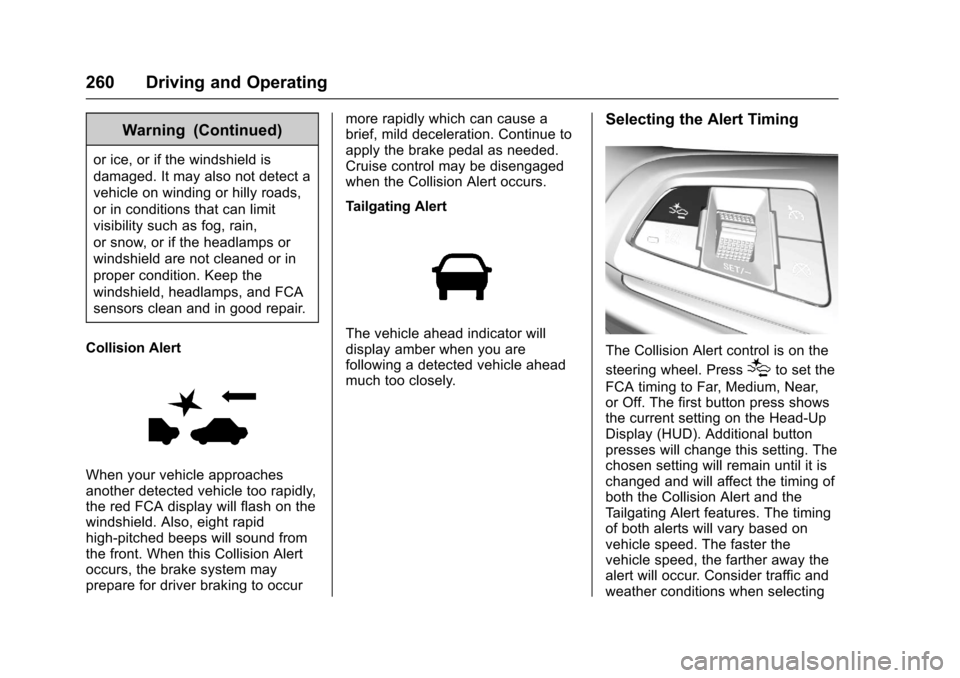
When your vehicle approachesanother detected vehicle too rapidly,the red FCA display will flash on thewindshield. Also, eight rapidhigh-pitched beeps will sound fromthe front. When this Collision Alertoccurs, the brake system mayprepare for driver braking to occur
more rapidly which can cause abrief, mild deceleration. Continue toapply the brake pedal as needed.Cruise control may be disengagedwhen the Collision Alert occurs.
Tailgating Alert
The vehicle ahead indicator willdisplay amber when you arefollowing a detected vehicle aheadmuch too closely.
Selecting the Alert Timing
The Collision Alert control is on the
steering wheel. Press[to set the
FCA timing to Far, Medium, Near,or Off. The first button press showsthe current setting on the Head-UpDisplay (HUD). Additional buttonpresses will change this setting. Thechosen setting will remain until it ischanged and will affect the timing ofboth the Collision Alert and theTa i l g a t i n g A l e r t f e a t u r e s . T h e t i m i n gof both alerts will vary based onvehicle speed. The faster thevehicle speed, the farther away thealert will occur. Consider traffic andweather conditions when selecting
Page 288 of 400
Chevrolet SS Sedan Owner Manual (GMNA-Localizing-U.S.-10122752) -2017 - crc - 8/31/16
Vehicle Care 287
Brakes
Disc brake pads have built-in wearindicators that make a high-pitchedwarning sound when the brake padsare worn and new pads are needed.The sound can come and go or canbe heard all the time when thevehicle is moving, except whenapplying the brake pedal firmly.
{Warning
The brake wear warning sound
means that soon the brakes will
not work well. That could lead to
acrash.Whenthebrakewear
warning sound is heard, have the
vehicle serviced.
Caution
Continuing to drive with worn-out
brake pads could result in costly
brake repair.
Some driving conditions or climatescan cause a brake squeal when thebrakes are first applied or lightlyapplied. This does not meansomething is wrong with the brakes.
Properly torqued wheel nuts arenecessary to help prevent brakepulsation. When tires are rotated,inspect brake pads for wear andevenly tighten wheel nuts in theproper sequence to torquespecifications. SeeCapacities andSpecifications0362.
Brake pads should be replaced ascomplete sets.
Brake Pedal Travel
See your dealer if the brake pedaldoes not return to normal height,or if there is a rapid increase inpedal travel. This could be a signthat brake service may be required.
Replacing Brake System Parts
Always replace brake system partswith new, approved replacementparts. If this is not done, the brakesmay not work properly. The brakingperformance expected can changein many other ways if the wrong
replacement brake parts areinstalled or if parts are improperlyinstalled.
Brake Fluid
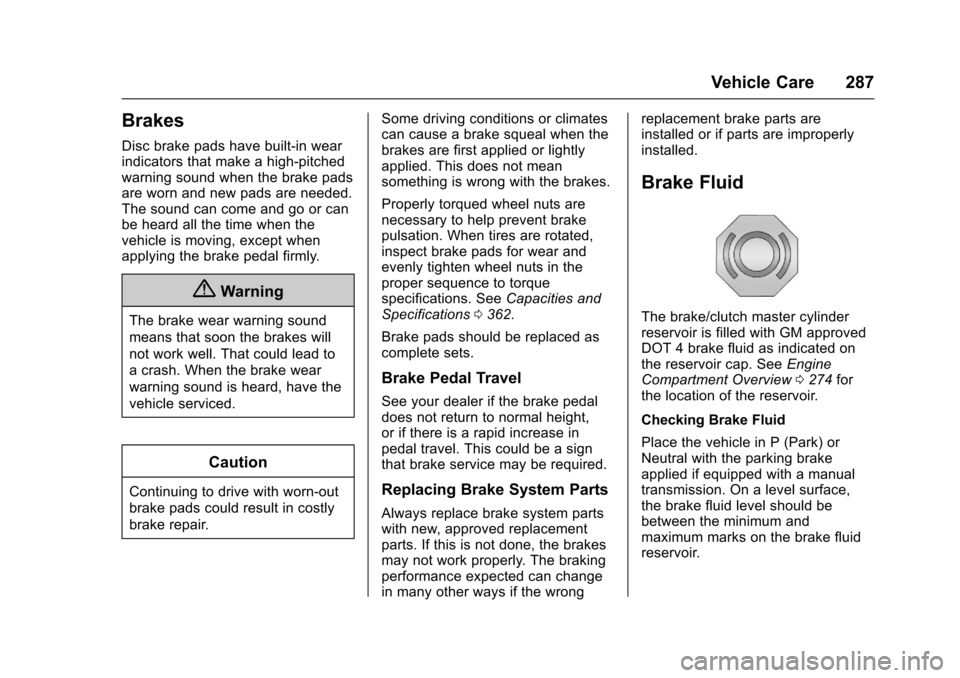
The brake/clutch master cylinderreservoir is filled with GM approvedDOT 4 brake fluid as indicated onthe reservoir cap. SeeEngineCompartment Overview0274forthe location of the reservoir.
Checking Brake Fluid
Place the vehicle in P (Park) orNeutral with the parking brakeapplied if equipped with a manualtransmission. On a level surface,the brake fluid level should bebetween the minimum andmaximum marks on the brake fluidreservoir.
Page 305 of 400
Chevrolet SS Sedan Owner Manual (GMNA-Localizing-U.S.-10122752) -2017 - crc - 8/31/16
304 Vehicle Care
Winter Tires
This vehicle was not originallyequipped with winter tires. Wintertires are designed for increasedtraction on snow and ice-coveredroads. Consider installing wintertires on the vehicle if frequentdriving on ice or snow coveredroads is expected. See your dealerfor details regarding winter tireavailability and proper tire selection.Also, seeBuying New Tires0317.
With winter tires, there may bedecreased dry road traction,increased road noise, and shortertread life. After changing to wintertires, be alert for changes in vehiclehandling and braking.
If using winter tires:
.Use tires of the same brand andtread type on all four wheelpositions.
.Use only radial ply tires of thesame size, load range, andspeed rating as the originalequipment tires.
Winter tires with the same speedrating as the original equipment tiresmay not be available for H, V, W, Y,and ZR speed rated tires. If wintertires with a lower speed rating arechosen, never exceed the tire'smaximum speed capability.
Low-Profile Tires
Caution
Low-profile tires are more
susceptible to damage from road
hazards or curb impact than
standard profile tires. Tire and/or
wheel assembly damage can
occur when coming into contact
with road hazards like potholes,
or sharp edged objects, or when
sliding into a curb. The warranty
does not cover this type of
damage. Keep tires set to the
correct inflation pressure and
when possible, avoid contact with
curbs, potholes, and other road
hazards.
Summer Tires
Ultra High Performance SummerTires
This vehicle may come with 245/40R19 and 275/35R19 ultra highperformance summer tires. Thesetires have a special tread andcompound that are optimized formaximum dry and wet roadperformance. This special tread andcompound will have decreasedperformance in cold climates, andon ice and snow. Driving a vehiclewith ultra high performance summertires when temperatures are belowapproximately 5 °C (40 °F) is notrecommended. If driving in theseconditions, winter tires should beinstalled. SeeWinter Tires0304.
Caution
Ultra high performance summer
tires have rubber compounds that
lose flexibility and may develop
surface cracks in the tread area
at temperatures below -7 °C (20 °
(Continued)
Page 317 of 400
Chevrolet SS Sedan Owner Manual (GMNA-Localizing-U.S.-10122752) -2017 - crc - 8/31/16
316 Vehicle Care
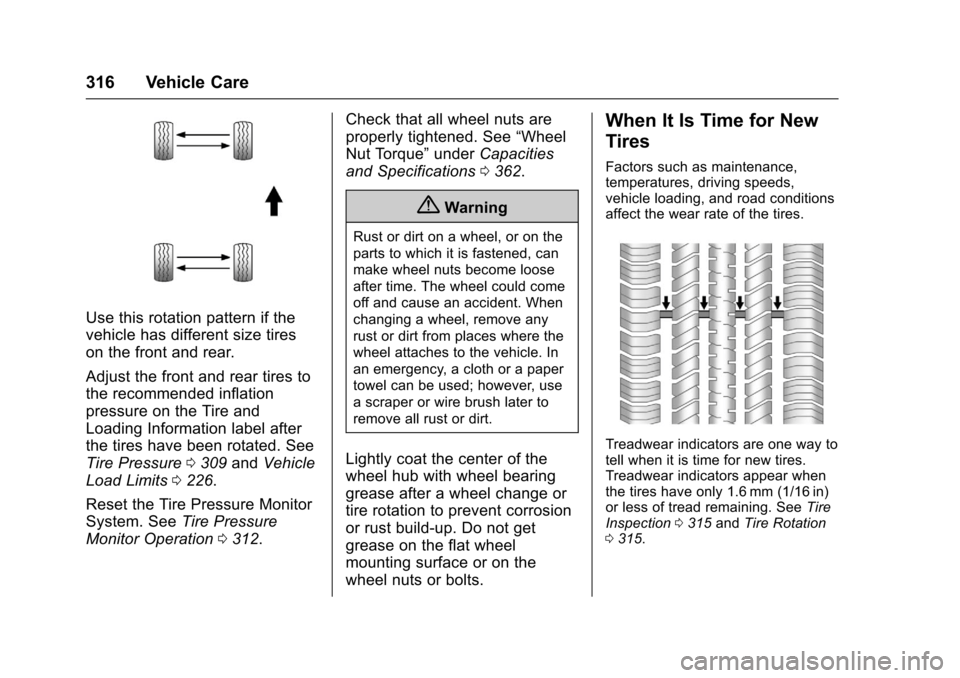
Use this rotation pattern if the
vehicle has different size tires
on the front and rear.
Adjust the front and rear tires to
the recommended inflation
pressure on the Tire and
Loading Information label after
the tires have been rotated. See
Tire Pressure0309andVehicle
Load Limits0226.
Reset the Tire Pressure Monitor
System. SeeTire Pressure
Monitor Operation0312.
Check that all wheel nuts are
properly tightened. See“Wheel
Nut Torque”underCapacities
and Specifications0362.
{Warning
Rust or dirt on a wheel, or on the
parts to which it is fastened, can
make wheel nuts become loose
after time. The wheel could come
off and cause an accident. When
changing a wheel, remove any
rust or dirt from places where the
wheel attaches to the vehicle. In
an emergency, a cloth or a paper
towel can be used; however, use
ascraperorwirebrushlaterto
remove all rust or dirt.
Lightly coat the center of the
wheel hub with wheel bearing
grease after a wheel change or
tire rotation to prevent corrosion
or rust build-up. Do not get
grease on the flat wheel
mounting surface or on the
wheel nuts or bolts.
When It Is Time for New
Tires
Factors such as maintenance,temperatures, driving speeds,vehicle loading, and road conditionsaffect the wear rate of the tires.
Treadwear indicators are one way totell when it is time for new tires.Treadwear indicators appear whenthe tires have only 1.6 mm (1/16 in)or less of tread remaining. SeeTireInspection0315andTire Rotation0315.
Page 323 of 400
Chevrolet SS Sedan Owner Manual (GMNA-Localizing-U.S.-10122752) -2017 - crc - 8/31/16
322 Vehicle Care
If a Tire Goes Flat
It is unusual for a tire to blow outwhile driving, especially if the tiresare maintained properly. SeeTires0303.Ifairgoesoutofatire,itismuch more likely to leak out slowly.But if there is ever a blowout, hereare a few tips about what to expectand what to do:
If a front tire fails, the flat tirecreates a drag that pulls the vehicletoward that side. Take your foot offthe accelerator pedal and grip thesteering wheel firmly. Steer tomaintain lane position, and thengently brake to a stop, well off theroad, if possible.
Arearblowout,particularlyonacurve, acts much like a skid andmay require the same correction asused in a skid. Stop pressing theaccelerator pedal and steer tostraighten the vehicle. It may bevery bumpy and noisy. Gently braketo a stop, well off the road,if possible.
{Warning
Driving on a flat tire will cause
permanent damage to the tire.
Re-inflating a tire after it has been
driven on while severely
underinflated or flat may cause a
blowout and a serious crash.
Never attempt to re-inflate a tire
that has been driven on while
severely underinflated or flat.
Have your dealer or an authorized
tire service center repair or
replace the flat tire as soon as
possible.
{Warning
Lifting a vehicle and getting under
it to do maintenance or repairs is
dangerous without the
appropriate safety equipment and
training. If a jack is provided with
the vehicle, it is designed only for
changing a flat tire. If it is used for
anything else, you or others could
(Continued)
Warning (Continued)
be badly injured or killed if the
vehicle slips off the jack. If a jack
is provided with the vehicle, only
use it for changing a flat tire.
If a tire goes flat, avoid further tireand wheel damage by driving slowlyto a level place, well off the road,if possible. Turn on the hazardwarning flashers. SeeHazardWarning Flashers0127.
{Warning
Changing a tire can be
dangerous. The vehicle can slip
off the jack and roll over or fall
causing injury or death. Find a
level place to change the tire. To
help prevent the vehicle from
moving:
1. Set the parking brake firmly.
(Continued)
Page 324 of 400
Chevrolet SS Sedan Owner Manual (GMNA-Localizing-U.S.-10122752) -2017 - crc - 8/31/16
Vehicle Care 323
Warning (Continued)
2. Put an automatictransmission in P (Park) or amanual transmission in1(First) or R(Reverse).
3. Turn off the engine and donot restart while the vehicleis raised.
4. Do not allow passengers toremain in the vehicle.
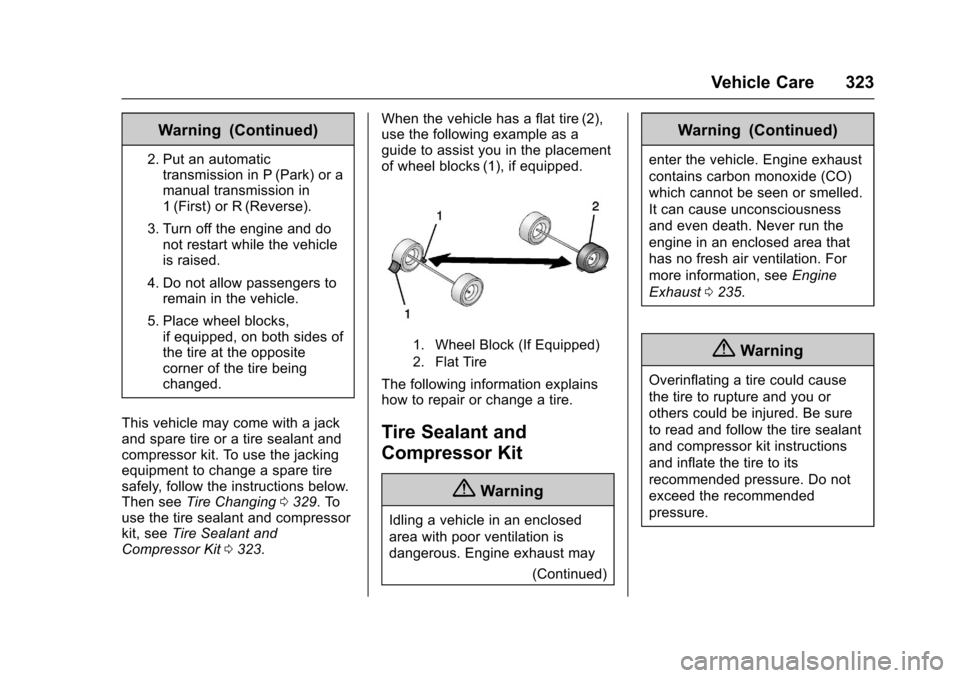
5. Place wheel blocks,if equipped, on both sides ofthe tire at the oppositecorner of the tire beingchanged.
This vehicle may come with a jackand spare tire or a tire sealant andcompressor kit. To use the jackingequipment to change a spare tiresafely, follow the instructions below.Then seeTire Changing0329.Touse the tire sealant and compressorkit, seeTire Sealant andCompressor Kit0323.
When the vehicle has a flat tire (2),use the following example as aguide to assist you in the placementof wheel blocks (1), if equipped.
1. Wheel Block (If Equipped)
2. Flat Tire
The following information explainshow to repair or change a tire.
Tire Sealant and
Compressor Kit
{Warning
Idling a vehicle in an enclosed
area with poor ventilation is
dangerous. Engine exhaust may
(Continued)
Warning (Continued)
enter the vehicle. Engine exhaust
contains carbon monoxide (CO)
which cannot be seen or smelled.
It can cause unconsciousness
and even death. Never run the
engine in an enclosed area that
has no fresh air ventilation. For
more information, seeEngine
Exhaust0235.
{Warning
Overinflating a tire could cause
the tire to rupture and you or
others could be injured. Be sure
to read and follow the tire sealant
and compressor kit instructions
and inflate the tire to its
recommended pressure. Do not
exceed the recommended
pressure.
Page 331 of 400
Chevrolet SS Sedan Owner Manual (GMNA-Localizing-U.S.-10122752) -2017 - crc - 8/31/16
330 Vehicle Care
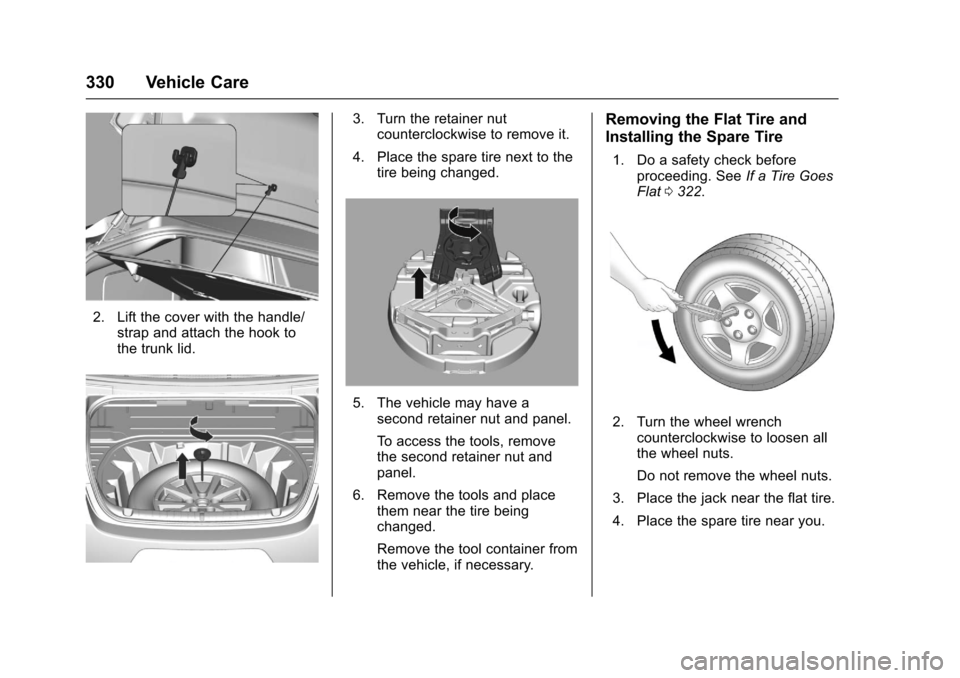
2. Lift the cover with the handle/strap and attach the hook tothe trunk lid.
3. Turn the retainer nutcounterclockwise to remove it.
4. Place the spare tire next to thetire being changed.
5. The vehicle may have asecond retainer nut and panel.
To a c c e s s t h e t o o l s , r e m o v ethe second retainer nut andpanel.
6. Remove the tools and placethem near the tire beingchanged.
Remove the tool container fromthe vehicle, if necessary.
Removing the Flat Tire and
Installing the Spare Tire
1. Do a safety check beforeproceeding. SeeIf a Tire GoesFlat0322.
2. Turn the wheel wrenchcounterclockwise to loosen allthe wheel nuts.
Do not remove the wheel nuts.
3. Place the jack near the flat tire.
4. Place the spare tire near you.
Page 351 of 400
Chevrolet SS Sedan Owner Manual (GMNA-Localizing-U.S.-10122752) -2017 - crc - 8/31/16
350 Service and Maintenance
ayearandtheoillifesystemmustbe reset. Your trained dealertechnician can perform this work.If the engine oil life system is resetaccidentally, service the vehiclewithin 5 000 km/3,000 mi since thelast service. Reset the oil lifesystem when the oil is changed.SeeEngine Oil Life System0277.
Tire Rotation and Required
Services Every 12 000 km/
7,500 mi
Rotate the tires, if recommended forthe vehicle, and perform thefollowing services. SeeTireRotation0315.
.Check engine oil level and oillife percentage. If needed,change engine oil and filter, andreset oil life system. SeeEngineOil0275andEngine Oil LifeSystem0277.
.Check engine coolant level. SeeEngine Coolant0281.
.Check windshield washer fluidlevel. SeeWasher Fluid0286.
.Visually inspect windshield wiperblades for wear, cracking,or contamination. SeeExteriorCare0338.Replacewornordamaged wiper blades. SeeWiper Blade Replacement0291.
.Check tire inflation pressures.SeeTire Pressure0309.
.Check spare wheel retainer.If loose, tighten with a torquewrench to 4.5Y+/✓0.5 (40 lbin +/✓4.5 lb in).
.Inspect tire wear. SeeTireInspection0315.
.Visually check for fluid leaks.
.Inspect engine air cleaner filter.SeeEngine Air Cleaner/Filter0279.
.Inspect brake system. SeeExterior Care0338.
.Visually inspect steering,suspension, and chassiscomponents for damaged, loose,or missing parts or signs ofwear. SeeExterior Care0338.
.Check restraint systemcomponents. SeeSafety SystemCheck056.
.Visually inspect fuel system fordamage or leaks.
.Visually inspect exhaust systemand nearby heat shields forloose or damaged parts.
.Lubricate body components. SeeExterior Care0338.
Page 369 of 400
Chevrolet SS Sedan Owner Manual (GMNA-Localizing-U.S.-10122752) -2017 - crc - 8/31/16
368 Customer Information
.Find theChevrolet-recommendedmaintenance services.
GM Mobility
Reimbursement Program
This program is available toqualified applicants for costreimbursement of eligibleaftermarket adaptive equipmentrequired for the vehicle, such ashand controls or a wheelchair/scooter lift for the vehicle.
For more information on the limitedoffer, visit www.gmmobility.com orcall the GM Mobility AssistanceCenter at 1-800-323-9935. TextTe l e p h o n e ( T T Y ) u s e r s , c a l l1-800-833-9935.
General Motors of Canada also hasaMobilityProgram.Visitwww.gm.caor call 1-800-GM-DRIVE (463-7483)for details. TTY users call1-800-263-3830.
Roadside Assistance
Program
For U.S.-purchased vehicles, call1-800-243-8872. (Text Telephone(TTY): 1-888-889-2438.)
For Canadian-purchased vehicles,call 1-800-268-6800.
Service is available 24 hours a day,365 days a year.
Calling for Assistance
When calling Roadside Assistance,have the following informationready:
.Yo u r n a m e , h o m e a d d r e s s , a n dhome telephone number.
.Te l e p h o n e n u m b e r o f y o u rlocation.
.Location of the vehicle.
.Model, year, color, and licenseplate number of the vehicle.
.Odometer reading, VehicleIdentification Number (VIN), anddelivery date of the vehicle.
.Description of the problem.
Coverage
Services are provided for theduration of the vehicle’spowertrainwarranty.
In the U.S., anyone driving thevehicle is covered. In Canada, aperson driving the vehicle withoutpermission from the owner is notcovered.
Roadside Assistance is not a part ofthe New Vehicle Limited Warranty.General Motors North America andChevrolet reserve the right to makeany changes or discontinue theRoadside Assistance program atany time without notification.
General Motors North America andChevrolet reserve the right to limitservices or payment to an owner ordriver if they decide the claims aremade too often, or the same type ofclaim is made many times.
Page 398 of 400

Chevrolet SS Sedan Owner Manual (GMNA-Localizing-U.S.-10122752) -2017 - crc - 9/1/16
Index 397
Shift Lock Control Function
Check, Automatic
Transmission . . . . . . . . . . . . . . . . . . 290
Shifting
Into Park . . . . . . . . . . . . . . . . . . . . . . 232
Out of Park . . . . . . . . . . . . . . . . . . . 233
Side Blind Zone Alert (SBZA) . . . 261
Signals, Turn and
Lane-Change . . . . . . . . . . . . . . . . . 128
Software Updates . . . . . . . . . . . . . . 139
Special Application Services . . . . 355
Specifications and
Capacities . . . . . . . . . . . . . . . . . . . . . 362
Speedometer . . . . . . . . . . . . . . . . . . . . 97
StabiliTrak
OFF Light . . . . . . . . . . . . . . . . . . . . . 105
Start Assist, Hill . . . . . . . . . . . . . . . . . 244
Start Vehicle, Remote . . . . . . . . . . . 30
Starter Switch Check . . . . . . . . . . . 290
Starting the Engine . . . . . . . . . . . . . 231
Starting the Vehicle
Messages . . . . . . . . . . . . . . . . . . . . . 118
Steering . . . . . . . . . . . . . . . . . . . . . . . . 218
Wheel Adjustment . . . . . . . . . . . . . . 91
Wheel Controls . . . . . . . . . . . . . . . . . 91
Steering Wheel Controls . . . . . . . . 134
Stitcher Internet Radio . . . . . . . . . . 153
Storage Areas
Center Console . . . . . . . . . . . . . . . . . 87
Convenience Net . . . . . . . . . . . . . . . 88
Glove Box . . . . . . . . . . . . . . . . . . . . . . 87
Roof Rack System . . . . . . . . . . . . . . 89
Storage Compartments . . . . . . . . . . 87
Storing the Tire Sealant and
Compressor Kit . . . . . . . . . . . . . . . 329
Stuck Vehicle . . . . . . . . . . . . . . . . . . . 225
Summer Tires . . . . . . . . . . . . . . . . . . 304
Sun Visors . . . . . . . . . . . . . . . . . . . . . . . 42
Sunroof . . . . . . . . . . . . . . . . . . . . . . . . . . 42
Symbols . . . . . . . . . . . . . . . . . . . . . . . . . . 3
Navigation . . . . . . . . . . . . . . . . . . . . 169
System
Forward Collision
Alert (FCA) . . . . . . . . . . . . . . . . . . 259
Global Positioning . . . . . . . . . . . . 186
Infotainment . . . . . . . . . . . . . 131, 377
Roof Rack . . . . . . . . . . . . . . . . . . . . . . 89
Systems
Driver Assistance . . . . . . . . . . . . . 253
T
Ta c h o m e t e r . . . . . . . . . . . . . . . . . . . . . . 9 7
Te x t M e s s a g i n g . . . . . . . . . . . . . . . . . 2 0 2
Te x t Te l e p h o n e ( T T Y ) U s e r s . . . . 3 6 7
Theft-Deterrent Systems . . . . . . . . . 37
Immobilizer . . . . . . . . . . . . . . . . . . . . . 37
Time . . . . . . . . . . . . . . . . . . . . . . . . . . . . . 93
Tires . . . . . . . . . . . . . . . . . . . . . . . . . . . . 303
Buying New Tires . . . . . . . . . . . . . 317
Chains . . . . . . . . . . . . . . . . . . . . . . . . 321
Changing . . . . . . . . . . . . . . . . . . . . . 329
Designations . . . . . . . . . . . . . . . . . 306
Different Size . . . . . . . . . . . . . . . . . 318
Full-Size Spare . . . . . . . . . . . . . . . 334
If a Tire Goes Flat . . . . . . . . . . . . 322
Inspection . . . . . . . . . . . . . . . . . . . . 315
Low Profile . . . . . . . . . . . . . . . . . . . 304
Messages . . . . . . . . . . . . . . . . . . . . .118
Pressure . . . . . . . . . . . . . . . . . 309, 310
Pressure Light . . . . . . . . . . . . . . . . 106
Pressure Monitor Operation . . 312
Pressure Monitor System . . . . . .311
Rotation . . . . . . . . . . . . . . . . . . . . . . 315
Sealant and
Compressor Kit . . . . . . . . . . . . . 323
Sealant and Compressor
Kit, Storing . . . . . . . . . . . . . . . . . . 329
Sidewall Labeling . . . . . . . . . . . . . 305
Te r m i n o l o g y a n d D e f i n i t i o n s . . 3 0 7
Uniform Tire Quality
Grading . . . . . . . . . . . . . . . . . . . . . 319
Wheel Alignment and Tire
Balance . . . . . . . . . . . . . . . . . . . . . 320
Wheel Replacement . . . . . . . . . . 320