automatic transmission CHEVROLET SSR 2006 1.G Owner's Guide
[x] Cancel search | Manufacturer: CHEVROLET, Model Year: 2006, Model line: SSR, Model: CHEVROLET SSR 2006 1.GPages: 390, PDF Size: 2.44 MB
Page 285 of 390
Jump Starting
If your battery has run down, you may want to use
another vehicle and some jumper cables to start your
vehicle. Be sure to use the following steps to do it safely.
{CAUTION:
Batteries can hurt you. They can be dangerous
because:
They contain acid that can burn you.
They contain gas that can explode
or ignite.
They contain enough electricity to
burn you.
If you do not follow these steps exactly, some
or all of these things can hurt you.
Notice:Ignoring these steps could result in costly
damage to your vehicle that would not be covered
by your warranty.
Trying to start your vehicle by pushing or pulling it
will not work, and it could damage your vehicle.
1. Check the other vehicle. It must have a 12-volt
battery with a negative ground system.Notice:If the other vehicle’s system is not a 12-volt
system with a negative ground, both vehicles can
be damaged. Only use vehicles with 12-volt systems
with negative grounds to jump start your vehicle.
2. Get the vehicles close enough so the jumper cables
can reach, but be sure the vehicles are not touching
each other. If they are, it could cause a ground
connection you do not want. You would not be able
to start your vehicle and the bad grounding could
damage the electrical systems.
To avoid the possibility of the vehicles rolling, set
the parking brake firmly on both vehicles involved in
the jump start procedure. Put an automatic
transmission in PARK (P) or a manual transmission
in NEUTRAL before setting the parking brake.
Notice:If you leave your radio or other accessories
on during the jump starting procedure, they could
be damaged. The repairs would not be covered
by your warranty. Always turn off your radio and
other accessories when jump starting your vehicle.
3. Turn off the ignition on both vehicles. Unplug
unnecessary accessories plugged into the cigarette
lighter or the accessory power outlets. Turn off
the radio and all lamps that are not needed. This
will avoid sparks and help save both batteries. And
it could save the radio!
5-37
Page 290 of 390
Rear Axle
When to Check and Change Lubricant
It is not necessary to regularly check the rear axle
fluid unless there is a leak in the system or you hear an
unusual noise. A fluid loss in the system indicates
that you have a problem. Have the system inspected
and repaired.
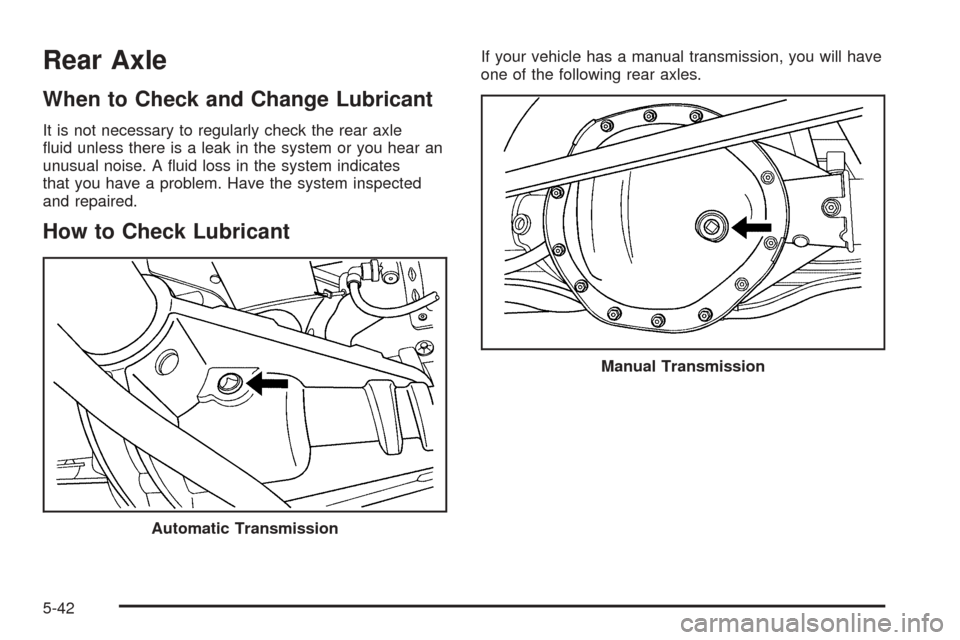
How to Check Lubricant
If your vehicle has a manual transmission, you will have
one of the following rear axles.
Automatic Transmission
Manual Transmission
5-42
Page 302 of 390
Tire Size
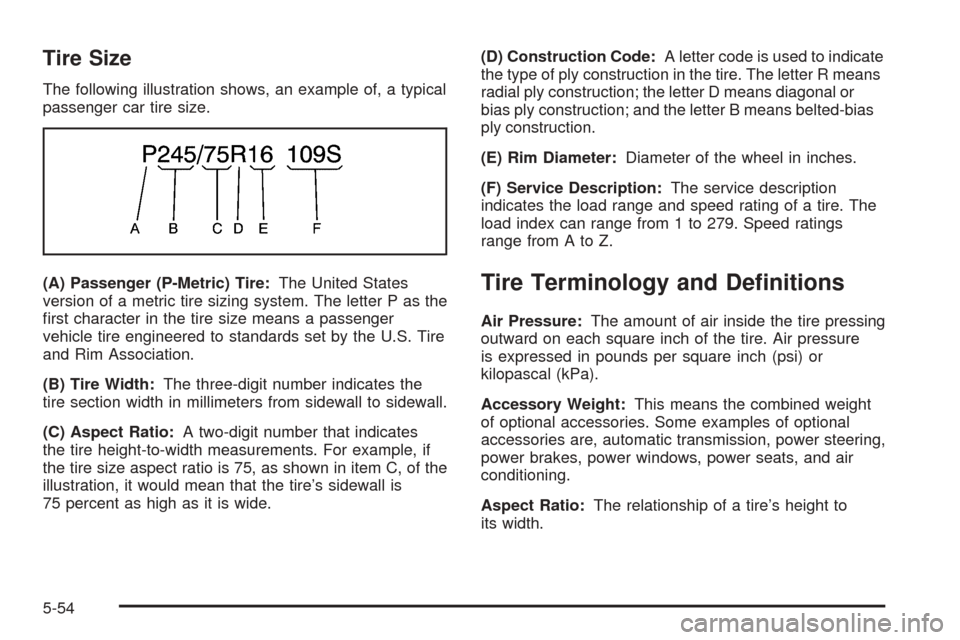
The following illustration shows, an example of, a typical
passenger car tire size.
(A) Passenger (P-Metric) Tire:The United States
version of a metric tire sizing system. The letter P as the
first character in the tire size means a passenger
vehicle tire engineered to standards set by the U.S. Tire
and Rim Association.
(B) Tire Width:The three-digit number indicates the
tire section width in millimeters from sidewall to sidewall.
(C) Aspect Ratio:A two-digit number that indicates
the tire height-to-width measurements. For example, if
the tire size aspect ratio is 75, as shown in item C, of the
illustration, it would mean that the tire’s sidewall is
75 percent as high as it is wide.(D) Construction Code:A letter code is used to indicate
the type of ply construction in the tire. The letter R means
radial ply construction; the letter D means diagonal or
bias ply construction; and the letter B means belted-bias
ply construction.
(E) Rim Diameter:Diameter of the wheel in inches.
(F) Service Description:The service description
indicates the load range and speed rating of a tire. The
load index can range from 1 to 279. Speed ratings
range from A to Z.
Tire Terminology and Denitions
Air Pressure:The amount of air inside the tire pressing
outward on each square inch of the tire. Air pressure
is expressed in pounds per square inch (psi) or
kilopascal (kPa).
Accessory Weight:This means the combined weight
of optional accessories. Some examples of optional
accessories are, automatic transmission, power steering,
power brakes, power windows, power seats, and air
conditioning.
Aspect Ratio:The relationship of a tire’s height to
its width.
5-54
Page 315 of 390

If a Tire Goes Flat
Your vehicle has no spare tire, no tire changing
equipment and no place to store a tire.
It is unusual for a tire to blow out while you are driving,
especially if you maintain your tires properly. See
Tires on page 5-51. If air goes out of a tire, it’s much
more likely to leak out slowly. But if you should
ever have a blow out here are a few tips about what to
expect and what to do:
If a front tire fails, the flat tire will create a drag that
pulls the vehicle toward that side. Take your foot off the
accelerator pedal and grip the steering wheel firmly.
Steer to maintain lane position, and then gently brake to
a stop well out of the traffic lane.
A rear blow out, particularly on a curve, acts much like
a skid and may require the same correction you
would use in a skid. In any rear blow out, remove your
foot from the accelerator pedal. Get the vehicle
under control by steering the way you want the vehicle
to go. It may be very bumpy and noisy, but you can
still steer. Gently brake to a stop, well off the road
if possible.If a tire goes flat, avoid further tire and wheel damage by
driving slowly to a level place and stopping. Then do this:
1. Turn on the hazard warning flashers.
2. Park your vehicle. If your vehicle has an automatic
transmission, set the parking brake firmly and put the
shift lever in PARK (P). SeeShifting Into Park (P) on
page 2-23for additional information. If your vehicle
has a manual transmission, move the shift lever to
REVERSE (R) and set the parking brake firmly. See
Parking Your Vehicle (Manual Transmission) on
page 2-25for additional information.
3. Turn off the engine.
4. Inspect the flat tire.
If the tire has been separated from the wheel or has
damaged sidewalls or large tears that allow rapid
air loss, call a tire repair facility. SeeRoadside
Assistance Program on page 7-6.
5-67
Page 339 of 390

Fuses Usage
4 Driver’s Side High Beam Headlamp
5 Driver’s Side Low Beam Headlamp
6 Cargo Cover Release
7Transmission Control
Module/Canister
8 Truck Body Controller
9 Windshield Washer
10 Driver’s Side Stoplamp/Turn Signals
11 Fuel Pump
12 Fog Lamps
13 Stoplamps
14 Headlamp Driver Module (HDM)
15Passenger’s Side Stoplamp/Turn
Signals
16 Cigarette Lighter
17 Hazard Warning Flashers
18 Coils
19 Truck Body Control, Ignition 1
20 Starter
21 Airbag System
22 Horn
23 Ignition EFuses Usage
24Instrument Panel Cluster, Driver
Information Center (DIC)
25Automatic Transmission Shift
Interlock Control System
26 Back-up lamps, Lock Out
27 Engine Control Module
28 Oxygen Sensor B
29 Injector B
30 Air Conditioning
31Engine Control Module (ECM),
Transmission Control Module (TCM)
32 Transmission
33 Engine 1
34Engine Control Module, Electronic
Brake Controller
35 Oxygen Sensor A
36 Injector A
37 Engine Cooling Fan
38 Anti-lock Brake System (ABS)
39 Ignition A
40 Climate Control Fan
41 Ignition B
5-91
Page 343 of 390

Capacities and Specications
The following approximate capacities are given in English and metric conversions. Refer toRecommended Fluids
and Lubricants on page 6-12for more information.
ApplicationCapacities
English Metric
Cooling System 13.7 qt 13.0 L
Engine Oil with Filter 6.0 qt 5.7 L
Fuel Tank 25.0 gal 94.6 L
Transmission
Automatic 5.0 qt 4.7 L
Manual 3.7 qt 3.5 L
Wheel Nut Torque 100 lb ft 140Y
All capacities are approximate. When adding fluids, be sure to fill to the appropriate level, as recommended in this
manual. Recheck the fluid level after filling.
Engine Specications
Engine VIN Code Transmission Spark Plug Gap
6.0L V8 HAutomatic
Manual0.040 inches (1.01 mm)
5-95
Page 350 of 390

Additional Required Services
The following services should be performed at the first maintenance service (IorII) after the indicated miles
(kilometers) shown for each item.
Additional Required Services
Service and Miles (Kilometers)25,000
(41 500)50,000
(83 000)75,000
(125 000)100,000
(166 000)125,000
(207 500)150,000
(240 000)
Inspect fuel system for damage or leaks.• •••••
Inspect exhaust system for loose or
damaged components.• •••••
Replace engine air cleaner filter. See
Engine Air Cleaner/Filter on page 5-18.•••
Change automatic transmission fluid and
filter (severe service).See footnotes (h)
and (l).• •••••
Change automatic transmission fluid and
filter (normal service).See footnote (l).•••
Replace spark plugs.An Emission
Control Service.•
Inspect spark plug wires.An Emission
Control Service.•
Engine cooling system service (or every
five years, whichever occurs first).An
Emission Control Service. See footnote (i).•
Inspect engine accessory drive belt.An
Emission Control Service. See footnote (k).•
6-6
Page 351 of 390

Maintenance Footnotes
(a)Visually inspect brake lines and hoses for proper
hook-up, binding, leaks, cracks, chang, etc. Inspect
disc brake pads for wear and rotors for surface
condition. Inspect other brake parts, including calipers,
parking brake, etc.
(b)Visually inspect front and rear suspension and
steering system for damaged, loose, or missing parts or
signs of wear. Inspect power steering lines and hoses
for proper hook-up, binding, leaks, cracks, chang, etc.
(c)Visually inspect hoses and have them replaced if
they are cracked, swollen, or deteriorated. Inspect
all pipes, ttings, and clamps; replace with genuine
GM parts as needed. To help ensure proper operation,
a pressure test of the cooling system and pressure
cap and cleaning the outside of the radiator and
air conditioning condenser is recommended at least
once a year.
(d)Visually inspect wiper blades for wear or cracking.
Replace wiper blades that appear worn or damaged
or that streak or miss areas of the windshield.
(e)Make sure the safety belt reminder light and all your
belts, buckles, latch plates, retractors, and anchorages
are working properly. Look for any other loose or
damaged safety belt system parts. If you see anything
that might keep a safety belt system from doing itsjob, have it repaired. Have any torn or frayed safety
belts replaced. Also look for any opened or broken
airbag coverings, and have them repaired or replaced.
The airbag system does not need regular maintenance.
(f)Lubricate all key lock cylinders, all body door and
fuel door hinges, latches and locks, including glove box
and console doors, hood assembly, secondary latch,
pivots, spring anchor, release pawl, and any moving
seat hardware. More frequent lubrication may be
required when exposed to a corrosive environment.
Applying silicone grease on weatherstrips with a clean
cloth will make them last longer, seal better, and
not stick or squeak.
(g)A uid loss in any vehicle system could indicate a
problem. Have the system inspected and repaired
and the uid level checked. Add uid if needed.
(h)Change automatic transmission uid and lter
if the vehicle is mainly driven under one or more of
these conditions:
-In heavy city traffic where the outside temperature
regularly reaches 90°F (32°C) or higher.
-In hilly or mountainous terrain.
-When doing frequent trailer towing.
-Uses such as found in taxi, police, or
delivery service.
6-7
Page 353 of 390

At Least Once a Month
Tire Inspection and Ination Check
Visually inspect your tires for wear and make sure tires
are inflated to the correct pressures. SeeTires on
page 5-51for further details.
At Least Once a Year
Starter Switch Check
{CAUTION:
When you are doing this inspection, the
vehicle could move suddenly. If the vehicle
moves, you or others could be injured.
1. Before you start, be sure you have enough room
around the vehicle.2. Firmly apply both the parking brake and the regular
brake. SeeParking Brake on page 2-23if
necessary.
Do not use the accelerator pedal, and be ready to
turn off the engine immediately if it starts.
3. On automatic transmission vehicles, try to
start the engine in each gear. The starter should
work only in PARK (P) or NEUTRAL (N). If the
starter works in any other position, contact your
GM Goodwrench
®dealer for service.
On manual transmission vehicles, put the shift lever
in NEUTRAL, push the clutch down halfway and
try to start the engine. The starter should work only
when the clutch is pushed down all the way to
the floor. If the starter works when the clutch is
not pushed all the way down, contact your
GM Goodwrench
®dealer for service.
6-9
Page 354 of 390

Automatic Transmission Shift Lock
Control System Check
{CAUTION:
When you are doing this inspection, the
vehicle could move suddenly. If the vehicle
moves, you or others could be injured.
1. Before you start, be sure you have enough room
around the vehicle. It should be parked on a level
surface.
2. Firmly apply the parking brake. SeeParking Brake
on page 2-23if necessary.
Be ready to apply the regular brake immediately if
the vehicle begins to move.
3. With the engine off, turn the ignition to RUN, but do
not start the engine. Without applying the regular
brake, try to move the shift lever out of PARK (P)
with normal effort. If the shift lever moves out
of PARK (P), contact your GM Goodwrench
®dealer
for service.
Ignition Transmission Lock Check
While parked, and with the parking brake set, try to turn
the ignition to OFF in each shift lever position.
•With an automatic transmission, the ignition should
turn to OFF only when the shift lever is in PARK (P).
The key should come out only in OFF.
•With a manual transmission, the key should come
out only in OFF.
Contact your GM Goodwrench
®dealer if service
is required.
6-10