cooling CHEVROLET SUBURBAN 1994 User Guide
[x] Cancel search | Manufacturer: CHEVROLET, Model Year: 1994, Model line: SUBURBAN, Model: CHEVROLET SUBURBAN 1994Pages: 385, PDF Size: 19.88 MB
Page 223 of 385
How to Add Coolant to the Coolant Surge Tank
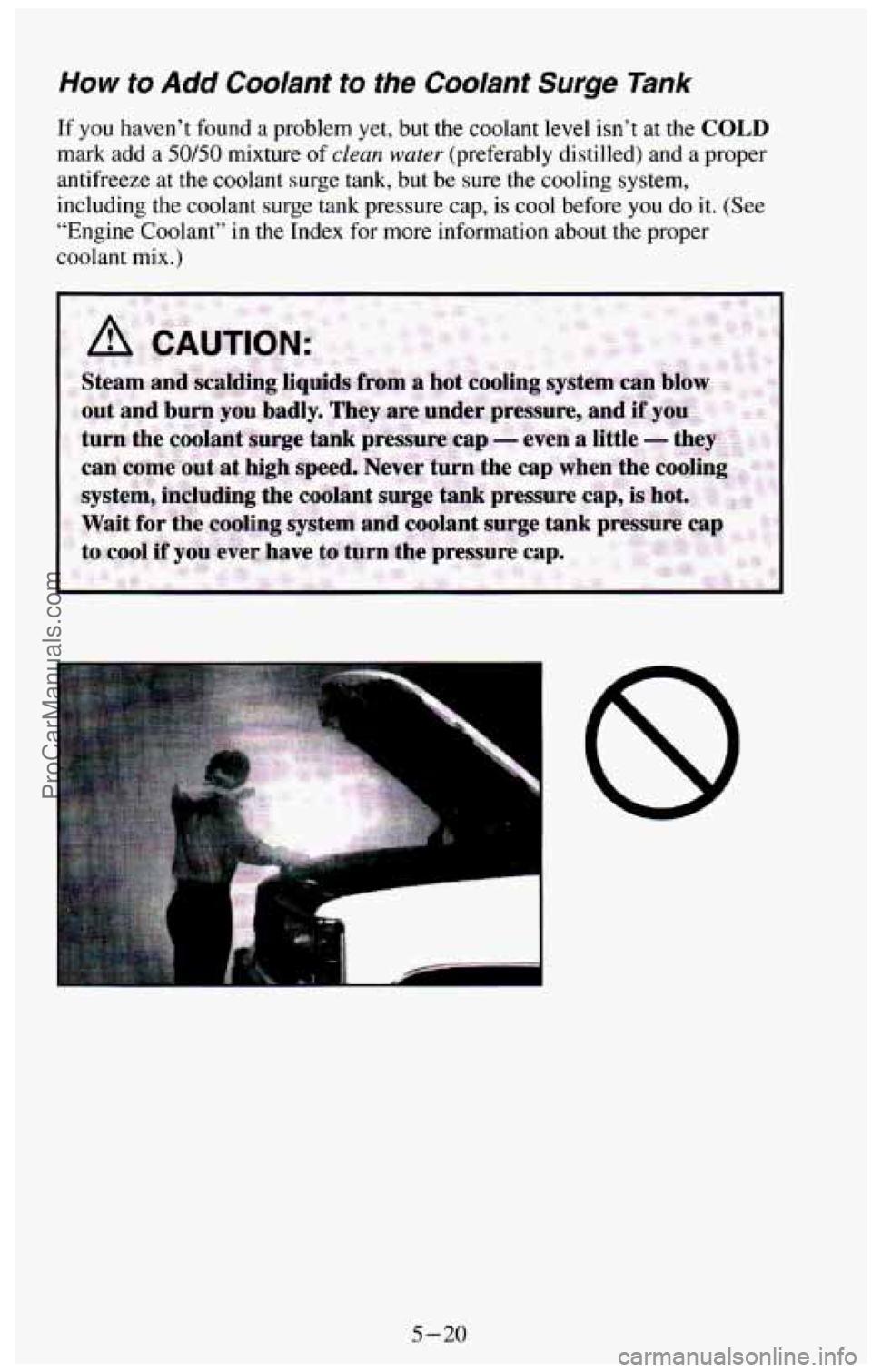
If you haven’t found a problem yet, but the coolant level isn’t at the COLD
mark add a 50/50 mixture of clean water (preferably distilled) and a proper
antifreeze
at the coolant surge tank, but be sure the cooling system,
including the coolant surge tank pressure cap,
is cool before you do it. (See
“Engine Coolant”
in the Index for more information about the proper
coolant mix.)
5-20
ProCarManuals.com
Page 224 of 385

NOTICE:
In cold weather, water can freeze and crack the engine, radiat\
or,
heater core and other parts.
So use the recommended coolant.
1. You can remove the coolant surge tank pressure cap when the cooling
system, including the coolant surge tank pressure cap and upper
radiator
hose, is no longer hot.
5-21
ProCarManuals.com
Page 227 of 385
Engine Fan Noise
Your vehicle has a clutched engine cooling fan. When the clutch is engaged,
the fan spins faster to provide more air to cool
the engine. In most every day
driving conditions the fan
is spinning slower and clutch is not fully engaged.
This improves
fuel economy and reduces fan noise. Under heavy vehicle
loading, trailer towing and/or high outside temperatures, the fan speed
increases as the clutch more fully engages.
So you may hear an increase in
fan noise. This is normal and should not be mistaken as the transmission
slipping or making extra shifts.
It is merely the cooling system functioning
properly. The
fan will slow down when additional cooling is not required
and the clutch partially disengages.
You may also hear this fan noise when you start the engine. It will go away
as the fan clutch partially disengages.
If a Tire Goes Flat
It’s unusual for a tire to “blow out” while you’re driving, especially if you
maintain your tires properly. If air goes out of a tire, it’s much more likely to
leak out slowly. But if you should ever have
a “blowout,” here are a few tips
about what to expect and what
to do:
If a front tire fails, the flat tire will create a drag that pulls the vehicle
toward that side. Take your foot off the accelerator pedal and grip the
steering wheel firmly. Steer to maintain lane position, then gently brake to a
stop well out of the traffic lane.
A rear blowout, particularly on a curve, acts much like a skid and may
require the same correction you’d use in a skid. In any rear blowout, remove
your foot from the accelerator pedal. Get the vehicle under control
by
steering the way you want the vehicle to go. It may be very bumpy and
noisy, but you can still steer. Gently brake to a stop, well off the road if
possible.
If a
tire goes flat, the next section shows how to use your jacking equipment
to change a flat tire safely.
5-24
ProCarManuals.com
Page 280 of 385
Front Axle
When to Check and Change Lubricant
Refer to the Maintenance Schedule to determine how often to check the
lubricant and when to change
it. See “Scheduled Maintenance Services” in
the Index.
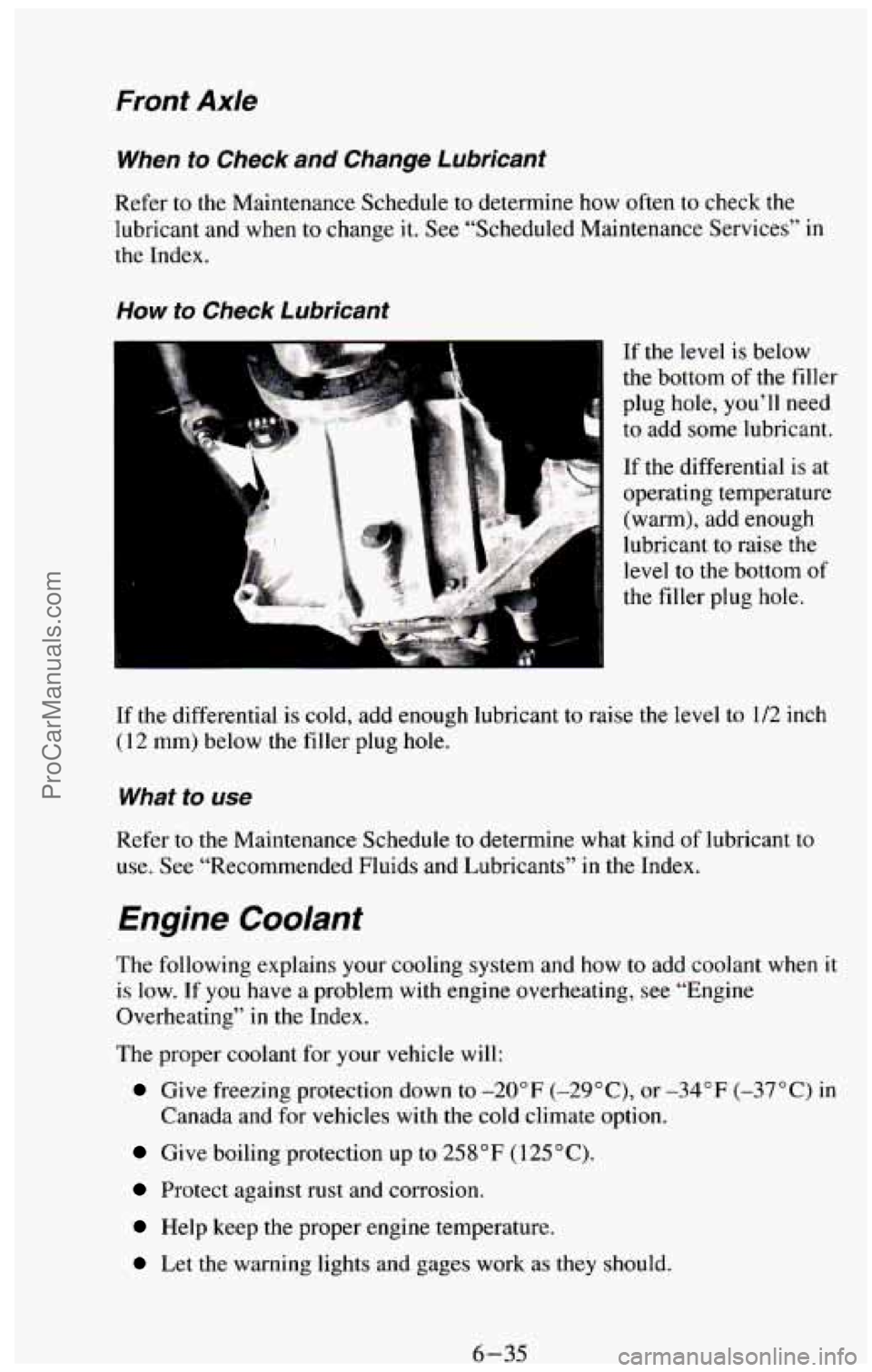
How to Check Lubricant
If the level is below
the bottom of the filler
plug hole, you’ll need
to add some lubricant.
If the differential is at
operating temperature
(warm), add enough
lubricant to raise the level
to the bottom of
the filler plug hole.
If the differential is cold, add enough lubricant to raise the level to
1/2 inch
(12 mm) below the filler plug hole.
What to use
Refer to the Maintenance Schedule to determine what kind of lubricant to
use. See “Recommended Fluids and Lubricants” in the Index.
Engine Coolant
The following explains your cooling system and how to add coolant when it
is low. If you have a problem with engine overheating, see “Engine
Overheating”
in the Index.
The proper coolant for your vehicle will:
Give freezing protection down to -20°F (-29”C), or -34°F (-37°C) in
Give boiling protection up to 258°F (1 25°C).
Protect against rust and corrosion.
Help keep the proper engine temperature.
Canada
and for vehicles with the cold climate option.
Let the warning lights and gages work as they should.
6-35 ProCarManuals.com
Page 281 of 385
What to Use
use a mixture of one-half clean water (preferably distilled) and one-half
antifreeze that meets
“GM Specification 6038-M,” which won’t damage
aluminum
parts. You can also use a recycled coolant conforming to “GM
Specification 6038-M” with a complete coolant flush and refill. If you use
this mixture, you don’t need
to add anything else.
NOTICE:
If you use an improper coolant mix, your engine could overheat
and be badly damaged. The repair cost wouldn’t be covered by
your warranty.
TOO much water in the mix can freeze and crack
the engine, radiator, heater core and other parts.
Some conditions, such as air trapped in the cooling system, can affect the
coolant level in the radiator. Check the coolant level when the engine is cold
and follow the steps under “Adding Coolant” for
the proper way to add
coolant.
If you have to add coolant more than four times a year, have your dealer
check your cooling system.
NOTICE:
If you use the proper coolant, you don’t have to add extra
inhibitors
or additives which claim to improve the system. These
can be harmful.
6-36
ProCarManuals.com
Page 285 of 385
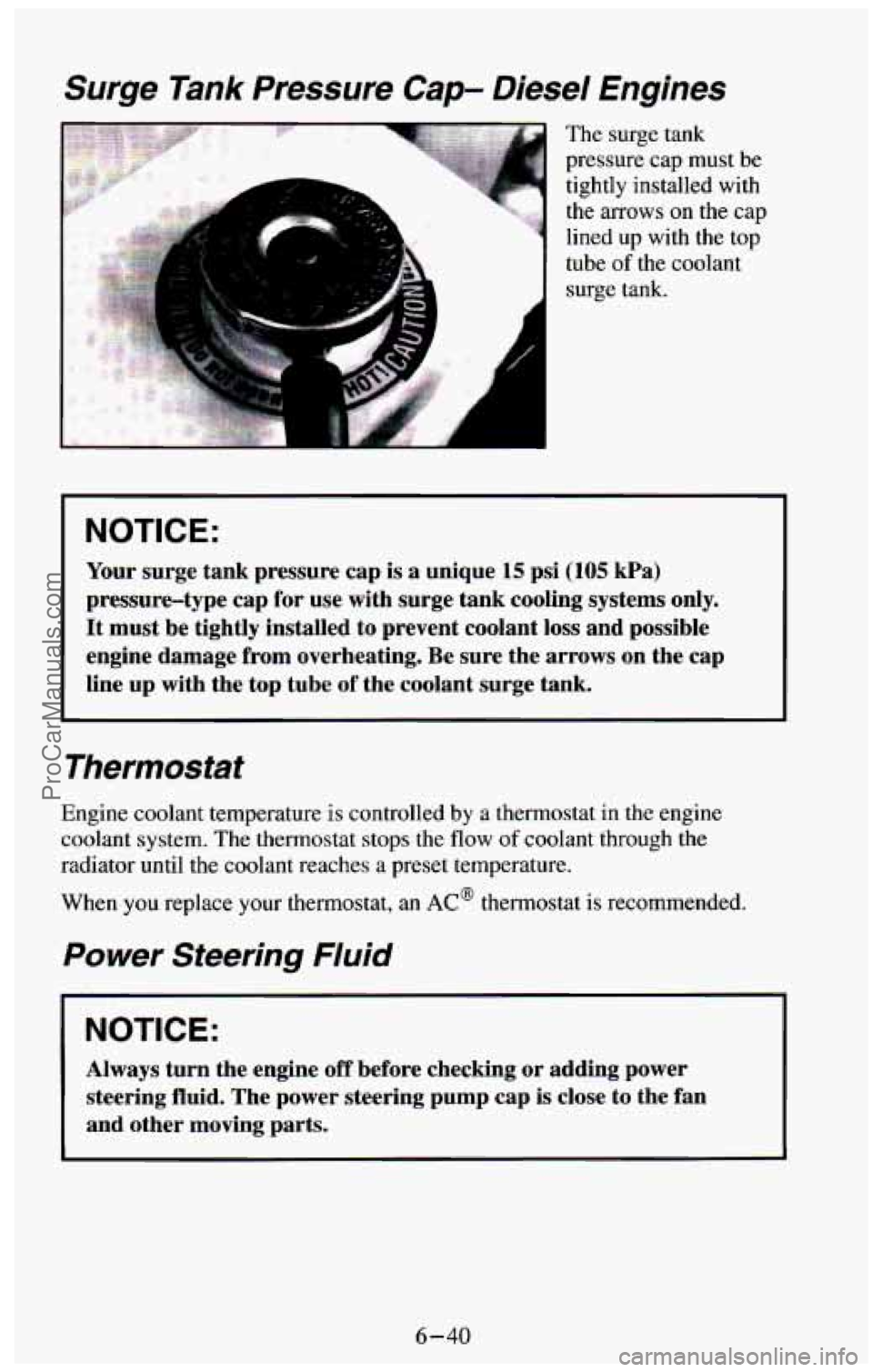
Surge Tank Pressure Cap- Diesel Engines
The surge tank
pressure cap must be
tightly installed with
the arrows
on the cap
lined up with the top
tube
of the coolant
surge tank.
NOTICE:
Your surge tank pressure cap 1s a unique 15 psi (105 kPa)
pressure-type cap for use with surge tank cooling systems only.
It must be tightly installed to prevent coolant loss and possible
engine damage from overheating. Be sure the arrows on the cap
line up with the top tube
of the coolant surge tank.
Thermostat
Engine coolant temperature is controlled by a thermostat in the engine
coolant system. The thermostat stops the flow
of coolant through the
radiator until the coolant reaches a preset temperature.
When you replace your thermostat, an
AC@ thermostat is recommended.
Power Steering Fluid
I NOTICE:
Always turn the engine off before checking or adding power
steering
fluid. The power steering pump cap is close to the fan
and other moving parts.
6-40
ProCarManuals.com
Page 292 of 385
Wheel Nut Torque
For vehicles with dual wheels, when the vehicle, wheel or fasteners are new,
have the torque set at
the first 100, 1,000 and 6,000 miles (160, 1600 and
9600 km). Use the torque specified in the appropriate Specification Chart
later
in this section.
Single Belt Accessory Drive
If your new vehicle uses a serpentine belt, it is lighter, and more durable
than systems with several belts.
The belt
ruIl 'li'vkf br iir6und the pulleys or^ the engine. A tensione'r'n'iay be
used to keep the belt tight at all times. The tensioner also makes replacing
the belt easier
if you need to replace the belt, be sure to get the correct
replacement belt. Your dealership
or parts supplier can help you with this.
The Accessory Drive Belt Routing label on your vehicle will show you how
to route the belt your vehicle uses.
Windshield Wiper Blade lnserts
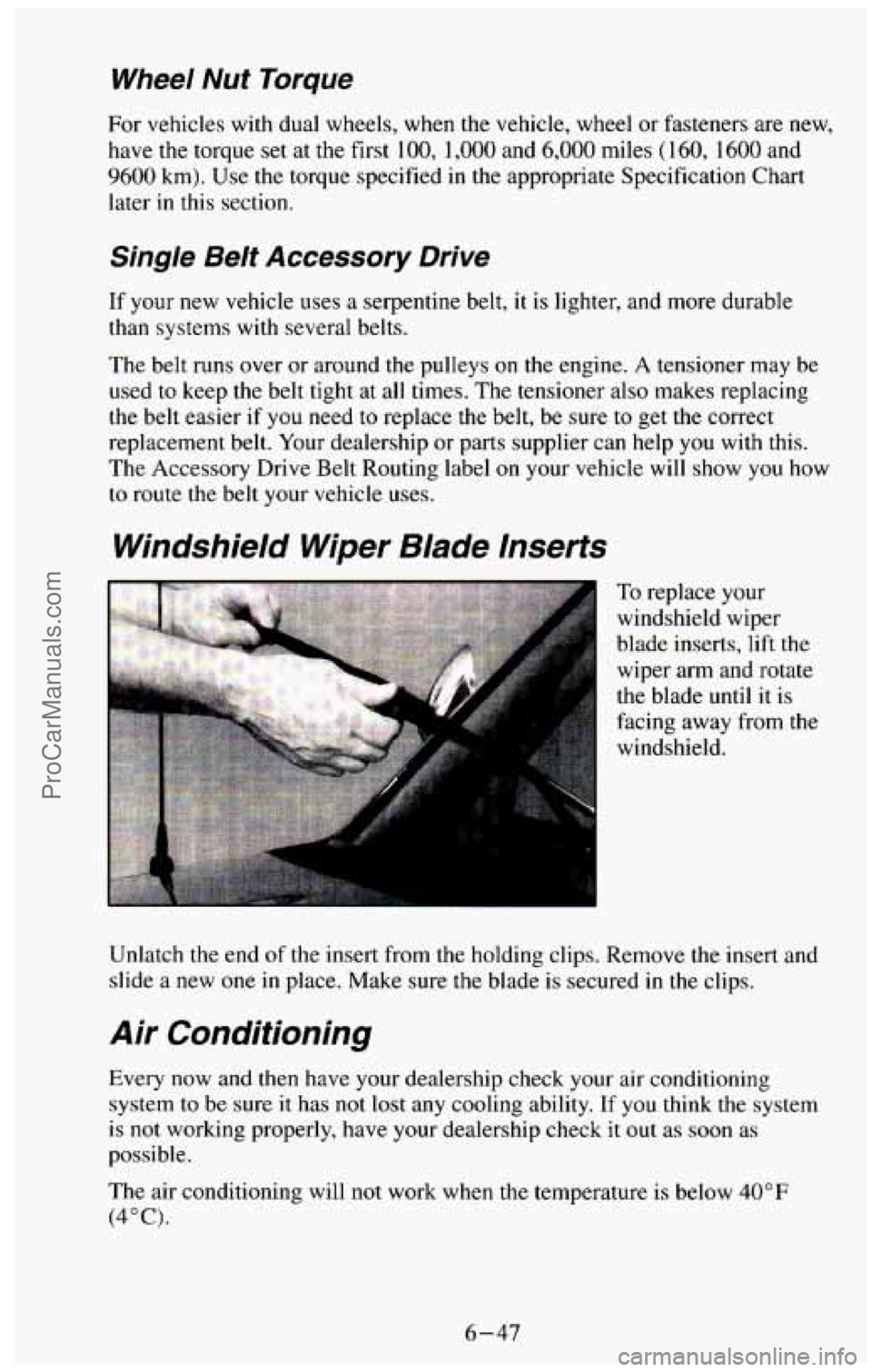
To replace your
windshield wiper
blade inserts, lift the
wiper arm and rotate
the blade until
it is
facing
away from the
windshield.
Unlatch the end
of the insert from the holding clips. Remove the insert and
slide
a new one in place. Make sure the blade is secured in the clips.
Air Conditioning
Every now and then have your dealership check your air conditioning
system to be sure
it has not lost any cooling ability. If you think the system
is not working properly, have your dealership check it out as soon as
possible.
The air conditioning will not work when the temperature
is below 40°F
(4°C).
6-47
ProCarManuals.com
Page 313 of 385
Wheel Replacement
Replace any wheel that is bent, cracked or badly rusted. If wheel nuts keep
coming loose, the wheel, wheel bolts, and wheel nuts should be replaced.
If
the wheel leaks air, replace it (except some aluminum wheels, which can
sometimes be repaired). See your GM dealer if any
of these conditions exist.
Your dealer will know the kind
of wheel you need.
Each new wheel should have the same load carrying capacity, diameter,
width, offset, and be mounted the same way as the one it replaces.
If you need to replace any of your wheels, wheel bolts, or wheel nuts,
replace them only with new GM original equipment parts. This way, you
will be sure to have the right wheel, wheel bolts, and wheel nuts
for your
GM model.
NOTICE:
The wrong wheel can also cause problems with bearing life,
brake cooling, speedometer/odometer calibration, headlight aim, bumper height, vehicle ground clearance, and tire or tire chain\
clearance to the body and chassis.
Used Replacement Wheels
ProCarManuals.com
Page 327 of 385
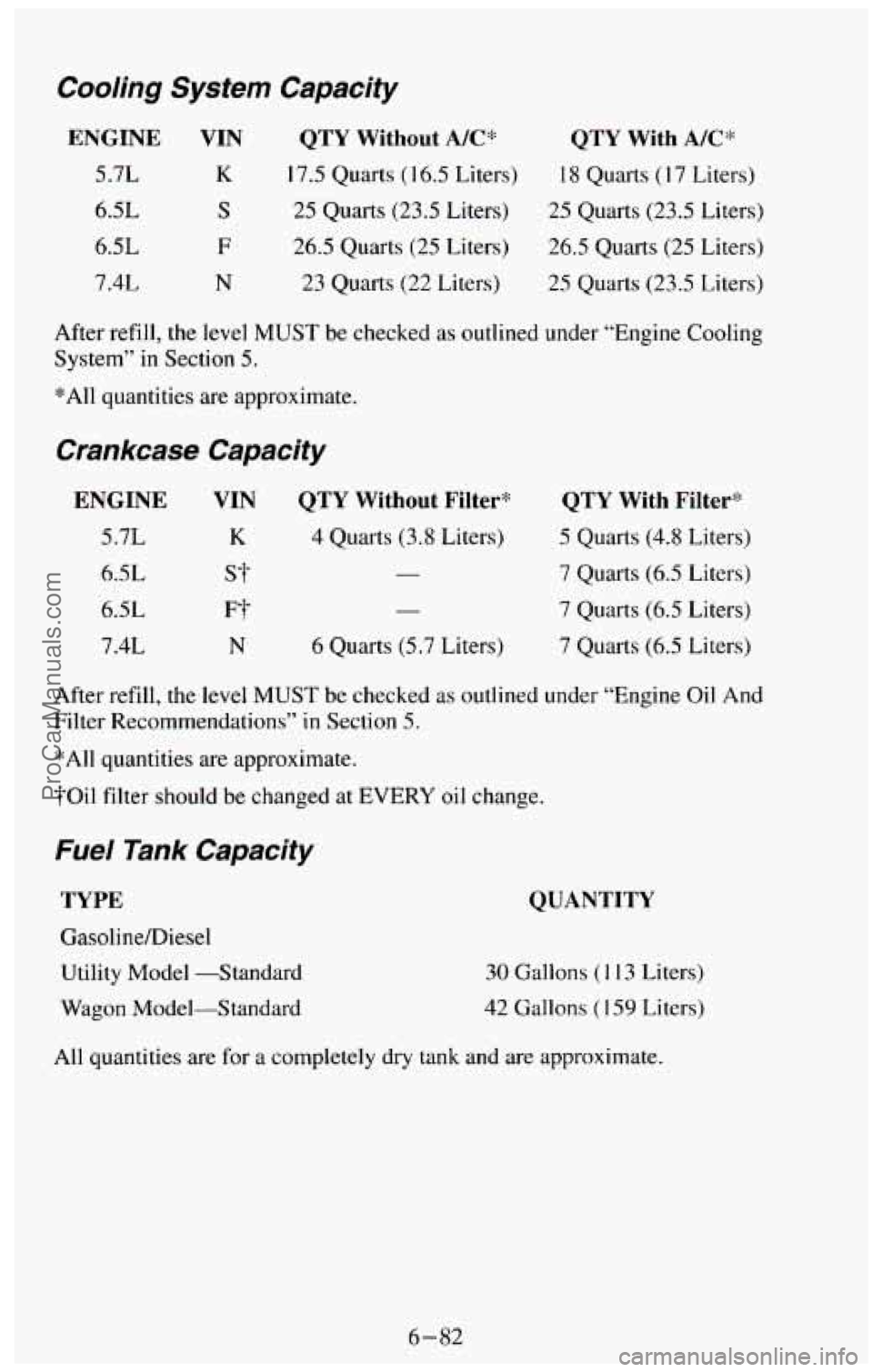
Cooling System Capacity
ENGINE VIN
5.7L K
6.5L S
6.5L F
7.4L N
QTY Without AfC* QTY With A/C*
17.5 Quarts (1 6.5 Liters)
18 Quarts ( I7 Liters)
25 Quarts
(23.5 Liters) 25 Quarts (23.5 Liters)
26.5 Quarts (25 Liters)
26.5 Quarts (25 Liters)
23 Quarts (22 Liters)
25 Quarts (23.5 Liters)
After refill, the level MUST be checked as outlined under “Engine Cooling
System”
in Section 5.
*All quantities are approximate.
Crankcase Capacity
ENGINE
5.7L
6.5L
6.5L
7.4L
VIN
K
ST
F?
N
QTY Without Filter“
4 Quarts (3.8 Liters)
6 Quarts (5.7 Liters)
QTY With Filter:$
5 Quarts (4.8 Liters)
7 Quarts (6.5 Liters)
7 Quarts
(6.5 Liters)
7 Quarts (6.5 Liters)
After refill, the level MUST be checked
as outlined under “Engine Oil And
Filter Recommendations”
in Section 5.
*All quantities are approximate.
?Oil filter should be changed at
EVERY oil change.
Fuel Tank Capacity
TYPE
Gasoline/Diesel
Utility Model -Standard
Wagon Model-S tandard
QUANTITY
30 Gallons (I 13 Liters)
42 Gallons (I 59 Liters)
All quantities are for a completely dry tank and are approximate.
6-82
ProCarManuals.com
Page 343 of 385
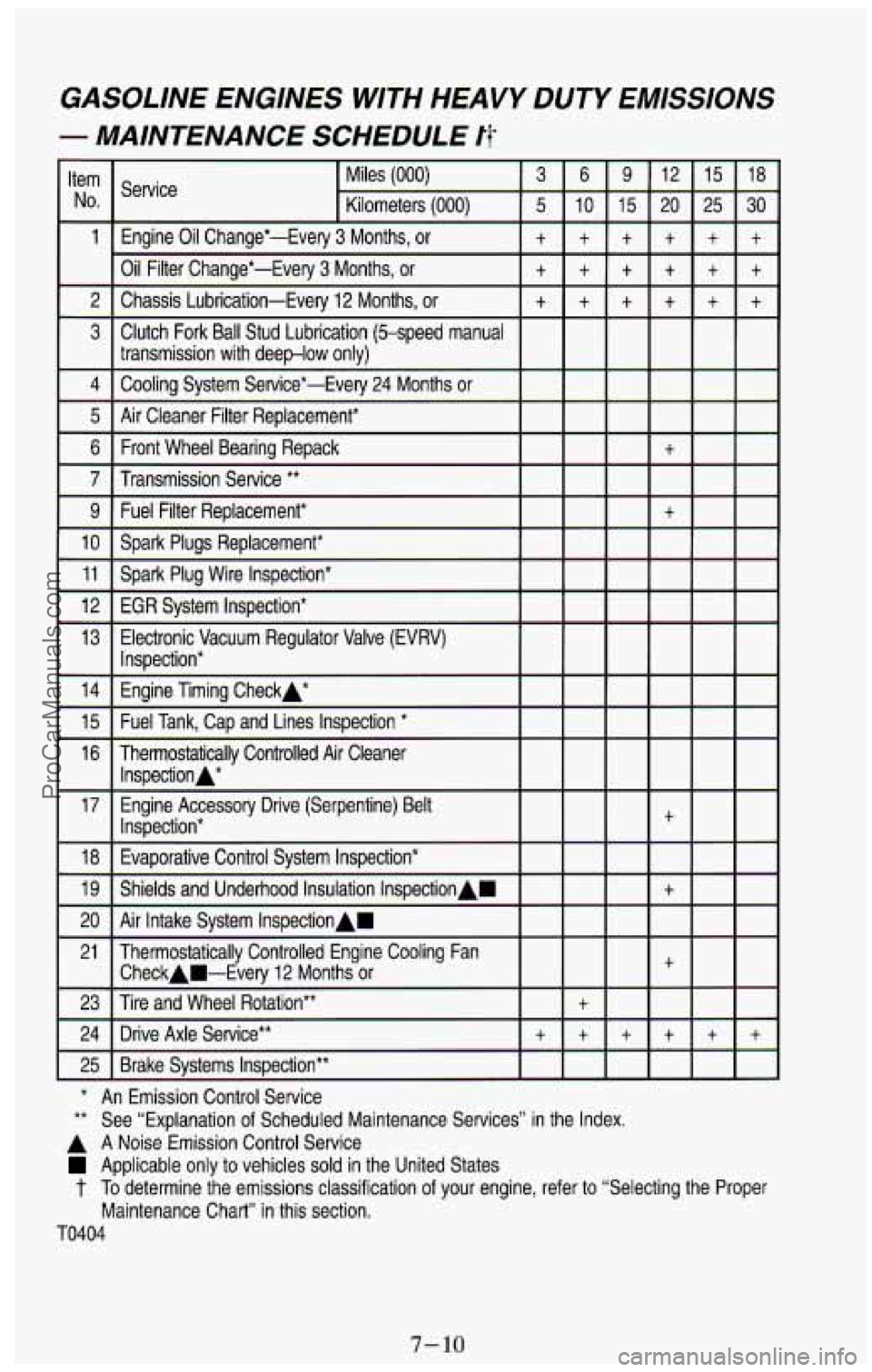
GASOLINE ENGINES WITH HEAVY DUTY EMISSIONS
- MAINTENANCE SCHEDULE yf
Item Miles (000) 3
No. Kilometers (000) 5 Service
I
1 Engine Oil Change*-Every 3 Months, or t
Oil Filter Change*-Every 3 Months, or t
12 Chassis Lubrication-Every 12 Months, or I+
II
3 Clutch Fork Ball Stud Lubrication (5-speed manual
transmission with deeplow only)
Cooling System Service*-Every 24 Months or
Air Cleaner Filter Replacement* Front Wheel Bearing Repack
Transmission Service
**
Fuel Filter Replacement*
10
11
12
13
14
15
16
17
18
I9
Spark Plugs Replacement*
Spark Plug Wire Inspection*
EGR System Inspection*
Electronic Vacuum Regulator Valve (EVRV)
Inspection*
Engine Timing Checkk
Fuel Tank, Cap and Lines Inspection
*
Thermostatically Controlled Air Cleaner
Inspectionk
Engine Accessory Drive (Serpentine) Belt
Inspection*
Evaporative Control System Inspection*
Shields and Underhood Insulation InspectionA.
20
21
-
23
24
-
Air Intake System InspectionA. I
Brake Systems Inspection** I
* An Emission Control Service
** See “Explanation of Scheduled Maintenance Services” in the Index.
A A Noise Emission Control Service
Applicable only to vehicles sold in the United States
t To determine the emissions classification of your engine, refer to “Selecting the Proper
Maintenance Chart” in this section.
TO404
7-10
ProCarManuals.com