stop start CHEVROLET SUBURBAN 1994 User Guide
[x] Cancel search | Manufacturer: CHEVROLET, Model Year: 1994, Model line: SUBURBAN, Model: CHEVROLET SUBURBAN 1994Pages: 385, PDF Size: 19.88 MB
Page 170 of 385
Skidding
In a skid, a driver can lose control of the vehicle. Defensive drivers avoid
most skids by taking reasonable care suited to existing conditions, and by
not “overdriving” those conditions. But skids are always possible.
The three types
of skids correspond to your vehicle’s three control systems.
In the braking skid your wheels aren’t rolling. In the steering or cornering
skid, too much speed or steering
in a curve causes tires to slip and lose
cornering force. And
in the acceleration skid too much throttle causes the
driving wheels to spin.
A cornering skid and an acceleration skid are best handled by easing your
foot off
the accelerator pedal.
If your vehicle starts to slide, ease your foot off the accelerator pedal and
quickly steer the way you want the vehicle to
go. If you start steering
quickly enough, your vehicle may straighten out. Always be ready for a
second skid if it occurs.
Of course, traction is reduced when water, snow, ice, gravel, or other material
is on the road. For safety, you’ll want to slow down and adjust your driving
to
these conditions. It is important to slow down on slippery surfaces because
stopping distance will be longer and vehicle control more limited.
While driving on a surface
with reduced traction, try your best to avoid
sudden steering, acceleration, or braking (including engine braking by
shifting to a lower gear).
Any sudden changes could cause the tires to slide.
You may not realize the surface is slippery
until your vehicle is skidding.
Learn to recognize warning clues
- such as enough water, ice or packed
snow on the road to make a “mirrored surface”
- and slow down when you
have
any doubt.
Remember: Any anti-lock braking
system (ABS) helps avoid only the
braking skid.
Driving Guidelines
This multipurpose passenger vehicle is defined as a utility vehicle in
Consumer Information Regulations issued by the National Highway Traffic
Safety Administration (NHTSA) of the United States Department of
Transportation. Utility vehicles have higher ground clearance and a narrower
track to make them capable
of performing in a wide variety of off-road
applications. Specific design characteristics give them
a higher center of
gravity than ordinary cars.
An advantage of the higher ground clearance is a
better view of the road allowing you to anticipate problems. They are not
designed for cornering at the same speeds as conventional 2-wheel drive
vehicles any more than low-slung
sports cars are designed to perform
satisfactorily under off-road conditions.
If at all possible, avoid sharp turns or
abrupt maneuvers. As
with other vehicles of this type, failure to operate this
vehicle correctly may result in loss of control or vehicle rollover.
4-11
ProCarManuals.com
Page 173 of 385
Controlling your vehicle is the key to successful off-road driving. One of
the best ways to control your vehicle is to control your speed. Here are some
things to keep in mind. At higher speeds:
you approach things faster and you have less time to scan the terrain for
you have less time to react.
obstacles.
0 you
have more vehicle bounce when you drive over obstacles.
0 you'll need more distance for braking, especially since you're on an
unpaved surface.
Scanning the Terrain
Off-road driving can take you over many different kinds of terrain. You
need
to be familiar with the terrain and its many different features. Here are
some things
to consider.
Surface Conditions. Off-roading can take you over hard-packed dirt,
gravel, rocks, grass, sand, mud,
snow or ice. Each of these surfaces affects
the steering, acceleration, and braking
of your vehicle in different ways.
Depending upon the kind of surface you are on, you may experience
slipping, sliding, wheel spinning, delayed acceleration, poor traction, and
longer braking distances.
Surface Obstacles. Unseen or hidden obstacles can be hazardous. A rock,
log, hole,
rut, or bump can startle you if you're not prepared for them. Often
these obstacles are hidden by grass, bushes, snow or even the rise and fall of
the terrain itself. Here are some things to consider:
Is the path ahead clear?
0 Will the surface texture change abruptly up ahead?
0 Does the travel take you uphill or downhill? (There's more discussion
Will you have to stop suddenly or change direction quickly?
of these subjects later.)
When you drive over obstacles
or rough terrain, keep a firm grip on the
steering wheel. Ruts, troughs, or other surface features can jerk the wheel
out of your hands
if you're not prepared.
4- 14
ProCarManuals.com
Page 176 of 385
0 Sound the horn as you approach the top of the hill to let opposing
Use your headlights even during the day. They make you more visible
traffic know you’re there.
to
oncoming traffic.
Q: What should I do if my vehicle stalls, or is about to stall, and I
can’t make it up the hill?
A: If this happens, there are some things you should do, and there are
some things you must not do. First, here’s what you
should do:
Push the brake pedal to stop the vehicle and keep it from rolling
backwards. Also, apply the parking brake.
If your engine is still running, shift the transmission into reverse,
release the parking brake, and slowly back down the hill in reverse.
If your engine has stopped running, you’ll need to restart it. With the
brake pedal depressed and the parking brake still applied, shift the
transmission to
“P” (Park) (or, shift to “N’ (Neutral) if your vehicle has
a manual transmission) and restart the engine. Then, shift to reverse,
release the parking brake, and slowly back down the
hill as straight as
possible in reverse.
wheel at the
12 o’clock position. This way, you’ll be able to tell if your
wheels are straight and maneuver as you back down. It’s best that you
back down the hill with your wheels straight rather than in the left or
right direction. Turning the wheel too far to the left or right will
increase the possibility of a rollover.
As you are backing down the hill, put your left hand on the steering
Here are some things you
must not do if you stall, or are about to stall,
when going
up a hill.
0 Never attempt to prevent a stall by shifting into “N” (Neutral) (or
depressing the clutch, if you have a manual transmission) to “rev-up”
the engine and regain forward momentum. This won’t work.
Your
4- 17
ProCarManuals.com
Page 178 of 385
If you decide you can go down a hill safely, then try to keep your vehicle
headed straight down, and use a low gear. This way, engine drag can help
your brakes and they won’t have to do all the work. Descend slowly,
keeping your vehicle under control at all times.
Q: Are there some things I should not do when driving down a hill?
A: Yes! These are important because if you ignore them you could lose
control and have a serious accident.
0 When driving downhill, avoid turns that take you across the incline of
the hill. A hill that’s not too steep to drive down may be too steep to
drive across. You could roll over if you don’t drive straight down.
0 Never go downhill with the transmission in “N’ (Neutral) , or with the
clutch pedal depressed in a manual shift
. This is called
“free-wheeling.” Your brakes will have to do all the work and could
overheat and fade.
Q: Am 1 likely to stall when going downhill?
A: It’s much more likely to happen going uphill. But if it happens going
downhill, here’s what to do.
Stop your vehicle by applying the regular brakes. Apply the parking
brake.
Shift to “P,’ (Park) (or to Neutral with the manual transmission) and,
while still braking, restart the engine.
Shift back to a low gear, release the parking brake, and drive straight
down.
If the engine won’t start, get out and get help.
4- 19
ProCarManuals.com
Page 181 of 385
Hard packed snow and ice offer the worst tire traction. On these surfaces,
it’s very easy to lose control.
On wet ice, for example, the traction is so poor
that you will have difficulty accelerating. And if you do get moving, poor
steering and difficult braking can cause
you to slide out of control.
Driving In Water
Light rain causes no special off-road driving problems. But heavy rain can
mean flash flooding, and flood waters demand extreme caution.
Find out how deep the water
is before you drive through it. If it’s deep
enough to cover your wheel hubs, axles,
or exhaust pipe, don’t try it - you
probably won’t get through. Also, water that deep
can damage your axle and
other vehicle parts.
If the water isn’t too deep, then drive through it slowly. At fast speeds, water
splashes on your ignition system and your vehicle can stall. Stalling
can also
occur if
you get your tailpipe under water. And, as long as your tailpipe is
under water, you’ll never be able to start your engine. When you go through
water, remember that when your brakes get wet, it may take
you longer to
stop.
If you have a diesel engine, see “Driving Through Water (Diesel Engines)”
in the Index for more information
on driving through water.
4-22
ProCarManuals.com
Page 187 of 385
Once you are moving on the freeway, make certain you allow a reasonable
following distance. Expect to move slightly slower
at night.
When you want to leave the freeway, move to the proper lane well
in
advance. If you miss your exit do not, under any circumstances, stop and
back up. Drive on to the next exit.
The exit ramp can be curved, sometimes quite sharply.
The exit speed is usually posted.
Reduce your speed according to your speedometer, not to your sense of
motion. After driving for
any distance at higher speeds, you may tend to
think you
are going slower than you actually are.
Before Leaving on a Long Trip
Make sure you’re ready. Try to be well rested. If you must start when you’re
not fresh
- such as after a day’s work - don’t plan to make too many
miles that first part of the journey. Wear comfortable clothing and shoes you
can easily drive
in.
Is your vehicle ready for a long trip? If you keep it serviced and maintained,
it’s ready
to go. If it needs service, have it done before starting out. Of
course, you’ll find experienced and able service experts in vehicle
dealerships all across North America. They’ll be ready and willing
to help if
you need
it.
Here are some things you can check before a trip:
0
0
0
0
0
0
Windshield Washer Fluid: Is the reservoir full? Are all windows clean
inside and outside?
Wiper Blades: Are they in good shape?
Fuel, Engine OiZ, Other Fluids: Have you checked all levels?
Lights: Are they all working? Are the lenses clean?
Tires: They are vitally important to a safe, trouble-free trip. Is the tread
good enough for long-distance driving? Are the tires all inflated to the
recommended pressure?
Weather Forecasts: What’s the weather outlook along your route?
Should you delay your trip a short time to avoid a major storm system?
Maps: Do you have up-to-date maps?
4-28
ProCarManuals.com
Page 201 of 385
Making Turns
When you’re turning with a trailer, make wider turns than normal. Do this
so your trailer won’t strike soft shoulders, curbs, road signs, trees, or other
objects. Avoid jerky or sudden maneuvers. Signal well
in advance.
Turn Signals When Towing a Trailer
When you tow a trailer, your vehicle has to have a different turn signal
flasher and extra wiring, The green arrows on your instrument panel will
flash whenever you signal a turn or lane change. Properly hooked up, the
trailer lights will also flash, telling other drivers you’re about to turn,
change lanes or stop.
When towing a trailer,
the green arrows on your instrument panel will flash
for turns even if the bulbs on the trailer are burned out. Thus, you may think
drivers behind you are seeing your signal when they are not. It’s important
to check occasionally
to be sure the trailer bulbs are still working.
Driving On Grades
Reduce speed and shift to a lower gear before you start down a long or
steep downgrade. If
you don’t shift down, you might have to use your
brakes
so much that they would get hot and no longer work well.
On
a long uphill grade, shift down and reduce your speed to around 45 mph
(70 kdh) to reduce the possibility of engine and transmission overheating.
If you have an automatic transmission, you should use “D” (or, as you need
to, a lower gear) when towing
a trailer. Operating your vehicle in “D” when
towing a trailer will minimize heat buildup and extend
the life of your
transmission.
If
you have a manual transmission and you are towing a trailer, it’s better
not
to use fifth gear. Just drive in fourth gear (or, as you need to, a lower
gear).
Parking on Hills
You really should not park your vehicle, with a trailer attached, on a hill. If
something goes wrong, your rig could start to move. People can be injured,
and both your vehicle and the trailer can be damaged.
But
if you ever have to park your rig on a hill, here’s how to do it:
1. Apply your regular brakes, but don’t shift into “P’ (Park) yet, or in gear
for a manual transmission.
2. Have someone place chocks under the trailer wheels.
3. When the wheel chocks are in place, release the regular brakes until the
chocks absorb
the load.
4-42
ProCarManuals.com
Page 202 of 385
4. Re-apply the regular brakes. Then apply your parking brake, and then
shift to
“P” (Park), or “R’ (Reverse) for a manual transmission.
5. If you have a four-wheel-drive vehicle, be sure the transfer case is in a
6. Release the regular brakes. drive
gear-not in “N” (Neutral).
When You Are Ready to Leave After Parking on a Hill
1. Apply your regular brakes and hold the pedal down while you:
Start your engine;
Shift into a gear; and
Release the parking brake.
2. Let up on the brake pedal.
3. Drive slowly until the trailer is clear of the chocks.
4. Stop and have someone pick up and store the chocks.
4-43
ProCarManuals.com
Page 227 of 385
Engine Fan Noise
Your vehicle has a clutched engine cooling fan. When the clutch is engaged,
the fan spins faster to provide more air to cool
the engine. In most every day
driving conditions the fan
is spinning slower and clutch is not fully engaged.
This improves
fuel economy and reduces fan noise. Under heavy vehicle
loading, trailer towing and/or high outside temperatures, the fan speed
increases as the clutch more fully engages.
So you may hear an increase in
fan noise. This is normal and should not be mistaken as the transmission
slipping or making extra shifts.
It is merely the cooling system functioning
properly. The
fan will slow down when additional cooling is not required
and the clutch partially disengages.
You may also hear this fan noise when you start the engine. It will go away
as the fan clutch partially disengages.
If a Tire Goes Flat
It’s unusual for a tire to “blow out” while you’re driving, especially if you
maintain your tires properly. If air goes out of a tire, it’s much more likely to
leak out slowly. But if you should ever have
a “blowout,” here are a few tips
about what to expect and what
to do:
If a front tire fails, the flat tire will create a drag that pulls the vehicle
toward that side. Take your foot off the accelerator pedal and grip the
steering wheel firmly. Steer to maintain lane position, then gently brake to a
stop well out of the traffic lane.
A rear blowout, particularly on a curve, acts much like a skid and may
require the same correction you’d use in a skid. In any rear blowout, remove
your foot from the accelerator pedal. Get the vehicle under control
by
steering the way you want the vehicle to go. It may be very bumpy and
noisy, but you can still steer. Gently brake to a stop, well off the road if
possible.
If a
tire goes flat, the next section shows how to use your jacking equipment
to change a flat tire safely.
5-24
ProCarManuals.com
Page 253 of 385
To drain water:
1. Stop and park the vehicle in a safe place. Turn off the engine and apply
2. Remove the fuel tank cap.
the parking brake.
3. Place a
fuel-resistant container under the filter
drain hose.
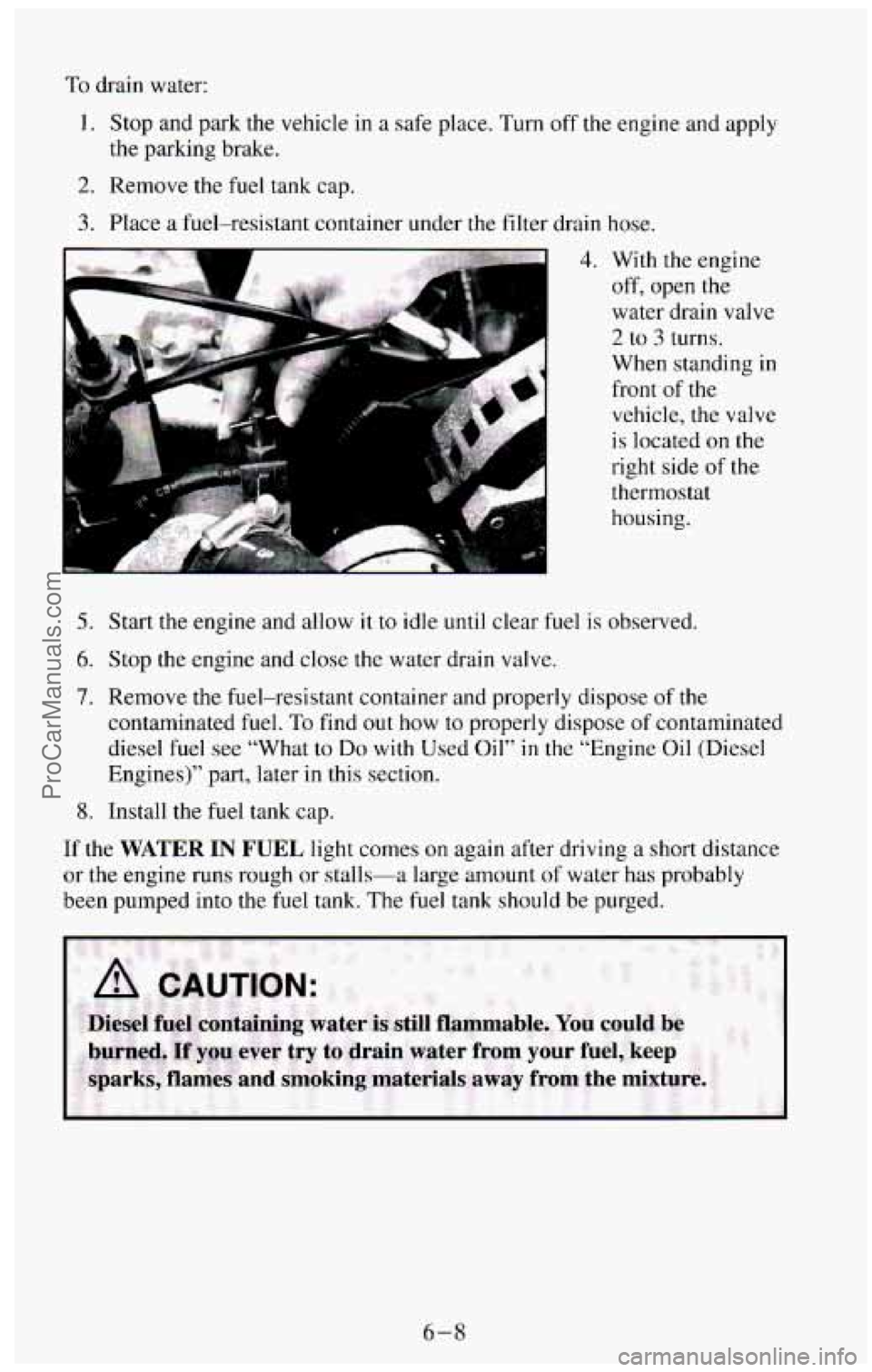
4. With the engine
off, open the
water drain valve
2 to 3 turns.
When standing in
front of the
vehicle,
the valve
is located
on the
right side
of the
thermostat housing.
5. Start the engine and allow it to idle until clear fuel is observed.
6. Stop the engine and close the water drain valve.
7. Remove the fuel-resistant container and properly dispose of the
contaminated fuel. To find out how
to properly dispose of contaminated
diesel
fuel see “What to Do with Used Oil” in the “Engine Oil (Diesel
Engines)” part, later in
this section.
8. Install the fuel tank cap.
If the
WATER IN FUEL light comes on again after driving a short distance
or the engine
runs rough or stalls-a large amount of water has probably
been pumped into the fuel tank. The fuel tank should be purged.
6-8
ProCarManuals.com