Door CHEVROLET SUBURBAN 1994 Owner's Guide
[x] Cancel search | Manufacturer: CHEVROLET, Model Year: 1994, Model line: SUBURBAN, Model: CHEVROLET SUBURBAN 1994Pages: 385, PDF Size: 19.88 MB
Page 198 of 385
After you’ve loaded your trailer, weigh the trailer and then the tongue,
separately, to
see if the weights are proper. If they aren’t, you may be able to
get them right simply by moving some items around in the trailer.
Total Weight on Your Vehicle’s Tires
Be sure your vehicle’s tires are inflated to the limit for cold tires. You’ll find
these numbers
on the Certification label at the rear edge of the driver’s door
or see “Tire Loading” in the Index. Then be sure you don’t go over the
GVW limit for your vehicle.
Hitches
It’s important to have the correct hitch equipment. Crosswinds, large trucKs
going by, and rough roads are a few reasons why you’ll need the right hitch.
Here are some rules
to follow:
If you use a step bumper hitch, and your trailer tongue has a V-shaped
foot, your bumper could be damaged
in sharp turns. Check the distance
from the front edge of
the foot to the middle of the hitch ball socket. If
the distance is less than 12 inches, take the foot off the trailer tongue.
If you’ll be pulling a trailer with a utility model that, when loaded, will
weigh more than
3,000 pounds (1 361 kg); or with a wagon model that,
when loaded, will weigh more than
4000 pounds (1 800 kg), be sure to
use
a properly mounted, weight-distributing hitch and sway control of
the proper size. This equipment is very important for proper vehicle
loading and good handling when you’re driving.
0 Will you have to make any holes in the body of your vehicle when you
install a trailer hitch? If
you do, then be sure to seal the holes later
when
you remove the hitch. If you don’t seal them, deadly carbon
monoxide
(CO) from your exhaust can get into your vehicle (see
“Carbon Monoxide”
in the Index). Dirt and water can, too.
Safety Chains
You should always attach chains between your vehicle and your trailer.
Cross the safety chains under
the tongue of the trailer so that the tongue will
not drop to the road if it becomes separated from the hitch. Instructions
about safety chains may be provided by
the hitch manufacturer or by the
trailer manufacturer. Follow the manufacturer’s recommendation for
attaching safety chains. Always leave
just enough slack so you can turn with
your rig. And, never allow safety chains to drag on the ground.
4-39
ProCarManuals.com
Page 257 of 385
Fuels in Foreign Countries
If you plan on driving in another country outside the U.S. or Canada,
unleaded fuel may be hard to find.
Do not use leaded gasoline. If you use
even one tankful, your emission controls won’t work well or at all. With
continuous use, spark plugs can get fouled, the exhaust system can corrode,
and your engine oil can deteriorate
quickly. Your vehicle’s oxygen sensor
will be damaged. All of that means costly repairs that wouldn’t be covered
by your warranty.
To check on fuel availability, ask an auto club, or contact a major oil
company that does business
in the country where you’ll be driving.
You
can also write us at the following address for advice. Just tell us where
you’re going and give
your Vehicle Identification Number (VIN).
General Motors Overseas Distribution Corporation,
North American Export Sales
(NAES)
1908 Colonel Sam Drive
Oshawa, Ontario
LlH 8P7
Filling Your Tank
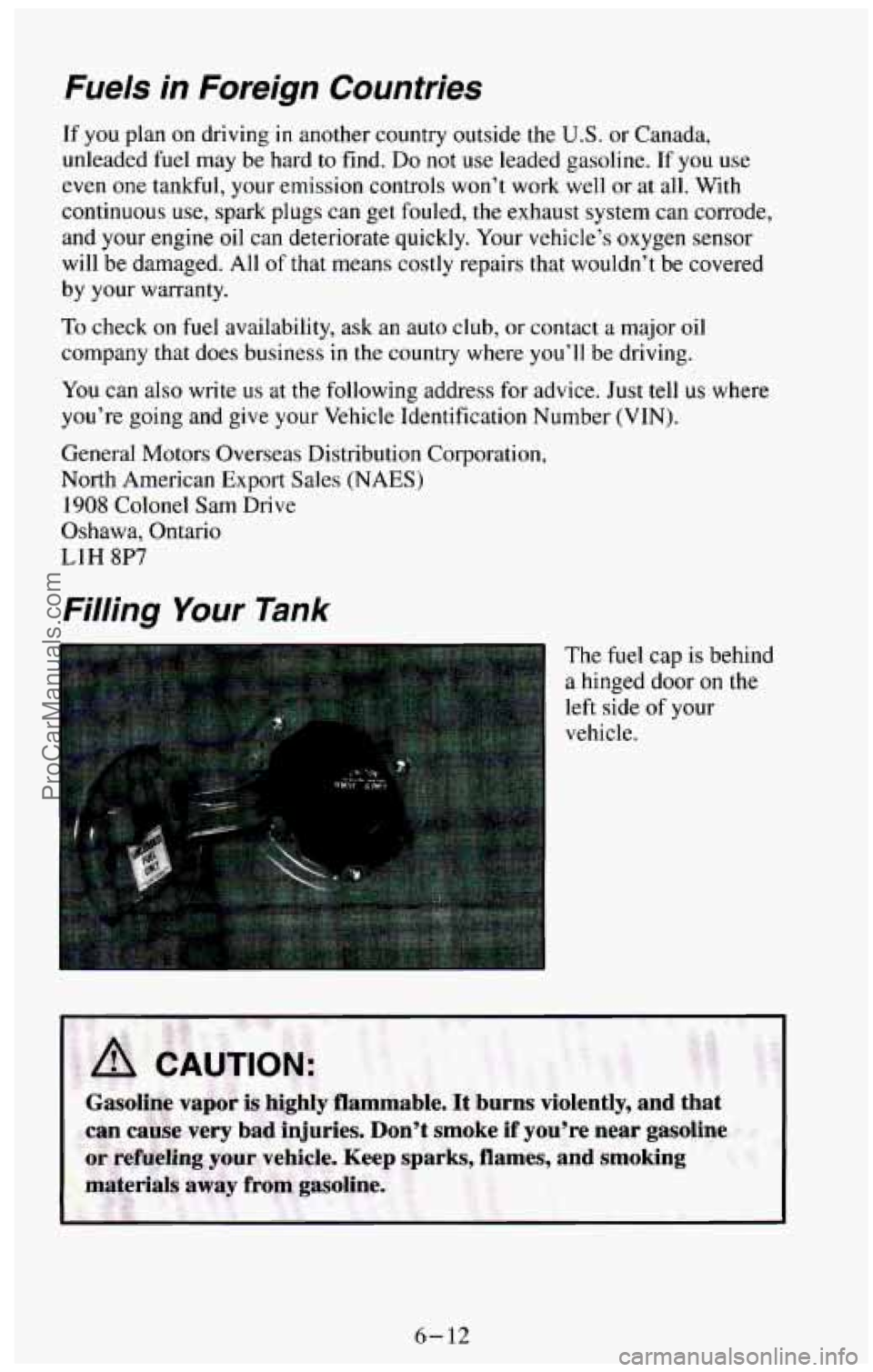
The fuel cap is behind
a hinged door on the
left side of your
vehicle.
6-12
ProCarManuals.com
Page 258 of 385
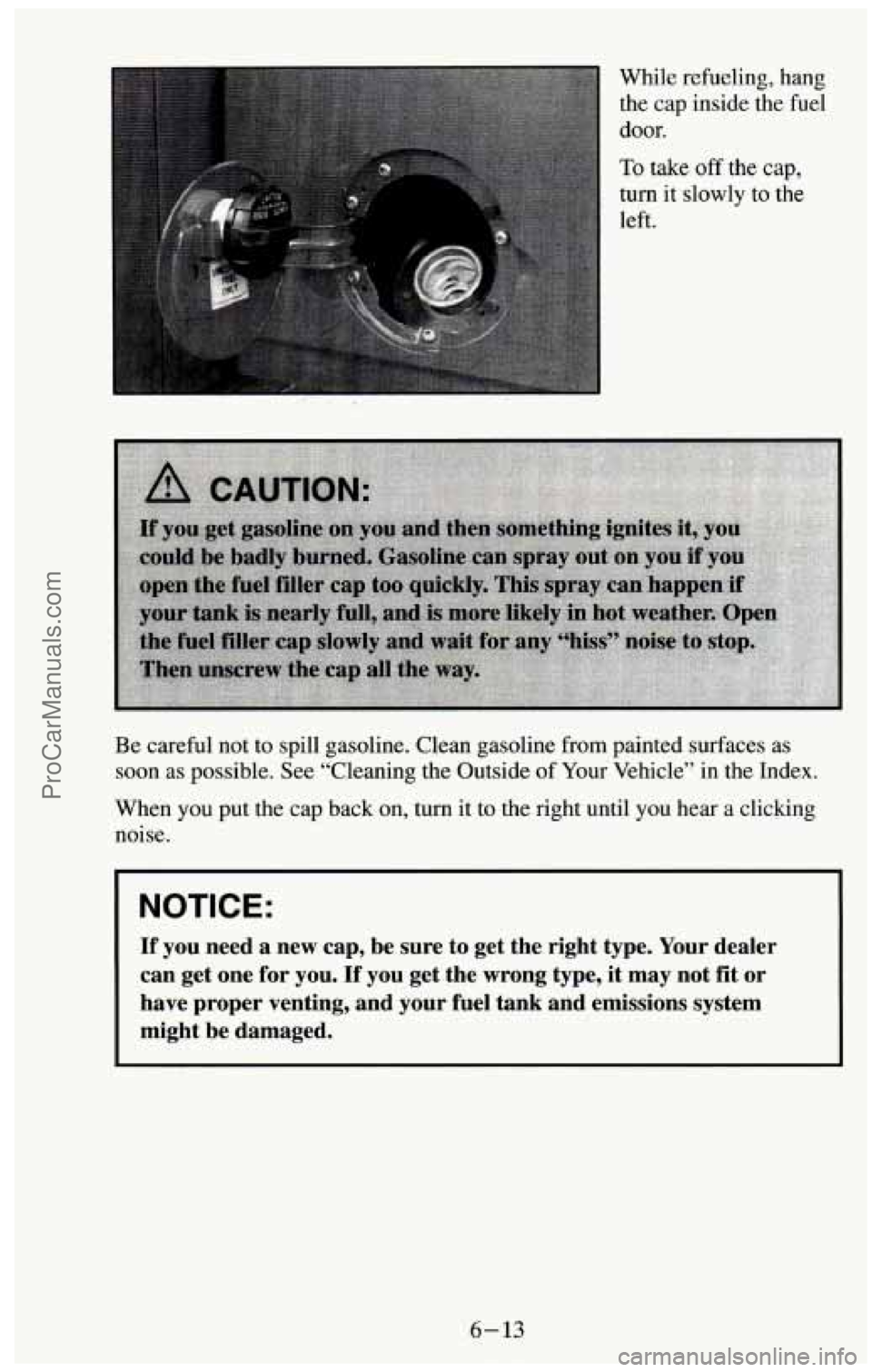
While refueling, hang
the cap inside the fuel
door.
To take off the cap,
turn it slowly to the
left.
,
Be careful not to spill gasoline. Clean gasoline from painted surfaces as
soon as possible. See “Cleaning the Outside of Your Vehicle” in the Index.
When you put the cap back on, turn it to the right until you hear
a clicking
noise.
I NOTICE:
If you need a new cap, be sure to get the right type. Your \
dealer
can get one for you.
If’ you get the wrong type, it may not fit or
have proper venting, and your fuel tank and emissions system
might be damaged.
6-13
ProCarManuals.com
Page 266 of 385
Engine Oil Additives
Don’t add anything to your oil. Your GM dealer is ready to advise if you
think something should be added.
When to Change Engine Oil
See if any one of these is true for you:
Most trips are less than 4 miles (6 km).
0 It’s below freezing outside and most trips are less than 10 miles (16 km).
The engine is at low speed most of the time (as in door-to-door
You tow a trailer often.
delivery,
or in stop-and-go traffic).
Most trips are through dusty places.
The vehicle is frequently operated off-road.
If any one
of these is true for your vehicle, then you need to change your oil
andfifilter every 3,000 miles (5 000 km) or 3 months - whichever comes
first
.
Light Duty Emissions:
If none of them is true, change the oil every 7,500 miles (12 500 km) or
12 months - whichever comes first. Change the filter at the first oil change
and at every other oil change after that.
Heavy Duty Emissions:
If none of them is true, change the oil every 6,000 miles ( 10 000 km) or
12 months - whichever comes first. Change the filter at the first oil change
and at every other oil change after that if mileage determines when you
change your oil.
If time determines when you change your oil, change the
filter each time you change your
oil.
Engine Coolant Heater (Engine Block Heater)
An engine coolant heater can be a big help if you have to park outside in
very cold weather,
0°F (-1 8 “C) or colder. If your vehicle has this option,
see “Engine Coolant Heater
” in the Index.
What to Do with Used Oil
Did you know that used engine oil contains certain elements that may be
unhealthy for your skin and could even cause cancer? Don’t let used oil stay
on your skin for very long. Clean your skin and nails with soap and water,
or
a good hand cleaner. Wash or properly throw away clothing or rags
containing
used engine oil. (See the manufacturer’s warnings about the use
and disposal of oil products.)
6-21
ProCarManuals.com
Page 271 of 385
This doughnut-shaped logo (symbol) is used on most oil containers to help
you select the correct oil.
You should look for this on the oil container, and use only those oils that
display the logo.
GM Goodwrench@ oil (in Canada, GM Engine Oil) meets all the
requirements for your vehicle.
Engine Oil Additives
Don’t add anything to your oil. Your GM dealer is ready to advise if you
think something should be added.
When to Change Engine Oil
See if any one of these is true for you:
Most trips are less than 4 miles (6 km).
0 It’s below freezing outside and most trips are less than 10 miles
0 The engine is at low speed most of the time (as in door-to-door
(16 km).
delivery,
or in stop-and-go traffic).
You tow a trailer often.
0 Most trips are through dusty places.
The vehicle is frequently operated off-road.
If any
of these is true for your vehicle, then you need to change your oil and
filter
every 2,500 miles (4 000 km) or 3 months - whichever comes first.
If none of them is true, change the oil and filter every 5,000 miles
(8 000 km) or 12 months - whichever comes first.
What to Do with Used Oil
Did you know that used engine oil contains certain elements that may be
unhealthy for your skin and could even cause cancer? Don’t let used oil stay
on your
skin for very long. Clean your skin and nails with soap and water,
or
a good hand cleaner. Wash or properly throw away clothing or rags
containing used engine
oil. (See the manufacturer’s warnings about the use
and disposal
of oil products.)
Used oil can be a real threat to the environment.
If you change your own oil.
be sure to drain all free-flowing oil from the filter before disposal. Don’t
ever dispose of oil by putting
it in the trash, pouring it on the ground, into
sewers, or into streams
or bodies of water. Instead, recycle it by taking it to
a place that collects used oil. If you have a problem properly disposing of
your used oil,
ask your dealer, a service station or a local recycling center
for help.
6-26
ProCarManuals.com
Page 293 of 385
Fluid Leak Check
After the vehicle has been parked for a while, inspect the surface under the
vehicle for water, oil, fuel or other fluids. Water dripping from the air
conditioning system after it has been used is normal. If you notice fuel leaks
or fumes, the causes should be found and corrected at once.
Lubrication
Accelerator Control System
Your maintenance schedule will tell you how often the accelerator linkage
pivot points must be lubricated. See “Recommended Fluids and Lubricants”
in
the Index for the proper lubricant to use.
Accelerator cables and cruise control cables should not be lubricated. Any
cables that are worn or
are hard to pull should be replaced.
Hood Latches and Hood Hinge
Your maintenance schedule will tell you how often to lubricate the hood
latch and hood hinge assembly. See the Index under “Recommended Fluids
and Lubricants” for the proper lubricant to use.
Propeller Shaft Slip Splines
See your maintenance schedule to find out how often the slip splines must
be lubricated. See “Recommended Fluids and Lubricants” in the Index for
the proper lubricant to use.
Constant Velocity Joints
See your maintenance schedule to find out how often the constant velocity
joints must be lubricated. See “Recommended Fluids and Lubricants” in the
Index for the proper lubricant to use.
Normal
use of your vehicle will cause metal to metal wear at some points on
the cab and body if they are not lubricated.
For exposed surfaces, such
as door checks, door lock bolts, lock striker plates,
dovetail bumper wedges, etc., a thin
film of engine oil should be applied.
The seat adjusters and seat track should be lubricated
with chassis grease.
Door weather strips and rubber hood bumpers should be lightly coated with
a rubber lubricant.
Never use too much of any lubricant and be sure to wipe up any extra
lubricant when you are finished.
6-48
ProCarManuals.com
Page 300 of 385
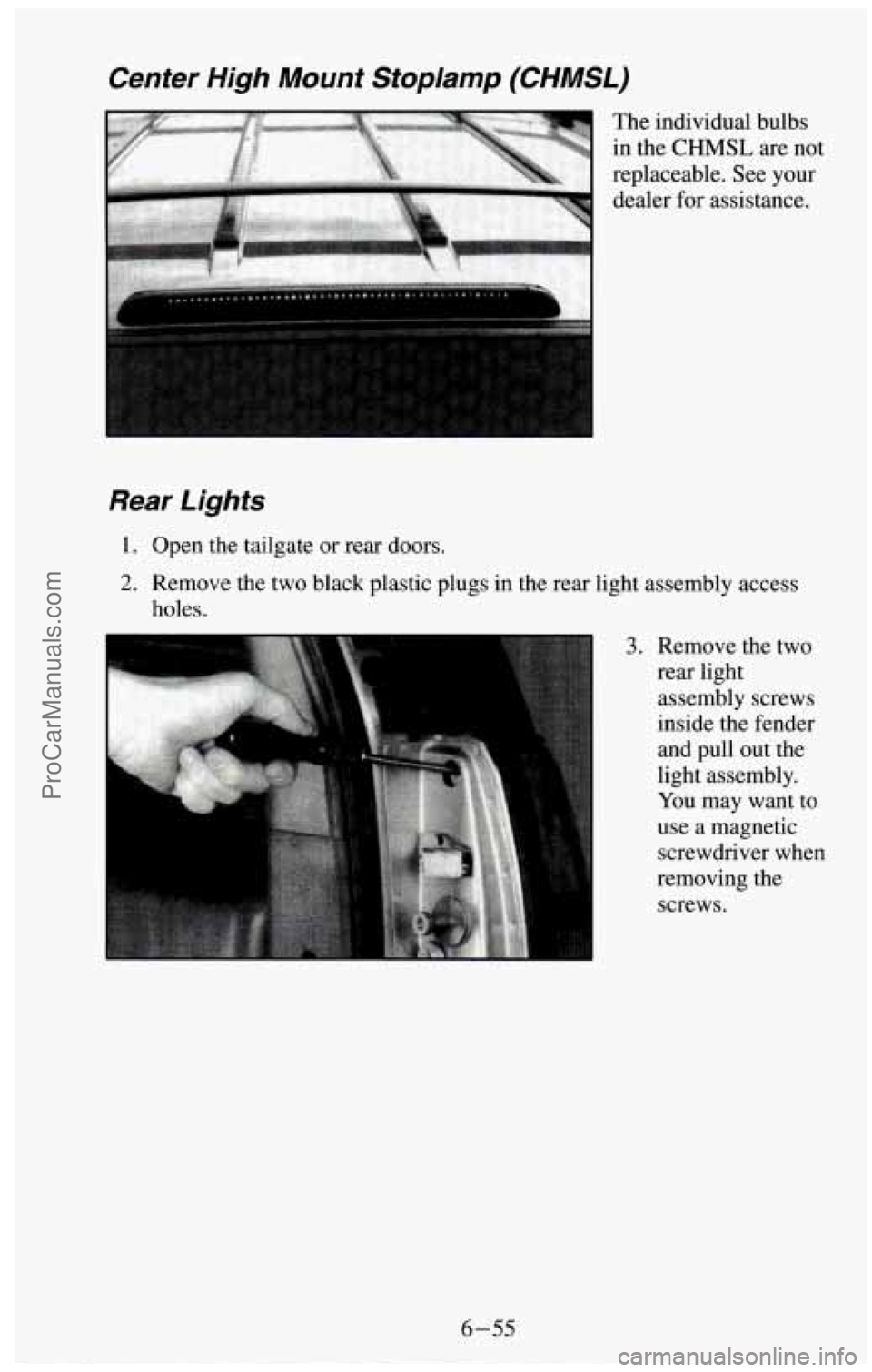
Center High Mount Stop/amp (CHMSL)
“,Gar-& ... “B 3 The individual bulbs
in the
CHMSL are not
replaceable. See your
dealer for assistance.
Rear Lights
1. Open the tailgate or rear doors.
2. Remove the two black plastic plugs in the rear light
holes.
I 3.
assembly access
Remove the two
rear light
assembly screws
inside the fender
and pull out the
light assembly. You may want to
use a magnetic
screwdriver when
removing the
screws.
6-55
ProCarManuals.com
Page 301 of 385
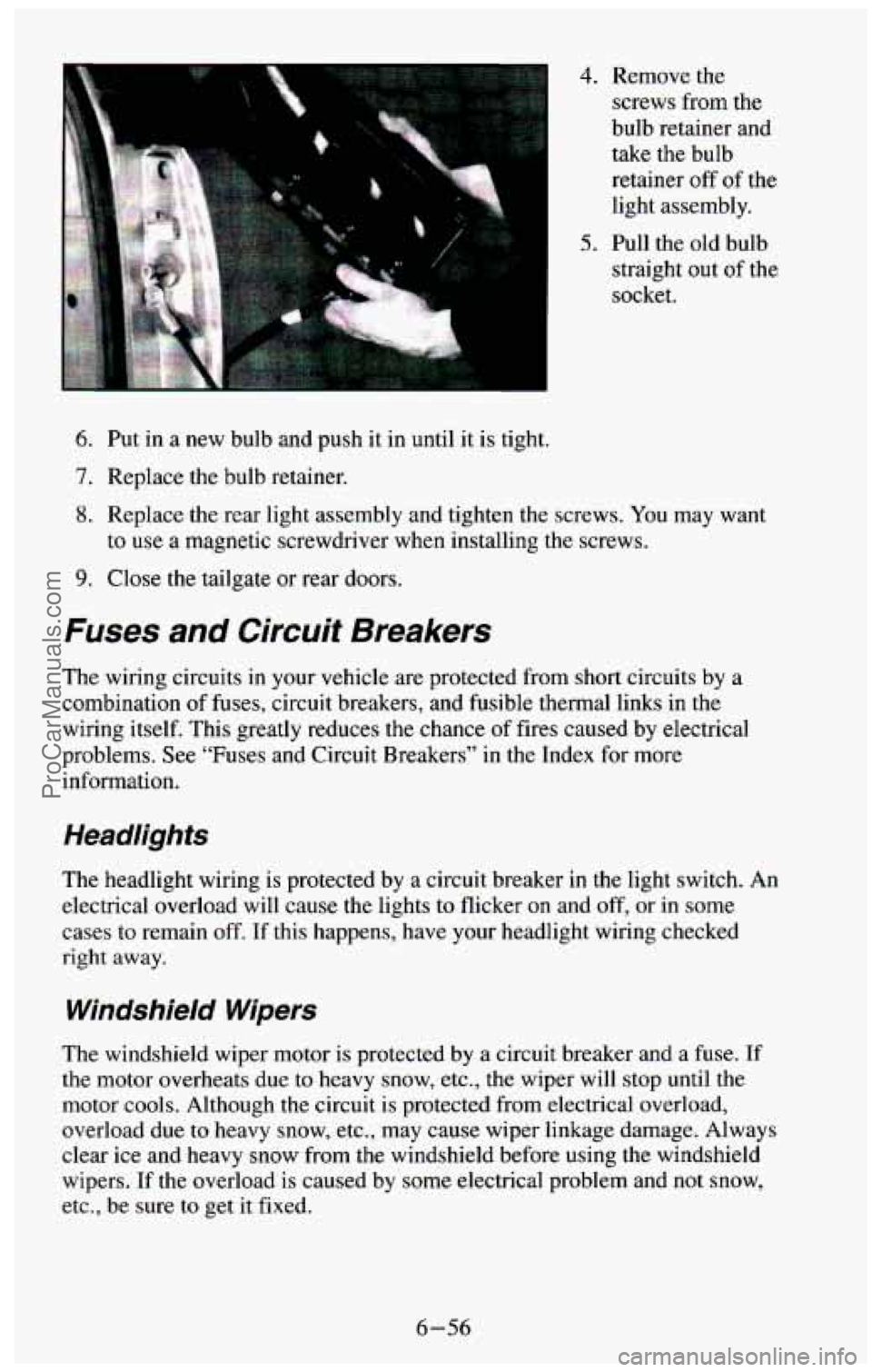
4. Remove the
screws from the
bulb retainer and
take the bulb
retainer
off of the
light assembly.
5. Pull the old bulb
straight out
of the
socket.
6. Put in a new bulb and push it in until it is tight.
7. Replace the bulb retainer.
8. Replace the rear light assembly and tighten the screws. You may want
to use
a magnetic screwdriver when installing the screws.
9. Close the tailgate or rear doors.
Fuses and Circuit Breakers
The wiring circuits in your vehicle are protected from short circuits by a
combination
of fuses, circuit breakers, and fusible thermal links in the
wiring itself. This greatly reduces the chance of fires caused by electrical
problems. See “Fuses and Circuit Breakers” in the Index for more
information.
The headlight wiring is protected by
a circuit breaker in the light switch. An
electrical overload
will cause the lights to flicker on and off, or in some
cases to remain off.
If this happens, have your headlight wiring checked
right away.
Windshield Wipers
The windshield wiper motor is protected by a circuit breaker and a fuse. If
the motor overheats due to heavy snow, etc., the wiper will stop until the
motor cools. Although
the circuit is protected from electrical overload,
overload due to heavy snow, etc., may cause wiper linkage damage. Always
clear ice and heavy snow from the windshield before using the windshield
wipers.
If the overload is caused by some electrical problem and not snow,
etc., be sure to get it fixed.
6-56
ProCarManuals.com
Page 302 of 385
Power Windows and Other Power Options
Circuit breakers in the fuse panel protect the power windows and other
power accessories. When the current load is too heavy, the circuit breaker
opens and closes. This protects the circuit until the current load returns to
normal or the problem is fixed
.
Trailer Wiring Harness
The optional seven-wire trailer wiring harness is protected by an in-line
fuse in the battery feed wire. This fuse is near the junction block. See
“Trailer Wiring Harness” in the Index for more information.
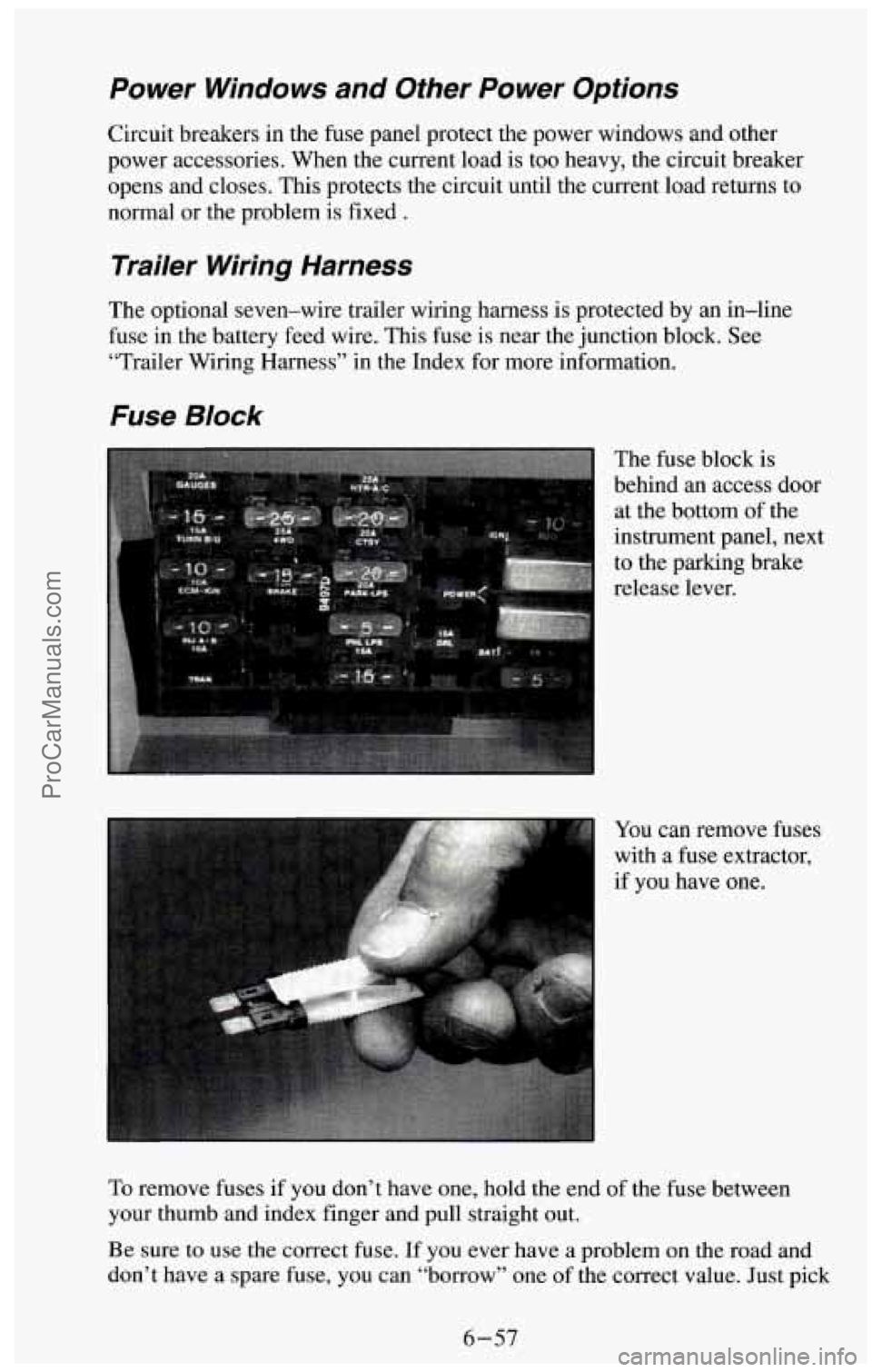
Fuse Block
The fuse block is
behind an access door
at the bottom
of the
instrument panel, next
to the parking brake
release lever.
You can remove fuses
with a fuse extractor,
if you have one.
To remove fuses if you don’t have one, hold the end of the fuse between
your thumb and index finger and pull straight out.
Be sure to use the correct fuse. If
you ever have a problem on the road and
don’t have a spare fuse, you can “borrow” one of the correct value. Just pick
6-57
ProCarManuals.com
Page 304 of 385
Malfunction Indicator
(SERVICE ENGINE SOON) Lamp
The Malfunction Indicator (SERVICE ENGINE SOON) Lamp on your
instrument panel lets you know when your emission system needs service.
The light
will come on briefly when you start your engine to let you know
that the system is working.
If it does not come on when you start your
engine,
or if it comes on and stays on while you're driving, your system
may need service. Your vehicle should still be driveable, but
you should
have your system serviced right away.
Secondary Air Injection Reaction (AIR) System
You may have this system. It has a control valve that will direct air to where
it is needed. If the AIR system needs service, your Malfunction Indicator
(SERVICE ENGINE SOON) Lamp on your instrument panel will come
on.
Loading Your Vehicle
MFD BY GENERAL MOT0 RSCORP
i IN EFFECT -
I
- MODEL [ISPEED w
u TIRE SIZE RTG FilM PSllKPA (COLD)
q----p nri
SEE OWNERS MANUAL FOR ADDITIONAL INFORMATION
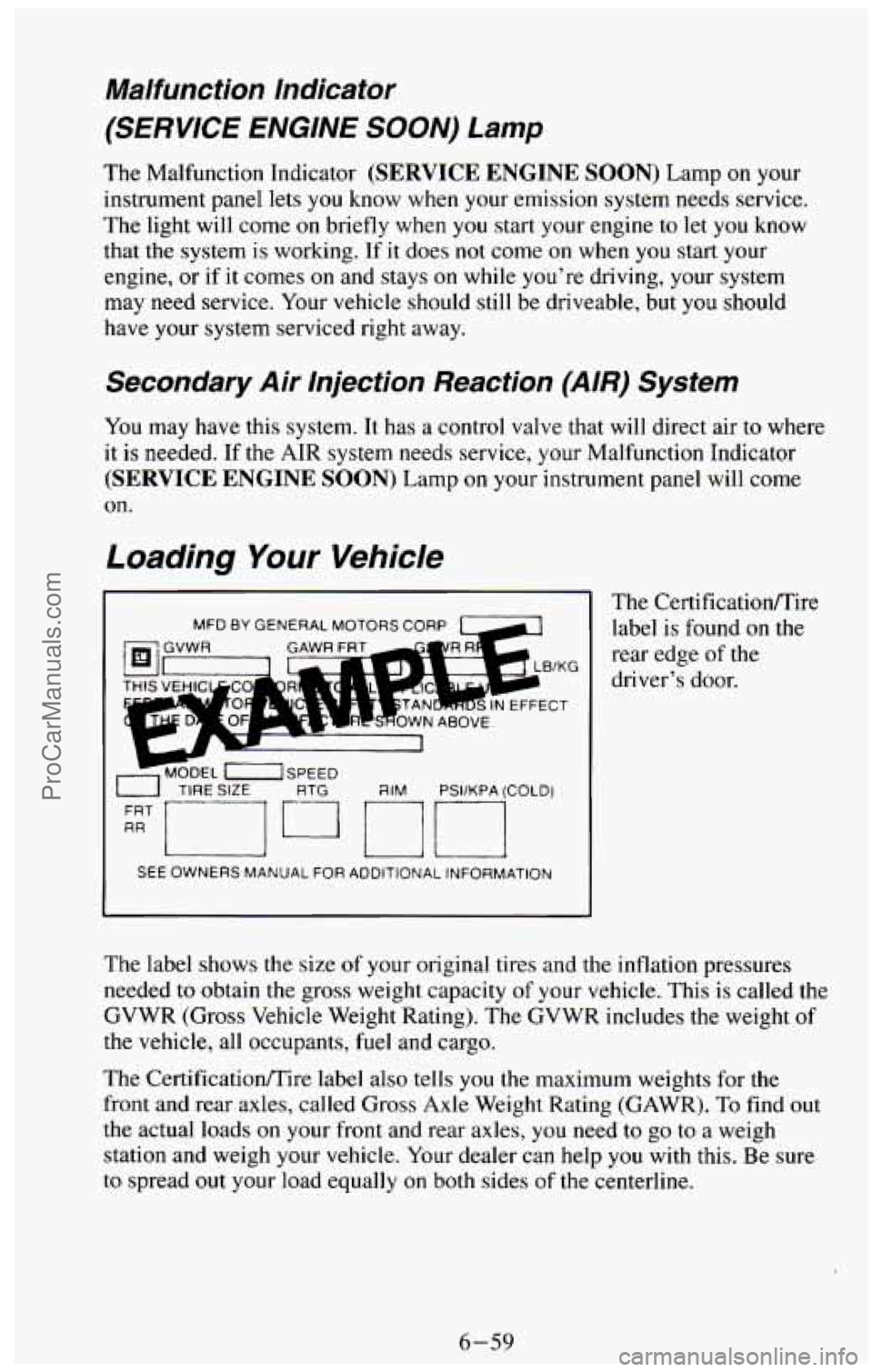
The CertificatiodTire
label is found
on the
rear edge
of the
driver's door.
The label shows the size
of your original tires and the inflation pressures
needed to obtain the gross weight capacity
of your vehicle. This is called the.
GVWR (Gross Vehicle Weight Rating). The GVWR includes the weight
of
the vehicle, all occupants, fuel and cargo.
The Certificatioflire label also tells you the maximum weights for the
front and rear axles, called Gross Axle Weight Rating (GAWR).
To find out
the actual loads on your front and rear axles,
you need to go to a weigh
station and weigh your vehicle. Your dealer can help you with this.
Be sure
to spread out your load equally on both sides of the centerline.
6-59
ProCarManuals.com