Door CHEVROLET SUBURBAN 1994 Service Manual
[x] Cancel search | Manufacturer: CHEVROLET, Model Year: 1994, Model line: SUBURBAN, Model: CHEVROLET SUBURBAN 1994Pages: 385, PDF Size: 19.88 MB
Page 307 of 385
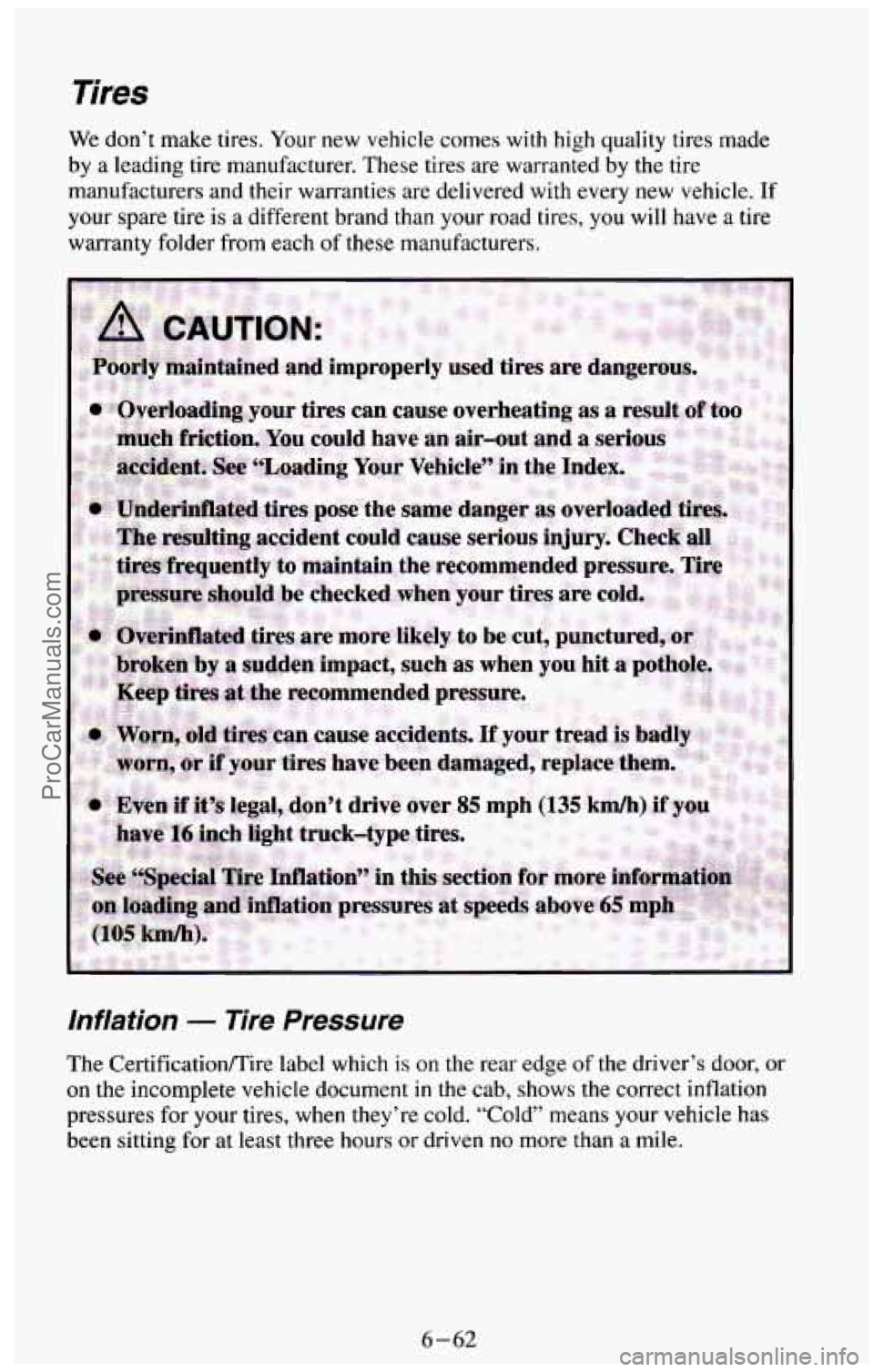
Tires
We don’t make tires. Your new vehicle comes with high quality tires made
by a leading tire manufacturer. These tires are warranted by the tire
manufacturers and their warranties are delivered with every
new vehicle. If
your spare tire is a different brand than your road tires, you will have a tire
warranty folder from each of
these manufacturers.
Inflation - Tire Pressure
The Certification/Tire label which is on the rear edge of the driver’s door, or
on the incomplete vehicle document in the cab, shows the correct inflation
pressures for your tires, when they’re cold.
“Cold” means your vehicle has
been sitting for at least three hours or driven no more than
a mile.
6-62
ProCarManuals.com
Page 308 of 385
You can operate some vehicles at reduced inflation pressures only when
you’ll be carrying reduced loads. On those vehicles, the minimum cold
inflation pressures for a typical reduced load are printed on the “Improved
Ride Tire Pressure” label located on the driver’s door. Weigh the vehicle to
find the load on each tire and see the label for the minimum cold inflation
pressures for that load.
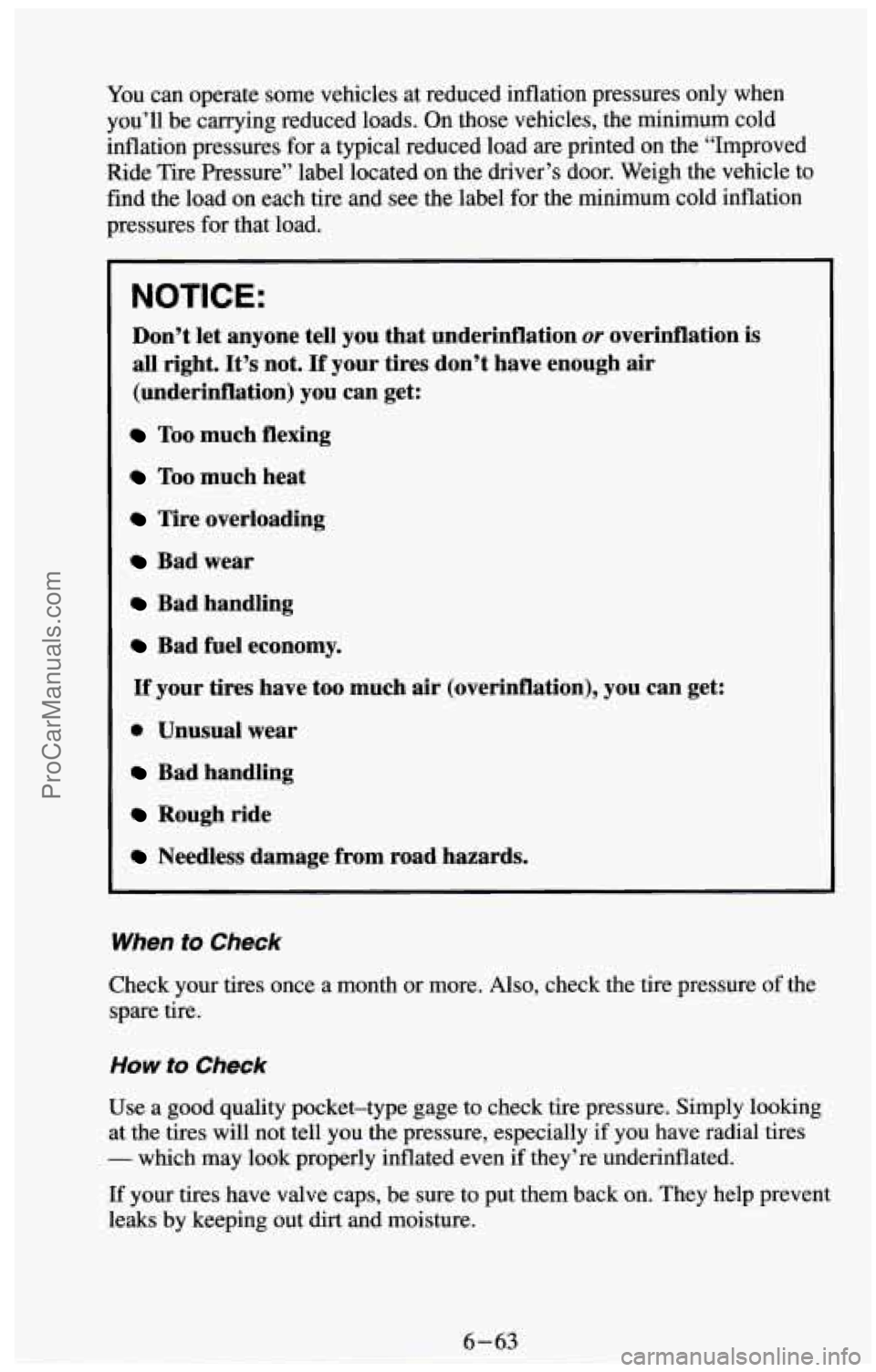
Don’t let anyone tell you that underinflation or overinflation is
all right.
It’s not. If your tires don’t have enough air
(underinflation) you can get:
Too much flexing
Too much heat
Tire overloading
Bad wear
Bad handling
Bad fuel economy.
If your tires have too much air (overinflation), you can get:
0 Unusual wear
Bad handling
Rough ride
Needless damage from road hazards.
When to Check
Check your tires once a month or more. Also, check the tire pressure of the
spare tire.
How to Check
Use a good quality pocket-type gage to check tire pressure. Simply looking
at the tires will not tell you the pressure, especially
if you have radial tires
- which may look properly inflated even if they’re underinflated.
If your tires have valve caps, be sure to put them back on. They help prevent
leaks by keeping out dirt and moisture.
ProCarManuals.com
Page 312 of 385
Traction - A, B, C
The traction grades, from highest to lowest are: A, B, and C. They represent
the tire’s ability to stop on wet pavement
as measured under controlled
conditions on specified government test surfaces
of asphalt and concrete. A
tire marked C may have poor traction performance.
Warning: The traction grade assigned to this tire is based on braking
(straight-ahead) traction tests and does not include cornering (turning)
traction.
Temperature - A, By C
The temperature grades are A (the highest), B, and C, representing the tire’s
resistance
to the generation of heat and its ability to dissipate heat when tested
under controlled conditions
on a specified indoor laboratory test wheel.
Sustained high temperature can cause the material of the tire to degenerate
and reduce tire life, and excessive temperature can lead to sudden tire failure.
The grade
C corresponds to a level of performance which all passenger car
tires
must meet under the Federal Motor Vehicle Safety Standard No. 109.
Grades B and A represent higher levels of performance on the laboratory test
wheel
than the minimum required by law.
Warning: The temperature grade for this tire is established for a tire that is
properly inflated and not overloaded. Excessive speed, underinflation, or
excessive loading, either separately or in combination, can cause heat
buildup and possible tire failure.
These grades are molded on the sidewalls of passenger car tires.
While the tires available as standard or optional equipment on General
Motors vehicles may vary with respect to these grades, all such tires meet
General Motors performance standards and have been approved for use on
General Motors vehicles. All passenger type
(P Metric) tires must conform
to Federal safety requirements in addition to these grades.
Wheel Alignment and Tire Balance
The wheels on your vehicle were aligned and balanced carefully at the
factory to give you the longest tire life and best overall performance.
In most cases, you will not need to have your wheels aligned again.
However,
if you notice unusual tire wear or your vehicle pulling one way or
the other, the alignment may need to be reset. If you notice your vehicle
vibrating when driving on
a smooth road, your wheels may need to be
rebalanced.
6-67 ProCarManuals.com
Page 314 of 385
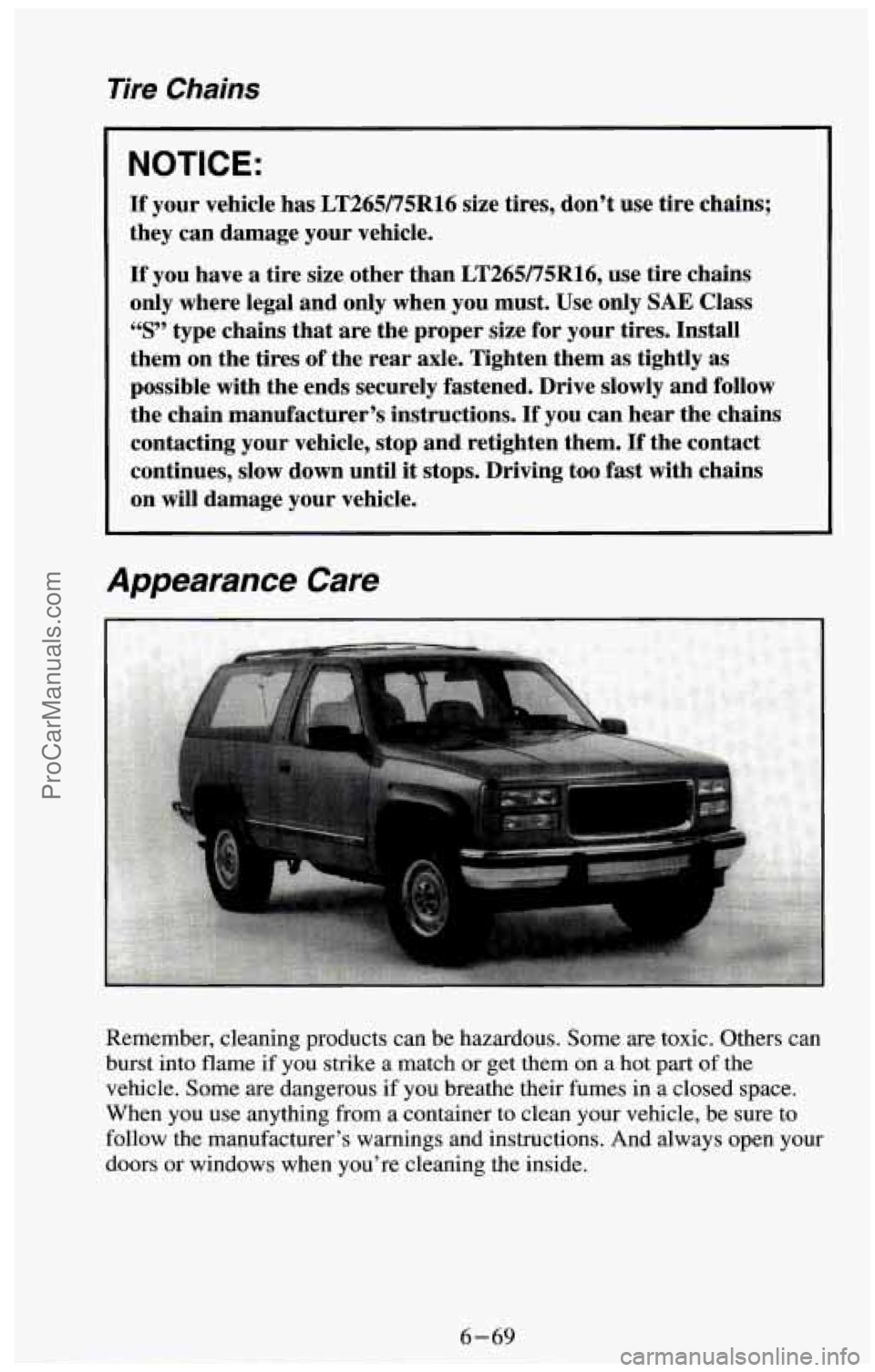
Tire Chains
NOTICE:
If your vehicle has LT265/75R16 size tires, don’t use tire chains;
they can damage your vehicle.
If you have a tire size other than LT265/75Rl6, use tire chains
only where legal and only when you must. Use only
SAE Class
“S” type chains that are the proper size for your tires. Install
them on the tires
of the rear axle. Tighten them as tightly as
possible
with the ends securely fastened. Drive slowly and follow
the chain manufacturer’s instructions.
If you can hear the chains
contacting your vehicle, stop and retighten them.
If the contact
continues, slow down until
it stops. Driving too fast with chains
on will damage your vehicle.
Appearance Care
Remember, cleaning products can be hazardous. Some are toxic. Others can
burst into flame
if you strike a match or get them on a hot part of the
vehicle. Some
are dangerous if you brea.the their fumes in a closed space.
When you use anything from a container to clean your vehicle, be sure to
follow the manufacturer’s warnings and instructions. And always open your doors or windows when you’re cleaning the inside.
ProCarManuals.com
Page 322 of 385
Although no defect in the paint job causes this, GM will repair, at no charge
to the owner, the surfaces of new vehicles damaged
by this fallout condition
within 12 months or 12,000 miles (20 000 km) of purchase, whichever
comes first.
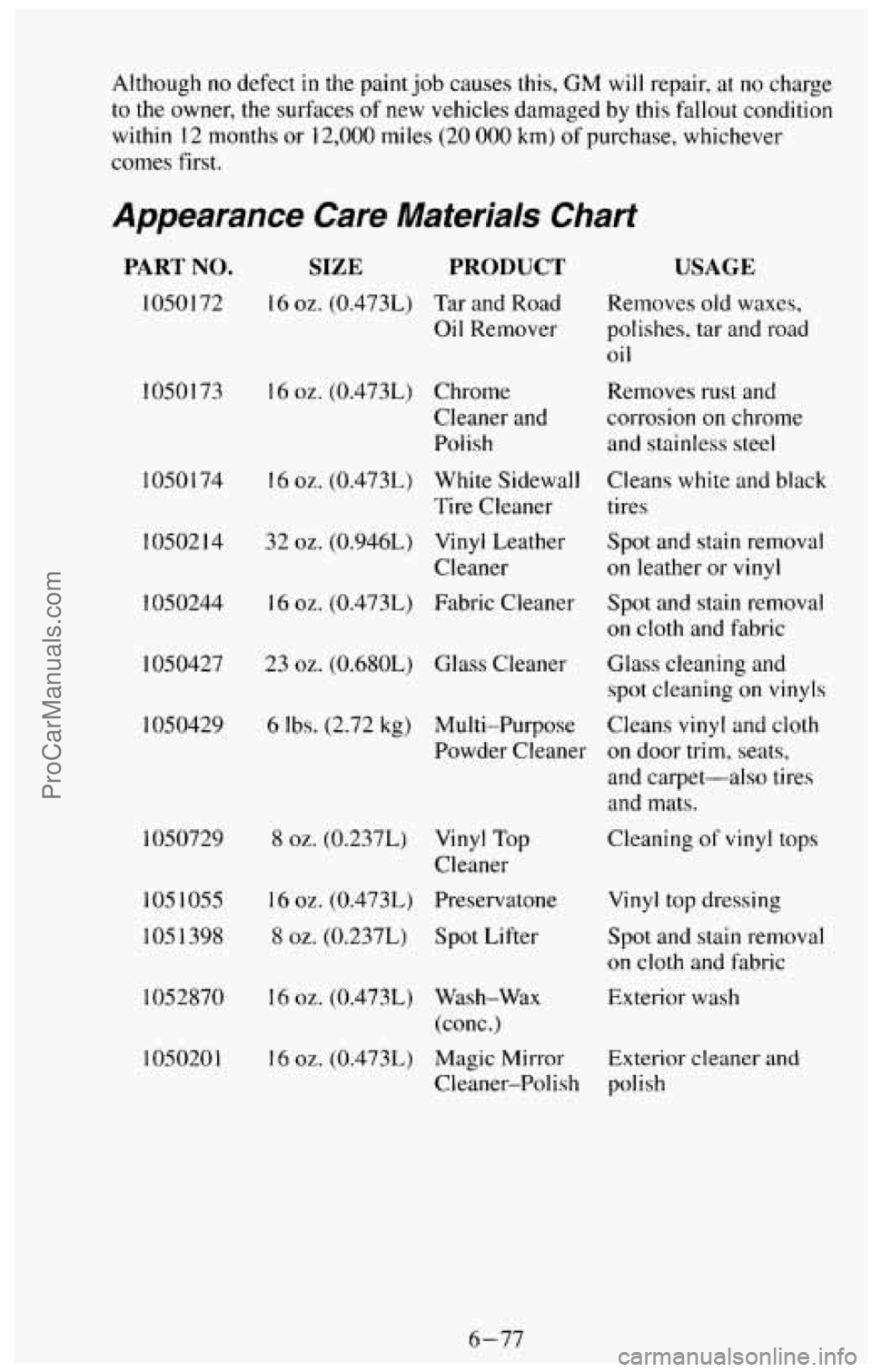
Appearance Care Materials Chart
PART NO.
1050172
1050173
1050 174
1050214
1050244 1050427
I050429
1050729
1051055 1051398
1052870
105020
1
SIZE PRODUCT
16 oz. (0.473L) Tar and Road
Oil Remover
16 02. (0.473L) Chrome
Cleaner and
Polish
I6 oz. (0.473L) White Sidewall
32
02. (0.946L) Vinyl Leather
Tire Cleaner
Cleaner
16 02. (0.473L) Fabric Cleaner
23
oz. (0.680L) Glass Cleaner
6 Ibs. (2.72 kg) Multi-Purpose
Powder Cleaner
8 oz. (0.237L) Vinyl Top
16
oz. (0.4731) Preservatone
8
02. (0.237L) Spot Lifter
Cleaner
USAGE
Removes
old waxes,
polishes, tar and road
oil
Removes rust and
corrosion on chrome
and stainless steel
Cleans white and black
tires
Spot and stain removal
on leather or
vinyl
Spot and stain removal
on cloth and fabric
Glass cleaning and
spot cleaning on vinyls
Cleans
vinyl and cloth
on door
trim, seats,
and carpet-also tires
and mats.
Cleaning
of vinyl tops
Vinyl top dressing
Spot and stain removal
on cloth and fabric
Exterior wash
16 oz. (0.473L) Wash-Wax
I6 oz. (0.473L) Magic Mirror Exterior cleaner and
(conc.)
Cleaner-Polish polish
6-77
ProCarManuals.com
Page 330 of 385
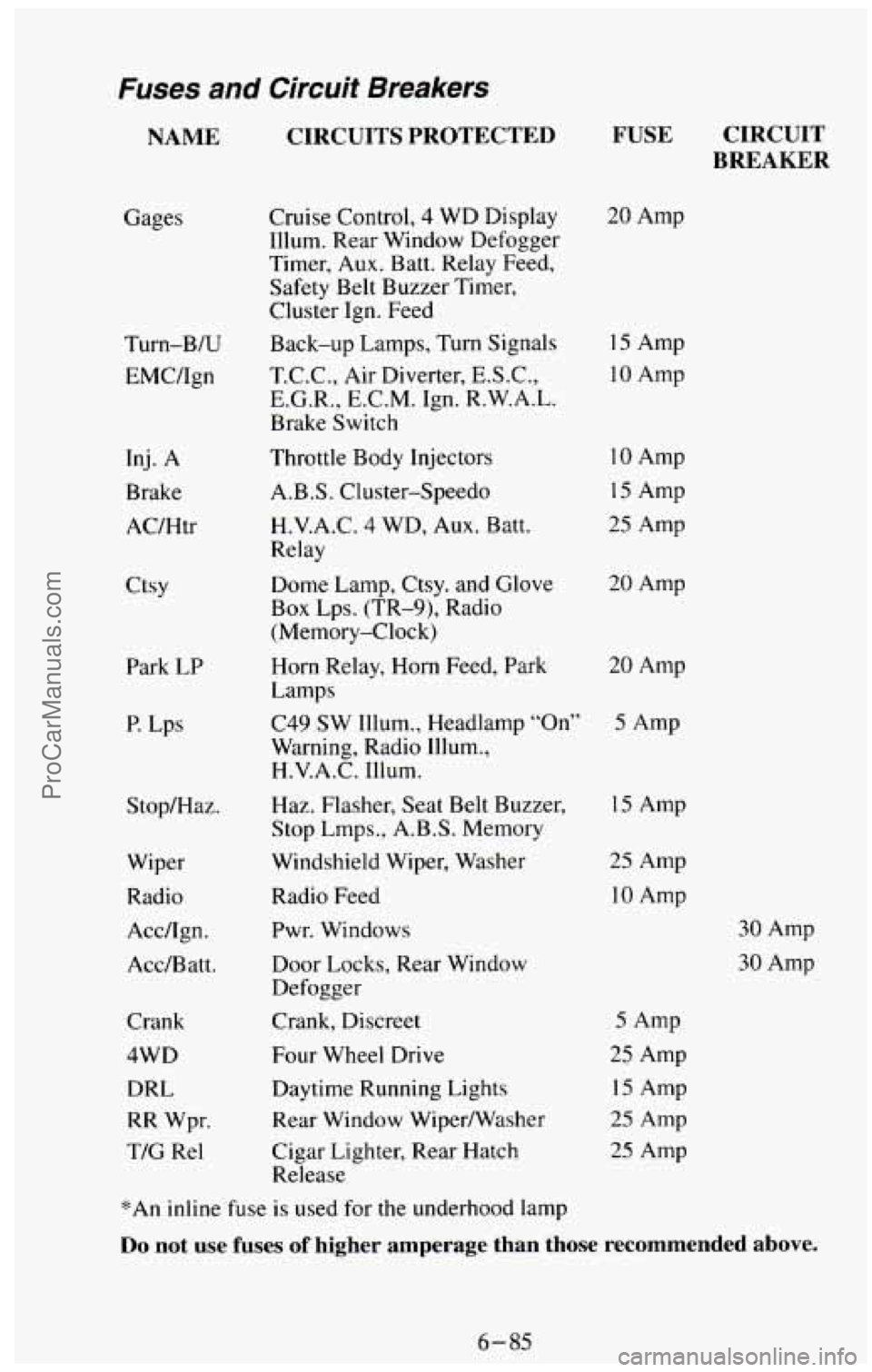
Fuses and Circuit Breakers
NAME CIRCUITS PROTECTED
Gages Turn-B/U
EMC/Ign
Inj. A
Brake
AC/Htr
Ctsy Park
LP
P. Lps
Stop/Haz.
Wiper
Radio Acc/Ign.
Acc/Batt.
Crank
4WD DRL
RR Wpr.
TIC Re1 Cruise Control,
4 WD Display
Illum. Rear Window Defogger
Timer, Aux. Batt. Relay Feed,
Safety Belt Buzzer Timer,
Cluster Ign. Feed
Back-up Lamps, Turn Signals
T.C.C., Air Diverter, E.S.C.,
E.G.R., E.C.M. Ign. R.W.A.L.
Brake Switch
Throttle Body Injectors
A.B.S. Cluster-Speed0
H.V.A.C.
4 WD, Aux. Batt.
Relay
Dome Lamp, Ctsy. and Glove
Box Lps. (TR-9), Radio
(Memory-Clock)
FUSE CIRCUIT
BREAKER
20 Amp
15 Amp
10 Amp
10 Amp
15 Amp
25 Amp
20 Amp
Horn Relay,
Horn Feed, Park 20 Amp
Lamps
C49 SW Illum., Headlamp
“On” 5 Amp
Warning, Radio Illum.,
H.V.A.C.
Illum.
Haz. Flasher, Seat Belt Buzzer,
Stop
Lmps., A.B.S. Memory
Windshield Wiper, Washer
Radio Feed Pwr. Windows
Door Locks, Rear Window
Defogger
Crank, Discreet
Four Wheel Drive
Daytime Running Lights
Rear Window Wipermasher
Cigar Lighter, Rear Hatch
Release
15 Amp
25 Amp
10 Amp
5 Amp
25 Amp
15 Amp
25 Amp
25 Amp
30 Amp
30 Amp
*An inline fuse is used for the underhood lamp
Do not use fuses of higher amperage than those recommended above.
6-85
ProCarManuals.com
Page 338 of 385
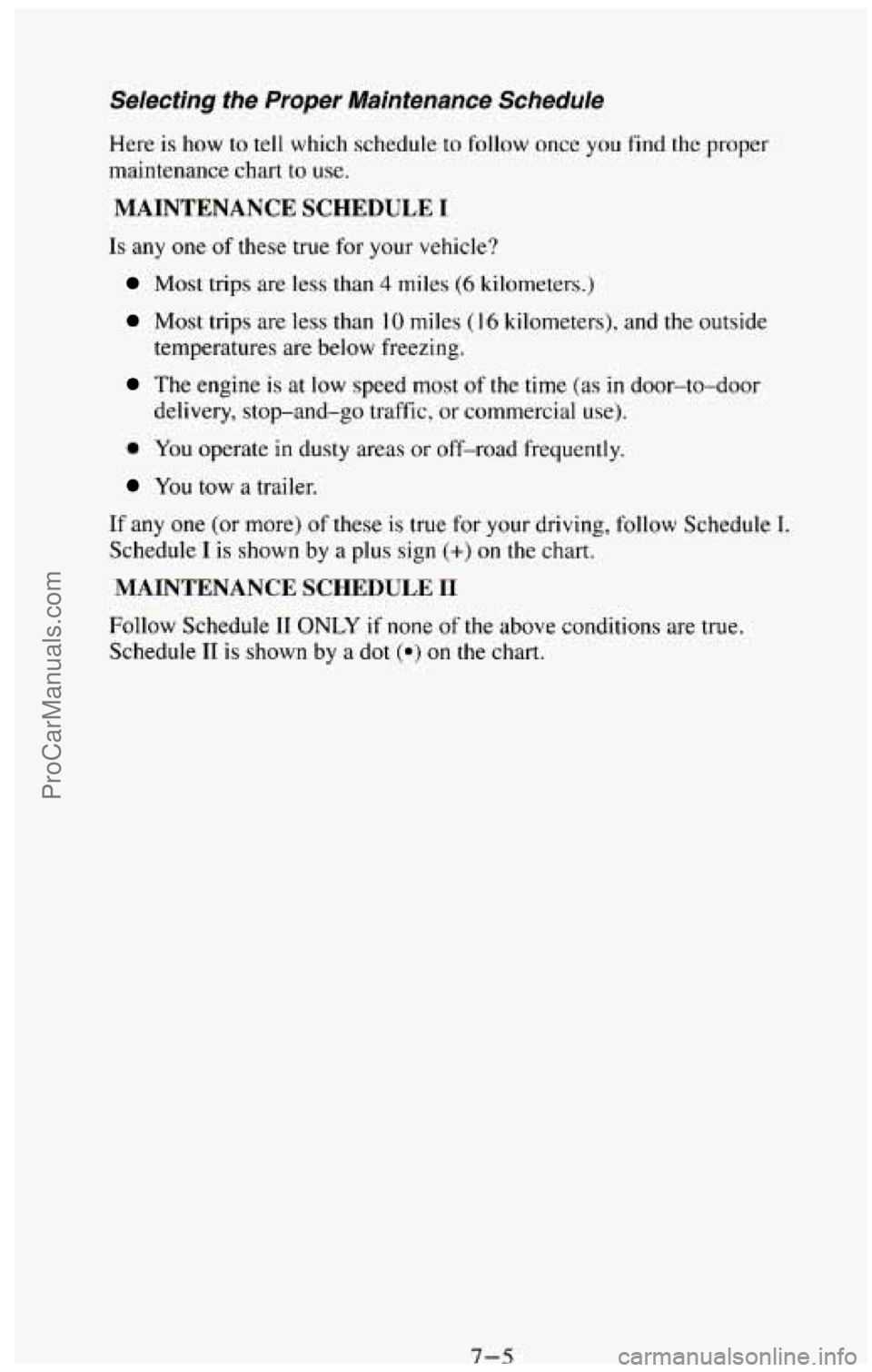
Selecting the Proper Maintenance Schedule
Here is how to tell which schedule to follow once you find the proper
maintenance chart to
use.
MAINTENANCE SCHEDULE I
Is any one of these true for your vehicle?
Most trips are less than 4 miles (6 kilometers.)
Most trips are less than 10 miles (16 kilometers), and the outside
temperatures are below freezing.
The engine is at low speed most of the time (as in door-to-door
delivery, stop-and-go traffic, or commercial use).
0 You operate in dusty areas or off-road frequently.
You tow a trailer.
If
any one (or more) of these is true for your driving, follow Schedule I.
Schedule I is shown by a plus sign (+) on the chart.
MAINTENANCE SCHEDULE II
Follow Schedule I1 ONLY if none of the above conditions are true.
Schedule
I1 is shown by a dot (0) on the chart.
7-5 ProCarManuals.com
Page 357 of 385

Lap and Shoulder Belts Condition and Operation - Inspect belt system,
including webbing, buckles, latch plates, retractors, guide loops\
and
anchors. Have
a belt assembly replaced if the webbing has been cut or
otherwise damaged.
Body Lubrication Service - Lubricate all body door hinges with engine
oil.
Also lubricate the tailgate, tailgate handle pivot points, and tailgate
mounted spare tire carrier (if equipped). Lubricate the body hood,
fuel door
and rear compartment hinges, latches and locks including interior glove box
and console doors, and any folding seat hardware. Lubricate the hood safety
lever pivot and prop rod pivot. More frequent lubrication may be required
when exposed to
a corrosive environment.
Periodic Maintenance Inspections - Listed below are inspections and
services which should be performed at least twice
a year (for instance each
spring or fall). You should let your
GM dealer’s service department or other
qualified service center do
these jobs. Make sure any necessary repairs are
completed at once.
Steering and Suspension Inspection? - Inspect front and rear suspension
and steering system for damaged, loose or missing parts, signs
of wear or
lack of lubrication. Inspect power steering lines and hoses for proper
hook-up, binding, leaks, cracks, chafing, etc. Lubricate the steering linkage.
Accelerator Control System - On gasoline engines, lubricate the pivot at
the
TBI throttle lever stud with engine oil. Do not oil any accelerator or
cruise control cables. Replace any cables that have high effort or excessive
wear.
Exhaust System Inspection - Inspect the complete system including the
three-way catalytic converter. Inspect the body near
the exhaust system.
Look for broken, damaged, missing or out-of-position parts,
as well as,
open seams, holes, loose connections or other conditions which could cause
a heat buildup
in the floor pan or could let exhaust fumes seep into the
passenger compartments.
Drive Axle Service? - Check readfront axle tluid level and add as needed,
Check constant velocity joints and axle seals for leaking.
Transfer Case (Four-wheel Drive) Inspection+ - Every 12 months or at
oil change intervals, check front axle and transfer case and add lubricant
when necessary. Oil the control lever pivot point and all exposed control
linkage. Check
vent hose at transfer case for kinks and proper installation.
More frequent lubrication may be required on heavy-duty or off-road use.
?A fluid loss in these systems may indicate a problem. Have them inspected
and repaired at once.
7-24
ProCarManuals.com
Page 359 of 385
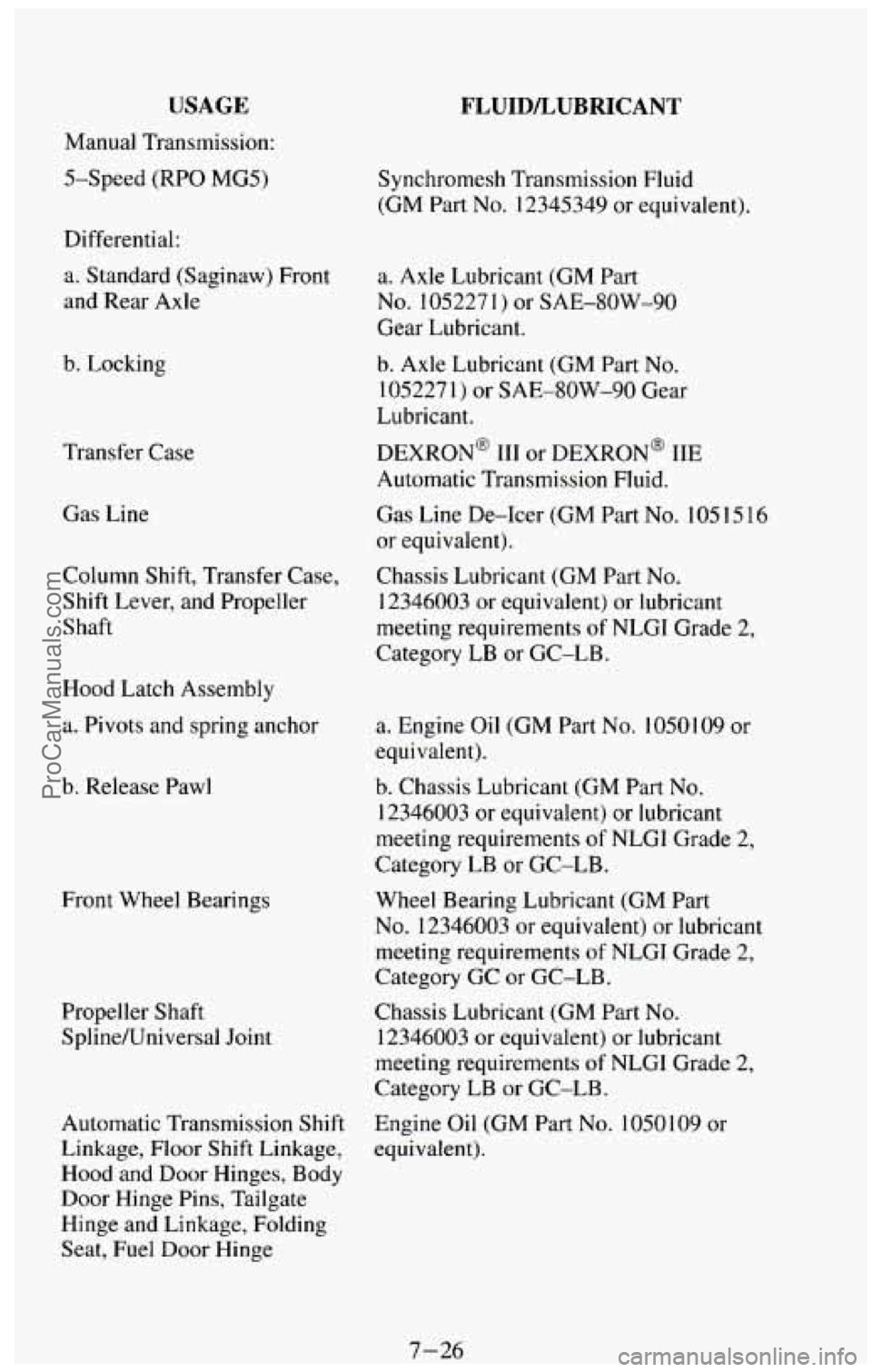
USAGE
Manual Transmission:
5-Speed
(RPO MG5)
Differential:
a. Standard (Saginaw) Front
and Rear Axle
b. Locking
Transfer Case
Gas Line
FLUIDLLUBRICANT
Synchromesh Transmission Fluid
(GM Part
No. I2345349 or equivalent).
a. Axle Lubricant (GM Part
No. 105227
I ) or SAE-80W-90
Gear Lubricant.
b. Axle Lubricant (GM Part
No.
1052271) or SAE-SOW-90 Gear
Lubricant.
DEXRON~ 111 or DEXRON~ IIE
Automatic Transmission Fluid.
Gas Line De-Icer (GM Part
No. 105 15 16
or equivalent).
Column Shift, Transfer Case,
Chassis Lubricant (GM Part
No.
Shift Lever, and Propeller
12346003 or equivalent) or lubricant
Shaft meeting requirements
of NLGI Grade 2,
Category LB or GC-LB.
Hood Latch Assembly
a. Pivots and spring anchor
b. Release Pawl
Front Wheel Bearings
Propeller Shaft
Spline/Universal Joint a.
Engine Oil (GM Part
No. 1050109 or
equivalent).
b. Chassis Lubricant (GM Part
No.
12346003 or equivalent) or lubricant
meeting requirements of NLGI Grade 2,
Category LB or GC-LB.
Wheel Bearing Lubricant (GM Part
No. 12346003 or equivalent) or lubricant
meeting requirements
of NLGI Grade 2,
Category GC
or GC-LB.
Chassis Lubricant (GM Part
No.
12346003 or equivalent) or lubricant
meeting requirements
of NLGI Grade 2,
Category LB or GC-LB.
Automatic Transmission Shift Engine
Oil (GM Part No. 1050109 or
Linkage, Floor Shift Linkage, equivalent).
Hood and
Door Hinges, Body
Door Hinge Pins, Tailgate
Hinge and Linkage, Folding
Seat, Fuel Door Hinge
7-26 ProCarManuals.com
Page 363 of 385
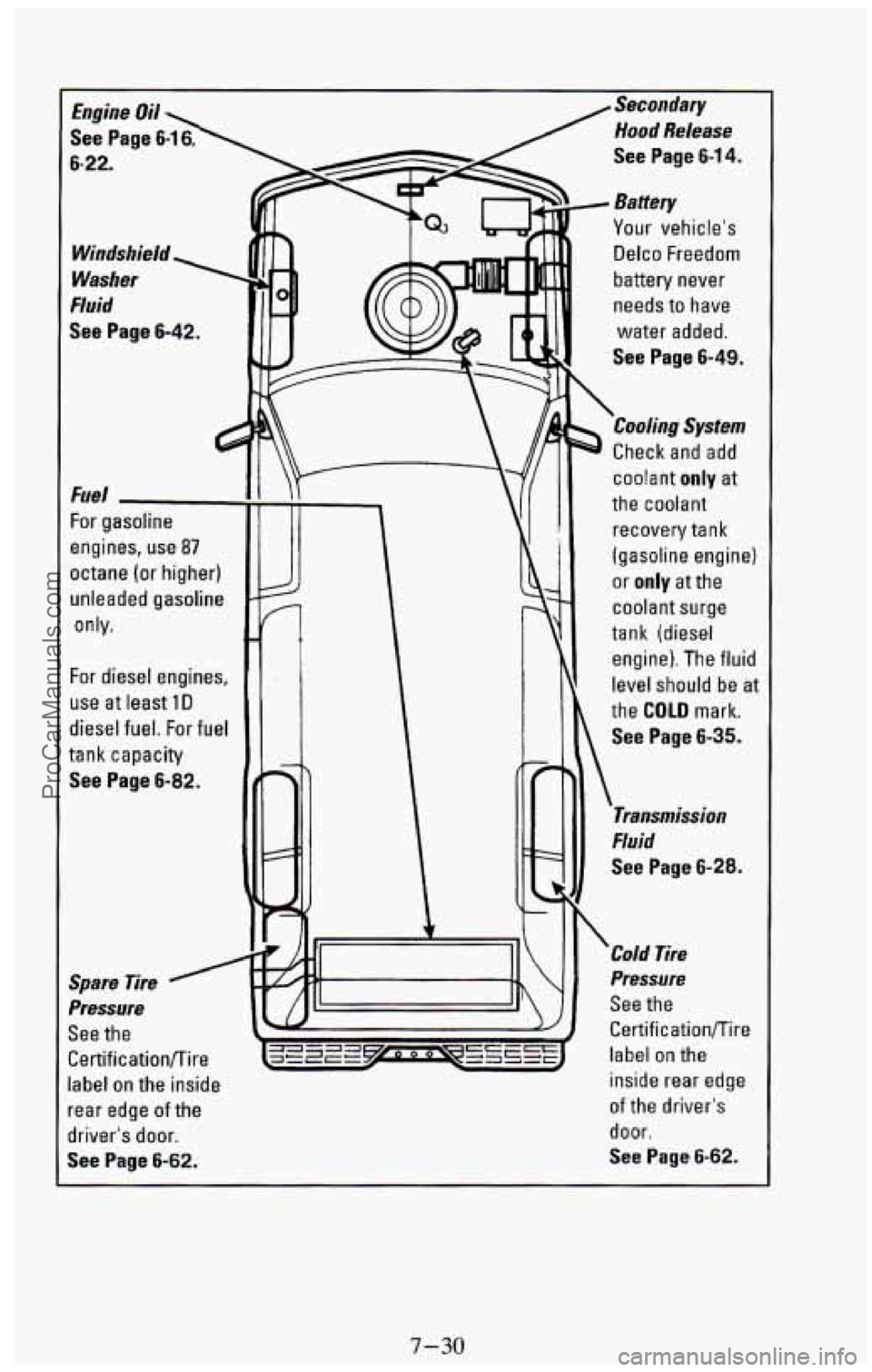
' Secondary
Hood
Release
See Page 6-1 4.
ILL Battery
Your vehicle's
Delco Freedom
battery never
needs to have
water added.
See Page 6-49.
a Cooling System
Check and add
coolant
only at
the coolant recovery tank
(gasoline engine)
or
only at the
coolant surge
tank (diesel engine).
The fluid
level should be at
the
COLD mark.
See Page 6-35.
1 Transmission
~ Fluid
See Page 6-28.
Cold Tire
Pressure
See the
Certificationflire
label
on the
inside rear edge
of the driver's
door.
See Page 6-62.
7-30
ProCarManuals.com