service CHEVROLET SUBURBAN 1994 Service Manual
[x] Cancel search | Manufacturer: CHEVROLET, Model Year: 1994, Model line: SUBURBAN, Model: CHEVROLET SUBURBAN 1994Pages: 385, PDF Size: 19.88 MB
Page 304 of 385
Malfunction Indicator
(SERVICE ENGINE SOON) Lamp
The Malfunction Indicator (SERVICE ENGINE SOON) Lamp on your
instrument panel lets you know when your emission system needs service.
The light
will come on briefly when you start your engine to let you know
that the system is working.
If it does not come on when you start your
engine,
or if it comes on and stays on while you're driving, your system
may need service. Your vehicle should still be driveable, but
you should
have your system serviced right away.
Secondary Air Injection Reaction (AIR) System
You may have this system. It has a control valve that will direct air to where
it is needed. If the AIR system needs service, your Malfunction Indicator
(SERVICE ENGINE SOON) Lamp on your instrument panel will come
on.
Loading Your Vehicle
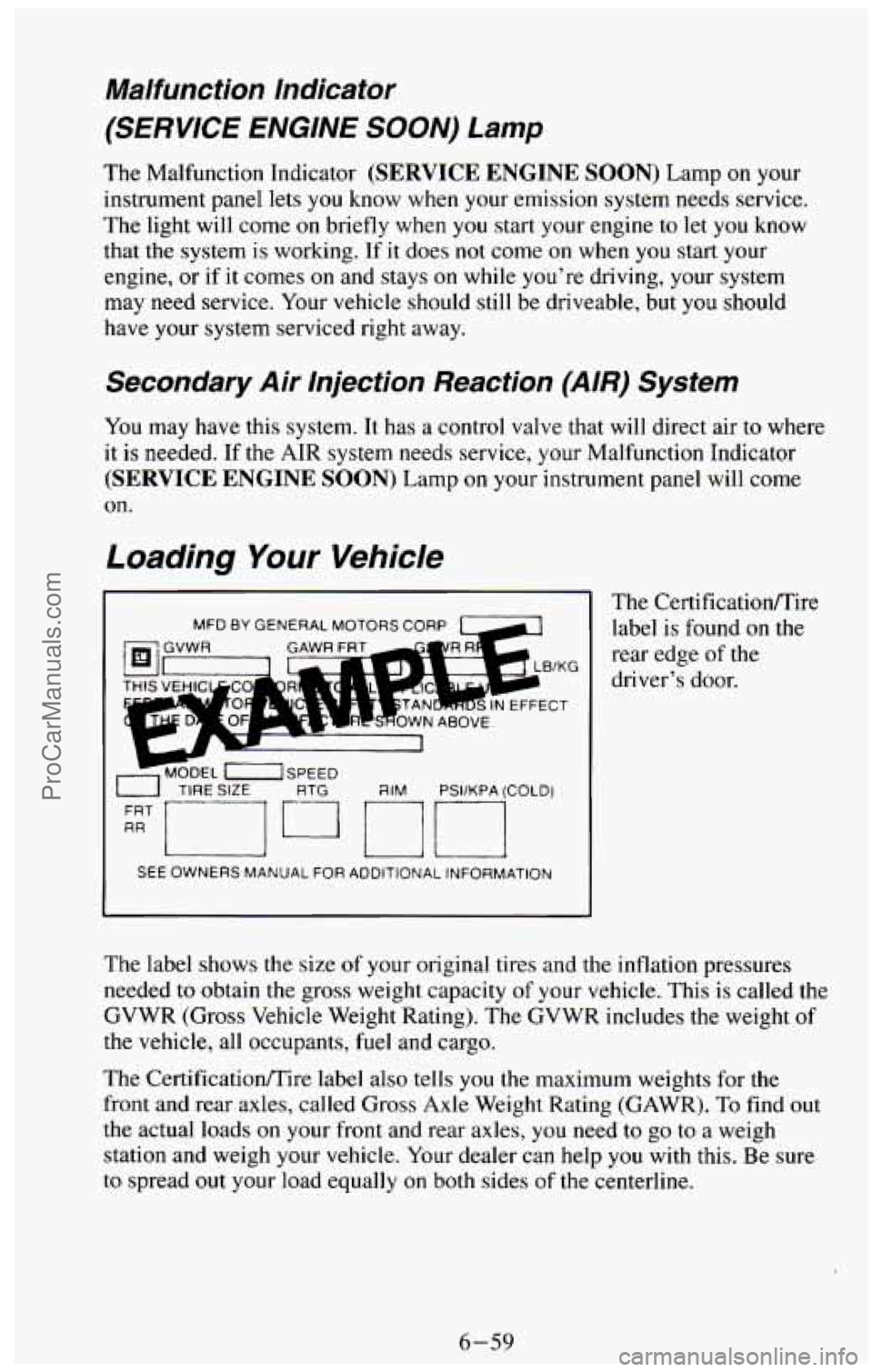
MFD BY GENERAL MOT0 RSCORP
i IN EFFECT -
I
- MODEL [ISPEED w
u TIRE SIZE RTG FilM PSllKPA (COLD)
q----p nri
SEE OWNERS MANUAL FOR ADDITIONAL INFORMATION
The CertificatiodTire
label is found
on the
rear edge
of the
driver's door.
The label shows the size
of your original tires and the inflation pressures
needed to obtain the gross weight capacity
of your vehicle. This is called the.
GVWR (Gross Vehicle Weight Rating). The GVWR includes the weight
of
the vehicle, all occupants, fuel and cargo.
The Certificatioflire label also tells you the maximum weights for the
front and rear axles, called Gross Axle Weight Rating (GAWR).
To find out
the actual loads on your front and rear axles,
you need to go to a weigh
station and weigh your vehicle. Your dealer can help you with this.
Be sure
to spread out your load equally on both sides of the centerline.
6-59
ProCarManuals.com
Page 309 of 385
Special Tire lnflation
If you have 16 inch tires on your vehicle, and:
- You’ll be driving for very long at speeds of 66 mph (105 kdh) to
75 mph (120 km/h) where legal, inflate tires to 10 psi (70 kPa)
more than the recommended cold inflation pressures.
- You’ll be driving for very long at speeds of 76 mph ( 120 kdh) to
85 mph (1 35 kdh) where legal, cold inflation pressures should be
increased by
10 psi (70 kPa) and you must also reduce axle load
capacity by 10%.
Do not drive over 85 mph (135 km/h) even if
it’s legal.
Inflation pressures should never exceed 10 psi (70 kPa) above the
inflation specified for the maximum load
of the tire.
Tire lnspection and Rotation
To make your tires last longer, have them inspected and rotated at the
mileages recommended
in the Maintenance Schedule. See “Scheduled
Maintenance Services” in the Index.
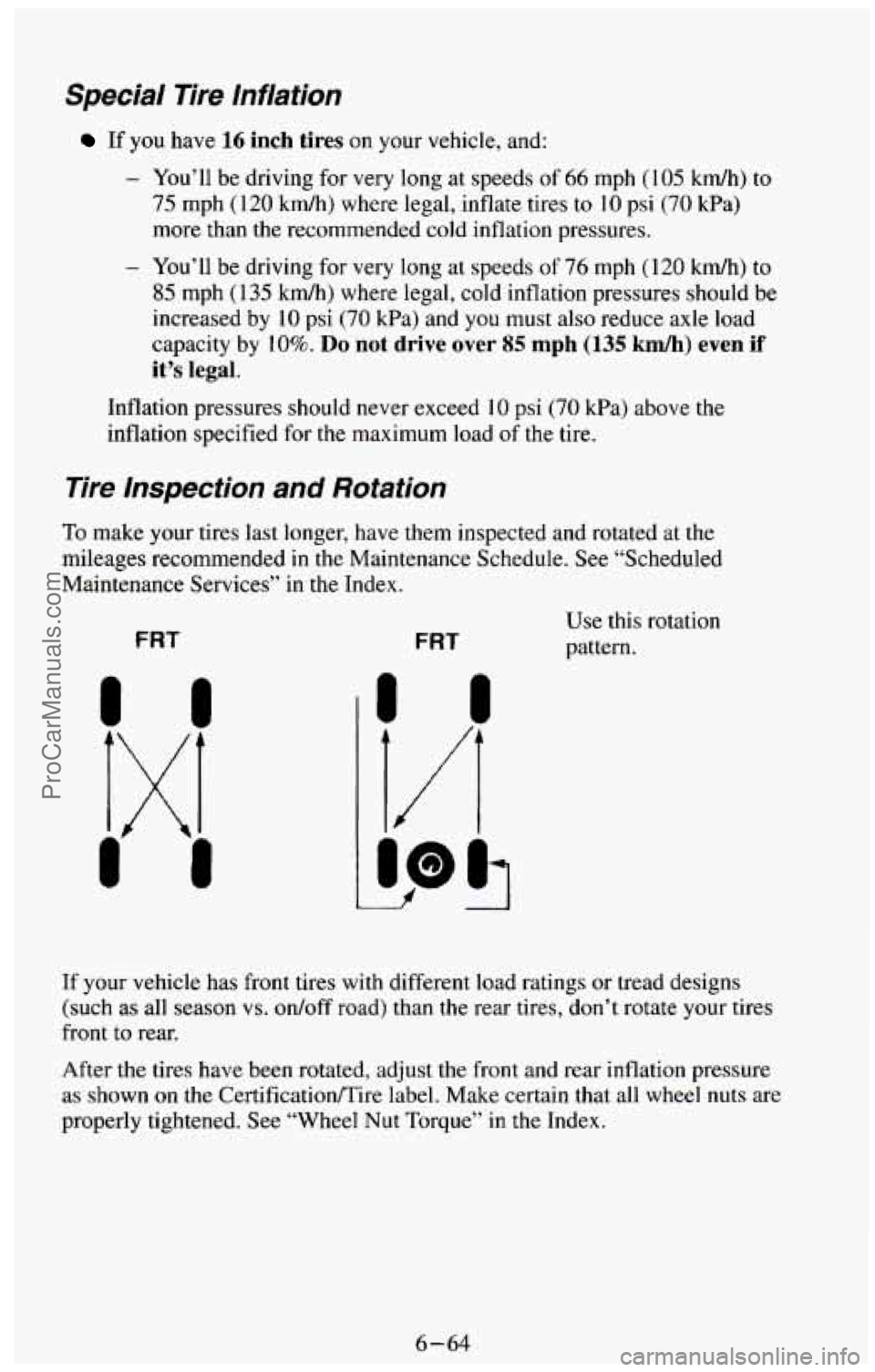
FRT FRT
Use this rotation
pattern.
If your vehicle has front tires with different load ratings or tread designs
(such
as all season vs. on/off road) than the rear tires, don’t rotate your tires
front
to rear.
After the tires have been rotated, adjust the front and rear inflation pressure
as shown on the Certificationmire label. Make certain that all wheel nuts are
properly tightened. See “Wheel Nut Torque” in the Index.
6-64
ProCarManuals.com
Page 311 of 385
Buying New Tires
To find out what kind and size of tires you need, look at the
CertificatiodTire label.
The tires installed
on your vehicle when it was new had a Tire Performance
Criteria Specification (TPC Spec) number on each tire’s sidewall. When you
get new tires, get ones with that same TPC Spec number. That way, your
vehicle will continue to have tires that are designed to give proper
endurance, handling, speed rating, traction, ride and other things during
normal service on your vehicle. If your tires have an all-season tread
design, the TPC number
will be followed by a “MS” (for mud and snow).
If you ever replace your tires with those not having a TPC Spec number,
make sure they
are the same size, load range, speed rating and construction
type (bias, bias-belted or radial)
as your original tires.
Uniform Tire Quality Grading
The following information relates to the system developed by the United
States National Highway Traffic Safety Administration which grades tires
by treadwear, traction and temperature performance. (This applies
only to
vehicles sold
in the United States.)
Treadwear
The treadwear grade is a comparative rating based on the wear rate of the
tire when tested under controlled conditions on a specified government test
course. For example, a tire graded
150 would wear one and a half ( 1 1 /2)
times as well on the government course as a tire graded 100. The relative
performance of tires depends upon the actual conditions
of their use,
however, and may depart significantly from the norm due to variations
in
driving habits, service practices and differences in road characteristics and
climate.
6-66 ProCarManuals.com
Page 321 of 385
Weatherstrips
Silicone grease on weatherstrips will make them last longer, seal better, and
not stick or squeak. Apply silicone grease with a clean cloth at least every
six months. During very cold, damp weather more frequent application may
be required. (See “Recommended Fluids
& Lubricants’’ in the Index.)
Sheet Metal Damage
If your vehicle is damaged and requires sheet metal repair or replacement,
make sure the body repair shop applies anti-corrosion material to the parts
repaired or replaced to
restore corrosion protection.
Foreign Material
Calcium chloride and other salts, ice melting agents, road oil and tar, tree
sap, bird droppings, chemicals from industrial chimneys, and other foreign
matter can damage your vehicle’s finish if they remain on painted surfaces.
Use cleaners that are marked safe for painted surfaces to remove foreign
matter.
Finish Damage
Any stone chips, fractures or deep scratches in the finish should be repaired
right away. Bare metal will corrode quickly and may develop into a major
repair expense.
Minor chips and scratches can be repaired with touch-up materials available
from your dealer or other service outlets. Larger areas of finish damage can
be corrected
in your dealer’s body and paint shop.
Underbody Maintenance
Chemicals used for ice and snow removal and dust control can collect on
the underbody. If these are not removed, accelerated corrosion (rust) can
occur
on the underbody parts such as fuel lines, frame, floor pan, and
exhaust system even though they have corrosion protection.
At least every spring,
flush these materials from the underbody with plain
water. Clean
any areas where mud and other debris can collect. Dirt packed
in closed areas of the frame should be loosened before being flushed. Your
dealer or an underbody vehicle washing system can do this for you.
Chemical Paint Spotting
Some weather and atmospheric conditions can create a chemical fallout.
Airborne pollutants can fall upon and attack painted surfaces on your
vehicle. This damage can take two
forms: blotchy, ringlet-shaped
discolorations, and small irregular dark
spots etched into the paint surface.
6-76
ProCarManuals.com
Page 323 of 385
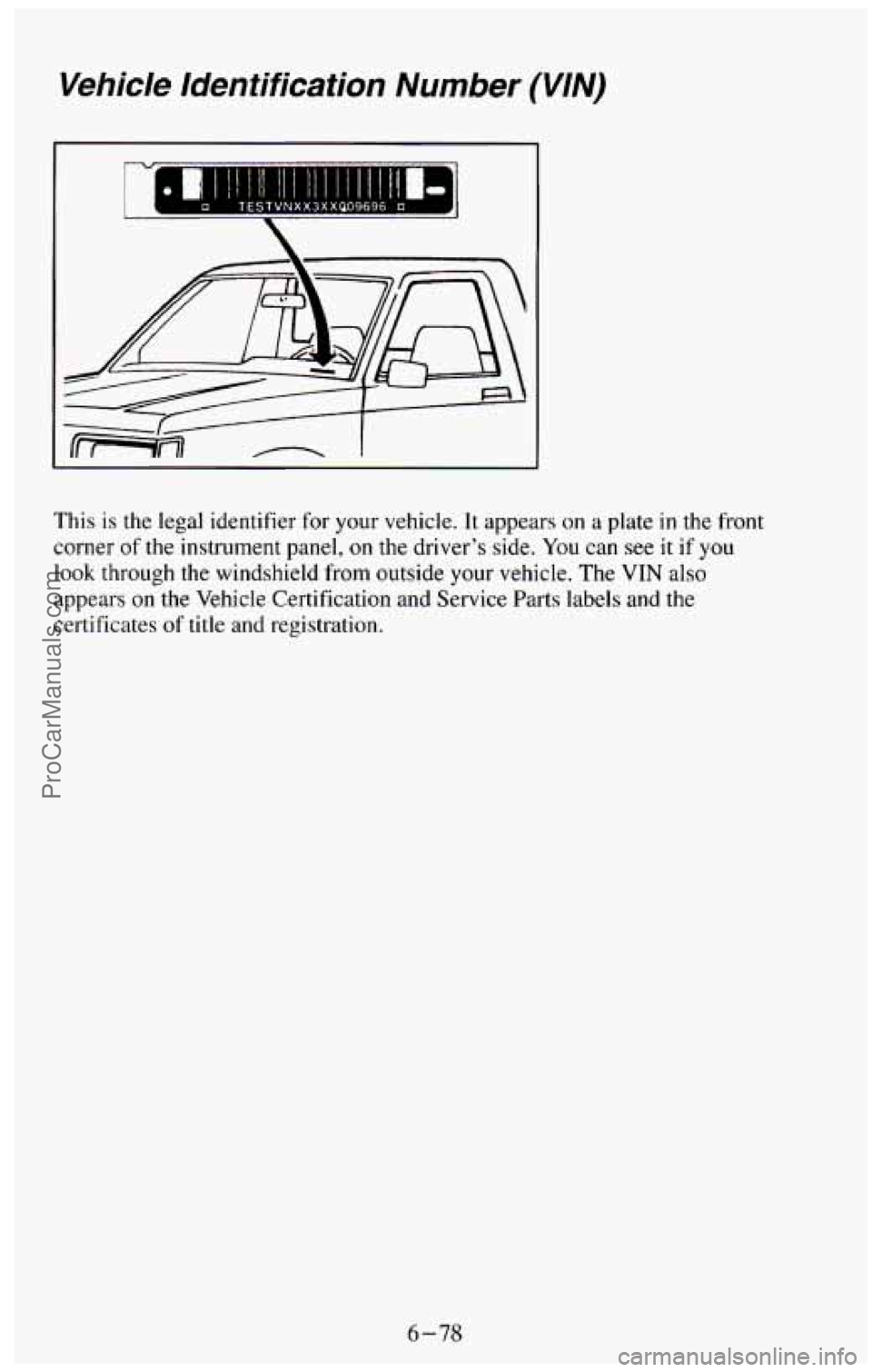
Vehicle Identification Number (VIN)
This is the legal identifier for your vehicle. It appears on a plate in the front
corner
of the instrument panel, on the driver’s side. You can see it if you
look through the windshield from outside your vehicle. The VIN also
appears on the Vehicle Certification and Service Parts labels and the
certificates of title and registration.
6-78
ProCarManuals.com
Page 325 of 385
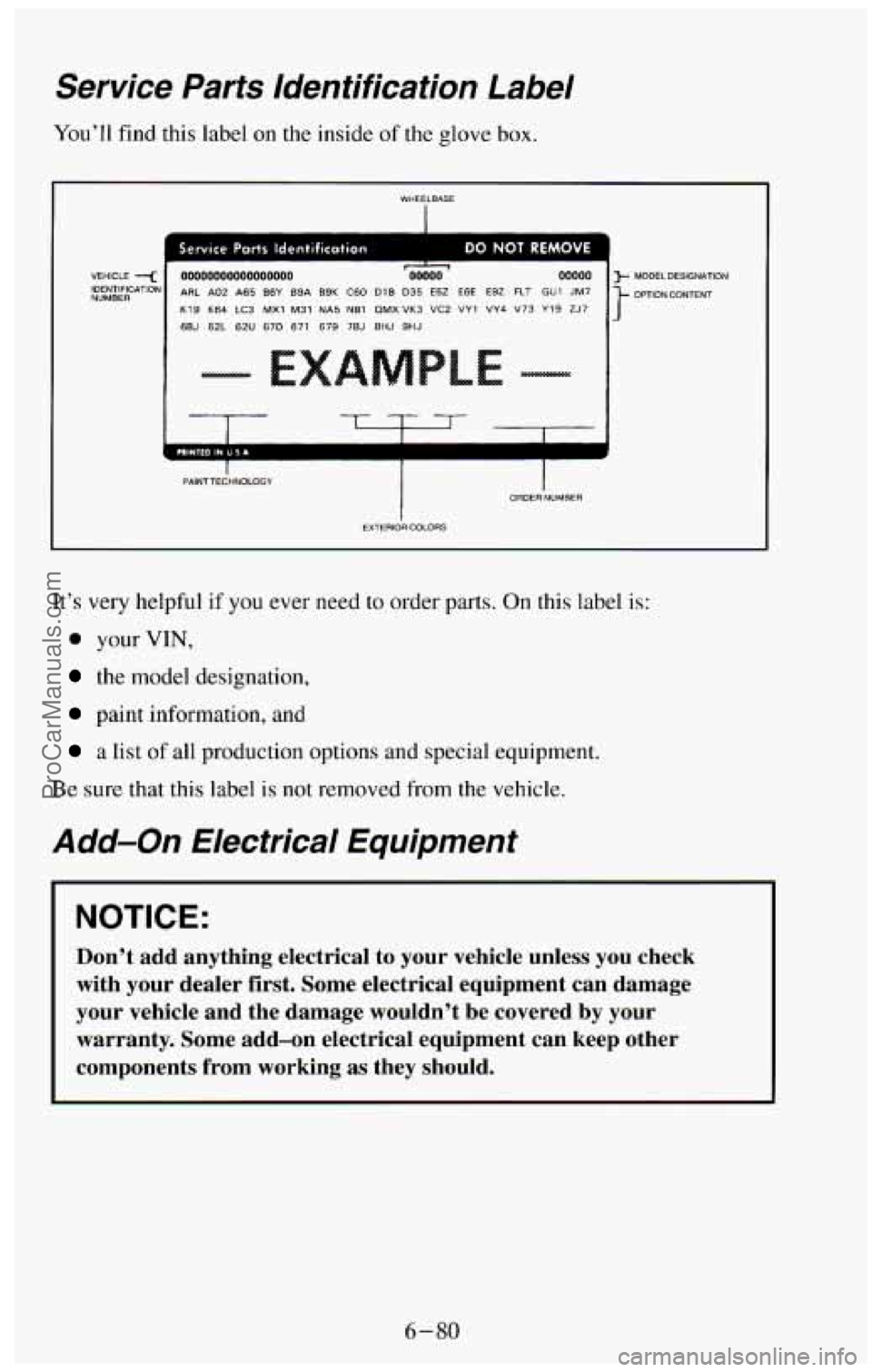
Service Parts Identification Label
You’ll find this label on the inside of the glove box.
WHEELBASE
I
MODEL DESIGNATION
OPTION CONTENT K19 K64 LC3 MXl M31 NA5 NB1 QMXVK3 VC2 VYl VY4 V73 Y19 ZJ7
6BJ 62L 62U 67D 671
679 7BJ 8HJ BHJ
I PAINT TECHNOLOGY I ORDER NUMBER
EXTERIOR COLORS
It’s very helpful if you ever need to order parts. On this label is:
0 your VIN,
the model designation,
paint information, and
a list of all production options and special equipment.
Be sure that this label is not removed from the vehicle.
Add-on E/ectrical Equipment
NOTICE:
Don’t add anything electrical to your vehicle unless you che\
ck
with
your dealer first. Some electrical equipment can damage
your vehicle and the damage wouldn’t be covered by your
warranty. Some add-on electrical equipment can keep other
components
from working as they should.
6-80
ProCarManuals.com
Page 328 of 385
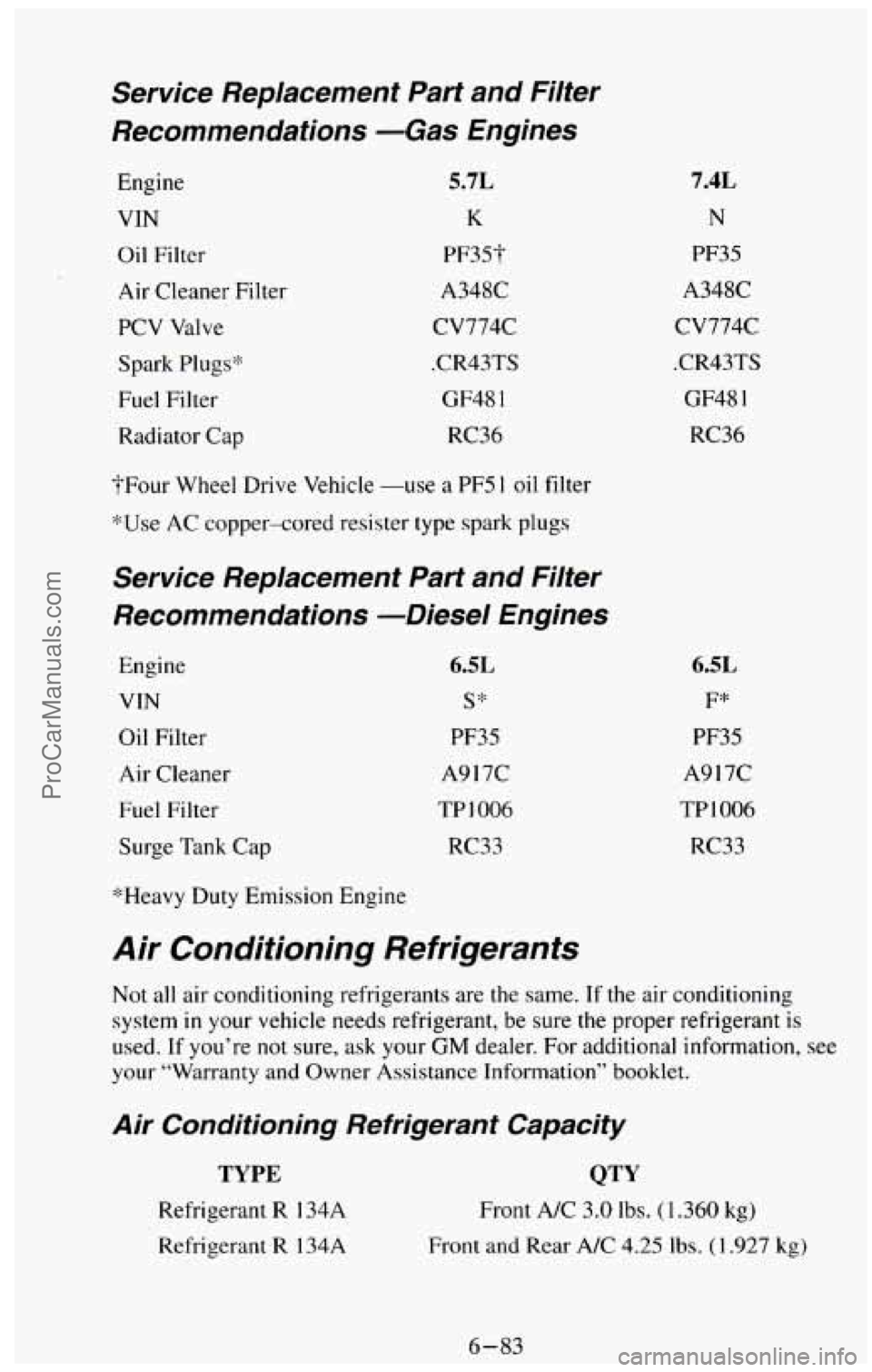
Service Replacement Part and Filter
Recommendations -Gas Engines
Engine
VIN
Oil Filter
Air Cleaner Filter
PCV Valve
Spark Plugs‘%
Fuel Filter
Radiator Cap
5.7L
K
PF353‘
A348C
cv774c
.CR43TS
GF48 1
RC36
$Four Wheel Drive Vehicle -use a
PFS 1 oil filter
*Use AC copper-cored resister type spark plugs
Service Replacement Part and Filter
Recommendations -Diesel Engines
Engine
VIN
Oil Filter
Air Cleaner
Fuel Filter
Surge Tank Cap 6.5L
S”
PF3S
A917C
TP
I 006
RC33
7.4L
N
PF35
A348C
cv774c
.CR43TS
GF48
I
RC36
6.5L
F”
PF35
A9 17C
TP
1006
RC33
*Heavy Duty Emission Engine
Air Conditioning Refrigerants
Not all air conditioning refrigerants are the same. If the air conditioning
system
in your vehicle needs refrigerant, be sure the proper refrigerant is
used. If you’re not sure, ask your GM dealer. For additional information, see
your “Warranty and Owner Assistance Information” booklet.
Air Conditioning Refrigerant Capacity
TYPE
Refrigerant R 134A
Refrigerant
R 134A
QTY
Front A/C 3.0 lbs. (1.360 kg)
Front and Rear A/C
4.25 Ibs. (I .927 kg)
6-83
ProCarManuals.com
Page 332 of 385
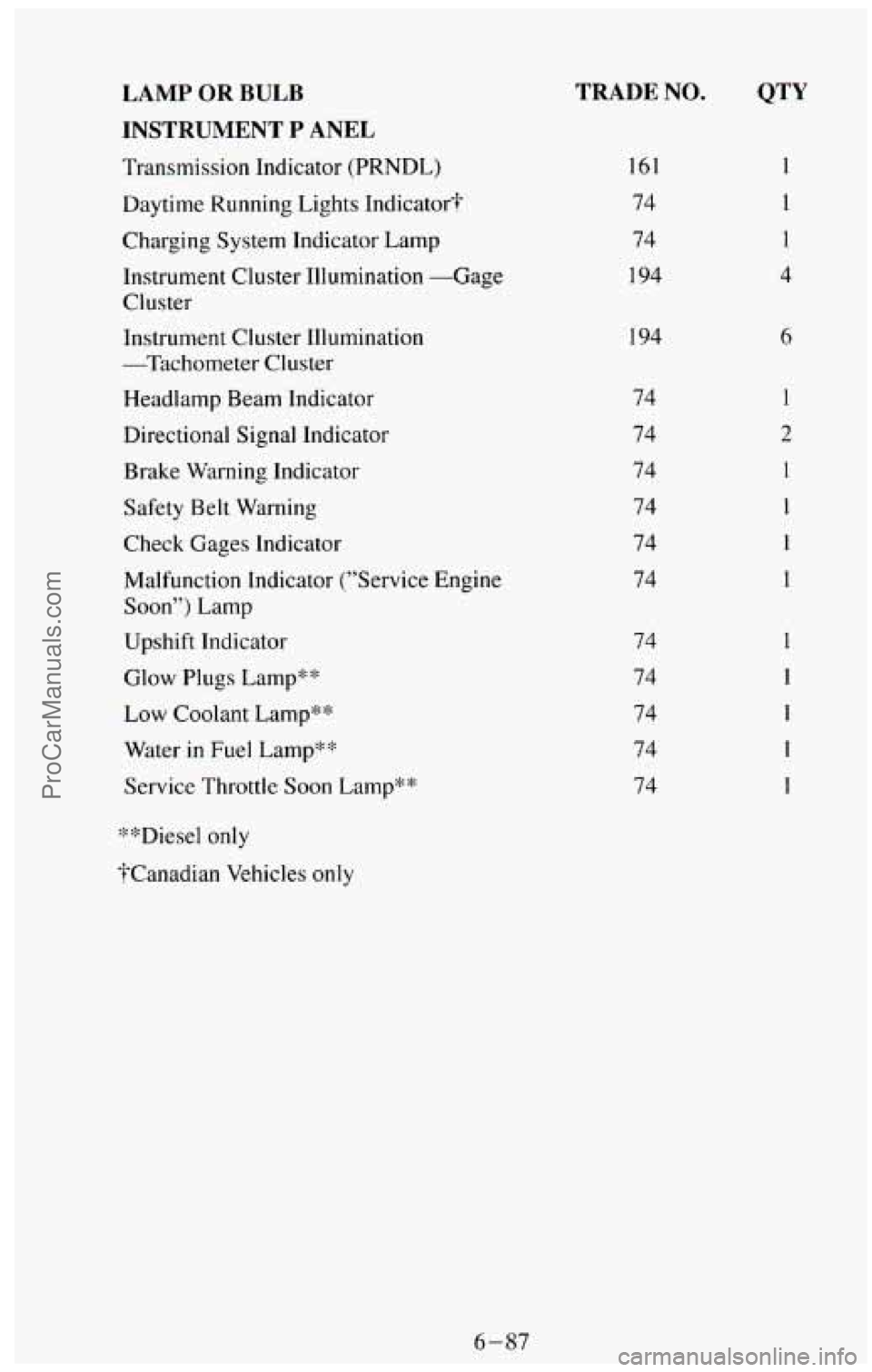
LAMP OR BULB
INSTRUMENT
P ANEL
Transmission Indicator (PRNDL)
Daytime Running Lights Indicator?'
Charging System Indicator Lamp
Instrument Cluster Illumination -Gage
Cluster
Instrument Cluster Illumination
-Tachometer Cluster
Headlamp Beam Indicator
Directional Signal Indicator
Brake Warning Indicator
Safety Belt Warning
Check Gages Indicator Malfunction Indicator ("Service Engine
Soon") Lamp
Upshift Indicator
Glow Plugs Lamp*:"
Low Coolant Lamp**
Water
in Fuel Lamp**
Service Throttle
Soon Lamp**
'k*Diesel only
'fCanadian Vehicles only
TRADE NO.
161 74
74
194
194 74
74
74
74
74 74
74
74 74
74
74
6
6-87
ProCarManuals.com
Page 334 of 385
Scheduled Maintenance Services
Section
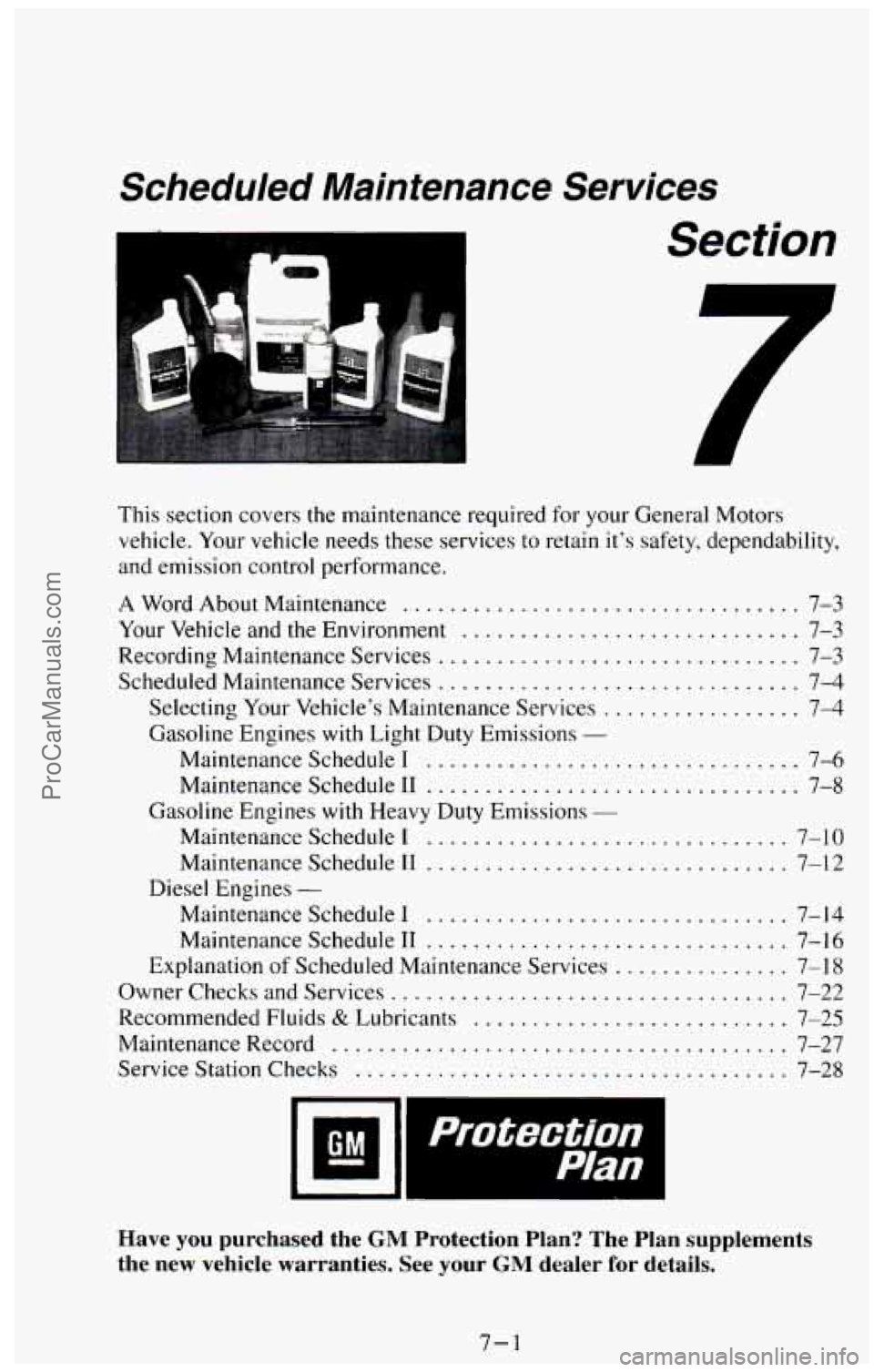
This section covers the maintenance required for your General Motors
vehicle
. Your vehicle needs these services to retain it’s safety. dependability.
and emission control performance
.
A Word About Maintenance .................................. 7-3
Your Vehicle and
the Environment ............................. 7-3
Recording Maintenance Services
............................... 7-3
Scheduled Maintenance Services
............................... 7-4
Selecting Your Vehicle’s Maintenance Services ........ ..... 7-4
Maintenance Schedule I ................................ 7-6
Maintenance Schedule
I1 ..................... ......... 7-8
Maintenance Schedule
I .........................
Maintenance Schedule I1 ...... ...............
Maintenance Schedule I ............................... 7-14
Maintenance Schedule
I1 ............................... 7-16
Explanation
of Scheduled Maintenance Services ............... 7-18
Owner Checks and Services .................................. 7-22
Recommended Fluids
& Lubricants ........................... 7-25
Maintenance Record
....................................... 7-27
Service Sta.tion Checks
..................................... 7-28
Gasoline Engines with Light Duty Emissions .
Gasoline Engines with Heavy Duty Emissions .
Diesel Engines .
.... 7-10
...... 7-12
Protection
Plan
Have you purchased the GM Protection Plan? The Plan supplements
the new vehicle warranties
. See your GM dealer for details .
7-1
ProCarManuals.com
Page 335 of 385
A Word About Maintenance
We at General Motors want to help you keep your vehicle in good working
condition. But we don’t know exactly how you’ll drive
it. You may drive
very short distances
only a few times a week. Or you may drive long
distances
all the time in very hot, dusty weather. You may use your vehicle
in making deliveries. Or you may drive it to work, to do errands, or in many
other ways.
Because of all the different ways people
use their GM vehicles, maintenance
needs vary. You may even need more frequent checks and replacements than
you will find in the schedules in this section. So please read this section and
note how you drive. If
you have any questions on how to keep your vehicle
in good condition, see your GM dealer, the place many GM owners choose
to have their maintenance work done. Your dealer can be relied
upon to use
the proper parts and practices.
Your Vehicle and the Environment
Proper vehicle maintenance not only helps keep your vehicle in good
working condition, but
also helps the environment. All recommended
maintenance procedures are important. Improper vehicle maintenance or the
removal of important components can significantly affect the quality
of the
air we breathe. Improper fluid levels or even the wrong tire inflation can
increase the
level of emissions from your vehicle. To help protect our
environment, and
to help keep your vehicle in good condition, please
maintain your vehicle properly.
Recording Maintenance Services
The Maintenance Record near the end of this section provides a place for
you
to record the maintenance performed on your vehicle. Whenever any
maintenance
is performed, be sure to write it down in the Maintenance
Record.
This will help you determine when your next maintenance should
be done. In addition,
it is a good idea to keep your maintenance receipts.
They may be needed to qualify your vehicle warranty repairs.
7-2
ProCarManuals.com