lock CHEVROLET SUBURBAN 1994 Workshop Manual
[x] Cancel search | Manufacturer: CHEVROLET, Model Year: 1994, Model line: SUBURBAN, Model: CHEVROLET SUBURBAN 1994Pages: 385, PDF Size: 19.88 MB
Page 172 of 385
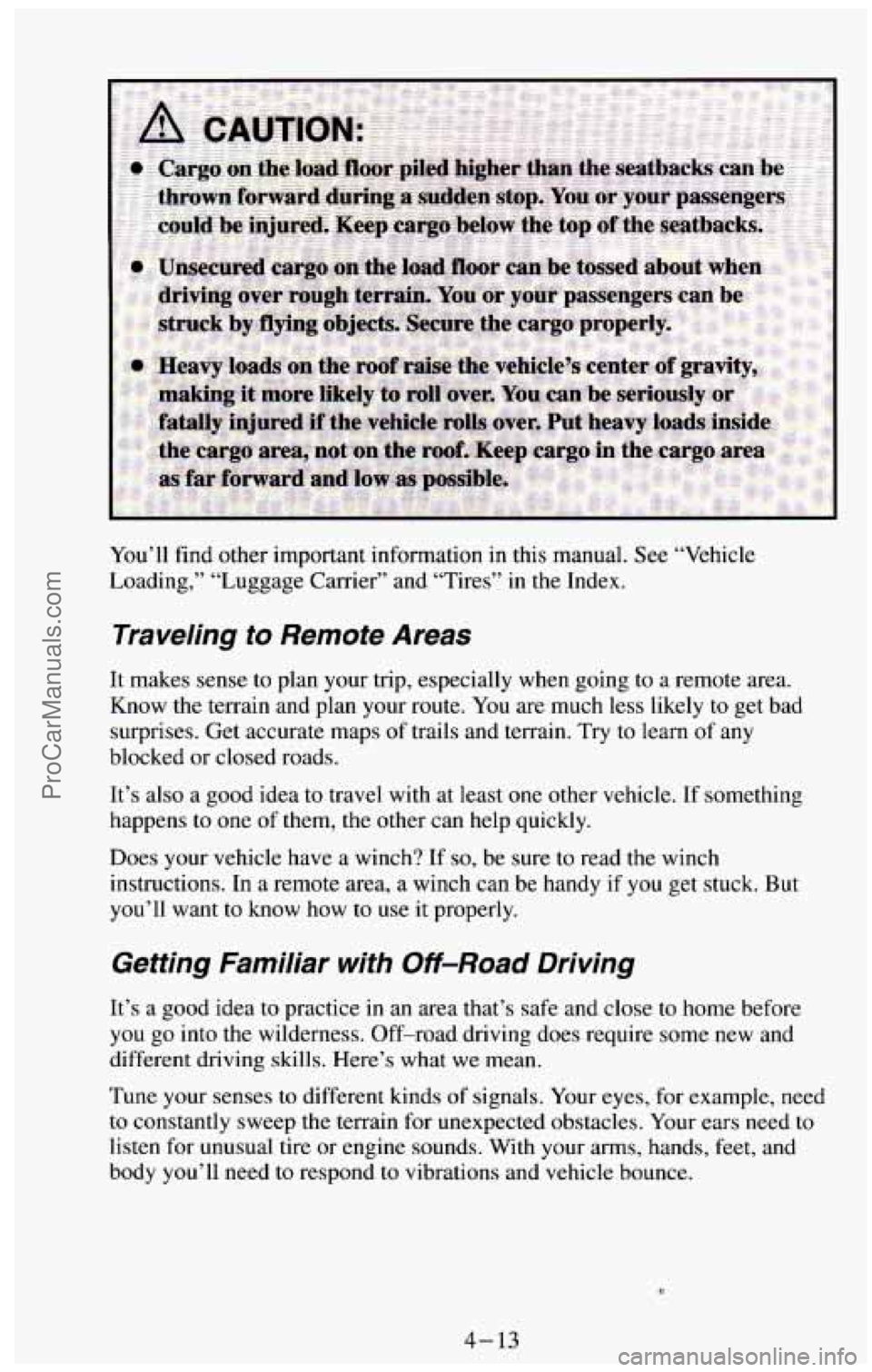
You’ll find other important information in this manual. See “Vehicle
Loading,’’ “Luggage Carrier” and “Tires” in the Index.
Traveling to Remote Areas
It makes sense to plan your trip, especially when going to a remote area.
Know the terrain and plan your route.
You are much less likely to get bad
surprises. Get accurate maps
of trails and terrain. Try to learn of any
blocked or closed roads.
It’s also a good idea to travel with at least one other vehicle.
If something
happens to one
of them, the other can help quickly.
Does your vehicle have a winch? If
so, be sure to read the winch
instructions.
In a remote area, a winch can be handy if you get stuck. But
you’ll want
to know how to use it properly.
Getting Familiar with Off-Road Driving
It’s a good idea to practice in an area that’s safe and close to home before
you go into the wilderness. Off-road driving does require some new and
different driving
skills. Here’s what we mean.
Tune your senses to different kinds
of signals. Your eyes, for example, need
to constantly sweep the terrain for unexpected obstacles. Your ears need to
listen for unusual tire or engine sounds. With your arms, hands, feet, and
body you’ll need to respond to vibrations and vehicle bounce.
4-13
ProCarManuals.com
Page 175 of 385
Here are some other things to consider as you approach a hill.
Is there a constant incline, or does the hill get sharply steeper in places?
0 Is there good traction on the hillside, or will the surface cause tire
slipping?
Is there a straight path up or down the hill so you won’t have to make
turning maneuvers?
Are there obstructions on the hill that can block your path (boulders,
trees, logs or ruts)?
What’s beyond the hill? Is there a cliff, an embankment, a drop-off, a
fence? Get out and walk the hill if you don’t know. It’s the smart way
to find out.
Is the hill simply too rough? Steep hills often have ruts, gullies, troughs
and exposed rocks because they are more susceptible
to the effects of
erosion.
Driving Uphill
Once you decide you can safely drive up the hill, you need to take some
special steps.
Use a low gear and get a firm grip on the steering wheel.
Get a smooth start up the hill and try to maintain your speed. Don’t use
more power than you need, because you don’t want your wheels to start
spinning
or sliding.
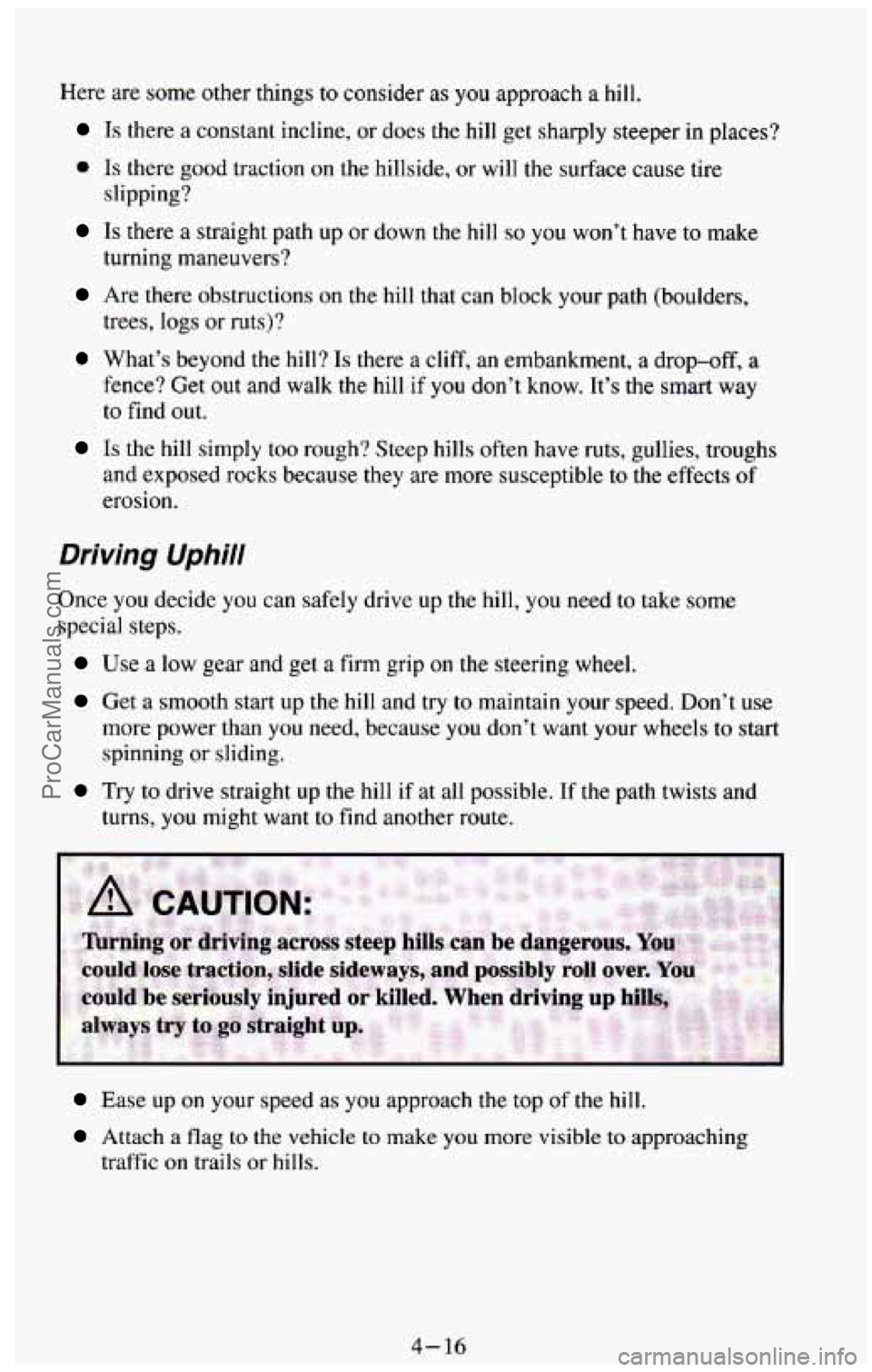
Try to drive straight up the hill if at all possible. If the path twists and
turns,
you might want to find another route.
Ease up on your speed as you approach the top of the hill.
Attach a flag to the vehicle to make you more visible to approaching
traffic
on trails or hills.
4-16
ProCarManuals.com
Page 176 of 385
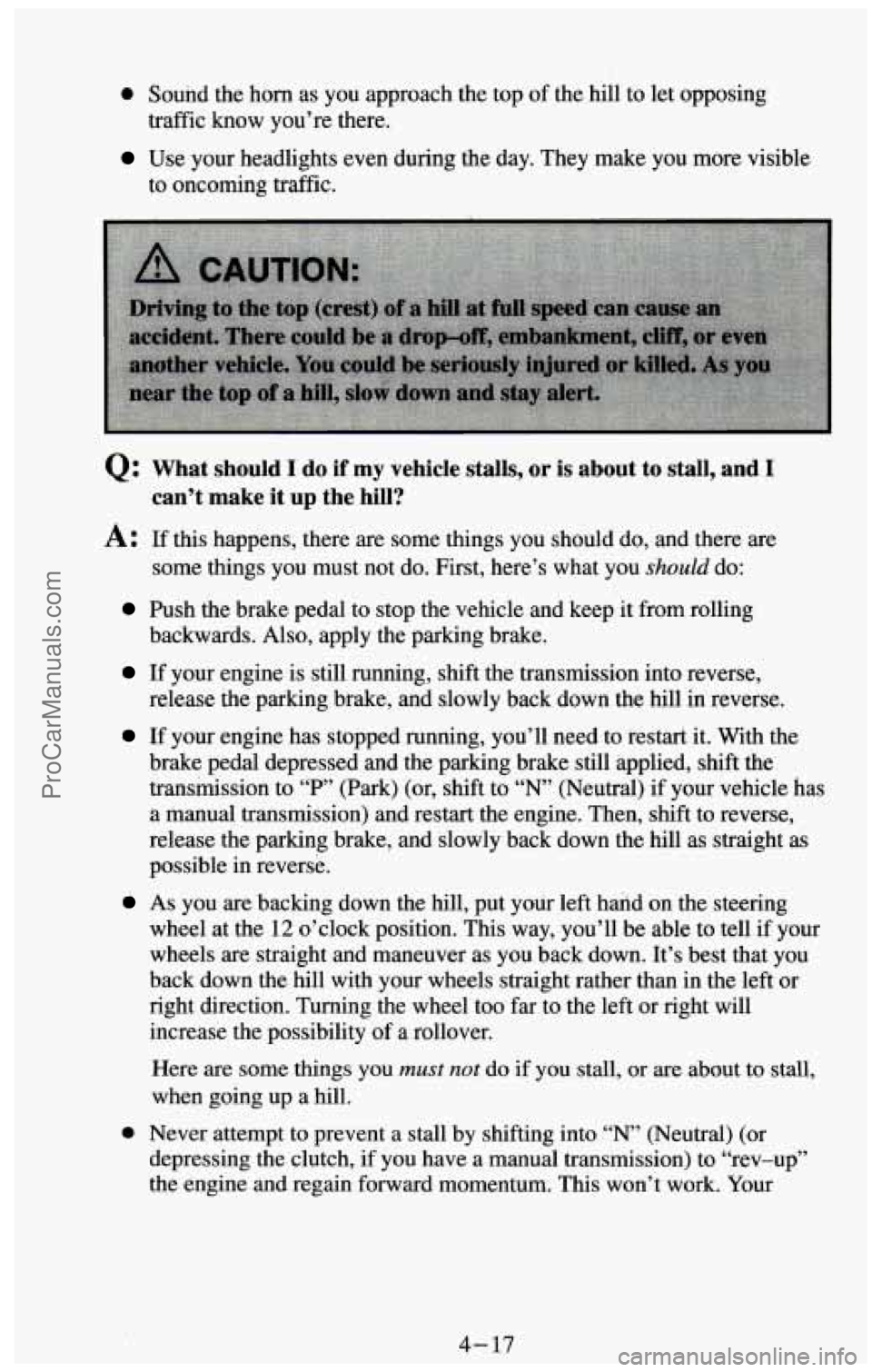
0 Sound the horn as you approach the top of the hill to let opposing
Use your headlights even during the day. They make you more visible
traffic know you’re there.
to
oncoming traffic.
Q: What should I do if my vehicle stalls, or is about to stall, and I
can’t make it up the hill?
A: If this happens, there are some things you should do, and there are
some things you must not do. First, here’s what you
should do:
Push the brake pedal to stop the vehicle and keep it from rolling
backwards. Also, apply the parking brake.
If your engine is still running, shift the transmission into reverse,
release the parking brake, and slowly back down the hill in reverse.
If your engine has stopped running, you’ll need to restart it. With the
brake pedal depressed and the parking brake still applied, shift the
transmission to
“P” (Park) (or, shift to “N’ (Neutral) if your vehicle has
a manual transmission) and restart the engine. Then, shift to reverse,
release the parking brake, and slowly back down the
hill as straight as
possible in reverse.
wheel at the
12 o’clock position. This way, you’ll be able to tell if your
wheels are straight and maneuver as you back down. It’s best that you
back down the hill with your wheels straight rather than in the left or
right direction. Turning the wheel too far to the left or right will
increase the possibility of a rollover.
As you are backing down the hill, put your left hand on the steering
Here are some things you
must not do if you stall, or are about to stall,
when going
up a hill.
0 Never attempt to prevent a stall by shifting into “N” (Neutral) (or
depressing the clutch, if you have a manual transmission) to “rev-up”
the engine and regain forward momentum. This won’t work.
Your
4- 17
ProCarManuals.com
Page 191 of 385
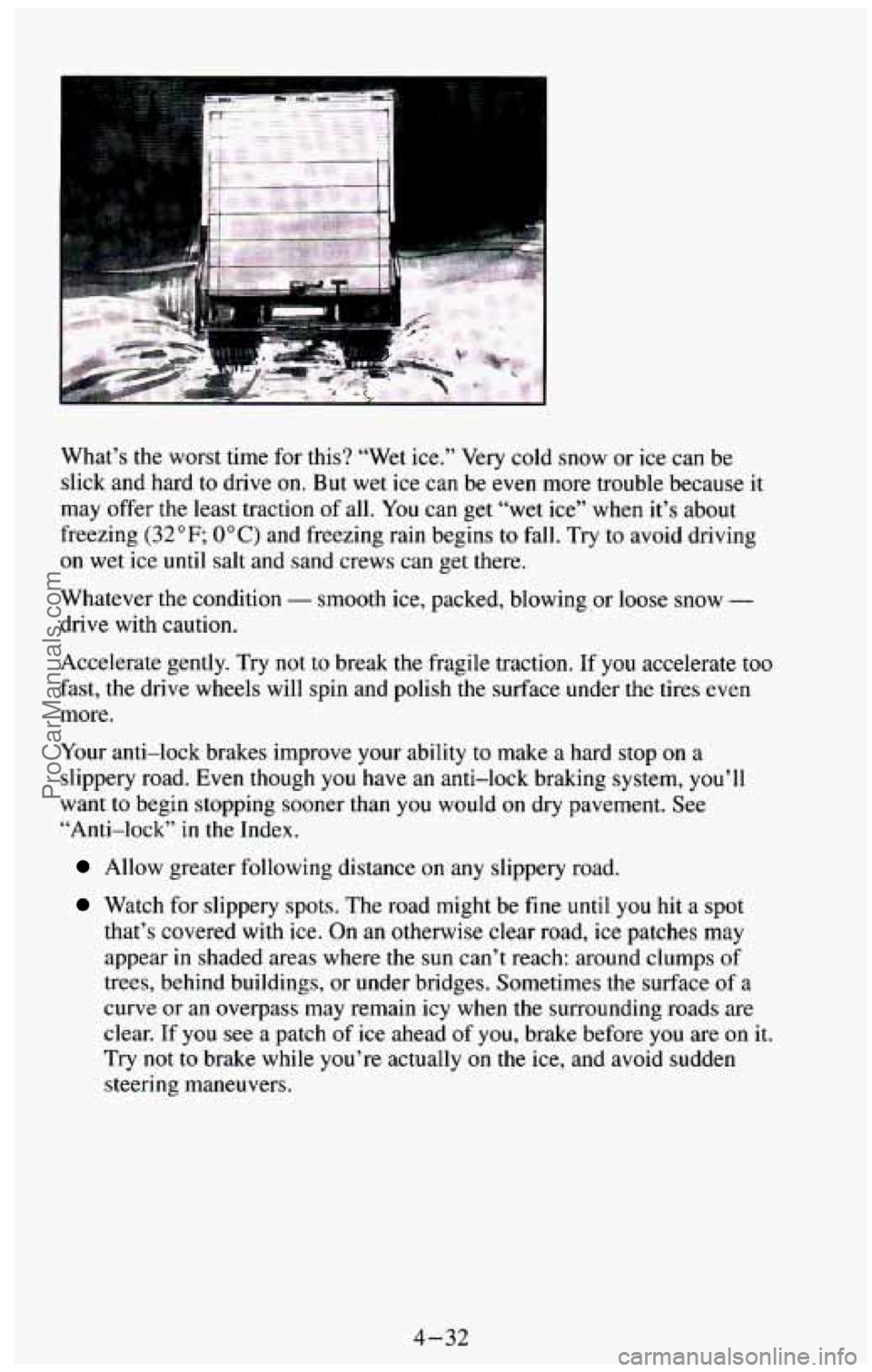
What’s the worst time for this? “Wet ice.” Very cold snow or ice can be
slick and hard to drive on.
But wet ice can be even more trouble because it
may offer the least traction of all. You can get “wet ice” when it’s about
freezing
(32°F; 0°C) and freezing rain begins to fall. Trv to avoid driving
on wet ice until salt and sand crews can get there.
Whatever the condition
- smooth ice, packed, blowing ,or loose snow -
drive with caution.
Accelerate gently. Try not to break the fragile traction. If you accelerate too
fast, the drive wheels will spin and polish the surface under the tires even
more.
Your anti-lock brakes improve your ability
to make a hard stop on a
slippery road. Even though you have an anti-lock braking system, you’ll
want to begin stopping sooner than you would on dry pavement. See
“Anti-lock” in the Index.
Allow greater following distance on any slippery road.
Watch for slippery spots. The road might be fine until you hit a spot
that’s covered with ice. On an otherwise clear road, ice patches may
appear
in shaded areas where the sun can’t reach: around clumps of
trees, behind buildings, or under bridges. Sometimes the surface of a
curve
or an overpass may remain icy when the surrounding roads are
clear. If you see a patch of ice ahead of you, brake before you are on it.
Try not to brake while you’re actually on the ice, and avoid sudden
steering maneuvers.
4-32
ProCarManuals.com
Page 193 of 385
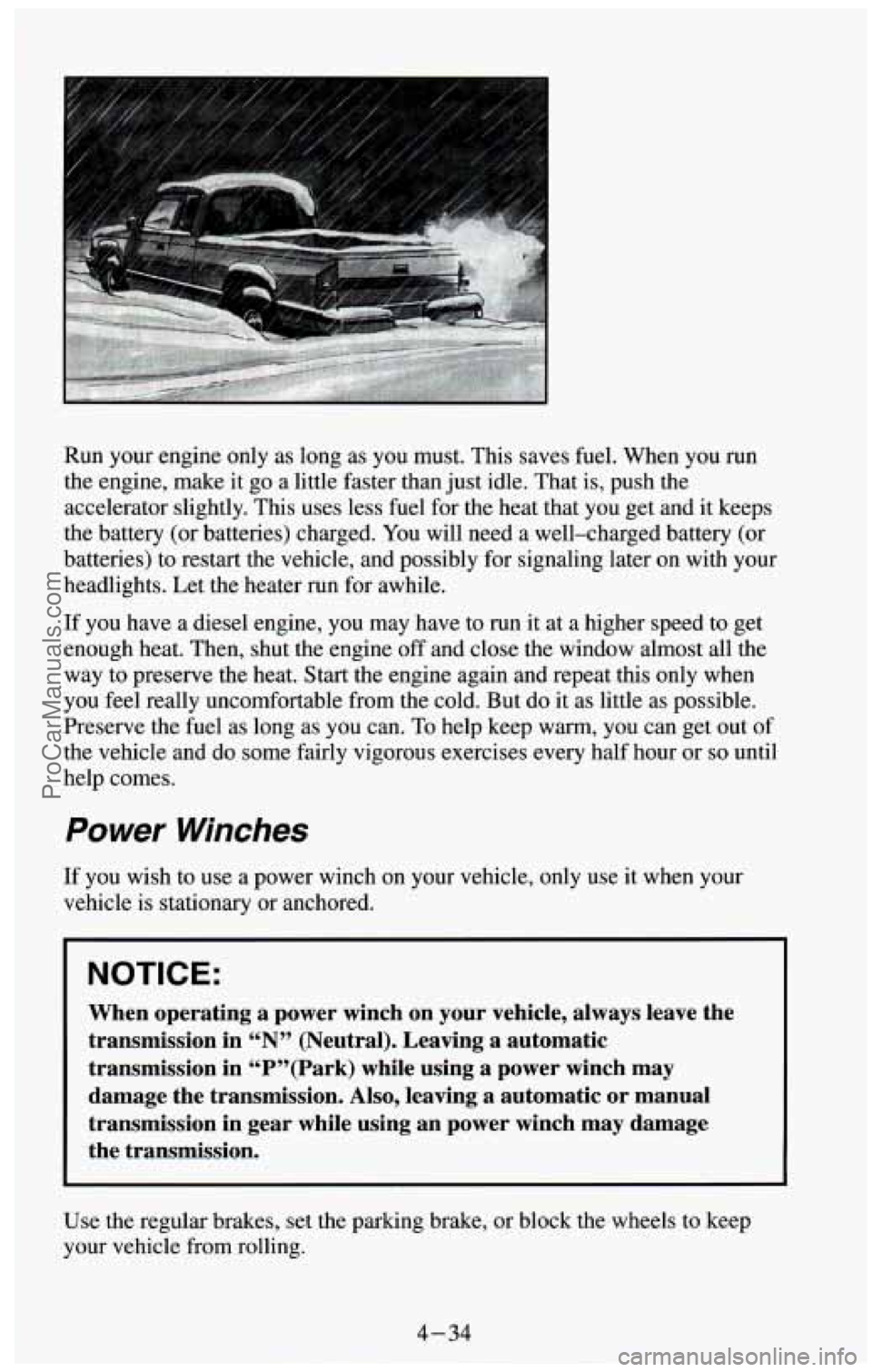
Run your engine only as long as you must. This saves fuel. When you run
the engine, make it
go a little faster than just idle. That is, push the
accelerator slightly. This uses less fuel for the heat that you get and it keeps
the battery (or batteries) charged.
You will need a well-charged battery (or
batteries) to restart the vehicle, and possibly for signaling later on with your
headlights. Let the heater run for awhile.
If you have a diesel engine, you may have to run it at a higher speed to get
enough heat. Then, shut the engine
off and close the window almost all the
way to preserve the heat. Start the engine again and repeat this only when
you feel really uncomfortable from the cold. But do it as little as possible.
Preserve the fuel as long as you can.
To help keep warm, you can get out of
the vehicle
and do some fairly vigorous exercises every half hour or so until
help comes.
Power Winches
If you wish to use a power winch on your vehicle, only use it when your
vehicle is stationary or anchored.
NOTICE:
When operating a power winch on your vehicle, always leave the
transmission in “N” (Neutral). Leaving a automatic
transmission in “P”(Park) while using a power winch may \
damage the transmission. Also, leaving a automatic or manual
transmission in gear while using an power winch may damage
the transmission.
Use the regular brakes, set the parking brake, or block the wheels to keep
your vehicle from rolling.
4-34
ProCarManuals.com
Page 211 of 385
0 Whether you can move the shift lever for the transmission and transfer
case,
if you have one.
If there was an accident, what was damaged.
When your vehicle is being towed, have the ignition key off. The steering
wheel should be clamped
in a straight-ahead position, with a clamping
device designed for towing service,
Do not use the vehicle’s steering
column lock for this.
The transmission and transfer case, if you have one,
should be in Neutral and the parking brake released.
5-8 ProCarManuals.com
Page 239 of 385
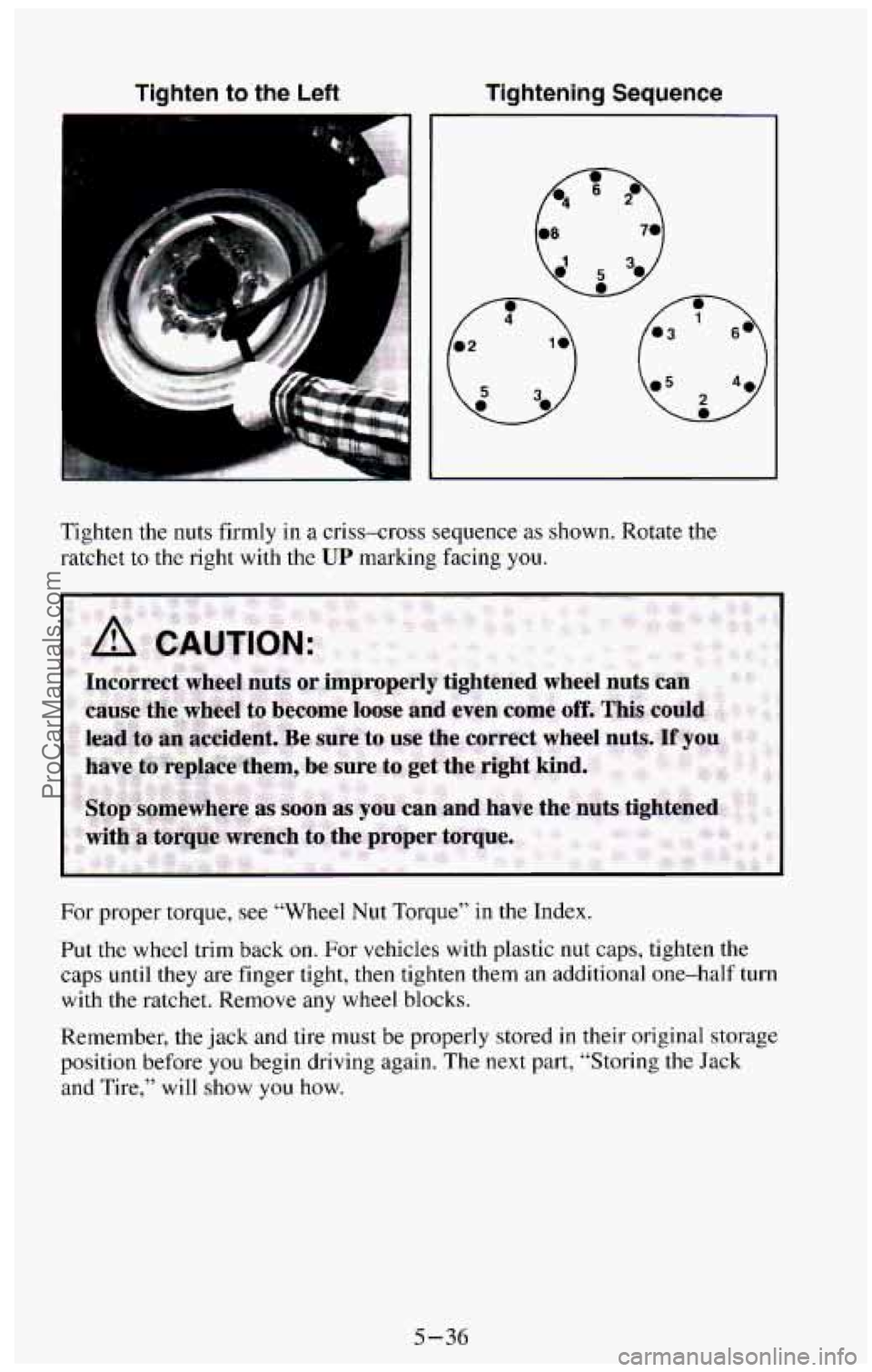
Tiqhten to the Left Tightening Sequence
Tighten the nuts firmly in a criss-cross sequence as shown. Rotate the
ratchet
to the right with the UP marking facing you.
For proper torque, see “Wheel Nut Torque” in the Index.
Put the wheel trim back on.
For vehicles with plastic nut caps, tighten the
caps until they are finger tight, then tighten them
an additional one-half turn
with the ratchet. Remove any wheel blocks.
Kernember, the jack and tire must be properly stored
in their original stbfige
position before you begin driving again. The
next part, “Storing the Jack
and Tire,” will show you how.
5-36
ProCarManuals.com
Page 266 of 385
Engine Oil Additives
Don’t add anything to your oil. Your GM dealer is ready to advise if you
think something should be added.
When to Change Engine Oil
See if any one of these is true for you:
Most trips are less than 4 miles (6 km).
0 It’s below freezing outside and most trips are less than 10 miles (16 km).
The engine is at low speed most of the time (as in door-to-door
You tow a trailer often.
delivery,
or in stop-and-go traffic).
Most trips are through dusty places.
The vehicle is frequently operated off-road.
If any one
of these is true for your vehicle, then you need to change your oil
andfifilter every 3,000 miles (5 000 km) or 3 months - whichever comes
first
.
Light Duty Emissions:
If none of them is true, change the oil every 7,500 miles (12 500 km) or
12 months - whichever comes first. Change the filter at the first oil change
and at every other oil change after that.
Heavy Duty Emissions:
If none of them is true, change the oil every 6,000 miles ( 10 000 km) or
12 months - whichever comes first. Change the filter at the first oil change
and at every other oil change after that if mileage determines when you
change your oil.
If time determines when you change your oil, change the
filter each time you change your
oil.
Engine Coolant Heater (Engine Block Heater)
An engine coolant heater can be a big help if you have to park outside in
very cold weather,
0°F (-1 8 “C) or colder. If your vehicle has this option,
see “Engine Coolant Heater
” in the Index.
What to Do with Used Oil
Did you know that used engine oil contains certain elements that may be
unhealthy for your skin and could even cause cancer? Don’t let used oil stay
on your skin for very long. Clean your skin and nails with soap and water,
or
a good hand cleaner. Wash or properly throw away clothing or rags
containing
used engine oil. (See the manufacturer’s warnings about the use
and disposal of oil products.)
6-21
ProCarManuals.com
Page 275 of 385
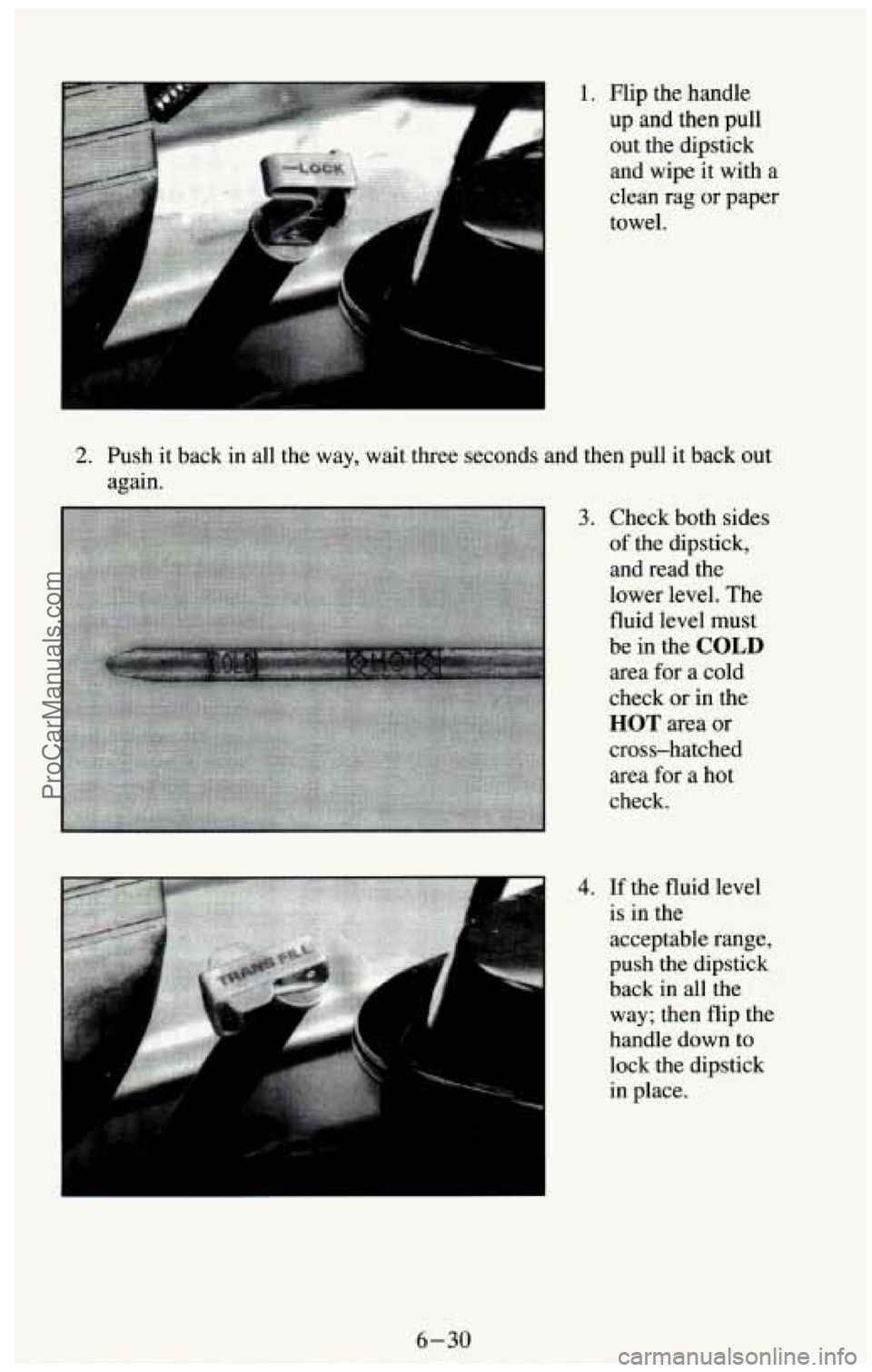
1. Flip the handle
up and then pull
out the dipstick
and wipe it with a
clean rag or paper
towel.
2. Push it back in all the way, wait three seconds and then pull it back out
again.
3. Check both sides
of the dipstick,
and read the
lower level. The
fluid level must
be in the
COLD
area for a cold
check or in the
HOT area or
cross-hatched
area for a hot
check.
4. If the fluid level
is in the
acceptable range,
push
the dipstick
back in all the
way; then flip the
handle down
to
lock the dipstick
in place.
ProCarManuals.com
Page 276 of 385
WOW to Add Fluid
Refer to the Maintenance Schedule to determine what kind of transmission
fluid to use. See “Recommended Fluids and Lubricants’’ in the Index.
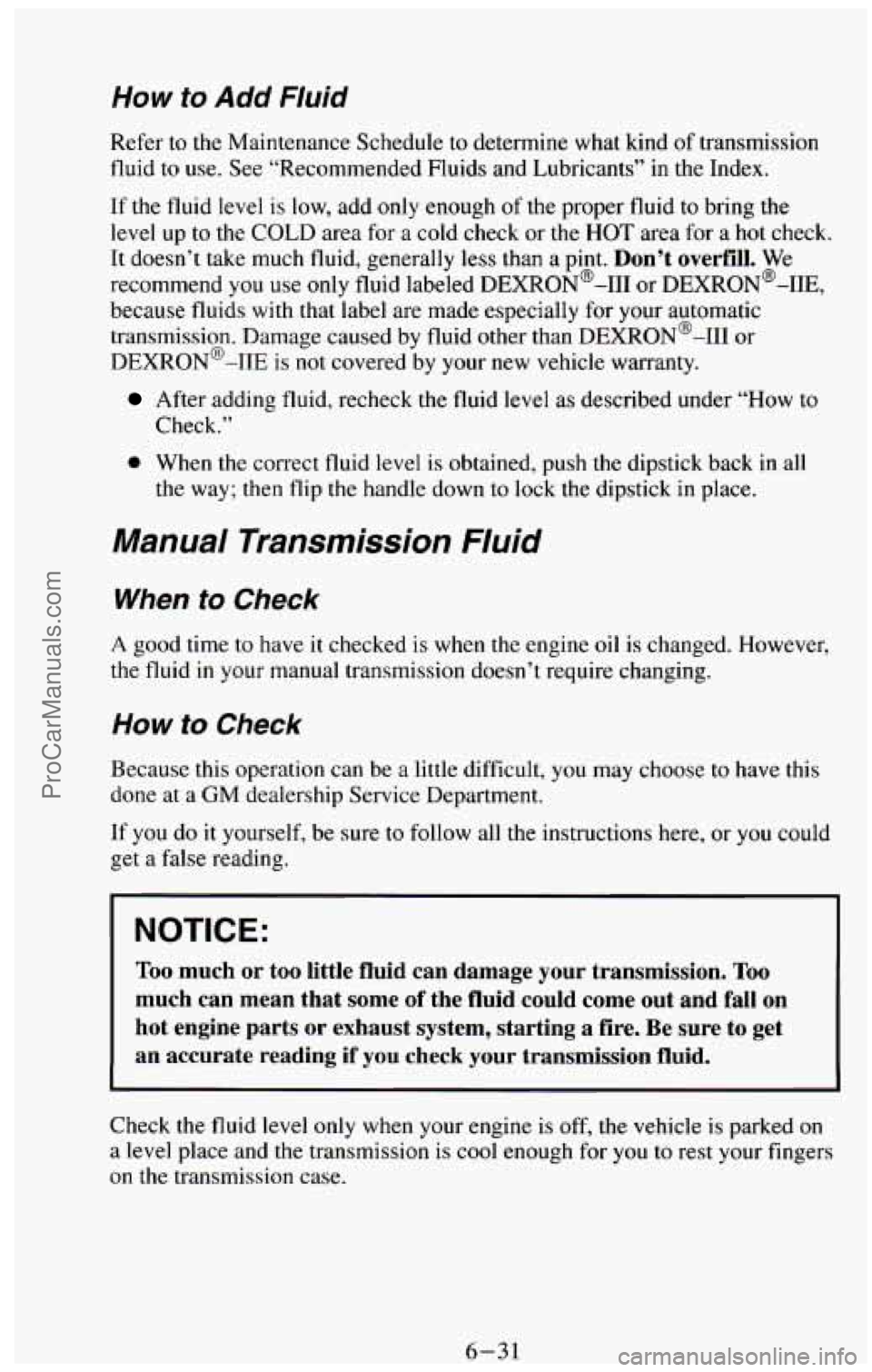
If the fluid level
is low, add only enough of the proper fluid to bring the
level up to the
COLD area for a cold check or the HOT area for a hot check.
It doesn’t take much fluid, generally
less than a pint. Don’t overfill. We
recommend you use
only fluid labeled DEXRON@-I11 or DEXRON@-IIE,
because fluids with that label are made especially for your automatic
transmission. Damage caused
by fluid other than DEXRON@-I11 or
DEXRON@-IIE is not covered
by your new vehicle warranty.
After adding fluid, recheck the fluid level as described under “How to
Check.”
When the correct fluid level is obtained, push the dipstick back in all
the way; then flip the handle down to lock the dipstick
in place.
Manual Transmission Fluid
When to Check
A good time to have it checked is when the engine oil is changed. However,
the fluid
in your manual transmission doesn’t require changing.
How to Check
Because this operation can be a little difficult, you may choose to have this
done at a
GM dealership Service Department.
If you do it yourself, be sure to follow all the instructions here, or you could
get
a false reading.
NOTICE:
Too much or too little fluid can damage your transmission. Too
much can mean that some of the fluid could come out and fall on
hot engine parts or exhaust system, starting a fire. Be sure to get
an accurate reading if
you check your transmission fluid.
Check the fluid level only when your engine is off, the vehicle is parked on
a level place and the transmission is cool enough for you to rest your fingers
on the transmission case.
6-31 ProCarManuals.com