light CHEVROLET SUBURBAN 1994 Manual Online
[x] Cancel search | Manufacturer: CHEVROLET, Model Year: 1994, Model line: SUBURBAN, Model: CHEVROLET SUBURBAN 1994Pages: 385, PDF Size: 19.88 MB
Page 296 of 385
NOTICE:
Avoid touching the bulb or letting it come in contact with
anything damp. Oil from
your skin or moisture on the bulb can
cause the bulb to explode when it is turned on. If either comes in
contact with the bulb, clean
it with alcohol or a suitable
degreaser and wipe the bulb dry.
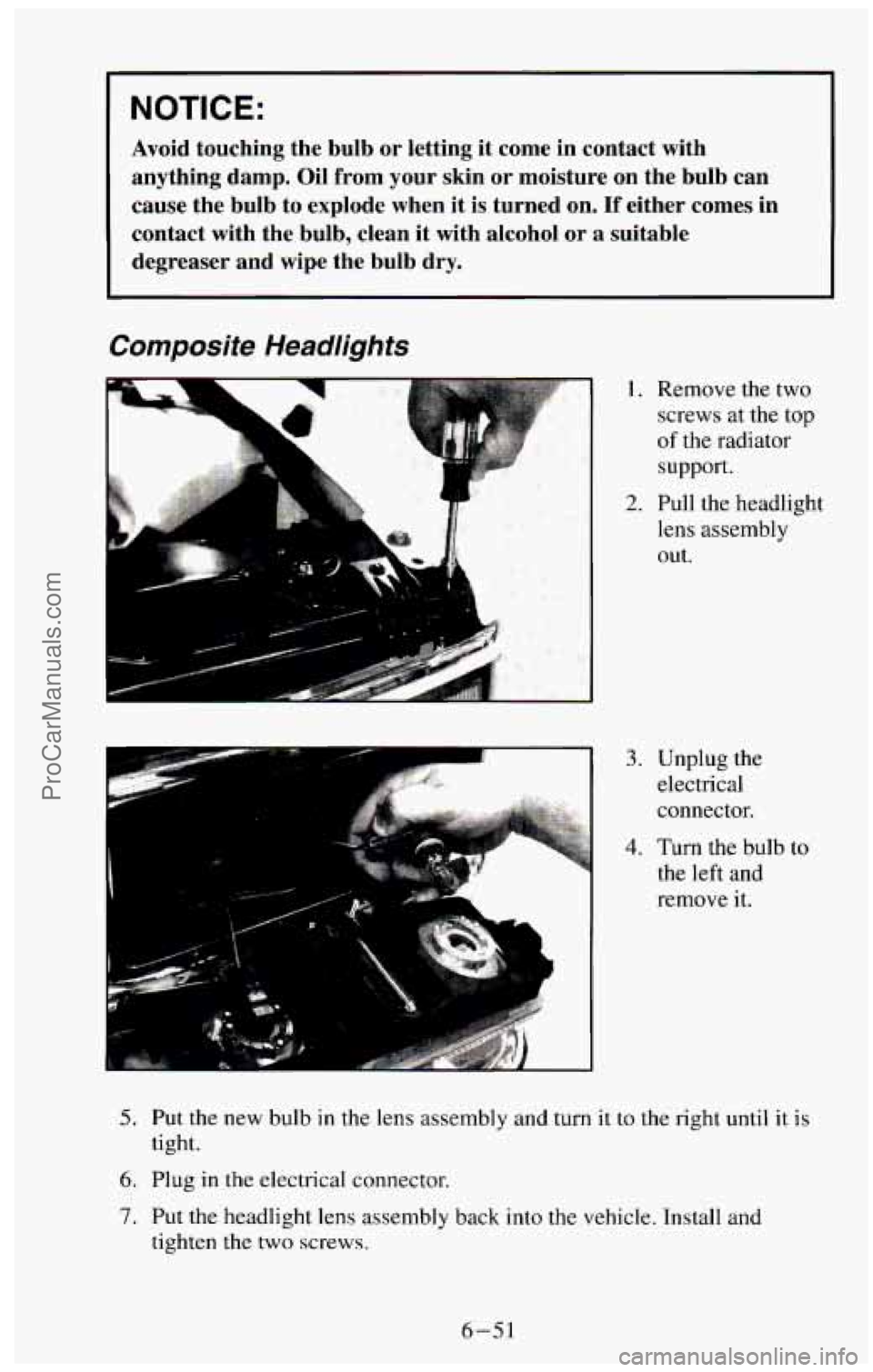
Composite Headlights
.' --6n k
'I
i 1. Remove the two
screws at the top
of the radiator
support.
2. Pull the headlight
lens assembly
out.
3. Unplug the
electrical
connector.
4. Turn the bulb to
the left and
remove it.
5. Put the new bulb in the lens assembly and turn it to the right until it is
6. Plug in the electrical connector.
7. Put the headlight lens assembly back into the vehicle. Install and
tight.
tighten the two screws.
6-51
ProCarManuals.com
Page 297 of 385
Front Parkingnurn Signal Lights with
Sealed Beam Headlights
1. Remove the two screws at the inside edge of the parkinghurn signal
light assembly.
2. Remove the light assembly by swinging it out from the inside edge and
3. Squeeze the tab on the side of the light socket while turning the socket
sliding
it out at the outside edge.
to the left.
4. Pull the socket out of the light assembly.
5. Push in gently on the bulb, turn it to the left and remove it from the
socket.
6. Put the new bulb in the socket, gently press in on the bulb and turn it to
the right until it is tight.
right until it
locks.
7. Put the socket back into the light assembly and turn it socket to the
8. Put the parkinghrn signal light assembly back into the vehicle and
tighten the screws.
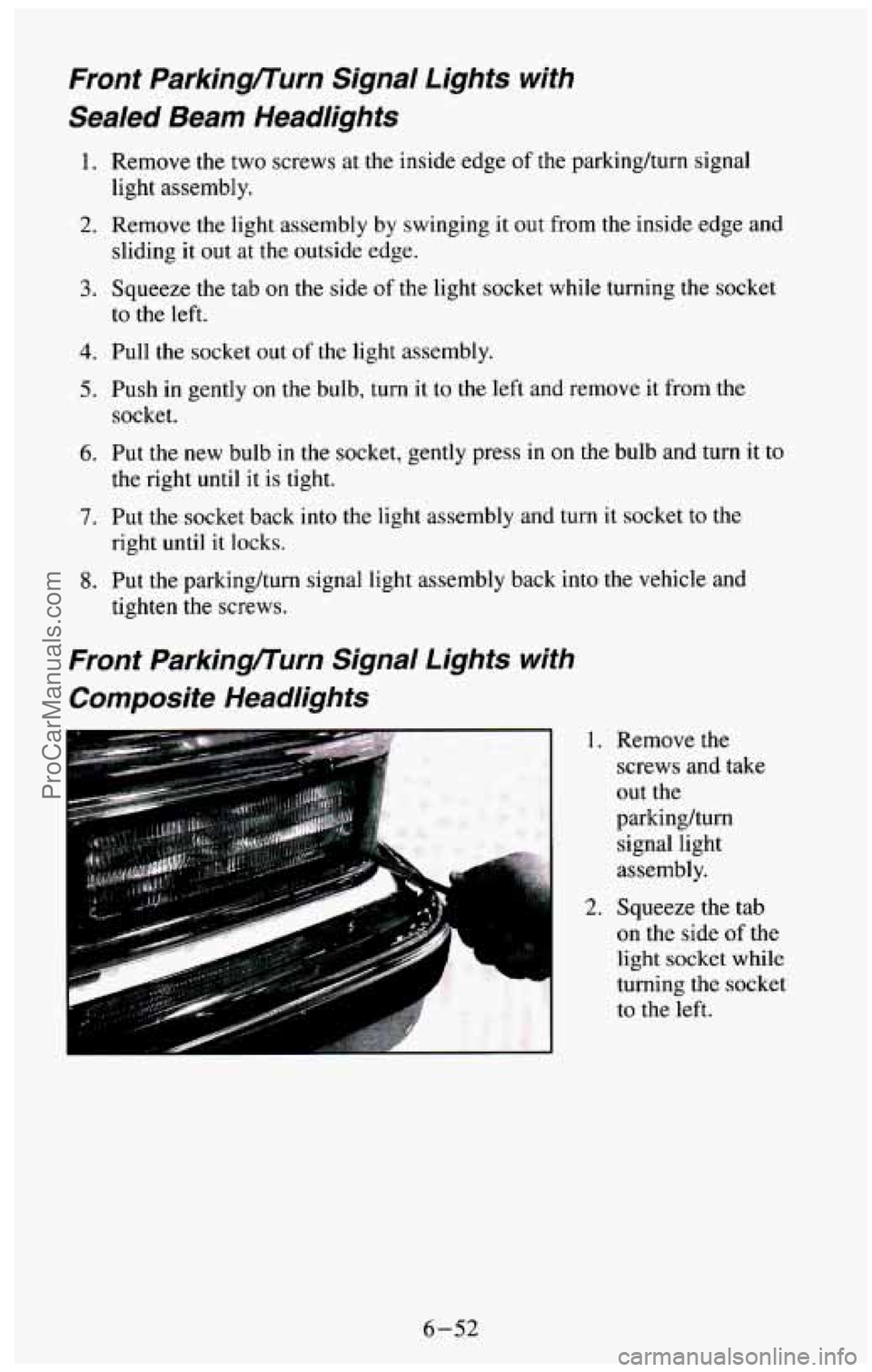
Front Parkingnurn Signal Lights with
Composite Headlights
1. Remove the screws and take
out the
parkinghum signal light
assembly.
2. Squeeze the tab
on the side of the
light socket while
turning
the socket
to the left.
6-52
ProCarManuals.com
Page 298 of 385
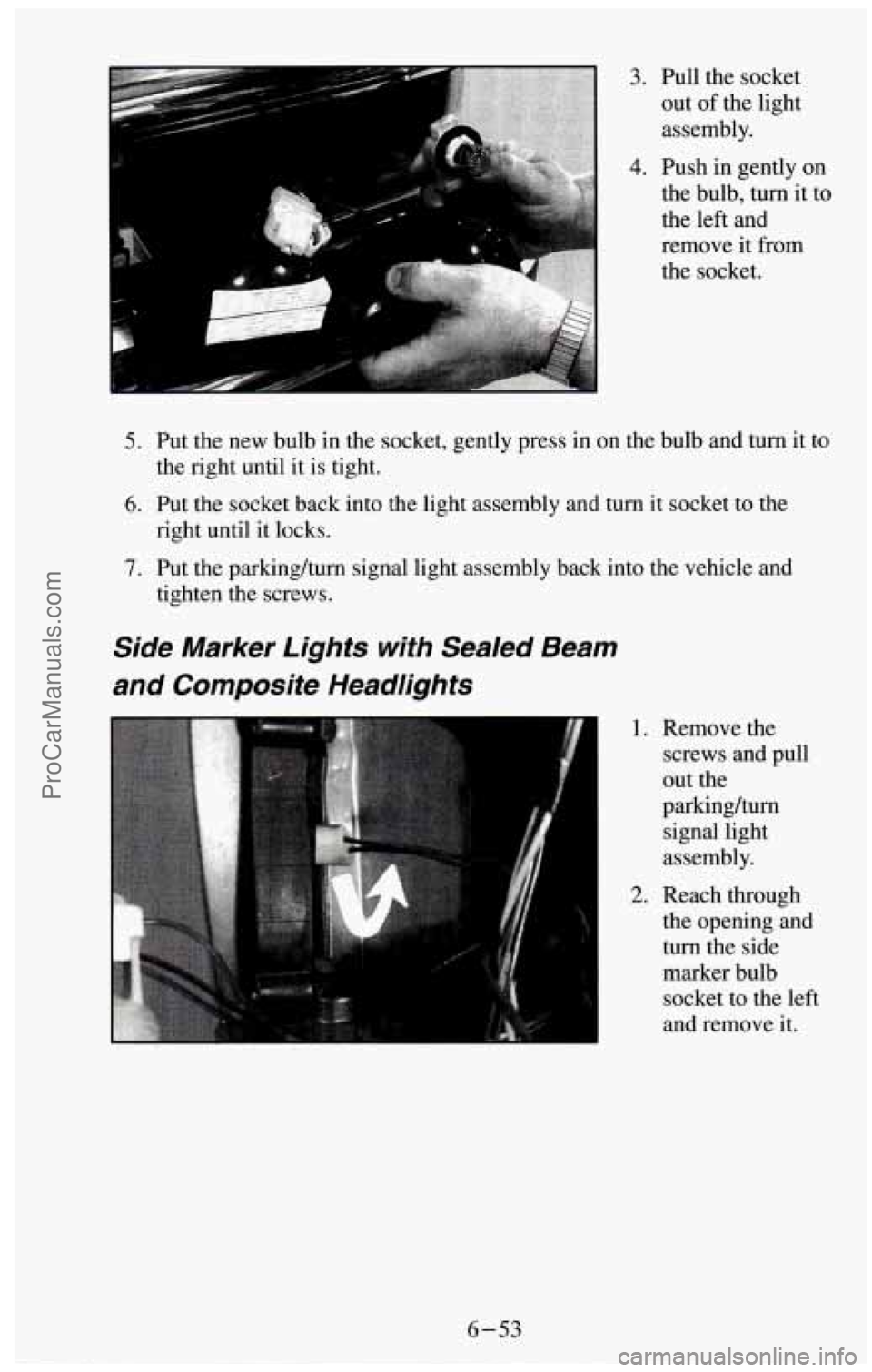
the left and
remove it from
the socket.
5. Put the new bulb in the socket, gently press in on the bulb and turn it to
6. Put the socket back into the light assembly and turn it socket to the
7. Put the parking/turn signal light assembly back into the vehicle and
the right until
it is tight.
right until it locks.
tighten the screws.
Side Marker Lights with Sealed Beam
and Composite Headlights
1. Remove the screws and pull
out the
parking/tum signal light
assembly.
2. Reach through the opening and
turn the side
marker bulb socket to the left
and remove it.
6-53
- ProCarManuals.com
Page 299 of 385
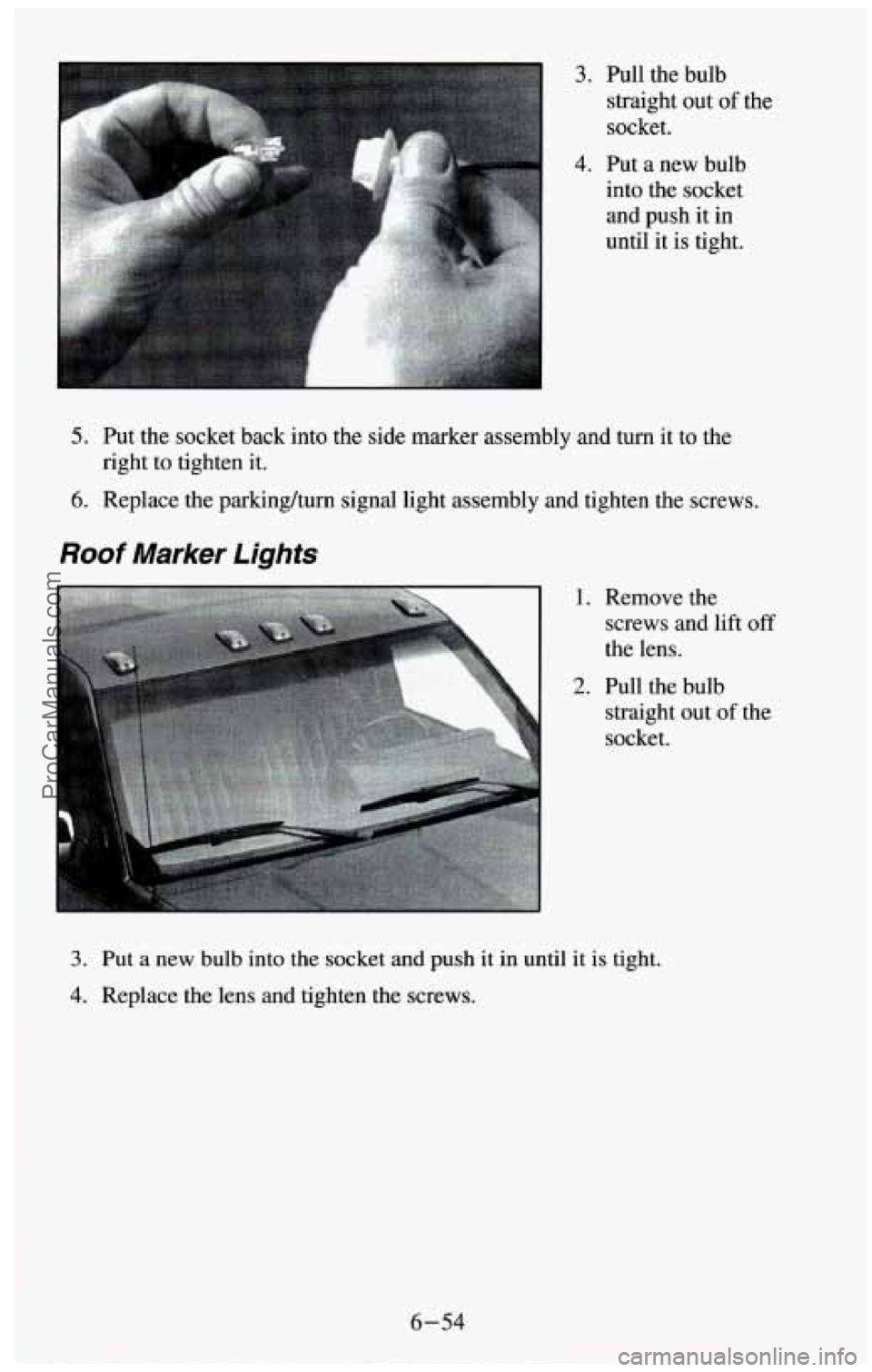
3. Pull the bulb straight out
of the
socket.
4. Put a new bulb
into the socket
and push it in
until it is tight.
5. Put the socket back into the side marker assembly and turn it to the
right to tighten it.
6. Replace the parking/turn signal light assembly and tighten the screws.
Roof Marker Lights
1. Remove the
screws and lift
off
the lens.
2. Pull the bulb
straight out
of the
socket.
3. Put a new bulb into the socket and push it in until it is tight.
4. Replace the lens and tighten the screws.
6-54
ProCarManuals.com
Page 300 of 385
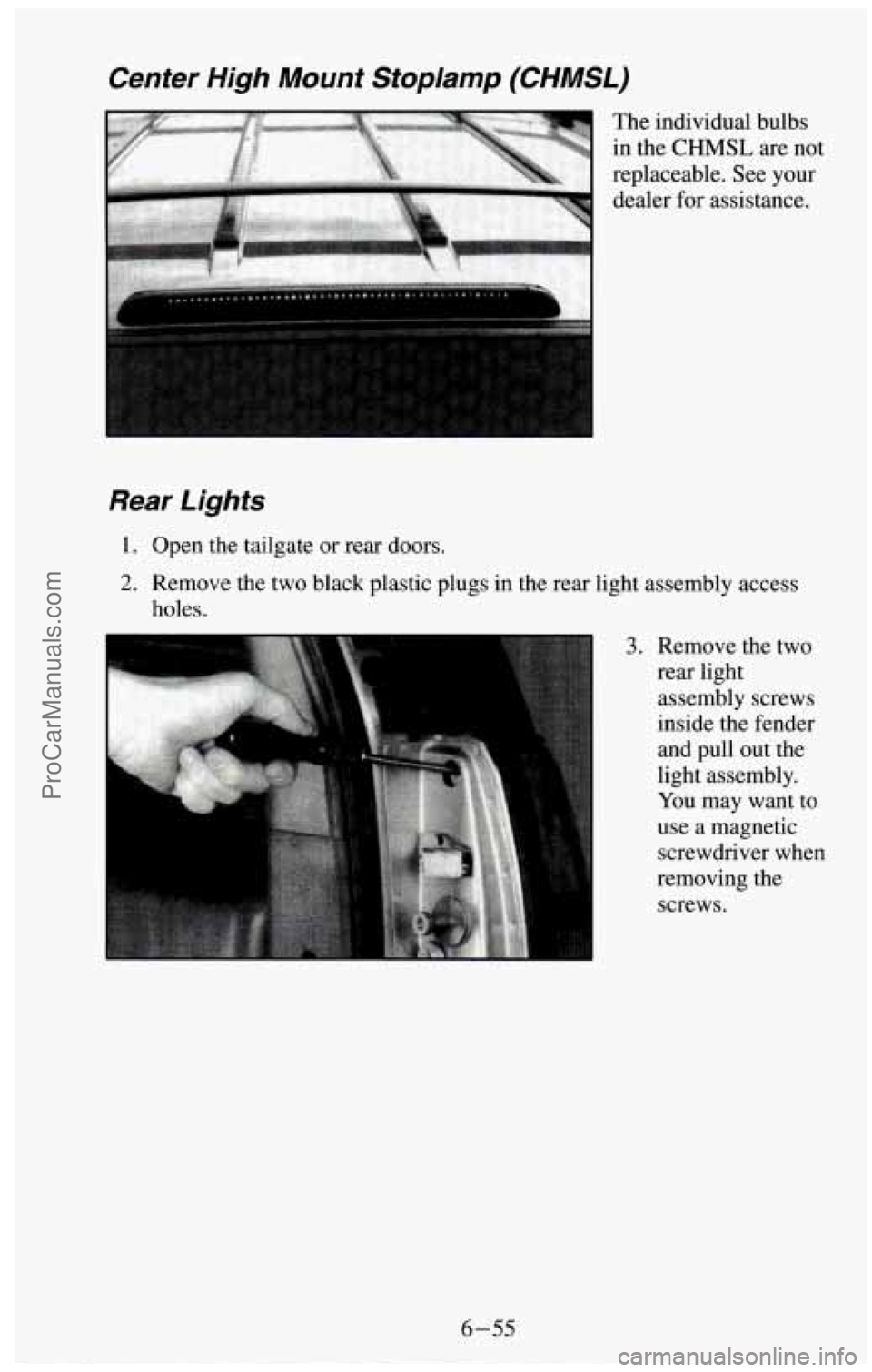
Center High Mount Stop/amp (CHMSL)
“,Gar-& ... “B 3 The individual bulbs
in the
CHMSL are not
replaceable. See your
dealer for assistance.
Rear Lights
1. Open the tailgate or rear doors.
2. Remove the two black plastic plugs in the rear light
holes.
I 3.
assembly access
Remove the two
rear light
assembly screws
inside the fender
and pull out the
light assembly. You may want to
use a magnetic
screwdriver when
removing the
screws.
6-55
ProCarManuals.com
Page 301 of 385
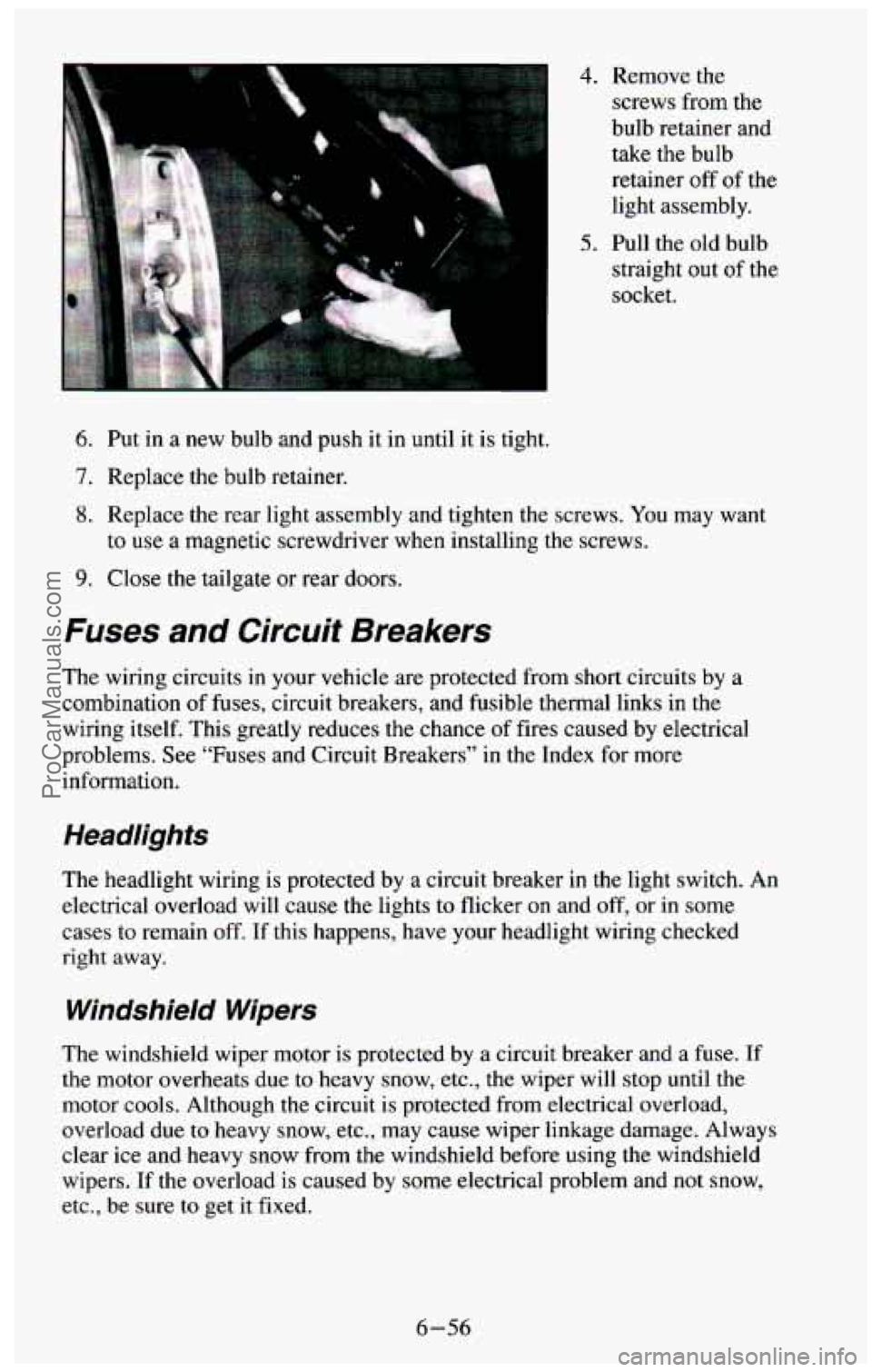
4. Remove the
screws from the
bulb retainer and
take the bulb
retainer
off of the
light assembly.
5. Pull the old bulb
straight out
of the
socket.
6. Put in a new bulb and push it in until it is tight.
7. Replace the bulb retainer.
8. Replace the rear light assembly and tighten the screws. You may want
to use
a magnetic screwdriver when installing the screws.
9. Close the tailgate or rear doors.
Fuses and Circuit Breakers
The wiring circuits in your vehicle are protected from short circuits by a
combination
of fuses, circuit breakers, and fusible thermal links in the
wiring itself. This greatly reduces the chance of fires caused by electrical
problems. See “Fuses and Circuit Breakers” in the Index for more
information.
The headlight wiring is protected by
a circuit breaker in the light switch. An
electrical overload
will cause the lights to flicker on and off, or in some
cases to remain off.
If this happens, have your headlight wiring checked
right away.
Windshield Wipers
The windshield wiper motor is protected by a circuit breaker and a fuse. If
the motor overheats due to heavy snow, etc., the wiper will stop until the
motor cools. Although
the circuit is protected from electrical overload,
overload due to heavy snow, etc., may cause wiper linkage damage. Always
clear ice and heavy snow from the windshield before using the windshield
wipers.
If the overload is caused by some electrical problem and not snow,
etc., be sure to get it fixed.
6-56
ProCarManuals.com
Page 303 of 385
some feature of your vehicle that you can get along without-like the radio
or cigarette lighter-and use its fuse, if it is of the value you need. Replace
it as soon as you can. See “Fuses and Circuit Breakers’’ in the Index
for
more information.
Exhaust System
To help prevent damage to your exhaust system, do not continue to drive
your vehicle if you notice:
Engine misfiring
Loss of performance
Other unusual operating conditions
Have your engine and exhaust system serviced regularly.
Three- Way Catalytic Converter (gas engines)
Your vehicle’s three-way catalytic converter is designed to reduce the
pollutants in your vehicle’s exhaust. Use only unleaded fuel in your vehicle.
If you use leaded fuel, you could damage your three-way catalytic converter
and other engine components.
Three- Way Catalytic Converter (diesel engines)
Your vehicle’s three-way catalytic converter is designed to reduce the
particulates in your vehicle’s exhaust. If your vehicle’s three-way catalytic
converter ever needs to be replaced, it must be replaced with a three-way
catalytic converter intended for use with diesel engines only.
Engine Contro/ Module System (All T61 equipped
vehicles and diesel engine vehicles below
8,500 lbs. GVWR)
Gasoline Engines
This system has an oxygen sensor (02) that helps keep your engine’s
air-fuel mixture at a proper level. Use only unleaded fuel in your vehicle. If
you use leaded fuel, you could damage your oxygen sensor
(02) and
three-way catalytic converter.
Diesel Vehicles Below S,5UU LBS. GVWR
This system monitors engine speed and throttle position. It adjusts exhaust
gas recirculation to limit emissions.
ProCarManuals.com
Page 304 of 385
Malfunction Indicator
(SERVICE ENGINE SOON) Lamp
The Malfunction Indicator (SERVICE ENGINE SOON) Lamp on your
instrument panel lets you know when your emission system needs service.
The light
will come on briefly when you start your engine to let you know
that the system is working.
If it does not come on when you start your
engine,
or if it comes on and stays on while you're driving, your system
may need service. Your vehicle should still be driveable, but
you should
have your system serviced right away.
Secondary Air Injection Reaction (AIR) System
You may have this system. It has a control valve that will direct air to where
it is needed. If the AIR system needs service, your Malfunction Indicator
(SERVICE ENGINE SOON) Lamp on your instrument panel will come
on.
Loading Your Vehicle
MFD BY GENERAL MOT0 RSCORP
i IN EFFECT -
I
- MODEL [ISPEED w
u TIRE SIZE RTG FilM PSllKPA (COLD)
q----p nri
SEE OWNERS MANUAL FOR ADDITIONAL INFORMATION
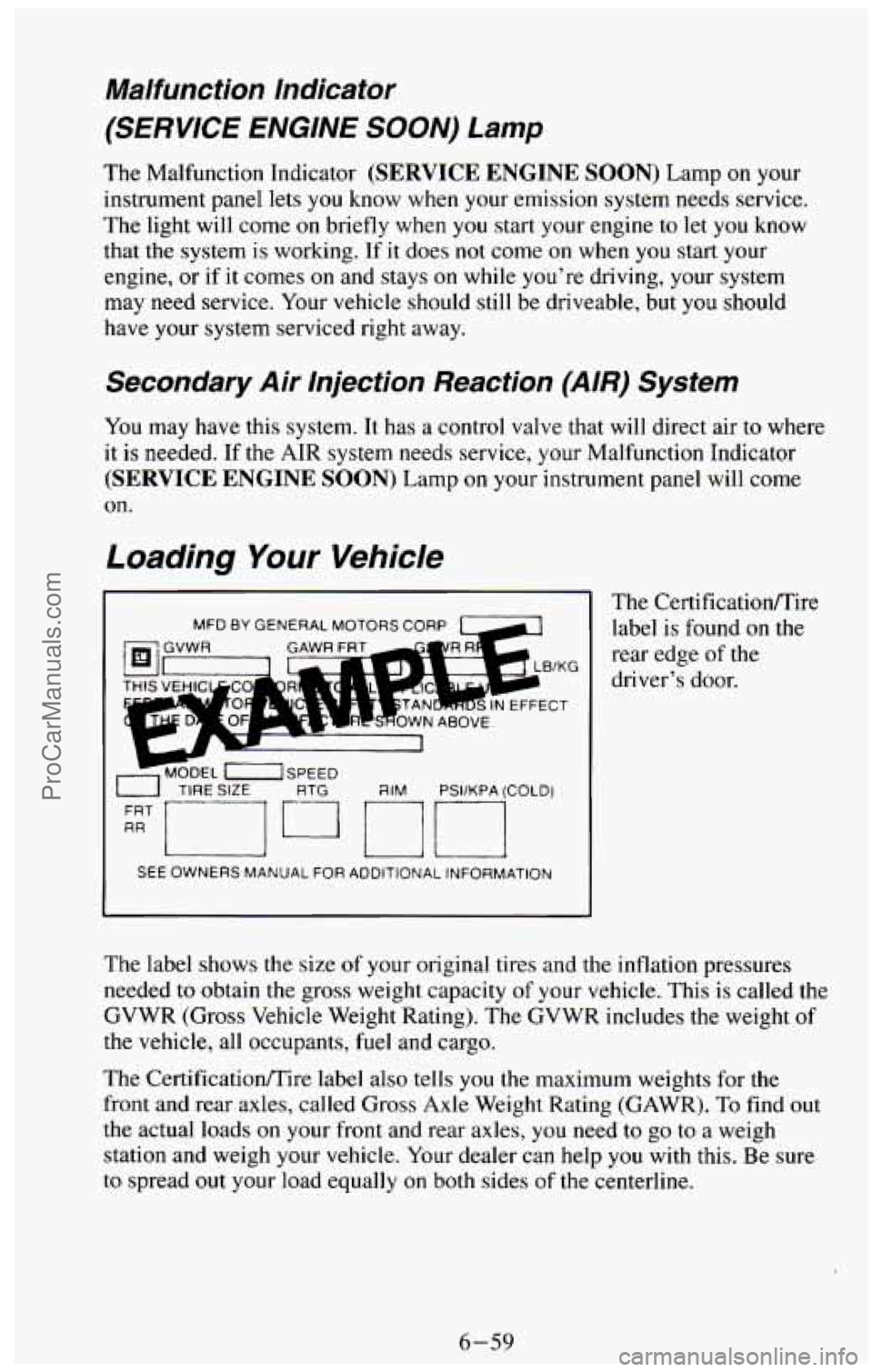
The CertificatiodTire
label is found
on the
rear edge
of the
driver's door.
The label shows the size
of your original tires and the inflation pressures
needed to obtain the gross weight capacity
of your vehicle. This is called the.
GVWR (Gross Vehicle Weight Rating). The GVWR includes the weight
of
the vehicle, all occupants, fuel and cargo.
The Certificatioflire label also tells you the maximum weights for the
front and rear axles, called Gross Axle Weight Rating (GAWR).
To find out
the actual loads on your front and rear axles,
you need to go to a weigh
station and weigh your vehicle. Your dealer can help you with this.
Be sure
to spread out your load equally on both sides of the centerline.
6-59
ProCarManuals.com
Page 313 of 385
Wheel Replacement
Replace any wheel that is bent, cracked or badly rusted. If wheel nuts keep
coming loose, the wheel, wheel bolts, and wheel nuts should be replaced.
If
the wheel leaks air, replace it (except some aluminum wheels, which can
sometimes be repaired). See your GM dealer if any
of these conditions exist.
Your dealer will know the kind
of wheel you need.
Each new wheel should have the same load carrying capacity, diameter,
width, offset, and be mounted the same way as the one it replaces.
If you need to replace any of your wheels, wheel bolts, or wheel nuts,
replace them only with new GM original equipment parts. This way, you
will be sure to have the right wheel, wheel bolts, and wheel nuts
for your
GM model.
NOTICE:
The wrong wheel can also cause problems with bearing life,
brake cooling, speedometer/odometer calibration, headlight aim, bumper height, vehicle ground clearance, and tire or tire chain\
clearance to the body and chassis.
Used Replacement Wheels
ProCarManuals.com
Page 316 of 385
Using Foam-Type Cleaner on Fabric
Vacuum and brush the area to remove any loose dirt.
Always clean a whole trim panel or section. Mask surrounding trim
Mix Multi-Purpose Powdered Cleaner following the directions on the
along
stitch or welt lines.
container label.
Use suds only and apply with a clean sponge.
Don’t saturate the material.
Don’t rub it roughly.
As soon as you’ve cleaned the section, use a sponge to remove me
suds.
Rinse the section with a clean, wet sponge.
Wipe off what’s left with a slightly damp paper towel or cloth.
0 Then dry it immediately with a blow dryer or a heat lamp.
NOTICE:
Be careful with a hair dryer or heat lamp. You could scorch the
fabric.
0 Wipe with a clean cloth.
Using Solvent-Type Cleaner on Fabric
First, see if you have to use solvent-type cleaner at all. Some spots and
stains will clean off better with just water and mild soap.
If
you need to use a solvent:
Gently scrape excess soil from the trim material with a clean, dull knife
or scraper. Use very little cleaner, light pressure and clean cloths
(preferably cheesecloth). Cleaning should start at the outside of
the
stain, “feathering” toward the center. Keep changing to a clean section
of the cloth.
When you clean a stain from fabric, immediately dry the area with an
air hose, hair dryer, or heat lamp to help prevent a cleaning ring. (See
the previous NOTICE.)
6-71
ProCarManuals.com