light CHEVROLET SUBURBAN 1994 Manual PDF
[x] Cancel search | Manufacturer: CHEVROLET, Model Year: 1994, Model line: SUBURBAN, Model: CHEVROLET SUBURBAN 1994Pages: 385, PDF Size: 19.88 MB
Page 263 of 385
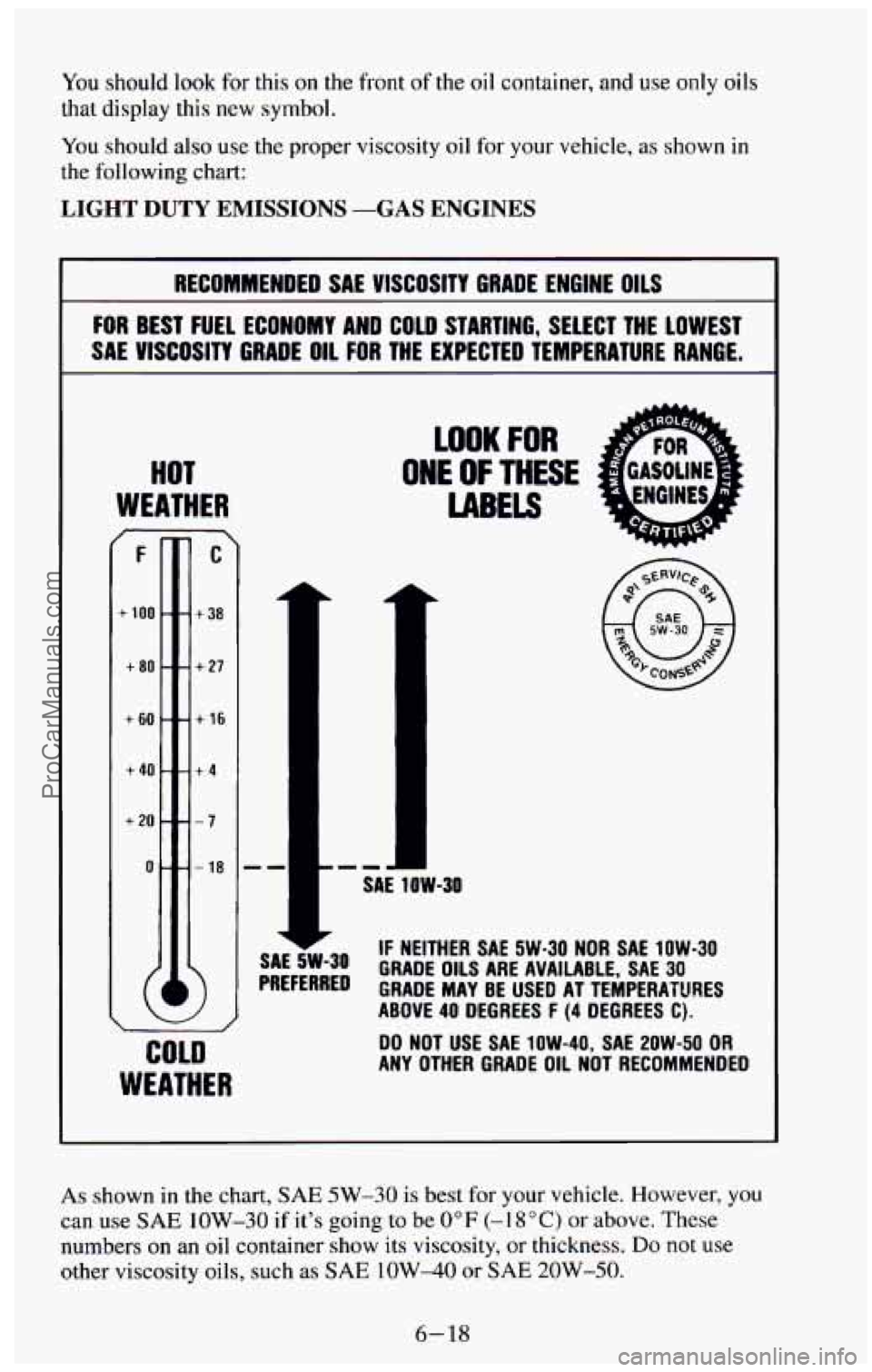
You should look for this on the front of the oil container, and use only oils
that display this new symbol.
You should also use the proper viscosity oil for your vehicle, as shown in
the following chart:
LIGHT DUTY EMISSIONS -GAS ENGINES
RECOMMENDED SAE VISCOSITY GRADE ENGINE OILS
FOR BEST FUEL ECONOMY AND COLD STARTING, SELECT THE LOWEST
SAL VISCOSITY GRADE OIL FOR THE EXPECTED TEMPERATURE RANGE.
HOT
WEATHER
F
+ 100 '
+80.
+60
+4a.
+20 -
0-
C
- +38
. +27
-+16
.+4
'-7
- 18
I
SAE SW-30
PREFERRED
LOOK FOR
ONE OF THESE
LABELS
SAE 1OW-30
IF NEITHER SAE 5W-30 NOR SAE 1OW-30
GRADE
OILS ARE AVAILABLE, SAE 30
GRADE MAY BE USED AT TEMPERATURES
ABOVE
40 DEGREES F (4 DEGREES C).
DO NOT USE SAE 1OW-40, SAE 2OW-50 OR
ANY OTHER GRADE OIL NOT RECOMMENDED
As shown in the chart, SAE 5W-30 is best for your vehicle. However, you
can use SAE 1OW-30 if it's going to be 0°F (- 1 8 O C) or above. These
numbers on
an oil container show its viscosity, or thickness. Do not use
other viscosity oils, such as SAE 1OW-40 or SAE 20W-50.
6-18
ProCarManuals.com
Page 265 of 385
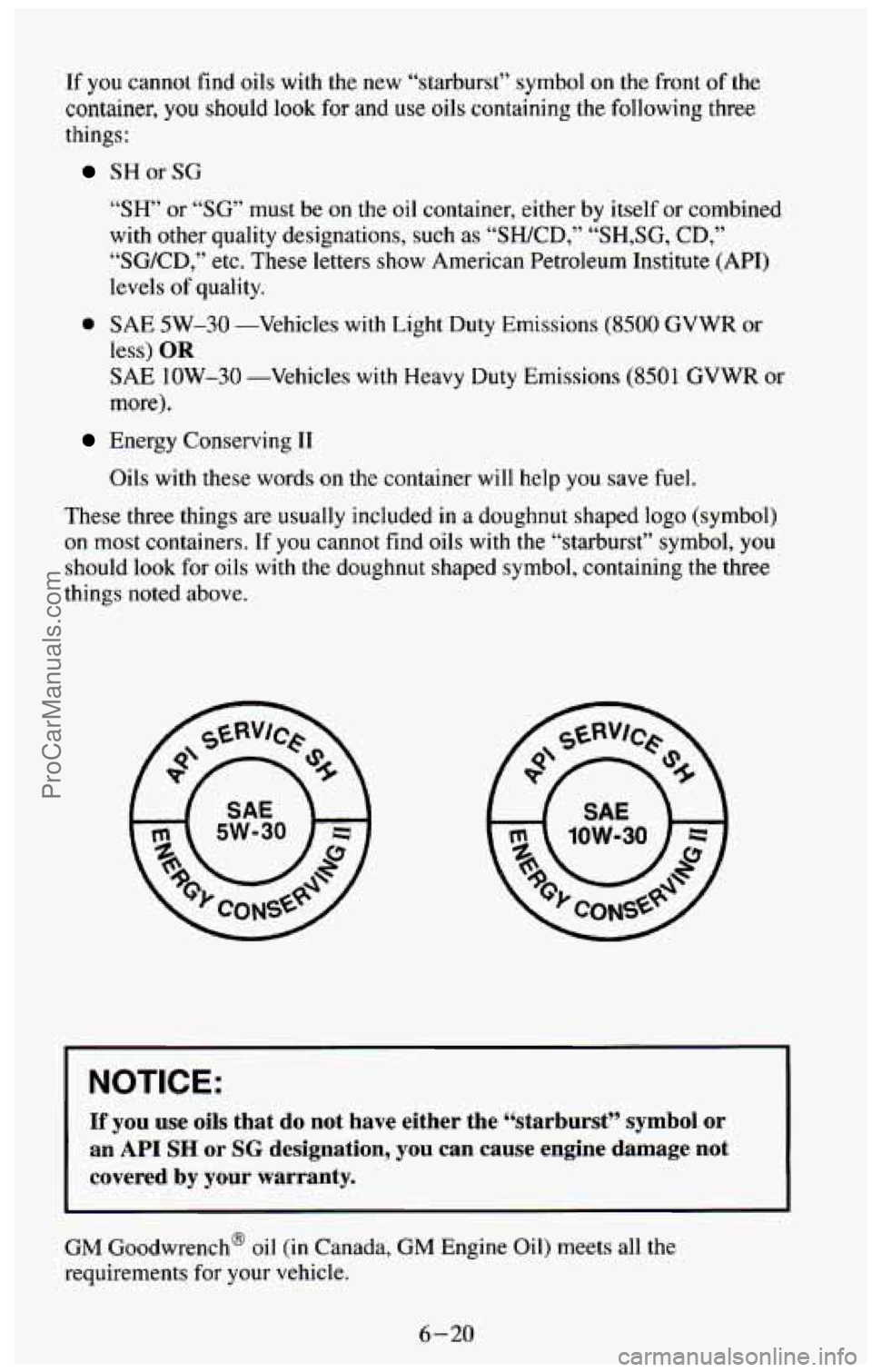
If you cannot find oils with the new “starburst” symbol on the front of the
container, you should look for and use oils containing the following three
things:
SHorSG
“SH’ or “SG’ must be on the oil container, either by itself or combined
with other quality designations, such as
“SWCD,” “SH,SG, CD,”
“SGKD,” etc. These letters show American Petroleum Institute (API)
levels
of quality.
less)
OR
SAE 1OW-30 -Vehicles with Heavy Duty Emissions (8501 GVWR or
more).
e SAE 5W-30 -Vehicles with Light Duty Emissions (8500 GVWR or
Energy Conserving I1
Oils with these words on the container will help you save fuel.
These three things are usually included
in a doughnut shaped logo (symbol)
on most containers.
If you cannot find oils with the “starburst” symbol, you
should look for
oils with the doughnut shaped symbol, containing the three
things noted above.
NOTICE:
If you use oils that do not have either the “starburst” sym\
bol or
an
API SH or SG designation, you can cause engine damage not
covered by your warranty.
GM Goodwrench@ oil (in Canada, GM Engine Oil) meets all the
requirements for your vehicle.
6-20
ProCarManuals.com
Page 266 of 385
Engine Oil Additives
Don’t add anything to your oil. Your GM dealer is ready to advise if you
think something should be added.
When to Change Engine Oil
See if any one of these is true for you:
Most trips are less than 4 miles (6 km).
0 It’s below freezing outside and most trips are less than 10 miles (16 km).
The engine is at low speed most of the time (as in door-to-door
You tow a trailer often.
delivery,
or in stop-and-go traffic).
Most trips are through dusty places.
The vehicle is frequently operated off-road.
If any one
of these is true for your vehicle, then you need to change your oil
andfifilter every 3,000 miles (5 000 km) or 3 months - whichever comes
first
.
Light Duty Emissions:
If none of them is true, change the oil every 7,500 miles (12 500 km) or
12 months - whichever comes first. Change the filter at the first oil change
and at every other oil change after that.
Heavy Duty Emissions:
If none of them is true, change the oil every 6,000 miles ( 10 000 km) or
12 months - whichever comes first. Change the filter at the first oil change
and at every other oil change after that if mileage determines when you
change your oil.
If time determines when you change your oil, change the
filter each time you change your
oil.
Engine Coolant Heater (Engine Block Heater)
An engine coolant heater can be a big help if you have to park outside in
very cold weather,
0°F (-1 8 “C) or colder. If your vehicle has this option,
see “Engine Coolant Heater
” in the Index.
What to Do with Used Oil
Did you know that used engine oil contains certain elements that may be
unhealthy for your skin and could even cause cancer? Don’t let used oil stay
on your skin for very long. Clean your skin and nails with soap and water,
or
a good hand cleaner. Wash or properly throw away clothing or rags
containing
used engine oil. (See the manufacturer’s warnings about the use
and disposal of oil products.)
6-21
ProCarManuals.com
Page 277 of 385
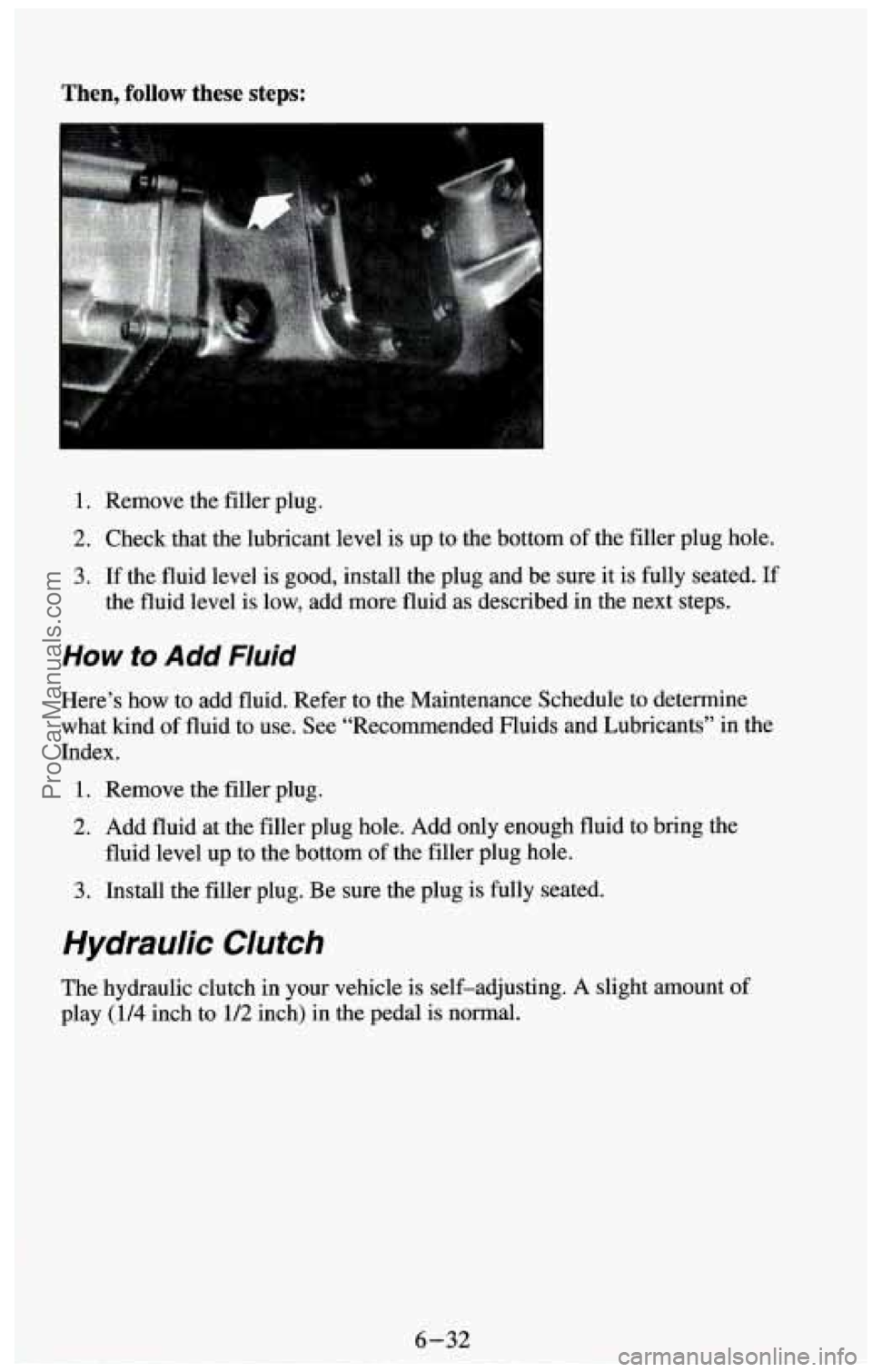
Then, follow these steps:
1. Remove the filler plug.
2. Check that the lubricant level is up to the bottom of the filler plug hole.
3. If the fluid level is good, install the plug and be sure it is fully seated. If
the fluid level is low, add more fluid as described in the next steps.
How to Add Fluid
Here’s how to add fluid. Refer to the Maintenance Schedule to determine
what kind
of fluid to use. See “Recommended Fluids and Lubricants” in the
Index.
1. Remove the filler plug.
2. Add fluid at the filler plug hole. Add only enough fluid to bring the
fluid level up to the bottom of the filler plug hole.
3. Install the filler plug. Be sure the plug is fully seated.
Hydraulic Clutch
The hydraulic clutch in your vehicle is self-adjusting. A slight amount of
play (1/4 inch to 1/2 inch) in the pedal is normal.
ProCarManuals.com
Page 280 of 385
Front Axle
When to Check and Change Lubricant
Refer to the Maintenance Schedule to determine how often to check the
lubricant and when to change
it. See “Scheduled Maintenance Services” in
the Index.
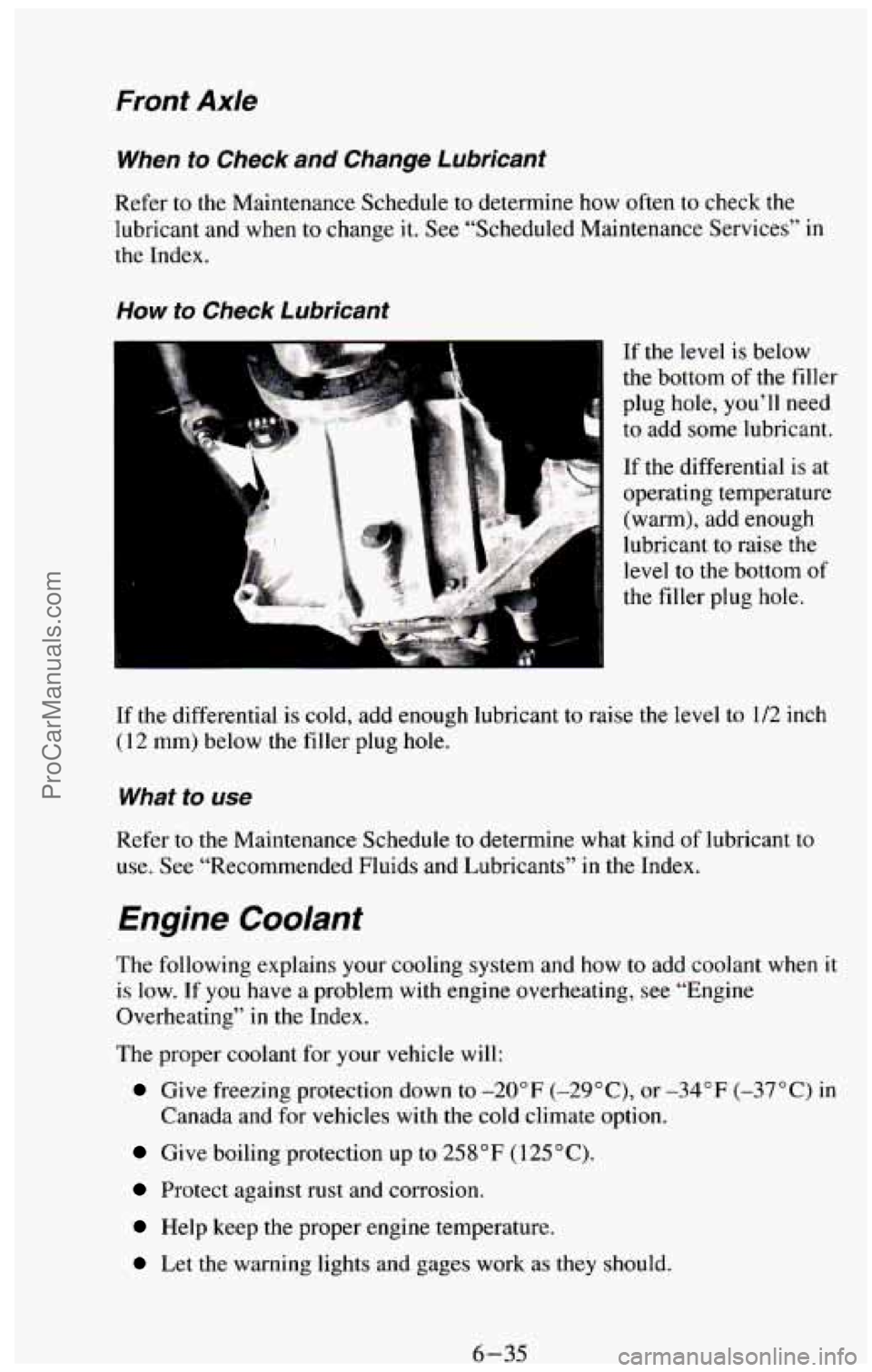
How to Check Lubricant
If the level is below
the bottom of the filler
plug hole, you’ll need
to add some lubricant.
If the differential is at
operating temperature
(warm), add enough
lubricant to raise the level
to the bottom of
the filler plug hole.
If the differential is cold, add enough lubricant to raise the level to
1/2 inch
(12 mm) below the filler plug hole.
What to use
Refer to the Maintenance Schedule to determine what kind of lubricant to
use. See “Recommended Fluids and Lubricants” in the Index.
Engine Coolant
The following explains your cooling system and how to add coolant when it
is low. If you have a problem with engine overheating, see “Engine
Overheating”
in the Index.
The proper coolant for your vehicle will:
Give freezing protection down to -20°F (-29”C), or -34°F (-37°C) in
Give boiling protection up to 258°F (1 25°C).
Protect against rust and corrosion.
Help keep the proper engine temperature.
Canada
and for vehicles with the cold climate option.
Let the warning lights and gages work as they should.
6-35 ProCarManuals.com
Page 283 of 385
Adding Coolant -Diesel Engines
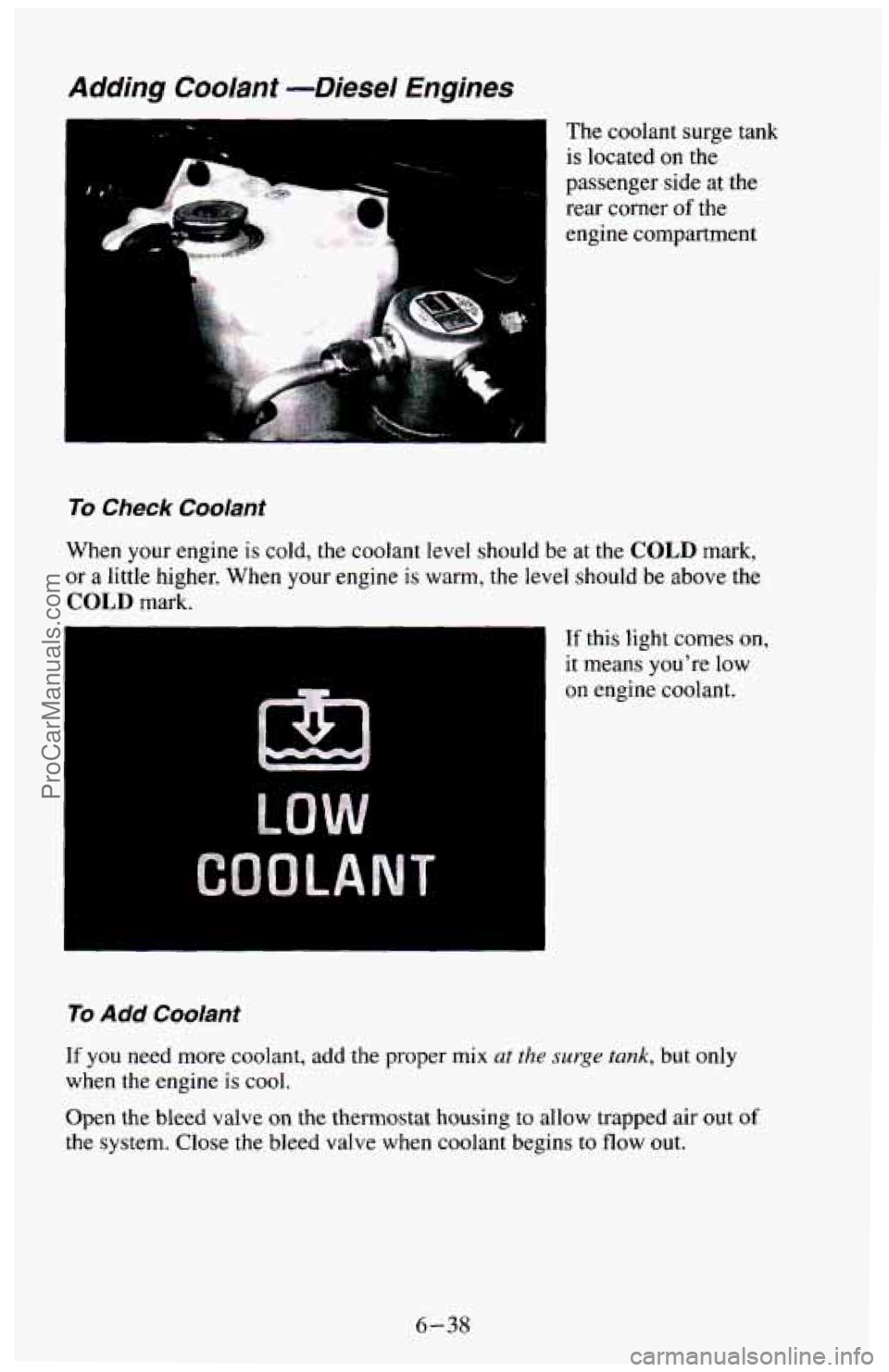
.. The coolant surge tank
is located on the
passenger side at the
rear corner
of the
engine compartment
To Check Coolant
When your engine is cold, the coolant level should be at the COLD mark,
or
a little higher. When your engine is warm, the level should be above the
COLD mark.
If this light comes on,
it means you're low
on engine coolant.
To Add Coolant
If you need more coolant, add the proper mix ut the surge tank, but only
when the
engine is cool.
Open the bleed valve
on the thermostat housing to allow trapped air out of
the system. Close the bleed valve when coolant begins to flow out.
6-38
ProCarManuals.com
Page 290 of 385
Brake Wear
Your vehicle has front disc brakes and rear drum brakes.
Disc brake pads have built-in wear indicators that make
a high-pitched
warning sound when the brake pads are worn and new pads are needed. The
sound
may come and go or be heard all the time your vehicle is moving
(except when you
are pushing on the brake pedal firmly).
NOTICE:
Continuing to drive with worn-out brake pads could result in
costly brake repair.
Some driving conditions or climates may cause a brake squeal when the
brakes are first applied or lightly applied. This does not mean something is
wrong with your brakes.
Rear drum brakes don’t have wear indicators, but if you ever hear a rear
brake rubbing noise,
have the rear brake linings inspected. Also, the rear
brake drums should be removed and inspected each time the tires are
removed for rotation or changing. When you have the front brakes replaced,
have the rear brakes inspected, too.
Brake linings should always be replaced as complete axle sets.
Brake Pedal Trave/
See your dealer if the brake pedal does not return to normal height, or if
there
is a rapid increase in pedal travel. This could be a sign of brake
trouble.
Brake Adjustment
Every time you make a brake stop, your disc brakes adjust for wear.
Tf your brake pedal goes down farther than normal, your rear drum brakes
may need adjustment. Adjust them by backing up and firmly applying the
brakes a few times.
6-45
ProCarManuals.com
Page 292 of 385
Wheel Nut Torque
For vehicles with dual wheels, when the vehicle, wheel or fasteners are new,
have the torque set at
the first 100, 1,000 and 6,000 miles (160, 1600 and
9600 km). Use the torque specified in the appropriate Specification Chart
later
in this section.
Single Belt Accessory Drive
If your new vehicle uses a serpentine belt, it is lighter, and more durable
than systems with several belts.
The belt
ruIl 'li'vkf br iir6und the pulleys or^ the engine. A tensione'r'n'iay be
used to keep the belt tight at all times. The tensioner also makes replacing
the belt easier
if you need to replace the belt, be sure to get the correct
replacement belt. Your dealership
or parts supplier can help you with this.
The Accessory Drive Belt Routing label on your vehicle will show you how
to route the belt your vehicle uses.
Windshield Wiper Blade lnserts
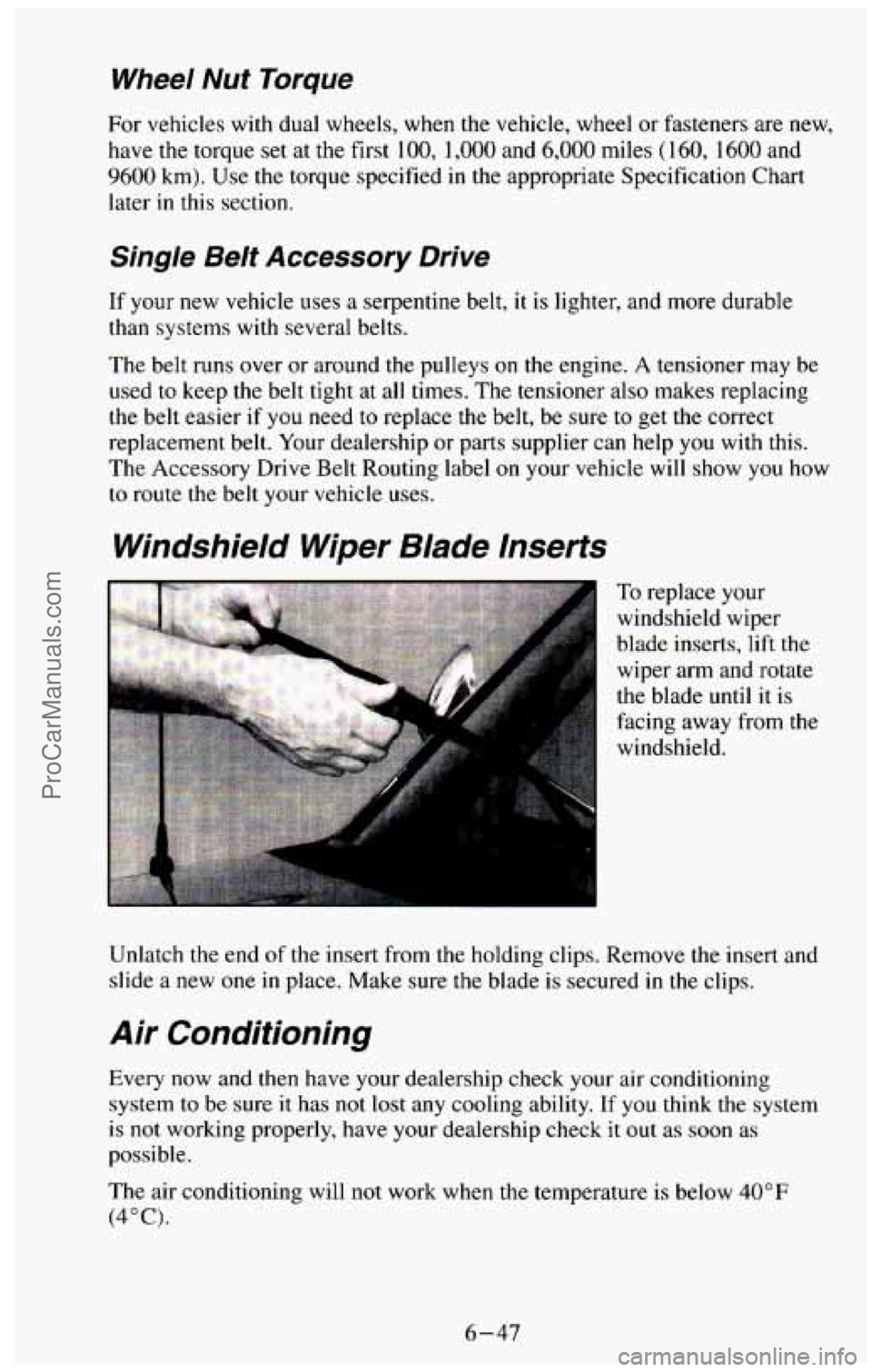
To replace your
windshield wiper
blade inserts, lift the
wiper arm and rotate
the blade until
it is
facing
away from the
windshield.
Unlatch the end
of the insert from the holding clips. Remove the insert and
slide
a new one in place. Make sure the blade is secured in the clips.
Air Conditioning
Every now and then have your dealership check your air conditioning
system to be sure
it has not lost any cooling ability. If you think the system
is not working properly, have your dealership check it out as soon as
possible.
The air conditioning will not work when the temperature
is below 40°F
(4°C).
6-47
ProCarManuals.com
Page 293 of 385
Fluid Leak Check
After the vehicle has been parked for a while, inspect the surface under the
vehicle for water, oil, fuel or other fluids. Water dripping from the air
conditioning system after it has been used is normal. If you notice fuel leaks
or fumes, the causes should be found and corrected at once.
Lubrication
Accelerator Control System
Your maintenance schedule will tell you how often the accelerator linkage
pivot points must be lubricated. See “Recommended Fluids and Lubricants”
in
the Index for the proper lubricant to use.
Accelerator cables and cruise control cables should not be lubricated. Any
cables that are worn or
are hard to pull should be replaced.
Hood Latches and Hood Hinge
Your maintenance schedule will tell you how often to lubricate the hood
latch and hood hinge assembly. See the Index under “Recommended Fluids
and Lubricants” for the proper lubricant to use.
Propeller Shaft Slip Splines
See your maintenance schedule to find out how often the slip splines must
be lubricated. See “Recommended Fluids and Lubricants” in the Index for
the proper lubricant to use.
Constant Velocity Joints
See your maintenance schedule to find out how often the constant velocity
joints must be lubricated. See “Recommended Fluids and Lubricants” in the
Index for the proper lubricant to use.
Normal
use of your vehicle will cause metal to metal wear at some points on
the cab and body if they are not lubricated.
For exposed surfaces, such
as door checks, door lock bolts, lock striker plates,
dovetail bumper wedges, etc., a thin
film of engine oil should be applied.
The seat adjusters and seat track should be lubricated
with chassis grease.
Door weather strips and rubber hood bumpers should be lightly coated with
a rubber lubricant.
Never use too much of any lubricant and be sure to wipe up any extra
lubricant when you are finished.
6-48
ProCarManuals.com
Page 295 of 385
Bulb Replacement
Before you replace any bulbs, be sure that all the lights are off and the
engine isn't running.
Sealed Beam Headlights
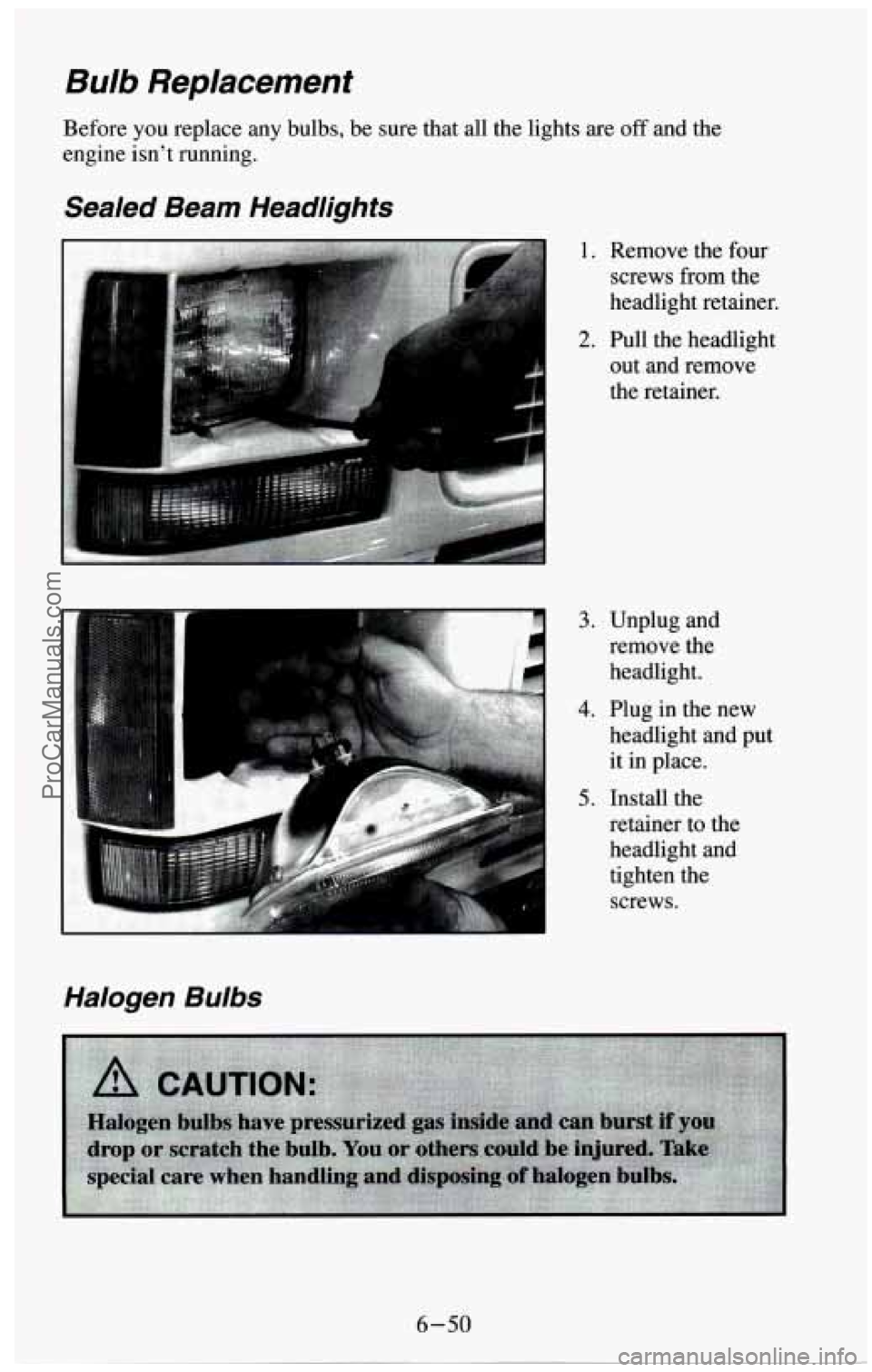
3. Unplug and
remove the
headlight.
headlight and put
it in place.
5. Install the
4. Plug in the new
retainer to the
headlight and tighten the
1. Remove the four
screws from the
headlight retainer.
2. Pull the headlight out and remove
the retainer.
screws.
Halogen Bulbs
6-50
ProCarManuals.com