Temp CHEVROLET SUBURBAN 1995 User Guide
[x] Cancel search | Manufacturer: CHEVROLET, Model Year: 1995, Model line: SUBURBAN, Model: CHEVROLET SUBURBAN 1995Pages: 486, PDF Size: 26.58 MB
Page 200 of 486
Q: What should I do if my vehicle stalls, or is about to stall, and I
can’t make it up the hill?
A: If this happens, there are some things you should do, and there are
some things you must not do. First, here’s what you should do:
0 Push the brake pedal to stop the vehicle and keep it from rolling
0 If your engine is still running, shift the transmission into reverse,
backwards.
Also, apply the parking brake.
release the parking brake, and
slowly back down the hill in reverse.
If your engine has stopped running, you’ll need to restart it. With the
brake pedal depressed and the parking brake still applied, shift the
transmission to
PARK (P) (or, shift to NEUTRAL (N) if your vehicle
has a manual transmission) and restart the engine. Then, shift to
reverse, release the parking brake, and slowly back down
the hill as
straight
as possible in reverse.
0 As you are backing down the hill, put your left hand on the steering
wheel at
the 12 o’clock position. This way, you’ll be able to tell if your
wheels are straight and maneuver as you back down. It’s best that you
back down the
hill with your wheels straight rather than in the left or
right direction. Turning
the wheel too far to the left or right will
increase the possibility of a rollover.
Here are
some things you must not do if you stall, or are about to stall,
when going up
a hill.
0 Never attempt to prevent a stall by shifting into NEUTRAL (N) (or
depressing the clutch, if you have a manual transmission) to “rev-up”
the engine and regain forward momentum. This won’t work. Your
vehicle
will roll backwards very quickly and you could go out of
control.
4-17
ProCarManuals.com
Page 201 of 486
Instead, apply the regular brake to stop the vehicle. Then apply the parking
brake. Shift into reverse, release the parking brake, and slowly back straight
down.
Never attempt to turn around if you are about to stall when going up a
hill. If the hill is steep enough
to stall your vehicle, it’s steep enough to
cause
you to roll over if you turn around. If you can’t make it up the
hill, you must back straight down the hill.
Q: Suppose, after stalling, I try to back down the hill and decide I just
can’t
do it. What should I do?
A: Set the parking brake, put your transmission in PARK (P) (or the
manual transmission
in first gear) , and turn off the engine. Leave the
vehicle and go get some help. Exit on the uphill side and stay clear
of
the path the vehicle would take if it rolled downhill. Do not shift the
transfer case to NEUTRAL
(N) when you leave the vehicle. Leave it in
some gear.
Driving Downhill
When off-roading takes you downhill, you’ll want to consider a number of
things:
How steep is the downhill? Will I be able to maintain vehicle control?
What’s the surface like? Smooth? Rough? Slippery? Hard-packed dirt?
Gravel?
Are there hidden surface obstacles? Ruts? Logs? Boulders?
What’s at the bottom of the hill? Is there a hidden creek bank or even a
river bottom with large rocks?
If
you decide you can go down a hill safely, then try to keep your vehicle
headed straight down, and use a low gear. This way, engine drag can help
4-18
ProCarManuals.com
Page 207 of 486
Night Vision
No one can see as well at night as in the daytime. But as we get older these
differences increase. A 50-year-old driver may require at least twice as
much light
to see the same thing at night as a 20-year-old.
What you do
in the daytime can also affect your night vision. For example,
if you spend the day
in bright sunshine you are wise to wear sunglasses.
Your eyes will have less trouble adjusting
to night. But if you’re driving,
don’t wear sunglasses at night. They may cut down
on glare from
headlamps, but
they also make a lot of things invisible.
You can be temporarily blinded by approaching lights. It can take a second
or two, or even several seconds, for your eyes to readjust to the dark. When
you are faced with severe glare (as from a driver who doesn’t lower the high
beams,
or a vehicle with misaimed headlamps), slow down a little. Avoid
staring directly into the approaching lights.
Keep your windshield and all the glass on your vehicle clean
- inside and
out. Glare at night is made much worse by dirt on the glass. Even the inside
of the glass can build up a film caused by dust. Dirty glass makes lights
dazzle and flash more than
clean glass would, making the pupils of your
eyes contract repeatedly.
Remember that your headlamps light
up far less of a roadway when you are
in
a turn or curve. Keep your eyes moving; that way, it’s easier to pick out
dimly lighted objects. Just as your headlamps should be checked regularly
for proper aim,
so should your eyes be examined regularly. Some drivers
suffer from night blindness
- the inability to see in dim light - and aren’t
even aware
of it.
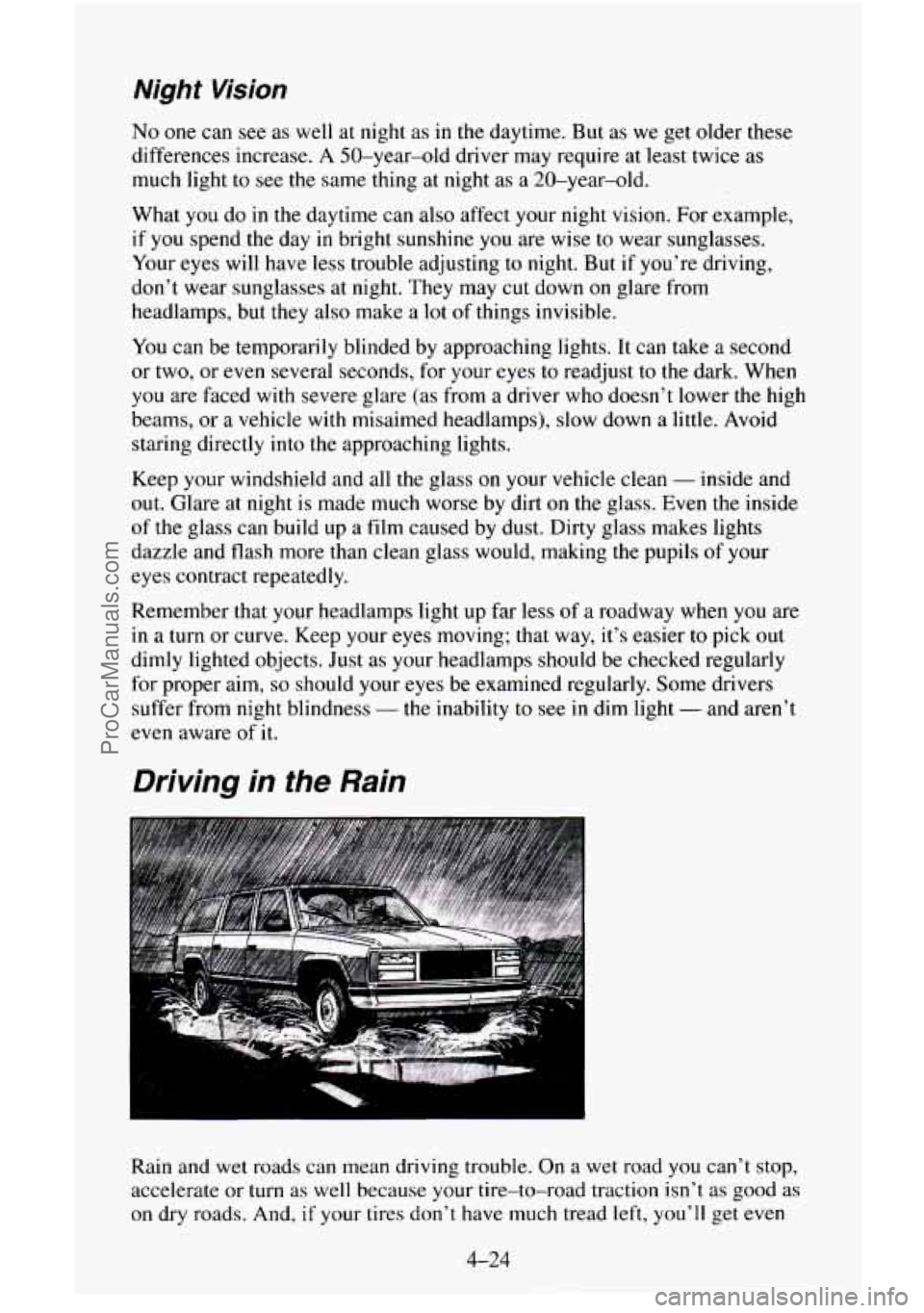
Driving in the Rain
Rain and wet roads can mean driving trouble. On a wet road you can’t stop,
accelerate or turn as well because your tire-to-road traction isn’t as good as
on dry roads. And,
if your tires don’t have much tread left, you’ll get even
4-24
ProCarManuals.com
Page 218 of 486
Power Take-Off (PTO)
NOTICE:
If you have a PTO that will exceed 35 horsepower installed on
your vehicle, it could damage the transfer case or transmission.
When having a PTO installed on your vehicle, make sure that it
will not exceed
35 horsepower.
Before using a power take-off, refer to the manufacturer’s or installer’s
instructions.
NOTICE:
Using a PTO while operating in one place before the vehicle has
reached normal operating temperature can damage the transfer
case or transmission.
If you will be using the PTO while
operating in one place, drive and warm up the vehicle before
using the PTO.
To engage a power take-off
1. Set the parking brake.
2. Shift the transmission into NEUTRAL (N).
3. Hold the clutch pedal down and engage the power take-off.
NOTICE:
Using a PTO for more than four hours without driving your
vehicle can damage the transfer case or transmission.
If using a
PTO for more than four hours without driving your vehicle,
drive your vehicle for
a while to allow the transfer case and
transmission to cool.
If you are going to drive the vehicle, shift the transmission into the gear
you want. Then shift the transfer case into the range you want
(if you
have four-wheel drive), apply the regular brakes and release the
parking brake.
4. Release the clutch (and the regular brakes) as you normally would.
When
you release the clutch, the power take-off will start.
4-35
ProCarManuals.com
Page 224 of 486
Three important considerations have to do with weight:
Weight of the Trailer
How heavy can a trailer safely be?
It depends on how you plan
to use your rig. For example, speed, altitude,
road grades, outside temperature and how much your vehicle is used to pull
a trailer are all important. And, it can also depend on any special equipment
that you have on your vehicle.
You can ask your dealer for our trailering information or advice, or you can
write
us at the address listed in your Warranty and Owner Assistance
Information Booklet.
In Canada, write to:
General Motors
of Canada Limited
Customer Assistance Center
1908 Colonel Sam Drive
Oshawa, Ontario
L 1 H 8P7
Weight of the Trailer Tongue
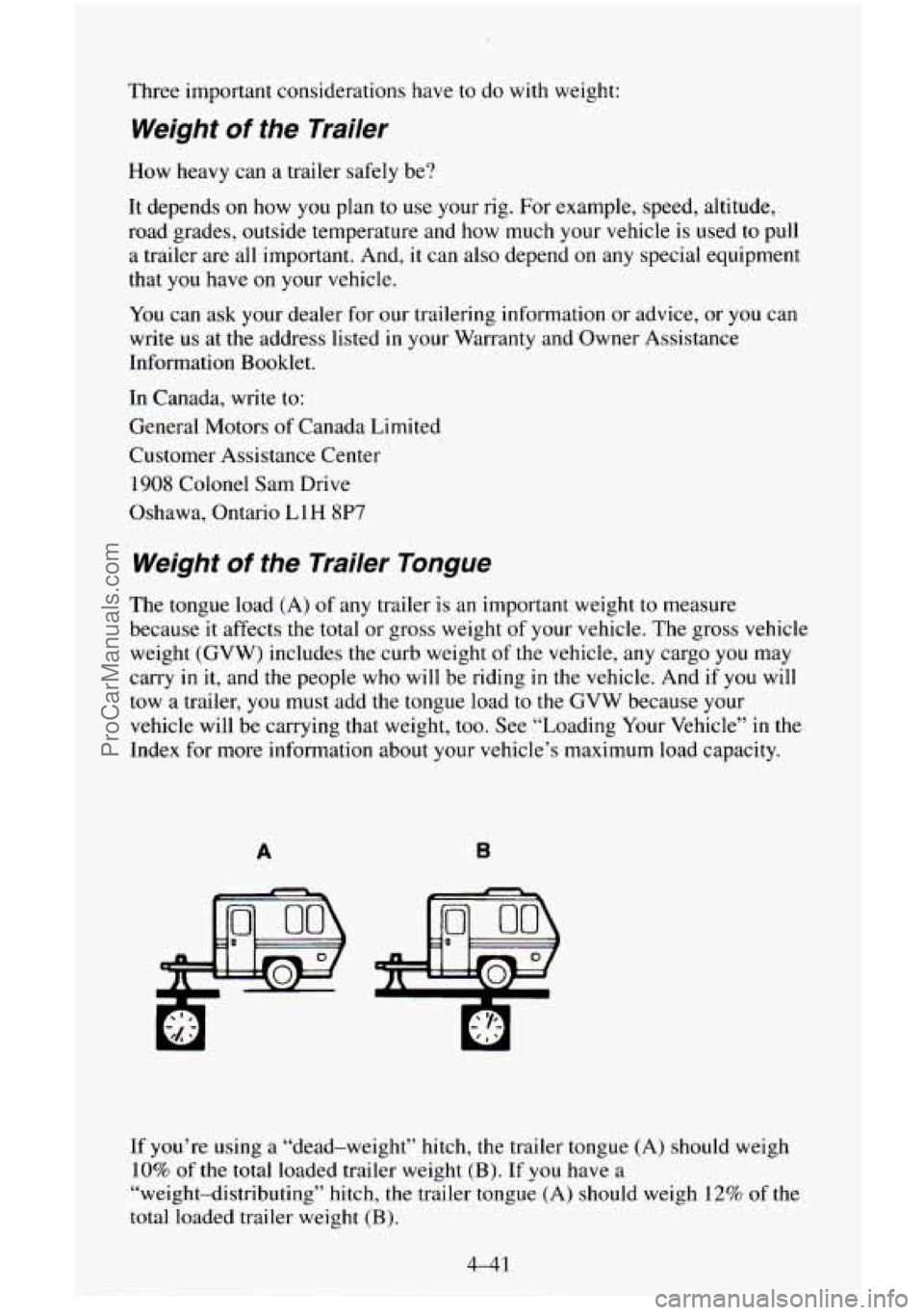
The tongue load (A) of any trailer is an important weight to measure
because
it affects the total or gross weight of your vehicle. The gross vehicle
weight (GVW) includes the curb weight
of the vehicle, any cargo you may
carry in it, and
the people who will be riding in the vehicle. And if you will
tow a trailer,
you must add the tongue load to the GVW because your
vehicle will be carrying that weight, too. See “Loading Your Vehicle” in the
Index for more information about your vehicle’s maximum load capacity.
A B
If you’re using a “dead-weight” hitch, the trailer tongue (A) should weigh
10% of the total loaded trailer weight (B). If you have a
“weight-distributing” hitch, the trailer tongue (A) should weigh
12% of the
total loaded trailer weight
(B).
ProCarManuals.com
Page 228 of 486
Turn Signals When Towing a Trailer
When you tow a trailer, your vehicle has to have extra wiring (included in
the optional trailering package). The green arrows
on your instrument panel
will flash whenever
you signal a turn or lane change. Properly hooked up,
the trailer lamps will
also flash, telling other drivers you’re about to turn,
change lanes or stop.
When towing a trailer, the green arrows on your instrument panel will flash
for turns even if the bulbs
on the trailer are burned out. Thus, you may think
drivers behind you are seeing your signal when they are not. It’s important
to check occasionally to be sure the trailer bulbs are still working.
Driving On Grades
Reduce speed and shift to a lower gear before you start down a long or steep
downgrade. If
you don’t shift down, you might have to use your brakes so
much that they would get hot and no longer work well.
On
a long uphill grade, shift down and reduce your speed to around 45 mph
(70 kdh) to reduce the possibility of engine and transmission overheating.
If
you have an automatic transmission you should use DRIVE (3) (or, as
you need to, a lower gear) when towing a trailer. Operating your vehicle in
DRIVE (3) when towing a trailer will minimize heat build-up and extend
the life
of your transmission.
If
you have a manual transmission and you are towing a trailer, it’s better
not to use FIFTH (5) gear. Just drive in FOURTH (4) gear (or, as you need
to,
a lower gear).
When towing at high altitude
on steep uphill grades, consider the following:
Engine coolant will boil at a lower temperature than at normal altitudes. If
you turn your engine off immediately after towing at high altitude on steep
uphill grades, your vehicle may show signs similar
to engine overheating.
To avoid this, let the engine run while parked (preferably on level ground)
with the automatic transmission
in PARK (P) (or the manual transmission
out of gear and the parking brake applied) for a few minutes before turning
the engine off.
If you do get the overheat warning, see “Engine
Overheating” in the Index.
Parking on Hills
You really should not park your vehicle, with a trailer attached, on a hill. If
something goes wrong, your rig could start to move. People can be injured,
and both your vehicle and
the trailer can be damaged.
But
if you ever have to park your rig on a hill, here’s how to do it:
1. Apply your regular brakes, but don’t shift into PARK (P) yet, or in gear
for a manual transmission.
ProCarManuals.com
Page 257 of 486
h
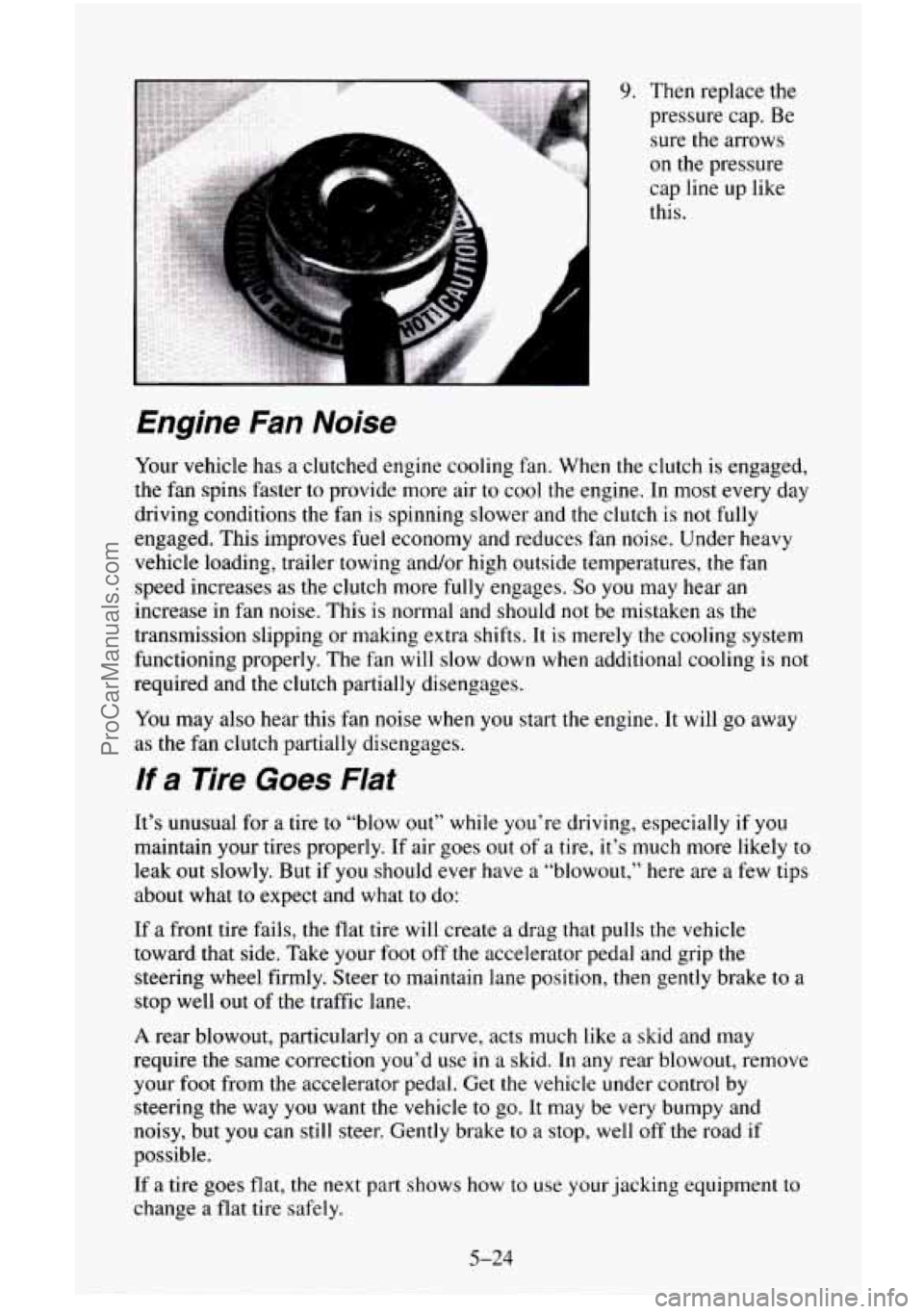
9. Then replace the
pressure cap. Be
sure the arrows
on the pressure
cap line up like
this.
Engine Fan Noise
Your vehicle has a clutched engine cooling fan. When the clutch is engaged,
the fan spins faster to provide more air to cool the engine. In most every day
driving conditions the fan
is spinning slower and the clutch is not fully
engaged. This improves fuel economy and reduces fan noise. Under heavy
vehicle loading, trailer towing and/or high outside temperatures,
the fan
speed increases as the clutch more
fully engages. So you may hear an
increase in fan noise. This is normal and should not be mistaken as the
transmission slipping
or making extra shifts. It is merely the cooling system
functioning properly. The fan will slow down when additional cooling is not
required and the clutch partially disengages.
You may also hear this fan noise when you start the engine. It will go away
as the fan clutch partially disengages.
If a Tire Goes Flat
It’s unusual for a tire to “blow out” while you’re driving, especially if you
maintain your tires properly. If air goes out of a tire, it’s much more likely to
leak out slowly. But if you should ever have a “blowout,” here are a few tips
about what
to expect and what to do:
If a front tire fails, the flat tire will create a drag that pulls the vehicle
toward that side. Take your foot off the accelerator pedal and grip the
steering wheel firmly. Steer
to maintain lane position, then gently brake to a
stop well out of the traffic lane.
A rear blowout, particularly on a curve, acts much like a skid and may
require the same correction you’d
use in a skid. In any rear blowout, remove
your foot from
the accelerator pedal. Get the vehicle under control by
steering the way
you want the vehicle to go. It may be very bumpy and
noisy, but you can still steer. Gently brake to a stop, well
off the road if
possible.
If a tire goes flat, the next part shows how to use your jacking equipment to
change a flat tire safely.
5-24
ProCarManuals.com
Page 281 of 486
You should ask your service station operators if their gasolines contain
deposit control additives and oxygenates, and
if they have been
reformulated
to reduce vehicle emissions.
Diesel Fuel Requirements and Fuel System
Some states and provinces have restrictions on the purchase of diesel fuel
for light-duty vehicles and require you
to buy permits or pay special taxes.
Some
of these restrictions apply only to residents, and others apply to both
residents and visitors. These restrictions can change.
To learn the current
restrictions
in any state or province, contact your auto club, the police or
other officials.
Fuel Requirements
NOTICE:
Diesel fuel or fuel additives not recommended in this manual
could damage your fuel system and engine. Your warranty
wouldn’t cover this damage. And:
Diesel fuel that has been mixed with engine oil could damage
your engine and emission controls.
Always check with your
service station operator to make sure his diesel fuel has not \
been mixed with engine oil.
If you ever run out of diesel fuel, it can be difficult to restart
your engine. “Running Out
of Fuel,” later in this section, tells
you how to get it started again.
To avoid all this, try never to
let your tank get empty.
What Fuel to Use
For best results, use Number 2-D diesel fuel year-round (above and below
freezing conditions) as
oil companies blend Number 2-D fuel to address
climate differences. Number 1-D diesel fuel may be used
in very cold
temperatures (when it stays below
0°F or -1 8°C); however, it will produce
a power and fuel economy
loss. The use of Number 1-D diesel fuel in warm
or hot climates may result in stalling, poor starting when the engine
is hot
and may damage the fuel injection system.
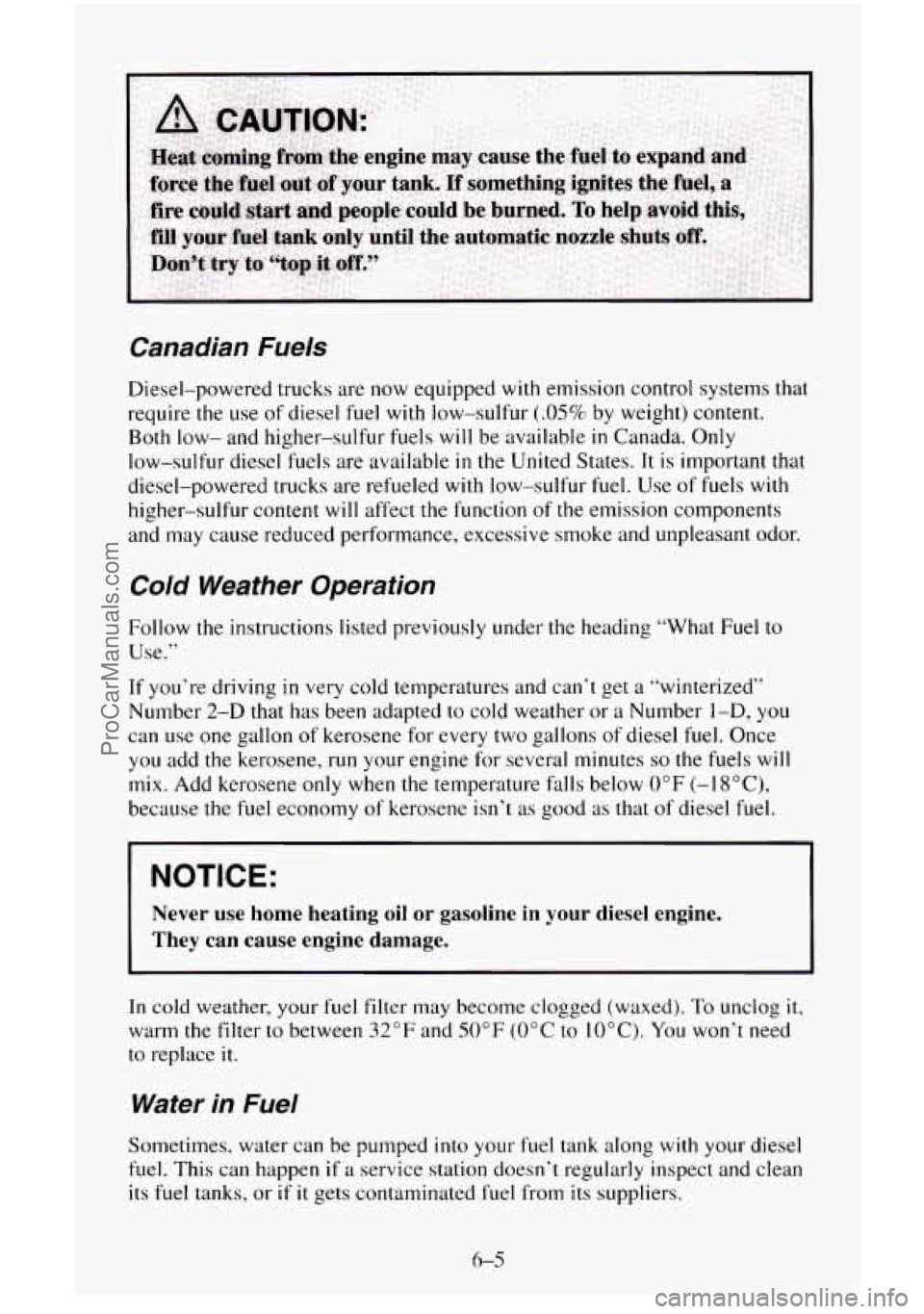
Diesel fuel may foam when you fill your tank. This can cause the automatic
pump nozzle
to shut off, even though your tank isn’t full. If this happens,
just wait for the foaming
to stop and then continue to fill your tank.
6-4
ProCarManuals.com
Page 282 of 486
Canadian Fuels
Diesel-powered trucks are now equipped with emission control systems that
require the use of diesel fuel with low-sulfur
(.05% by weight) content.
Both low- and higher-sulfur fuels will be available
in Canada. Only
low-sulfur diesel fuels are available
in the United States. It is important that
diesel-powered trucks are refueled with low-sulfur fuel. Use of fuels with
higher-sulfur content will affect the function
of the emission components
and may cause reduced performance, excessive smoke and unpleasant odor.
Cold Weather Operation
Follow the instructions listed previously under the heading “What Fuel to
Use
.”
If you’re driving in very cold temperatures and can’t get a “winterized”
Number
2-D that has been adapted to cold weather or a Number 1-D, you
can use one gallon of kerosene for every two gallons of diesel fuel. Once
you add the kerosene, run your engine for several minutes
so the fuels will
mix. Add kerosene only when
the temperature fills below 0°F (-I 8”C),
because the fuel economy of kerosene isn’t as good as that of diesel fuel.
I NOTICE:
Never use home heating oil or gasoline in your diesel engine.
They can cause engine damage.
In cold weather, your fuel filter may become clogged (waxed). To unclog it,
warm the filter to between 32°F and 50°F (0°C to 10°C). You won’t need
to replace it.
Water in Fuel
Sometimes, water can be pumped into your fuel tank along with your diesel
fuel. This can happen if a service station doesn’t regularly inspect and clean
its fuel tanks, or if it gets contaminated fuel from its suppliers.
ProCarManuals.com
Page 283 of 486
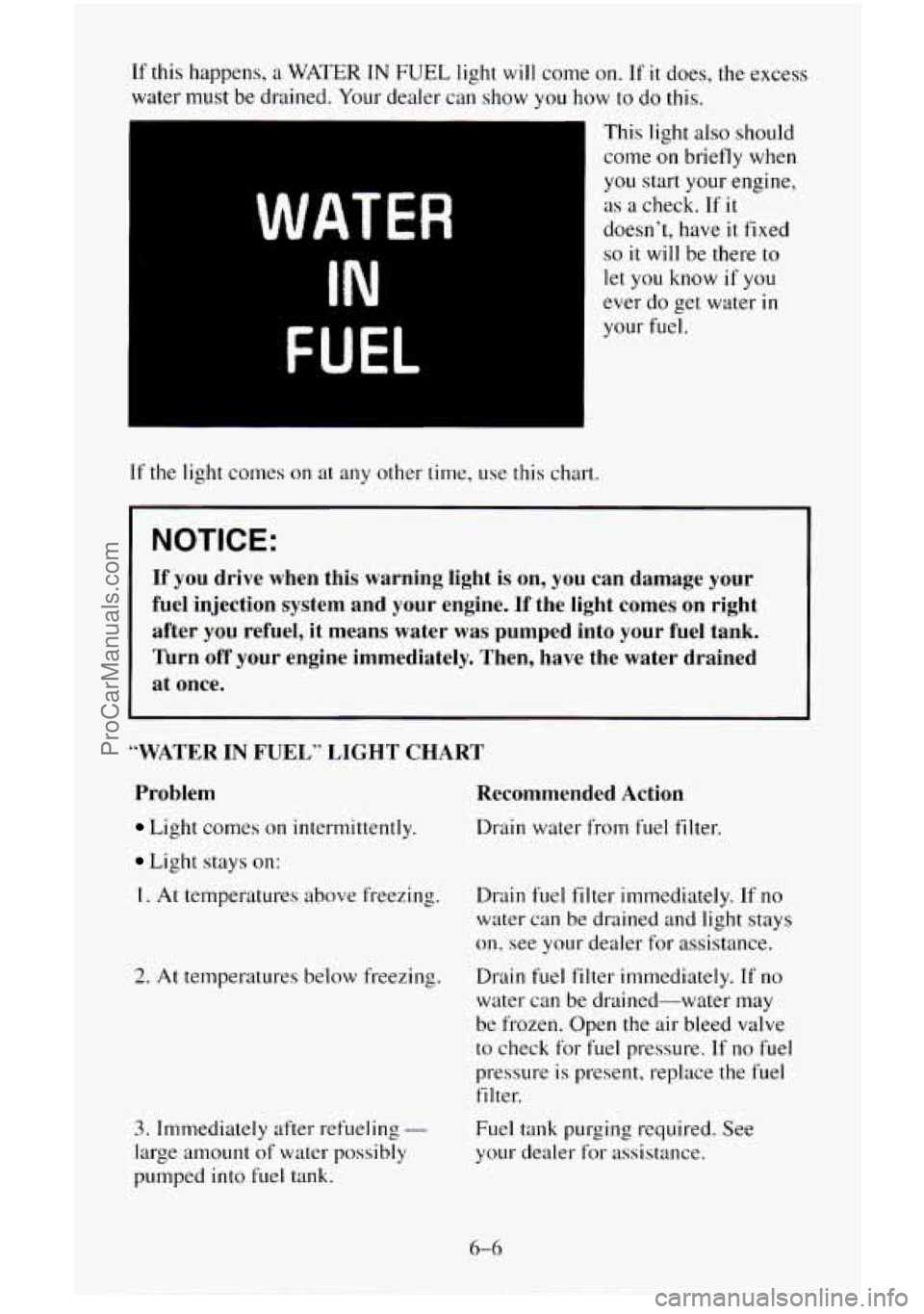
If this happens, a WATER IN FUEL light will come
water must be drained. Your Cfpder can show you
hc
I
WATER
IN
FUEL
If the light comes on at any other time, use this chart.
! on. If it does, the excess
3w to do this.
This light
also should
come
on briefly when
you start your engine,
as a check. If it
doesn’t, have it fixed
so it will be there to
let you know if you
ever do get water
in
your fuel.
NOTICE:
If you drive when this warning light is on, you can damage your \
fuel injection system and your engine. If the light comes on \
right
after you refuel,
it means water was pumped into your fuel tank.
Turn off your engine immediately. Then, have the water drained \
at once.
“WATER IN FUEL” LIGHT CHART Problem
Light comes on intermittently.
Light stays on:
Recommended Action
Drain water from fuel filter.
1. At temperatures above freezing. Drain fuel filter immediately. If no
water can be drained and light stays
on, see your dealer for assistance.
2. At temperatures below freezing. Drain fuel filter immediately. If no
water can be drained-water may
be frozen. Open the air bleed valve
to check for fuel pressure. If
no fuel
pressure is present, replace the fuel
filter.
3. Immediately after refueling -
large amount of water possibly
pumped into fuel tank. Fuel tank
purging required. See
your dealer for assistance.
6-4
ProCarManuals.com