Temp CHEVROLET SUBURBAN 1995 Owner's Guide
[x] Cancel search | Manufacturer: CHEVROLET, Model Year: 1995, Model line: SUBURBAN, Model: CHEVROLET SUBURBAN 1995Pages: 486, PDF Size: 26.58 MB
Page 336 of 486
Uniform lire Qualify Grading
The following information relates to the system developed by the United
States National Highway Traffic Safety Administration which grades tires
by treadwear, traction and temperature performance. (This applies
only to
vehicles sold in the United States.)
Treadwear
The treadwear grade is a comparative rating based on the wear rate of the
tire when tested under controlled conditions on a specified government test
course. For example, a tire graded 150 would wear one and a half
(I 1/2)
times as well on the government course as a tire graded 100. The relative
performance of tires depends upon the actual conditions
of their use,
however, and may depart significantly from the norm due to variations
in
driving habits, service practices and differences in road characteristics and
climate.
Traction - A, B, C
The traction grades. from highest to lowest are: A, B, and C. They represent
the tire’s ability to stop on wet pavement as measured under controlled
conditions on specified government test surfaces
of asphalt and concrete. A
tire marked
C may have poor traction performance.
Warning:
The traction grade assigned to this tire is based on braking
(straight-ahead) traction tests and does not include cornering (turning)
traction.
Temperature - A, 6, C
The temperature grades are A (the highest), B, and C, representing the tire’s
resistance to the generation
of heat and its ability to dissipate heat when
tested under controlled conditions on
a specified indoor laboratory test
wheel. Sustained high temperature can cause
the material of the tire to
degenerate and reduce
tire life, and excessive temperature can lead to
sudden tire fdilure. The grade
C corresponds to a level of performance
which all passenger car tires must meet under the Federal Motor Vehicle
Safety Standard
No. 109. Grades B and A represent higher levels of
performance on the laboratory test wheel than the minimum required
by
law.
6-59
-- ProCarManuals.com
Page 337 of 486
Warning: The temperature grade for this tire is established for a tire that is
properly inflated and
not overloaded. Excessive speed, underinflation, or
excessive loading, either separately or
in combination, can cause heat
buildup and possible tire failure.
These grades are molded on the sidewalls of passenger car tires.
While
the tires available as standard or optional equipment on General
Motors vehicles may vary with respect to these grades, all such tires meet
General Motors performance standards and have been approved for
use on
General Motors vehicles.
All passenger type (P Metric) tires must conform
to Federal safety requirements in addition to these grades.
Wheel Alignment and Tire Balance
The wheels on your vehicle were aligned and balanced carefully at the
factory
to give you the longest tire life and best overall performance.
In most cases, you will not need
to have your wheels aligned again.
However,
if you notice unusual tire wear or your vehicle pulling one way or
the other, the alignment may need
to be reset. If you notice your vehicle
vibrating when driving
on a smooth road, your wheels may need to be
rebalanced.
Wheel Replacement
Replace any wheel that is bent, cracked, or badly rusted or corroded. If
wheel nuts keep coming loose, the wheel, wheel bolts, and wheel nuts
should be replaced. If the wheel leaks air, replace it (except some aluminum
wheels, which can sometimes be repaired). See your GM dealer if any of
these conditions exist.
Your dealer will know the kind
of wheel you need.
Each new wheel should have the same load carrying capacity, diameter,
width, offset, and be mounted the same way as
the one it replaces.
If you need to replace any of your wheels, wheel bolts, or wheel nuts,
replace them only with new GM original equipment parts. This way, you
will be
sure to have the right wheel, wheel bolts, and wheel nuts for your
vehicle.
ProCarManuals.com
Page 344 of 486
Glass
Glass should be cleaned often. GM Glass Cleaner (GM Part No. 1050427)
or a liquid household glass cleaner will remove normal tobacco smoke and
dust films.
Don’t use abrasive cleaners
on glass, because they may cause scratches.
Avoid placing decals on the inside rear window, since
they may have to be
scraped off later. If abrasive cleaners are used on
the inside of the rear
window, an electric defogger element may be damaged. Any temporary
license should not be attached across the defogger grid.
Cleaning the Outside of the Windshield,
Backglass and Wiper Blades
If the windshield is not clear after using the windshield washer, or if the
wiper blade chatters when running, wax or other material may be on the
blade
or windshield.
Clean the outside
of the windshield with GM Windshield Cleaner, Bon-Ami
Powder@
(GM Part No. 10500 I 1 ). The windshield is clean if beads do not
form when you rinse it with water.
Clean the blade by wiping vigorously with a cloth soaked
in full strength
windshield washer solvent. Then rinse the blade with water.
Wiper blades should be checked on a regular basis and replaced when worn.
Weatherstrips
Silicone grease on weatherstrips will make them last longer, seal better, and
not stick or squeak. Apply silicone grease with a clean cloth
at least every
six months. During very cold, damp weather more frequent application may
be required. (See “Recommended Fluids and Lubricants”
in the Index.)
Cleaning the Outside of Your Vehicle
The paint finish on your vehicle provides beauty, depth of color, gloss
retention and durability.
6-67
ProCarManuals.com
Page 351 of 486
Service Parts Identification Label
You’ll find this label on the inside of the glove box.
Tt’s very helpful if you ever need
to order parts. On this label is:
your VIN,
the model designation,
paint information, and
0 a list of all production options and special equipment.
Be sure
that this label is not removed from the vehicle.
Add-on Electrical Equipment
I NOTICE:
Don’t add anything electrical to your vehicle unless you che\
ck
with your dealer first. Some electrical equipment can damage
your vehicle and the damage wouldn’t be covered by your
warranty. Some add-on electrical equipment can keep other
components from working as they should.
Your vehicle has an air bag system. Before attempting to add anything
electrical to your vehicle,
see “Servicing Your Air Bag-Equipped Vehicle”
in the Index.
6-74
ProCarManuals.com
Page 367 of 486
If your engine has more than one emissions classification, the classification
is determined by the Gross Vehicle Weight Rating (GVWR) of your vehicle
as shown on the Certification Label. See “Loading Your Vehicle” in the
Index.
Once you’ve determined your engine type and,
if necessary, emissions
classification, you’ll need
to decide which of the two schedules is right for
your vehicle. See Definitions for Maintenance Schedule I and Maintenance
Schedule I1 following.
Schedule I Definition - Gasoline Engines With Light Duty
Emissions
Follow Maintenance Schedule I if any one of these is true for your vehicle:
0 Most trips are less than 5 to 10 miles (8 to 16 km). This is particularly
important when outside temperatures are below freezing.
stop-and-go traffic).
0 Most trips include extensive idling (such as frequent driving in
0 You operate your vehicle in dusty areas or off-road frequently.
You frequently tow a trailer or use a carrier on top of your vehicle.
Schedule
I should also be followed if the vehicle is used for delivery
service, police, taxi, or other commercial application.
Schedule I Intervals - Gasoline Engines With Light Duty
Emissions
Every
3,000 Miles (5 000 km) or 3 Months
Engine Oil and Filter Change
Chassis Lubrication
Drive Axle Service
At 6,000 Miles (10 000 km) - Then Every 12,000 Miles (25 000 km)
Tire Rotation
Every 15,000 Miles (25 000 km)
Air Cleaner Filter Inspection, if driving in dusty conditions
Front Wheel Bearing Repack (or at each brake relining)
(2WD Only)
7-4
ProCarManuals.com
Page 369 of 486
Every 30,000 Miles (50 000 km)
Cooling System Service (or every 24 months, whichever occurs first)
Spark Plug Replacement
Fuel Filter Replacement
Air Cleaner Filter Replacement Front Wheel Bearing Repack
Every 50,000 Miles (83 000 km)
Automatic Transmission Service (severe conditions only)
Every 60,000 Miles (100 000 km)
Spark Plug Wire Inspection
Engine Accessory Drive Belt Inspection
Fuel Tank, Cap and Lines Inspection
Engine Timing Check
Schedule 1 Definition - Gasoline Engines With Heavy Duty
Emissions
Follow Maintenance Schedule I if any one of these is true for your vehicle:
e
e
e
e
Most trips are less than 5 to 10 miles (8 to 16 km). This is particularly
important when outside temperatures are below freezing.
Most trips include extensive idling (such as frequent driving
in stop and
go traffic).
You operate
your vehicle in dusty areas or off-road frequently.
You frequently tow
a trailer or use a carrier on top of your vehicle.
Schedule
I should also be followed if the vehicle is used for delivery
service, police, taxi, or other commercial application.
Schedule I Intervals - Gasoline Engines with Heavy Duty
Emissions
Every
3,000 Miles (5 000 km)
Engine Oil and Filter Change (or every 3 months, whichever occurs first)
Chassis Lubrication (or every
3 months, whichever occurs first)
Drive Axle Service
7-6
ProCarManuals.com
Page 372 of 486
Every 27,000 Miles (45 000 km)
Spark Plugs Replacement
Every 50,000 Miles (83 000 km)
Automatic Transmission Service
Every 60,000 Miles (100 000 km)
Spark Plug Wire Inspection
Exhaust Gas Recirculation
(EGR) System Inspection
Fuel Tank, Cap and Lines Inspection
Evaporative Emission Control System Inspection
Electronic Vacuum Regulator Valve (EVRV) Inspection
1 Schedu/e I Definition - Diesel Engines I
Follow Maintenance Schedule I if any one of these is true for your vehicle:
Most trips are less than 5 to 10 miles (8 to 16 km). This is particularly
important when outside temperatures are below freezing.
Most trips include extensive idling (such as frequent driving in stop and
You operate your vehicle in dusty areas or off-road frequently.
go
traffic).
0 You frequently tow a trailer or use a carrier on top of your vehicle,
Schedule
I should also be followed if the vehicle is used for delivery
service, police, taxi, or other commercial application.
7-9
ProCarManuals.com
Page 376 of 486
Maintenance Schedule I - Gasoline Engines With
Light Duty Emissions
3,000 Miles (5 000 km)
0 Change engine oil and filter (or every 3 months, whichever occurs
first).
An Emission Control Service.
0 Lubricate the front suspension, king pin bushings, steering linkage,
transmission shift linkage, transfer case shift linkage, parking brake
cable guides, rear driveline center splines, front axle propshaft splines,
brake pedal springs and clutch pedal springs. Ball joints and king pin
bushings should not be lubricated unless their temperature
is 10" F
(-1 2" C), or higher. When weather is cold, let the ball joints and king
pin bushings warm up before lubrication or
they could be damaged.
Perform each of the listed lubrication service items at this mileage
interval (or every
6 months, whichever occurs first).
0 Check readfront axle fluid level and add fluid as needed. Check
constant velocity joints and axle seals for leaking.
**
I DATE I ACTUALMILEAGE I SERVICED BY: I
6,000 Miles (10 000 km)
0 Change engine oil and filter (or every 3 months, whichever occurs
first).
An EInission Control Service.
0 Lubricate the front suspension, king pin bushings, steering linkage,
transmission shift linkage, transfer case shift linkage, parking brake
cable guides, rear driveline center splines, front axle propshaft splines,
brake pedal springs and clutch pedal springs. Ball joints and king pin
bushings should not be lubricated unless their temperature is
10" F
(-12" C), or higher. When weather is cold, let the ball joints and king
pin bushings warm up before lubrication or they could be damaged.
Perform each
of the listed lubrication service items at this mileage
interval (or every
6 months, whichever occurs first).
(Continued)
7-13
ProCarManuals.com
Page 377 of 486
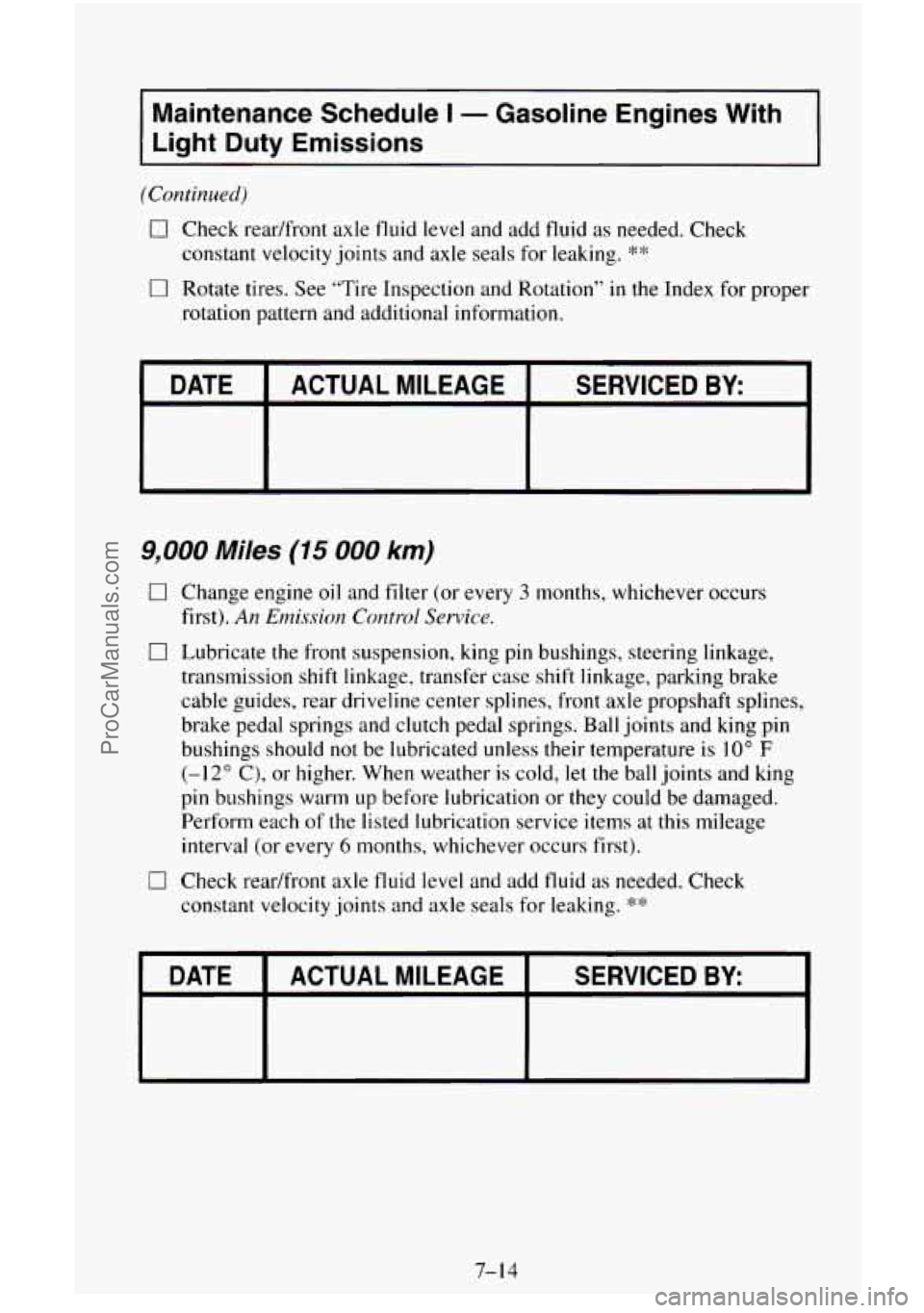
Maintenance Schedule I - Gasoline Engines With
Light Duty Emissions
(Continued)
0 Check readfront axle tluid level and add fluid as needed. Check
constant
velocity joints and axle seals for leaking. **
0 Rotate tires. See “Tire Inspection and Rotation’’ in the Index for proper
rotation pattern and additional information.
DATE SERVICED BY: ACTUAL MILEAGE
9,000 Miles (15 000 km)
0 Change engine oil and filter (or every 3 months, whichever occurs
first).
An Emission Control Service.
0 Lubricate the front suspension, king pin bushings, steering linkage,
transmission shift linkage, transfer case shift linkage, parking brake
cable guides, rear driveline center splines, front axle propshaft splines,
brake pedal springs and clutch pedal springs.
Ball joints and king pin
bushings should
not be lubricated unless their temperature is IO” F
(-1 2” C), or higher. When weather is cold, let the ball joints and king
pin bushings warm
up before lubrication or they could be damaged.
Perform each
of the listed lubrication service items at this mileage
interval (or every
6 months, whichever occurs first).
0 Check readfront axle fluid level and add tluid as needed. Check
constant velocity joints and axle seals for leaking.
**
DATE
SERVICED BY: ACTUAL MILEAGE
a
7-1 4
~~ ProCarManuals.com
Page 378 of 486
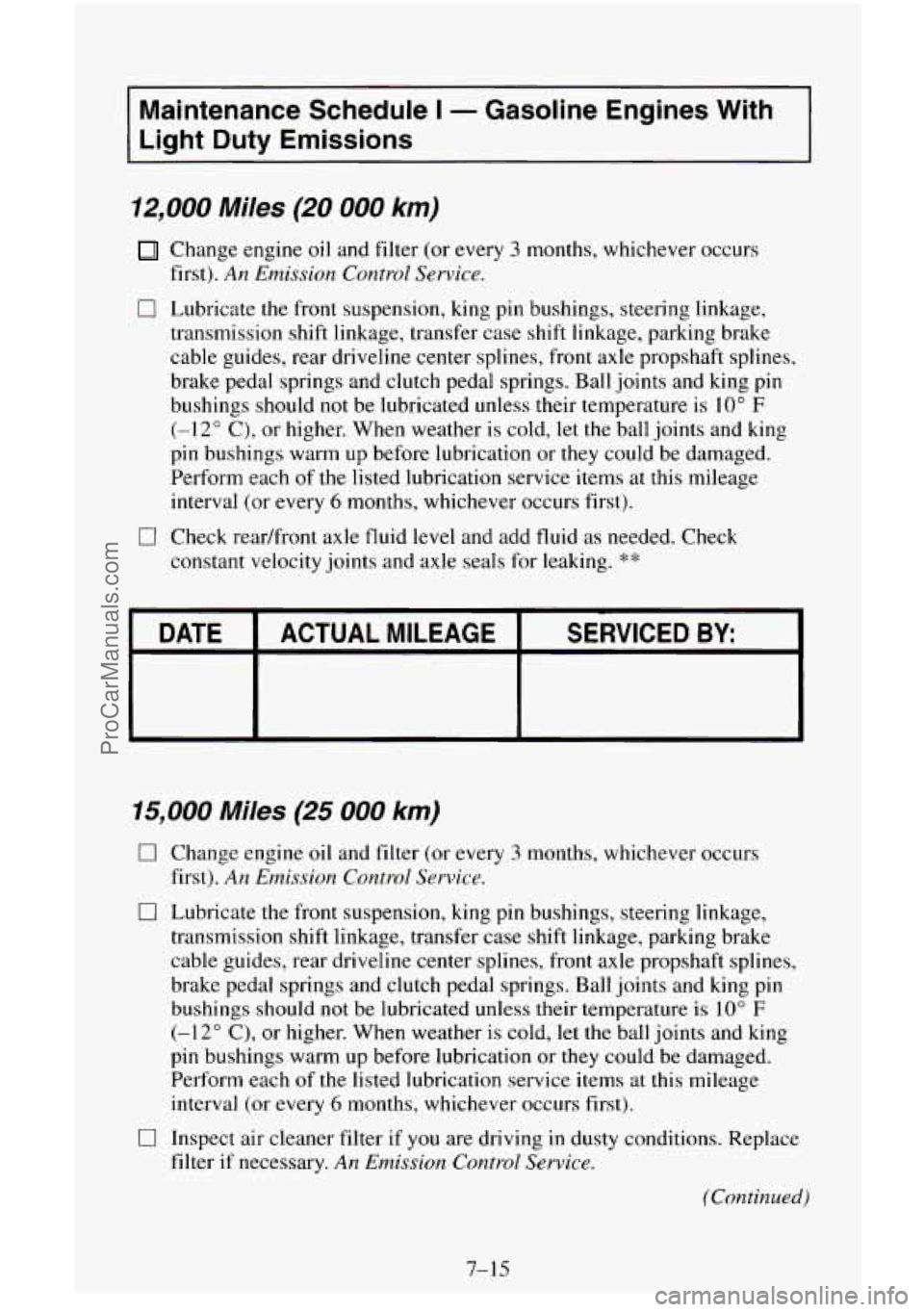
I Maintenance Schedule I - Gasoline Engines With I
I Light Duty Emissions
12,000 Miles (20 000 km)
Change engine oil and filter (or every 3 months, whichever occurs
first).
An Emission Control Service.
0 Lubricate the front suspension, king pin bushings, steering linkage,
transmission shift linkage, transfer case shift linkage, parking brake
cable guides, rear driveline center splines, front axle propshaft splines,
brake pedal springs and clutch pedal springs. Ball joints and king pin
bushings should not be lubricated unless their temperature is
10" F
(-12" C), or higher. When weather is cold, let the ball joints and king
pin bushings warm
up before lubrication or they could be damaged.
Perform each of
the listed lubrication service items at this mileage
interval (or every
6 months, whichever occurs first).
0 Check readfront axle fluid level and add fluid as needed. Check
constant velocity joints and axle seals for leaking.
**
DATE SERVICED BY ACTUAL MILEAGE
15,000 Miles (25 000 km)
17 Change engine oil and filter (or every 3 months, whichever occurs
first).
An Emission Control Service.
0 Lubricate the front suspension, king pin bushings, steering linkage,
transmission shift linkage, transfer case shift linkage, parking brake
cable guides, rear driveline center splines, front axle propshaft splines,
brake pedal springs and clutch pedal springs. Ball joints and king pin
bushings should
not be lubricated unless their temperature is 10" F
(-1 2" C), or higher. When weather is cold, let the ball joints and king
pin bushings warm up before lubrication or
they could be damaged.
Perform each of the listed lubrication service items at this mileage
interval (or every
6 months, whichever occurs first).
0 Inspect air cleaner filter if you are driving in dusty conditions. Replace'
filter if necessary.
An Emission Control Service.
(Continued)
7-1 5
-_ ProCarManuals.com