ignition CHEVROLET SUBURBAN 1996 User Guide
[x] Cancel search | Manufacturer: CHEVROLET, Model Year: 1996, Model line: SUBURBAN, Model: CHEVROLET SUBURBAN 1996Pages: 486, PDF Size: 26.58 MB
Page 87 of 486

NOTICE:
After you’ve used the coolant heater, be sure to store the \
cord as
it
was before to keep it away from moving engine parts. If you
don’t, it could be damaged.
How long should you keep the coolant heater plugged in‘? The answer
depends on the weather, the kind of oil
you have, and some other things.
Instead of trying
to list everything here, we ask that you contact your GM
dealer in the area where you’ll be parking your vehicle. The dealer can give
you the best advice for that particular area.
Automatic Transmission
T
There are several different positions for your shift lever.
If your vehicle is equipped with an automatic transmission, it now features
an electronic shift position indicator within
the instrument cluster. This
display must be powered anytime the shift lever
is capable of being moved
out
of the PARK (P) position. This means that if your key is in the OFF
position, but not locked, there will be a small current drain on your battery
which could discharge your battery over a period of time. If you have a need
to leave your key
in the ignition in the OFF position for an extended period
for any reason,
it is recommended that you disconnect the battery cable
from the battery to prevent discharging your battery.
PARK (P) -This locks your rear wheels. It’s the best position to use
when you start your engine because your vehicle can’t move easily.
2-20
ProCarManuals.com
Page 88 of 486
Your vehicle has a brake-transmission shift interlock. With the ignition in
the RUN position, you must fully apply your regular brakes before you can
shift from PARK (P).
If you cannot shift out
of PARK (P), ease pressure on the shift lever and
push the shift lever
all the way into PARK (P) as you continue pressing the
brake pedal. Then move the shift lever
into the gear you want. If you still
cannot shift the shift lever out of PARK (P), see “Shifting Out of PARK (P)”
later in this section.
REVERSE (R) - Use this gear to back up.
NOTICE:
Shifting to REVERSE (R) while your vehicle is moving forward \
could damage your transmission. Shift to REVERSE (R) only
after your vehicle
is stopped.
To rock your vehicle back and forth to get out’of snow, ice or sand
without damaging your transmission, see “If You’re Stuck: In Sand,
Mud, Ice or Snow” in the Index.
0 NEUTRAL (N) - In this position, your engine doesn’t connect with
the wheels. To restart when you’re already moving, use NEUTRAL
(N)
only. Also, use NEUTRAL (N) when your vehicle is being towed.
2-21
ProCarManuals.com
Page 93 of 486
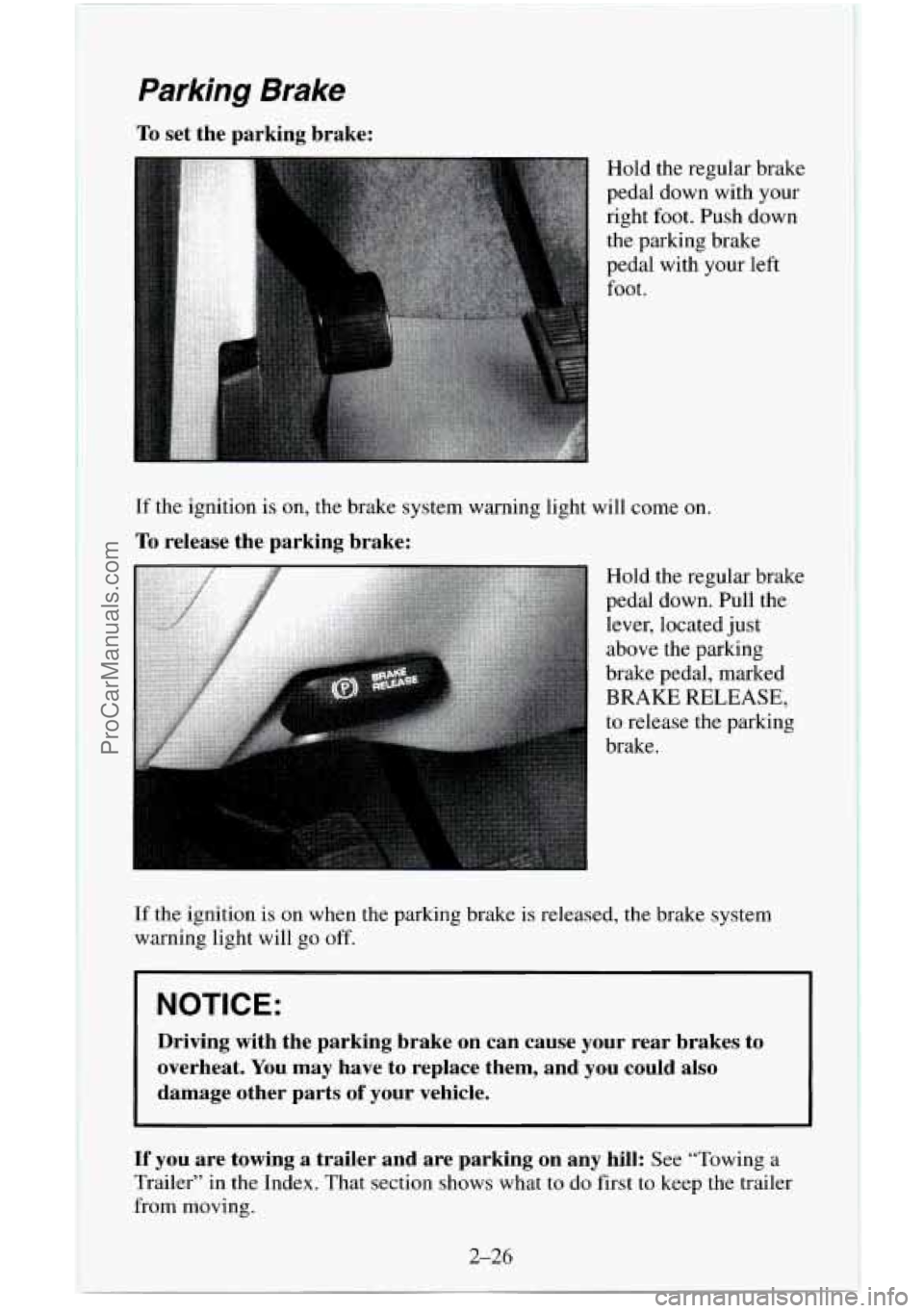
Parking Brake
To set the parking brake:
Hold the regular brake
pedal down with your
right foot. Push down
the parking brake
pedal with your left
foot.
If the ignition is on, the brake system warning light will come on.
To release the parking brake:
Hold the regular brake
pedal down. Pull the
lever, located just
above the parking
brake pedal, marked
BRAKE RELEASE,
to release the parking
brake.
If the ignition is on when the parking brake is released, the brake system
warning light will
go off.
I NOTICE:
Driving with the parking brake on can cause your rear brakes to
overheat. You may have to replace them, and you could also
damage other parts
of your vehicle.
If you are towing a trailer and are parking on any hill: See “Towing a
Trailer” in the Index. That section shows what to do first to keep the trailer
from moving.
2-26
I I
ProCarManuals.com
Page 95 of 486
3. If you have four-wheel drive, be sure the transfer case is in a drive gear
4. Move the ignition key to LOCK.
-not in NEUTRAL (N)
5. Remove the key and take it with you. If you can walk away from your
vehicle with the ignition key
in your hand, your vehicle is in PARK (P).
Shifting Out of PARK (P)
Your vehicle has a brake-transmission shift interlock system. You have to
fully apply your regular brakes before you can shift from PARK (P). See
“Automatic Transmission”
in the Index.
If
you cannot shift out of PARK (P), ease pressure on the shift lever and
push the shift lever all the way up into PARK
(P) as you maintain brake
application. Then, move the shift lever into the gear you want.
If
you ever hold the brake pedal down but still can’t shift out of PARK (P),
try this:
1. Turn the key to OFF.
2. Apply and hold the brake until the end of Step 4.
3. Shift to NEUTRAL (N).
4. Start the vehicle and then shift to the drive gear you want.
5. Have the brake-transmission shift interlock system fixed as soon as
you can.
Leaving Your Vehicle With the Engine Running
(Automatic Transmission
Models Only)
It can be dangerous to leave your vehicle with the engine
running. Your vehicle could move suddenly if the shift lever
is
not fully in PARK (P) with the parking brake firmly set. If you
have four-wheel drive with
a manual transfer case shift lever
and your transfer case
is in NEUTRAL (N), your vehicle will be
free to roll, even if your shift lever
is in PARK (P). So be sure the
transfer case is in
a drive gear - not in NEUTRAL (N). And, if
you leave the vehicle with the engine running, it could overheat
and even catch
fire. You or others could be injured. Don’t leave
your vehicle with the engine running unless you have to.
2-28
ProCarManuals.com
Page 103 of 486
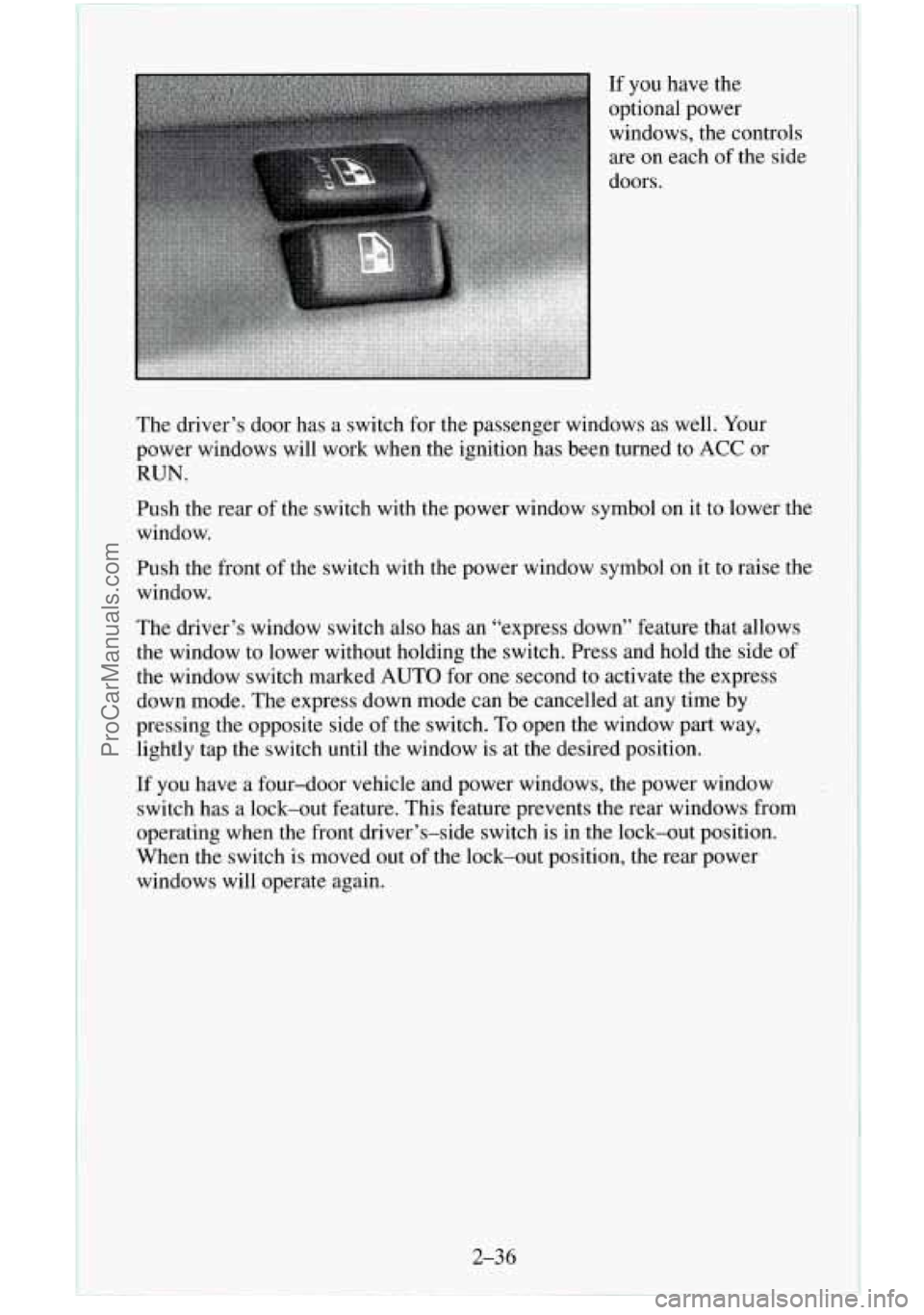
The driver’s door has a switch for the passenger windows as well. Your
power windows will work when the ignition has been turned to
ACC or
RUN.
Push the rear of the switch with the power window symbol on it to lower the
window.
Push the front of the switch with the power window symbol on
it to raise the
window.
The driver’s window switch also has an “express down” feature that allows
the window to lower without holding the switch. Press and hold the side
of
the window switch marked AUTO for one second to activate the express
down mode. The express down mode can be cancelled at any time by
pressing the opposite side
of the switch. To open the window part way,
lightly tap the switch until the window is at the desired position.
If you have a four-door vehicle and power windows, the power window
switch has a lock-out feature. This feature prevents the rear windows from
operating when the front driver’s-side switch
is in the lock-out position.
When the switch is moved
out of the lock-out position, the rear power
windows will operate again.
2-36
I
ProCarManuals.com
Page 115 of 486
To Erase Speed Memory
When you turn off the Cruise Control or the ignition, your Cruise Control
set speed memory
is erased.
Headamps and Vehicle Lighting
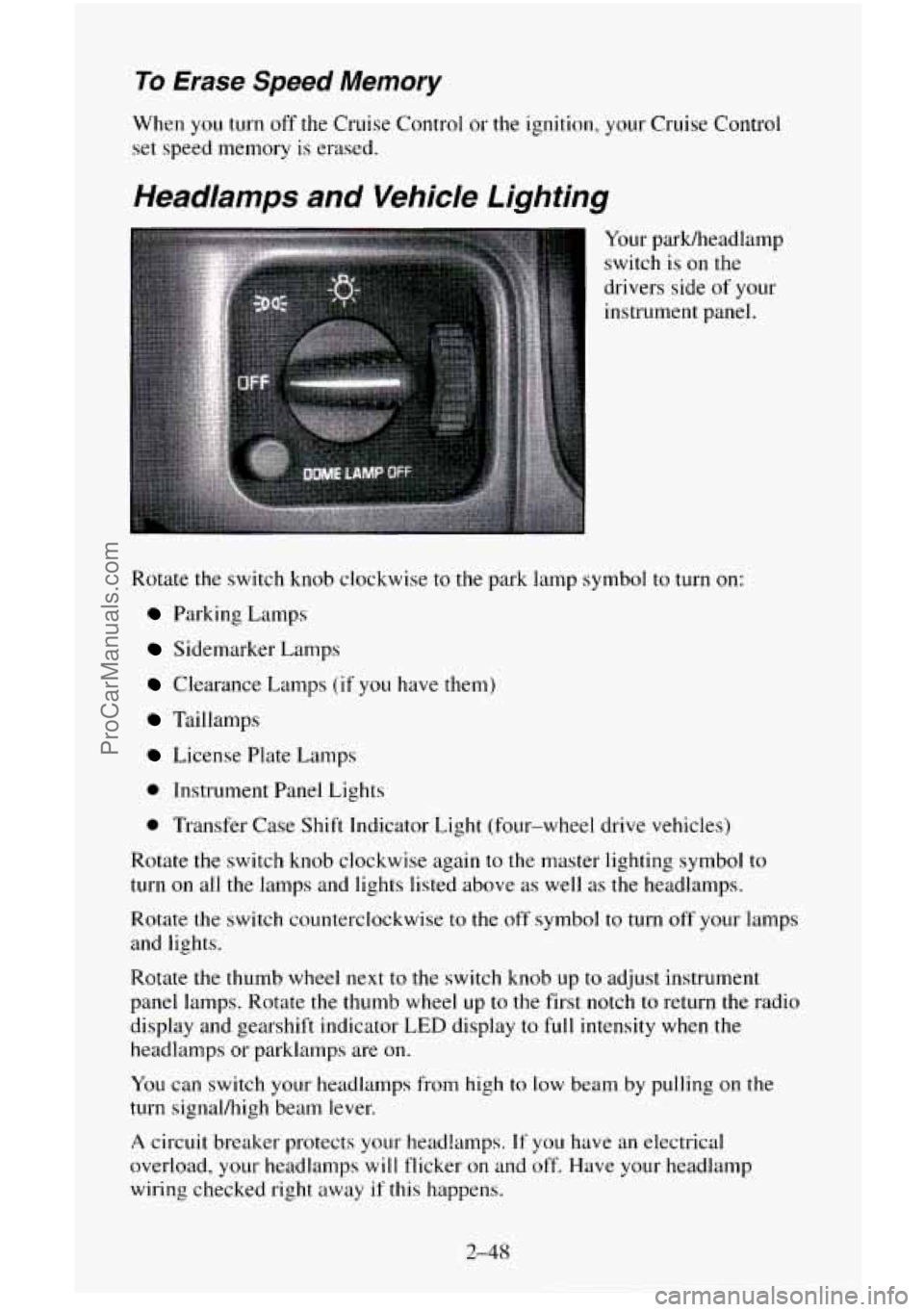
Your parWheadlamp
switch
is on the
drivers side
of your
instrument panel.
Rotate
the switch knob clockwise to the park lamp symbol to turn on:
Parking Lamps
Sidemarker Lamps
Clearance Lamps (if you have them}
Taillamps
License Plate Lamps
0 Instrument Panel Lights
0 Transfer Case Shift Indicator Light (four-wheel drive vehicles)
Rotate
the switch knob clockwise again to the master lighting symbol to
turn on all the lamps and lights listed above as well as the headlamps.
Rotate the switch counterclockwise to the off sylnbol to turn
off your lamps
and lights.
Rotate the thumb wheel
next to the switch knob up to adjust instrument
panel lamps. Rotate the thumb wheel up to the first notch to return
the radio
display and gearshift indicator LED display
to full intensity when the
headlamps or parklamps are on.
You can switch your headlamps from high to low beam by pulling on the
turn signal/high beam lever.
A circuit breaker protects your headlamps. If you have an electrical
overload, your headlamps
will flicker on and off. Have your headlamp
wiring checked right away
if this happens.
2-48
ProCarManuals.com
Page 116 of 486
Headlamps-On Reminder
A buzzer will sound when your headlamps are turned on and your ignition is
in OFF, LOCK or ACC. If you need to use your headlamps when the ignition
switch is
in OFF, LOCK or ACC, the buzzer can be turned off by turning the
thumb wheel next to the park/headlamp switch
all the way down.
Daytime Running Lamps (DRL) Indicator Light
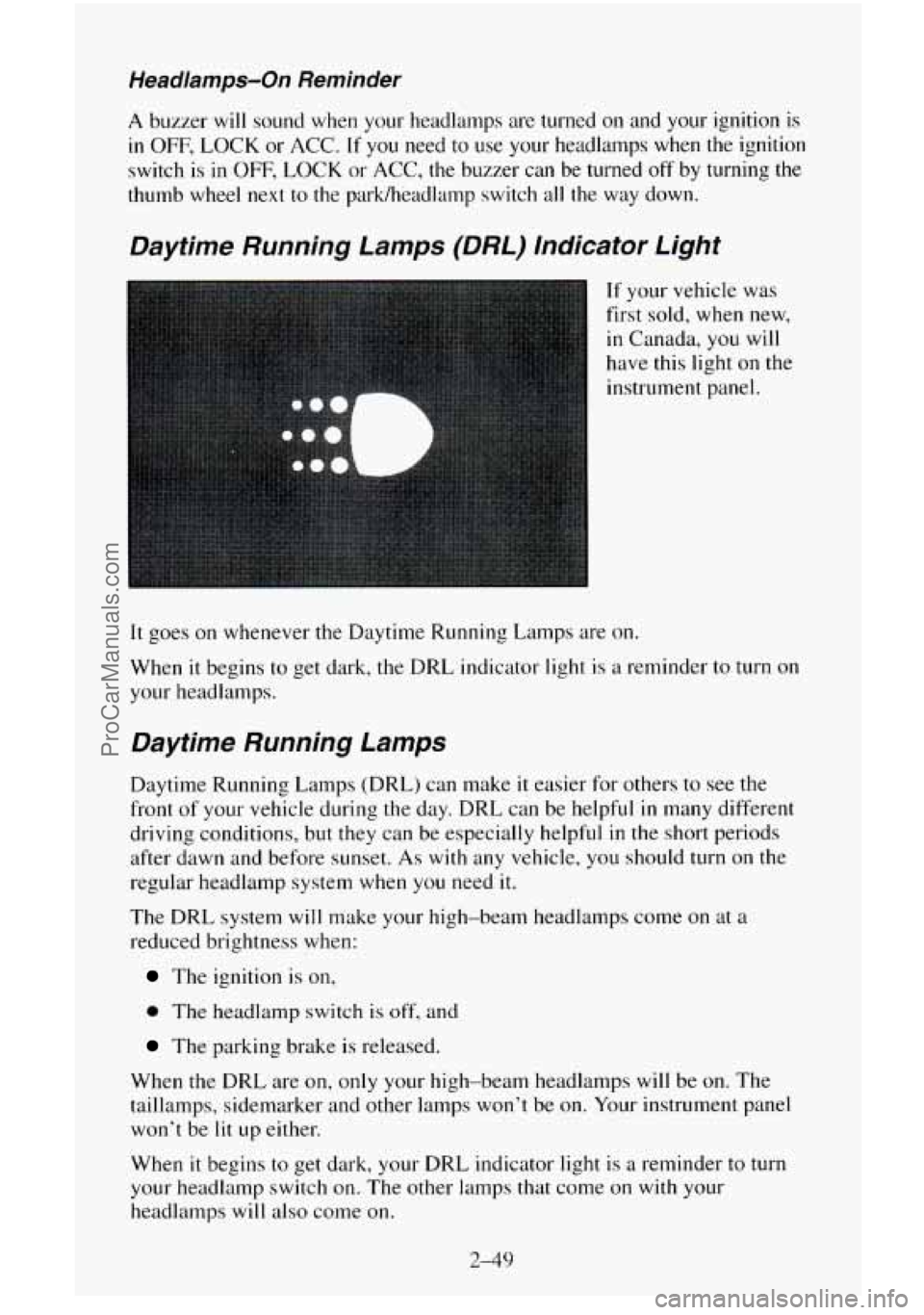
If your vehicle was
first sold, when new,
in Canada, you will
have this light on the
instrument panel.
It goes on whenever the Daytime Running Lamps are on.
When it begins to get dark,
the DRL indicator light is a reminder to turn on
your headlamps.
Daytime Running Lamps
Daytime Running Lamps (DRL) can make it easier for others to see the
front
of your vehicle during the day. DRL can be helpful in many different
driving conditions, but they can be especially helpful
in the short periods
after dawn and before sunset. As
with any vehicle, you should turn on the
regular headlamp system when you need it.
The DRL system will make your high-beam headlamps come
on at a
reduced brightness when:
The ignition is on,
0 The headlamp switch is off, and
The parking brake is released.
When the DRL are on, only your high-beam headlamps will be on. The
taillamps, sidemarker and other lamps won’t be
on. Your instrument panel
won’t be
lit up either.
When
it begins to get dark, your DRL indicator light is a reminder to turn
your headlamp switch on. The other lamps that come on with your
headlamps will also come on.
2-49
ProCarManuals.com
Page 120 of 486
Compass Operation
When the ignition is on and the mirror switch is in the C/M position, the
compass display will show two character boxes for approximately two
seconds.
If, after two seconds, the display does not show a compass heading
(“N” for North, for example), there may be strong magnetic field interfering
with the compass. Such interference may include magnetic antenna mounts,
a magnetic note pad holder, or a similar magnetic item. If removing these
items does
not correct the condition, see your GM dealer for assistance.
When cleaning
the mirror, use a paper towel or similar material dampened
with glass cleaner.
Do not spray glass cleaner directly on the mirror as that
may cause liquid cleaner
to enter the mirror housing.
Compass Variance
Under certain circumstances, as during a long distance cross-country trip, it
will be necessary to adjust the compass to compensate for compass
variance. Compass variance
is the difference between earth’s magnetic
North and true geographic North.
If not adjusted to account for compass
variance, your compass could give false readings.
To adjust for compass variance:
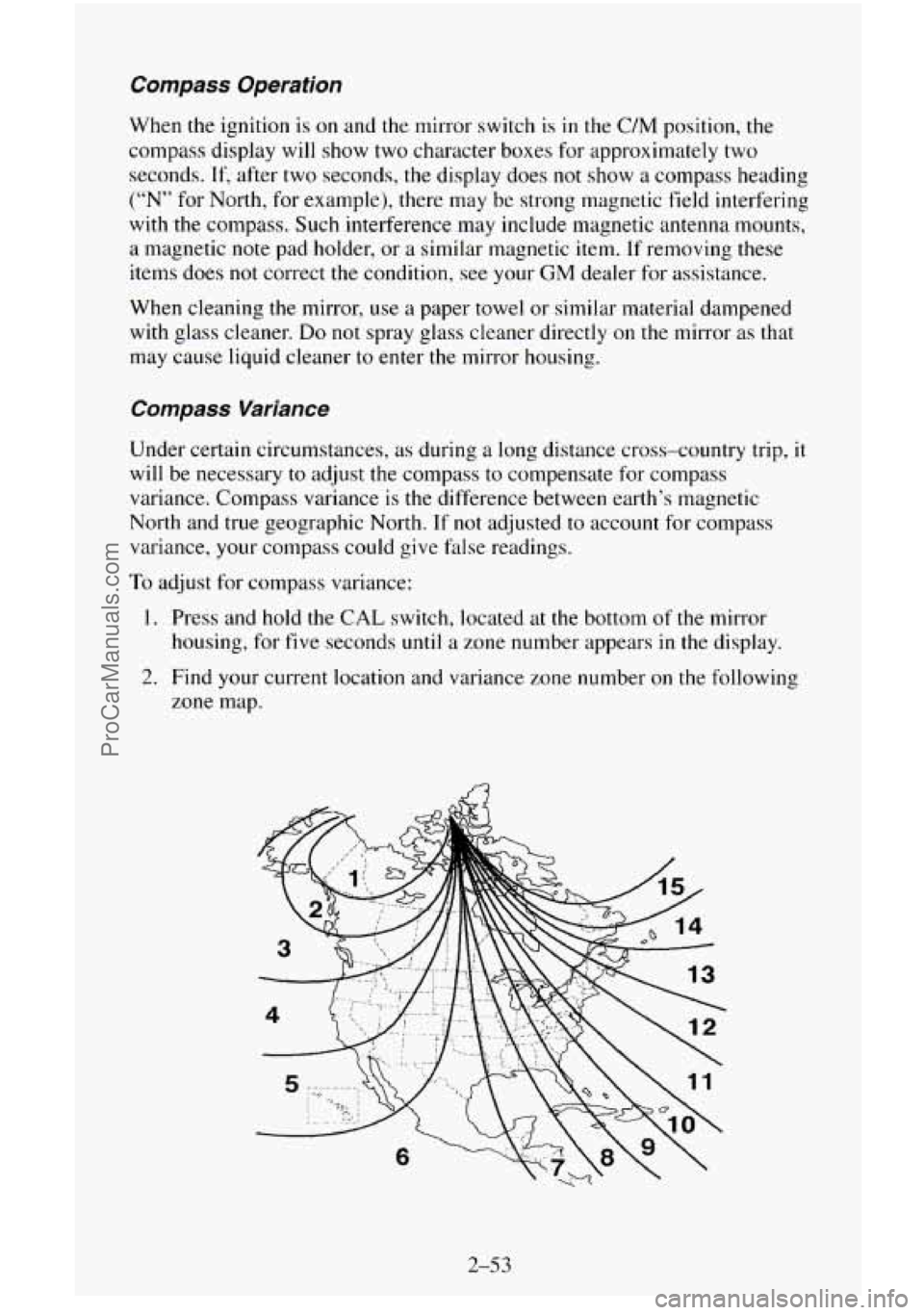
1. Press and hold the CAL switch, located at the bottom of the mirror
housing, for five seconds
until a zone number appears in the display.
2. Find your current location and variance zone number on the following
zone map.
2-53
ProCarManuals.com
Page 138 of 486
You will see this light flash for a few seconds when you turn your ignition
to RUN or START. Then the light should go out. This means the system is
ready.
If the air bag readiness light doesn’t come on when you start your vehicle,
or stays
on, or comes on when you are driving, your air bag system may not
work properly. Have your vehicle serviced right away.
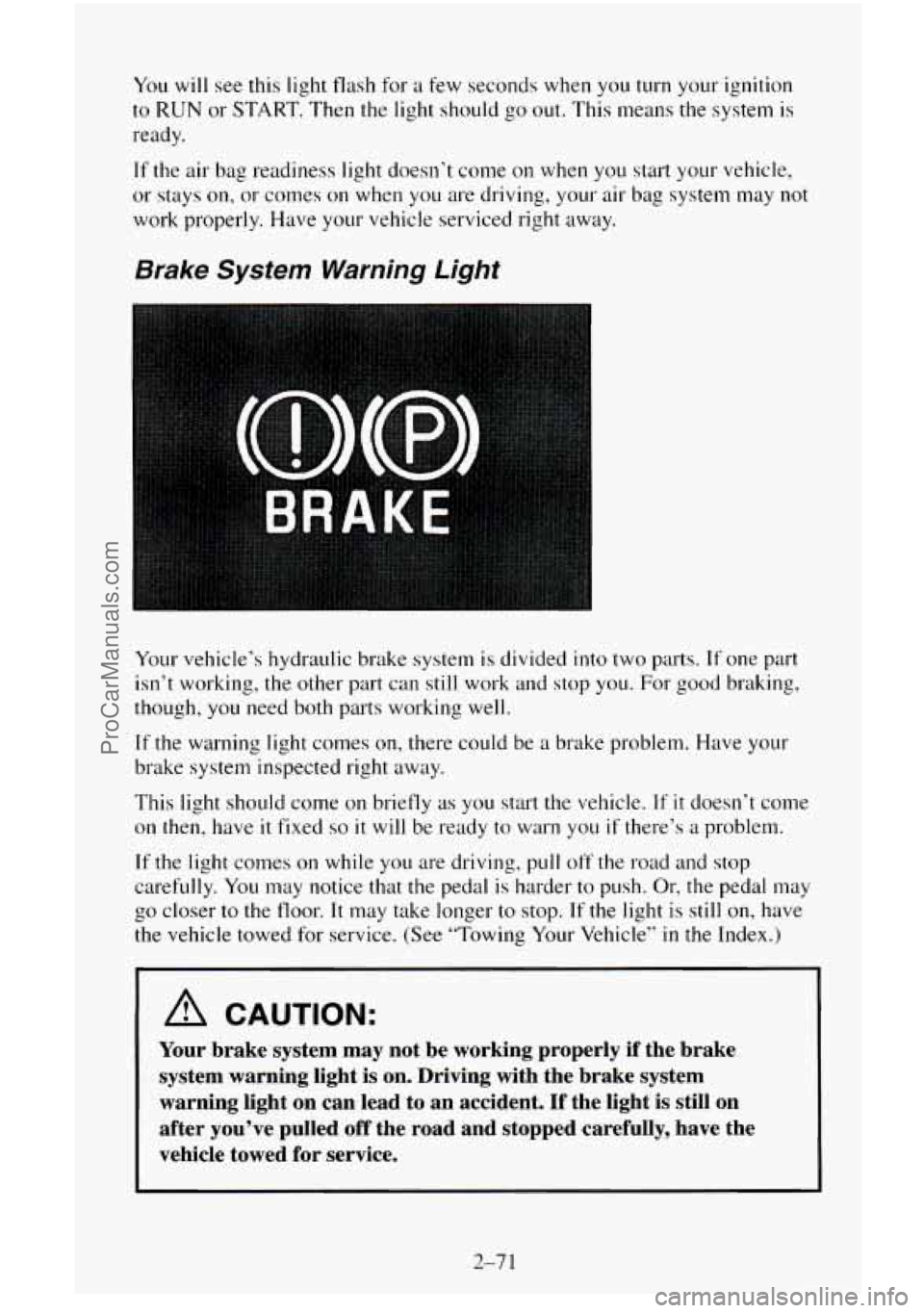
Brake System Warning Light
Your vehicle’s hydraulic brake system is divided into two parts. If one part
isn’t working, the other part can still
work and stop you. For good braking,
though, you need both parts working well.
If the warning light comes on, there could be a brake problem. Have your
brake system inspected right away.
This light should come on briefly as
you start the vehicle. If it doesn’t come
on then, have it fixed so it will be ready to warn you if there’s a problem.
If the light comes on while you are driving, pull off the road and stop
carefully. You may notice that the pedal is harder
to push. Or, the pedal may
go closer
to the floor. It may take longer to stop. If the light is still on, have
the vehicle towed
for service. (See “Towing Your Vehicle” in the Index.)
~~
A CAUTION:
Your brake system may not be working properly if the brake
system warning light is
on. Driving with the brake system
warning light on can lead to an accident. If the light is still on
after you’ve pulled
off the road and stopped carefully, have the
vehicle towed for service.
2-7 1
ProCarManuals.com
Page 140 of 486
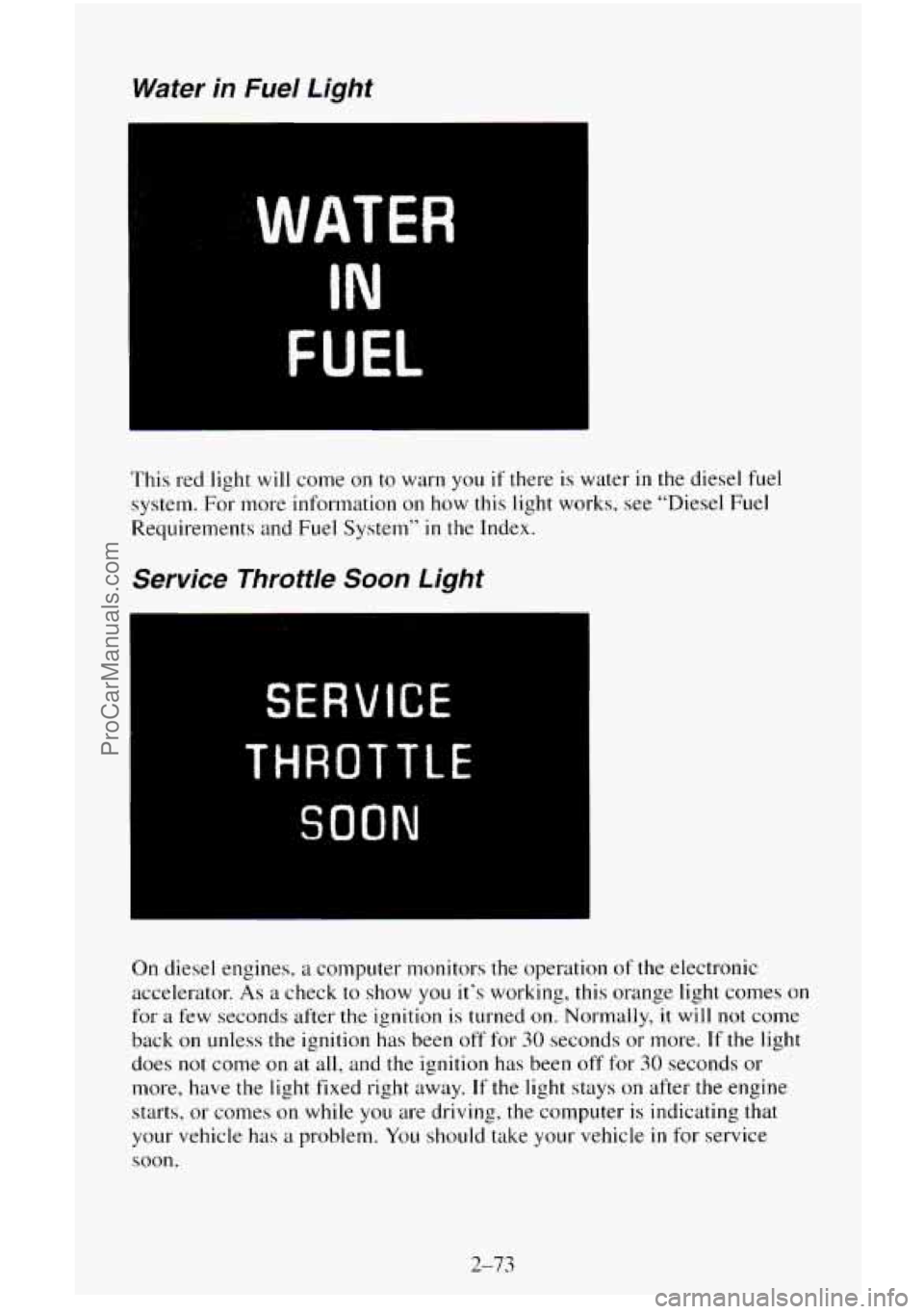
Water in Fuel Light
WATER
IN
FUEL
This red light will come on to warn you if there is water in the diesel fuel
system. For more information
on how this light works, see “Diesel Fuel
Requirements and Fuel System” in the Index.
Service Throttle Soon Light
SERVICE
THROTTLE
SOON
On diesel engines, a computer monitors the operation of the electronic
accelerator.
As a check to show you it’s working, this orange light comes on
for a few seconds after the ignition is turned on. Normally, it will not come
back on unless the ignition has been off for 30 seconds or more. If the light
does not come on at
all, and the ignition has been off for 30 seconds or
more, have the light fixed right away.
If the light stays on after the engine
starts, or comes on while
you are driving, the computer is indicating that
your vehicle
has a problem. You should take your vehicle in for service
soon.
2-73
ProCarManuals.com