ignition CHEVROLET SUBURBAN 1996 Owner's Manual
[x] Cancel search | Manufacturer: CHEVROLET, Model Year: 1996, Model line: SUBURBAN, Model: CHEVROLET SUBURBAN 1996Pages: 486, PDF Size: 26.58 MB
Page 141 of 486
Glow Plugs Light
GLOW
PLUGS
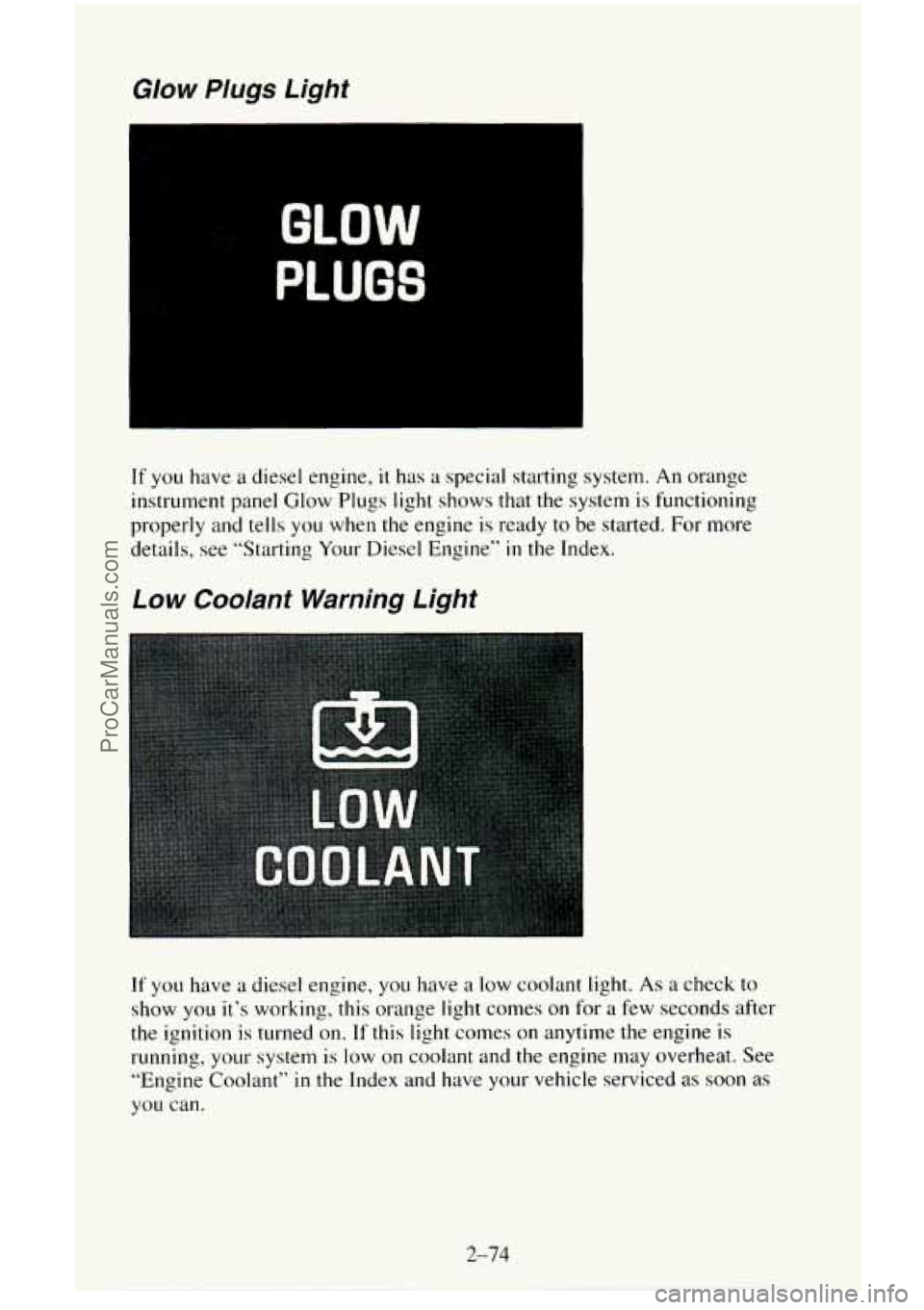
If you have a diesel engine, it has a special starting system. An orange
instrument panel Glow Plugs light shows that the system is functioning
properly and tells you when the engine is ready to be started. For more
details, see “Starting Your Diesel Engine”
in the Index.
Low Coolant Warning Light
If you have a diesel engine, you have a low coolant light. As a check to
show you it’s working, this orange light comes on for a few seconds after
the ignition
is turned on. If this light comes on anytime the engine is
running,
your system is low on coolant and the engine may overheat. See
“Engine
Coolant” in the Index and have your vehicle serviced as soon as
you can.
2-74
ProCarManuals.com
Page 142 of 486
Charging System Warning Light
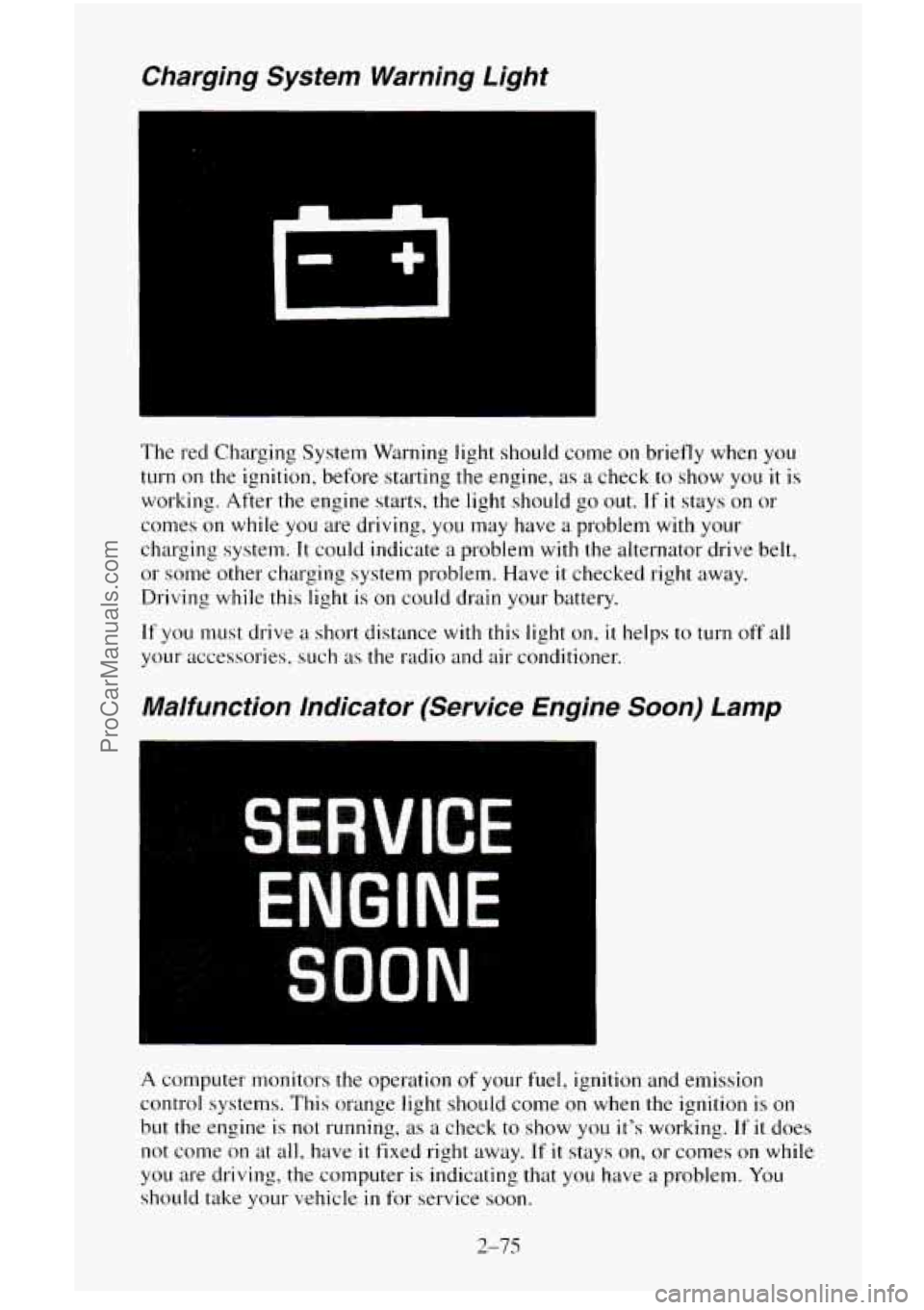
The red Charging System Warning light should come on briefly when you
turn on the ignition, before starting the engine, as a check to show you it is
working. After the engine starts, the light should go out. If it stays on or
conles on while you are driving, you may have a problem with your
charging system.
It could indicate a problem with the alternator drive belt,
or some other charging system problem. Have
it checked right away.
Driving while this light is on could drain your battery.
If you must drive a short distance with this light on, it helps to turn off all
your accessories, such
as the radio and air conditioner.
Malfunction indicator (Service Engine Soon) Lamp
A computer monitors the operation of your fuel, ignition and emission
control systems.
This orange light should come on when the ignition is on
but the engine is
not running, as a check to show you it’s working. If it does
not come on at all, have
it fixed right away. If it stays on, or comes on while
you are driving, the computer is indicating that you have a problem. You
should take your vehicle in for service soon.
2-75
ProCarManuals.com
Page 145 of 486
Turn Signal and Lane Change lndicator Lights
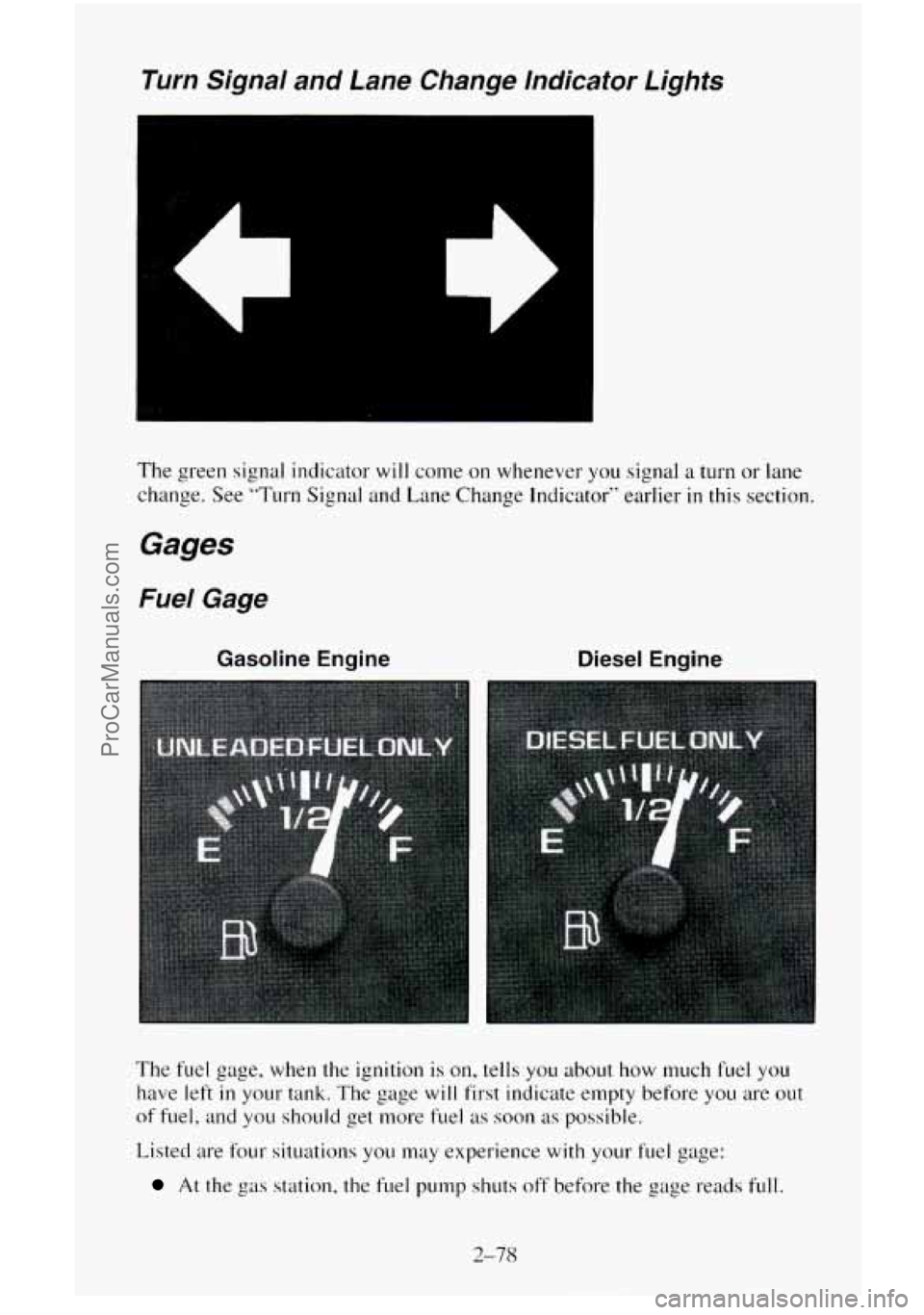
The green signal indicator will come on whenever you signal a turn or lane
change. See
“Turn Signal and Lane Change Indicator’‘ earlier in this section.
Gages
Fuel Gage
Gasoline Engine Diesel Engine
The fuel gage, when the ignition is on, tells you about how much fuel YOLI
have left in your tank. The gage will first indicate empty before you are out
of fuel,
and you should get more fuel as soon as possible.
Listed are
four situations you may experience with your fuel ea tracre:
At the gas station, the fuel pump shuts off before the gage reads ~LIII.
2-78
ProCarManuals.com
Page 146 of 486
It takes a little more or less fuel to fill up than the fuel gage indicated.
For example, the gage may have indicated the tank was half
full, but it
actually took a little more or less than half the tank’s capacity to fill the
tank.
The gage moves a little when you turn a corner or speed up.
0 The gage doesn’t go back to empty when you turn off the ignition.
None of these indicate a problem with the fuel gage.
For information on how to fill your fuel tank, see “Fuel
- Filling Your
Tank”
in the Index.
For your
fuel tank capacity, see “Fuel -Tank Capacity” in the Index.
Engine Coolant Temperature Gage
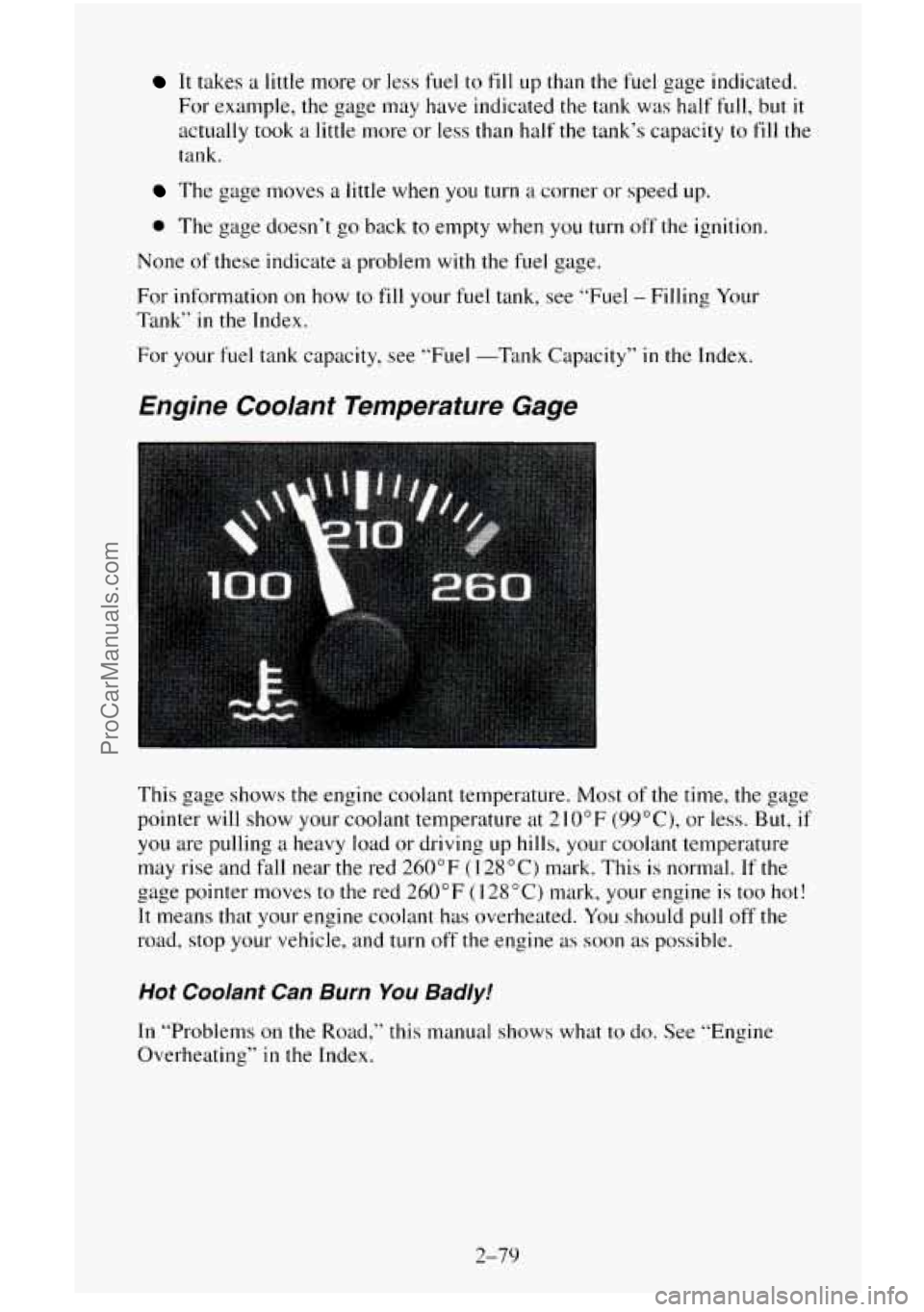
This gage shows the engine coolant temperature. Most of the time, the gage
pointer will show your coolant temperature at 210°F (99”C), or less. But,
if
you are pulling a heavy load or driving up hills, your coolant temperature
may rise and fall near
the red 260°F (1 28°C) mark. This is normal. If the
gage pointer moves
to the red 260°F (1 28°C) mark, your engine is too hot!
It means that your engine coolant has overheated. You should pull off the
road, stop
your vehicle, and turn off the engine as soon as possible.
Hot Coolant Can Burn You Badly!
In “Problems on the Road,” this manual shows what to do. See “Engine
Overheating”
in the Index.
2-79
ProCarManuals.com
Page 148 of 486
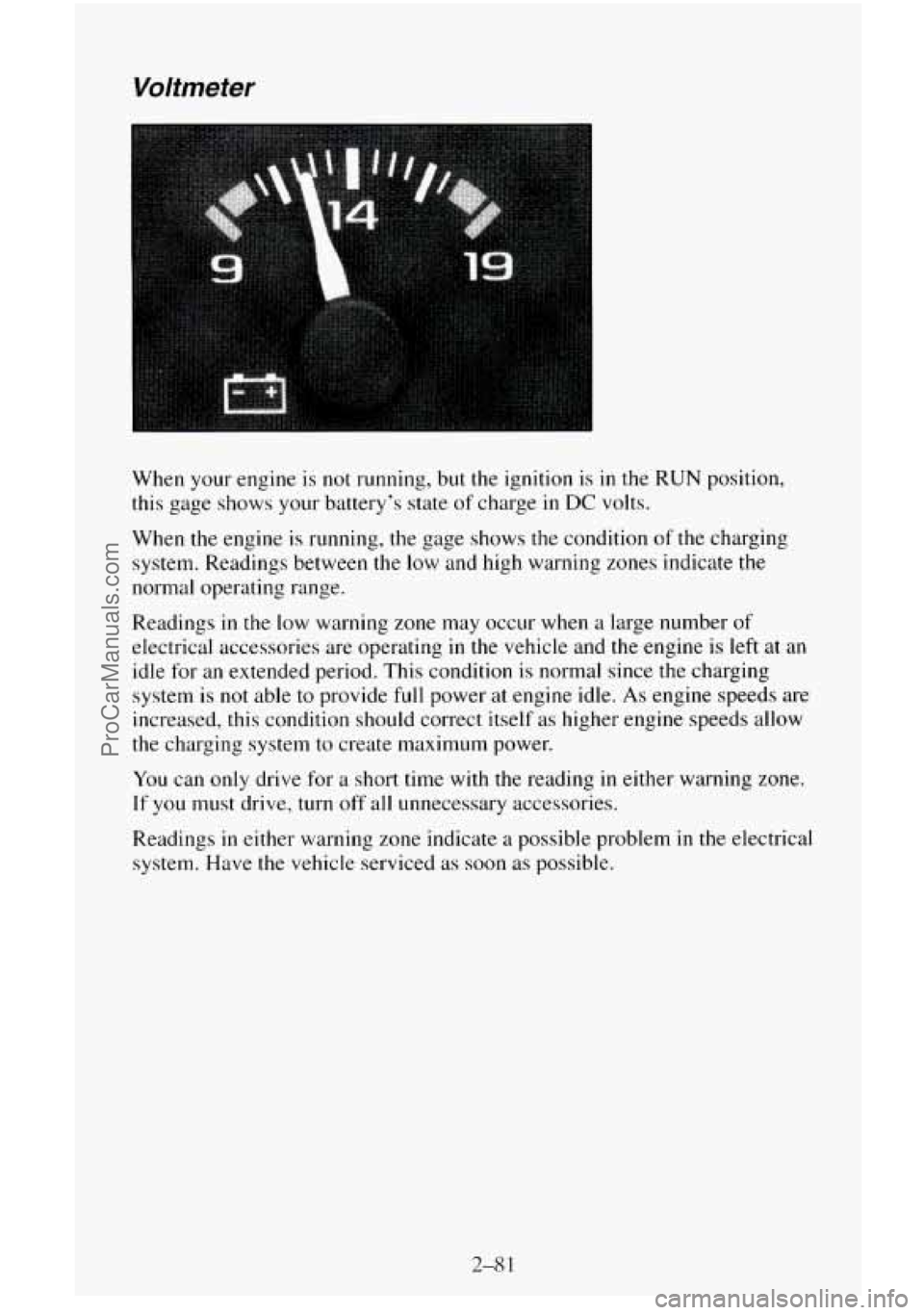
Voltmeter
When your engine is not running, but the ignition is in the RUN position,
this gage shows your battery’s state of charge
in DC volts.
When
the engine is running, the gage shows the condition of the charging
system. Readings between the low and high warning zones indicate
the
normal operating range.
Readings in the low warning zone may occur when a large number
of
electrical accessories are operating in the vehicle and the engine is left at an
idle
for an extended period. This condition is normal since the charging
system
is not able to provide full power at engine idle. As engine speeds are
increased,
this condition should correct itself as higher engine speeds allow
the charging system
to create maximum power.
You can only drive for a short time with the reading in either warning zone.
If you must drive, turn off all unnecessary accessories.
Readings in either warning zone indicate a possible problem
in the electrical
system. Have the vehicle serviced as soon as possible.
2-8 1
ProCarManuals.com
Page 162 of 486
Rear Window Defogger (Option)
You can tell if your vehicle has this option by looking at the rear window. If
you see lines running across the glass, you have it. These are the wire-like
elements which heat your window.
NOTICE:
Scraping the inside of your rear window could cut and damage
the defogger. Your warranty would not cover this damage. And,
don’t put decals there, you might have to scrape them off.
For best results, clear the window of as much snow or ice as possible first.
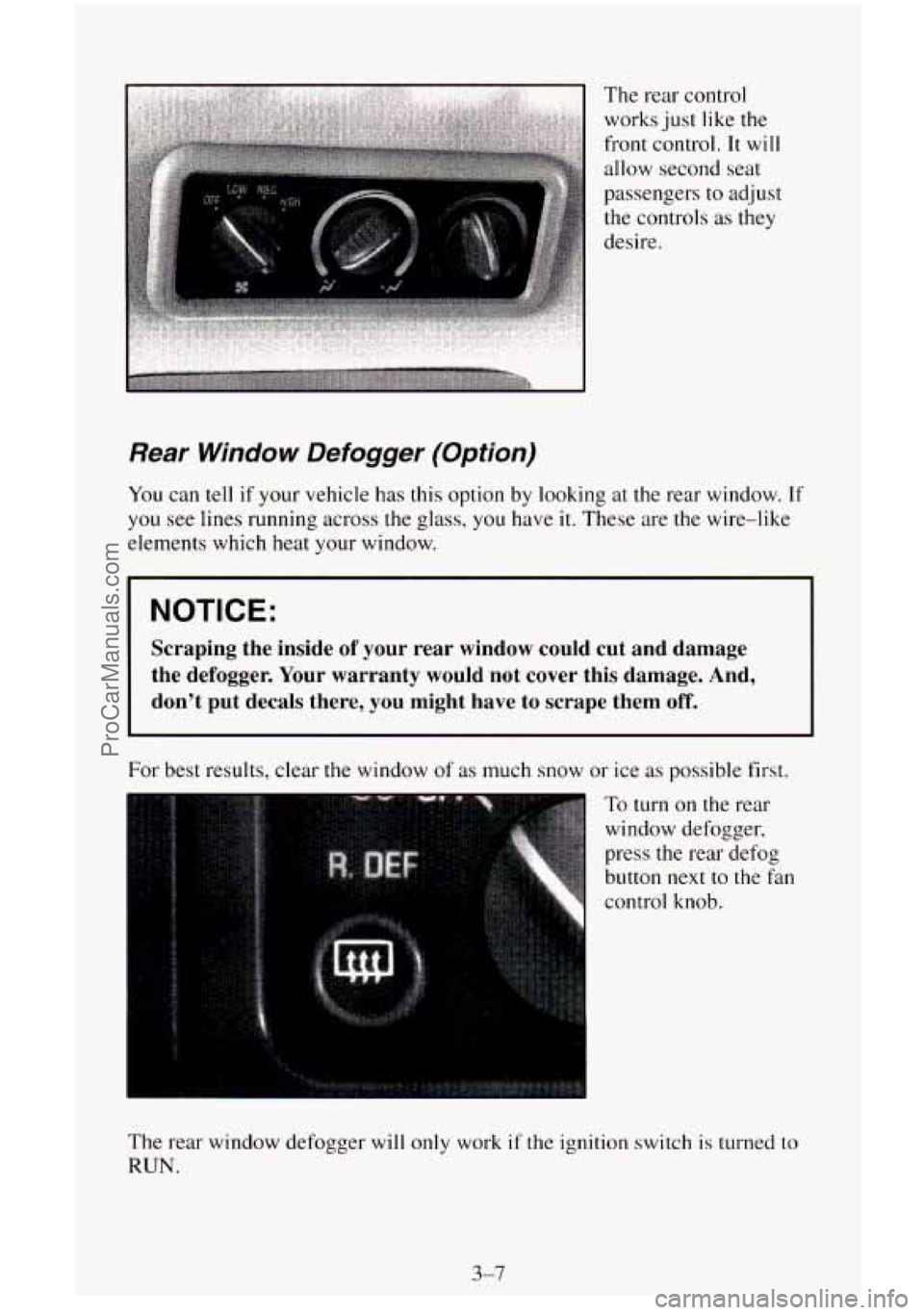
To turn on the rear
window defogger,
press the rear defog
button
next to the fan
control knob.
The rear window defogger will
only work if the ignition switch is turned to
RUN.
3-7
ProCarManuals.com
Page 164 of 486
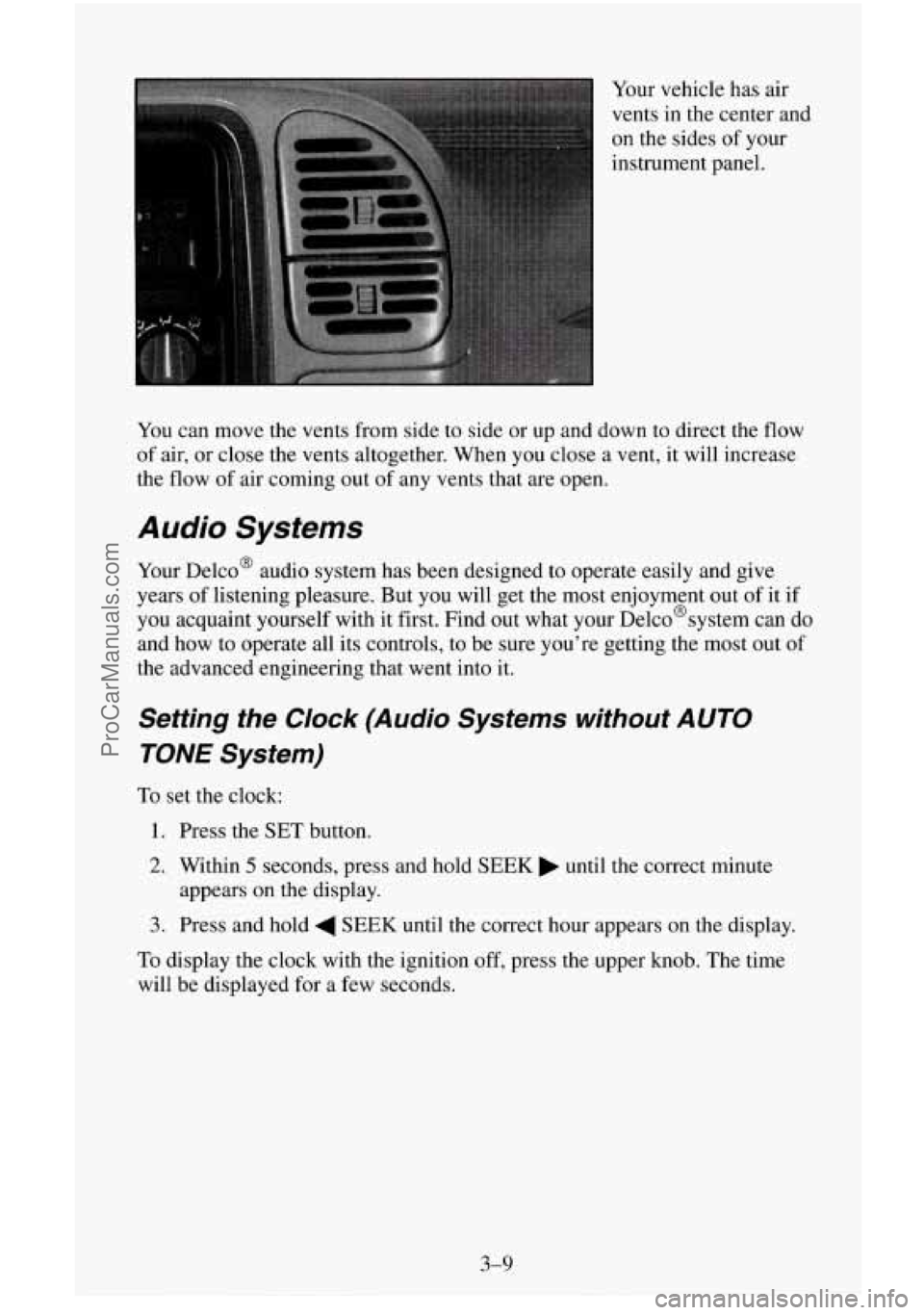
Your vehicle has air
vents in the center and
on the sides of your
instrument panel.
You can move the vents from side to side or up and down to direct the
flow
of air, or close the vents altogether. When you close a vent, it will increase
the flow of air coming out of any vents that are open.
Audio Systems
Your Delco@ audio system has been designed to operate easily and give
years of listening pleasure. But
you will get the most enjoyment out of it if
you acquaint yourself with it first. Find out what your Delco@systern can
do
and how to operate all its controls, to be sure you’re getting the most out of
the advanced engineering that went into it.
Setting the Clock (Audio Systems without AUTO
TONE System)
To set the clock:
1. Press the SET button.
2. Within 5 seconds, press and hold SEEK until the correct minute
3. Press and hold 4 SEEK until the correct hour appears on the display.
appears
on the display.
To display the clock with the ignition off, press the upper knob. The time
will be displayed for a few seconds.
3-9
ProCarManuals.com
Page 165 of 486
Setting the Clock (Audio Systems with AUTO TONE
System)
The buttons used to set the clock are located below the AUTO TONE button
in the bottom right corner of your audio system.
To set the clock:
1. Press and hold HR until the correct hour appears on the display.
2. Press and hold MIN until the correct minute appears on the display.
To display the clock with the ignition off, press the recall button. The time
will be displayed for a few seconds.
There is an initial two-second delay before the clock goes into the time-set
mode.
How to Operate Your ETW AM-FM Stereo Audio
System
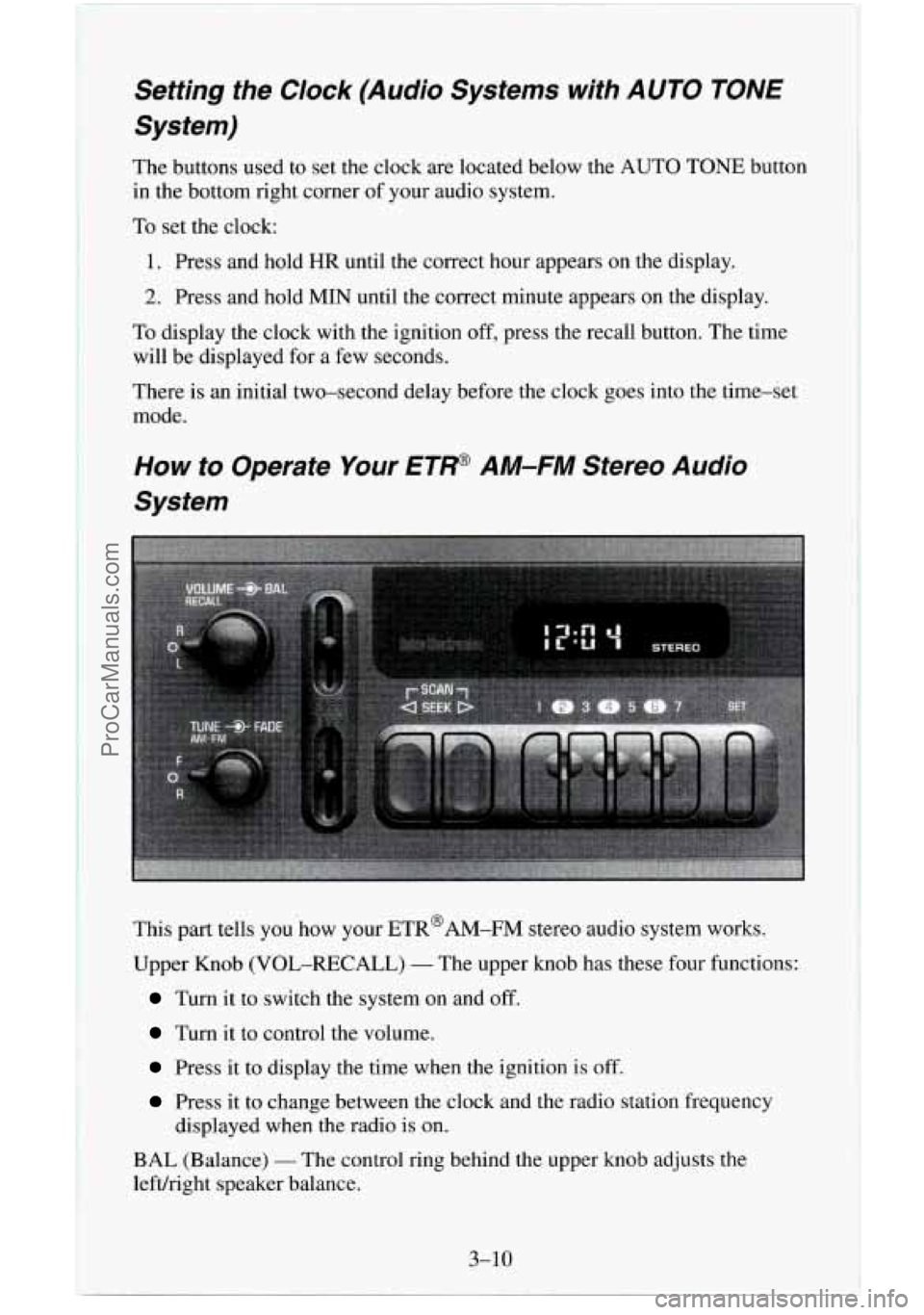
This part tells you.how your ETR@AM-FM stereo audio system works.
Upper Knob (VOL-RECALL)
- The upper knob has these four functions:
Turn it to switch the system on and off.
Turn it to control the volume.
Press it to display the time when the ignition is off.
Press it to change between the clock and the radio station frequency
displayed when the radio is
on.
BAL (Balance) - The control ring behind the upper knob adjusts the
left/right speaker balance.
3-10
ProCarManuals.com
Page 167 of 486
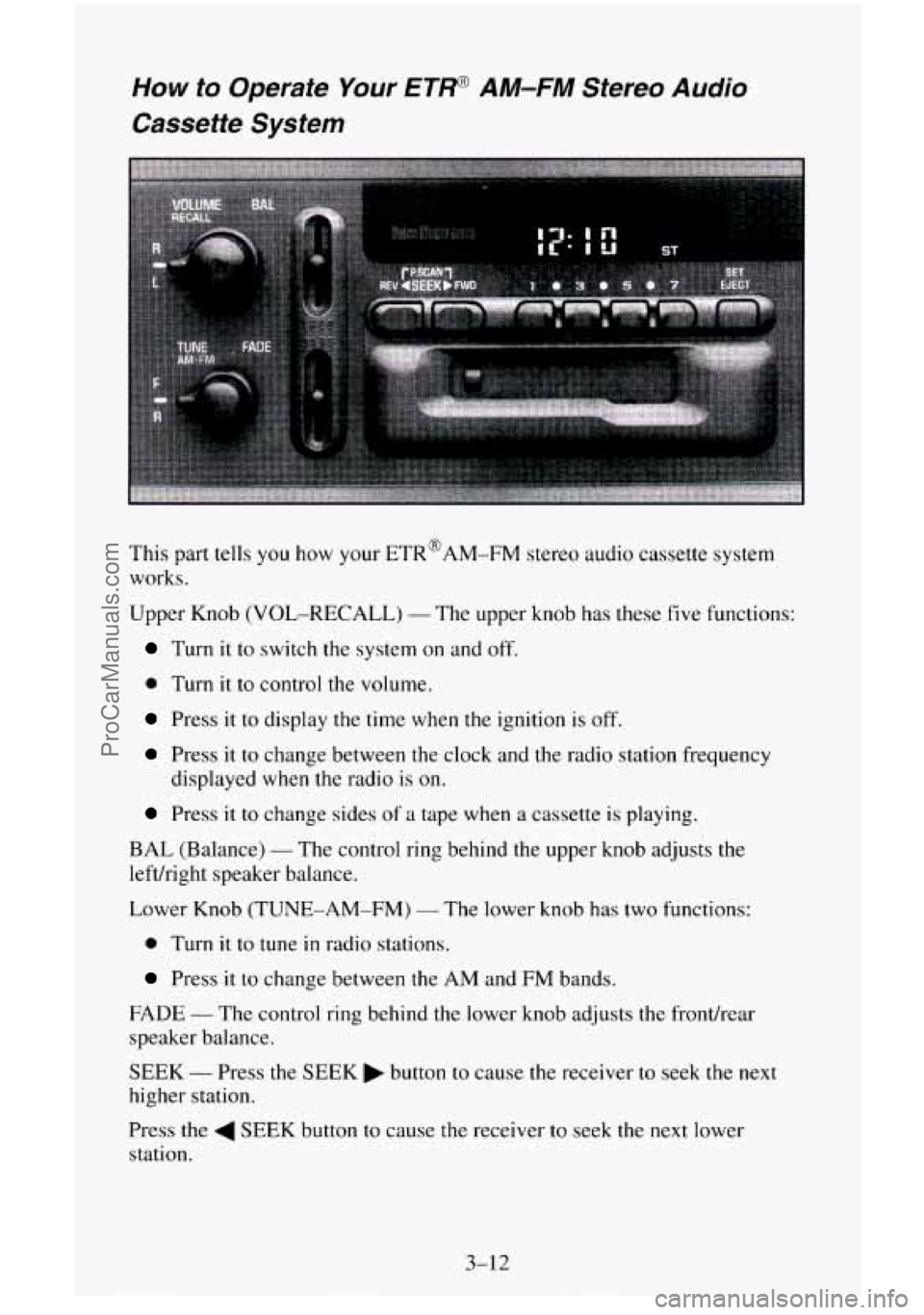
How to Operate Your ETP AM-FM Stereo Audio
Cassette System
This part tells you how your ETR@AM-FM stereo audio cassette system
works.
Upper Knob (VOL-RECALL)
- The upper knob has these five functions:
Turn it to switch the system on and off.
0 Turn it to control the volume.
Press it to display the time when the ignition is off.
Press it to change between the clock and the radio station frequency
displayed when the radio
is on.
Press it to change sides of a tape when a cassette is playing.
BAL (Balance)
- The control ring behind the upper knob adjusts the
lefthight speaker balance.
Lower Knob (TUNE-AM-FM)
- The lower knob has two functions:
0 Turn it to tune in radio stations.
Press it to change between the AM and FM bands.
FADE
- The control ring behind the lower knob adjusts the fronthear
speaker balance.
SEEK
- Press the SEEK button to cause the receiver to seek the next
higher station.
Press the
4 SEEK button to cause the receiver to seek the next lower
station.
3-12
ProCarManuals.com
Page 170 of 486
RCL (Recall) - Press this button to change between the clock and the radio
station frequency displayed when the radio is on. Also, press this button to
display the time when the ignition is off.
TUNE - Press lightly on the TUNE button to release it from its stored
position. Rotate
the knob clockwise to increase frequency and
counterclockwise to decrease radio frequency. When done, press
the knob
again to return
it to its stored position.
Pushbuttons
- The six pushbuttons let you return to favorite stations. To
set the pushbuttons for up to
18 favorite stations (6 AM, 6 FM1 and 6 FM2):
1. Tune in the desired station.
2. Press AUTO TONE to select the best setting for the type of station
chosen.
3. Press and hold one of the pushbuttons until sound returns
(approximately two seconds). Whenever you press
that button, me
preset station will return.
Repeat these steps for each pushbutton.
SEEK
- Press SEEK to cause the receiver to seek the next higher
station.
Press
4 SEEK to cause the receiver to seek the next lower station.
SCAN
- Press and hold the center of the SEEK button to momentarily hear
each available station. Release the button when SCAN appears
in the
display. The receiver will continue to scan and momentarily stop at each
station
until you press the center of the SEEK button again.
P. SCAN (Preset Scan)
- Press this button to scan each preset pushbutton
station. The receiver will continue to scan and momentarily stop at each
station
until you press either P. SCAN again or one of the six pushbuttons.
The AUTO SCAN setting for
that preset button will also return. The
pushbutton number (PI-P6)
will appear momentarily just before frequency
is displayed.
AUTO TONE
- Press this button to select between five preset equalization
settings and tailor the sound to
the music or voice being heard. Each time
you press the button, the selection
will switch to one of the preset settings of
CLASSIC, NEWS, ROCK, POP, or
JAZZ. The display will show which
mode the receiver is in. To return to the manual mode, press and release
AUTO TONE until
MAN (manual) appears in the display. This will return
the tone adjustment to the TREB and BASS controls. Also, any time a
TREB or BASS control is rotated, tone is automatically set back to MAN
(manual).
3-15
ProCarManuals.com