ignition CHEVROLET SUBURBAN 1996 Service Manual
[x] Cancel search | Manufacturer: CHEVROLET, Model Year: 1996, Model line: SUBURBAN, Model: CHEVROLET SUBURBAN 1996Pages: 486, PDF Size: 26.58 MB
Page 205 of 486
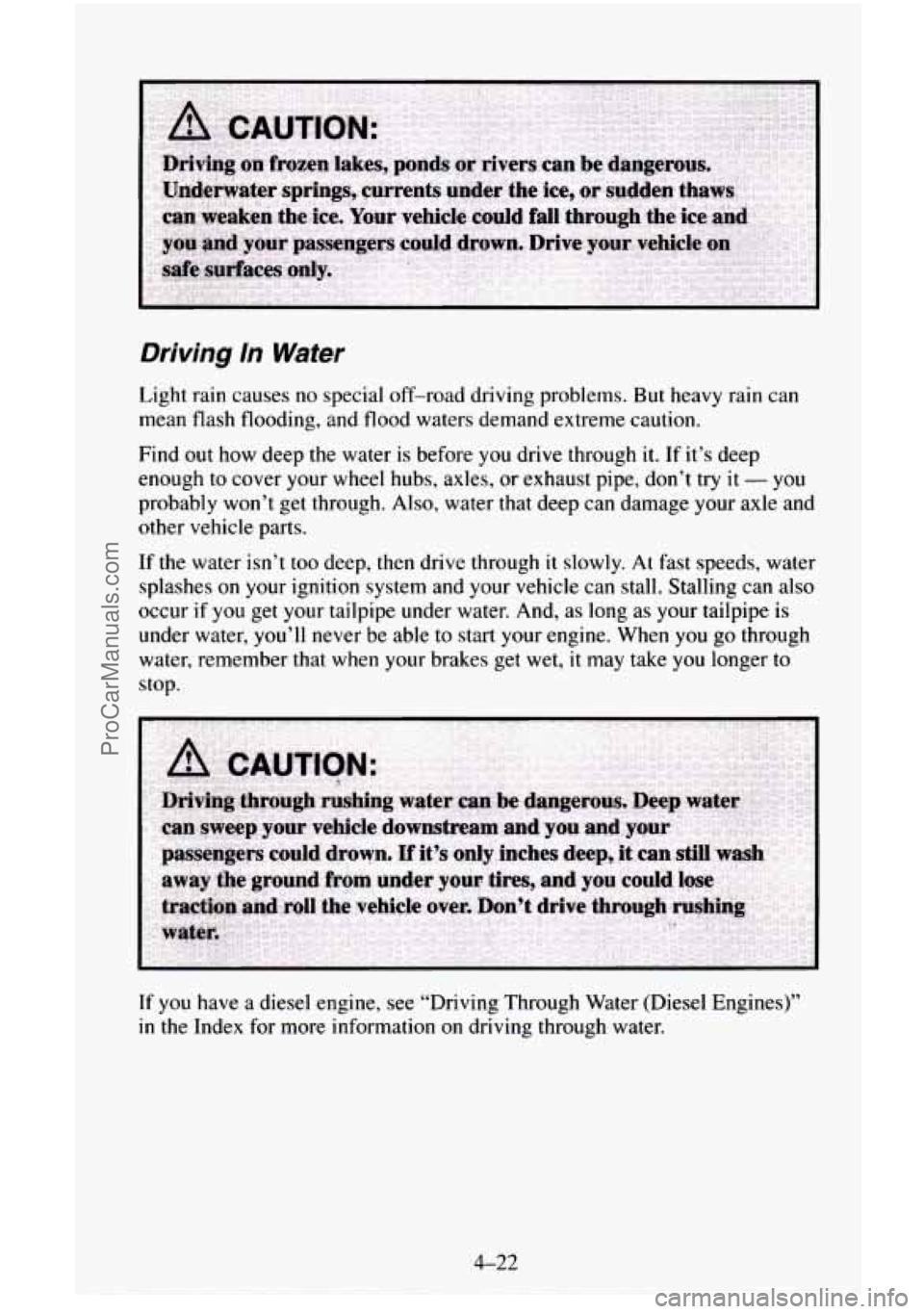
Driving ln Water
Light rain causes no special off-road driving problems. But heavy rain can
mean flash flooding, and flood waters demand extreme caution.
Find out how deep the water
is before you drive through it. If it’s deep
enough to cover your wheel hubs, axles,
or exhaust pipe, don’t try it - you
probably won’t get through. Also, water that deep can damage your axle and
other vehicle parts.
If the water isn’t
too deep, then drive through it slowly. At fast speeds, water
splashes
on your ignition system and your vehicle can stall. Stalling can also
occur
if you get your tailpipe under water. And, as long as your tailpipe is
under water, you’ll never be able
to start your engine. When you go through
water, remember that when your brakes get wet, it may take you longer to
stop.
If
you have a diesel engine, see “Driving Through Water (Diesel Engines)”
in the Index for more information on driving through water.
4-22
ProCarManuals.com
Page 237 of 486
Turn off the ignition on both vehicles. Turn off all lights that aren’t
needed, and radios. This will avoid sparks and help save both batteries.
And it could
save your radio!
I NOTICE:
If you leave your radio on, it could be badly damaged. The
repairs wouldn’t be covered by your warranty.
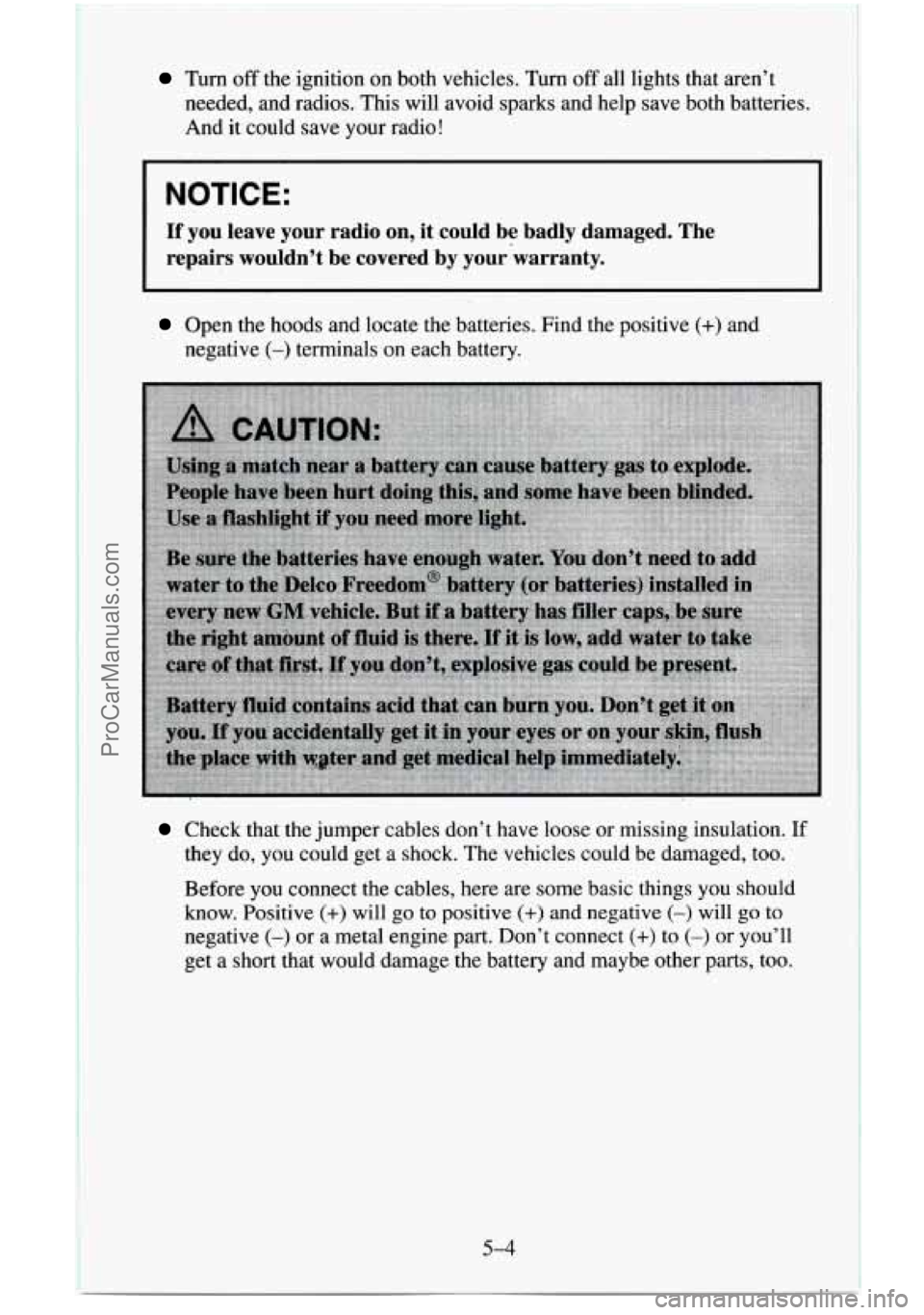
Open the hoods and locate the batteries. Find the positive (+) and
negative
(-) terminals on each battery.
Check that the jumper cables don’t have loose or missing insulation. If
they do, you could get a shock. The vehicles could be damaged, too.
Before
you connect the cables, here are some basic things you should
know. Positive
(+) will go to positive (+) and negative (-) will go to
negative (-) or a metal engine part. Don’t connect (+) to (-) or you’ll
get a short that would damage the battery and maybe other parts, too.
5-4
ProCarManuals.com
Page 240 of 486
To wing Your Vehicle
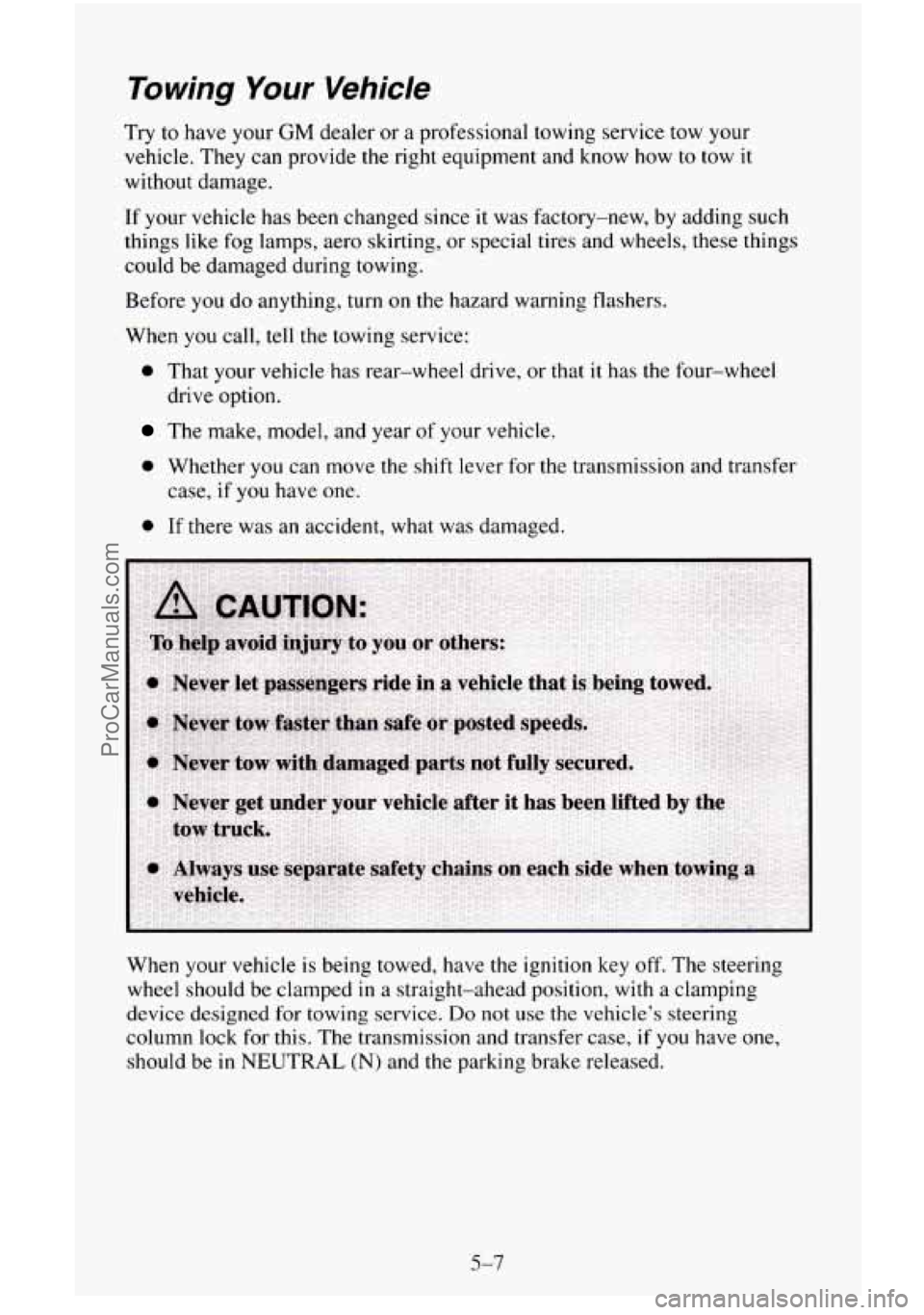
Try to have your GM dealer or a professional towing service tow your
vehicle. They can provide the right equipment and know how
to tow it
without damage.
If your vehicle has been changed since it was factory-new, by adding such
things like fog lamps, aero skirting, or special tires and wheels, these things
could be damaged during towing.
Before you do anything, turn on the hazard warning flashers.
When you call, tell the towing service:
0 That your vehicle has rear-wheel drive, or that it has the four-wheel
drive option.
The make, model, and year of your vehicle.
0 Whether you can move the shift lever for the transmission and transfer
case, if you have one.
0 If there was an accident, what was damaged.
When your vehicle is being towed, have
the ignition key off. The steering
wheel should be clamped
in a straight-ahead position, with a clamping
device designed for towing service.
Do not use the vehicle’s steering
column
lock for this. The transmission and transfer case, if you have one,
should be in NEUTRAL (N) and the parking brake released.
5-7
ProCarManuals.com
Page 285 of 486
NOTICE:
If there is water in your diesel fuel and the weather is warm or
humid, fungus and bacteria can grow in the fuel. They can
damage your fuel system. You’ll need
a diesel fuel biocide to
sterilize your fuel system. Your dealer can advise you if you ever
need this.
If your fuel tank needs to be purged to remove water,
see your
dealer or
a qualified technician. Improper purging can damage
your fuel system.
Running Out of Fuel (Diesel Engines)
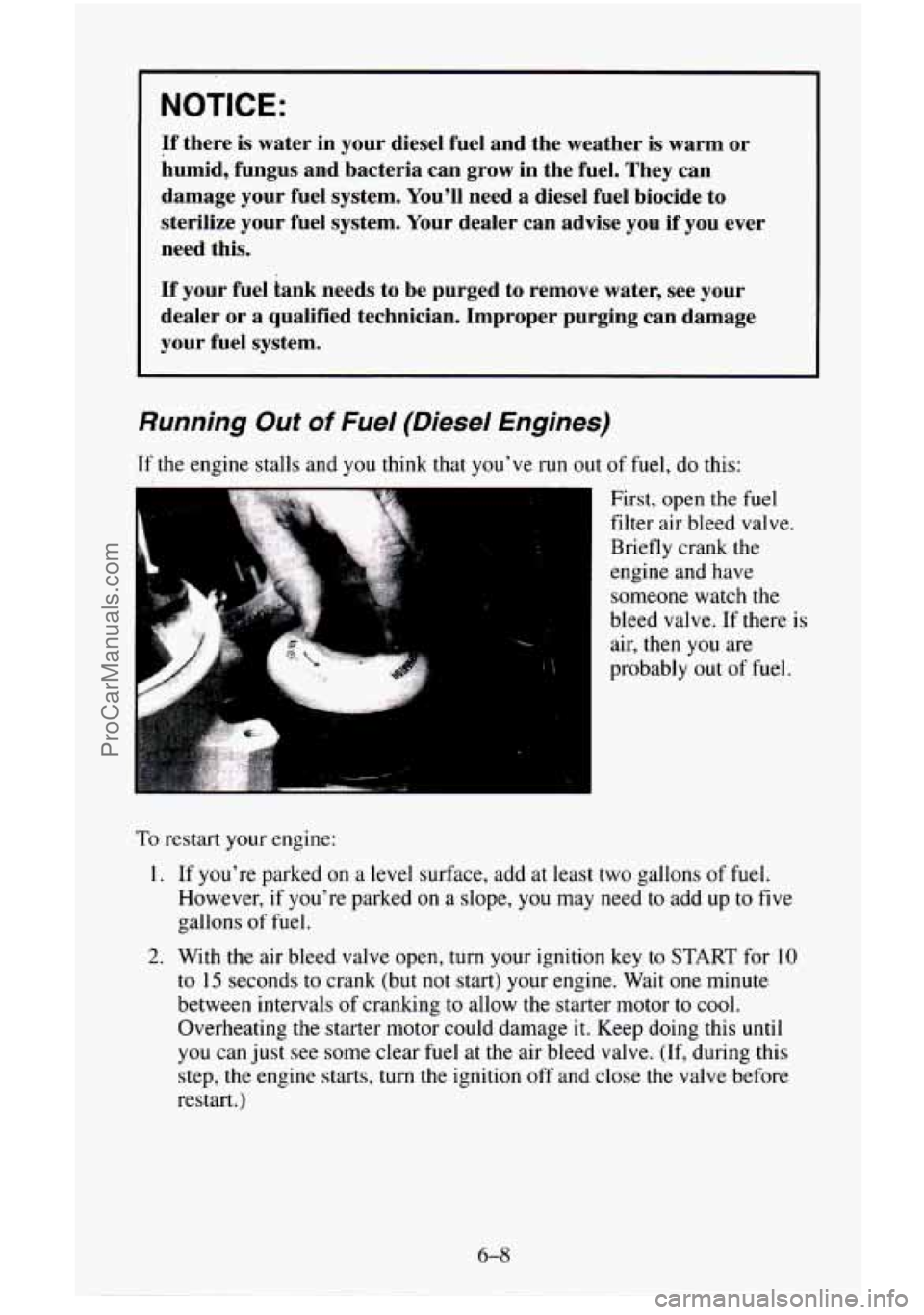
If the engine stalls and you think that you’ve run out of fuel, do this:
First, open the fuel
filter air bleed valve.
Briefly crank the
engine and have
someone watch
the
bleed valve. If there is
air,
then you are
probably
out of fuel.
To restart your engine:
1. If you’re parked on a level surface, add at least two gallons of fuel.
However, if you’re parked on a slope, you may need to add up to five
gallons of fuel.
2. With the air bleed valve open, turn your ignition key to START for 10
to 15 seconds to crank (but not start) your engine. Wait one minute
between intervals of cranking to allow the starter motor
to cool.
Overheating the starter motor could damage
it. Keep doing this until
you can just see some clear fuel at the air bleed valve. (If, during this
step, the engine starts, turn the ignition off and close the valve before
restart.)
ProCarManuals.com
Page 286 of 486
3. Close the air bleed valve.
4. Turn the ignition key to START for 10 to 15 seconds at a time until
your engine starts.
Fuel Filter Replacement (Diesel Engines)
If you want to change the fuel filter yourself, here's how to do it:
First, drain any water from the filter following the procedure for draining
water listed previously.
Your vehicle's engine should be off until the end of the following procedure.
r.
1. Apply the parking brake.
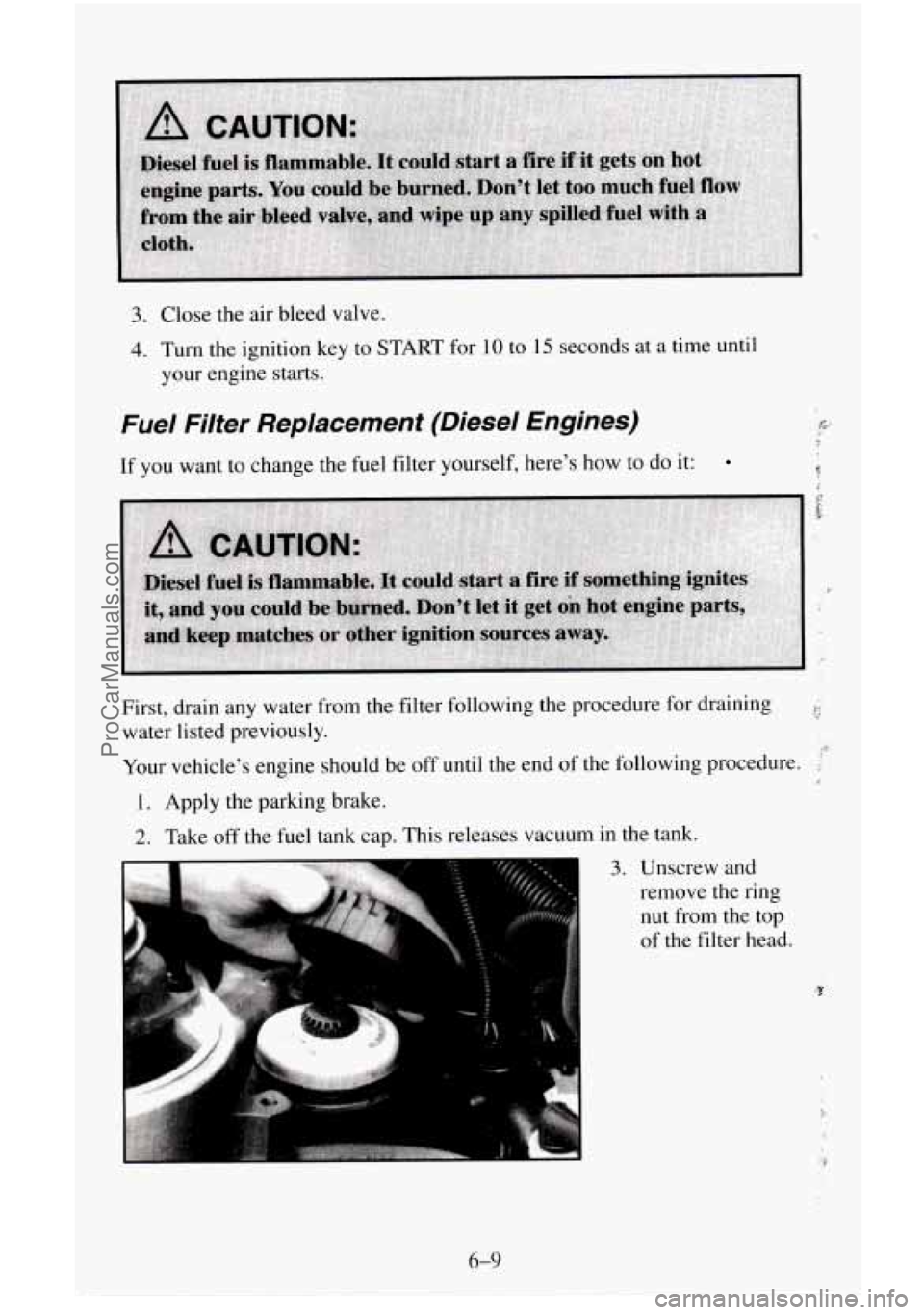
2. Take off the fuel tank cap. This releases vacuum in the tank.
3. Unscrew and
remove the ring
nut from the top
of the filter head.
6-9
ProCarManuals.com
Page 287 of 486
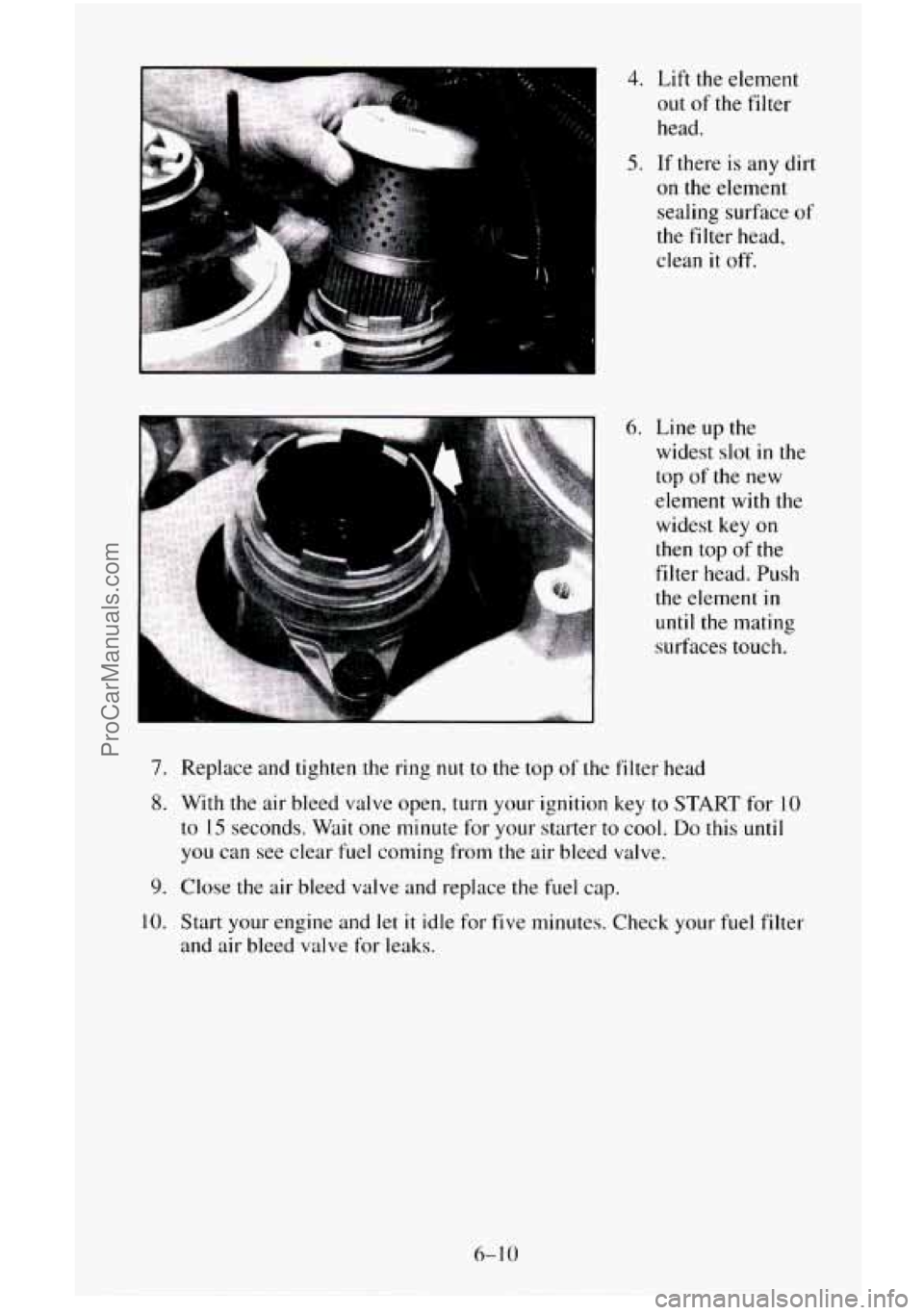
4. Lift the element
out
of the filter
head.
5. If there is any dirt
on the element
sealing surface
of
the filter head,
clean
it off.
6. Line up the
widest slot
in the
top
of the new
element with the
widest key on
then top of the
filter head. Push
the element
in
until the mating
surfaces touch.
7. Replace and tighten the ring nut to the top of'the filter head
8. With the air bleed valve open, turn your ignition key to START for 10
to 15 seconds, Wait one minute for your starter to cool. Do this until
you can see clear fuel coming from the air bleed valve.
9. Close the air bleed valve and replace the fuel cap.
10. Start your engine and let it idle for five minutes. Check your fuel filter
and air bleed valve for leaks.
6-10
ProCarManuals.com
Page 478 of 486
G
Gages Engine Coolant Temperature Gage
................................
FuelGage ...................................................
Oil Pressure Gage .............................................
Speedometer .................................................
Tachometer ..................................................
Tamper Resistant Odometer .....................................
Trip Odometer ................................................
Voltmeter ....................................................
2-79
2-78
2-80
2-68
2-69
2-68
2-68
2-81
Halogen Bulbs (See “Bulb Replacement”)
Hazard Warning Flashers
........................................... 5-1
Head Restraints (See “Seats”)
Headlamps and Vehicle Lighting
.................................... 2-48
Replacement (See “Bulb Replacement”)
High Beam Indicator Light (See “Lights”)
High-LowBeamChanger
...................................... 2-38
Reminder .................................................... 2-46
Heatercontrols .................................................. 3-1
RearHeater ................................................... 3-5
Heater/Air Conditioning Controls .................................... 3-2
Rear Air Conditioning ........................................... 3-4
Refrigerant Capacity ........................................... 6-79
Highway Hypnosis (See “Driving-Highway Hypnosis”)
Hitches (See “Towing-Hitches”)
Hood Checking Under, Hood Release
.................................. 6-13
Horn .......................................................... 2-38
Hydraulicclutch ................................................ 6-30
Howtocheck ................................................ 6-31
When to Check and What to Use ................................. 6-31
Hydroplaning (See “Driving in the Rain”)
If You’re Stuck in Sand. Mud. Ice. or Snow ........................... 5-41
Ignitionswitch .................................................. 2-12
Inflation-Tire Pressure (See “Tires”)
Instrument Cluster
............................................... 2-67
Instrumentpanel ................................................ 2-67
Jacking Equipment Storage ................................... 5.26. 5-40
Jump Starting .................................................... 5-2
.
ProCarManuals.com