Index CHEVROLET TAHOE 1997 1.G Owner's Guide
[x] Cancel search | Manufacturer: CHEVROLET, Model Year: 1997, Model line: TAHOE, Model: CHEVROLET TAHOE 1997 1.GPages: 433, PDF Size: 22.05 MB
Page 186 of 433
Downloaded from www.Manualslib.com manuals search engine Avoid needless heavy braking. Some people drive in
spurts
-- heavy acceleration followed by heavy
braking
-- rather than keeping pace with traffic. This is a
mistake. Your brakes may not have time to cool between
hard stops. Your brakes will wear out much faster if you
do a lot of heavy braking. If you keep pace with the
traffic and allow realistic following distances, you will
eliminate a lot
of unnecessary braking. That means
better braking and longer brake life.
If your engine ever stops while you’re driving, brake
normally but don’t pump your brakes. If you do, the
pedal may get harder to push down. If your engine
stops, you will still have some power brake assist. But
you will use it when you brake. Once the power assist is
used up, it may take longer to stop and the brake pedal
will be harder to push.
Anti-Lock Brakes (ABS)
Your vehicle has anti-lock brakes (ABS). ABS is an
advanced electronic braking system that will help
prevent a braking skid.
When you start your engine and begin to drive away,
your anti-lock brake system will check itself. You may
hear a momentary motor or clicking noise while this test
is going on. This is normal.
ANTI -
LOCK
If there’s a problem with the
anti-lock brake system, this
warning light will stay on.
See “Anti-Lock Brake
System Warning Light” in
the Index.
4-7
Page 193 of 433
Downloaded from www.Manualslib.com manuals search engine While driving on a surface with reduced traction, try
your best to avoid sudden steering, acceleration
or
braking (including engine braking by shifting to a lower
gear). Any sudden changes could cause the tires to slide.
You may not realize the surface is slippery until your
vehicle is skidding. Learn to recognize warning
clues
-- such as enough water, ice or packed snow on
the road to make a “mirrored surface”
-- and slow down
when you have any doubt.
Remember:
Any anti-lock brake system (ABS) helps
avoid only the braking skid.
Driving Guidelines
This multipurpose passenger vehicle is defied as a utility
vehicle in Consumer Information Regulations issued by
the National Highway Trafpc Safety Administration
(NHTSA) of the United States Department of
Transportation. Utility vehicles have higher ground
clearance and a narrower track to make them capable of
performing in a wide variety of off-road applications.
Specific design characteristics give them a higher center of
gravity than ordinary cars.
An advantage of the higher
ground clearance is a better view of the road allowing you
to anticipate problems. They are not designed for
cornering at the same speeds as conventional
two-wheel-drive vehicles any more than low-slung
sports
cars are designed to perform satisfactorily under off-road conditions.
If at
all possible, avoid sharp turns or abrupt
maneuvers. As with other vehicles of this type, failure to
operate
this vehicle correctly may result in loss of control
or vehicle rollover.
Off-Road Driving with Your
Four-Wheel-Drive Vehicle
This off-road guide is for vehicles that have
four-wheel drive.
Also, see “Anti-Lock Brakes”
in the Index.
If your vehicle doesn’t have four-wheel drive, you
shouldn’t drive off-road unless you’re on
a level,
solid surface.
Off-road driving can
be great fun. But it does have some
definite hazards. The greatest of these is the terrain itself.
“Off-roading” means you’ve left the great North
American road system behind. Traffic lanes aren’t
marked. Curves aren’t banked. There are no road signs.
Surfaces can be slippery, rough, uphill or downhill. In
short, you’ve gone right back to nature.
Off-road driving involves some new skills.
And that’s
why it’s very important that you read this guide. You’ll
find many driving tips
and suggestions. These will help
make your off-road driving safer and more enjoyable.
4-14
Page 194 of 433
Downloaded from www.Manualslib.com manuals search engine Before You Go Off-Roading
There are some things to do before you go out. For
example, be sure to have all necessary maintenance and
service work done. Check to make sure all underbody
shields
(if so equipped) are properly attached. Be sure
you read all the information about your
four-wheel-drive vehicle in this manual.
Is there enough
fuel? Is the spare tire fully inflated? Are the fluid levels
up where they should be? What are the local laws that
apply
to off-roading where you’ll be driving? If you
don’t know, you should check with law enforcement
people in the area. Will you be on someone’s private
land? If
so, be sure to get the necessary permission.
Loading Your Vehicle for Off-Road Driving
There are some important things to remember about
how to load your vehicle.
The heaviest things should be on the load floor and
forward of your rear axle. Put heavier items as far
forward as you can.
0 Be sure the load is secured properly, so driving on
the off-road terrain doesn’t toss things around.
0
0
0
Cargo on the load floor piled higher than
the seatbacks can be thrown forward
during a sudden stop. You or your
passengers could be injured. Keep cargo
below the top of the seatbacks.
Unsecured cargo on the load floor can be
tossed about when driving over rough terrain.
You or your passengers
can be struck by flying
objects. Secure the cargo properly.
Heavy loads on the roof raise the vehicle’s
center of gravity, making it more likely to
roll over. You can be seriously or fatally
injured
if the vehicle rolls over. Put heavy
loads inside the cargo area, not on the roof.
Keep cargo in the cargo area as far forward
and low as possible.
You’ll find other important information in this manual.
See “Vehicle Loading,” “Luggage Carrier” and “Tires”
in the Index.
4-15
Page 197 of 433
Downloaded from www.Manualslib.com manuals search engine When you drive over obstacles or rough terrain, keep a
firm grip
on the steering wheel. Ruts, troughs or other
surface features can jerk the wheel out of your hands if
you’re not prepared.
When you drive over bumps, rocks, or other obstacles,
your wheels can leave the ground.
If this happens, even
with one or two wheels, you can’t control the vehicle as
well or at all.
Because you will be on an unpaved surface, it’s
especially important to avoid sudden acceleration, sudden turns or sudden braking.
In a way, off-road driving requires a different kind of
alertness from driving on paved roads and highways.
There are no road signs, posted speed limits or signal
lights. You have to use your own good judgment about
what is safe and what isn’t.
Drinking and driving can be very dangerous on any
road. And this is certainly true for off-road driving. At
the very time you need special alertness and driving
skills, your reflexes, perceptions and judgment can be
affected by even a small amount of alcohol. You could
have a serious
-- or even fatal -- accident if you drink
and drive or ride with
a driver who has been drinking.
See “Drunken Driving” in the Index.
Driving on Off-Road Hills
Off-road driving often takes you up, down or across a
hill. Driving safely on hills requires good judgment and
an understanding of what your vehicle can and can’t
do.
There are some hills that simply can’t be driven, no
matter how well built the vehicle.
Many hills are simply too steep for any vehicle. If
you drive up them, you will stall. If you drive
down them, you can’t control your speed. If you
drive across them, you will roll over. You could be
seriously injured or killed. If you have any doubt
about the steepness, don’t drive the hill.
4-18
Page 206 of 433
Downloaded from www.Manualslib.com manuals search engine Hard packed snow and ice offer the worst tire traction.
On these surfaces, it’s very easy to lose control. On wet
ice, for example, the traction is
so poor that you will
have difficulty accelerating. And if
you do get moving,
poor steering and difficult braking can cause you to slide
out of control. through.
Also, water that deep can damage your axle
and other vehicle parts.
If the water isn’t too deep, then drive through it slowly. At
fast speeds, water splashes on your ignition system and
your vehicle can stall. Stalling can
also occur if you get
your tailpipe under water. And, as long as your tailpipe
is
under water, you’ll never be able to start your engine.
When you
go through water, remember that when your
brakes get wet, it may take you longer to stop.
I
Driving on frozen lakes, ponds or rivers can be
dangerous. Underwater springs, currents under
the ice, or sudden thaws can weaken the ice. Your
vehicle could fall through the ice and you and
your passengers could drown. Drive your vehicle
on safe surfaces only.
Driving in Water
Light rain causes no special off-road driving problems.
But heavy rain can mean flash flooding, and flood
waters demand extreme caution.
Find out how deep the water is before you drive through
it. If it’s deep enough to cover your wheel hubs, axles or
exhaust pipe, don’t
try it -- you probably won’t get
A CAUTION:
Driving through rushing water can be dangerous.
Deep water can sweep your vehicle downstream
and you and your passengers could drown.
If it’s
only shallow water, it can still wash away the
ground from under your tires, and you could lose
traction and roll the vehicle over. Don’t drive
through rushing water.
See “Driving Through Water” in the Index for more
information on driving through water.
4-27
Page 211 of 433
Downloaded from www.Manualslib.com manuals search engine Hydroplaning usually happens at higher speeds. There
just isn’t a hard and fast rule about hydroplaning.
The
best advice is to slow down when it is raining.
Driving Through Deep Standing Water
I NOTICE: I
If you drive too quickly through deep puddles or
standing water, water can come in through your
engine’s air intake and badly damage your
engine. Never drive through water that is slightly
lower than the underbody
of your vehicle. If you
can’t avoid deep puddles or standing water, drive
through them very slowly.
Some Other Rainy Weather Tips
Besides slowing down, allow some extra following
distance. And
be especially careful when you pass
another vehicle. Allow yourself more clear
room
ahead, and be prepared to have your view restricted
by road spray.
“Tires” in the Index.)
Have good tires with proper tread depth. (See
City Driving
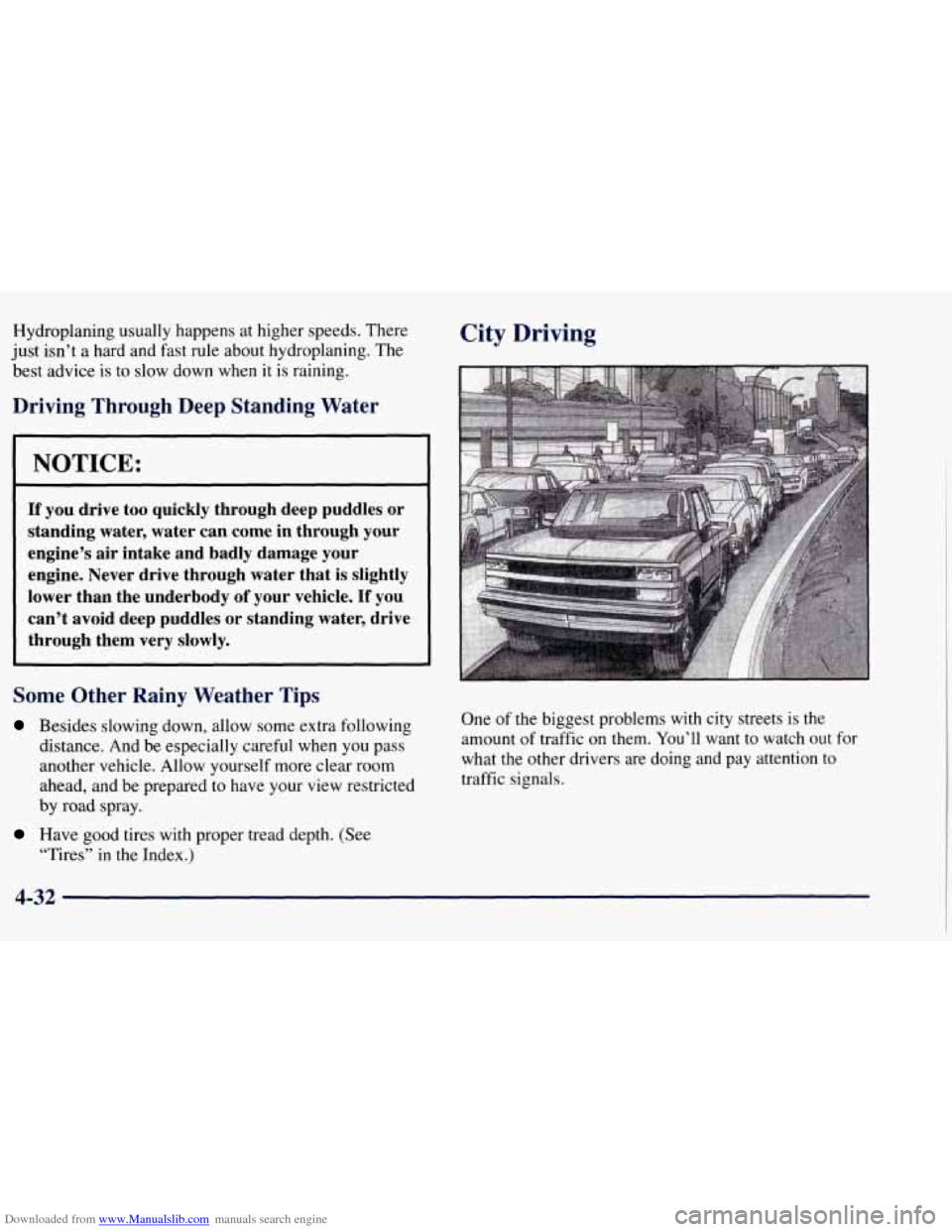
One of the biggest problems with city streets is the
amount
of traffic on them. You’ll want to watch out for
what the other drivers are doing and pay attention to
traffic signals.
4-32
Page 215 of 433
Downloaded from www.Manualslib.com manuals search engine Hill and Mountain Roads If you drive regularly in steep country, or if you’re
planning to visit there, here are some tips that can make
your trips safer and more enjoyable. (See “Off-Road
Driving” in the Index for information about driving
off-road.)
Keep your vehicle in good shape. Check all fluid
levels and also the brakes, tires, cooling system and
transmission. These parts can work hard on
mountain roads.
Know how to go down hills. The most important
thing to know is this: let your engine do some of the
slowing down. Shift to a lower gear when you go
down a steep or long hill.
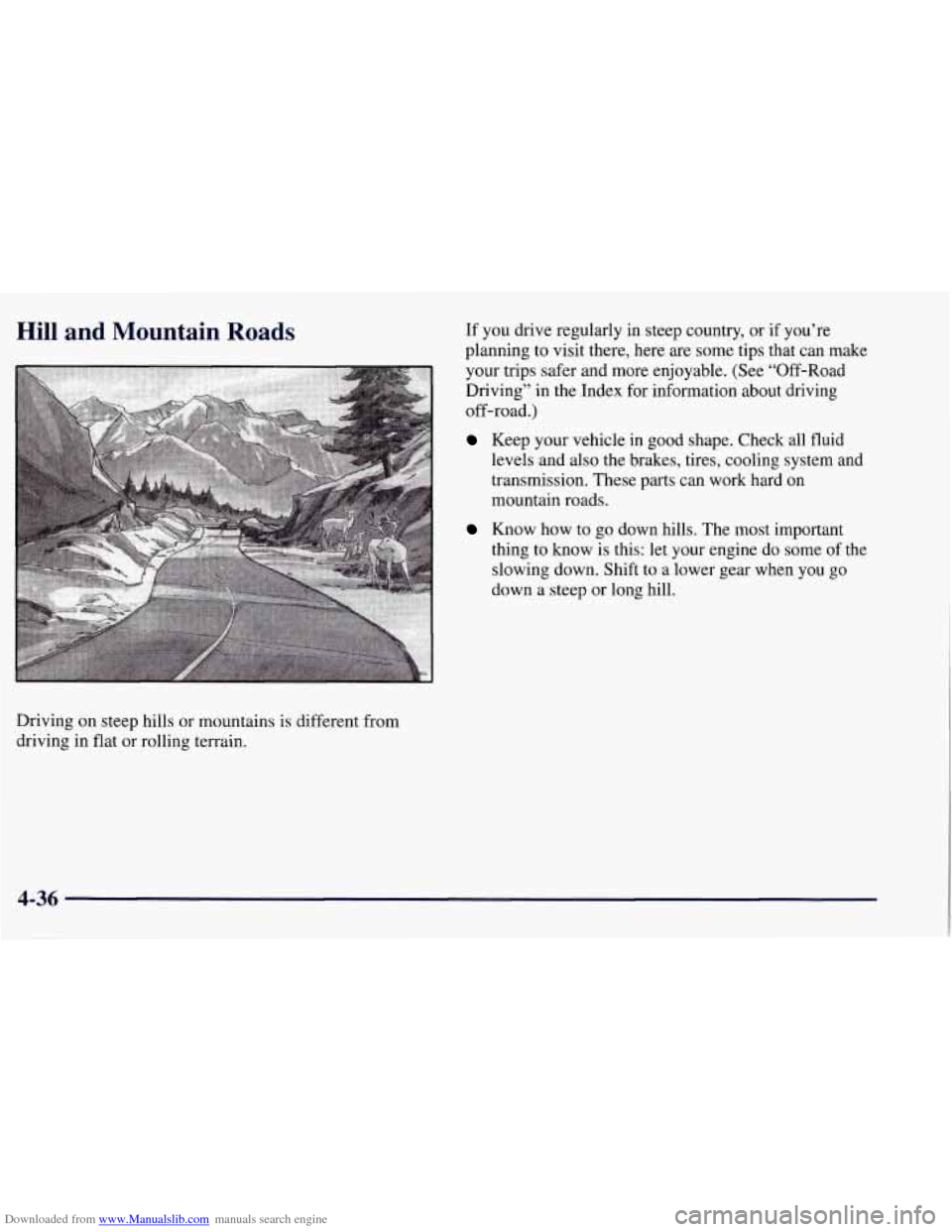
Driving on steep hills or mountains is different from
driving in flat or rolling terrain.
4-36
Page 218 of 433
Downloaded from www.Manualslib.com manuals search engine --
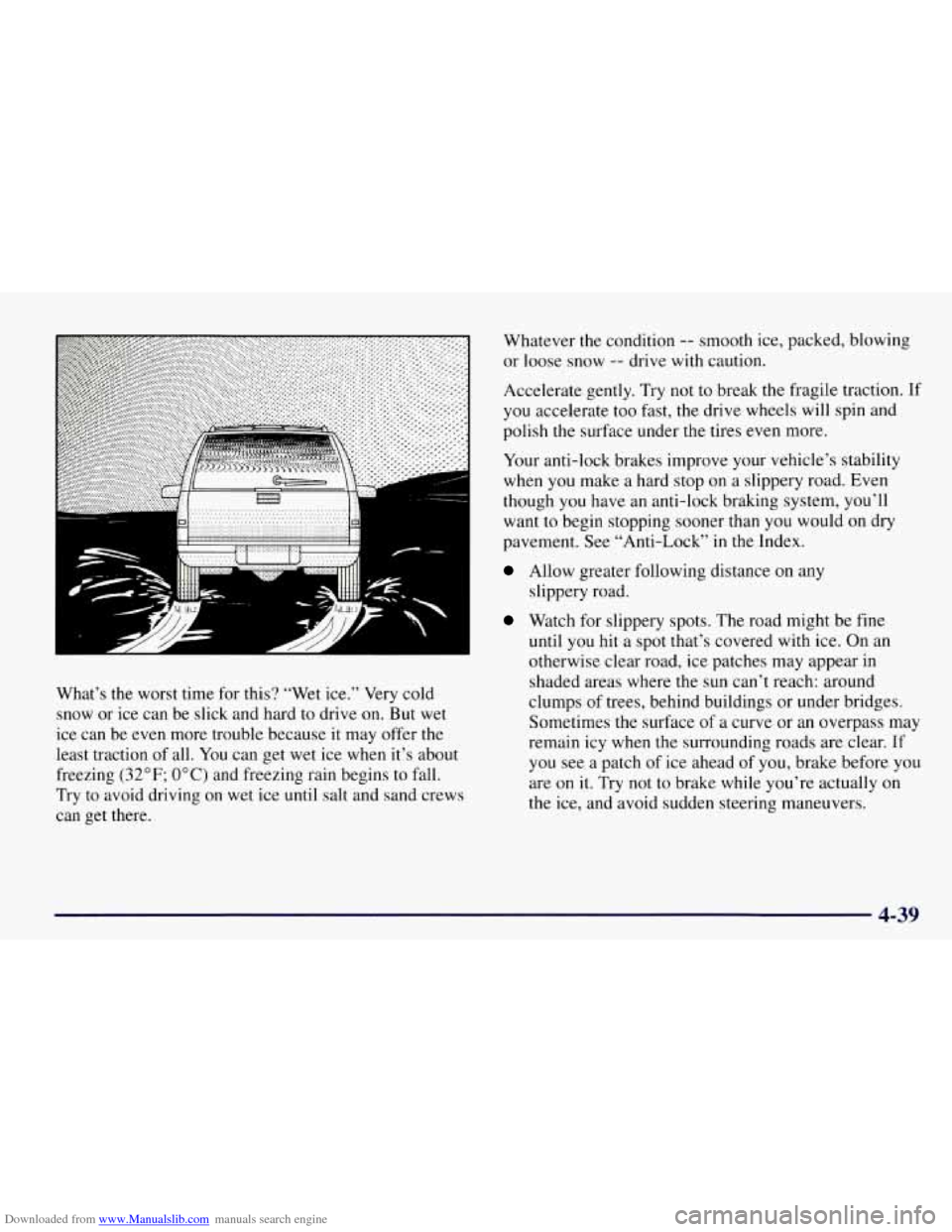
What’s the worst time for this? “Wet ice.” Very cold
snow or ice can be slick and hard to drive on. But wet
ice can be even more trouble because it may offer the
least traction of all. You can get wet ice
when it’s about
freezing
(32°F; 0°C) and freezing rain begins to fall.
Try to avoid driving on
wet ice until salt and sand crews
can get there. Whatever the condition
-- smooth ice, packed, blowing
or loose snow
-- drive with caution.
Accelerate gently. Try not to break the fragile traction. If
you accelerate too fast, the drive wheels will spin and
polish the surface under the tires even more.
Your anti-lock brakes improve your vehicle’s stability
when you make a hard stop on a slippery road. Even
though
you have an anti-lock braking system, you’ll
want to begin stopping sooner than you would on dry
pavement. See “Anti-Lock” in
the Index.
Allow greater following distance on any
slippery road.
Watch for slippery spots. The road might be fine
until
you hit a spot that’s covered with ice. On an
otherwise clear road, ice patches may appear in
shaded areas where the
sun can’t reach: around
clumps of trees, behind buildings or under bridges.
Sometimes the surface
of a curve or an overpass may
remain icy when the surrounding roads are clear.
If
you see a patch of ice ahead of you, brake before you
are on
it. Try not to brake while you’re actually on
the ice, and avoid sudden steering maneuvers.
4-39
Page 222 of 433
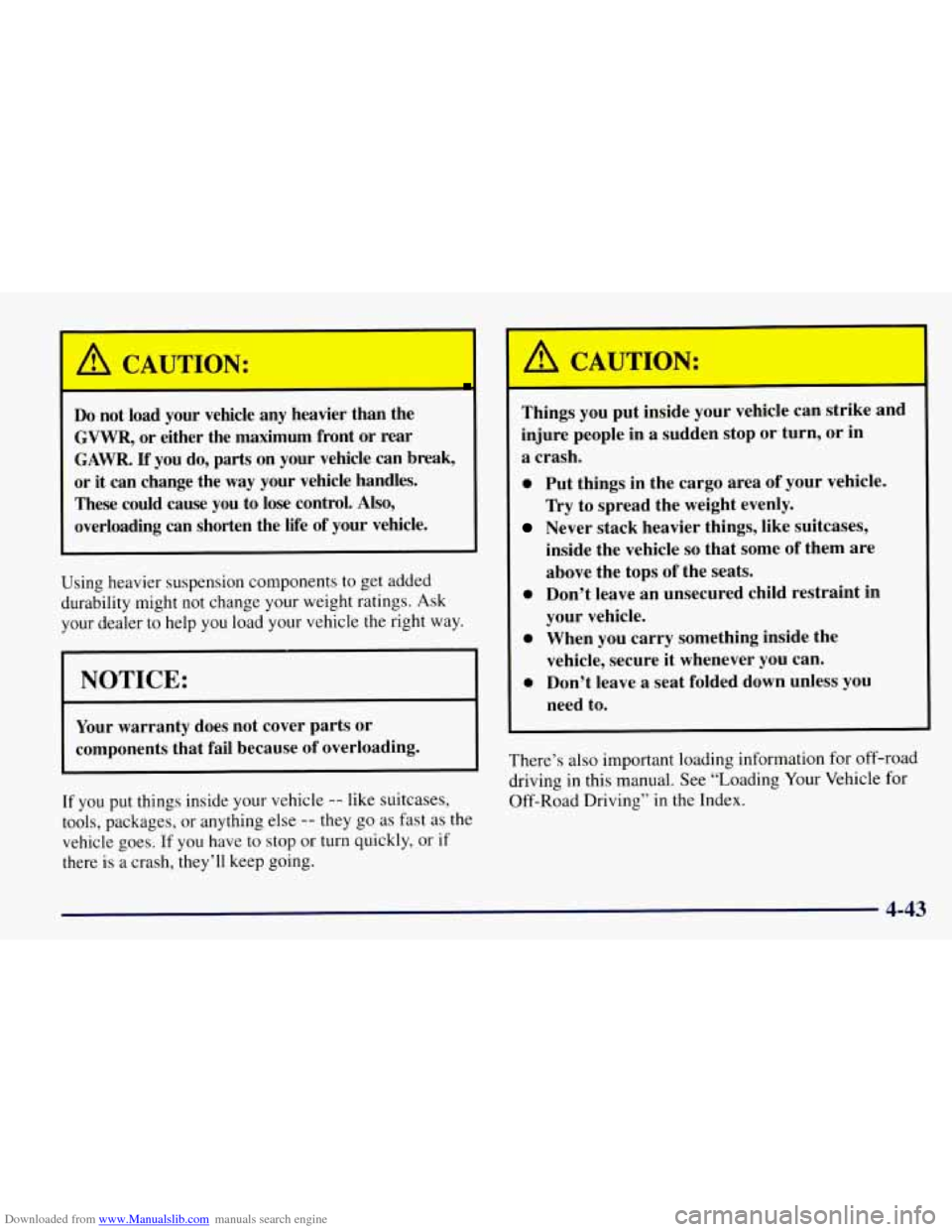
Downloaded from www.Manualslib.com manuals search engine A CAUTION:
-
Do not load your vehicle any heavier than the
GVWR, or either the maximum front
or rear
3AWR.
If’ you do, parts on your vehicle can break,
or it can change the way your vehicle handles.
These could cause you to lose control. Also,
overloading can shorten the life of your vehicle.
Using heavier suspension components to get added
durability might not change your weight ratings. Ask
your dealer to help you load your vehicle the right way.
I
NOTICE:
Your warranty does not cover parts or
components that fail because of overloading.
If you put things inside your vehicle -- like suitcases,
tools, packages, or anything else
-- they go as fast as the
vehicle goes. If you have to stop or turn quickly, or
if
there is a crash, they’ll keep going.
IT CAUTION: -
Things you put inside your vehi,,,! can strike and
injure people in
a sudden stop or turn, or in
a crash.
0 Put things in the cargo area of your vehicle.
Never stack heavier things, like suitcases,
Try to spread the weight evenly.
inside the vehicle
so that some of them are
above the tops of the seats.
0 Don’t leave an unsecured child restraint in
your vehicle.
0 When you carry something inside the
vehicle, secure it whenever you can.
0 Don’t leave a seat folded down unless you
need to.
There’s also important loading information for off-road
driving in this manual. See “Loading
Your Vehicle for
Off-Road Driving” in the Index.
4-43
Page 227 of 433
Downloaded from www.Manualslib.com manuals search engine You can ask your dealer for our trailering information or
advice, or you can write
us at the address listed in your
Warranty and Owner Assistance Information Booklet.
In Canada, write to:
General Motors of Canada Limited
Customer Communication Centre
1908 Colonel Sam Drive
Oshawa, Ontario
LlH 8P7
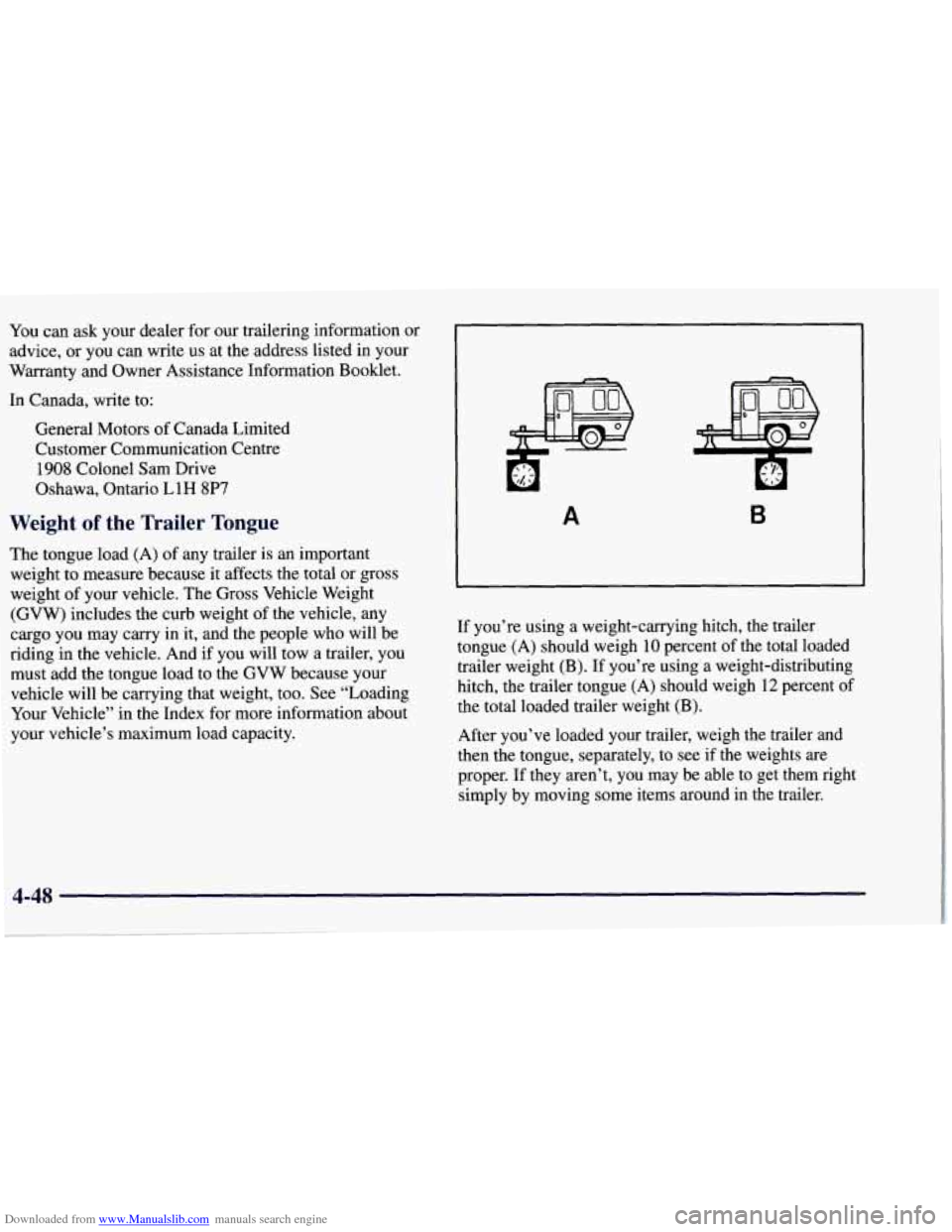
Weight of the Trailer Tongue
The tongue load (A) of any trailer is an important
weight
to measure because it affects the total or gross
weight of your vehicle. The Gross Vehicle Weight
(GVW) includes the curb weight of the vehicle, any
cargo
you may carry in it, and the people who will be
riding in the vehicle. And if you will tow a trailer, you
must add the tongue load to the GVW because your
vehicle will be carrying that weight, too. See “Loading
Your Vehicle” in the Index for more information about
your vehicle’s maximum load capacity.
B
If you’re using a weight-carrying hitch, the trailer
tongue (A) should weigh
10 percent of the total loaded
trailer weight
(B). If you’re using a weight-distributing
hitch, the trailer tongue
(A) should weigh 12 percent of
the total loaded trailer weight
(B).
After you’ve loaded your trailer, weigh the trailer and
then the tongue, separately, to see if
the weights are
proper. If they aren’t, you may be able to get them right
simply by moving some items around in the trailer.