Index CHEVROLET TAHOE 1997 1.G Workshop Manual
[x] Cancel search | Manufacturer: CHEVROLET, Model Year: 1997, Model line: TAHOE, Model: CHEVROLET TAHOE 1997 1.GPages: 433, PDF Size: 22.05 MB
Page 281 of 433
Downloaded from www.Manualslib.com manuals search engine Service
Your GM dealer knows your vehicle best and wants you
to be happy with it. We hope you’ll go to your dealer for
all your service needs. You’ll get genuine GM
parts and
GM-trained and supported service people.
We hope you’ll want to keep your GM vehicle all GM.
Genuine GM parts have one
of these marks:
n
Delco
Doing Your Own Service Work
If you want to do some of your own service work, you’ll
want to get the proper service manual. It tells you much
more about how to service your vehicle than this manual
can.
To order the proper service manual, see “Service
and Owner Publications” in the Index.
Your vehicle has an air bag system. Before attempting
to do your own service work, see “Servicing Your
Air Bag-Equipped Vehicle” in the Index.
You should keep a record with all parts receipts and list
the mileage and
the date of any service work you
perform. See “Maintenance Record”
in the Index.
6-2
Page 286 of 433
Downloaded from www.Manualslib.com manuals search engine While refueling, hang the
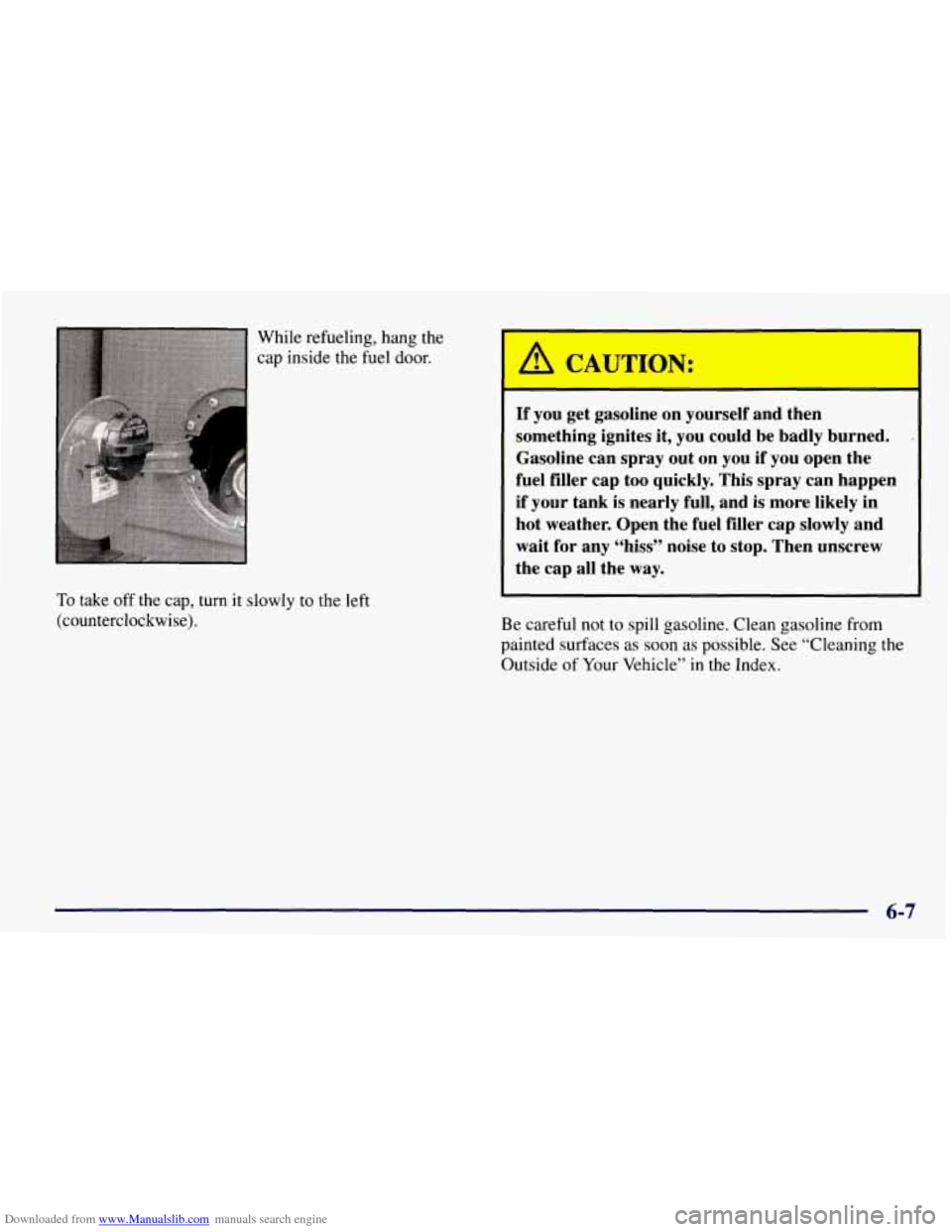
cap inside the fuel door.
To take off the cap, turn it slowly to the left
(counterclockwise).
A CAUTION:
I
If you get gasoline on yourself and then
something ignites it, you could be badly burned.
.
Gasoline can spray out on you if you open the
fuel filler cap too quickly. This spray can happen
if your tank is nearly full, and is more likely in
hot weather. Open the fuel filler cap slowly and
wait for any “hiss” noise to stop. Then unscrew
the cap all the way.
,
Be careful not to spill gasoline. Clean gasoline from
painted surfaces as soon as possible. See “Cleaning the
Outside of Your Vehicle” in the Index.
6-7
Page 294 of 433
Downloaded from www.Manualslib.com manuals search engine When to Add Oil
If the oil is at or below the ADD mark, then you’ll need
to add at least one quart of oil. But you must use the
right kind. This part explains what kind
of oil to use. For
crankcase capacity, see “Capacities and Specifications”
in the Index.
NOTICE:
Don’t add too much oil. If your engine has so
much oil that the oil level gets above the upper
mark that
shows the proper operating range,
your engine could be damaged.
The engine oil fill cap on the “VORTEC” 5700 is
located on the driver’s side engine valve cover. The
engine oil fill cap on the “VORTEC”
7400 is located on
the front
of the engine, near the radiator.
Be sure to fill it enough to put the level somewhere in
the proper operating range. Push the dipstick all the way
back in when you’re through.
What Kind of Oil to Use
Oils recommended for your vehicle can be identified by
looking for the “Starburst” symbol. This symbol
indicates that the oil has been certified by the American
Petroleum Institute (API).
Do not use any oil which
does not carry this Starburst symbol.
If you change your own oil,
be sure you use oil that has
the Starburst symbol
on the
front of the oil container.
If you have your oil changed for you, be sure the oil put
into your engine is American Petroleum Institute
certified for gasoline engines.
You should also use the proper viscosity oil for your
vehicle, as shown in the following chart:
6-15
Page 297 of 433
Downloaded from www.Manualslib.com manuals search engine Air Cleaner (Gasoline Engines)
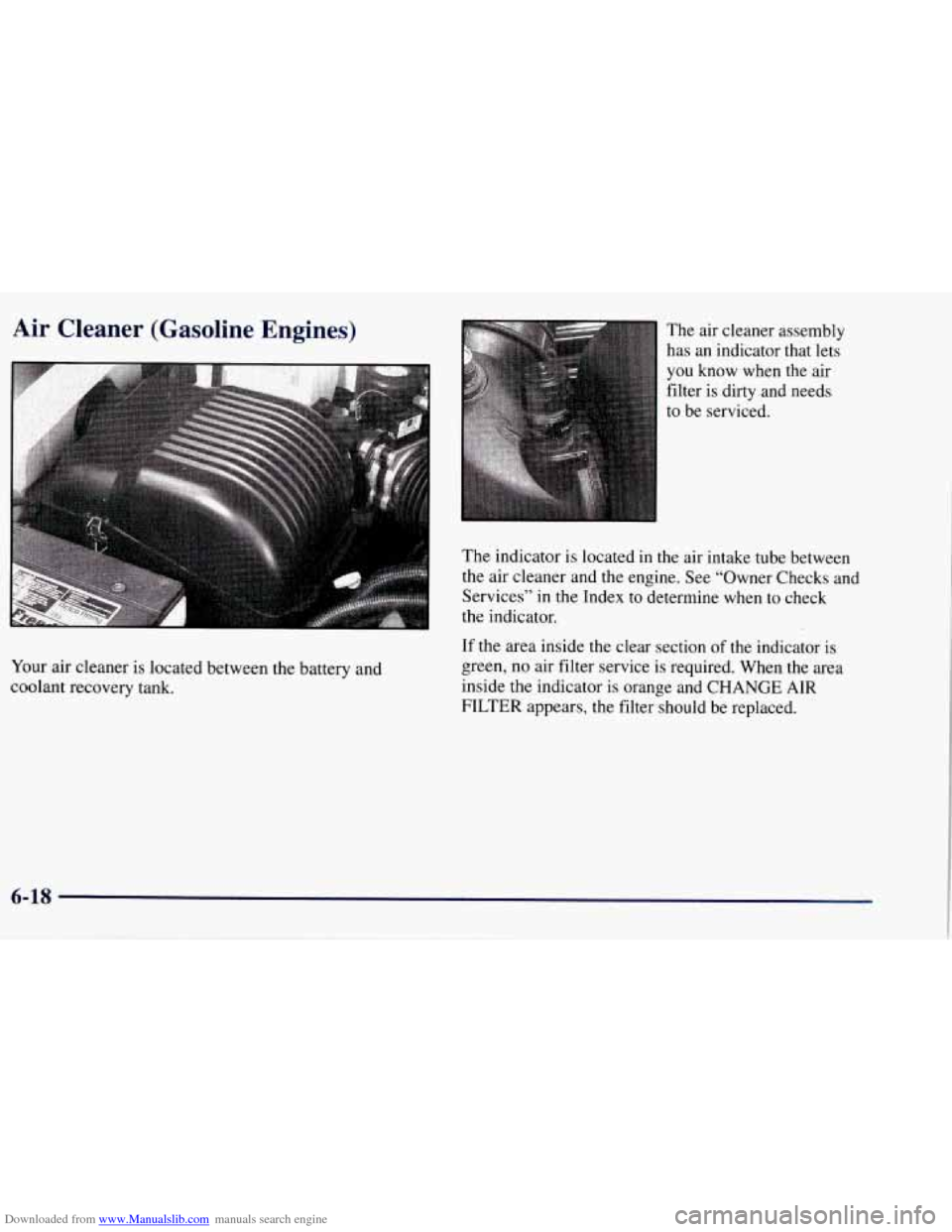
Your air cleaner is located between the battery and
coolant recovery tank. The air cleaner assembly
has an
indicator that lets
you know when the air
filter is dirty and needs
to be serviced.
The indicator is located in the air intake tube between
the air cleaner and the engine. See “Owner Checks and
Services” in the Index to determine when to check
the indicator.
If the area inside the clear section
of the indicator is
green, no air filter service is required. When the area
inside
the indicator is orange and CHANGE AIR
FILTER appears, the filter should be replaced.
Page 299 of 433
Downloaded from www.Manualslib.com manuals search engine Refer to the Maintenance Schedule to determine when to
replace the
air filter. See “Owner Checks and Services”
in the Index.
A CAUTION:
Operating the engine with the air cleaner off can
cause you or others to be burned. The air cleaner
not only cleans the air, it stops flame if the engine
backfhes.
If it isn’t there, and the engine
backfires, you could be burned. Don’t drive with
it
off, and be careful working on the engine with
the
air cleaner off.
NOTICE:
If the air cleaner is off, a backfire can cause a
damaging engine fire. And, dirt can easily get
into your engine, which will damage
it. Always
have the air cleaner in place when you’re driving.
Automatic Transmission Fluid
When to Check and Change
A good time to check your automatic transmission fluid
level is when the engine oil is changed.
Change both the fluid and filter every
50,000 miles
(83 000 km) if the vehicle is mainly driven under one or
more
of these conditions:
0 In heavy city traffic where the outside temperature
regularly reaches
90°F (32 “C) or higher.
In hilly or mountainous terrain.
When doing frequent trailer towing.
0 Uses such as found in taxi, police or delivery service.
If you do not use your vehicle under any of these
conditions, the fluid and filter do not require changing.
See “Scheduled Maintenance Services” in the Index.
How to Check
Because this operation can be a little difficult, you
may choose to have this done at your
GM dealership
Service Department.
Page 302 of 433
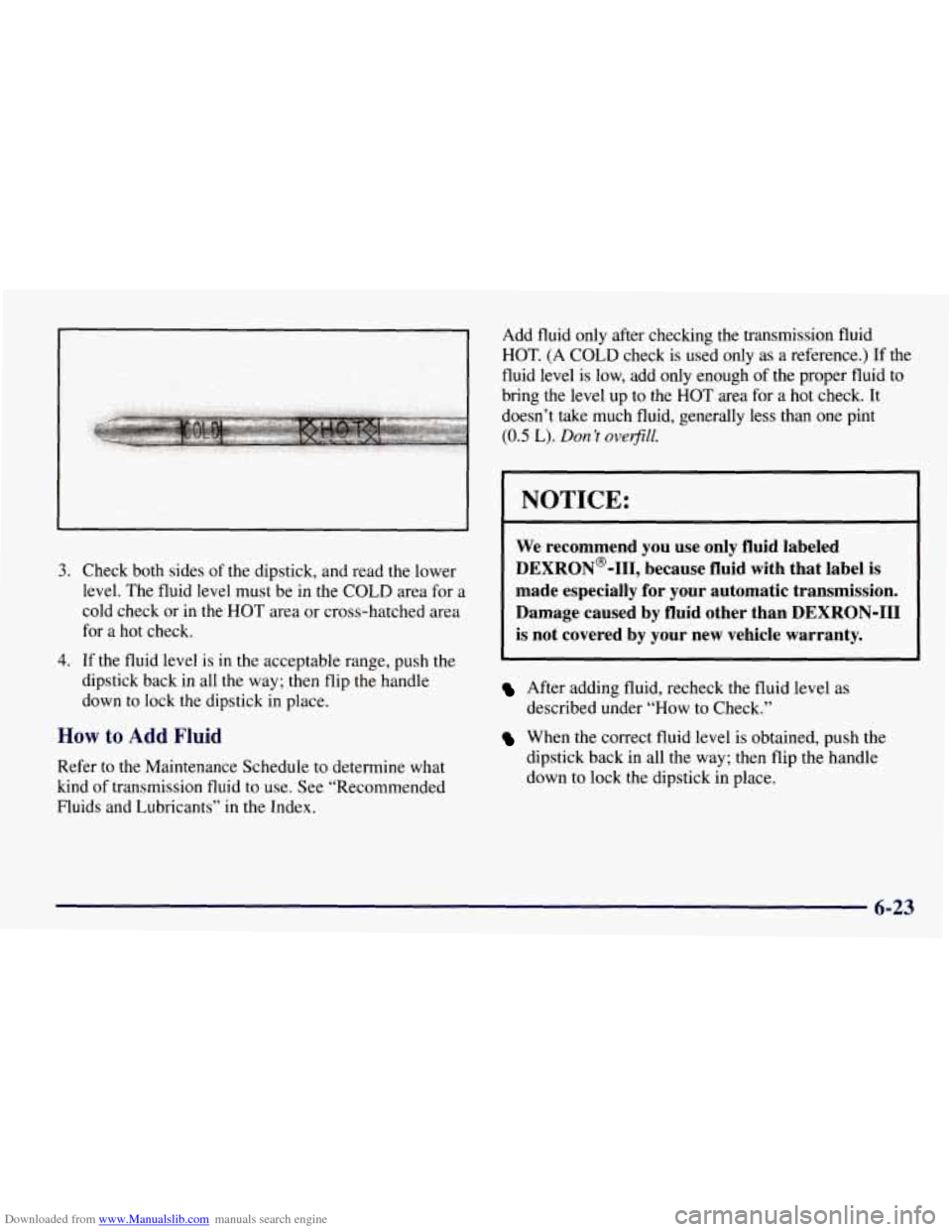
Downloaded from www.Manualslib.com manuals search engine 3. Check both sides of the dipstick, and read the lower
level. The fluid level must be in the COLD area for a
cold check or in the
HOT area or cross-hatched area
for a hot check.
4. If the fluid level is in the acceptable range, push the
dipstick back in all the way; then flip the handle
down to lock the dipstick in place.
How to Add Fluid
Refer to the Maintenance Schedule to determine what
kind
of transmission fluid to use. See “Recommended
Fluids and Lubricants” in the Index. Add
fluid only after checking the transmission fluid
HOT. (A COLD check is used only as a reference.) If the
fluid level is low, add only enough of the proper fluid to
bring the level up to the HOT area for
a hot check. It
doesn’t take much fluid, generally less
than one pint
(0.5 L). Don’t ove$ll.
NOTICE:
We recommend you use only fluid labeled
DEXRON@-111, because fluid with that label is
made especially for your automatic transmission.
Damage caused by fluid other than DEXRON-I11
is not covered by your new vehicle warranty.
After adding fluid, recheck the fluid level as
When the correct fluid level is obtained, push the
described under “How
to Check.”
dipstick back in all the way; then flip the handle
down to lock the dipstick in place.
6-23
Page 303 of 433
Downloaded from www.Manualslib.com manuals search engine Rear Axle
When to Check and Change Lubricant
Refer to the Maintenance Schedule to determine how
often to check the lubricant and when to change it. See
“Scheduled Maintenance Services” in the Index.
How to Check Lubricant What to Use
Refer
to the Maintenance Schedule to determine what
kind of lubricant to use. See “Recommended Fluids and
Lubricants” in the Index.
Four-wheel Drive
Most lubricant checks in this section also apply to
four-wheel-drive vehicles. However, they have
two additional systems that need lubrication.
Transfer Case
When to Check Lubricant
Refer to the Maintenance Schedule to determine how
often to check the lubricant. See “Periodic Maintenance
Inspections” in the Index.
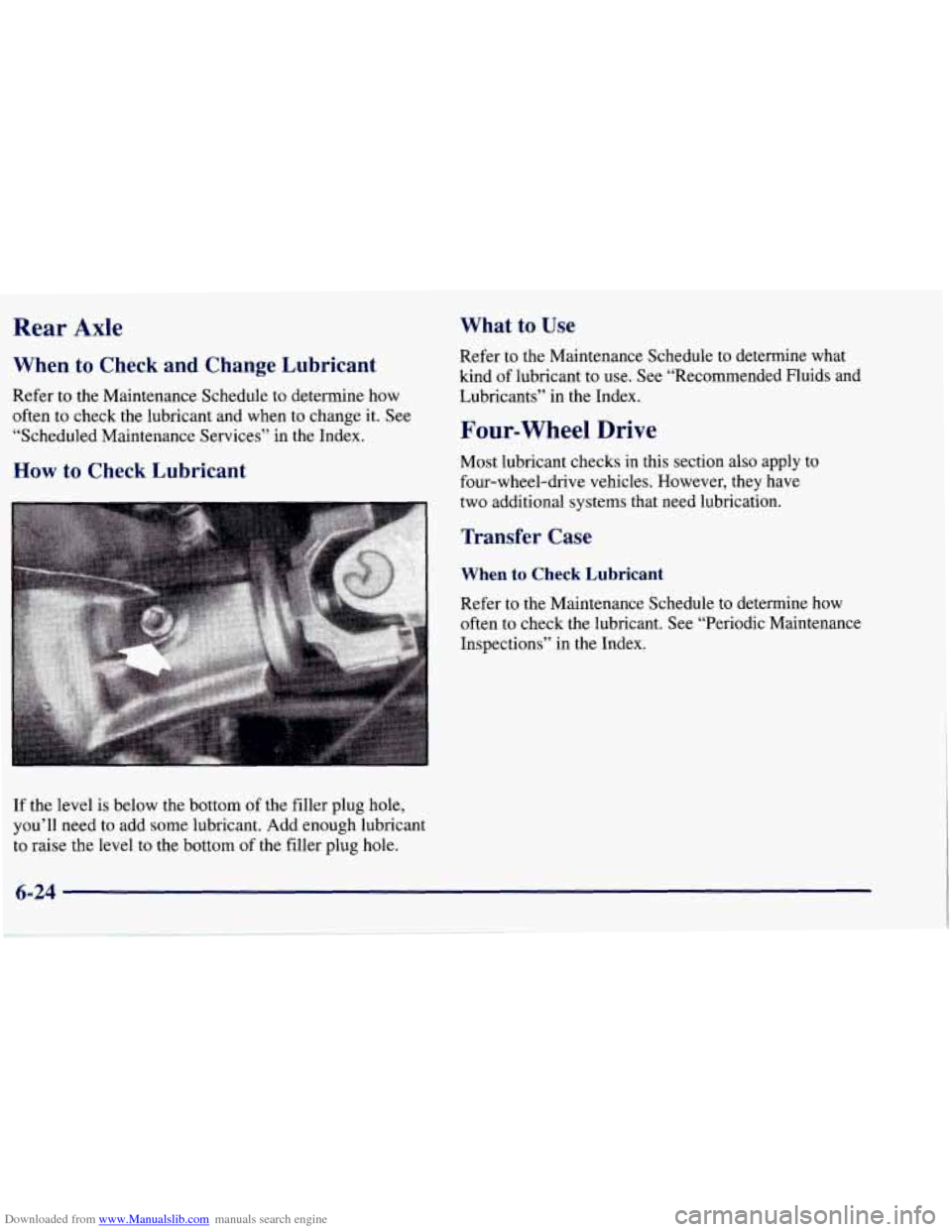
If the level
is below the bottom of the filler plug hole,
you’ll need to add some lubricant. Add enough lubricant
to raise the level
to the bottom of the filler plug hole.
6-24
Page 304 of 433
Downloaded from www.Manualslib.com manuals search engine How to Check Lubricant Front Axle
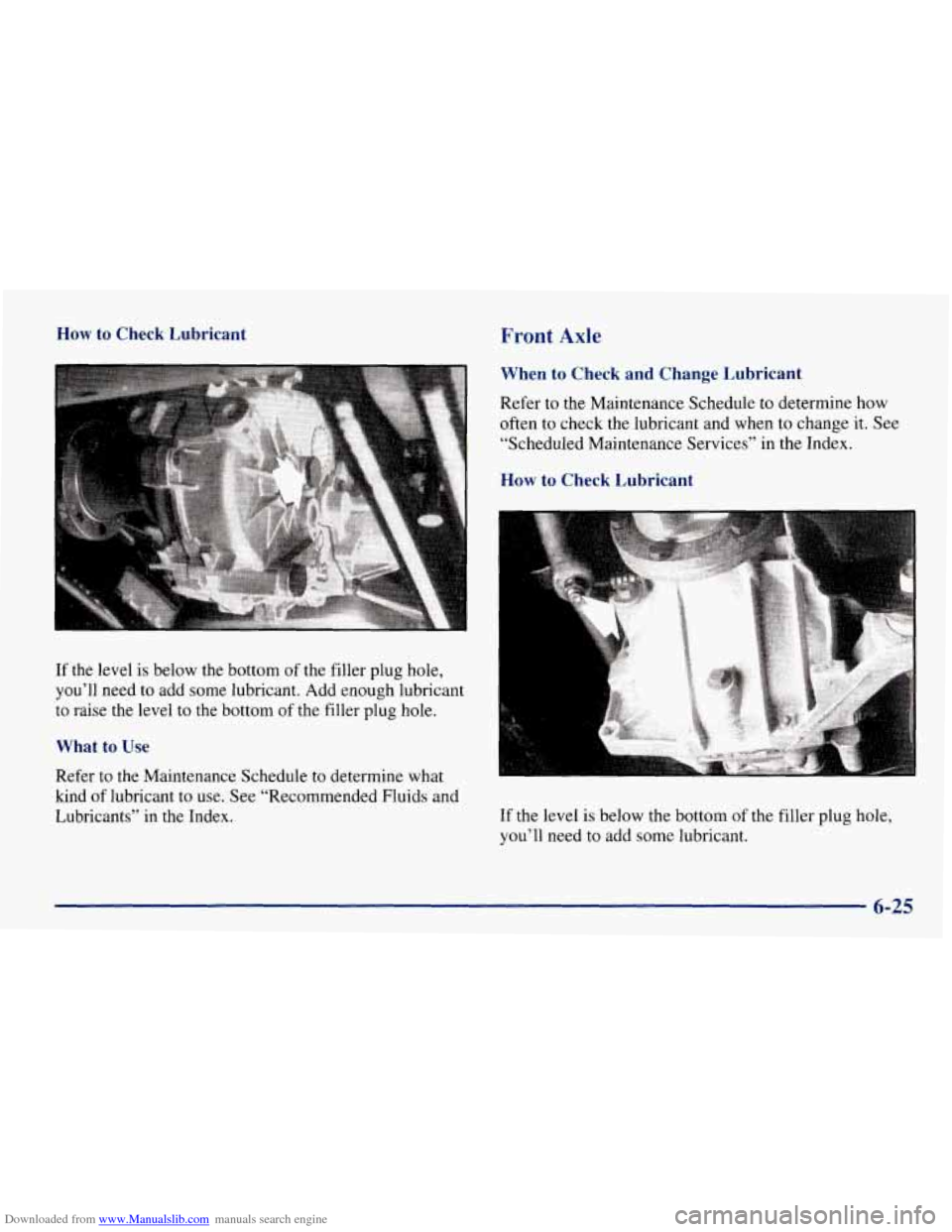
If the level is below the bottom of the filler plug hole,
you’ll need to add some lubricant. Add enough lubricant
to raise the level to the bottom of the filler plug hole.
What to Use
Refer to the Maintenance Schedule to determine what
kind of lubricant to use. See “Recommended Fluids and
Lubricants” in the Index.
When to Check and Change Lubricant
Refer to the Maintenance Schedule to determine how
often to check the lubricant and when to change it. See
“Scheduled Maintenance Services” in the Index.
How to Check Lubricant
If the level is below the bottom of the filler plug hole,
you’ll need to add some lubricant.
6-25
Page 305 of 433
Downloaded from www.Manualslib.com manuals search engine If the differential is at operating temperature (warm),
add enough lubricant to raise the level
to the bottom of
the filler plug hole.
If the differential is cold, add enough lubricant
to raise
the level to
1/2 inch (12 mm) below the filler plug hole.
What to Use
Refer to the Maintenance Schedule to determine what
kind
of lubricant to use. See “Recommended Fluids and
Lubricants” in the Index.
Engine Coolant
The cooling system in your vehicle is filled with new
DEX-COOL@ engine coolant. This coolant is designed
to remain
in your vehicle for 5 years or 150,000 miles
(240
000 km), whichever occurs first, if you add only
DEX-COOL@ extended life coolant.
The following explains
your cooling system and how
to add coolant when it is low. If you have a problem
with engine overheating, see “Engine Overheating” in
the Index.
A 50/50 mixture of water and the proper coolant for
your vehicle will:
0 Give freezing protection down to -34°F (-37°C).
0 Give boiling protection up to 265 “F ( 129 * C).
0 Protect against rust and corrosion.
0 Help keep the proper engine temperature.
0 Let the warning gages work as they should.
NOTICE:
When adding coolant, it is important that you use
only DEX-COOL@ (silicate-free) coolant.
If coolant other than DEX-COOL@ is added to
the system, premature engine, heater core or
radiator corrosion may result.
In addition, the
engine coolant will require change sooner
-- at
30,000 miles (50 000 km) or 24 months,
whichever occurs first. Damage caused by the use
of coolant other than DEX-COOL@ is not
covered by your new vehicle warranty.
6-26
Page 309 of 433
Downloaded from www.Manualslib.com manuals search engine Power Steering Fluid
When to Check Power Steering Fluid
It is not necessary to regularly check power steering
fluid unless you suspect there is a leak in the system or
you hear an unusual noise.
A fluid loss in this system
could indicate a problem. Have the system inspected
and repaired.
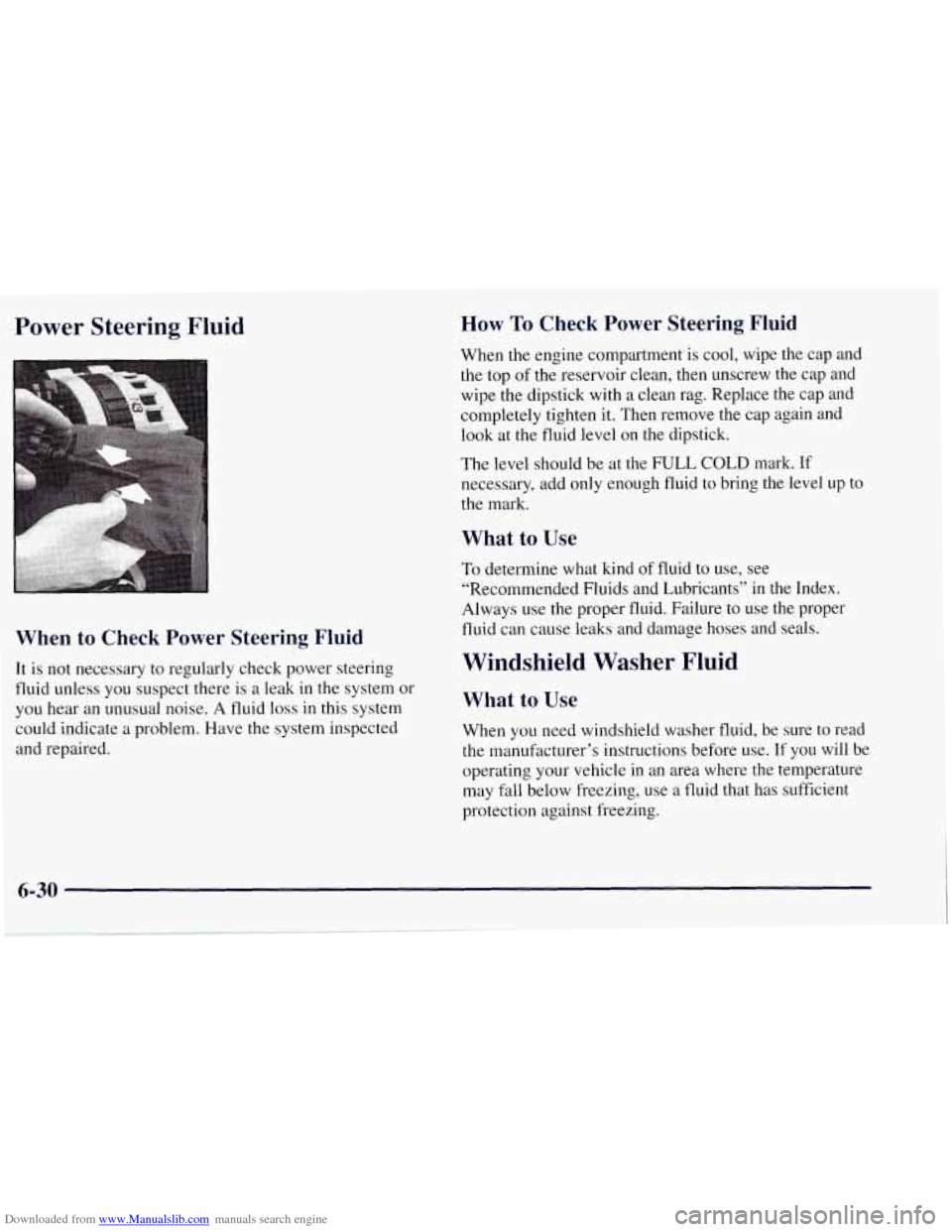
How To Check Power Steering Fluid
When the engine compartment is cool, wipe the cap and
the top of the reservoir clean, then unscrew the cap and
wipe the dipstick with
a clean rag. Replace the cap and
completely tighten it. Then remove the cap again and
look at the fluid level on the dipstick.
The level should be at the FULL
COLD mark. If
necessary, add only enough fluid to bring the level
up to
the mark.
What to Use
To determine what kind of fluid to use, see
“Recommended Fluids and Lubricants’’ in the Index.
Always use the proper fluid. Failure to use the proper
fluid can cause leaks and damage hoses and seals.
Windshield Washer Fluid
What to Use
When you need windshield washer fluid, be sure to read
the manufacturer’s instructions before use.
If you will be
operating your vehicle
in an area where the temperature
may fall below freezing, use a fluid that has sufficient
protection against freezing.