Index CHEVROLET TAHOE 1997 1.G Repair Manual
[x] Cancel search | Manufacturer: CHEVROLET, Model Year: 1997, Model line: TAHOE, Model: CHEVROLET TAHOE 1997 1.GPages: 433, PDF Size: 22.05 MB
Page 311 of 433
Downloaded from www.Manualslib.com manuals search engine Brakes
Brake Fluid
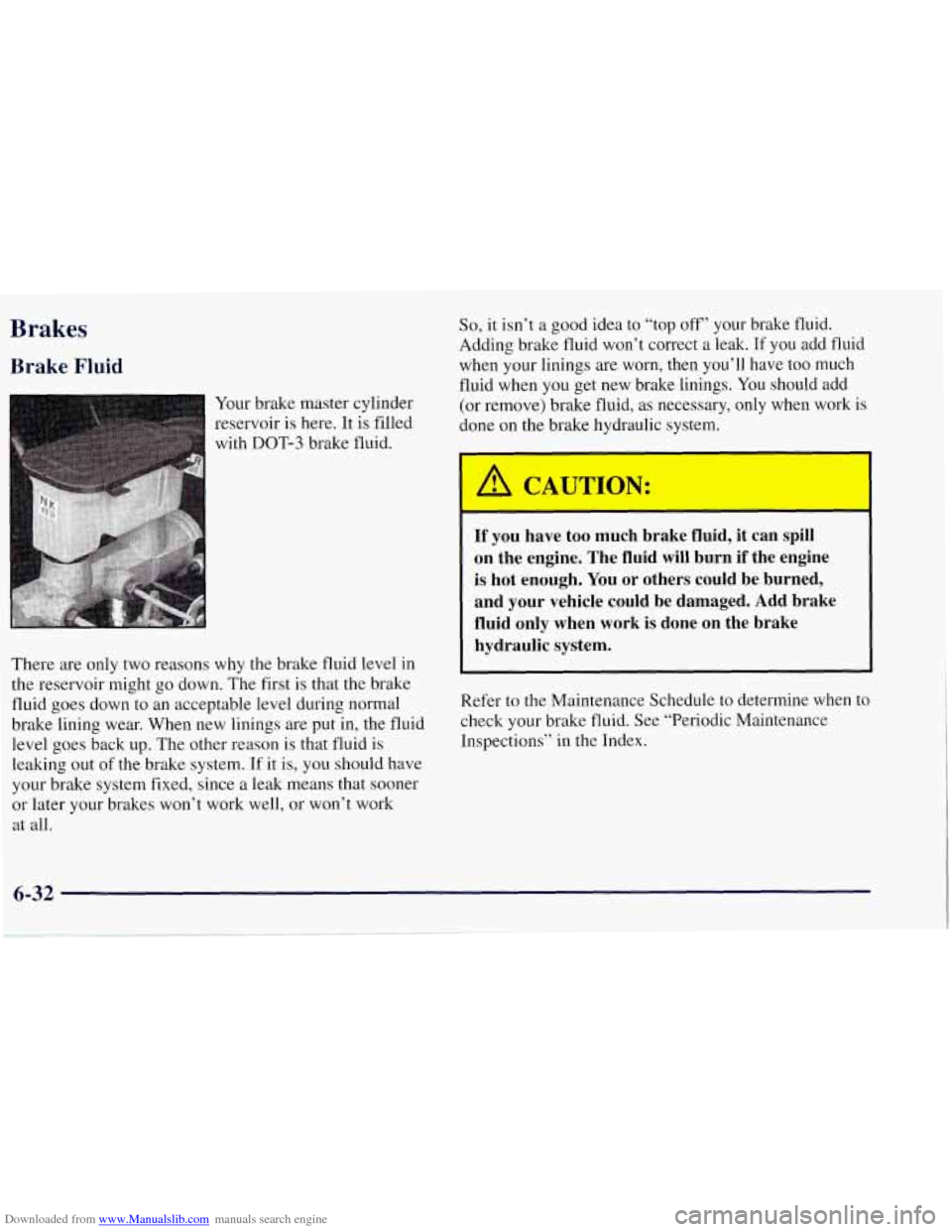
Your brake master cylinder
reservoir
is here. It is filled
with DOT-3 brake fluid.
So, it isn’t a good idea to “top off’ your brake fluid.
Adding brake fluid won’t correct a leak.
If you add fluid
when your linings are worn, then you’ll have too much
fluid when you get new brake linings.
You should add
(or remove) brake fluid, as necessary, only when work is
done on the brake hydraulic system.
KCAUTION:
If you have too much brake fluid, it can spill
on the engine. The fluid
will burn if the engine
is hot enough.
You or others could be burned,
and your vehicle could be damaged. Add brake
fluid only when work is done on the brake
hydraulic system.
There are only two reasons why the brake fluid level in
the reservoir might go down. The first is that the brake
fluid goes down to an acceptable level during normal Refer to the Maintenance Schedule to determine when to
brake lining wear. When
new linings are put in, the fluid check your brake fluid. See “Periodic Maintenance
level goes back up. The other reason is that fluid is Inspections’’ in the Index.
leaking out of the brake system. If it is, you should have
your brake system fixed, since a leak means that sooner
or later your brakes won’t work well, or won’t work
at all.
6-32
Page 313 of 433
Downloaded from www.Manualslib.com manuals search engine NOTICE:
0 Using the wrong fluid can badly damage
brake system parts. For example, just
a few
drops of mineral-based oil, such
as engine
oil, in your brake system can damage brake
system parts
so badly that they’ll have to be
replaced. Don’t let someone put in the
wrong kind of fluid.
If you spill brake fluid on your vehicle’s
painted surfaces, the paint finish can be
damaged. Be careful not to spill brake fluid
on your vehicle. If you do, wash it off
immediately. See “Appearance Care” in
the Index.
Brake Wear
worn and new pads are needed. The sound may come and
go or be heard all the time your vehicle is moving (except
when you are pushing on the brake pedal firmly).
I
The brake wear warning sound means that soon
your brakes won’t work well. That could lead to
an accident. When you hear the brake wear
warning sound, have your vehicle serviced.
I NOTICE:
r
Continuing to drive with worn-out brake pads
could result in costly brake repair.
Your vehicle has front disc brakes and rear drum brakes.
Disc brake pads have built-in wear indicators that make a
high-pitched warning sound when the brake pads are Some
driving conditions or climates may cause a brake
squeal when the brakes are first applied or lightly
applied. This does not mean something is wrong with
your brakes.
Page 315 of 433
Downloaded from www.Manualslib.com manuals search engine Fluid Leak Check
After the vehicle has been parked for a while, inspect
the surface under the vehicle for water, oil, fuel or other
fluids. Water dripping from the air conditioning system
after
it has been used is normal. If you notice fuel leaks
or fumes, the causes should be found and corrected
at once.
Battery
Every new vehicle has a Delco Freedom@ battery. You
never have to add water to one of these. When it’s time
for a new battery, we recommend a Delco Freedom
battery. Get one that has the replacement number shown
on the original battery’s label.
Vehicle Storage
If you’re not going to drive your vehicle for 25 days
or more, take off the black, negative
(-) cable from
the battery. This will help keep your battery from
running down.
/d CAUTION:
Batteries have acid that can burn you and gas
that can explode. You can be badly hurt if
you
aren’t careful. See “Jump Starting” in the Index
for tips on working around a battery without
getting hurt.
Contact your dealer to learn how to prepare your vehicle
for longer storage periods.
Also, for your audio system, see “Theft-Deterrent
Feature” in the Index.
6-36
Page 316 of 433
Downloaded from www.Manualslib.com manuals search engine Bulb Replacement
Before you replace any bulbs, be sure that all the lamps
are off and the engine isn’t running. For the proper bulb
-
lbs” in the
type,
see “Replacement Bu
Halogen Bulbs
A CAUTION:
Index.
-
Halogen bulbs have pressurized gas inside and
can burst if
you drop or scratch the bulb. You or
others could be injured. Be sure to read and
follow the instructions on the bulb package.
1
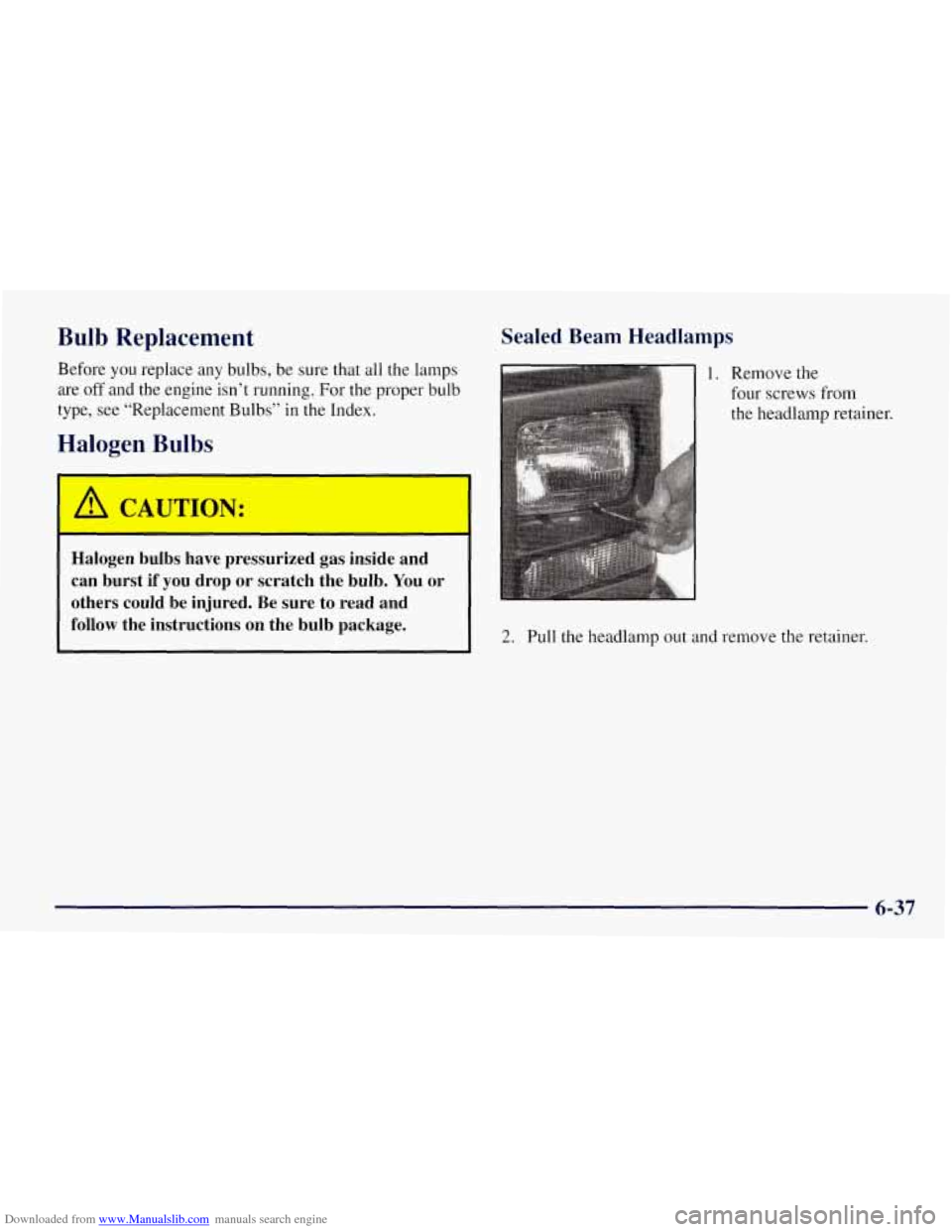
Sealed Beam Headlamps
1. Remove the
four screws from
the headlamp retainer.
2. Pull the headlamp out and remove the retainer.
6-37
Page 323 of 433
Downloaded from www.Manualslib.com manuals search engine Windshield Wiper Blade Replacement
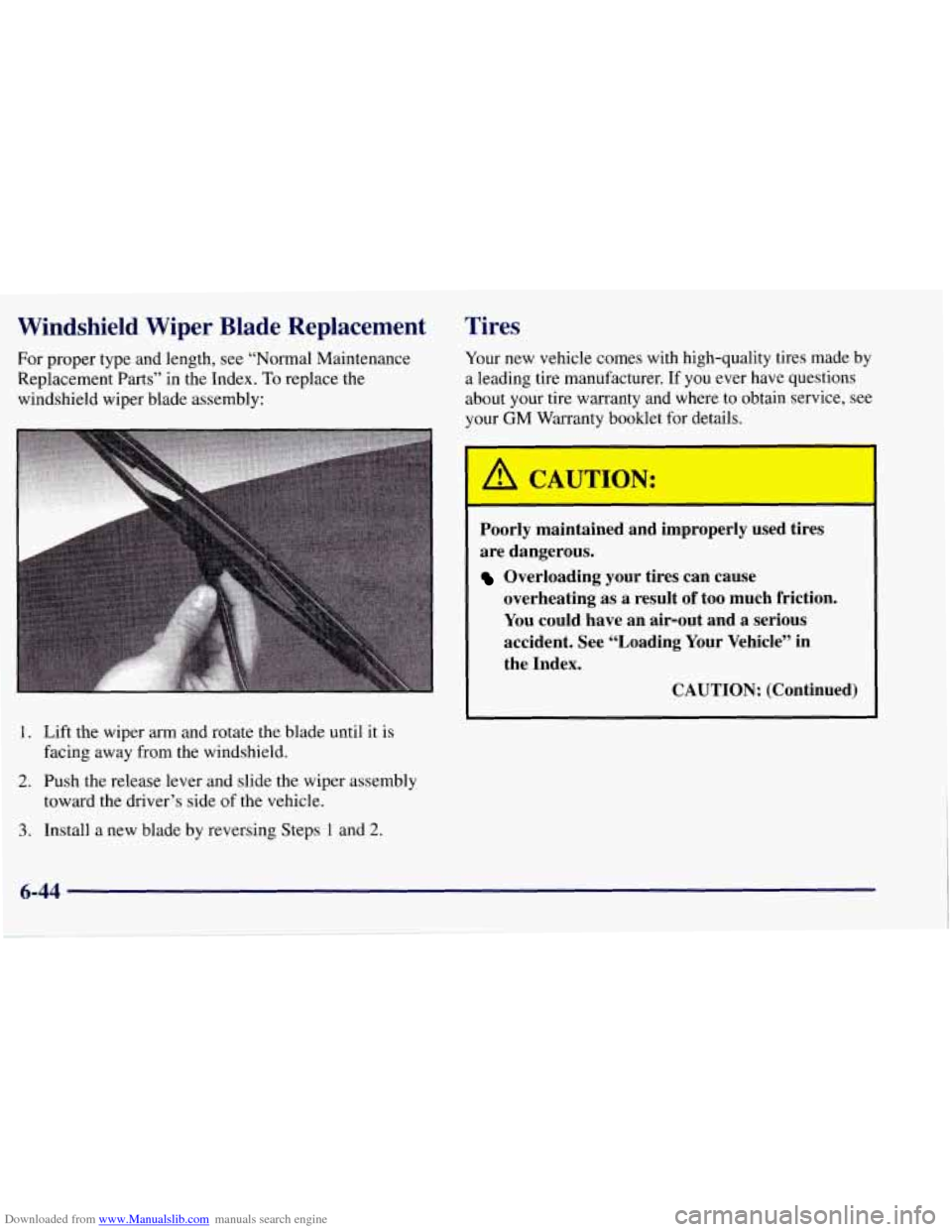
For proper type and length, see “Normal Maintenance
Replacement Parts” in the Index.
To replace the
windshield wiper blade assembly:
1. Lift the wiper arm and rotate the blade until
it is
2. Push the release lever and slide the wiper assembly
3. Install a new blade by reversing Steps 1 and 2.
facing away from the windshield.
toward the driver’s side of the vehicle.
Tires
Your new vehicle comes with high-quality tires made by
a leading tire manufacturer. If you ever have questions
about your tire warranty and where to obtain service, see
your GM Warranty booklet for details.
Poorly maintained and improperly used tires
are dangerous.
Overloading your tires can cause
overheating as a result
of too much friction.
You could have an air-out and a serious
accident. See “Loading Your Vehicle” in
the Index.
CAUTION: (Continued)
J
6-44
Page 325 of 433
Downloaded from www.Manualslib.com manuals search engine NOTICE:
Don’t let anyone tell you that underinflation or
overinflation is all right. It’s not.
If your tires
don’t have enough air (underinflation), you can
get the following:
Too much flexing
Too much heat
Tire overloading
Bad wear
0 Bad handling
Bad fuel economy.
If your tires have too much air (overinflation),
you can get the following:
Unusual wear
Bad handling
Rough ride
Needless damage from road hazards.
When to Check
Check your tires once a month or more. Also, check the
tire pressure of the spare tire.
How to Check
Use a good quality pocket-type gage to check tire
pressure. You can’t tell
if your tires are properly inflated
simply by looking at them. Radial tires may look
properly inflated even when they’re underinflated.
Be sure to put the valve caps back on the valve stems.
They help prevent
leaks by keeping out dirt and moisture.
Tire Inspection and Rotation
Tires should be rotated every 6,000 to 8,000 miles
(10 000 to 13 000 km). Any time you notice unusual
wear, rotate your tires as soon as possible and check
wheel alignment. Also check for damaged tires or
wheels. See “When It’s Time for New Tires” and
“Wheel Replacement” later in this section for
more information.
The purpose
of regular rotation is to achieve more
uniform wear for all tires on the vehicle. The first
rotation is the most important. See “Scheduled
Maintenance Services” in the Index for scheduled
rotation intervals.
Page 326 of 433
Downloaded from www.Manualslib.com manuals search engine FRT
f DO5
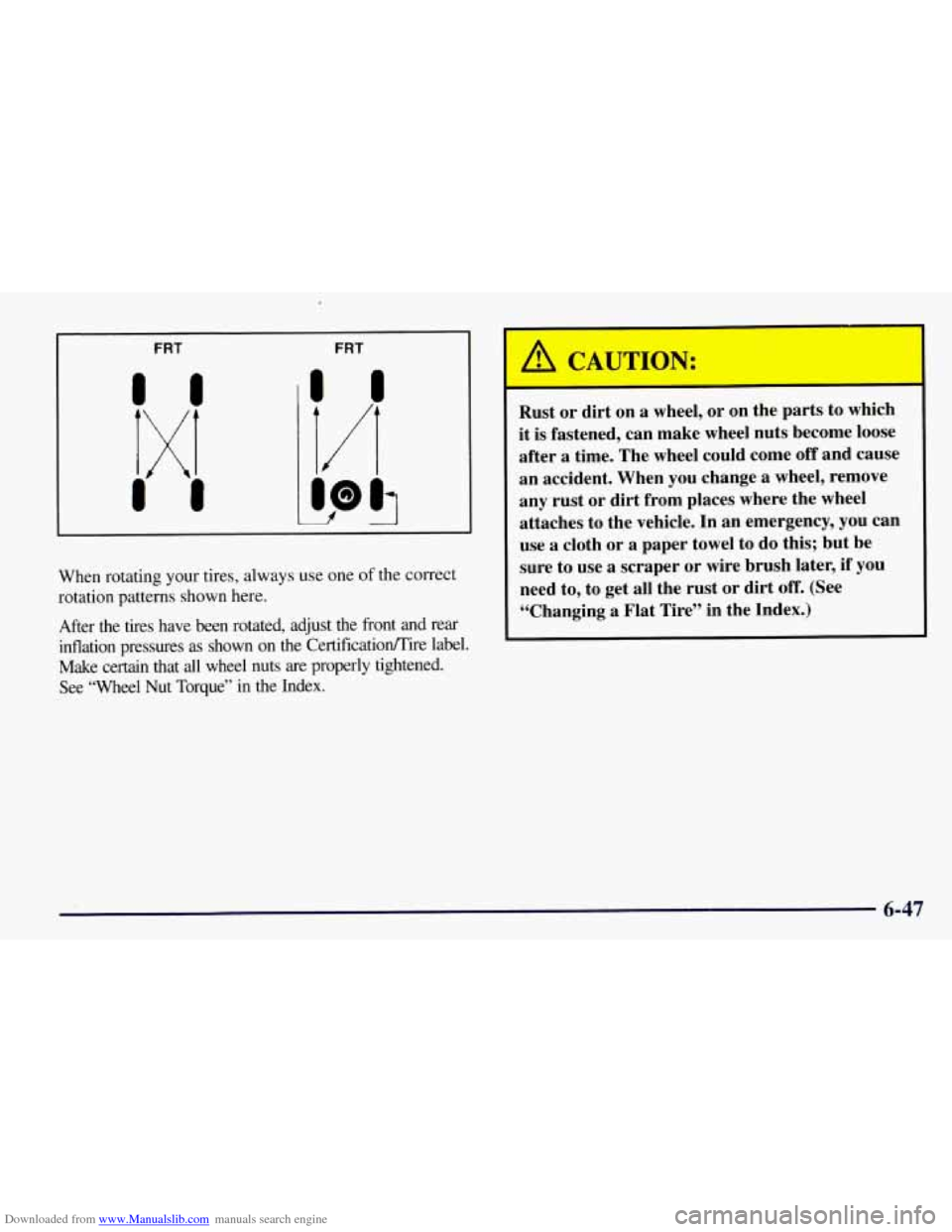
When rotating your tires, always use one of the correct
rotation patterns shown here.
After the tires have been rotated, adjust the front and rear
inflation pressures as shown
on the Certificatioflire label.
Make certain that
all wheel nuts are properly tightened.
See “Wheel Nut Torque” in the Index.
I A C. UTION:
Rust or dirt on a wheel, or on the parts to which
it is fastened, can make wheel nuts become loose
after
a time. The wheel could come off and cause
an accident. When you change a wheel, remove
any rust
or dirt from places where the wheel
attaches to the vehicle. In an emergency, you can
use a cloth or a paper towel to do this; but be
sure to use a scraper or wire brush later,
if you
need to, to get all the rust or dirt
off. (See
“Changing a Flat Tire” in the Index.)
6-47
Page 330 of 433
Downloaded from www.Manualslib.com manuals search engine I A CAUTION:
Using the wrong replacement wheels, wheel bolts
or wheel nuts on your vehicle can be dangerous.
It could affect the braking and handling of your
vehicle, make your tires lose air and make you
lose control. You could have a collision in which
you or others could be injured. Always use the
correct wheel, wheel bolts and wheel nuts
for replacement.
-
I NOTICE:
The wrong wheel can also cause problems with
bearing life, brake cooling, speedometer or
odometer calibration, headlamp aim, bumper
height, vehicle ground clearance and tire or tire
chain clearance to the body and chassis.
See “Changing a Flat
Tire” in the Index for
more information. Used
Replacement Wheels
I
Putting a used wheel on your vehicle is
dangerous. You can’t know how
it’s been used or
how far it’s been driven. It could fail suddenly
and cause an accident. If you have to replace
a
wheel, use a new GM original equipment wheel.
Tire Chains
NOTICE:
If your vehicle has P265/75R16 size tires, don’t
use tire chains. They can damage your vehicle
because there’s not enough clearance.
NOTICE: (Continued)
6-51
Page 336 of 433
Downloaded from www.Manualslib.com manuals search engine Cleaning Exterior LampsLenses Weatherstrips
silicone grease on weatherstrips will make them last
longer, seal better, and not stick or squeak. Apply silicone
grease with a clean cloth at least every six months. During
very cold, damp weather more frequent application may
be required. (See “Recommended Fluids and Lubricants” in the Index.)
Cleaning the Outside of Your Vehicle
The paint finish on your vehicle provides beauty, depth
of color, gloss retention and durability.
Washing Your Vehicle
The best way to preserve your vehicle’s finish is to keep it
clean by washing it often with lukewarm or cold water.
Don’t wash your vehicle in the direct rays
of the sun.
Don’t use strong soaps or chemical detergents. Use
liquid hand, dish or car washing (mild detergent) soaps.
Don’t use cleaning agents that are petroleum based, or
that contain acid or abrasives. All cleaning agents
should be flushed promptly and not allowed to dry on
the surface, or they could stain. Dry the finish with a
soft, clean chamois or an all-cotton towel to avoid
surface scratches and water spotting. Use lukewarm
or cold water, a soft cloth and a liquid
hand, dish or car washing (mild detergent) soap to clean
exterior lamps and lenses. Follow instructions under
“Washing Your Vehicle.”
Finish Care
Occasional waxing or mild polishing of your vehicle by
hand may be necessary to remove residue from the paint
finish. You can get GM-approved cleaning products
from your dealer. (See “Appearance Care and Materials”
in the Index.)
Your vehicle has a “basecoatklearcoat” paint finish. The
clearcoat gives more depth and gloss to the colored basecoat.
Always use waxes and polishes that are non-abrasive and
made for a basecoatklearcoat paint finish.
I NOTICE:
Machine compounding or aggressive polishing on
a basecoatklearcoat paint finish may dull the
finish
or leave swirl marks.
High pressure car washes may cause water to enter
your vehicle.
6-57
Page 341 of 433
Downloaded from www.Manualslib.com manuals search engine Electrical System
Add-on Electrical Equipment
NOTICE:
Don’t add anything electrical to your vehicle
unless you check with your dealer first. Some
electrical equipment can damage your vehicle
and the damage wouldn’t be covered by your
warranty. Some add-on electrical equipment
can keep other components from working as
they should.
Your vehicle has an air bag system. Before attempting to
add anything electrical to your vehicle, see “Servicing
Your Air Bag-Equipped Vehicle” in the Index.
Headlamps
The headlamp wiring is protected by a circuit breaker in
the lamp switch. An electrical overload will cause the
lamps to flicker on and off, or in some cases to remain
off. If this happens, have your headlamp wiring checked
right away.
Windshield Wipers
The windshield wiper motor is protected by a circuit
breaker and a fuse. If the motor overheats due
to heavy
snow, etc., the wiper will stop until the motor cools.
Although the circuit is protected from electrical
overload, overload due to heavy snow, etc., may cause
wiper linkage damage. Always clear ice and heavy snow
from the the windshield before using the windshield
wipers. If the overload is caused by some electrical
problem and not snow, etc., be sure to get it fixed.
6-62