wheel CHEVROLET TAHOE 1997 1.G Workshop Manual
[x] Cancel search | Manufacturer: CHEVROLET, Model Year: 1997, Model line: TAHOE, Model: CHEVROLET TAHOE 1997 1.GPages: 433, PDF Size: 22.05 MB
Page 235 of 433
Downloaded from www.Manualslib.com manuals search engine To engage a PTO:
1. Turn the ignition off.
2. Set the parking brake.
3. Shift the transmission into NEUTRAL (N).
4. Engage the PTO.
NOTICE:
Using a PTO for more than four hours without
driving your vehicle
can damage the transfer case
or transmission.
If using a PTO for more than
four hours without driving your vehicle, drive
your vehicle for a while to allow the transfer case
and transmission to cool.
5. Start the vehicle. If you are going to drive the
vehicle, shift the transmission into the gear you
want. Then shift the transfer case into the range you
want (if you have four-wheel drive), apply the
regular brakes and release the parking brake.
Using a Transfer Case Mounted Power
Take-Off
1.
2.
3.
4.
5.
6.
7.
Set the parking brake.
Turn the ignition off.
Shift the transfer case into NEUTRAL
(N).
Shift the transmission into NEUTRAL (N).
Engage the PTO.
If you are going to drive the vehicle, shift the
transfer case into the range you want. Then apply the
regular brakes and release the parking brake.
Shift the transmission to THIRD
(3) to start the
Power Take-Off.
Release the regular brakes to drive the vehicle.
4-56
Page 240 of 433
Downloaded from www.Manualslib.com manuals search engine Other Warning Devices
If you carry reflective triangles, you can set one up at
the side of the road about
300 feet (100 m) behind
your vehicle.
Jump Starting
If your battery (or batteries) has run down, you may
want to
use another vehicle and some jumper cables to
start your vehicle. But please use the following steps to
do it safely.
Batteries can hurt you. They can be
dangerous because:
0 They contain acid that can burn you.
0 They contain gas that can explode or ignite.
0 They contain enough electricity to burn you.
If you don’t follow these steps exactly, some or all
of these things can hurt you.
NOTICE:
Ignoring these steps could result in costly damage
to your vehicle that wouldn’t be covered
by your
vehicle warranty.
Trying to start your vehicle by pushing
or pulling
it could damage your vehicle. With an automatic
transmission, it won’t start that
way.
1. Check the other vehicle. It must have a 12-volt
battery with a negative ground system.
2. Get the vehicles close enough
so the jumper cables
can reach, but be sure the vehicle’s aren’t touching
each other. If they are, it could cause a ground
connection you don’t want. You wouldn’t be able to
start your vehicle, and the bad grounding could
damage the electrical systems.
To avoid the possibility of the vehicles rolling, set the
parking brake
fiiy on both vehicles involved in the
jump
start procedure. Put an automatic transmission
in
PARK (P). If you have a four-wheel-drive vehicle,
be sure the transfer case is not
in NEUTRAL (N).
5-3
Page 245 of 433
Downloaded from www.Manualslib.com manuals search engine Towing Your Vehicle
Try to have your GM dealer or a professional towing
service tow your vehicle. See “Roadside Assistance” in
the Index. They can provide the right equipment and
know-how to tow it without damage.
If
your vehicle has been changed since it was
factory-new, by adding such things as
fog lamps, aero
skirting,
or special tires and wheels, these things could
be damaged during towing.
Before you
do anythmg, turn on the hazard warning flashers.
When you call, tell the towing service:
That your vehicle has rear-wheel drive, or that it has
The make, model and year of your vehicle.
Whether you can move the shift lever for the
If there was an accident, what was damaged.
the
four-wheel-drive option.
transmission and transfer case,
if you have one. When
the towing service arrives, let the tow operator
know that this manual contains these towing
instructions. The operator may want to see them.
To help avoid injury to you or others:
0 Never let passengers ride in a vehicle that is
0 Never tow faster than safe or posted speeds.
being
towed.
~ 0 Never tow with damaged parts not
’ 0 Never get under your vehicle after it has
~ been lifted by the tow truck.
fully
secured.
0 Always use separate safety chains on each
side when towing a vehicle.
Page 246 of 433
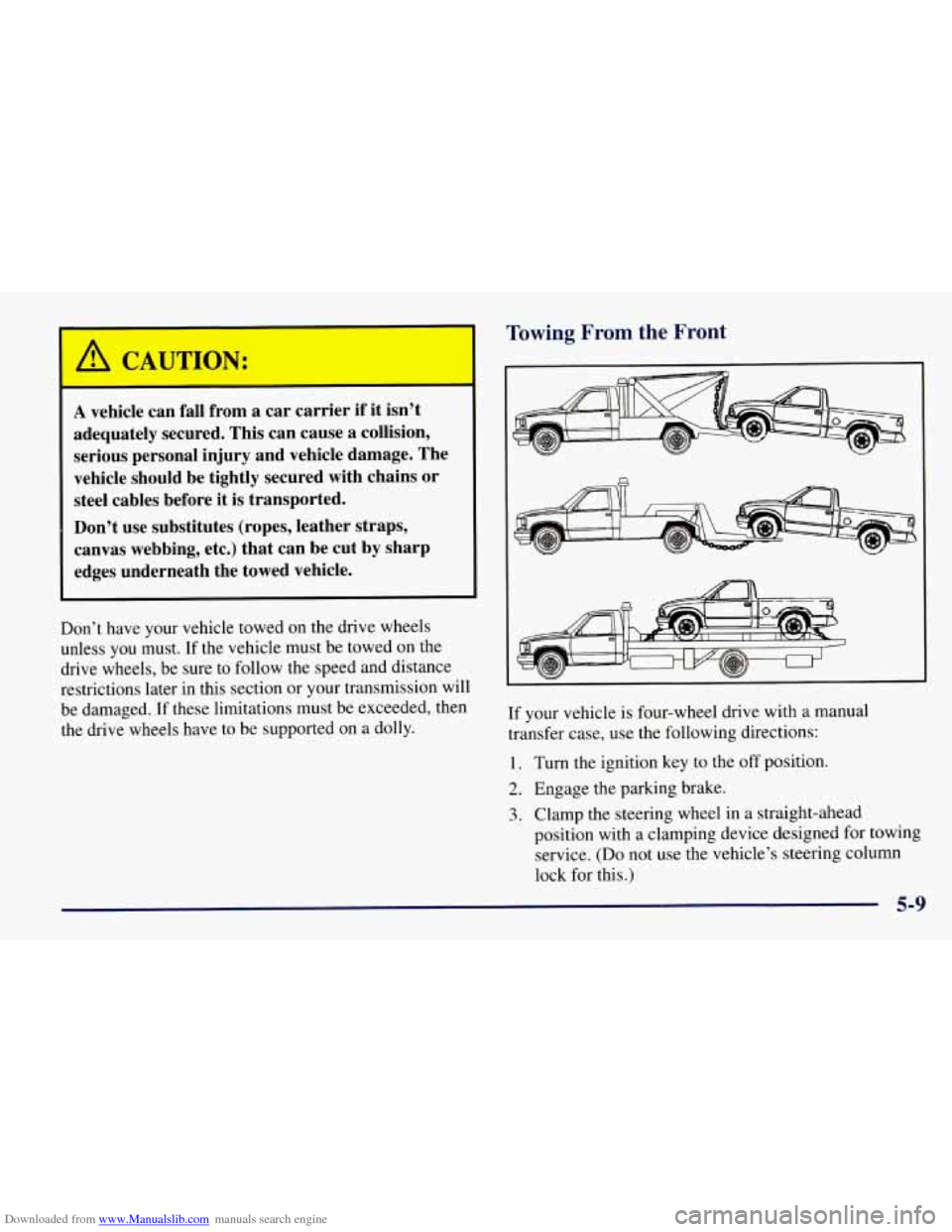
Downloaded from www.Manualslib.com manuals search engine Towing From the Front
A vehicle can fall from a car carrier if it isn’t
adequately secured. This can cause a collision,
serious personal injury and vehicle damage. The
vehicle should be tightly secured with chains or
steel cables before it is transported.
Don’t use substitutes (ropes, leather straps,
canvas webbing, etc.) that can be cut by sharp
edges underneath the towed vehicle.
Don’t have your vehicle towed on the drive wheels
unless you must. If the vehicle must be towed
on the
drive wheels, be sure to follow the speed and distance
restrictions later in this section or your transmission will
be damaged.
If these limitations must be exceeded, then
the drive wheels have to be supported on a dolly. If
your vehicle is four-wheel drive with a manual
transfer case, use the following directions:
1. Turn the ignition key to the off position.
2. Engage the parking brake.
3. Clamp the steering wheel in a straight-ahead
position with a clamping device designed for towing
service. (Do not use the vehicle’s steering column
lock for this.)
5-9
Page 247 of 433
Downloaded from www.Manualslib.com manuals search engine 4. Put the transmission in PARK (P).
5. Put the transfer case in NEUTRAL (N).
6. When the vehicle is hooked up, release the
7. Maximum speed 55 mph (88 km/h),
If your vehicle is a two-wheel drive or a four-wheel
drive with an electric shift transfer case, use the
following directions:
1. Turn the ignition key to the OFF position.
2. Engage the parking brake.
3. Clamp the steering wheel in a straight-ahead
parking
brake.
distance unlimited.
position with a clamping device designed for towing
service.
(Do not use the vehicle’s steering column
lock for this.)
4. Put the transmission in NEUTRAL (N).
5. Put the transfer case in 2HIGH (2HI).
6. When the vehicle is hooked up, release the
7. Maximum speed 35 mph (55 km/h), maximum
parking
brake.
distance
50 miles (80 km).
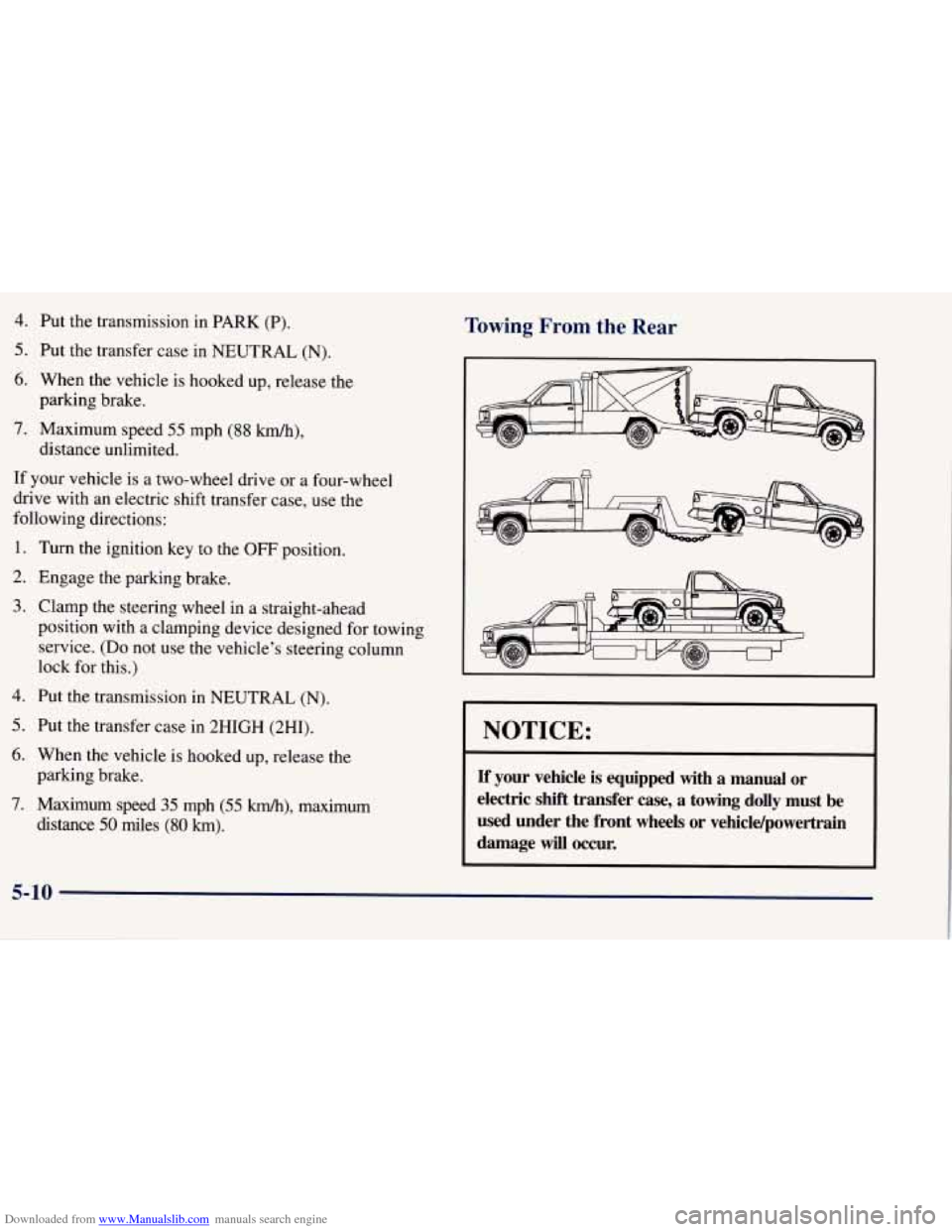
Towing From the Rear
I 3
NOTICE:
If your vehicle is equipped with a manual or
electric shift transfer case, a towing dolly must be
used under the front wheels or vehicldpowertrain
damage will occur.
SI1 n
Page 258 of 433
Downloaded from www.Manualslib.com manuals search engine Engine Fan Noise If a Tire Goes Flat
Your vehicle has a clutched engine cooling fan. When
the clutch is engaged,
the fan spins faster to provide
more air to cool the engine.
In most everyday driving
conditions, the fan is spinning slower and the clutch is
not fully engaged. This improves fuel economy and
reduces fan noise. Under heavy vehicle loading, trailer
towing and/or high outside temperatures, the fan speed
increases as the clutch more fully engages.
So you may
hear an increase
in fan noise. This is normal and should
not be mistaken as the transmission slipping or making
extra shifts. It is merely the cooling system functioning
properly. The fan will slow down when additional
cooling is not required and the clutch disengages.
You may also hear this fan noise when you start the
engine. It will go away as the fan clutch disengages. It’s
unusual for a tire to “blow out’’ while you’re driving,
especially if you maintain your tires properly. If air goes
out of a tire, it’s much more likely to leak out slowly.
But if you should ever have a “blowout,” here are a
few tips about what to expect and what
to do:
If
a front tire fails, the flat tire will create a drag that
pulls the vehicle toward that side. Take your
foot off
the accelerator pedal and grip the steering wheel firmly.
Steer to maintain lane position, and then’ gently brake to
a stop well out
of the traffic lane.
A rear blowout, particularly on a curve, acts much like a
skid and may require the same correction you’d use in
a skid. In any rear blowout, remove your foot from
the accelerator pedal. Get the vehicle under control
by
steering the way you want the vehicle to go. It may be
very bumpy and noisy, but you can still steer. Gently
brake to a stop
-- well off the road if possible.
If a tire goes flat, the next part shows how
to use your
jacking equipment to change a flat tire safely.
5-21
Page 259 of 433
Downloaded from www.Manualslib.com manuals search engine Changing a Flat Tire
If a tire goes flat, avoid further tire and wheel damage
by driving slowly to a level place.
Turn on your hazard
warning flashers.
Changing a tire can cause an injury. The vehicle
can slip
off the jack and roll over you or other
people. You and they could be badly injured.
Find
a level place to change your tire. To help
prevent the vehicle from moving:
1. Set the parking brake firmly.
2. Put the shift lever in PARK (P).
3. If you have a four-wheel-drive vehicle,
be sure the transfer case is in a drive
gear
-- not in NEUTRAL (N).
4. firn off the engine.
To be even more certain the vehicle won't move,
you can put blocks at the front and rear of the
tire farthest away from the one being changed.
That would be the tire on the other side of the
vehicle, at the opposite end.
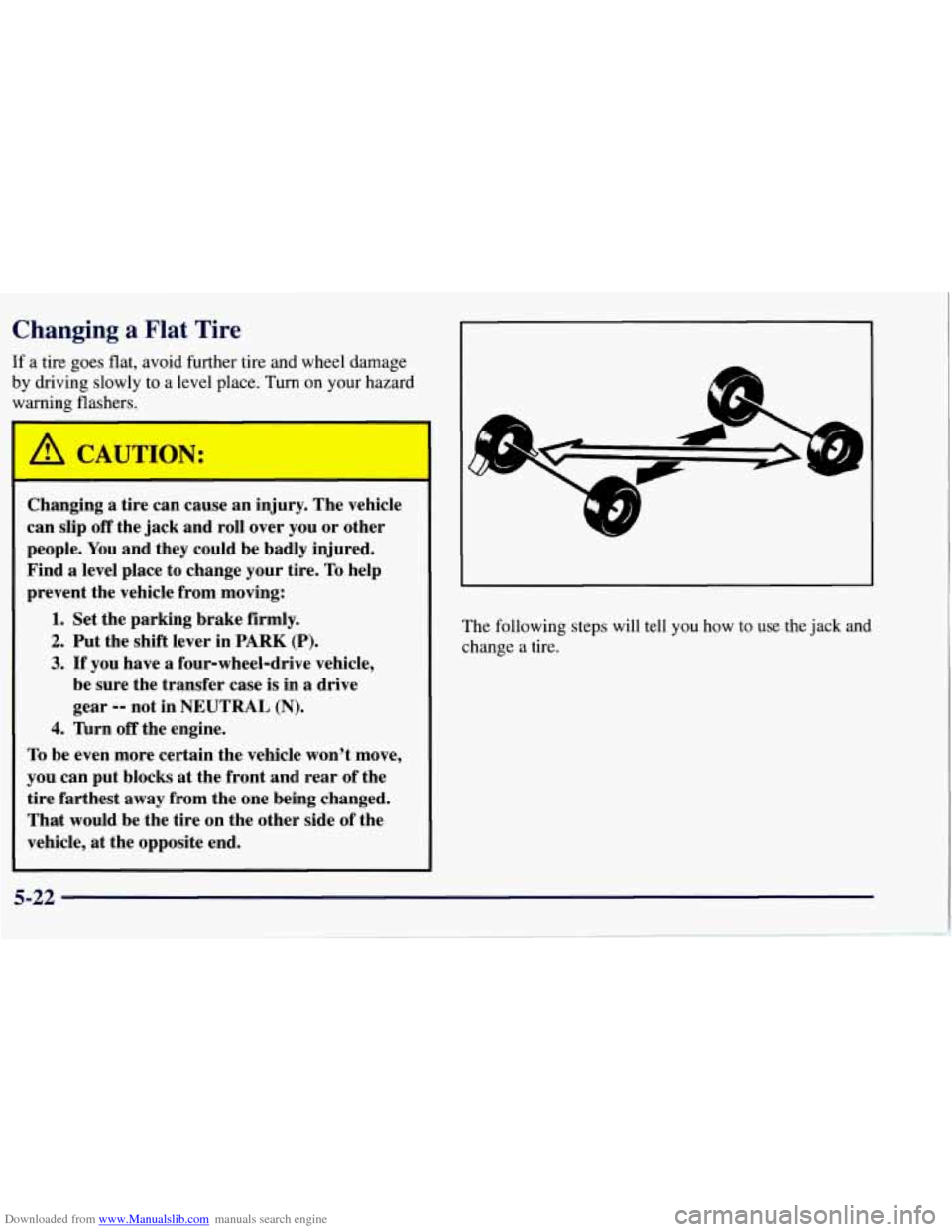
The following steps will tell you how to use the jack and
change
a tire.
5-22
Page 261 of 433
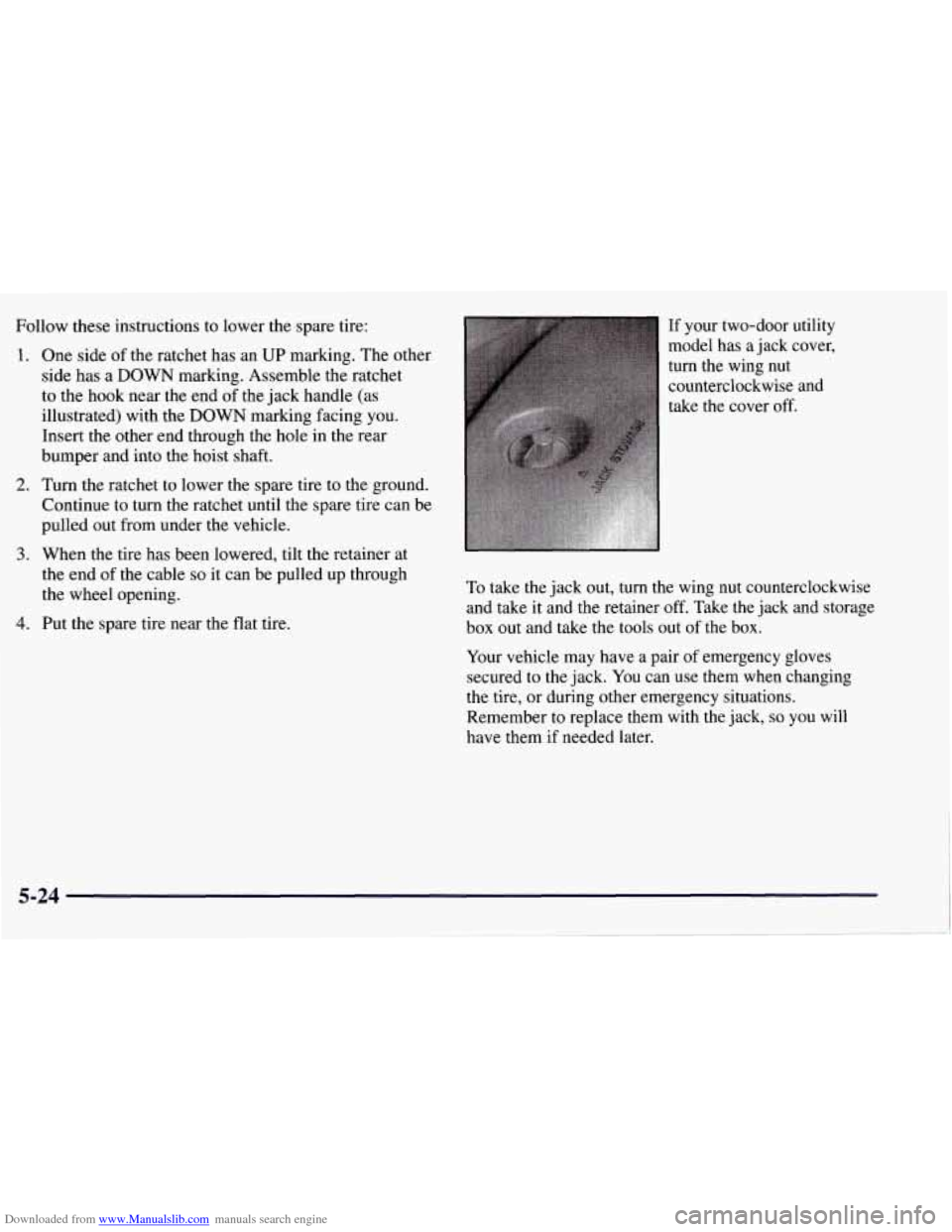
Downloaded from www.Manualslib.com manuals search engine Follow these instructions to lower the spare tire:
1. One side of the ratchet has an UP marking. The other
side has a DOWN marking. Assemble the ratchet
to the hook near the end of the jack handle (as
illustrated) with the DOWN marking facing you.
Insert the other end through the hole in the rear
bumper and into the hoist shaft.
2. Turn the ratchet to lower the spare tire to the ground.
Continue to turn the ratchet until the spare tire can be
pulled out from under the vehicle.
3. When the tire has been lowered, tilt the retainer at
the end of the cable
so it can be pulled up through
the wheel opening.
4. Put the spare tire near the flat tire. If
your two-door utility
model has a jack cover,
turn the wing nut
counterclockwise and
take the cover
off.
To take the jack out, turn the wing nut counterclockwise
and take it and the retainer off. Take the jack and storage
box out and take the tools out of the box.
Your vehicle may have a pair of emergency gloves
secured
to the jack. You can use them when changing
the tire, or during other emergency situations.
Remember to replace them with the jack,
so you will
have them
if needed later.
5-24
!
Page 263 of 433
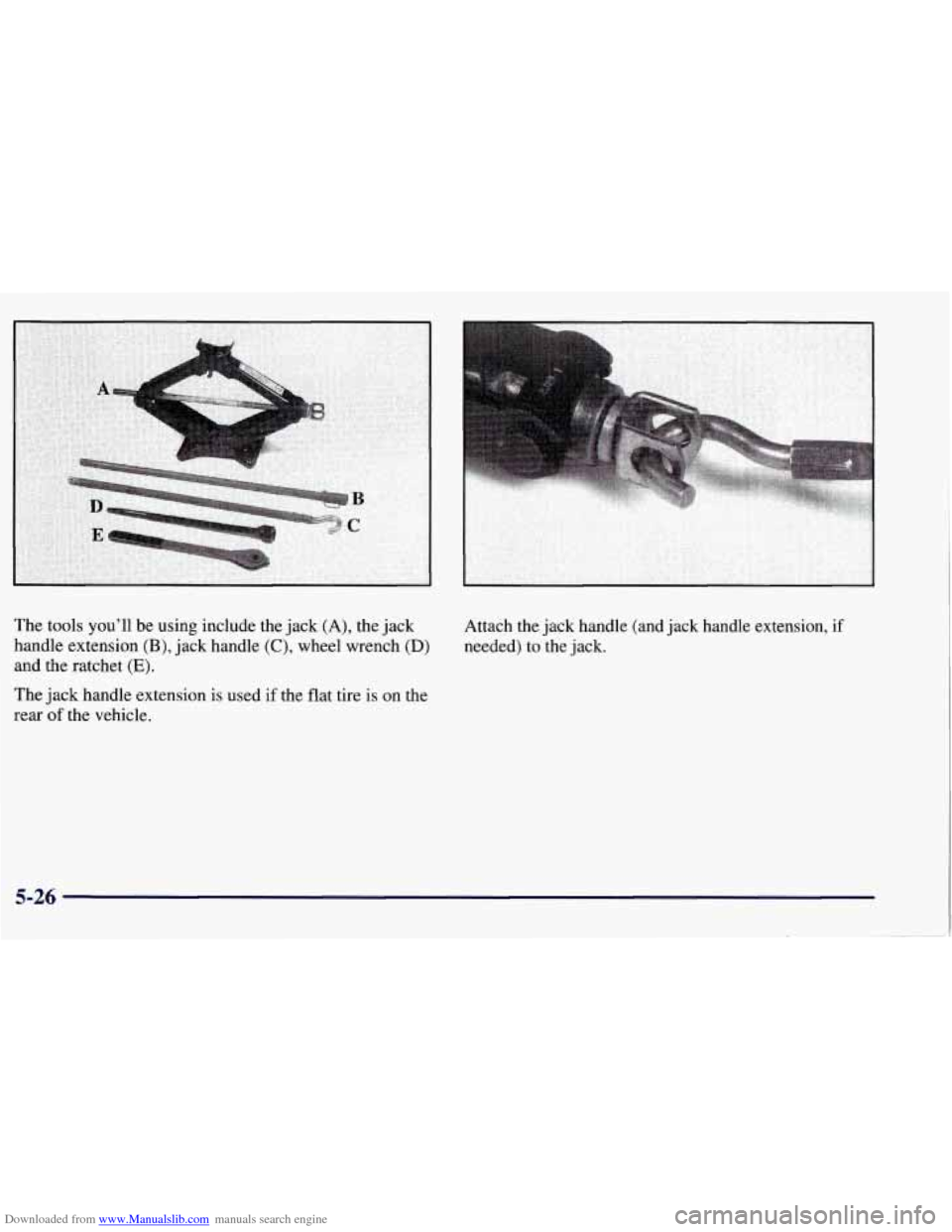
Downloaded from www.Manualslib.com manuals search engine The tools you’ll be using include the jack (A), the jack
handle extension
(B), jack handle (C), wheel wrench (D)
and the ratchet (E).
The jack handle extension is used if the flat tire is on the
rear
of the vehicle. Attach the
jack handle (and jack handle extension,
if
needed) to the jack.
5-26
Page 265 of 433
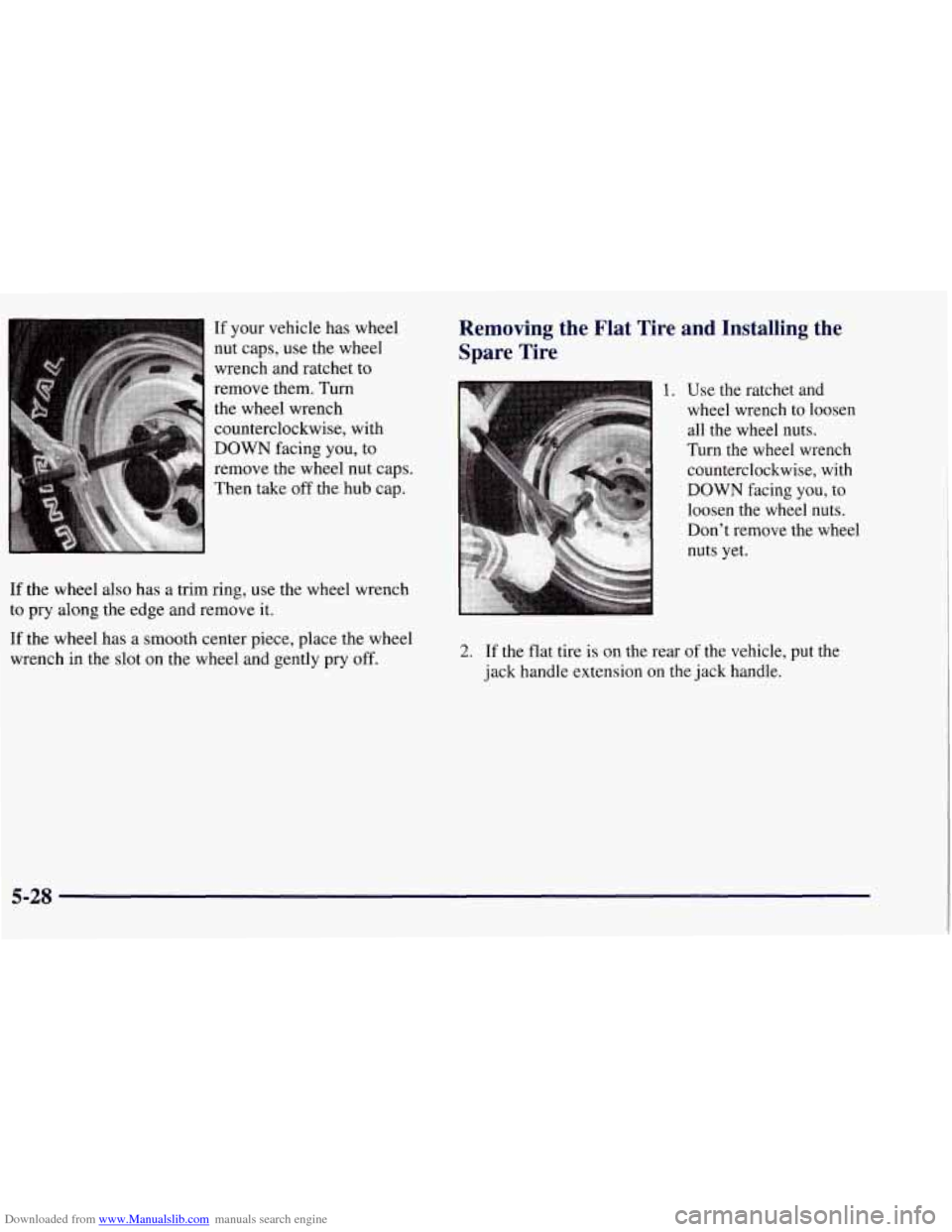
Downloaded from www.Manualslib.com manuals search engine If your vehicle has wheel
nut caps, use the wheel
wrench and ratchet to
remove them. Turn
the wheel wrench
counterclockwise, with
DOWN facing you, to
If the wheel also has a trim ring, use
the wheel wrench
to pry along the edge and remove it.
If the wheel has a smooth center piece, place the wheel
wrench in the slot on the wheel and gently pry
off.
Removing the Flat Tire and Installing the
Spare Tire
1. Use the ratchet and
wheel wrench to loosen
all the wheel nuts.
Turn the wheel wrench
counterclockwise, with
DOWN facing you, to
loosen the wheel nuts.
Don’t remove the wheel nuts yet.
2. If the flat tire is on the rear of the vehicle, put the
jack handle extension
on the jack handle.
5-28