wheel CHEVROLET TAHOE 1997 1.G Repair Manual
[x] Cancel search | Manufacturer: CHEVROLET, Model Year: 1997, Model line: TAHOE, Model: CHEVROLET TAHOE 1997 1.GPages: 433, PDF Size: 22.05 MB
Page 267 of 433
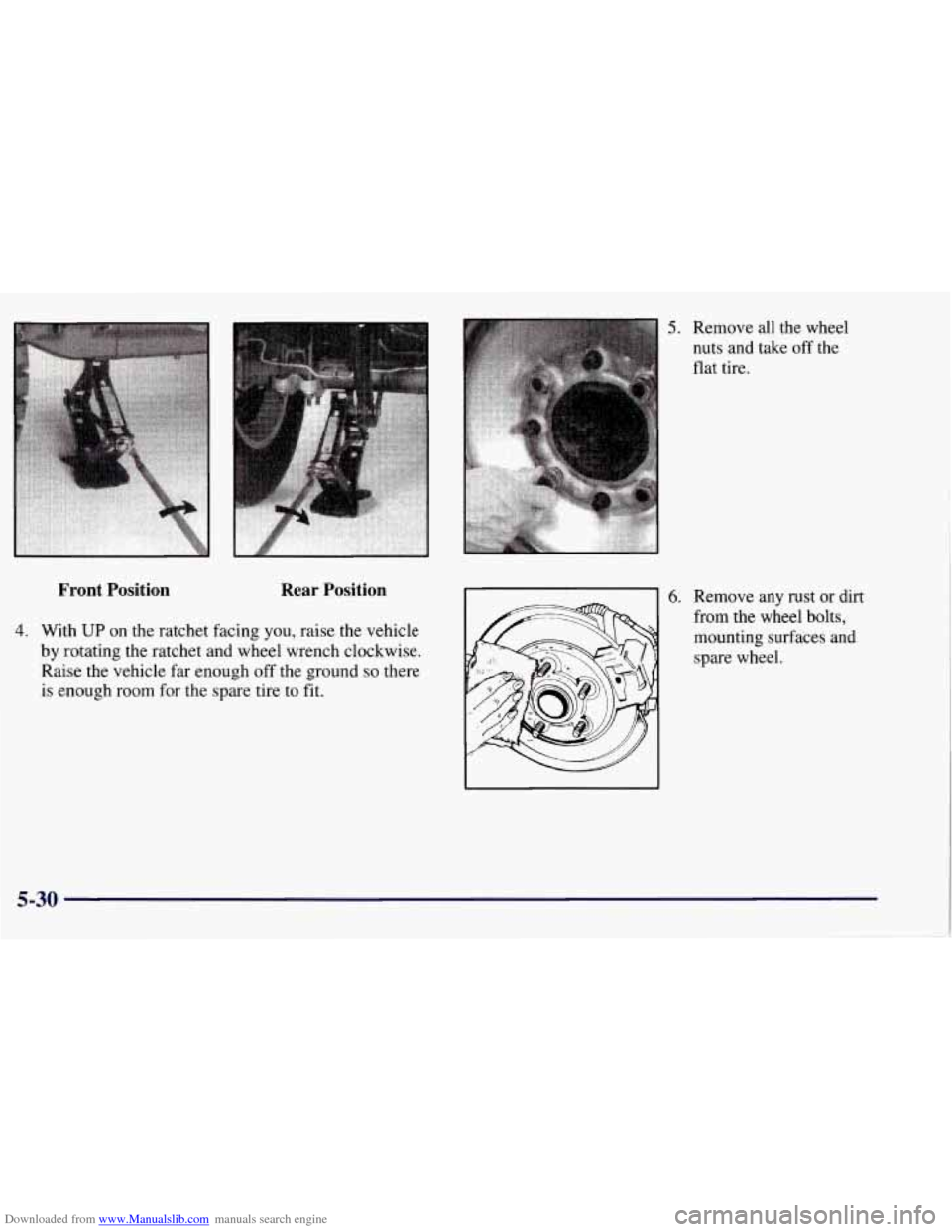
Downloaded from www.Manualslib.com manuals search engine Front Position Rear Position
4. With UP on the ratchet facing you, raise the vehicle
by rotating the ratchet and wheel wrench clockwise.
Raise the vehicle far enough
off the ground so there
is enough room for the spare tire to fit.
5. Remove all the wheel
nuts and take off the
flat tire.
5-30
6. Remove any rust or dirt
from the wheel bolts,
mounting surfaces
and
spare wheel.
Page 268 of 433
Downloaded from www.Manualslib.com manuals search engine A CAUTION:
I
Rust or dirt on the wheel, or on the parts to
which it is fastened, can make the wheel nuts
become loose after a time. The wheel could come
off and cause an accident. When you change a
wheel, remove any rust or dirt from the places
where the wheel attaches to the vehicle. In an
emergency, you can use
a cloth or a paper towel
to do this; but be sure to use a scraper or wire
brush later, if you need to, to get all the rust or
dirt
off.
A CAUTION: I
Never use oil or grease on studs or nuts. If you
do, the nuts might come loose. Your wheel could
fall
off, causing a serious accident.
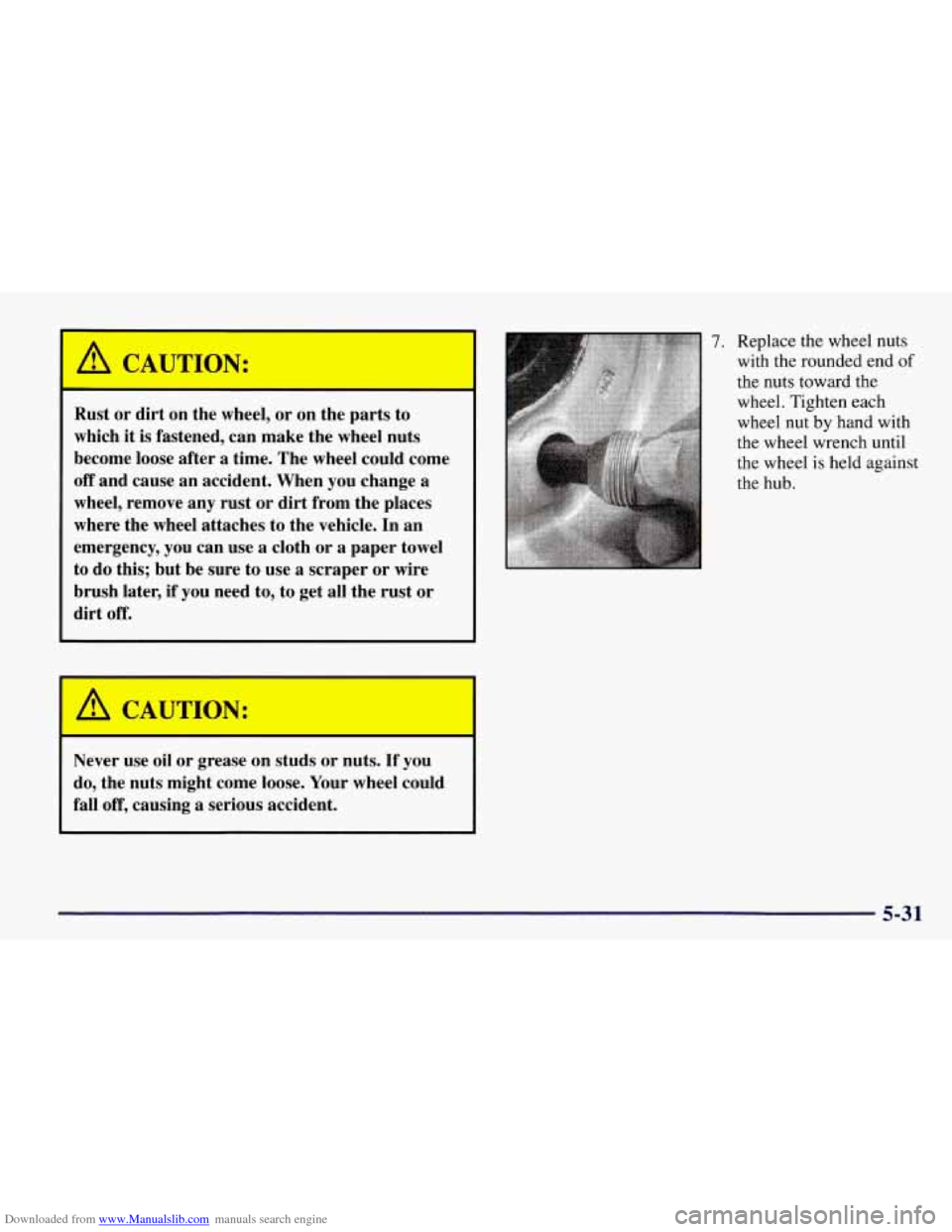
7. Replace the wheel nuts
with the rounded end
of
the nuts toward the
wheel. Tighten each
wheel nut
by hand with
the wheel wrench until
the wheel
is held against
the hub.
5-31
Page 269 of 433
Downloaded from www.Manualslib.com manuals search engine 7
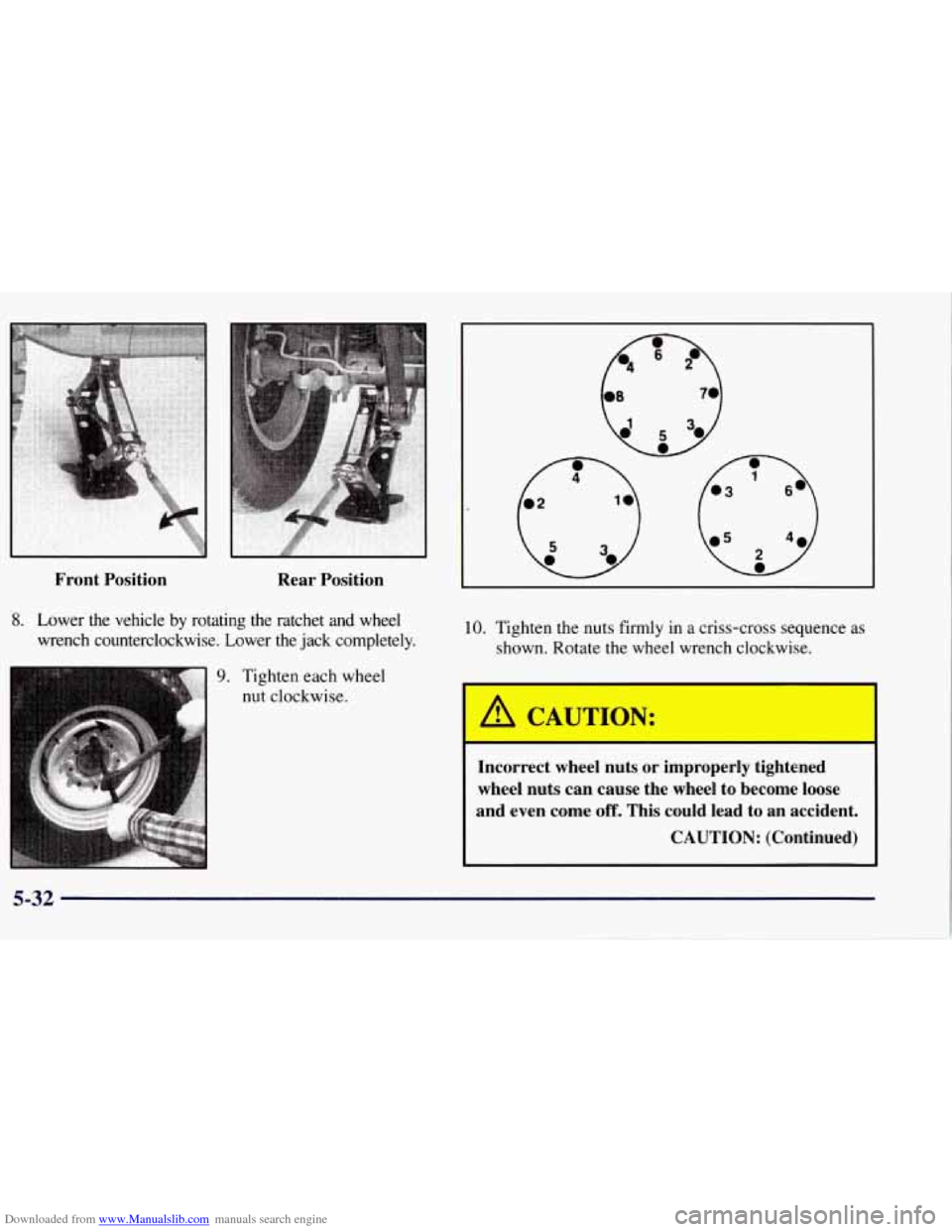
Front Position Rear Position
10. Tighten the nuts firmly in a criss-cross sequence as
shown. Rotate the wheel wrench clockwise.
Incorrect wheel nuts or improperly tightened
wheel nuts can cause the wheel to become loose
and even come
off. This could lead to an accident.
CAUTION: (Continued)
5-32
Page 270 of 433
Downloaded from www.Manualslib.com manuals search engine I CAU‘IWN: (Continued)
Be sure to use the correct wheel nuts. If you have
to replace them, be sure to get new
GM original
equipment wheel nuts.
Stop somewhere as soon as you can and have the
nuts tightened with a torque wrench to the
proper torque. For proper torque, see
“Capacities and Specifications” in the Index.
L
NOTICE:
Improperly tightened wheel nuts can lead to
brake pulsation and rotor damage.
To avoid
expensive brake repairs, evenly tighten the wheel
nuts
in the proper sequence and to the proper
torque specification.
11. Put the wheel trim back on. For vehicles with
plastic wheel nut caps, tighten the caps until
they
are finger tight, then tighten them an additional
one-half turn with the ratchet and wheel wrench.
Storing a Flat or Spare Tire and Tools
I I
’
C TION:
-
Storing a jack, a tire or other equipment in the
passenger compartment
of the vehicle could
cause injury. In
a sudden stop or collision, loose
equipment could strike someone. Store all these
in the proper place.
Store the flat tire where the spare tire is stored.
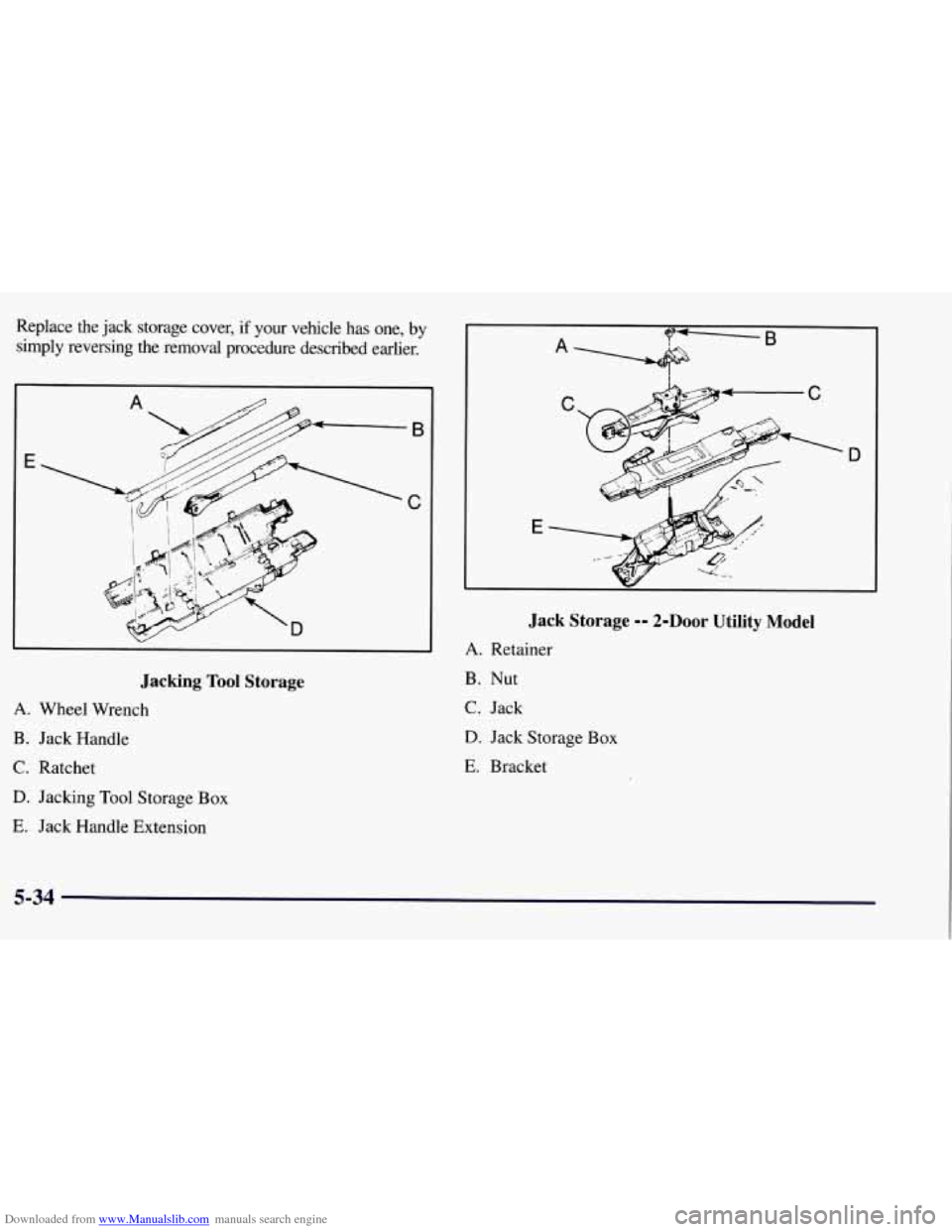
Put the tools into the storage box and close it tightly. Fit
the storage box on the bracket with the bolt through the
box. Put the jack onto the box. Be sure the jack is stored
as shown in the following illustrations. The jack handle
attachment point is circled in the following illustrations
to show the direction the jack should face when it is
stored properly. Secure the emergency gloves, if your
vehicle has them,
to the jack using the provided strap.
Slide the retainer over the bolt onto the jack and put the
wing nut
on it. Turn the nut clockwise until it is tight
against the retainer.
5-33
Page 271 of 433
Downloaded from www.Manualslib.com manuals search engine Replace the jack storage cover, if your vehicle has one, by
simply reversing the removal procedure described earlier.
Jacking Tool Storage
A. Wheel Wrench
B. Jack Handle
C. Ratchet
D. Jacking Tool Storage Box
E. Jack Handle Extension
D
Jack Storage 9- 2-Door Utility Model
A. Retainer
B. Nut
C. Jack
D. Jack Storage Box
E. Bracket
5-34
Page 273 of 433
Downloaded from www.Manualslib.com manuals search engine A B
n
C
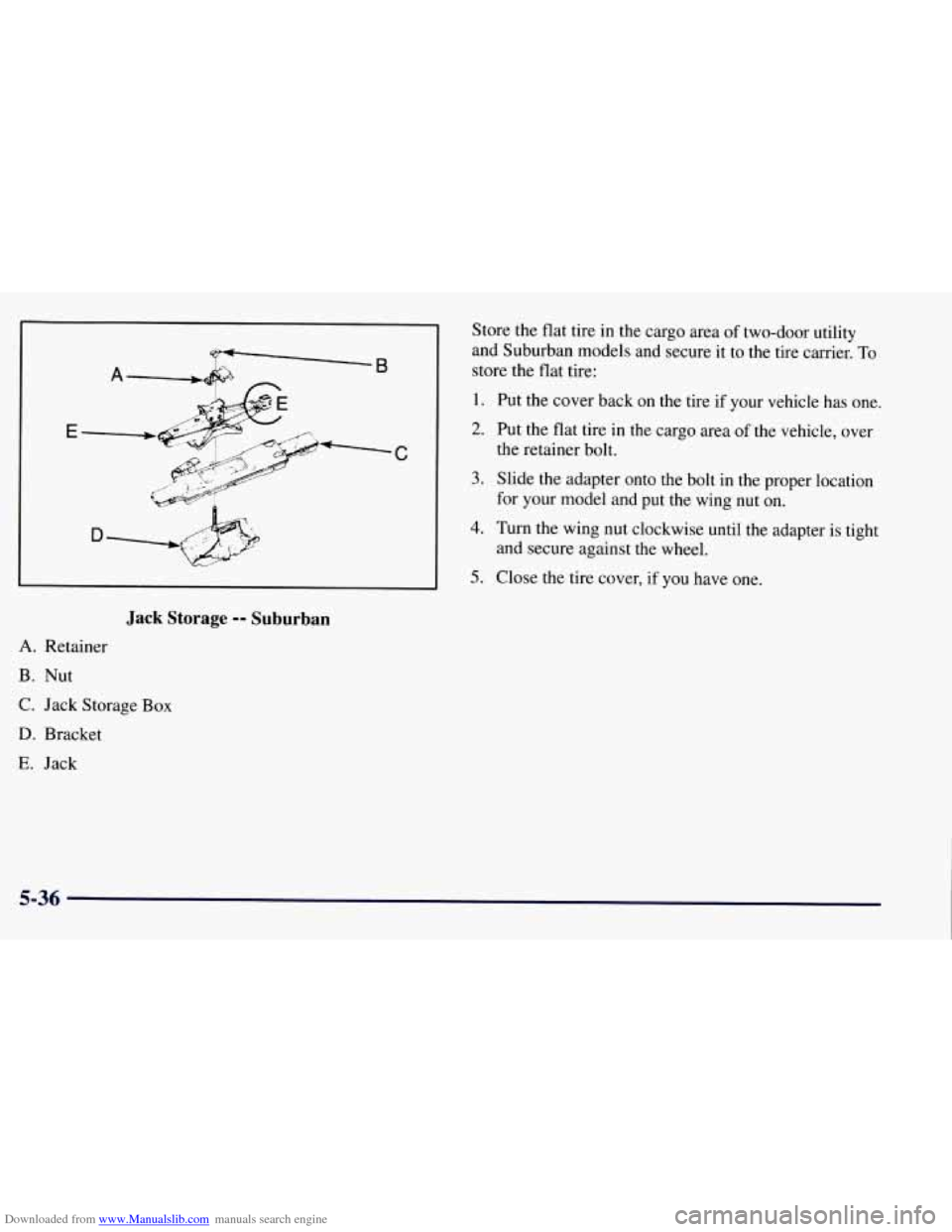
Jack Storage -- Suburban
A. Retainer
B. Nut
C. Jack Storage
Box
D. Bracket
E. Jack Store
the flat tire in the cargo area of two-door utility
and Suburban models and secure it to the tire carrier.
To
store the flat tire:
1.
2.
3.
4.
5.
Put the cover back on the tire if your vehicle has one.
Put the flat tire in the cargo area of the vehicle, over
the retainer bolt.
Slide
the adapter onto the bolt in the proper location
for your model and put
the wing nut on.
Turn the wing nut clockwise until the adapter is tight
and secure against the wheel.
Close the tire cover, if you have
one.
5-36
Page 275 of 433
Downloaded from www.Manualslib.com manuals search engine D
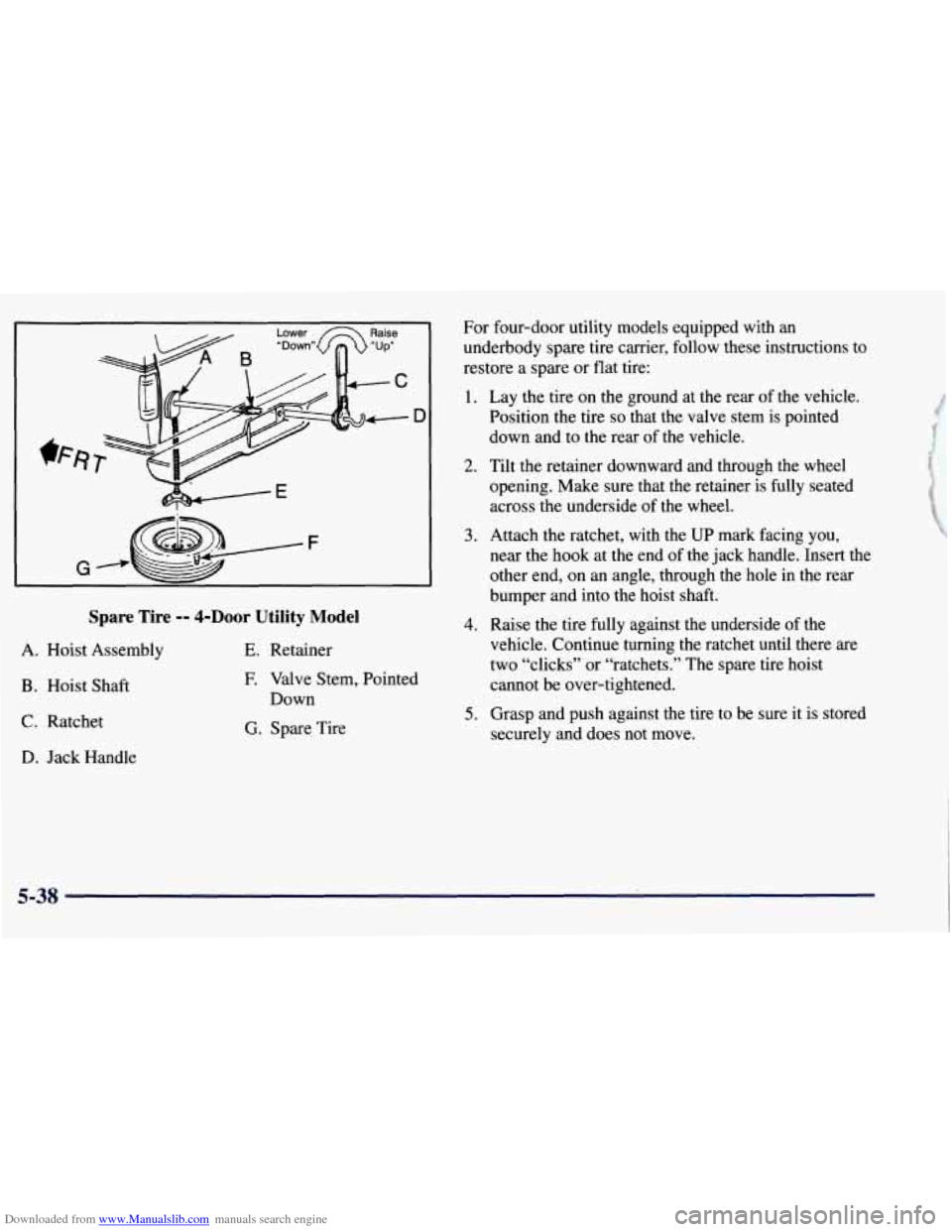
Spare Tire -- 4-Door Utility Model
A.
Hoist Assembly
B. Hoist Shaft
C. Ratchet
D. Jack Handle
E. Retainer
E Valve Stem, Pointed
Down
G. Spare Tire For four-door utility
models equipped with an
underbody spare tire carrier, follow these instructions to
restore a spare or flat tire:
1. Lay the tire on the ground at the rear of the vehicle.
Position the tire
so that the valve stem is pointed
down and to the rear of the vehicle.
2. Tilt the retainer downward and through the wheel
opening. Make sure that the retainer is fully seated
across the underside of the wheel.
3. Attach the ratchet, with the UP mark facing you,
near the hook at the end
of the jack handle. Insert the
other end, on an angle, through the hole in the rear
bumper and into the hoist shaft.
4. Raise the tire fully against the underside of the
vehicle. Continue turning the ratchet until there are
two “clicks” or “ratchets.” The spare tire hoist
cannot be over-tightened.
securely and does not move.
5. Grasp and push against the tire to be sure it is stored
5-38
Page 276 of 433
Downloaded from www.Manualslib.com manuals search engine If You’re Stuck: In Sand, Mud,
Ice
or Snow
What you don’t want to do when your vehicle is stuck is
to spin your wheels too fast. The method known as
“rocking” can help you get out when you’re stuck, but
you must use caution.
A CAUTION:
If you let your tires spin at high speed, they can
explode, and you or others could be injured.
And, the transmission or other parts of the
vehicle can overheat. That could cause an engine
compartment fire or other damage. When you’re
stuck, spin the wheels
as little as possible. Don’t
spin the wheels above
35 mph (55 km/h) as shown
on the speedometer.
NOTICE:
Spinning your wheels can destroy parts of your
vehicle as well as the tires.
If you spin the wheels
too fast while shifting your transmission back
and forth, you can destroy your transmission.
For information about using tire chains on your vehicle,
see “Tire Chains’’ in the Index.
5-39
Page 277 of 433
Downloaded from www.Manualslib.com manuals search engine Rocking Your Vehicle To Get It Out
First, turn your steering wheel left and right. That will
clear the area around your front wheels. Then shift back
and forth between REVERSE
(R) and a forward gear,
spinning the wheels as little as possible. Release the
accelerator pedal while you shift, and press lightly on
the accelerator pedal when the transmission is in gear. If
that doesn’t get you out after a few tries, you may need
to be towed out. Or, you can use your recovery hooks if
your vehicle has them. If you do need to be towed out,
see “Towing Your Vehicle’’ in the Index.
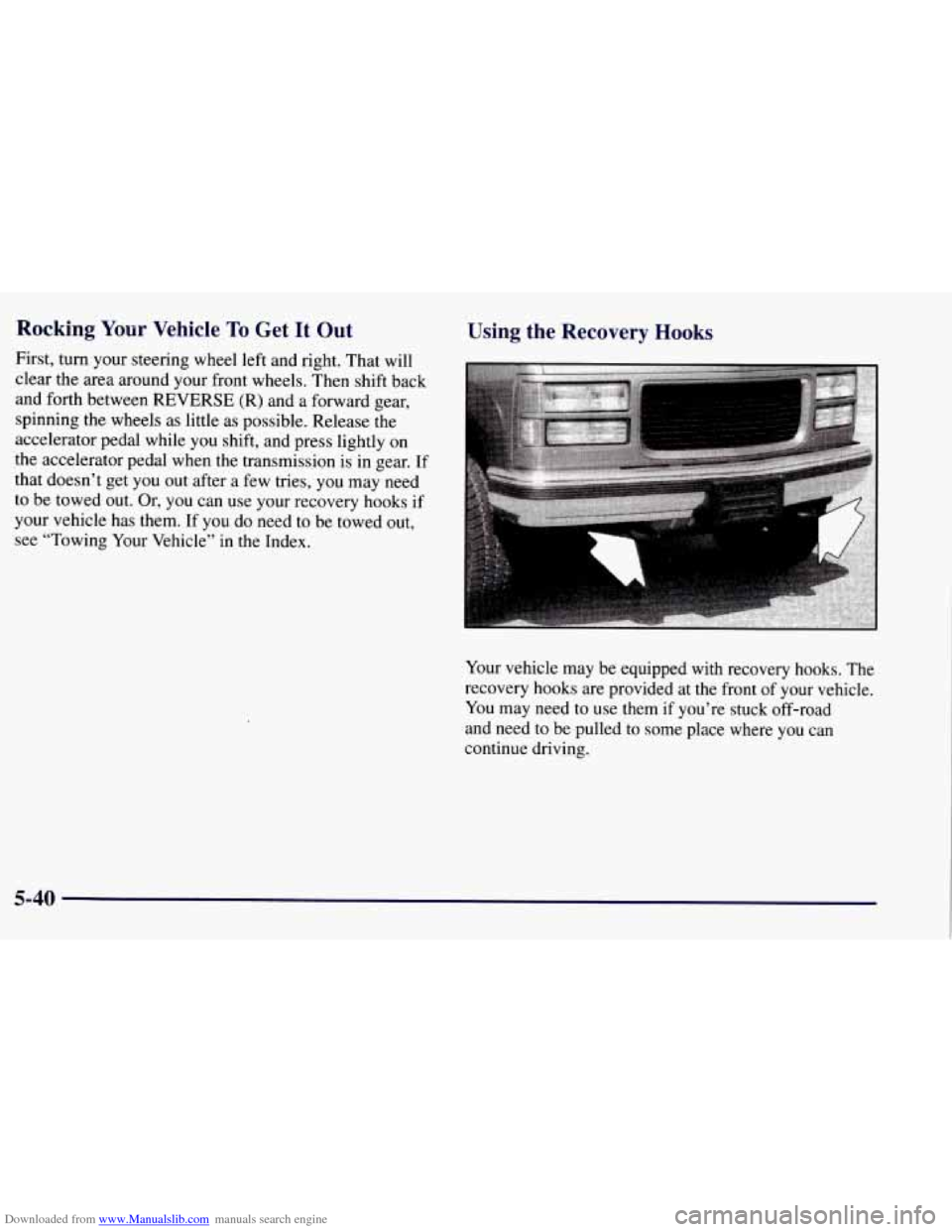
Using the Recovery Hooks
Your vehicle may be equipped with recovery hooks. The
recovery hooks are provided at the front
of your vehicle.
You may need to use them if you’re stuck off-road
and need
to be pulled to some place where you can
continue driving.
5-40
Page 280 of 433
Downloaded from www.Manualslib.com manuals search engine Section 6 Service and Appearance Care
Here you will find information about the care of your vehicle. This section begins with service and fuel information,
and then it shows how to check important fluid and lubricant levels. There is also technical information about your
vehicle, and a part devoted to its appearance care.
6-2
6-3
6-5
6-6
6-8
6- 14
6-18
6-20
6-24 6-24
6-26
6-29
6-29
6-30
6-30
6-32 Service
Fuel (Gasoline Engine)
Fuels
in Foreign Countries -- Gasoline
Engines
Filling Your Tank
Checking Things Under the Hood
Engine Oil (Gasoline Engine)
Air Cleaner (Gasoline Engines)
Automatic Transmission Fluid
Rear Axle
Four-wheel Drive
Engine Coolant
Radiator Pressure Cap
Thermostat
Power Steering Fluid
Windshield Washer Fluid
Brakes
6-36
6-37
6-44
6-44
6-52
6-53
6-56
6-57
6-59
6-60 6-6 1
6-62
6-67
6-69
6-70
6-72 Battery
Bulb Replacement
Windshield Wiper Blade Replacement
Tires Appearance Care
Cleaning the Inside
of Your Vehicle
Care of the Safety Belts
Cleaning the Outside of Your Vehicle
Underbody Maintenance
Appearance Care Materials Chart
Vehicle Identification Number (VIN)
Electrical System
Replacement Bulbs
Capacities and Specifications
Normal Replacement Parts
Air Conditioning Specifications
6-1