automatic transmission CHEVROLET TRACKER 1993 User Guide
[x] Cancel search | Manufacturer: CHEVROLET, Model Year: 1993, Model line: TRACKER, Model: CHEVROLET TRACKER 1993Pages: 339, PDF Size: 15.75 MB
Page 187 of 339
J
It be dangerous tu get out
of your vehicle if the shift lever
is not fully in P (Park) with the
parking brake firmly set.
If you have left the engine running,
the veficle can
move suddenly. You
or others could be injured. To be
sure your vehicle won’t move, when
you’re
on fairly level ground, use
the steps that follow.
If you have four-wheel drive, and
your transfer
case is in N (NeutraI) ,
your vehicle will be free to roll,
even
if your shift lever is in
P (Park). So, be sure the transfer
case is in a drive gear - not in
N (Neutral).
If you are parking on a hill, or if
you’re pulling a trailer; also see
“Parking On Hills” in the Index.
6. Release the regular brakes.
When You Are Ready to Leave after
Parking on a
Hill
1. Apply your regular brakes and hold
the pedal down while you:
Start your engine;
Shift into a gear; and
Release the parking brake.
2. Let up on the brake pedal.
3. Drive slowly until the trailer is clear
4. Stop and have someone pick up and
of the chocks.
store
the chocks.
Maintenance When Trailer Towing
Your vehicle will need service more
often when you’re pulling a trailer.
See
the Maintenance Schedule for more on
this. Things that are especially important
in trailer operation are automatic
transmission fluid (don’t overfill),
engine oil, axle lubricant, belts, cooling
system, and brake adjustment. Each
of
these is covered in this manual, and the
Index will help you find them quickly.
If
you’re trailering, it’s a good idea to
review these sections before you start
your trip.
Check periodically
to see that all hitch
nuts and bolts are tight.
185 9 =
ProCarManuals.com
Page 188 of 339
Your Driving and the Road
Recreational Towing
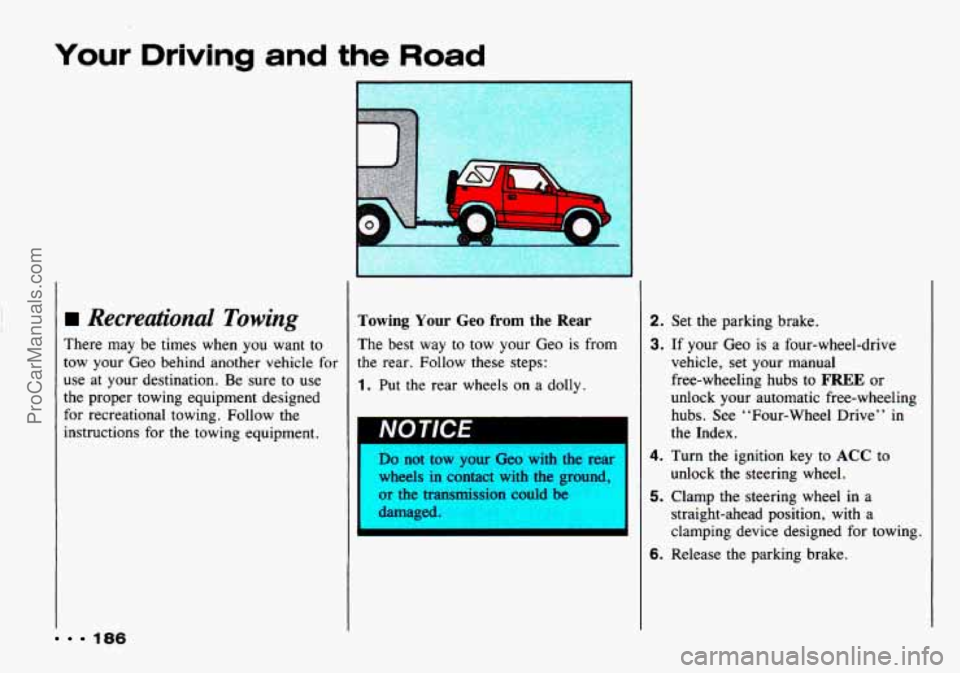
There may be times when you want to
tow your Geo behind another vehicle for
use at your destination. Be sure to use
the proper towing equipment designed
for recreational towing. Follow
the
instructions for the towing equipment.
186
Towing Your Geo from the Rear
The best way to tow your Geo is from
the rear. Follow these steps:
1 . Put the rear wheels on a dolly.
NOTlCE
Do not tow your Geo with the re--
wheels in contact with the grounL,
or
the transmission could be
damaged.
2. Set the parking brake.
3. If your Geo is a four-wheel-drive
vehicle, set your manual
free-wheeling hubs to
FREE or
unlock your automatic free-wheeling
hubs. See “Four-Wheel Drive’’
in
the Index.
4. Turn the ignition key to ACC to
unlock the steering wheel.
5. Clamp the steering wheel in a
straight-ahead position,
with a
clamping device designed for towing.
6. Release the parking brake.
ProCarManuals.com
Page 189 of 339
Make sure that the towing speed
dues not exceed 55 mph
(90 km/h), or your Geo could be
badly damaged.
Towing Your Geo from the Front
If your vehicle has automatic
I free-wheeling hubs or two-whet
drive, do not tow it
on all fa
I wheels. If you do, you transmission could be damaged.
I
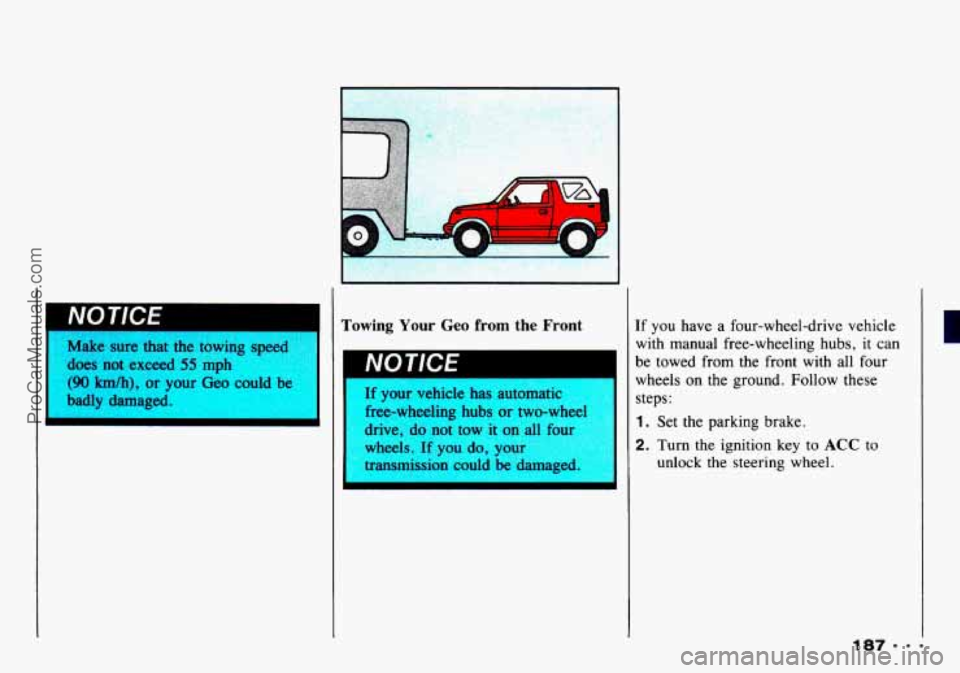
If you have a four-wheel-drive vehicle
with manual free-wheeling hubs, it can
be towed from the front with all four
wheels on the ground. Follow these
steps:
1. Set the parking brake.
2. Turn the ignition key to ACC to
unlock the steering wheel.
ProCarManuals.com
Page 190 of 339
Your Driving and the Road
= - 9 188
3. Shift your automatic transmission
into
P (Park), or your manual
transmission into
2 (Second).
4. Shift the transfer case to N (Neutral).
5. Set the hubs to FREE. See
“Four-Wheel Drive” in the Index.
6. Release the parking brake. Stop towing every
200 miles (300 km)
and
start the engine. Leave the transfer
case shift lever in
N (Neutral). Shift
your automatic transmission
to
D (Drive); leave a manual transmission
in
2 (Second) and release the clutch.
Run the engine at medium speed for one
minute to circulate
the oil in the transfer
case. Turn
the ignition key to ACC.
Now, you can continue towing your
Geo
.
NU I Kt
Make sure that the towing speed
does not exceed
50 mph
(80 km/h), or your Geo could
badly damaged.
ProCarManuals.com
Page 193 of 339
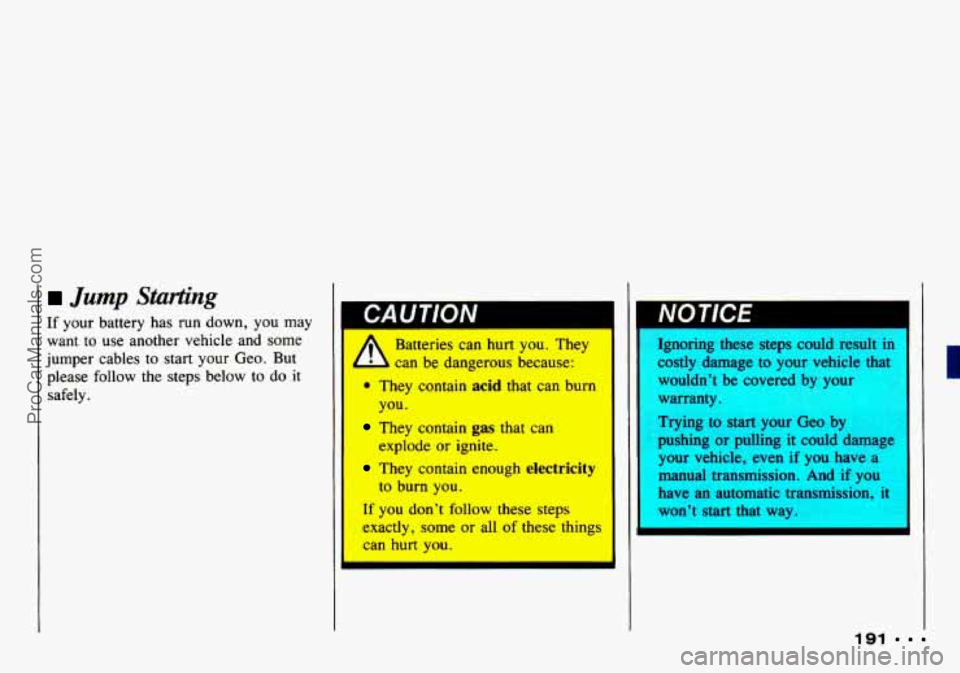
Jump Startirtg
If your battery has run down, you may
want to use another vehicle and
some
jumper cables to start your Geo. But
please follow the steps below to do it
safely. Batteries
can hurt you.
They
L can be dangerous because:
0 They contain acid that can burn
They contain gas that can
They contain enough electricity
If you don't follow these steps
exactly, some or
all of these thin
can hurt you.
you.
explode or ignite.
to burn you. Ignoring these steps could result in
costly
damage to your vehicle that
wouldn't be covered by your
warranty.
Trying
to start your Geo by
pushing or pulling it could damage
your vehicle, even if you have
a
manual transmission. And if you
have an automatic transmission, it
won't start that way.
191
ProCarManuals.com
Page 194 of 339
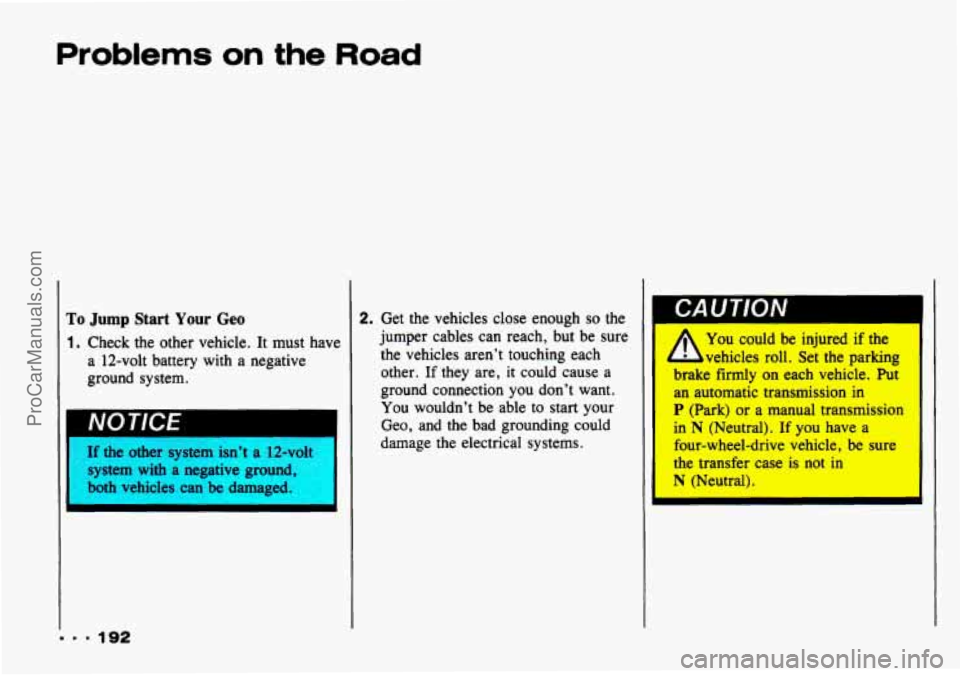
Problems on the Road
To Jump Start Your Geo
1. Check the other vehicle. It must have
a 12-volt battery with a negative
ground system.
If the other system isn’t a 12-volt I
system with a negative ground,
both vehicles can
be damaged.
I I
2. Get the vehicles close enough so the
jumper cables can reach, but be sure
the vehicles aren’t touching each
other.
If they are, it could cause a
ground connection you don’t want.
You wouldn’t be able
to start your
Geo, and the bad grounding could
darnage the electrical systems.
CAUTION -1
A
You could be injured if the
vehicles roll. Set the parking
brake firmly on each vehicle. Put
an automatic transmission in
P (Park) or a manual transmission
in
N (Neutral). If you have a
four-wheel-drive vehicle, be sure
the transfer case
is not in
N (Neutral).
ProCarManuals.com
Page 223 of 339
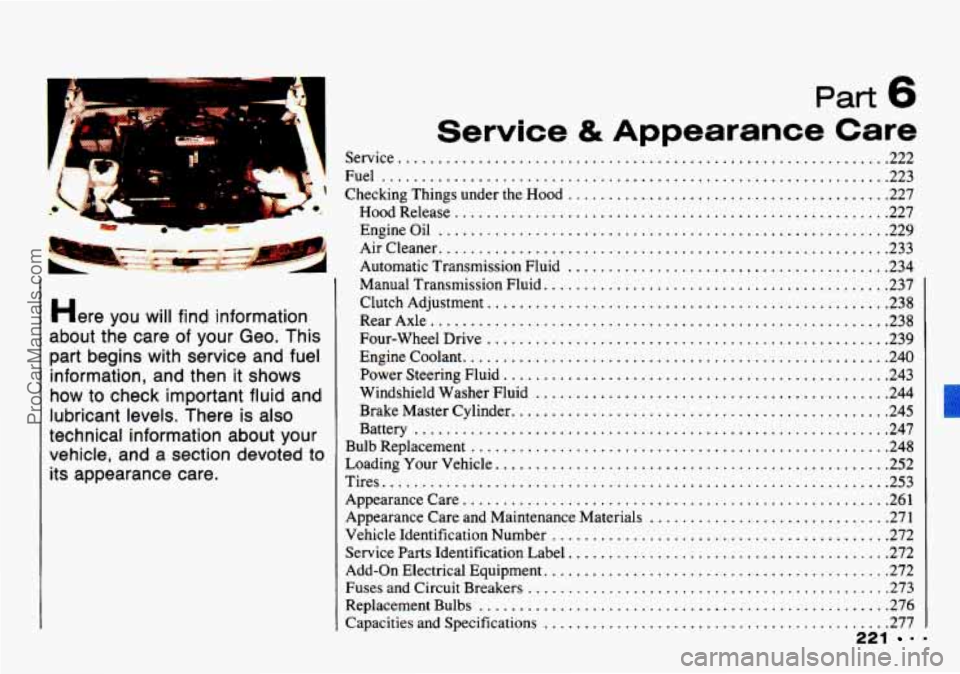
Part 6
Here you wit1 find information
about the care of your Geo
. This
part begins with service and fuel
information. and then it shows
how to check important fluid and
lubricant levels
. There is also
technical information about your
vehicle. and
a section devoted to
its appearance care
.
ii iervice & Appearance Care
Service ............................................................. 222
Fuel ............................................................... 223
Checking Things under the Hood ........................................ 227 .
HoodRelease 227
Engineoil ........................................................ 229
Aircleaner ........................................................ 233
Automatic Transmission Fluid ........................................ 234
Manual Transmission Fluid ........................................... 237
Clutch Adjustment .................................................. 238
RearAxle ......................................................... 238
Four-WheelDrive .................................................. 239
Enginecoolant ..................................................... 240
Power Steering Fluid ................................................ 243
Windshield Washer Fluid ............................................ 244
Brake Master Cylinder ............................................... 245
Battery ........................................................... 247
Bulb Replacement .................................................... 248
LoadingYourVehicle ................................................. 252
Tires ............................................................... 253
Appearancecare ..................................................... 261
Appearance Care and Maintenance Materials .............................. 271
Vehicle Identification Number .......................................... 272
Service Parts Identification Label ........................................ 272
Add-on Electrical Equipment ........................................... 272
Fuses and Circuit Breakers ............................................. 273
ReplacementBulbs ................................................... 276
Capacities and Specifications ........................................... 277
221 .
.
......................................................
ProCarManuals.com
Page 230 of 339
Service & Appearance Care
l-
a
I LUU I lV1V
An electric fan under the
hood can start up and injure
you even when the engine is not
running. Keep hands, clothing and
tools away from any underhood
electric
fan. Don't reach through
the grille to release the underhood
lever.
I
7."
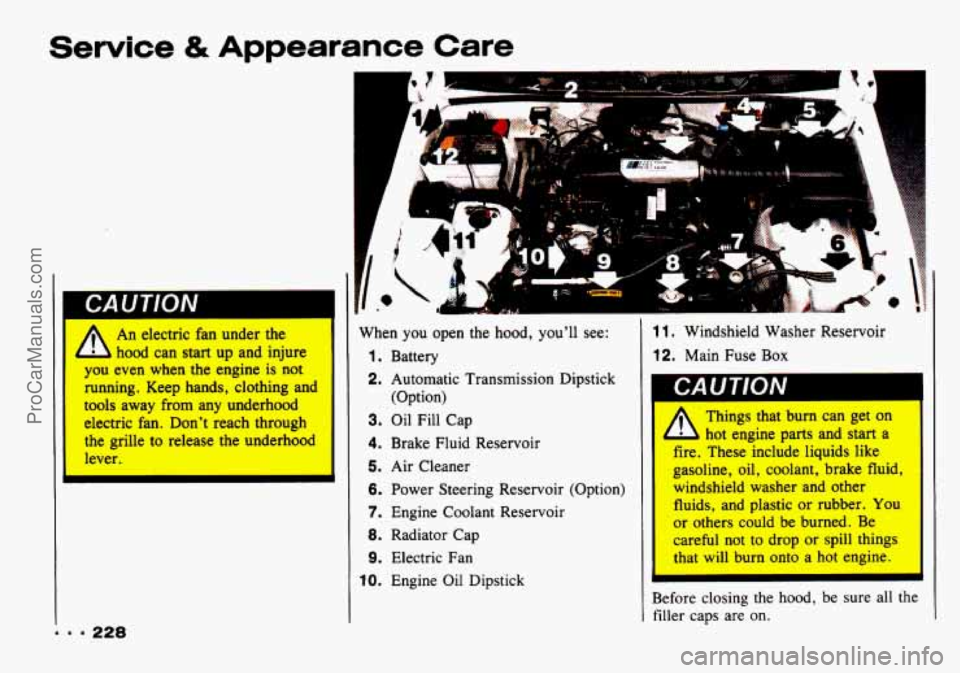
When you open the hood, you'll see:
1. Battery
2. Automatic Transmission Dipstick
(Option)
3. Oil Fill Cap
4. Brake Fluid Reservoir
5. Air Cleaner
6. Power Steering Reservoir (Option)
7. Engine Coolant Reservoir
8. Radiator Cap
9. Electric Fan
10. Engine Oil Dipstick
11. Windshield Washer Reservoir
12. Main Fuse Box
CAUTION
A
Things that burn can get on
hot engine parts and start a
fire. These include liquids like
gasoline, oil, coolant, brake fluid,
windshield washer and other
fluids, and plastic or rubber. You
or others could be burned. Be
careful not to drop or spill things
that will burn onto a hot engine.
Before closing the hood, be sure all the
filler caps are on.
... 228
ProCarManuals.com
Page 236 of 339
Service & Appearance Care
c
If the air cleaner is off, a backfire
can cause a damaging engine fire.
And, dirt can easily get into your
engine, which will damage it.
Always have
the air cleaner in
place when you're driving.
... 234
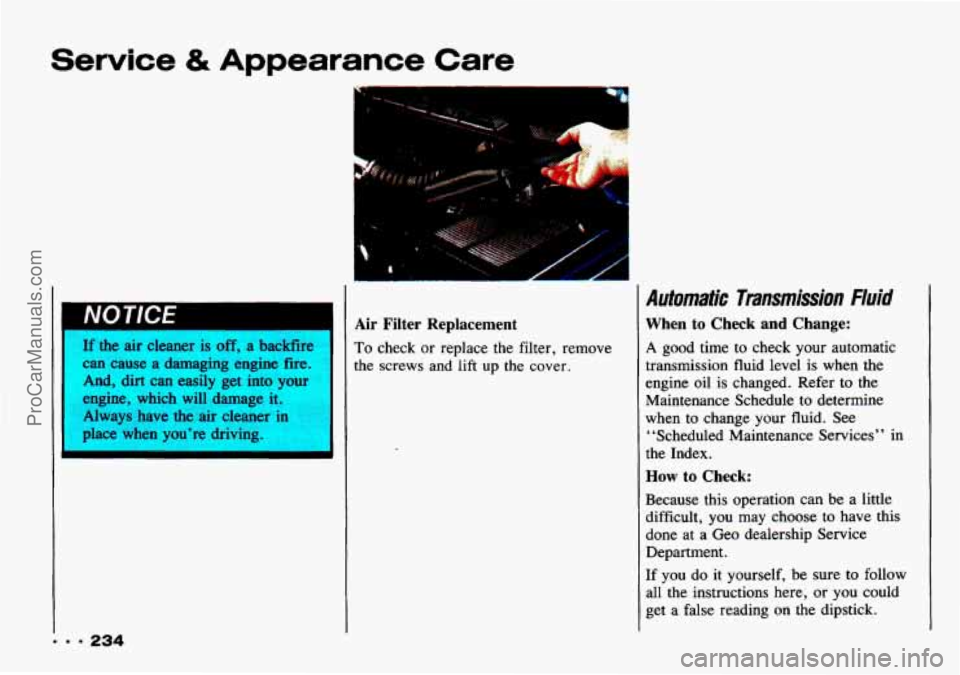
Air Filter Replacement
To check or replace the filter, remove
the screws and lift up the cover.
Automatic Tmnsmissian Fluid
When to Check and Change:
A good time to check your automatic
transmission
fluid level is when the
engine oil is changed. Refer to the
Maintenance Schedule to determine
when to change your fluid. See
"Scheduled Maintenance Services"
in
the Index.
How to Check:
Because this operation can be a little
difficult, you may choose to have this
done at a Geo dealership Service
Department.
If you do
it yourself, be sure to follow
all the instructions here, or you could
get a false reading
on the dipstick.
ProCarManuals.com
Page 238 of 339

Service & Appearance Care
... 236
Let the engine run at idle for three
minutes or more.
To check the fluid hot or cold:
Park your vehicle on a level place.
Place the shift lever in P (Park) with
the parking brake applied.
With your foot on the brake pedal,
move the shift lever through each gear
range, pausing for about three seconds
in each range. Then, position the shift
lever in
P (Park).
Then, without shutting off the engine,
follow these steps:
1. Pull out the dipstick and wipe it with
2. Push it back in all the way, wait
a clean rag
or paper towel.
three seconds and then pull
it back
out again.
3. Check both sides of the dipstick, and
read the lower level. The fluid level
must be
in the COLD (A) area for a
cold check or in the
HOT (B) or
cross-hatched area for a hot check.
4. If the fluid level is where it should
be, push the dipstick back
in all the
way.
How to Add Fluid:
Refer to the Maintenance Schedule to
determine what kind of transmission fluid to use.
See “Recommended Fluids
and Lubricants”
in the Index.
If the fluid level is low, add only
enough of the proper fluid to bring the
level up into the COLD area for a cold
check or the
HOT area for a hot check.
It doesn’t take much fluid, generally less
than a pint. Don’t overfill. We
recommend you use only fluid labeled
DEXRON@-11, because fluids with that
label are made especially for our
automatic transmission. Damage caused
by fluid other than DEXRON@-I1 is not
covered by your new vehicle warranty.
ProCarManuals.com