automatic transmission CHEVROLET TRACKER 1993 Owners Manual
[x] Cancel search | Manufacturer: CHEVROLET, Model Year: 1993, Model line: TRACKER, Model: CHEVROLET TRACKER 1993Pages: 339, PDF Size: 15.75 MB
Page 45 of 339
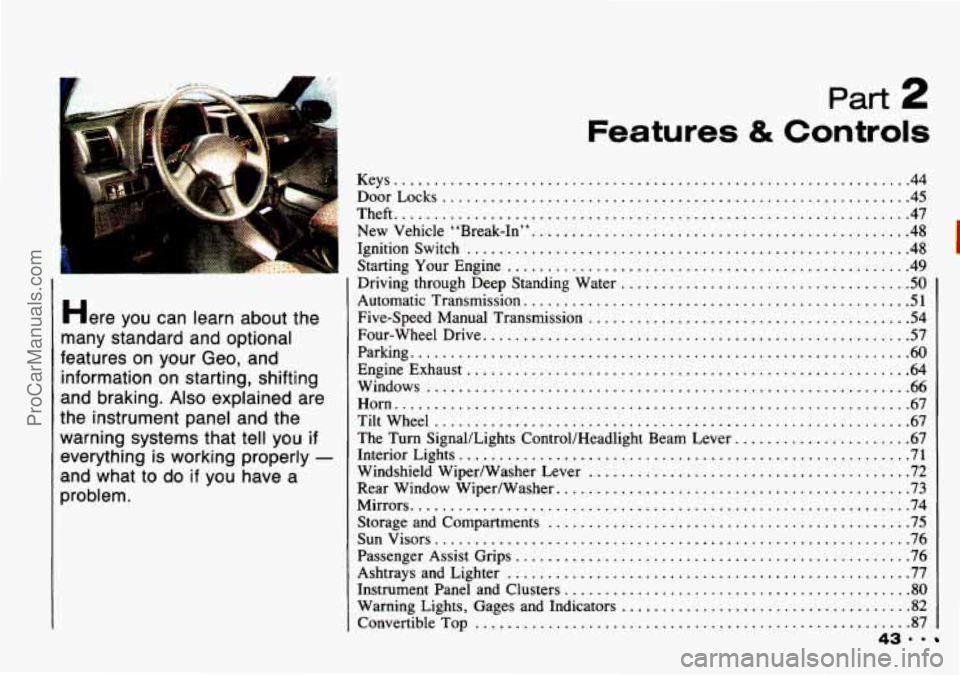
Here you can learn about the
many standard and optional
features on your Geo. and
information on starting. shifting
and braking
. Also explained are
the instrument panel and the
warning systems that tell you
if
everything is working properly -
and what to do if you have a
problem
.
Part 2
Features & Controls
Keys ................................................................ 44
Door Locks
.......................................................... 45
Theft
................................................................ 47
New Vehicle “Break-In”
............................................... 48
Ignitionswitch ....................................................... 48
Starting Your Engine .................................................. 49
Driving through Deep Standing Water
.................................... 50
Five-Speed Manual Transmission ........................................ 54
Parking
.............................................................. 60
EngineExhaust ....................................................... 64
Automatic Transmission
................................................ 51
Four-wheel Drive
..................................................... 57
Windows
............................................................ 66
Horn
................................................................ 67
Tiltwheel ........................................................... 67
The Turn Signal/Lights Control/Headlight Beam Lever
...................... 67
Interior Lights
........................................................ 71
Windshield Wiper/Washer Lever
........................................ 72
Rear Window Wiper/Washer ............................................ 73
Mirrors .............................................................. 74
Storage and Compartments ............................................. 75
SunVisors ........................................................... 76
Passenger Assist Grips
................................................. 76
Ashtrays and Lighter .................................................. 77
Instrument Panel and Clusters
........................................... 80
Warning Lights, Gages and Indicators .................................... 82
ConvertibleTop ...................................................... 87
43.-
ProCarManuals.com
Page 49 of 339
meft
Vehicle theft is big business, especially
in some cities. Although your Geo has a
number of theft-deterrent features, we
know that nothing we put on it can make
it impossible to steal. However, there
are ways you can help. Key in the Ignition: If you walk away
from your vehicle
with the key inside,
it’s
an easy target for joy riders or
professional thieves
- so don’t do it.
When you park your Geo and open the
driver’s door, you’ll hear a chime
reminding
you to remove your key from
the ignition and take it with you. Always
do this. Your steering wheel will be
locked,
and so will your ignition. If you
have an automatic transmission, taking
your key out also locks your
transmission. And remember to lock the
doors.
Parking at Night: Park in a lighted
spot, close all windows and lock your
vehicle. Remember
to keep your
valuables out
of sight. Put them in a
storage area, or take them with you.
47. =
ProCarManuals.com
Page 50 of 339
Features & Controls
New Vehicle
“Break-In ’’
Your modern Geo doesn’t need an
:laborate “break-in.” But it will
perform better in the long
1
1 follow these guideli~
A
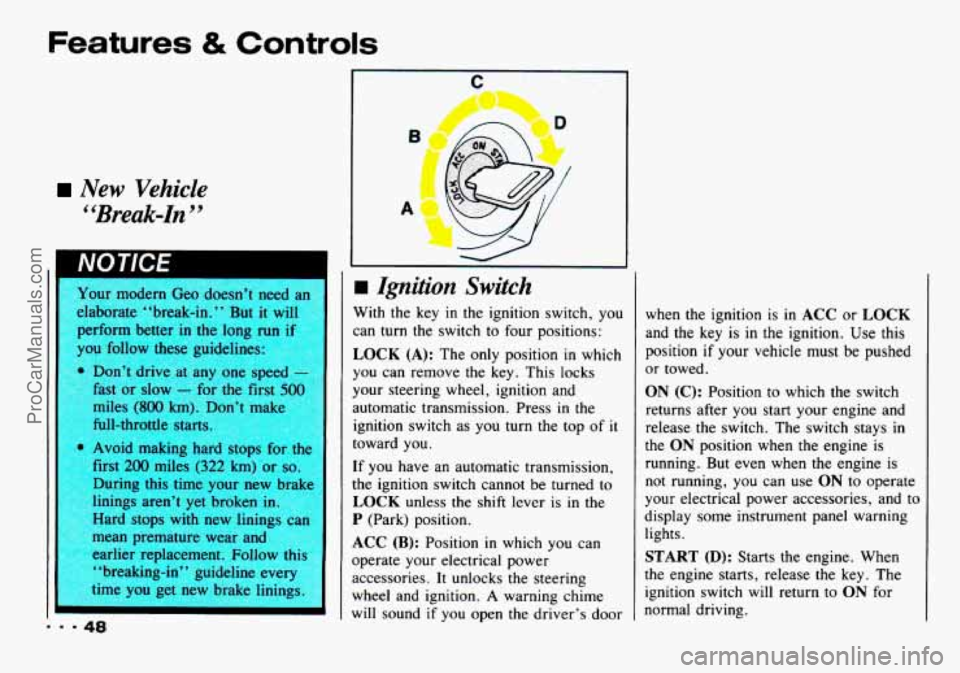
m Ignition Switch
With the key in the ignition switch, you
can turn the switch to four positions:
LOCK (A): The only position in which
you can remove the key. This locks
your steering wheel, ignition and
automatic transmission. Press
in the
ignition switch as you turn the top of it
toward you.
If you have an automatic transmission,
the ignition switch cannot be turned to
LOCK unless the shift lever is in the
P (Park) position.
ACC (B): Position in which you can
operate your electrical power accessories. It unlocks the steering
wheel and ignition.
A warning chime
will sound if you open the driver’s door when the ignition is
in ACC or LOCK
and the key is in the ignition.
Use this
position if your vehicle must be pushed
or towed.
ON (C): Position to which the switch
returns after you start your engine and
release the switch. The switch stays in
the
ON position when the engine is
running. But even when the engine is not running, you can use
ON to operate
your electrical power accessories, and to
display some instrument panel warning
lights.
START (D): Starts the engine. When
the engine starts, release the key. The
ignition switch will return to
ON for
normal driving.
ProCarManuals.com
Page 51 of 339
c
Note that even if the engine is not
running
ACC and ON allow you to
operate your electrical accessories, such
as the radio and ventilation fan.
4 Starting Your Engine
Automatic Transmission: Move your
shift lever to
P (Park) or N (Neutral).
Your engine
won’t start in any other
position
- that’s a safety feature. To
restart when you’re already moving, use
N (Neutral) only.
I Don’t try to shift to P (Park) if
your Geo is moving. If you do,
you could damage the
transmission. Shift to P (Park)
only
when your vehicle is stopped. I
Manual Transmission: Shift your gear
selector
to neutral and hold the clutch
pedal to the floor while starting the
engine. Your vehicle won’t start
if the
clutch pedal is
not all the way down -
that’s a safety feature.
1. Don’t push the accelerator pedal
before starting
your engine. In some
other vehicles you might need to do
this, but because
of your vehicle’s
computer systems, you don’t.
2. Turn your ignition key to START.
When the engine starts, let go of the
key.
49.’.
ProCarManuals.com
Page 53 of 339
r
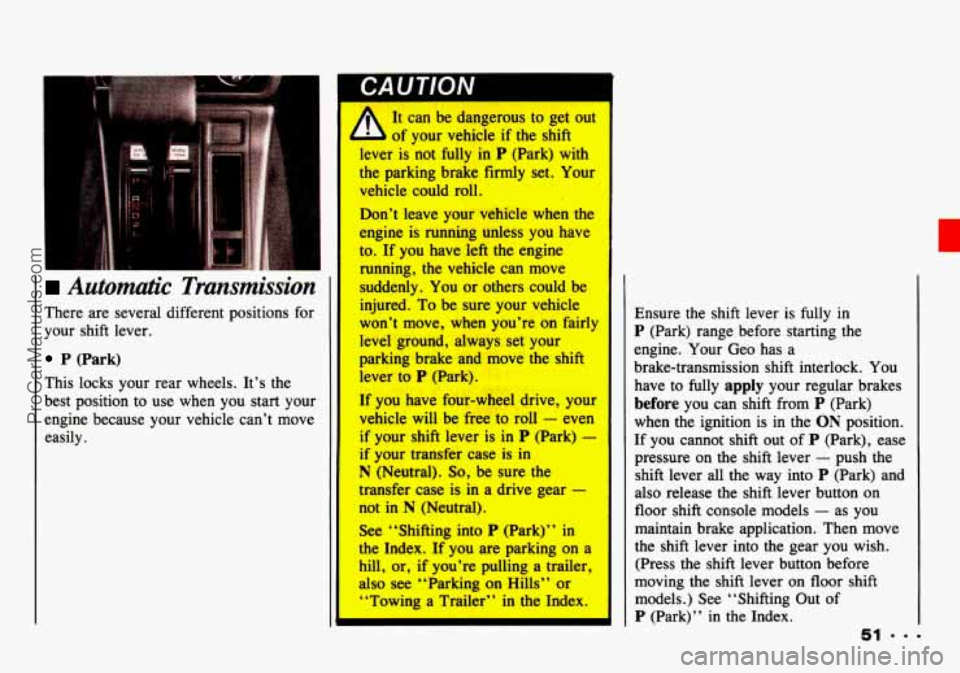
Automatic Transmission
There are several different positions for
your shift lever.
P (Park)
This locks your rear wheels. It’s the
best position to use when you start your
engine because your vehicle can’t move
easily.
GAU I IUN I
It can be dangerous to get out
of your vehicle if the shift
lever is not
fully in P (Park) with
the parking brake firmly set. Your
vehicle could roll.
Don’t leave your vehicle when the
engine is running unless you have
to. If you have ieft the engine
running, the vehicle can move
suddenly. You or others could be
injured. To be sure your vehicle
won’t move, when you’re on fairly
level ground, always set your
parking brake and move the shift
lever
to P (Park).
If you have four-wheel drive, your
vehicle will be free to roll
- even
if your shift lever is in P (Park) - I
if your transfer case is in
N (Neutral). So, be sure the
transfer case is
in a drive gear -
not in N (Neutral).
See “Shifting into
P (Park)’’ in
the Index.
If you are parking on a
hill, or,
if you’re pulling a trailer,
also see “Parking
on Hills” or
“Towing a Trailer’’ in the Index.
I P (Park) range before starti& the
engine. Your Geo has a
brake-transmission shift interlock.
You
have to fully apply your regular brakes
before you can shift from P (Park)
when the ignition is in
the ON position.
If you cannot shift out of P (Park), ease
pressure on the shift lever
- push the
shift lever all the way into
P (Park) and
also release the shift lever button on
floor shift console models
- as you
maintain brake application. Then move
the shift lever into the gear you wish.
(Press the shift lever button before
moving the shift lever on floor shift
models.) See “Shifting Out of
P (Park)’’ in the Index.
51 ..=
ProCarManuals.com
Page 59 of 339
Four-wheel Drive
CAUTION I
It can be dangerous to get out
4 b of your vehicle if the shift
rcyer is not fdly in P (Park)
(automatic transmission) or
R (Reverse) (manual transmission)
with the parking brake firmly set.
If you have four-wheel drive, also
be sure the transfer case is in a
drive gear. Your vehicle can roll.
If you have left the engine
running,
the vehicle can move
suddenly.
You or others could be
injured. To be sure your vehicle
won’t move, follow the step
below. If you are parking on a
hill’, or if you’re pulling a trailer,
see “Parking on Hills” cw
“Towing a Trailer” in the Index.
[f your vehicle has four-wheel drive,
you can send your engine’s driving
power to all four wheels for extra
traction.
To shift out of two-wheel drive
and into four-wheel drive, lock the
free-wheeling hubs and move
the
transfer case shift lever to 4H or 4L
(see the following). You should use 2H
for most normal driving.
Rear wheel anti-lock brakes
do not work
when you shift into four-wheel drive.
Your regular brakes will still work.
When
you shift back into two-wheel
drive, your rear wheel anti-lock brakes
will take over again. Driving
in 4H or 4L positions for
a long time on dry or wet
pavement could shorten
thP 1 nf
your vehicle’s drivetrain.
ProCarManuals.com
Page 64 of 339
Features & Controls
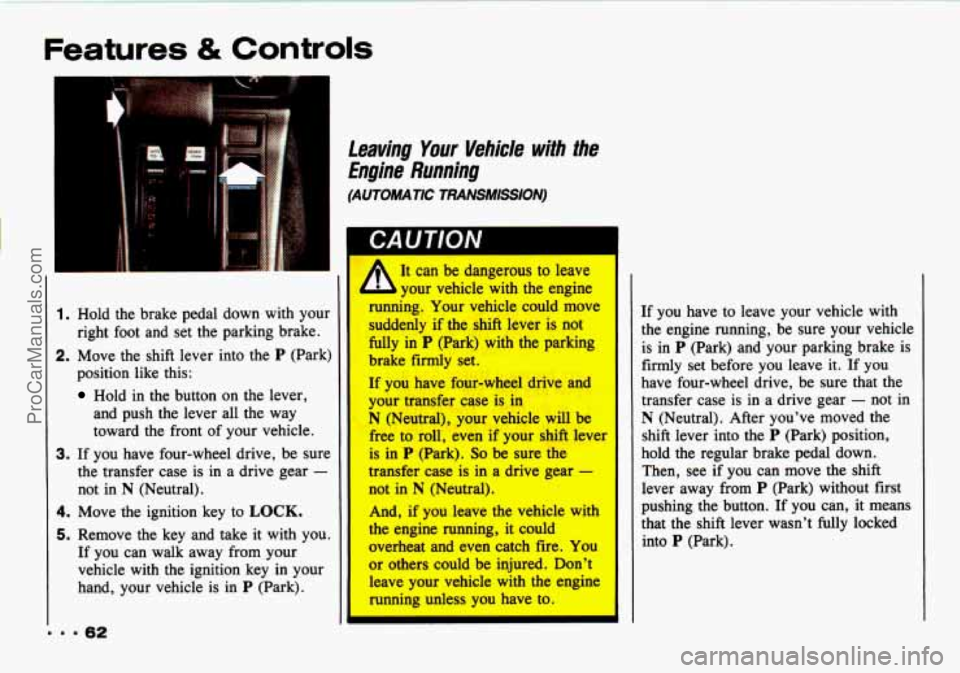
1. Hold the brake pedal down with your
right foot and set the parking brake.
2. Move the shift lever into the P (Park)
position like this:
Hold in the button on the lever,
and push the lever all the way
toward the front of your vehicle.
3. If you have four-wheel drive, be sure
the transfer case is in a drive gear
-
not in N (Neutral).
4. Move the ignition key to LOCK.
5. Remove the key and take it with you.
If you can walk away from your
vehicle with the ignition key in your
hand, your vehicle is
in P (Park).
Leaving Your Vehide with the
Engine Running
(AUTOMATIC TRANSMISSION)
A It can be dangerous to leave
your vehicle with the engine
running. Your vehicle could move
suddenly if the &ifl lever is not
fully in P (Park) with the parking
brake firmly set.
If you have f0.w-wheel drive and
your -fer we is. in
N (Neutral), your vehicle will be
free to roll, even if your shift lever
is in P (Park). So be sure the
transfer case is in a drive gear -
not in N (Neutral).
And, if you leave the vehicle with
the
engine running, it could
overheat and even catch fire. You
or others could be injured. Don't
leave your vehicle with the engine
running unless you have to.
If you have to leave your vehicle with
the engine running, be sure your vehicle
is in
P (Park) and your parking brake is
firmly set before you leave
it. If you
have four-wheel drive, be sure that the
transfer case is in a drive gear
- not in
N (Neutral). After you've moved the
shift lever into the
P (Park) position,
hold the regular brake pedal down.
Then, see if you can move the shift
lever away from
P (Park) without first
pushing the button. If you can, it means
that the shift lever wasn't fully locked
into
P (Park).
ProCarManuals.com
Page 65 of 339
Shifling out of P (Park)
(AUTOMATIC TRANSMISSION)
Your Geo has a brake-transmission shift
interlock. You have to fully
apply your
regular brake
before you can shift from
P (Park) when the ignition is in the ON
position. See “Automatic Transmission”
in the Index.
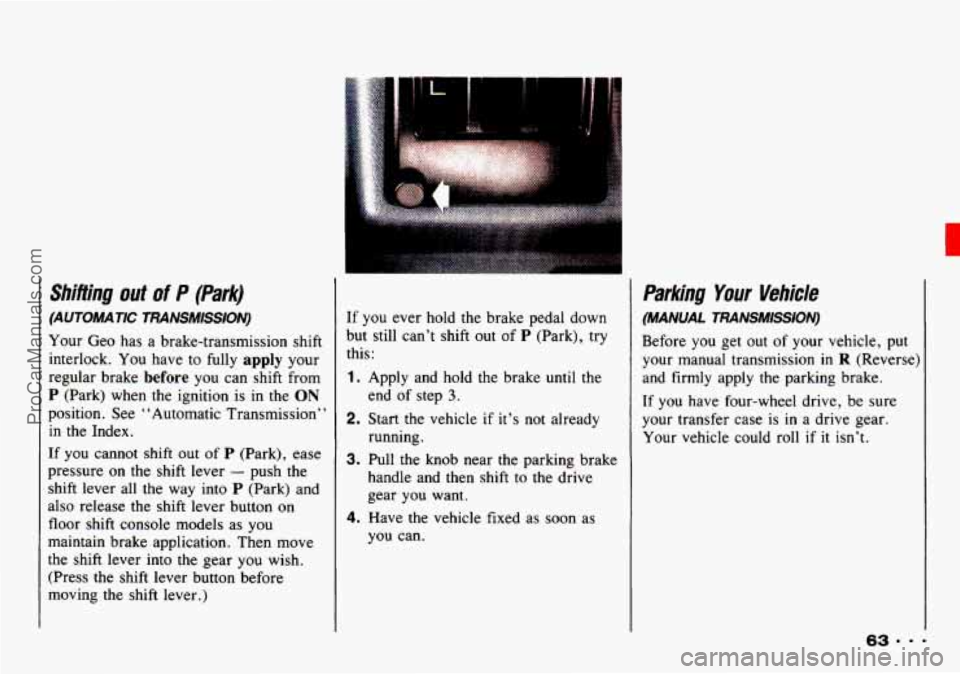
If you cannot shift out of P (Park), ease
pressure on the shift lever
- push the
shift lever all the way into P (Park) and
also release
the shift lever button on
floor shift console models as you
maintain brake application. Then move
the shift lever into the gear you wish.
(Press
the shift lever button before
moving
the shift lever.)
I
If you ever hold the brake pedal down
but still can’t shift out of
P (Park), try
this:
1. Apply and hold the brake until the
end
of step 3.
2. Start the vehicle if it’s not already
running.
3. Pull the knob near the parking brakc
handle and then shift
to the drive
gear you want.
4. Have the vehicle fixed as soon as
you can.
Parking Your Vehicle
(MANUAL TRANSMISSION)
Before you get out of your vehicle, put
your manual transmission in
R (Reverse)
and firmly apply the parking brake.
If you have four-wheel drive, be sure
your transfer case is in a drive gear.
Your vehicle could roll
if it isn’t.
ProCarManuals.com
Page 67 of 339
Running Your Engine While
You’re Parked
(AUTOMATIC TRANSMISSION)
It’s better not to park with the engine
running. But if
you ever have to, here
are some things to
know.
CAUTION
A
Idling the engine with the air system control off could allow dangerous
exhaust into your vehicle (see
the earlier Caution under “Engine
Exhaust’
’).
Also, idling in a closed-in place can let deadly carbon monoxide (CO) into
your vehicle even if
the fan switch is at the highest setting. One place this
can happen is a garage. Exhaust - with CO - can come in easily. NEVER
park in a garage with
the engine running.
Another closed-in place can be a blizzard. (See “Blizzard”
in the Index.)
It can be dangerous to get out of your vehicle if the shift lever is not
fully in
P (Park) with the parking brake firmly set. Your vehicle can roll. Don’t
leave your vehicle when
the engine is running unless you have to. If you’ve
left the engine running, the vehicle can move suddenly. You or others could
be injured.
To be sure your vehicle won’t move, even when you’re on fairly
level ground, always set your parking brake and move the shift lever
to P
(Park).
If you have four-wheel drive and your transfer case
is in N (Neutral), your
vehicle will be free to roll, even
if your shift lever is in P (Park). So, be sure
the transfer case
is in a drive gear - not in N (Neutral). Follow the proper
steps to be sure your vehicle won’t move. See “Shifting into
P (Park)” in
the Index.
If you are parking on a hill, or if you’re pulling a trailer, also see “Parking
on Hills” or “Towing a Trailer” in the Index.
c
ProCarManuals.com
Page 175 of 339
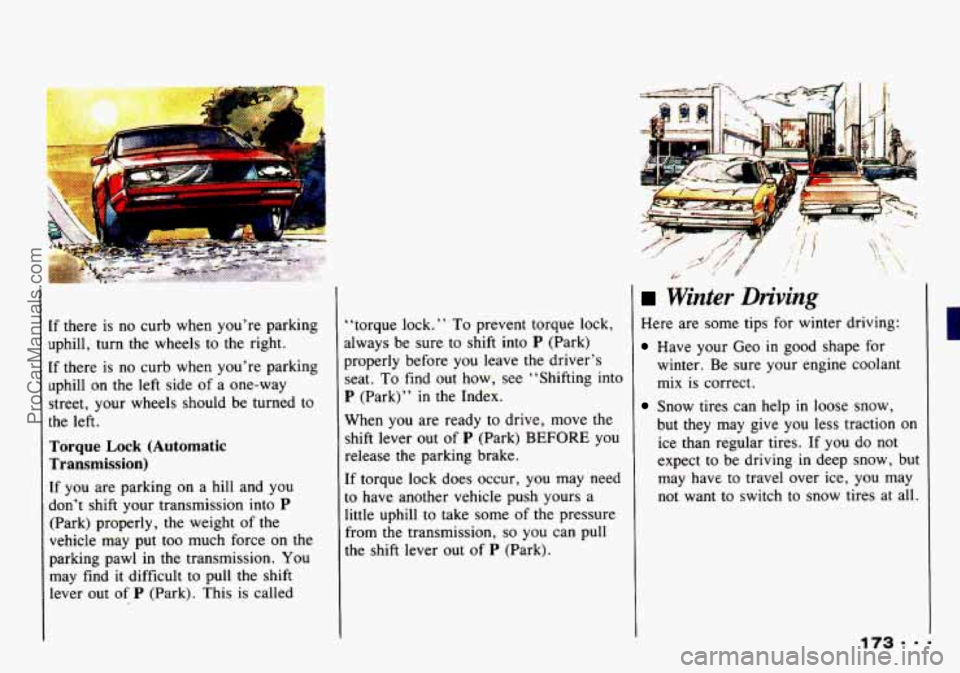
[f there is no curb when you’re parking
uphill, turn the wheels to the right.
[f there is
no curb when you’re parking
uphill on the left side
of a one-way
street, your wheels should be turned
to
the left.
Torque Lock (Automatic
Transmission)
If you are parking on a hill and you
don’t shift your transmission into
P
(Park) properly, the weight of the
vehicle may put too much force on the
parking pawl in the transmission.
You
may find it difficult to pull the shift
lever out of
P (Park). This is called “torque
lock.”
To prevent torque lock,
always be sure to shift into
P (Park)
properly before you leave the driver’s
seat.
To find out how, see ‘‘Shifting into
P (Park)” in the Index.
When you are ready to drive, move the
shift lever out
of P (Park) BEFORE you
release the parking brake.
If torque lock does occur, you may need
to have another vehicle push yours a
little uphill
to take some of the pressure
from the transmission,
so you can pull
the shift lever out
of P (Park).
Winter Driving
Here are some tips for winter driving:
Have your Geo in good shape for
winter. Be sure your engine coolant
mix is correct.
Snow tires can help in loose snow,
but they may give you less traction on
ice than regular tires.
If you do not
expect
to be driving in deep snow, but
may have to travel over ice, you may
not want
to switch to snow tires at all.
I
ProCarManuals.com