four wheel drive CHEVROLET TRACKER 1993 User Guide
[x] Cancel search | Manufacturer: CHEVROLET, Model Year: 1993, Model line: TRACKER, Model: CHEVROLET TRACKER 1993Pages: 339, PDF Size: 15.75 MB
Page 119 of 339
Here YOU’II find information
about driving on different kinds
of roads and in varying weather
conditions
. We’ve also included
many other useful tips on driving
.
Part 4
Your Driving and the Road
Roadsigns .......................................................... 118
DefensiveDriving
.................................................... 122
DrunkenDriving
..................................................... 123
Control of a Vehicle
.................................................. 126
Driving Guidelines
................................................... 140
Off-Road Driving with Your
Geo
Four-Wheel-Drive Vehicle ....................................... 140
Drivingat Night
..................................................... 157
Driving in the Rain
................................................... 160
Driving in Fog. Mist and Haze
......................................... 162
City Driving
........................................................ 164
Freeway Driving
..................................................... 165
Driving a Long Distance
.............................................. 167
Hilland MountainRoads
.............................................. 169
ParkingonHills
..................................................... 171
Winter Driving
...................................................... 173
TowingaTrailer
..................................................... 177
Recreational Towing
.................. ......................... 186
117 . =
ProCarManuals.com
Page 132 of 339
Your Driving and the Road
To Use Anti-Lock:
Use rear wheel anti-lock like regular
brakes.
You may feel the brakes vibrate,
or you may notice some noise outside
your vehicle, but this is normal. Let
anti-lock work for you, but remember:
Your front wheels can still stop rolling.
If that happens, release enough pressure
on the brakes to get the wheels rolling
again
so that you can steer.
With the four-wheel-drive option, you
won't have anti-lock braking when you
shift into four-wheel drive. But you will
have regular braking. When you shift
back into two-wheel drive, you will
have anti-lock again.
- 130
Disc Brake Wear Indicators
Your Geo has front disc and rear drum
brakes.
Disc brake pads have built-in wear
worn and new pads are needed. The
sound may come and go
or be heard all
the time your vehicle is moving (except
when you are pushing on the brake
pedal firmly).
t
The brake wear warning
l sound means that sooner or
1; : your brakes won't work well.
I'hat could lead to an accident.
When you hear the brake wear
cerviced.
indicators
that make
a high-pitched
warning
sound when the brake Pads are I I warning sound, have your vehicle
I
II
IVV I IUL
Continuing to drive with worn-out
brake pads cc
in cost'
brake rep;
'I
ProCarManuals.com
Page 137 of 339
Depending on your speed, this can be
rather violent for an unprepared driver.
This is one of the reasons driving
experts recommend that you use your
safety belts and keep both hands on the
steering wheel.
The fact that such emergency situations are always possible is a good reason to
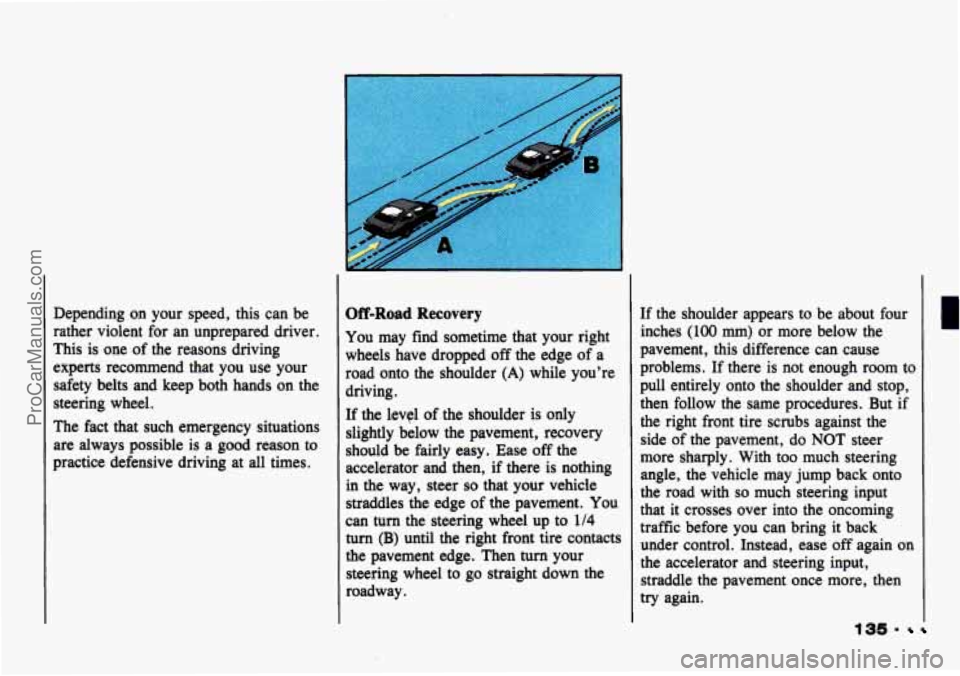
practice defensive driving at all times. Off-Road Recovery
You may find sometime that your right
wheels have dropped off the edge of a
road onto the shoulder
(A) while you’re
driving.
If the level of the shoulder is only
slightly below the pavement, recovery
should be fairly easy. Ease
off the
accelerator and then, if there is nothing
in the way, steer
so that your vehicle
straddles the edge of the pavement. You
can turn the steering wheel up to
1/4
turn (B) until the right front tire contacts
the pavement edge. Then turn your
steering wheel to go straight down the
roadway.
If the shoulder appears to be about four
inches
(100 mm) or more below the
pavement,
this difference can cause
problems. If there is not enough room to
pull entirely onto the shoulder and stop,
then follow the same procedures. But
if
the right front tire scrubs against the
side of the pavement, do NOT steer
more sharply. With too much steering
angle, the vehicle may jump back onto
the road with
so much steering input
that it crosses over into the oncoming
traffic before you can bring it back
under control. Instead, ease
off again on
the accelerator and steering input,
straddle the pavement once more, then
try again.
I
136-
ProCarManuals.com
Page 142 of 339
Your Driving and the Road
Driving Guidelines
... 140
This multipurpose passenger vehicle is
defined as a utility vehicle in Consumer
Information Regulations issued by the
National Highway Traffic Safety
Administration (NHTSA) of the United
States Department of Transportation.
Utility vehicles have higher ground
clearance and a narrower track to make
them capable of performing in a wide
variety of off-road applications. Specific
design characteristics give them a higher
center of gravity than ordinary cars. An
advantage
of the higher ground
clearance
is a better view of the road
allowing you to anticipate problems. They
are not designed for cornering at
the same speeds as conventional
two-wheel drive vehicles any more than
low-slung sports cars are designed to
perform satisfactorily under off-road
conditions. If at all possible, avoid sharp
turns or abrupt maneuvers. As with
other vehicles of this type, failure to
operate this vehicle correctly may result
in
loss of control or vehicle rollover.
1 Off-Road Driving with
Your Geo Four-Wheel-
Drive Vehicle
This off-road guide is for vehicles that
have four-wheel drive.
Also, see “Anti-Lock Brakes” in the
Index.
If your vehicle doesn’t have four-wheel
drive, you shouldn’t drive off-road
unless you’re on a level, solid surface.
Off-road driving can be great
fun. But it
does have some definite hazards. The
greatest of these is the terrain itself.
“Off-roading” means you’ve left the
great North American road system
behind. Traffic lanes aren’t marked.
Curves aren’t banked. There are no road
ProCarManuals.com
Page 143 of 339
signs. Surfaces can be slippery, rough,
uphill or downhill. In short, you’ve
gone right back to nature.
Off-road driving involves some new
skills. And that’s why
it’s very
important that you read this guide.
You’ll find many driving tips and
suggestions. These will help make your
off-road driving safer and more
enjoyable.
Before You Go Off-Roading
There are some things to do before you
go out. For example, be sure to have all
necessary maintenance and service work
done. Be sure
to read all the information
about your four-wheel drive vehicle in
this manual.
Is there enough fuel? Is the spare
tire fully inflated? Are the fluid
levels up where they should be? What
are the local laws that apply to
off-roading where you’ll be driving? If
you don’t
know, you should check with
law enforcement people in the area. Wil
you be on someone’s private land?
If so
be sure to get the necessary permission.
Loading Your Vehicle for Off-Road
Driving
There are some important things to
remember about how to load your
vehicle.
The heaviest things should be on the
load floor and forward of your rear
axle. Put heavier items as far forward
as you can.
Be sure the load is secured properly,
so driving on the off-road terrain
doesn’t
toss things around.
ProCarManuals.com
Page 186 of 339
Your Driving and the Road
they are not. It’s important to check
occasionally to be sure the trailer bulbs
are still working.
Driving on Grades
Reduce speed and shift to a lower gear
before you start down a long or steep
downgrade. If you don’t shift down, you
might have to use your brakes
so much
that they would get hot and no longer
work well.
On a long uphill grade, shift down and
reduce your speed
to around 45 mph
(70 km/h) to reduce the possibility of
engine and transmission overheating.
If your trailer weighs more than 1,000
pounds
(450 kg), and you have a manual
transmission with fifth gear, it’s better
not to use fifth gear. Just drive
in fourth
gear (or, as you need to, a lower gear).
Parking on Hills
You really should not park your vehicle,
with a trailer attached, on a hill. If
something goes wrong, your rig could
start to move. People can be injured,
and both your vehicle and the trailer can
be damaged.
But
if you ever have to park your rig on
a hill, here’s how to do
it:
1. Apply your regular brakes, but don’t shift into
P (Park)
yet, or into gear
for a manual transmission.
the trailer wheels.
2. Have someone place chocks under
3. When the wheel chocks are in place,
release the regular brakes until the
chocks absorb the load.
apply your parking brake, and then
shift
to P (Park), or R (Reverse) for
a manual transmission.
vehicle, be sure the transfer case is
in a drive gear - not in N (Neutral).
4. Reapply the regular brakes. Then
5. If you have a four-wheel-drive
... 184
ProCarManuals.com
Page 187 of 339
J
It be dangerous tu get out
of your vehicle if the shift lever
is not fully in P (Park) with the
parking brake firmly set.
If you have left the engine running,
the veficle can
move suddenly. You
or others could be injured. To be
sure your vehicle won’t move, when
you’re
on fairly level ground, use
the steps that follow.
If you have four-wheel drive, and
your transfer
case is in N (NeutraI) ,
your vehicle will be free to roll,
even
if your shift lever is in
P (Park). So, be sure the transfer
case is in a drive gear - not in
N (Neutral).
If you are parking on a hill, or if
you’re pulling a trailer; also see
“Parking On Hills” in the Index.
6. Release the regular brakes.
When You Are Ready to Leave after
Parking on a
Hill
1. Apply your regular brakes and hold
the pedal down while you:
Start your engine;
Shift into a gear; and
Release the parking brake.
2. Let up on the brake pedal.
3. Drive slowly until the trailer is clear
4. Stop and have someone pick up and
of the chocks.
store
the chocks.
Maintenance When Trailer Towing
Your vehicle will need service more
often when you’re pulling a trailer.
See
the Maintenance Schedule for more on
this. Things that are especially important
in trailer operation are automatic
transmission fluid (don’t overfill),
engine oil, axle lubricant, belts, cooling
system, and brake adjustment. Each
of
these is covered in this manual, and the
Index will help you find them quickly.
If
you’re trailering, it’s a good idea to
review these sections before you start
your trip.
Check periodically
to see that all hitch
nuts and bolts are tight.
185 9 =
ProCarManuals.com
Page 188 of 339
Your Driving and the Road
Recreational Towing
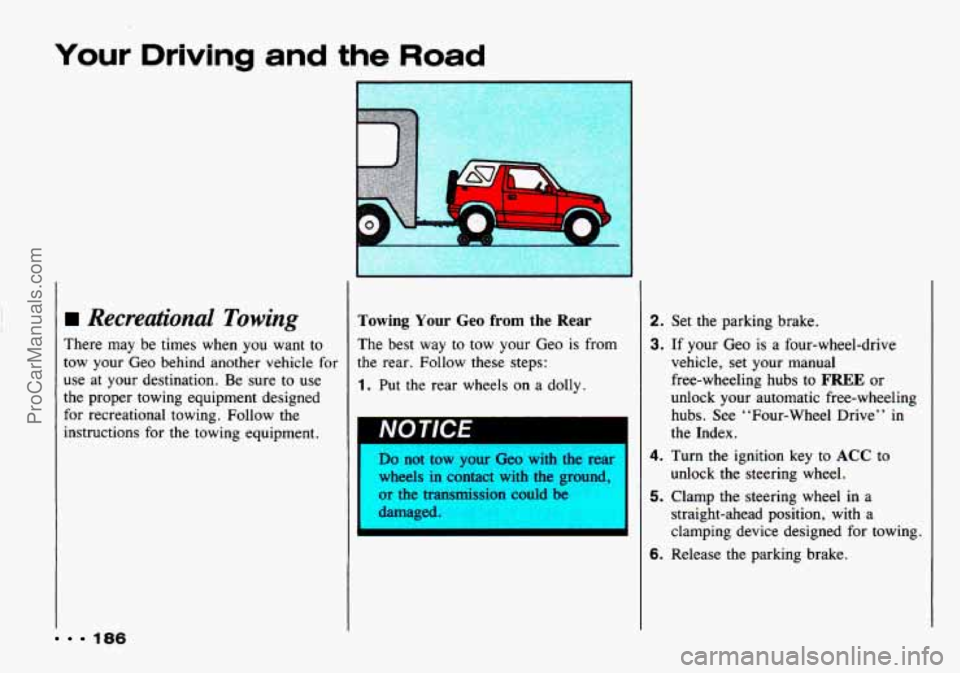
There may be times when you want to
tow your Geo behind another vehicle for
use at your destination. Be sure to use
the proper towing equipment designed
for recreational towing. Follow
the
instructions for the towing equipment.
186
Towing Your Geo from the Rear
The best way to tow your Geo is from
the rear. Follow these steps:
1 . Put the rear wheels on a dolly.
NOTlCE
Do not tow your Geo with the re--
wheels in contact with the grounL,
or
the transmission could be
damaged.
2. Set the parking brake.
3. If your Geo is a four-wheel-drive
vehicle, set your manual
free-wheeling hubs to
FREE or
unlock your automatic free-wheeling
hubs. See “Four-Wheel Drive’’
in
the Index.
4. Turn the ignition key to ACC to
unlock the steering wheel.
5. Clamp the steering wheel in a
straight-ahead position,
with a
clamping device designed for towing.
6. Release the parking brake.
ProCarManuals.com
Page 189 of 339
Make sure that the towing speed
dues not exceed 55 mph
(90 km/h), or your Geo could be
badly damaged.
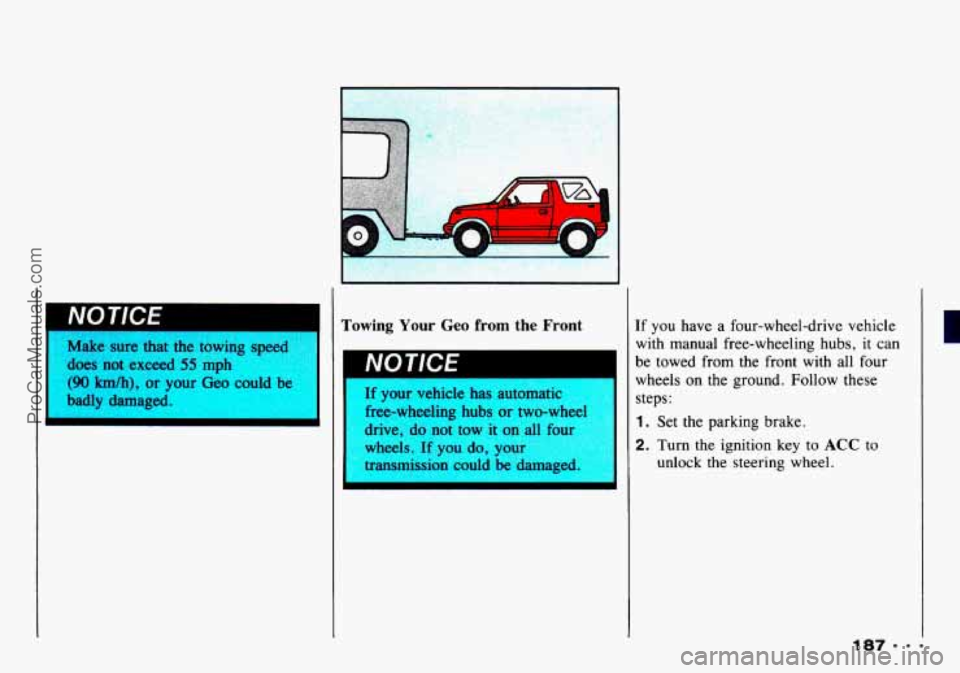
Towing Your Geo from the Front
If your vehicle has automatic
I free-wheeling hubs or two-whet
drive, do not tow it
on all fa
I wheels. If you do, you transmission could be damaged.
I
If you have a four-wheel-drive vehicle
with manual free-wheeling hubs, it can
be towed from the front with all four
wheels on the ground. Follow these
steps:
1. Set the parking brake.
2. Turn the ignition key to ACC to
unlock the steering wheel.
ProCarManuals.com
Page 190 of 339
Your Driving and the Road
= - 9 188
3. Shift your automatic transmission
into
P (Park), or your manual
transmission into
2 (Second).
4. Shift the transfer case to N (Neutral).
5. Set the hubs to FREE. See
“Four-Wheel Drive” in the Index.
6. Release the parking brake. Stop towing every
200 miles (300 km)
and
start the engine. Leave the transfer
case shift lever in
N (Neutral). Shift
your automatic transmission
to
D (Drive); leave a manual transmission
in
2 (Second) and release the clutch.
Run the engine at medium speed for one
minute to circulate
the oil in the transfer
case. Turn
the ignition key to ACC.
Now, you can continue towing your
Geo
.
NU I Kt
Make sure that the towing speed
does not exceed
50 mph
(80 km/h), or your Geo could
badly damaged.
ProCarManuals.com