oil level CHEVROLET TRACKER 1993 User Guide
[x] Cancel search | Manufacturer: CHEVROLET, Model Year: 1993, Model line: TRACKER, Model: CHEVROLET TRACKER 1993Pages: 339, PDF Size: 15.75 MB
Page 239 of 339
After adding fluid, recheck the fluid
level as described under “How to
Check.
”
obtained, push the dipstick back in all
the way.
When the correct fluid level is
Manual Transmiisioon Fluid
When to Check and Change:
A good time to have it checked is when
the engine oil is changed. Refer to the
Maintenance Schedule to find out
when
to change your transmission fluid. See
‘ ‘Scheduled Maintenance Services’ ’ in
the Index.
How to Check:
Because this operation can be a little
difficult, you may choose to have this
done at a Geo dealership Service
Department.
If you do
it yourself, be sure to follow
all the instructions here, or you could
get
a false reading.
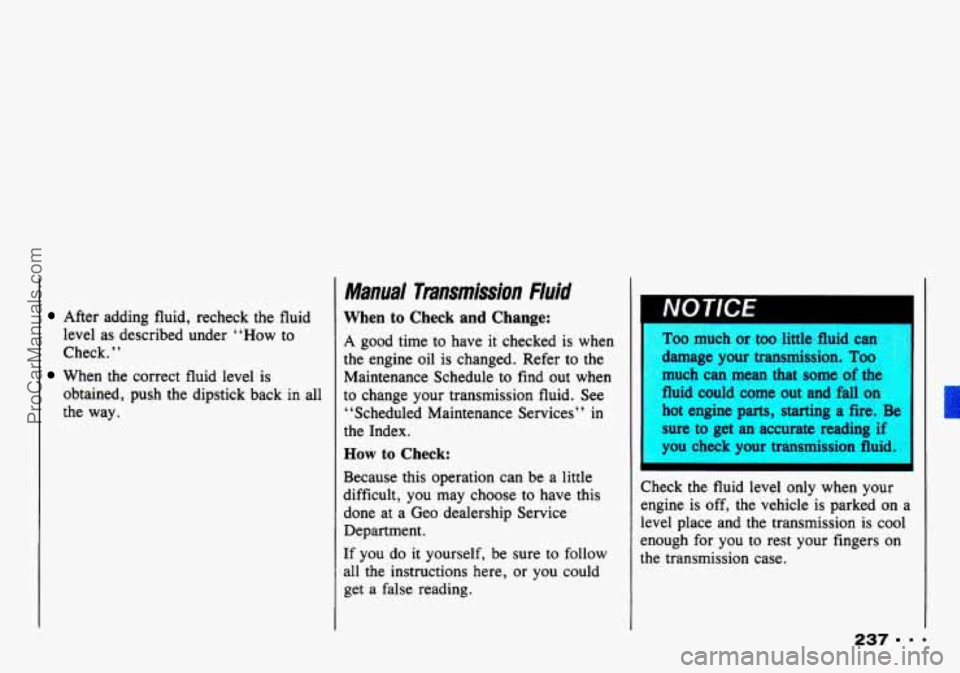
90 much or too little fluid can
...anage your transmission.
Too
much can mean that some of the
fluid could come
out and fall on I
hot engine parts, starting a fire.
I sure to get an accurate reading if
you check your transmission fluid.
I
Check the fluid level only when your
engine is off, the vehicle is parked on a
level place and the transmission
is cool
enough
for you to rest your fingers on
the transmission case.
237 8
ProCarManuals.com
Page 242 of 339
Service & Appearance Care
How to Check Lubricant:
If the level is below the bottom of the
filler plug hole, you’ll need to add some
lubricant.
If the differential is at operating
temperature (warm), add enough
lubricant to raise the level to the bottom
of the filler plug hole.
If the differential
is cold, add enough
lubricant to raise the level to
1/2 inch
(12 mm) below the filler plug hole.
What to Use:
Refer to the Maintenance Schedule to
determine what kind of lubricant to use.
See “Recommended Fluids and
Lubricants” in the Index.
Engine Coolant
The following explains your cooling
system and how to add coolant when it
is low. If you have a problem with
engine overheating, see “Engine
Overheating” in the Index.
The proper coolant for your Geo will:
Give freezing protection down to
Give boiling protection up to 258°F
Protect against rust and corrosion.
Help keep the proper engine
Let the warning lights work as they
-34°F (-37°C).
(125°C).
temperature. should.
What to Use:
Use a mixture of one-half clean water
(preferably distilled) and one-half
antifreeze or approved recycled coolant
that meets “GM Specification 6038M,”
which won’t damage aluminum parts.
Also use GM Engine Coolant
Supplement (sealer) with a complete
coolant change. If you use these, you
don’t need to add anything else.
ProCarManuals.com
Page 243 of 339
r
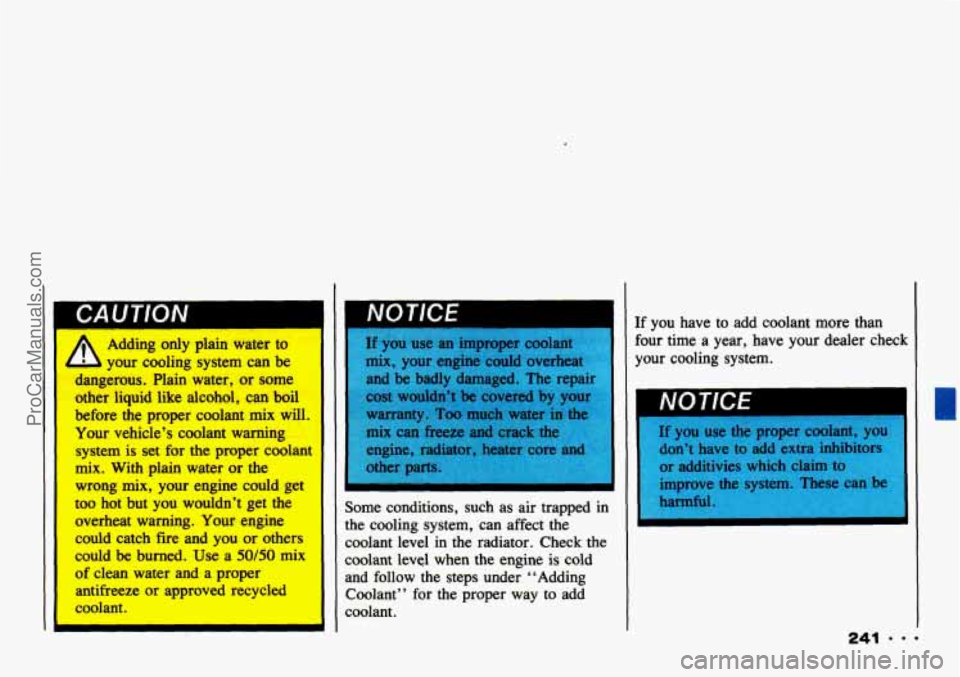
Adding only plain water to
b your cooling system can be
dmgemus. Plaia water, or some
other liquid like alcohol, can boil
before the proper coolant mix will.
Your vehicle’s coolant warning
system is set for the proper coolant
mix, With plain water or the
wrong mix, your engine could get
too hot but you wouldn’t get the
overheat warning. Your engine
could catch fire and you or others
could be burned. Use a 50/50 mix
of clean water and a proper
antifreeve or approved recycled
coolant.
I
Some conditions, such as air trapped in
the cooling system, can affect the
coolant level in the radiator. Check the
coolant level when the engine is cold
and follow the steps under ‘‘Adding Coolant” for
the proper way to add
coolant. If you have to add coolant
more than
four time
a year, have your dealer check
your cooling system.
If
you use the proper coolant, you
don’t have to add extra inhibitors
or additivies which claim to
II
241
ProCarManuals.com
Page 248 of 339
Service & Appearance Care
CA U TlON
R
d
fl
I1
A If you have too much brake
L,,E;ine. The fluid will burn
if the
engine is hot enough.
You or
others could be burned, and your
vehicle could be damaged. Add
brake fluid only when work
is
done on the brake hydraulic
system.
L fluid, it can spill on the
Lefer to
the Maintenance Schedule to
etermine when to check your brake
hid. See ‘‘Periodic Maintenance
Ispections” in the Index.
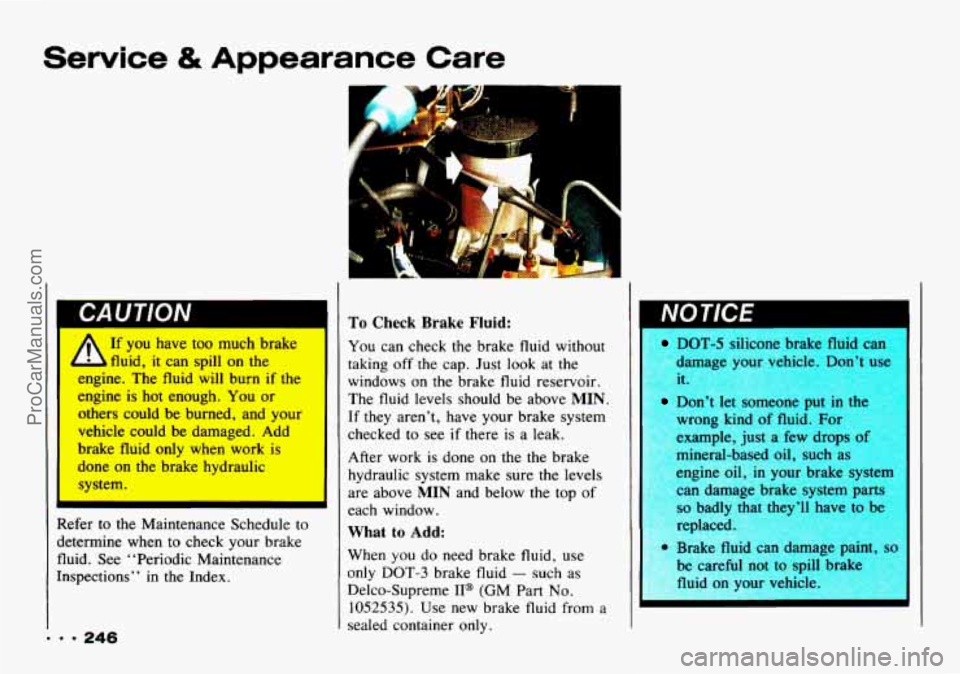
’ To Check Brake Fluid:
1
You can check the brake fluid without
taking
off the cap. Just look at the
windows on the brake fluid reservoir.
The fluid levels should be above
MIN.
If they aren’t, have your brake system
checked to see
if there is a leak.
After work is done
on the the brake
hydraulic system make sure the levels
are above
MIN and below the top of
each window.
What to Add:
When you do need brake fluid, use
only DOT-3 brake fluid
- such as
Delco-Supreme
II@ (GM Part No.
I DOT-5 silicone brake fluid can
damage your llehicle. Don’t use
it.
I D0n.t so1 : put In tf
wrong mnd 01 kd. For
example, just a few drops
mineral-based oil,
such as
engine oil,
in your brake systt
can damage brake system part
so badly that they’ll have to b
replaced.
Brake fluid
I Ige paint,
be careful not to spill
fluid
on your vehicle
1052535). Use new brake fluid from a
sealed container only.
ProCarManuals.com
Page 280 of 339
Service & Appearance Care
Capacities (Approximate)
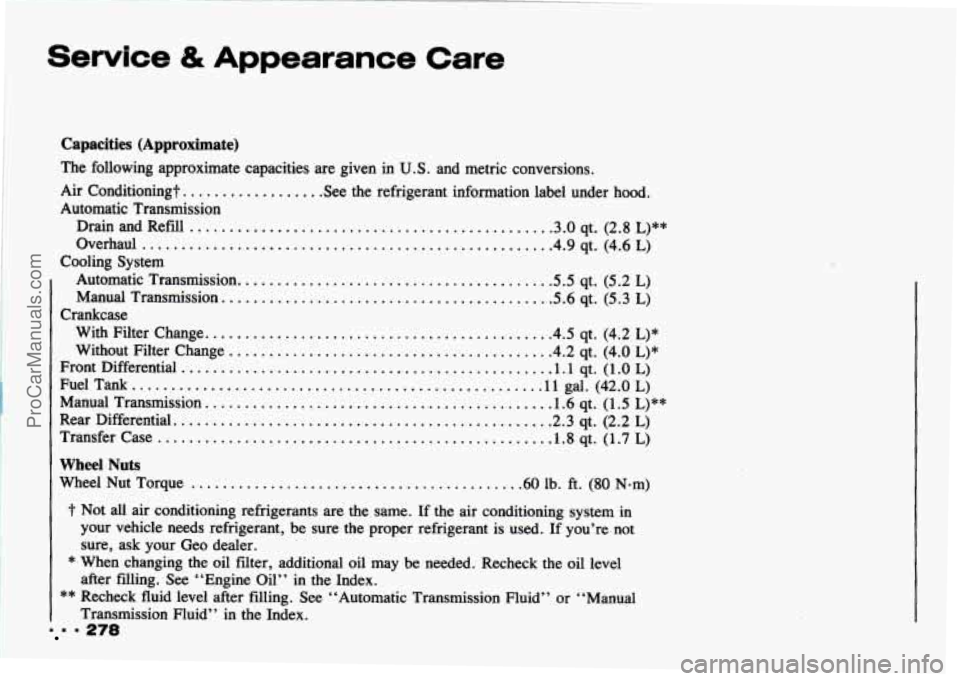
The following approximate capacities are given in U.S. and metric conversions.
Automatic Transmission Air
Conditioning?.
................ .See the refrigerant information label under hood.
.............................................
................................................... Drain and Refill .3.0 qt. (2.8 L)**
Overhaul .4.9 qt. (4.6 L)
Cooling System
Automatic Transmission. ...................................... S.5 qt. (5.2 L)
I Manual Transmission. ........................................ S.6 qt. (5.3 L)
FuelT ank....................................................llgal.(42.0L) .
Crankcase
..........................................
........................................
With Filter Change. .4.5 qt. (4.2 L)*
Without Filter Change .4.2 qt. (4.0 L)*
Front Differential ............................................... 1 1 qt. (1 .O L)
Manual Transmission. .1.6 qt. (1.5 L)**
Rear Differential. .2.3 qt. (2.2 L)
Transfer Case .................................................. 1 .8 qt. (1.7 L)
..........................................
..............................................
Wheel Nuts
Wheel Nut Torque .60 lb. ft. (80 N-m)
? Not all air conditioning refrigerants are the same. If the air conditioning system in
your vehicle needs refrigerant, be sure
the proper refrigerant is used. If you’re not
sure, ask your Geo dealer.
after filling.
See “Engine Oil” in the Index.
Transmission Fluid” in the Index.
.........................................
*.When changing the oil filter, additional oil may be needed. Recheck the oil level
** Recheck fluid level after filling. See “Automatic Transmission Fluid” or “Manual
9 278
ProCarManuals.com
Page 283 of 339
IMPORTANT:
KEEP ENGINE OIL
AT THE PROPER
LEVEL AND CHANGE AS
RECOMMENDED
I
This part covers the maintenance
required for your Geo
. Your vehicle
needs these services to retain its
safety. dependability and emission
control performance
.
Part 7
Maintenance Schedule
Section
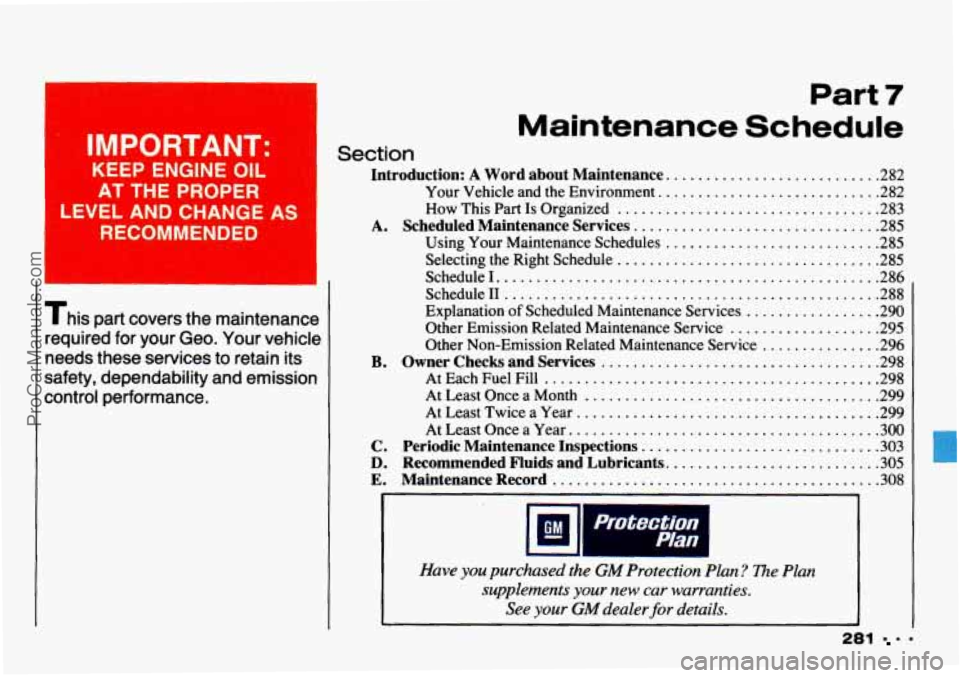
Introduction: A Word about Maintenance ........................... 282
Your Vehicle and the Environment
............................ 282
How This Part Is Organized
................................. 283
Using Your Maintenance Schedules
........................... 285
Selecting the Right Schedule
................................. 285
Schedule1
................................................ 286
Schedule11
............................................... 288
Explanation
of Scheduled Maintenance Services ................. 290
Other Emission Related Maintenance Service
................... 295
Other Non-Emission Related Maintenance Service
............... 296
At Each Fuel Fill 298
At Least Twice a Year ...................................... 299
At Least Once a Year ....................................... 300
A . Scheduled Maintenance Services ............................... 285
B . OwnerChecksandServices ................................... 298
AtLeastOnceaMonth
..................................... 299
C . Periodic Maintenance Inspections .............................. 303
D . Recommended Fluids and Lubricants ........................... 305
E . MaintenanceRecord ......................................... 308
..........................................
u1 Protection I . Plan
281 9 9
L
Have you purchased the GM Protection Plan ? 7he Plan
supplements your new car warranties
.
See your GM dealer for details .
ProCarManuals.com
Page 292 of 339
Maintenance Schedule
Section A: Scheduled Maintenance Services (Cont.)
Dplanatiun of Scheduled Maintenance Services
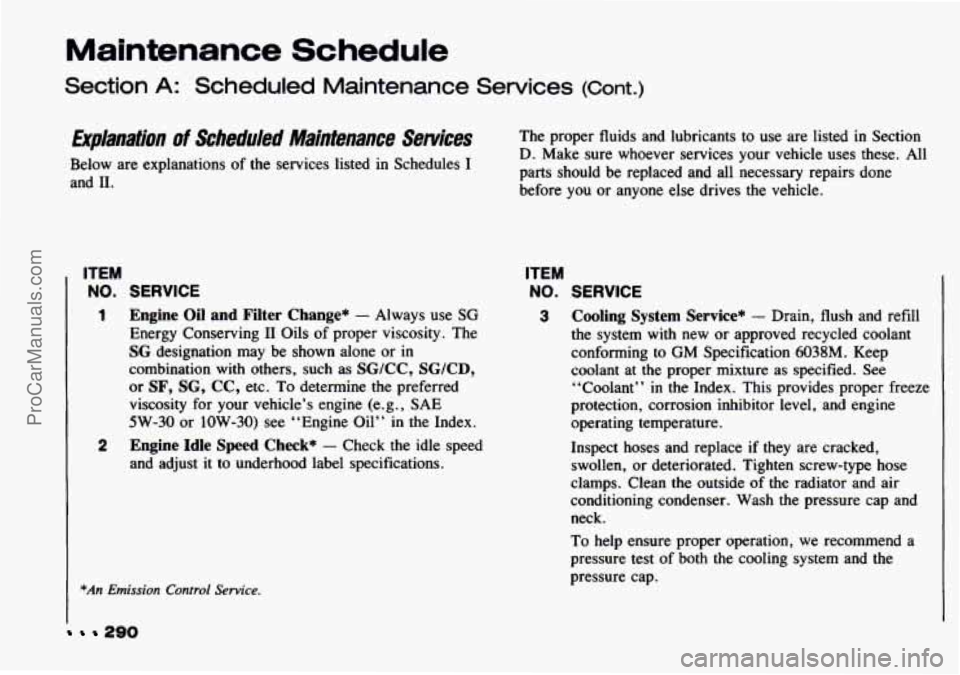
Below are explanations of the services listed in Schedules I
and 11.
290
ITEM
NO.
1
2
SERVICE
Engine Oil and Filter Change* - Always use SG
Energy Conserving I1 Oils of proper viscosity. The
SG designation may be shown alone or in
combination with others, such as SG/CC, SG/CD,
or SF, SG, CC, etc. To determine the preferred
viscosity for your vehicle’s engine (e.g., SAE
5W-30 or 1OW-30) see “Engine Oil’’ in the Index.
Engine Idle Speed Check* - Check the idle speed
and adjust it to underhood label specifications.
*An Emission Control Service.
The proper fluids and lubricants to use are listed in Section
D. Make sure whoever services your vehicle uses these. All
parts should be replaced and all necessary repairs done
before
you or anyone else drives the vehicle.
ITEM
NO. SERVICE
3 Cooling System Service* - Drain, flush and refill
the system with new or approved recycled coolant
conforming to
GM Specification 4038M. Keep
coolant at
the proper mixture as specified. See
“Coolant”
in the Index. This provides proper freeze
protection, corrosion inhibitor level, and engine
operating temperature.
Inspect hoses and replace
if they are cracked,
swollen, or deteriorated. Tighten screw-type hose
clamps. Clean the outside of the radiator and air
conditioning condenser. Wash
the pressure cap and
neck.
To help ensure proper operation, we recommend a
pressure test of both
the cooling system and the
pressure cap.
ProCarManuals.com
Page 293 of 339
ITEM
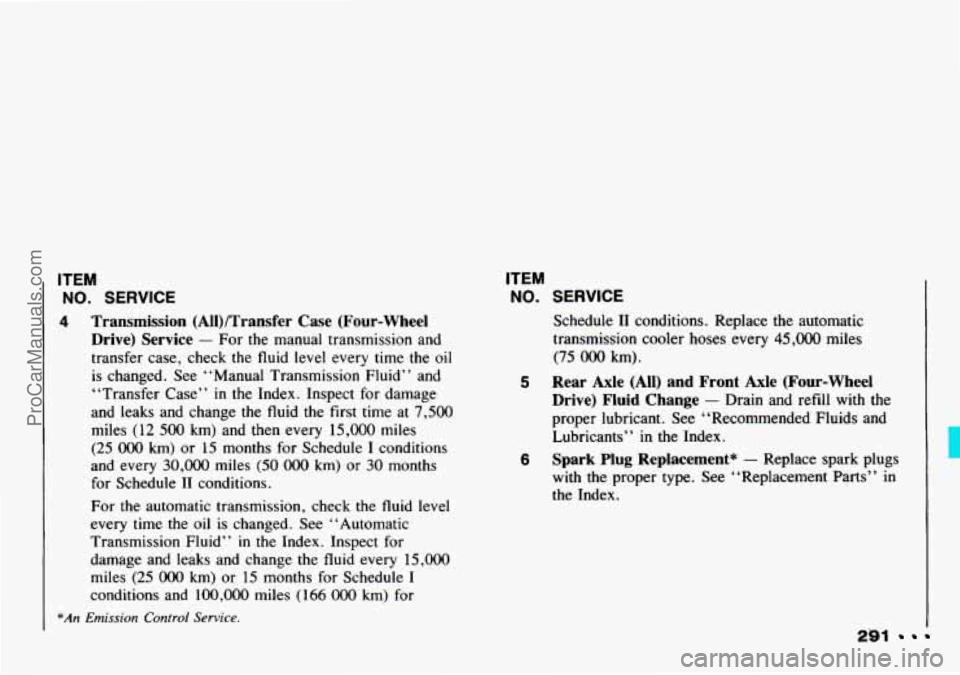
NO. SERVICE
4 Transmission (AlI)/Transfer Case (Four-wheel
Drive) Service
- For the manual transmission and
transfer case, check the fluid level every
time the oil
is changed. See “Manual Transmission Fluid” and
“Transfer Case”
in the Index. Inspect for damage
and leaks and change the fluid the first time at
7,500
miles (12 500 km) and then every 15,000 miles
(25 000 km) or 15 months for Schedule I conditions
and every
30,000 miles (50 OOO km) or 30 months
for Schedule
I1 conditions.
For the automatic transmission, check the fluid level
every time the oil is changed. See “Automatic
Transmission Fluid”
in the Index. Inspect for
damage and leaks and change the
fluid every 15,000
miles (25 OOO km) or 15 months for Schedule I
conditions and
100,OOO miles (166 000 km) for
*An Emission Control Service.
ITEM
NO. SERVICE
Schedule I1 conditions. Replace the automatic
transmission cooler hoses every
45,000 miles
(75 000 km).
5 Rear Axle (All) and Front Axle (Four-wheel
Drive) Fluid Change
- Drain and refill with the
proper lubricant. See “Recommended Fluids and
Lubricants”
in the Index.
6 Spark Plug Replacement* - Replace spark plugs
with the proper type. See “Replacement Parts’’ in
the Index.
291
ProCarManuals.com
Page 296 of 339
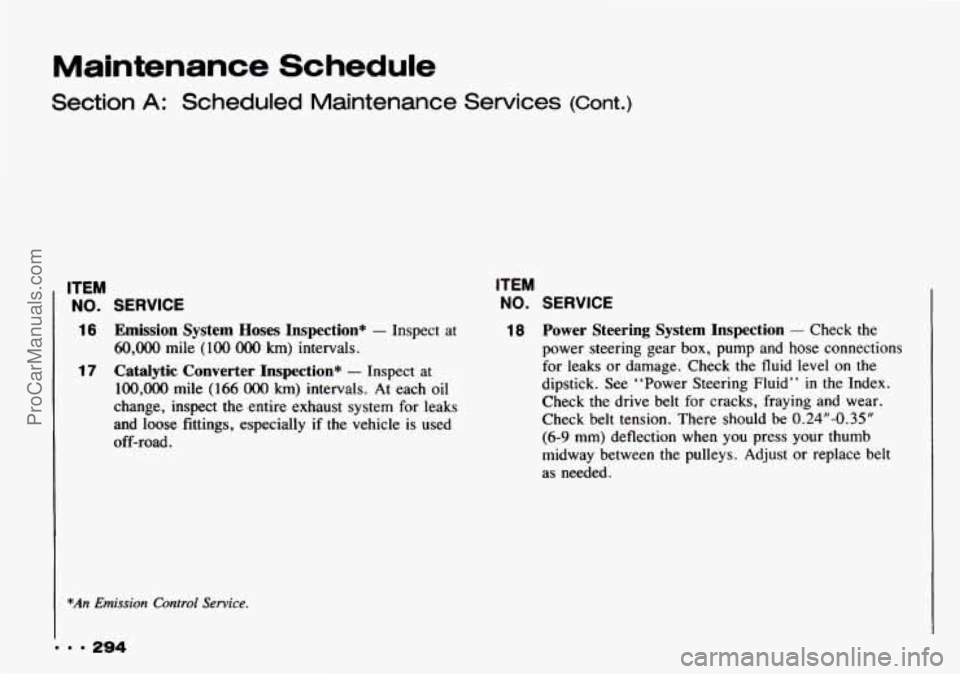
Maintenance Schedule
Section A: Scheduled Maintenance Services (Cont.)
ITEM
NO. SERVICE
16 Emission System Hoses Inspection* - Inspect at
60,OOO mile (lo0 OOO km) intervals.
17 Catalytic Converter Inspection* - Inspect at
100,OOO mile (166 OOO km) intervals. At each oil
change, inspect the entire exhaust system for leaks
and loose fittings, especially if the vehicle is used
off-road.
*An Emission Control Service.
9 9 294
ITEM
NO. SERVICE
18 Power Steering System Inspection - Check the
power steering gear box, pump and hose connections
for leaks
or damage. Check the fluid level on the
dipstick.
See “Power Steering Fluid” in the Index.
Check the drive belt for cracks, fraying and wear.
Check belt tension. There should be
0.24”-0.35”
(6-9 mm) deflection when you press your thumb
midway between the pulleys. Adjust or replace belt
as needed.
ProCarManuals.com
Page 300 of 339
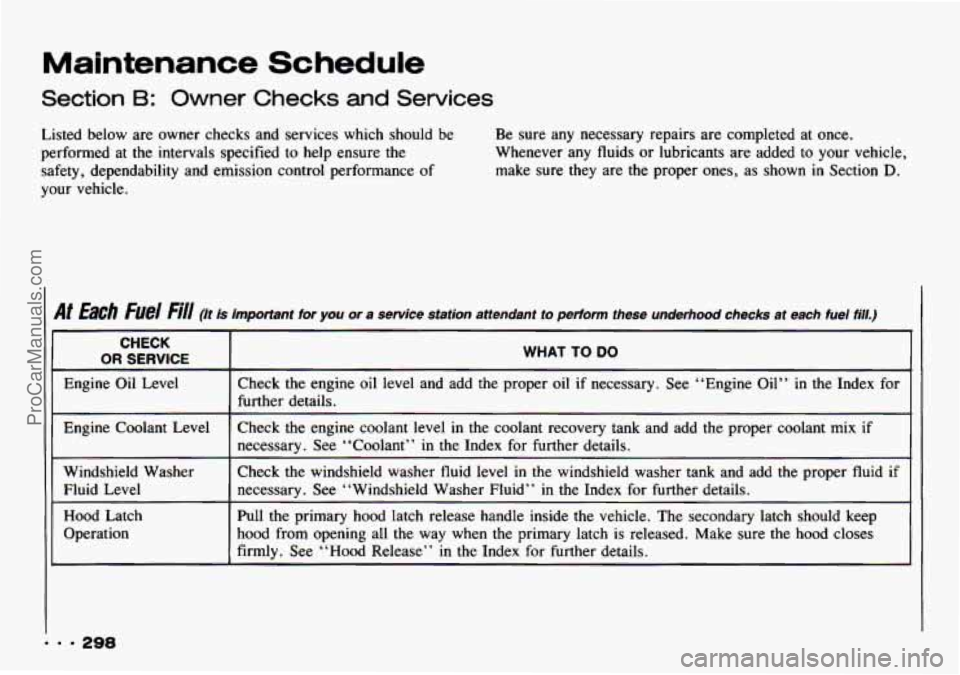
Maintenance Schedule
Section B: Owner Checks and Services
Listed below are owner checks and services which should be
performed at the intervals specified to help ensure the
safety, dependability and emission control performance of
your vehicle. Be
sure any necessary repairs are completed at once.
Whenever any fluids or lubricants are added to your vehicle,
make sure they are the proper ones, as shown
in Section D.
Af Each Fuel fj// (It is important for you or a service station attendant to perform these underhood checks at \
each fuel fill.)
1
CHECK
1 OR SERVICE I WHAT TO DO
I Engine Oil Level Check the engine oil level and add the proper oil if necessary. See “Engine Oil” in the Index for
further details.
I
I Engine Coolant Level Check the engine coolant level in the coolant recovery tank and add the proper coolant mix if
1 necessary. See “Coolant” in the Index for further details.
Windshield Washer
Fluid Level
Hood Latch
Operation Check
the windshield washer fluid level in the windshield washer tank and add the proper fluid if
necessary. See “Windshield Washer Fluid” in the Index for further details.
Pull the primary hood latch release handle inside the vehicle. The secondary latch should keep
hood from opening all the way when the primary latch is released. Make sure the hood closes
firmly. See
“Hood Release” in the Index for further details.
... 298
ProCarManuals.com