fuel CHEVROLET TRACKER 1993 Owner's Manual
[x] Cancel search | Manufacturer: CHEVROLET, Model Year: 1993, Model line: TRACKER, Model: CHEVROLET TRACKER 1993Pages: 339, PDF Size: 15.75 MB
Page 231 of 339
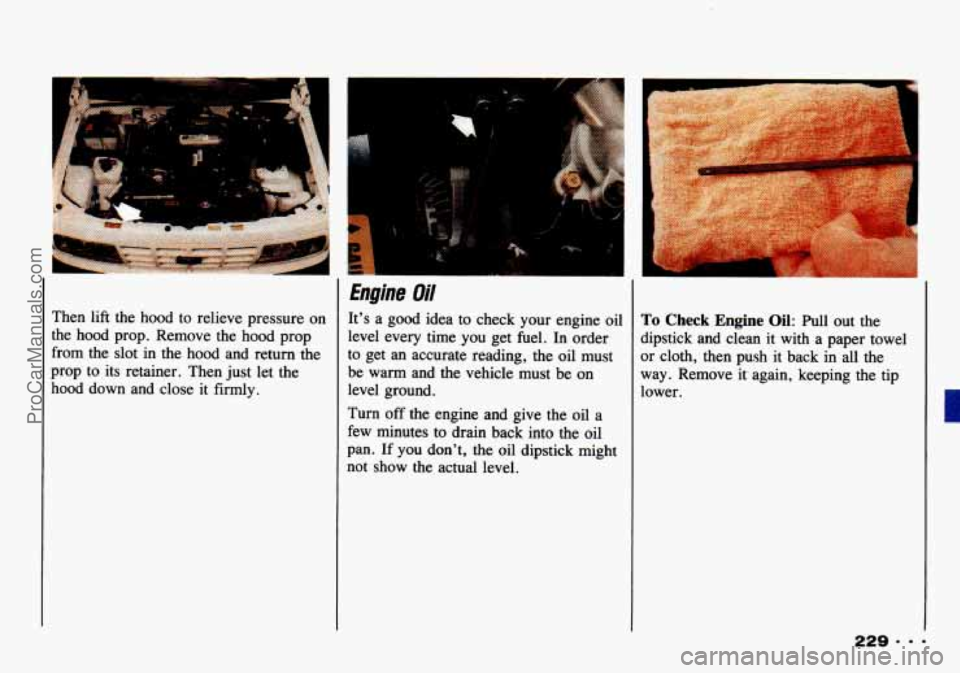
Then lift the hood to relieve pressure on
the hood prop. Remove the hood prop
from the slot in the hood and return the
prop to its retainer. Then just let the
hood down and close it firmly.
Engine Oil
It’s a good idea to check your engine oil
level every time you get fuel.
In order
to get an accurate reading, the oil must
be warm and the vehicle must be on
level ground.
Turn
off the engine and give the oil a
few minutes to drain back into the oil
pan.
If you don’t, the oil dipstick might
not show the actual level.
To Check Engine Oil: Pull out the
dipstick and clean it with a paper towel
or cloth, then push it back
in all the
way. Remove
it again, keeping the tip
lower.
ProCarManuals.com
Page 233 of 339
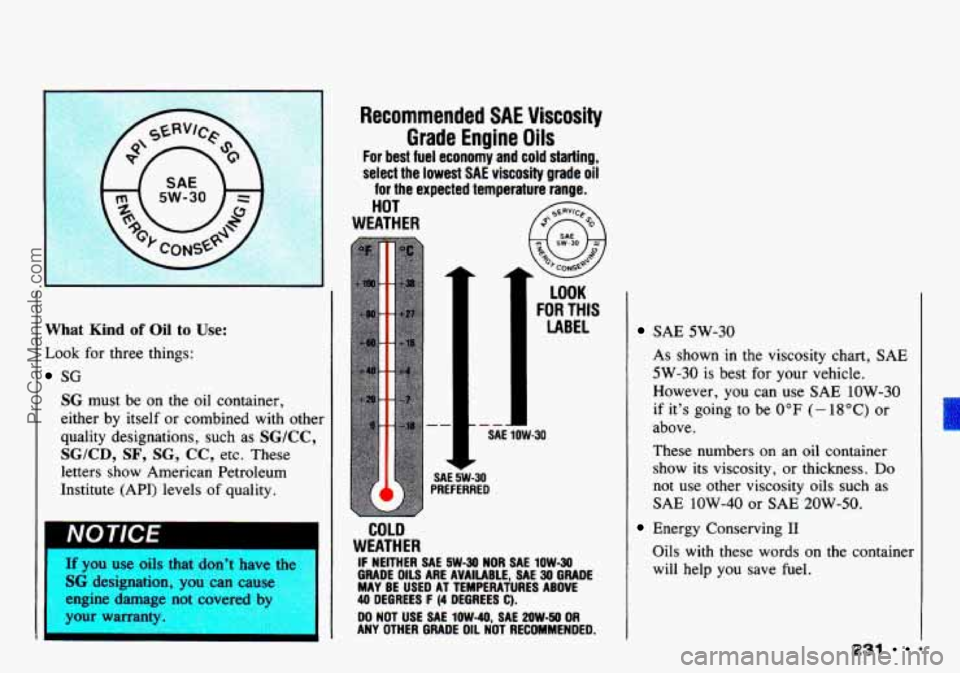
What Kind of Oil to Use:
Look for three things:
SG
SG must be on the oil container,
either by itself or combined with other
quality designations, such
as SGKC,
SG/CD, SF, SG, CC, etc. These
letters show American Petroleum
Institute (API) levels
of quality.
Recommended SAE Viscosity
Grade Engine
Oils
For best fuel economy and cold starting,
select the lowest
SAE viscosity grade oil
for the expected temperature range.
HOT
WEATHER
1-1
@ 1 5W.30
c~coNs.8
LOOK
FOR THIS
LABEL
4$
--
SAE 1OW-30
SAE 5W-30 PREFERRED
COLD
WEATHER
you use oils that don’t have the IF NEITHER SAE 5W-30 NOR SAE 1OW-30
GRADE OILS ARE AVAILABLE, SAE 30 GRADE
MAY BE USED AT TEMPERATURES ABOVE BG designation, you can cause
engine damage not covered
Sy 40 DEGREES F (4 DEOREES C).
your warranty. DO NOT USE SAE 10W-40, SAE 2OW-50 OR 1 ANY OTHER GRADE OIL NOT RECOMMENDED.
SAE 5W-30
As shown in the viscosity chart, SAE
5W-30 is best for your vehicle.
However, you can use SAE
1OW-30
if it’s going to be 0°F (- 18°C) or
above.
These numbers
on an oil container
show its viscosity, or thickness. Do
not use other viscosity oils such as
SAE
1OW-40 or SAE 2OW-50.
Energy Conserving I1
Oils with these words on the container
will help you save fuel.
231
ProCarManuals.com
Page 254 of 339
Service & Appearance Care
Loading Your Vehicle
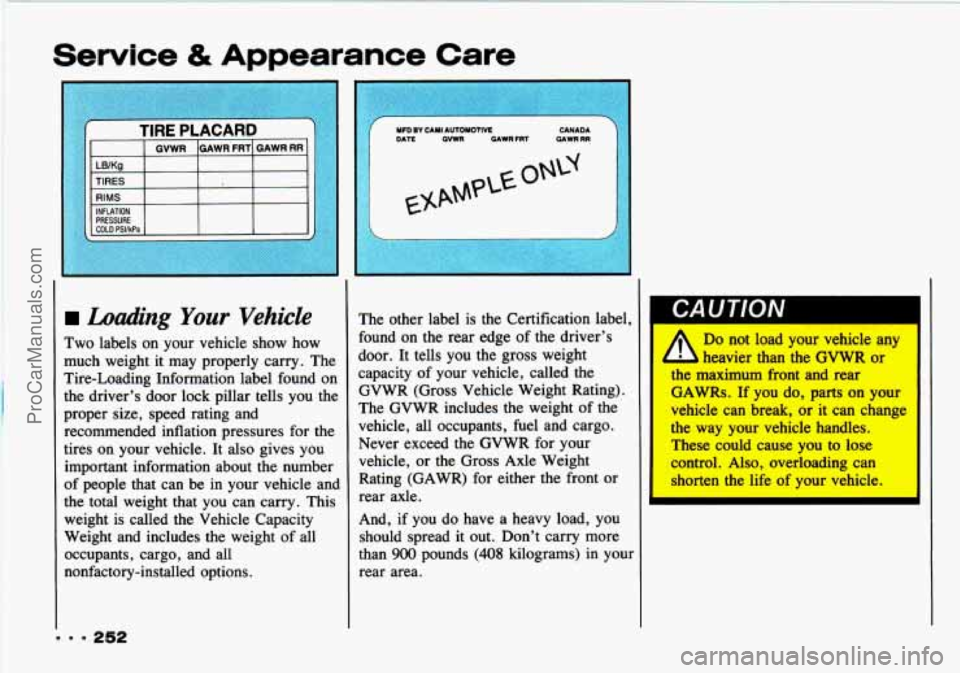
Two labels on your vehicle show how
much weight
it may properly carry. The
Tire-Loading Information label found on
the driver’s door lock pillar tells you the
proper size, speed rating and
recommended inflation pressures for the
tires on your vehicle. It also gives you
important information about the number
of people that can be in your vehicle and
the total weight that you can carry. This
weight is called the Vehicle Capacity
Weight and includes the weight of all
occupants, cargo, and all
nonfactory-installed options. The other
label is the Certification label,
11
found on the rear edge of the driver’s
door. It tells you the gross weight
capacity of your vehicle, called the
GVWR (Gross Vehicle Weight Rating).
The GVWR includes the weight of the
vehicle, all occupants, fuel and cargo.
Never exceed the GVWR for your
vehicle, or the Gross Axle Weight
Rating (GAWR) for either the front or
rear axle.
And, if you do have a heavy load, you
should spread it out. Don’t carry more
than
900 pounds (408 kilograms) in your
rear area.
1
CAUTION
Do not load your vehicle any
heavier than the GVWR or
the
maximum front and rear I
GAWRs. If you do, parts on you]
vehicle can break, or it can chang
the way your vehicle handles.
These could cause you to lose
control. Also, overloading can
shorten the life of your vehicle.
ProCarManuals.com
Page 272 of 339
Service & Appearance Care
Finish Damage
Any stone chips, fractures or deep
scratches in the finish should be repaired
right away. Bare metal will corrode
quickly and may develop into a major
repair expense.
Minor chips and scratches can be
repaired with touch-up materials
available from your dealer or other
service outlets. Larger areas of finish
damage can be corrected in your
dealer’s body and paint shop.
Underbody Maintenance
Chemicals used for ice and snow
removal and dust control can collect on
the underbody. If these are not removed,
accelerated corrosion (rust) can occur on
the underbody parts such as fuel lines,
frame, floor pan, and exhaust system
even though they have corrosion
protection.
At least every spring, flush these
materials from the underbody
with plain
water. Clean any areas where mud and
other debris can collect. Dirt packed in
closed areas of the frame should be
loosened before being flushed. Your
dealer or an underbody vehicle washing
system can do this for you.
Chemical Paint Spotting
Some weather and atmospheric
conditions can create a chemical fallout.
Airborne pollutants can
fall upon and
attack painted surfaces on your vehicle. This damage can take two forms:
blotchy, ringlet-shaped discolorations,
and small irregular dark spots etched
into the paint surface.
Although no defect in the paint job
causes this, Geo will repair, at no
charge to the owner, the surfaces of new
vehicles damaged by this fallout
condition within
12 months or 12,000
miles (20 OOO km) of purchase,
whichever comes first.
ProCarManuals.com
Page 277 of 339
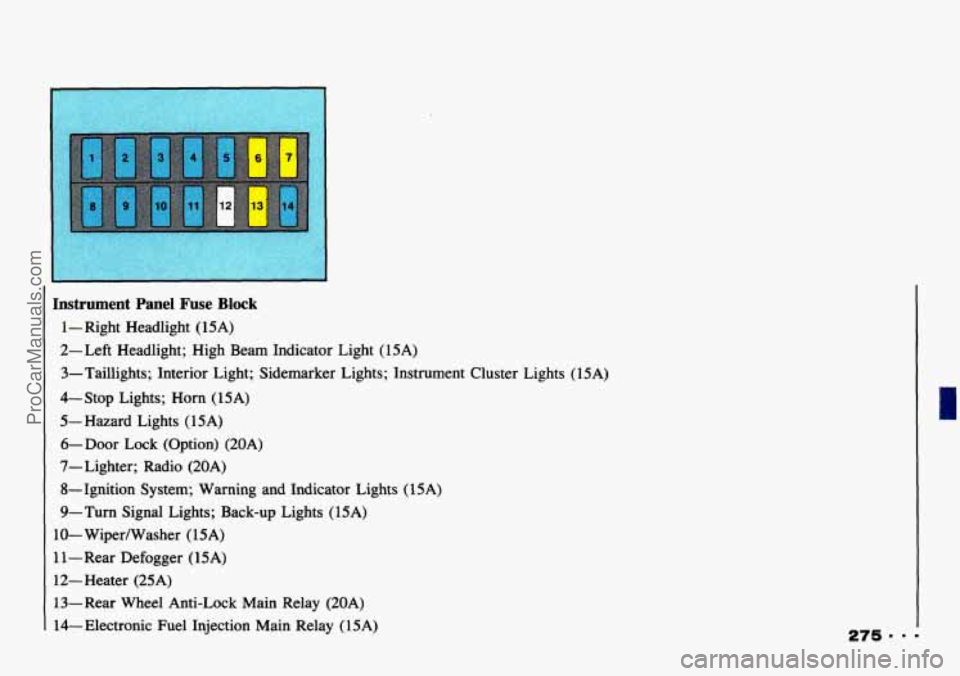
[ Instrument Panel Fuse Block
1 - Right Headlight (15A)
2- Left Headlight; High Beam Indicator Light (1 5A)
3-Taillights; Interior Light; Sidemarker Lights; Instrument Cluster Lights (15A)
4-Stop Lights; Horn (15A)
5- Hazard Lights (15A)
6-Door Lock (Option) (20A)
7- Lighter; Radio (20A)
8-Ignition System; Warning and Indicator Lights (15A)
9-Turn Signal Lights; Back-up Lights (15A)
10- Wiperwasher
(1 SA)
1 1 - Rear Defogger ( 15A)
12-Heater (25A) 13-Rear Wheel Anti-Lock Main Relay (20A)
14-Electronic Fuel Injection Main Relay (15A)
ProCarManuals.com
Page 279 of 339
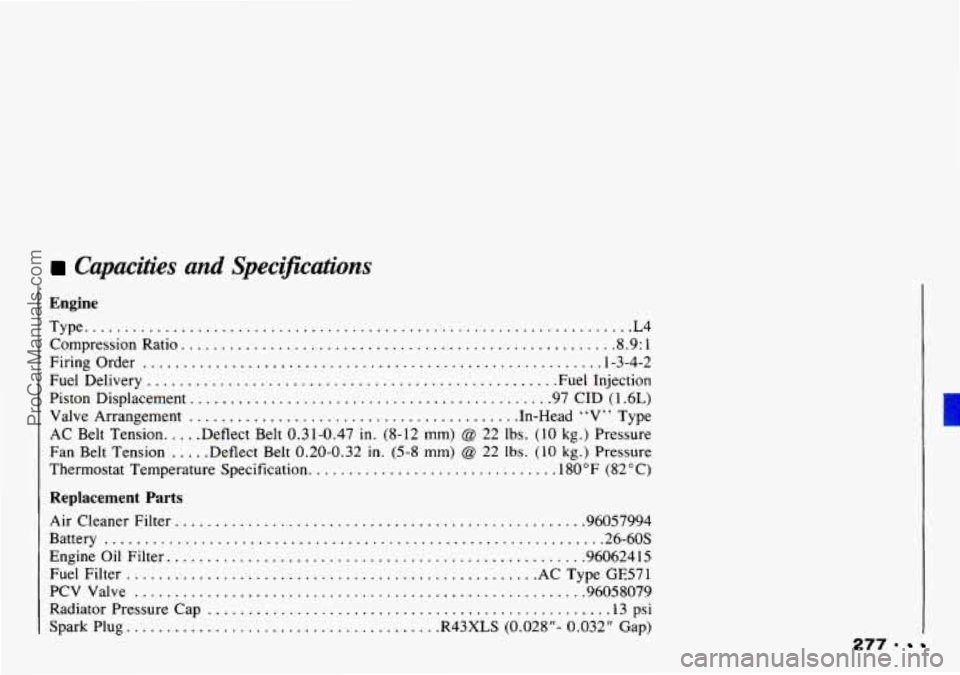
Capacities and Specifictu?ons
Engine
Type ....................................................................L4
Compression Ratio. . . . . . . . . . . . . . . . . . . . . . . . . . . . . . . . . . . . . . . . . . . . . . . . . . . . . .8.9: 1
Firing Order . . . . . . . . . . . . . . . . . . . . . . . . . . . . . . . . . . . . . . . . . . . . . . . . . . . . . . . . . l-3-4-2
Fuel Delivery . . . . . . . . . . . . . . . . . . . . . . . . . . . . . . . . . . . . . . . . . . . . . . . . . . .Fuel Injection
Piston Displacement
. . . . . . . . . . . . . . . . . . . . . . . . . . . . . . . . . . . . . . . . . . . . .97 CID (1.6L)
Valve Arrangement . . . . . . . . . . . , . . . . . . . . . . . , . . . . . . . . . . . . . . . . .In-Head “V” Type
AC Belt Tension.
. . . .Deflect Belt 0.31-0.47 in. (8-12 mm) @ 22 Ibs. (10 kg.) Pressure
Fan Belt Tension
. . . . .Deflect Belt 0.20-0.32 in. (5-8 mm) @ 22 Ibs. (10 kg.) Pressure
Thermostat Temperature Specification.
. . . . . . . . . . . . . . . . . . . . . . . . . . . . . .180”F (82°C)
Replacement Parts
Air Cleaner Filter ................................................... 96057994
Battery
..............................................................26-60s
Engineoil Filter .................................................... 96062415
Fuel Filter
................................................... AC TypeGE571
PCVValve
........................................................96058079
Radiator Pressure Cap . . . . . . . . . , . . . . . . . . . . . . . . . . . . . . . . . . . . . . . . . . . . . . . . . .13 psi
Spark Plug.
. . . . . . . . . . . . . . . . . . . . . . . . . . . . . . . . . . . . . .R43XLS (0.028”- 0.032” Gap)
277 9
ProCarManuals.com
Page 280 of 339
Service & Appearance Care
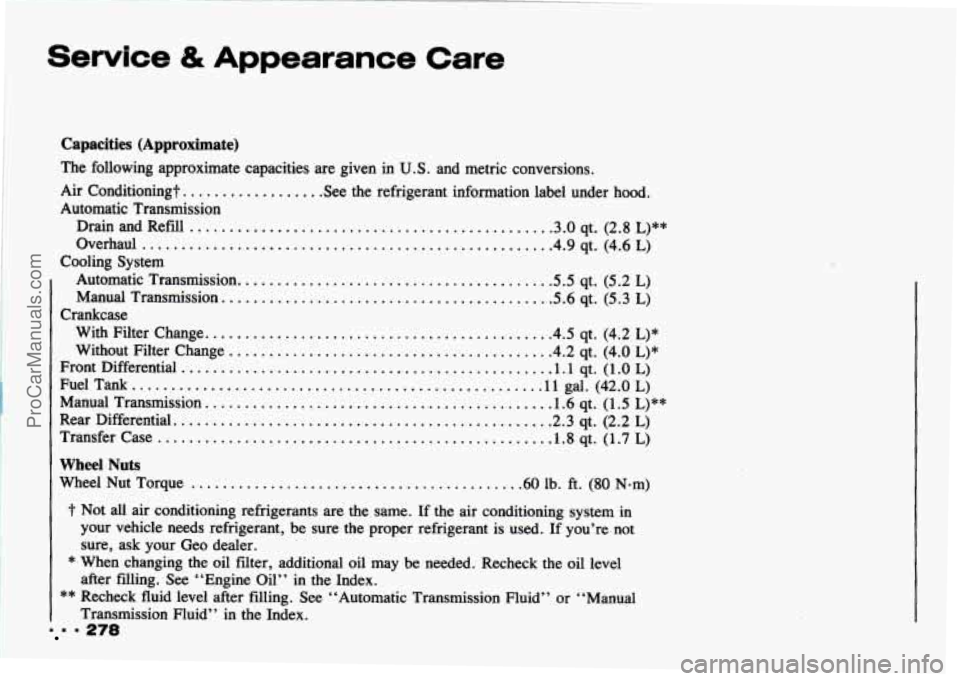
Capacities (Approximate)
The following approximate capacities are given in U.S. and metric conversions.
Automatic Transmission Air
Conditioning?.
................ .See the refrigerant information label under hood.
.............................................
................................................... Drain and Refill .3.0 qt. (2.8 L)**
Overhaul .4.9 qt. (4.6 L)
Cooling System
Automatic Transmission. ...................................... S.5 qt. (5.2 L)
I Manual Transmission. ........................................ S.6 qt. (5.3 L)
FuelT ank....................................................llgal.(42.0L) .
Crankcase
..........................................
........................................
With Filter Change. .4.5 qt. (4.2 L)*
Without Filter Change .4.2 qt. (4.0 L)*
Front Differential ............................................... 1 1 qt. (1 .O L)
Manual Transmission. .1.6 qt. (1.5 L)**
Rear Differential. .2.3 qt. (2.2 L)
Transfer Case .................................................. 1 .8 qt. (1.7 L)
..........................................
..............................................
Wheel Nuts
Wheel Nut Torque .60 lb. ft. (80 N-m)
? Not all air conditioning refrigerants are the same. If the air conditioning system in
your vehicle needs refrigerant, be sure
the proper refrigerant is used. If you’re not
sure, ask your Geo dealer.
after filling.
See “Engine Oil” in the Index.
Transmission Fluid” in the Index.
.........................................
*.When changing the oil filter, additional oil may be needed. Recheck the oil level
** Recheck fluid level after filling. See “Automatic Transmission Fluid” or “Manual
9 278
ProCarManuals.com
Page 283 of 339
IMPORTANT:
KEEP ENGINE OIL
AT THE PROPER
LEVEL AND CHANGE AS
RECOMMENDED
I
This part covers the maintenance
required for your Geo
. Your vehicle
needs these services to retain its
safety. dependability and emission
control performance
.
Part 7
Maintenance Schedule
Section
Introduction: A Word about Maintenance ........................... 282
Your Vehicle and the Environment
............................ 282
How This Part Is Organized
................................. 283
Using Your Maintenance Schedules
........................... 285
Selecting the Right Schedule
................................. 285
Schedule1
................................................ 286
Schedule11
............................................... 288
Explanation
of Scheduled Maintenance Services ................. 290
Other Emission Related Maintenance Service
................... 295
Other Non-Emission Related Maintenance Service
............... 296
At Each Fuel Fill 298
At Least Twice a Year ...................................... 299
At Least Once a Year ....................................... 300
A . Scheduled Maintenance Services ............................... 285
B . OwnerChecksandServices ................................... 298
AtLeastOnceaMonth
..................................... 299
C . Periodic Maintenance Inspections .............................. 303
D . Recommended Fluids and Lubricants ........................... 305
E . MaintenanceRecord ......................................... 308
..........................................
u1 Protection I . Plan
281 9 9
L
Have you purchased the GM Protection Plan ? 7he Plan
supplements your new car warranties
.
See your GM dealer for details .
ProCarManuals.com
Page 285 of 339
1 How This Part 1s Organized
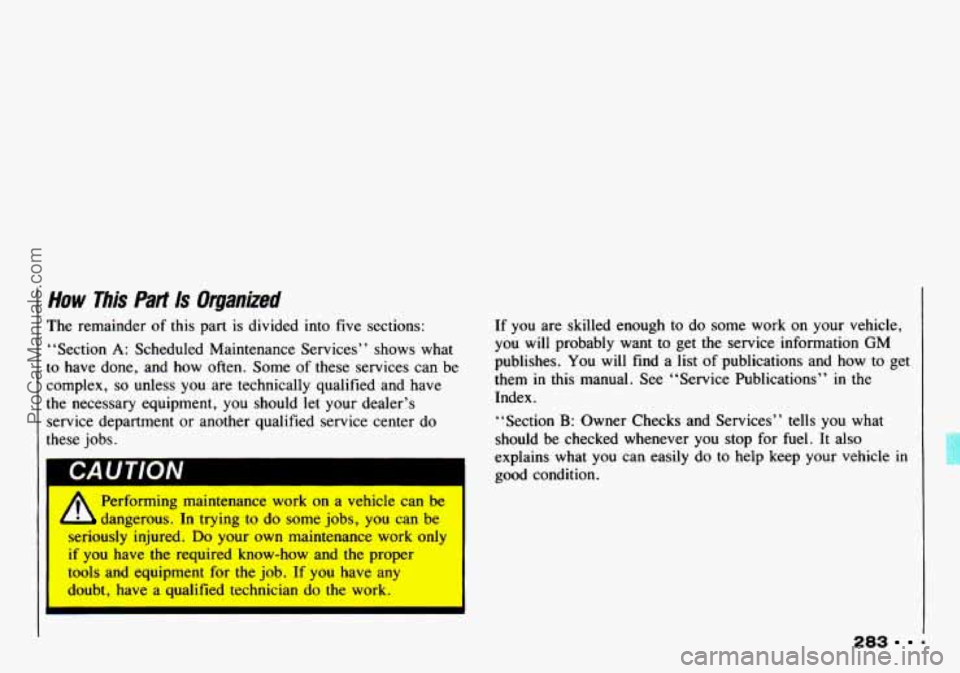
I The remainder of this part is divided into five sections:
“Section
A: Scheduled Maintenance Services” shows what
to have done, and how often. Some
of these services can be
complex,
so unless you are technically qualified and have
the necessary equipment, you should let your dealer’s
service department or another qualified service center do
these jobs.
CAUTION
I-
I
Performing maintenance work on a vehicle can be
6 - dangerous. In trying to do some jobs, you can be I
seriously injured. Do your own maintenance work only
if you have the required know-how and the proper
tools and equipment for the job.
If you have any
doubt, have a qualified technician
do the work.
If you are skilled enough to do some work on your vehicle,
you
will probably want to get the service information GM
publishes.
You will find a list of publications and how to get
them
in this manual. See “Service Publications” in the
Index.
“Section
B: Owner Checks and Services” tells you what
should be checked whenever you stop for fuel. It also
explains what you can easily
do to help keep your vehicle in
good condition.
283 9
ProCarManuals.com
Page 287 of 339
Maintenance Schedule
Section A: Scheduled Maintenance Services
Using Your Maintenance Schedules
This section tells you the maintenance services you should
have done and when you should schedule them. Your Geo
dealer knows your vehicle best and wants
you to be happy
with it. If you go to your dealer for your service needs,
you’ll know that GM-trained and supported service people
will perform the work using genuine GM parts.
These schedules are for vehicles that:
carry passengers and cargo within recommended limits.
You will find these limits on your vehicle’s Tire-Loading
Information Label. See “Loading Your Vehicle’’
in the
Index.
are driven on reasonable road surfaces within legal
use the recommended unleaded fuel. See “Fuel” in the
driving
limits.
Index.
Selecting the RiQht Schedule
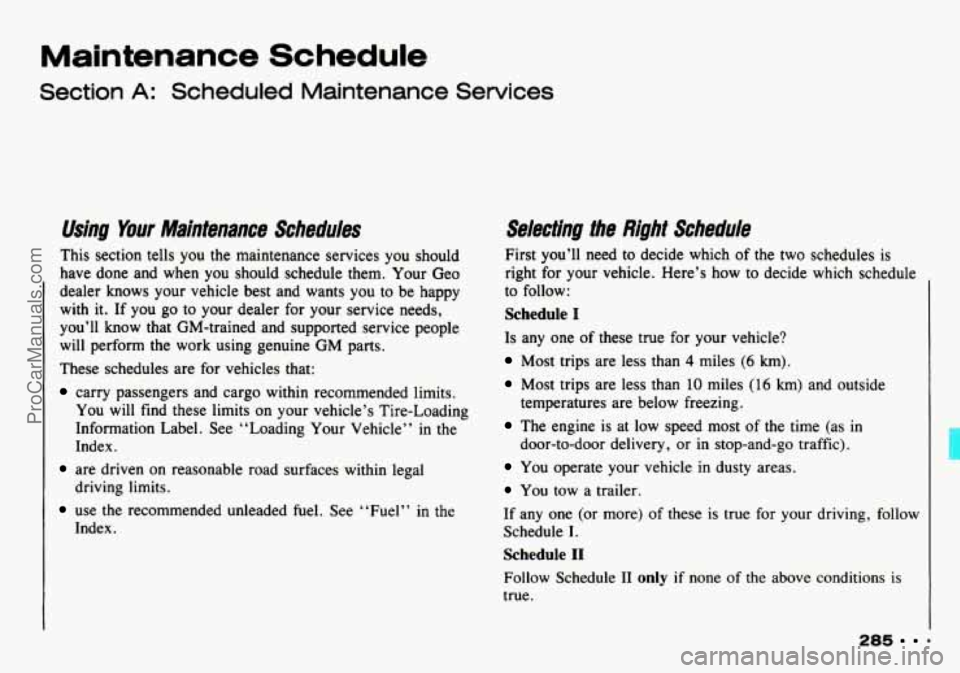
First you’ll need to decide which of the two schedules is
right for your vehicle. Here’s
how to decide which schedule
to follow:
Schedule I
Is any one of these true for your vehicle?
Most trips are less than 4 miles (6 km).
Most trips are less than 10 miles (16 km) and outside
temperatures are below freezing.
The engine is at low speed most of the time (as in
door-to-door delivery, or
in stop-and-go traffic).
You operate your vehicle in dusty areas.
You tow a trailer.
If any one (or more) of these is true for your driving, follow
Schedule
I.
Schedule I1
Follow Schedule I1 only if none of the above conditions is
true.
285 =
ProCarManuals.com