fuel CHEVROLET TRACKER 1993 User Guide
[x] Cancel search | Manufacturer: CHEVROLET, Model Year: 1993, Model line: TRACKER, Model: CHEVROLET TRACKER 1993Pages: 339, PDF Size: 15.75 MB
Page 143 of 339
signs. Surfaces can be slippery, rough,
uphill or downhill. In short, you’ve
gone right back to nature.
Off-road driving involves some new
skills. And that’s why
it’s very
important that you read this guide.
You’ll find many driving tips and
suggestions. These will help make your
off-road driving safer and more
enjoyable.
Before You Go Off-Roading
There are some things to do before you
go out. For example, be sure to have all
necessary maintenance and service work
done. Be sure
to read all the information
about your four-wheel drive vehicle in
this manual.
Is there enough fuel? Is the spare
tire fully inflated? Are the fluid
levels up where they should be? What
are the local laws that apply to
off-roading where you’ll be driving? If
you don’t
know, you should check with
law enforcement people in the area. Wil
you be on someone’s private land?
If so
be sure to get the necessary permission.
Loading Your Vehicle for Off-Road
Driving
There are some important things to
remember about how to load your
vehicle.
The heaviest things should be on the
load floor and forward of your rear
axle. Put heavier items as far forward
as you can.
Be sure the load is secured properly,
so driving on the off-road terrain
doesn’t
toss things around.
ProCarManuals.com
Page 159 of 339
After Off-Road Driving
Remove any brush or debris that has
collected on the underbody, chassis or
under the hood. These accumulations
can be a fire hazard.
After operation in mud or sand, have the
brake linings cleaned and checked.
These substances can cause glazing and
uneven braking. Check the body
structure, steering, suspension, wheels,
tires, and exhaust system for damage.
Also, check the fuel lines and cooling
system for any leakage.
Your vehicle will require more frequent
service due to off-road use. Refer
to the
Maintenance Schedule for additional
information.
rn Driving at Night
Night driving is more dangerous than
day driving. One reason is that some
drivers are likely to be impaired
- by
alcohol or drugs, with night vision
problems, or by fatigue.
Here are some tips
on night driving.
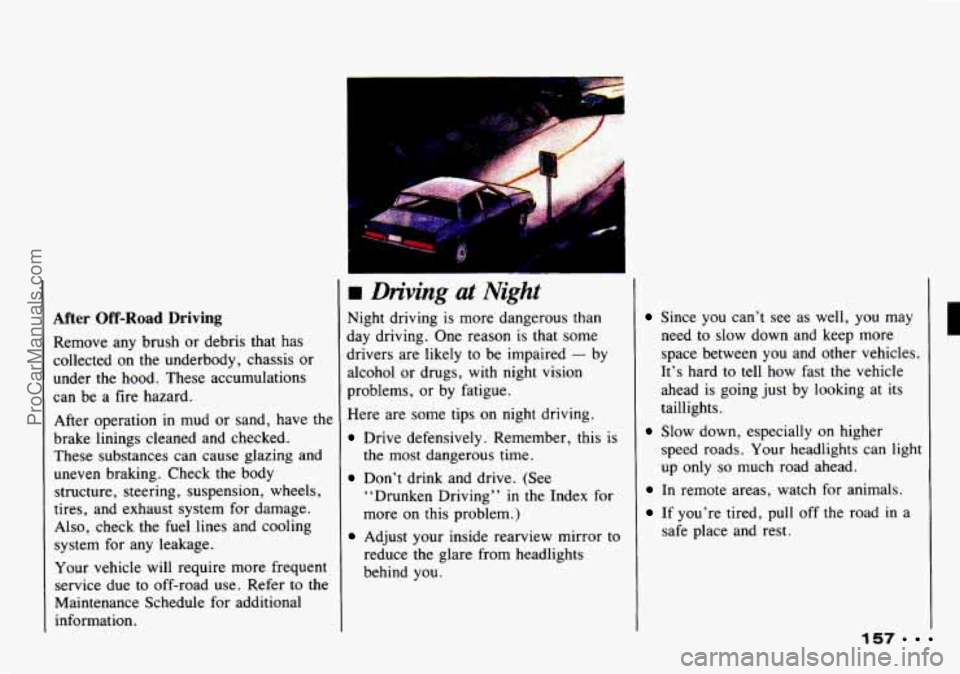
Drive defensively. Remember, this is
the most dangerous time.
Don’t drink and drive. (See
“Drunken Driving” in the Index for
more on this problem.)
Adjust your inside rearview mirror to
reduce the glare from headlights
behind you.
Since you can’t see as well, you may
need to slow down and keep more
space between you and other vehicles.
It’s hard to tell how fast the vehicle
ahead is going just by looking at its
taillights.
Slow down, especially on higher
speed roads.
Your headlights can light
up only so much road ahead.
In remote areas, watch for animals.
If you’re tired, pull off the road in a
safe place and rest.
157
ProCarManuals.com
Page 169 of 339
I Driving a Long
Distunce
Although most long trips today are made
on freeways, there are still many made
on regular highways.
Long-distance driving on freeways and
regular highways is the same in some
ways. The trip has
to be planned and the
vehicle prepared, you drive at
higher-than-city speeds, and there are
longer turns behind the wheel. You’ll
l enjoy your trip more if you and your
vehicle are in good shape. Here are
some tips for a successful long trip.
Before Leaving on a Long Trip
Make sure you’re ready. Try to be well
rested. If you must start when you’re
not fresh
- such as after a day’s work
- don’t plan to make too many miles
that first part
of the journey. Wear
comfortable clothing and shoes you can
easily drive in.
Is your vehicle ready for a long trip? If
you keep it serviced and maintained, it’s
ready to go.
If it needs service, have it
done before starting out. Of course,
you’ll find experienced and able service
experts in Geo dealerships all across
North America. They’ll be ready and
willing to help
if you need it. Here
are some things you can check
before a trip:
Windshield Washer Fluid: Is the
reservoir full? Are all windows clean
inside and outside?
Wiper Blades: Are they in good
shape?
Fuel, Engine Oil, Other Fluids:
Have you checked all levels?
Lights: Are they all working? Are the
lenses clean?
Tires: They are vitally important to a
safe, trouble-free trip. Is the tread
good enough
for long-distance
driving? Are the tires all inflated
to
the recommended pressure?
167-9.
ProCarManuals.com
Page 178 of 339
Your Driving and the Road
.._
176
If you have no blankets or extra
clothing, make body insulators from
newspapers, burlap bags, rags, floor
mats
- anything you can wrap around
yourself or tuck under your clothing to
keep warm.
You can run the engine to keep warm,
but be careful.
A
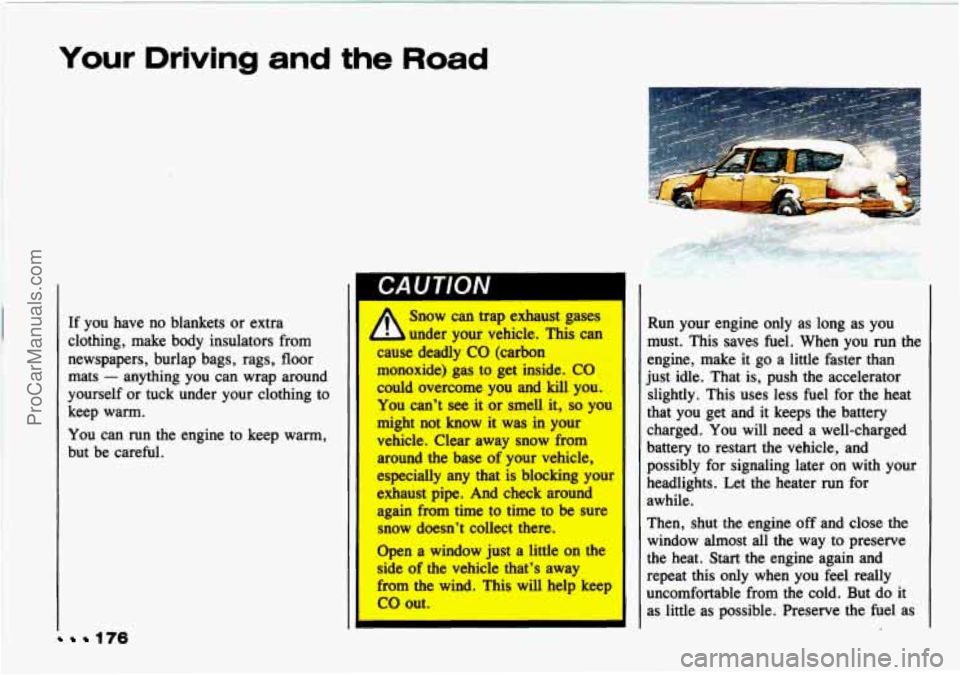
Snow can trap exhaust gases
under your vehicle. This can
cause deadly
CO (carbon
monoxide) gas to get inside.
CO
could overcome you and kill you.
You can't see it or smell it,
so you
might not know it was in your
vehicle. Clear away snow from around the base
of your vehicle,
especially any that is blocking your
exhaust pipe. And check around
again from time to time to be sure
snow doesn't collect there.
Open a window just a little on
the
side of the vehicle that's away
from the wind. This will help keep
co out. Run your engine only as long as you
must. This saves fuel. When
you run the
engine, make it go a little faster than
just idle. That is, push the accelerator
slightly. This uses less fuel for the heat
that you get and it keeps the battery
charged. You will
need a well-charged
battery to restart the vehicle, and
possibly for signaling later on with your
headlights.
Let the heater run for
awhile.
Then, shut the engine off and close the
window almost all the way to preserve
the heat.
Start the engine again and
repeat this only when you feel really
uncomfortable from the cold. But do it
as little as possible. Preserve the fuel as
ProCarManuals.com
Page 180 of 339
Your Driving and the Road
Your Geo can tow a trailer. To identify
what the vehicle trailering capacity is for
your vehicle, you should read the
information
in “Weight of the Trailer”
that appears later in
this section. But
trailering is different than just driving
your vehicle by itself. Trailering means
changes in handling, durability, and fuel
economy. Successful, safe trailering
takes correct equipment, and it has to be
used properly.
That’s the reason for this section.
In it
are many time-tested, important
trailering tips and safety rules. Many of
these are important for your safety and
that of your passengers.
So please read
this section carefully before you pull a
trailer.
9 178
Load-pulling components such as the
engine, transmission, wheel assemblies,
and tires are forced to work harder
against the drag
of the added weight.
The engine is required to operate at
relatively higher speeds and under
greater loads, generating extra heat.
What’s more, the trailer adds
considerably to wind resistance,
increasing the pulling requirements.
All
of that means changes in:
Handling
Durability
Fuel economy
If You Do Decide to Pull a Trailer
If you do, here are some important
points.
There are many different laws having
to do with trailering. Make sure your
rig will be legal, not only where you
live but also where you’ll be driving.
A good source for this information
can be state or provincial police.
Consider using a sway control.
You can ask a hitch dealer about sway
controls.
Don’t tow a trailer at all during the
first
500 miles (800 km) your new
vehicle is driven. Your engine, axle
or other parts could be damaged.
ProCarManuals.com
Page 223 of 339
Part 6
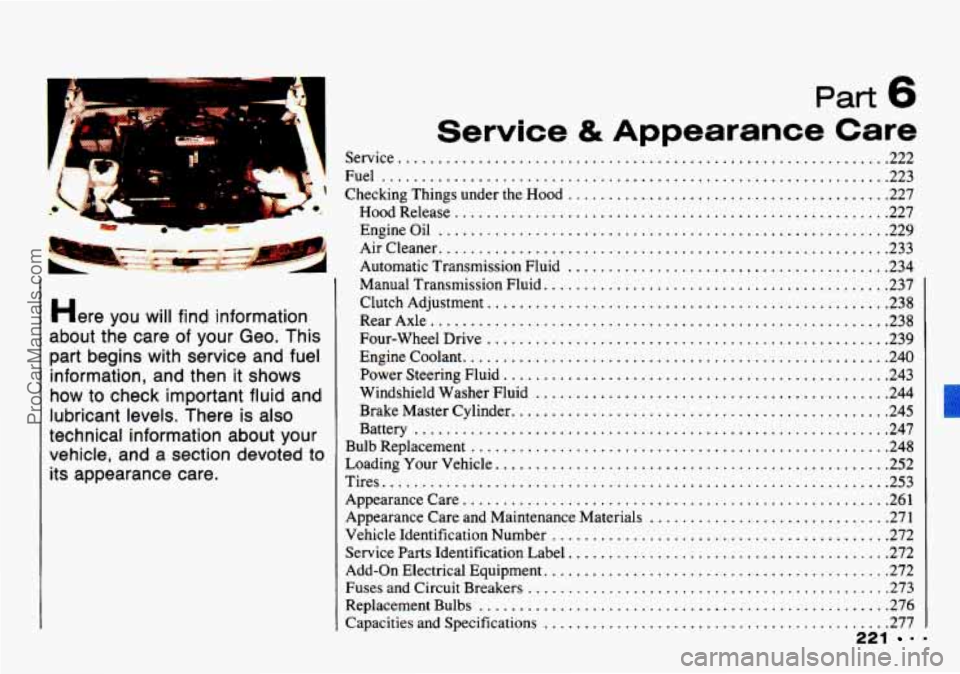
Here you wit1 find information
about the care of your Geo
. This
part begins with service and fuel
information. and then it shows
how to check important fluid and
lubricant levels
. There is also
technical information about your
vehicle. and
a section devoted to
its appearance care
.
ii iervice & Appearance Care
Service ............................................................. 222
Fuel ............................................................... 223
Checking Things under the Hood ........................................ 227 .
HoodRelease 227
Engineoil ........................................................ 229
Aircleaner ........................................................ 233
Automatic Transmission Fluid ........................................ 234
Manual Transmission Fluid ........................................... 237
Clutch Adjustment .................................................. 238
RearAxle ......................................................... 238
Four-WheelDrive .................................................. 239
Enginecoolant ..................................................... 240
Power Steering Fluid ................................................ 243
Windshield Washer Fluid ............................................ 244
Brake Master Cylinder ............................................... 245
Battery ........................................................... 247
Bulb Replacement .................................................... 248
LoadingYourVehicle ................................................. 252
Tires ............................................................... 253
Appearancecare ..................................................... 261
Appearance Care and Maintenance Materials .............................. 271
Vehicle Identification Number .......................................... 272
Service Parts Identification Label ........................................ 272
Add-on Electrical Equipment ........................................... 272
Fuses and Circuit Breakers ............................................. 273
ReplacementBulbs ................................................... 276
Capacities and Specifications ........................................... 277
221 .
.
......................................................
ProCarManuals.com
Page 225 of 339
I NOTICE
r
Fuel
Use regular unleaded gasoline rated at
87 octane or higher. It should meet
specifications, ASTM
D4814 in the U.S.
and CGSB 3.5-M92 in Canada. These
fuels should have the proper additives,
so you should not have to add anything
to the fuel.
In the U.S. and Canada, it’s easy to be
sure you get the right kind of gasoline
(unleaded). You’ll see
UNLEADED
right on the pump. And only unleaded
nozzles will fit into your vehicle’s filler
neck.
Be sure the posted octane is at least
87.
If the octane is less than 87, you may
get a heavy knocking noise when you drive.
If it’s bad enough, it can damage
your engine.
If you’re using fuel rated at
87 octane or
higher and you still hear heavy
knocking, your engine needs service.
But don’t worry if you hear a little
pinging noise when you’re accelerating or driving up a
hill. That’s normal, and
you don’t have to buy a higher octane
fuel to get rid of pinging. It’s the heavy,
constant knock that means you have a
problem.
What about gasoline with blending materials that contain oxygen, such as
MTBE or alcohol?
c
223 -
ProCarManuals.com
Page 226 of 339
Service & Appearance Care
MTBE is ‘ ‘methyl tertiary-butyl ether. ’ ’
Fuel that is no more than 15% MTBE is
fine for your vehicle.
Ethanol is ethyl or grain alcohol.
Properly-blended fuel that is
no more I
than 10% ethanol is fine for your
vehicle.
Methanol is methyl or wood alcohol. I
... 224
I
I
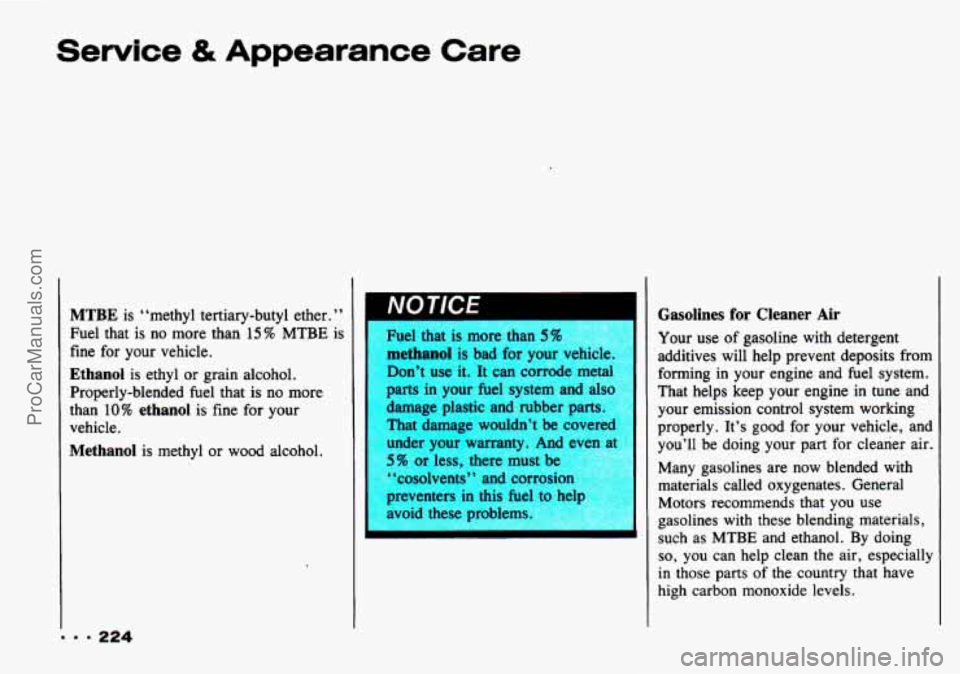
methanol is bad for your vehicle.
on’t use it.
It can corrode metal
parts in your fuel system and
also
damage plastic and rubber pr
That damage wouldn’t be covered
under your warranty. And
e-? at
5% or less, there must be
“cosolvents” and corrosion
,:eventers in this fuel
+n hpll
Gasolines for Cleaner Air
Your use of gasoline with detergent
additives will help prevent deposits from
forming in your engine and fuel system.
That helps keep your engine in tune and your emission control system working
properly. It’s
good for your vehicle, and
you’ll be doing your part for cleaner air.
Many gasolines are now blended with
materials called oxygenates. General
Motors recommends that you use
gasolines
with these blending materials,
such as MTBE and ethanol.
By doing
so, you can help clean the air, especially
in those parts of the country that have
high carbon monoxide levels.
ProCarManuals.com
Page 227 of 339

In addition, some gasoline suppliers are
now producing reformulated gasolines.
These gasolines are specially designed to
reduce vehicle emissions. General
Motors recommends that you use
reformulated gasoline. By doing
so, you
can help clean the air, especially in
those parts of the country that have high
ozone levels,
You should ask your service station
operators
if their gasolines contain
detergents and oxygenates, and if they
have been reformulated
to reduce
vehicle emissions.
Fuels in Foreign Countries
If you plan on driving in another
country outside the
U.S. or Canada,
unleaded fuel may be hard to find.
Do
not use leaded gasoline. If you use even
one tankful, your emission controls
won’t work well or at
all. With
continuous use, spark plugs can get
fouled, the exhaust system can corrode,
and your engine oil
can deteriorate
quickly. Your vehicle’s oxygen sensor
will be damaged. All of that means costly repairs that wouldn’t be covered
by your warranty.
To check on fuel availability, ask an
auto club, or contact a major oil company that does business in
the
country where you’ll be
driving.
You can also write us at the following
address for advice. Just tell us where
you’re going and give your Vehicle
Identification Number
(VIN).
General Motors of Canada Limited
International Export Sales
P.O. Box 828
Oshawa, Ontario LIH 7N1
Canada
ProCarManuals.com
Page 228 of 339
Service & Appearance Care
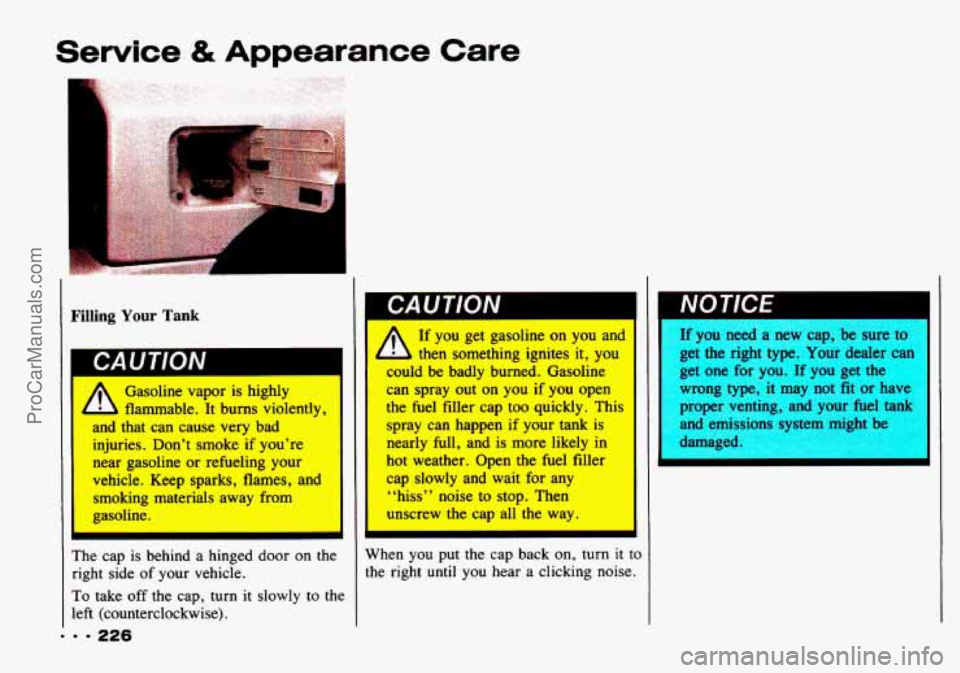
Filling Your Tank
bA u 1 lU/V
1 Gasoline vapor is highly
and that can cause very bad
injuries. Don’t smoke if you’re
near gasoline
or refueling your
vehicle. Keep sparks,
flames, and
smoking materials away
from
gasoline. flammable.
It bums violently,
The cap is behind a hinged door on the
right side of your vehicle.
To take off the cap, turn
it slowly to the
left (counterclockwise).
... 226
I
I
If you get gasoline on you and
then something ignites it, you
could be badly burned. Gasoline
can spray out on you if you open
the fuel filler cap too quickly. This
spray can happen if your tank is
nearly full, and is more likely in
hot weather. Open the
fuel filler
cap slowly and wait for any
“hiss” noise to stop. Then
unscrew the cap all the way.
When you put the cap back on, turn it to
the right until you hear a clicking noise.
NU I ILt
If you need a new cap, be sure to
get the right type.
Your dealer can
get one
for you. If you get the
wrong type, it may not fit
or have
proper venting, and your fuel
tank
and emissions system IT ‘It be
damal ‘ ~
‘
ProCarManuals.com