tow CHEVROLET TRACKER 1993 Owner's Guide
[x] Cancel search | Manufacturer: CHEVROLET, Model Year: 1993, Model line: TRACKER, Model: CHEVROLET TRACKER 1993Pages: 339, PDF Size: 15.75 MB
Page 185 of 339
Following Distance
Stay at least twice as far behind the
vehicle ahead as you would when
driving your vehicle without a trailer.
This can help you avoid situations that
require heavy braking and sudden turns.
Passing
You’ll need more passing distance up
ahead when you’re towing a trailer.
And, because you’re a good deal longer,
you’ll need to
go much farther beyond
the passed vehicle before you can return
to your lane.
Backing Up
Hold the bottom of the steering wheel
with one hand. Then, to move the trailer
to the left, just move that hand to the
left.
To move the trailer to the right,
move your hand to the right. Always
back up slowly and, if possible, have
someone guide you.
Making Turns
When you’re turning with a trailer,
make wider turns than normal.
Do this
so your trailer won’t strike soft
shoulders, curbs, road signs, trees, or
other objects. Avoid jerky
or sudden
maneuvers. Signal well in advance.
Turn Signals When Towing a Trailer
When you tow a trailer, your vehicle
has to have a different turn signal
flasher and extra wiring. The green
arrows on your instrument panel will
flash whenever you signal
a turn or lane
change. Properly hooked up, the trailer
lights will also flash telling other drivers
you’re about
to turn, change lanes, or
stop.
When towing a trailer, the green arrows
on your instrument panel will flash for
turns even if the bulbs on the trailer are
burned out. Thus, you may think drivers
behind you are seeing your signal when
ProCarManuals.com
Page 187 of 339
J
It be dangerous tu get out
of your vehicle if the shift lever
is not fully in P (Park) with the
parking brake firmly set.
If you have left the engine running,
the veficle can
move suddenly. You
or others could be injured. To be
sure your vehicle won’t move, when
you’re
on fairly level ground, use
the steps that follow.
If you have four-wheel drive, and
your transfer
case is in N (NeutraI) ,
your vehicle will be free to roll,
even
if your shift lever is in
P (Park). So, be sure the transfer
case is in a drive gear - not in
N (Neutral).
If you are parking on a hill, or if
you’re pulling a trailer; also see
“Parking On Hills” in the Index.
6. Release the regular brakes.
When You Are Ready to Leave after
Parking on a
Hill
1. Apply your regular brakes and hold
the pedal down while you:
Start your engine;
Shift into a gear; and
Release the parking brake.
2. Let up on the brake pedal.
3. Drive slowly until the trailer is clear
4. Stop and have someone pick up and
of the chocks.
store
the chocks.
Maintenance When Trailer Towing
Your vehicle will need service more
often when you’re pulling a trailer.
See
the Maintenance Schedule for more on
this. Things that are especially important
in trailer operation are automatic
transmission fluid (don’t overfill),
engine oil, axle lubricant, belts, cooling
system, and brake adjustment. Each
of
these is covered in this manual, and the
Index will help you find them quickly.
If
you’re trailering, it’s a good idea to
review these sections before you start
your trip.
Check periodically
to see that all hitch
nuts and bolts are tight.
185 9 =
ProCarManuals.com
Page 188 of 339
Your Driving and the Road
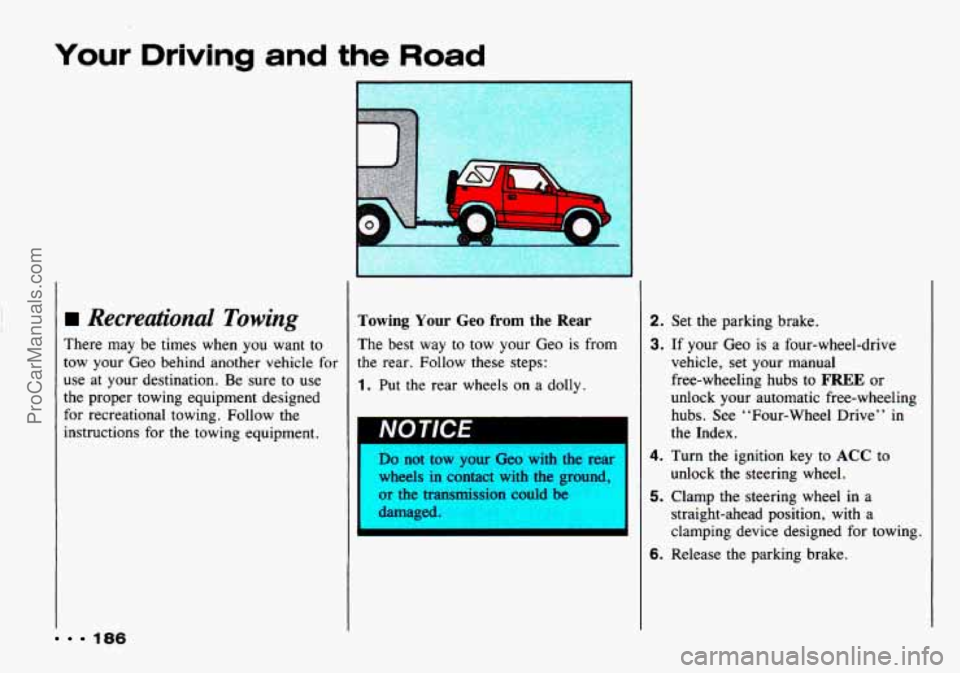
Recreational Towing
There may be times when you want to
tow your Geo behind another vehicle for
use at your destination. Be sure to use
the proper towing equipment designed
for recreational towing. Follow
the
instructions for the towing equipment.
186
Towing Your Geo from the Rear
The best way to tow your Geo is from
the rear. Follow these steps:
1 . Put the rear wheels on a dolly.
NOTlCE
Do not tow your Geo with the re--
wheels in contact with the grounL,
or
the transmission could be
damaged.
2. Set the parking brake.
3. If your Geo is a four-wheel-drive
vehicle, set your manual
free-wheeling hubs to
FREE or
unlock your automatic free-wheeling
hubs. See “Four-Wheel Drive’’
in
the Index.
4. Turn the ignition key to ACC to
unlock the steering wheel.
5. Clamp the steering wheel in a
straight-ahead position,
with a
clamping device designed for towing.
6. Release the parking brake.
ProCarManuals.com
Page 189 of 339
Make sure that the towing speed
dues not exceed 55 mph
(90 km/h), or your Geo could be
badly damaged.
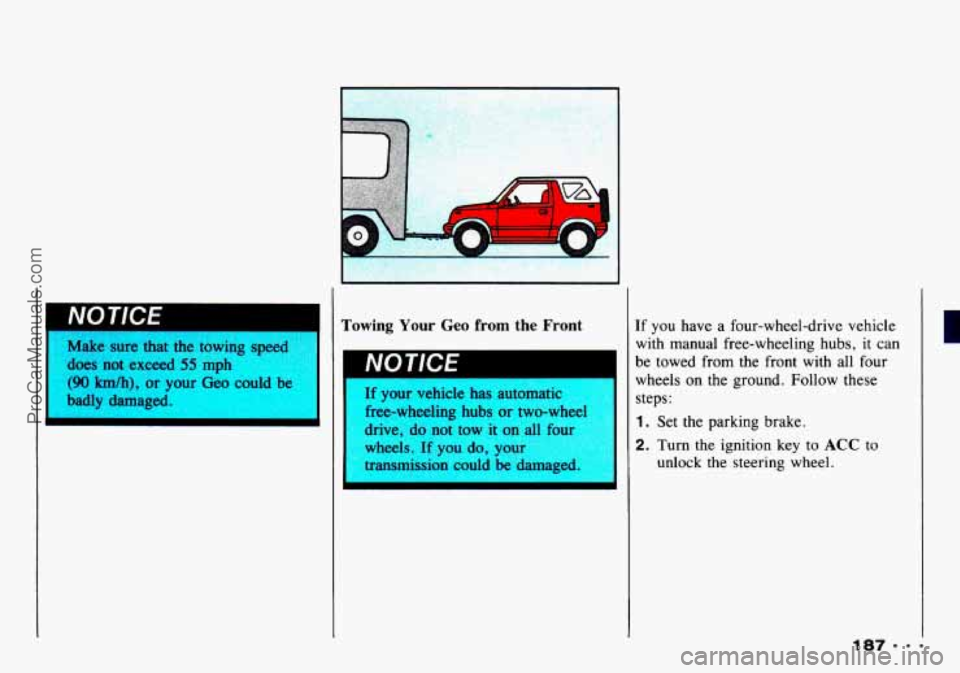
Towing Your Geo from the Front
If your vehicle has automatic
I free-wheeling hubs or two-whet
drive, do not tow it
on all fa
I wheels. If you do, you transmission could be damaged.
I
If you have a four-wheel-drive vehicle
with manual free-wheeling hubs, it can
be towed from the front with all four
wheels on the ground. Follow these
steps:
1. Set the parking brake.
2. Turn the ignition key to ACC to
unlock the steering wheel.
ProCarManuals.com
Page 190 of 339
Your Driving and the Road
= - 9 188
3. Shift your automatic transmission
into
P (Park), or your manual
transmission into
2 (Second).
4. Shift the transfer case to N (Neutral).
5. Set the hubs to FREE. See
“Four-Wheel Drive” in the Index.
6. Release the parking brake. Stop towing every
200 miles (300 km)
and
start the engine. Leave the transfer
case shift lever in
N (Neutral). Shift
your automatic transmission
to
D (Drive); leave a manual transmission
in
2 (Second) and release the clutch.
Run the engine at medium speed for one
minute to circulate
the oil in the transfer
case. Turn
the ignition key to ACC.
Now, you can continue towing your
Geo
.
NU I Kt
Make sure that the towing speed
does not exceed
50 mph
(80 km/h), or your Geo could
badly damaged.
ProCarManuals.com
Page 198 of 339
Problems on the Road
10. Now start the vehicle with the good
battery and
run the engine for
awhile.
dead battery.
If it won't start after a few tries, it
probably needs service.
11. Try to start the vehicle with the
I
I-
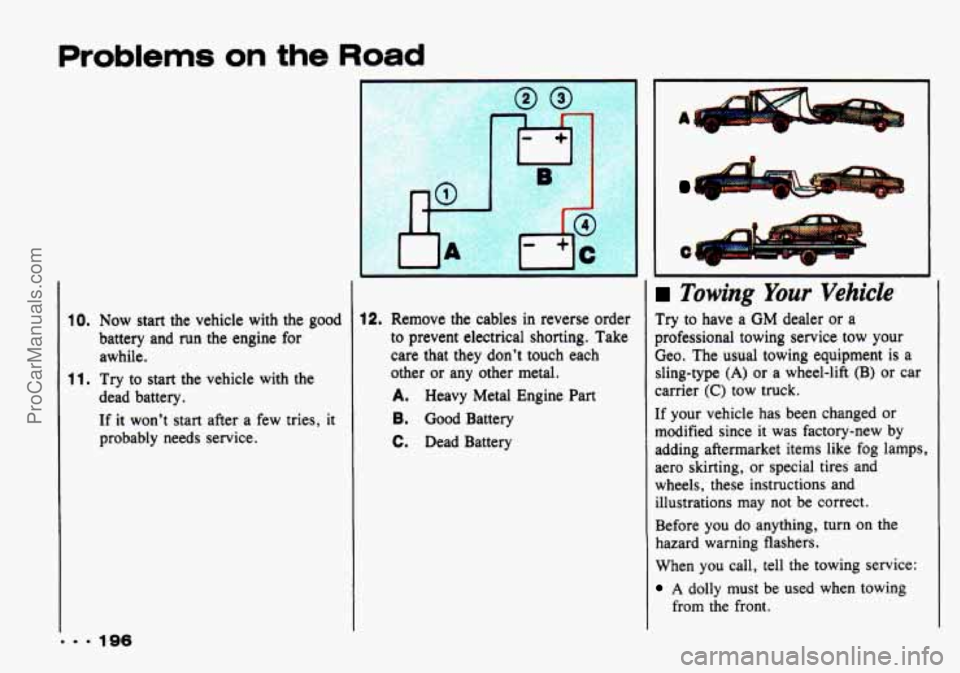
12. Remove the cables in reverse order
to prevent electrical shorting. Take
care that they don't touch each
other or any other metal.
A. Heavy Metal Engine Part
B. Good Battery
C. Dead Battery
r
L
Towing Your Vehicle
Try to have a GM dealer or a
professional towing service tow your
Geo. The usual towing equipment is
a
sling-type (A) or a wheel-lift (B) or car
carrier
(C) tow truck.
If your vehicle has been changed or
modified since it was factory-new by
adding aftermarket items like fog lamps,
aero skirting, or special tires and
wheels, these instructions and
illustrations may not be correct.
Before you
do anything, turn on the
hazard warning flashers.
When you call, tell the towing service:
A dolly must be used when towing
from the front.
ProCarManuals.com
Page 199 of 339
That your vehicle has rear-wheel
drive, or that
it has the
four-wheel-drive option.
vehicle.
The make, model, and year of your
Whether you can still move the shift
levers for the transmission and
transfer case,
if you have one.
If there was an accident, what was
damaged.
When the towing service arrives, let the
tow operator know that this manual
contains detailed towing instructions and
illustrations. The operator may want to
see them.
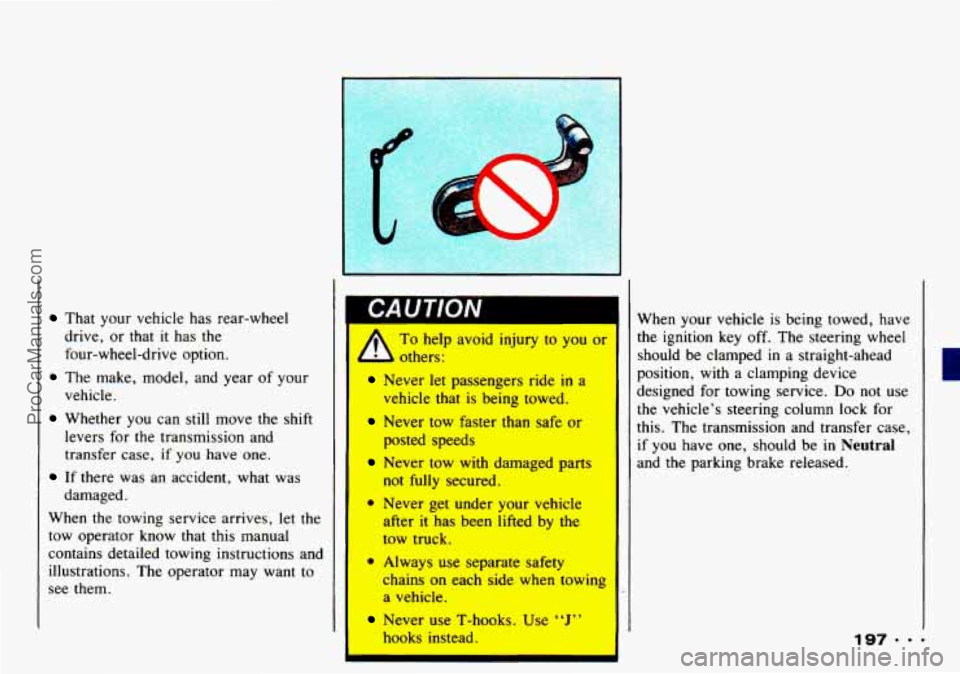
* T- help avoid injury to you or
Never let passengers ride in a
vehicle that is being towed.
Never tow faster than safe or
posted speeds
Never tow with damaged parts
not fully secured.
0 Never get under your vehicle
after it
has been lifted by the
tow truck.
chains on each side when towing
a vehicle.
hooks instead.
* Always use separate safety
Never use T-hooks. Use “J”
When your vehicle is being towed, have
the ignition key off. The steering wheel
should be clamped
in a straight-ahead
position, with
a clamping device
designed for towing service.
Do not use
the vehicle’s steering column lock for
this. The transmission and transfer case,
if you have one, should be in Neutral
and the parking brake released.
ProCarManuals.com
Page 200 of 339
Problems on the Road
front with sling-type or wheel lift
equipment, the rear wheels must be
supported on a dolly.
If your vehicle has four-wheel drive,
don’t have it towed on the front wheels
unless you must. If a vehicle with
four-wheel drive must be towed on the
front wheels, set your manual,
free-wheeling hubs to
FREE or unlock
your automatic free-wheeling hubs, and
set your transfer case to two-wheel
drive.
If your vehicle must be towed on
the front wheels, don’t go more than
55 mph (90 km/h).
= 9.198
CAUTION Don’t have your vehicle towed with the I
rear wheels in contact with the ground.
If
a vehicle must be towed from the I A vehicle can fall from a car A
’ carrier if it isn’t properly
,,cured. This can cause a
collision, serious personal injury
and vehicle damage. The vehicle
should be tightly secured with
chains or steel cables before it is
transported.
Don’t use substitutes (ropes,
leather straps, canvas webbing,
etc.) that can be cut by sharp
edges underneath
the towed
vehicle.
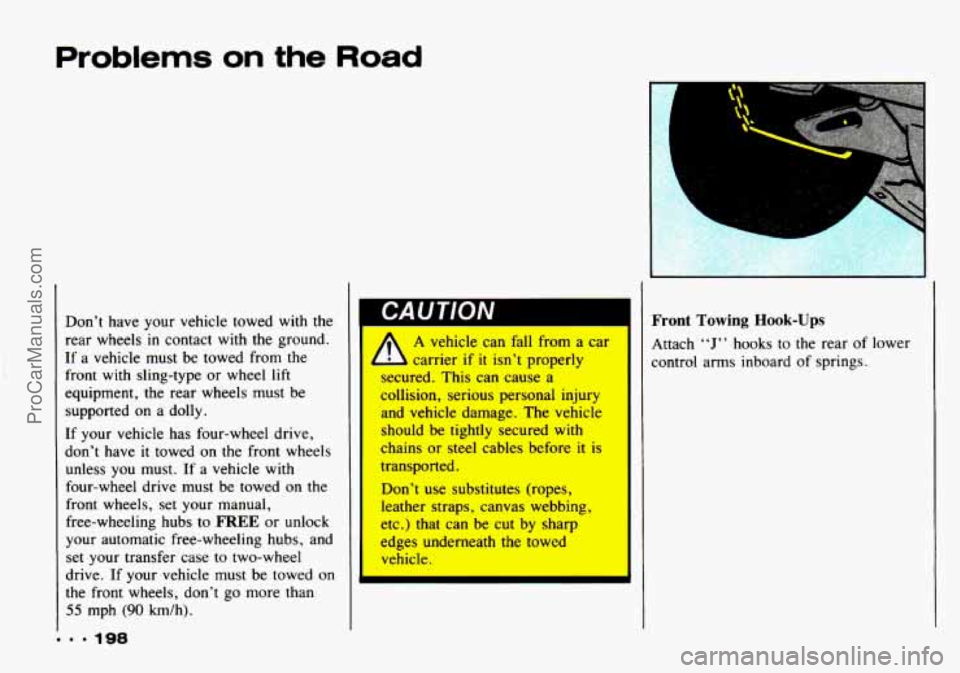
Front Towing Hook-Ups
Attach “J” hooks to the rear o
control arms inboard of springs
If lower
ProCarManuals.com
Page 201 of 339
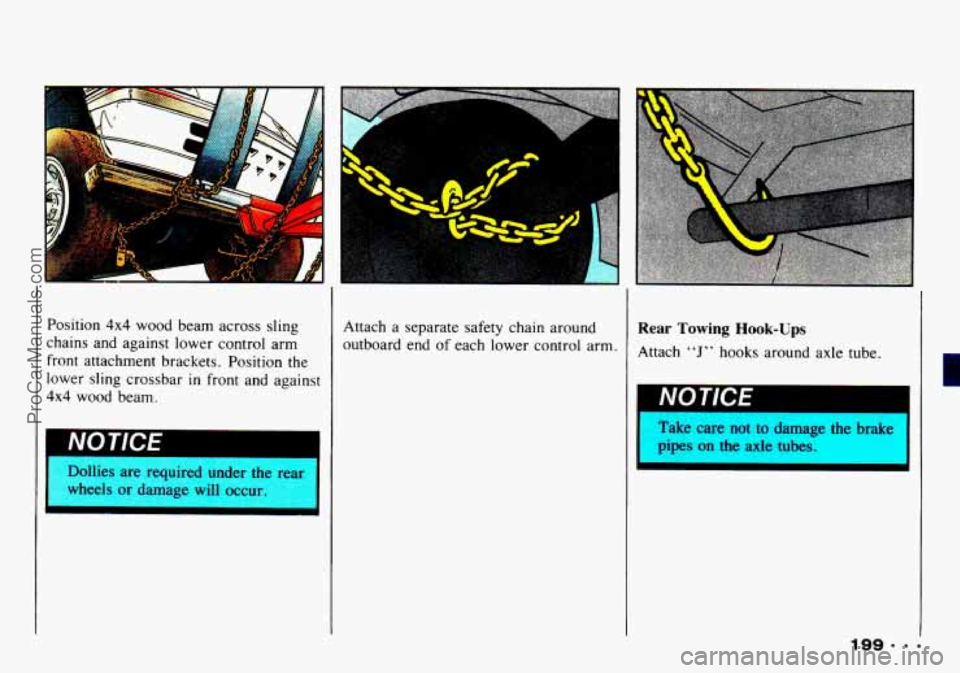
Position 4x4 wood beam across sling
chains and against lower control arm
front attachment brackets. Position the
lower sling crossbar
in front and against
4x4 wood beam. Attach a separate safety chain around
outboard end
of each lower
control arm.
Rear Towing Hook-Ups
Attach “J” hooks around axle tube.
I Take care not to damage the brake I
pipes on the axle tubes. 1
ProCarManuals.com
Page 204 of 339
Problems on the Road
... 202
If No Steam Is Coming from Your
Engine:
If you get the overheat warning but see
or hear no steam,
the problem may not
be too serious. Sometimes the engine
can get a little too hot when you:
Climb a long hill on a hot day.
Stop after high speed driving.
Idle for long periods in traffic.
Tow a trailer. If you
get the overheat warning with no
sign of steam, try this for
a minute or
1. If you have an air conditioner, turn it
2. Turn on your heater to full hot at the
so:
off.
highest fan speed and open
the
window as necessary.
3. If you’re in a traffic jam, shift to
N (Neutral).
If
you no longer have the overheat
warning, you can drive. Just to be safe,
drive slower for about ten minutes. If
the warning doesn’t come back on, you
can drive normally.
If the warning continues, pull over,
stop, and park your vehicle right away.
If there’s still no sign of steam, you can
idle the engine for two
or three minutes
while you’re parked, to see if the
warning stops. But then, if you still have
the warning, TURN OFF THE
ENGINE AND GET EVERYONE OUT
OF THE VEHICLE until it cools down.
You may decide not to lift the hood but
to get service help right away.
ProCarManuals.com