tow CHEVROLET TRACKER 1993 Service Manual
[x] Cancel search | Manufacturer: CHEVROLET, Model Year: 1993, Model line: TRACKER, Model: CHEVROLET TRACKER 1993Pages: 339, PDF Size: 15.75 MB
Page 210 of 339
Problems on the Road
Zf a Tire Goes Hut
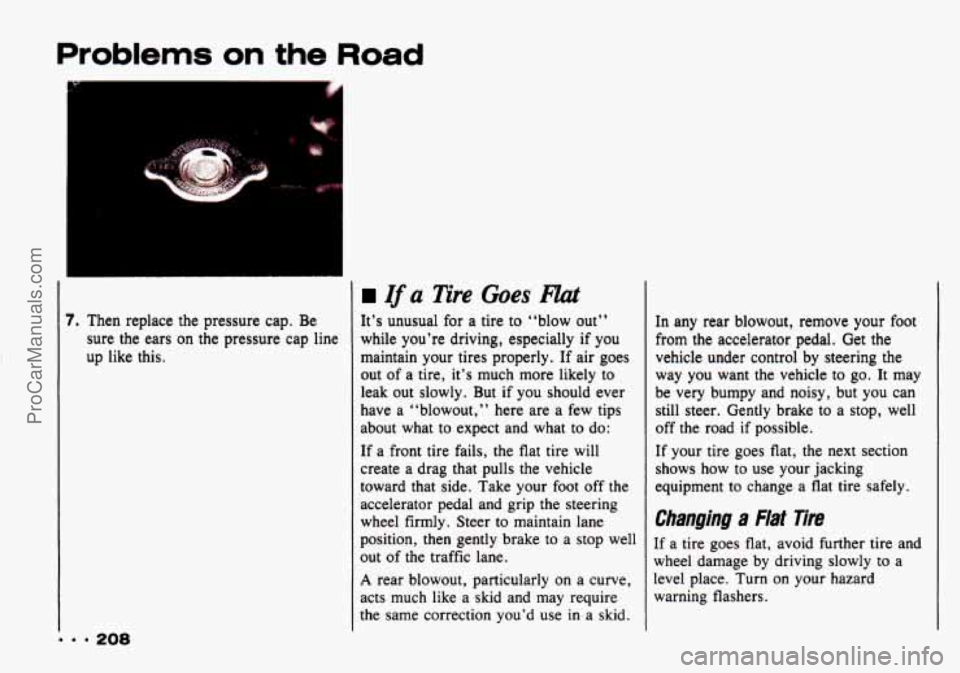
Then replace the pressure cap. Be
sure
the ears on the pressure cap line
up like
this.
9 208
It’s unusual for a tire to “blow out’’
while you’re driving, especially
if you
maintain your tires properly. If air goes
out of a tire, it’s much more likely to
leak out slowly. But if you should ever
have a “blowout,
” here are a few tips
about what to expect and what to do:
If a front tire fails, the flat tire will
create a drag that pulls the vehicle
toward that side. Take your foot off the
accelerator pedal and grip the steering
wheel firmly. Steer to maintain lane
position, then gently brake to a stop well
out of the traffic lane.
A rear blowout, particularly on a curve,
acts much like a skid and may require
the same correction you’d use
in a skid. In any
rear blowout, remove your
foot
from the accelerator pedal. Get the
vehicle under control by steering
the
way you want the vehicle to go. It may
be
very bumpy and noisy, but you can
still steer. Gently brake to a stop, well
off the road
if possible.
If your tire goes flat, the next section
shows how to use your jacking
equipment to change a flat tire safely.
ChanginQ a Flat lire
If a tire goes flat, avoid further tire and
wheel damage by driving slowly to a
level place. Turn
on your hazard
warning flashers.
..
ProCarManuals.com
Page 215 of 339
c
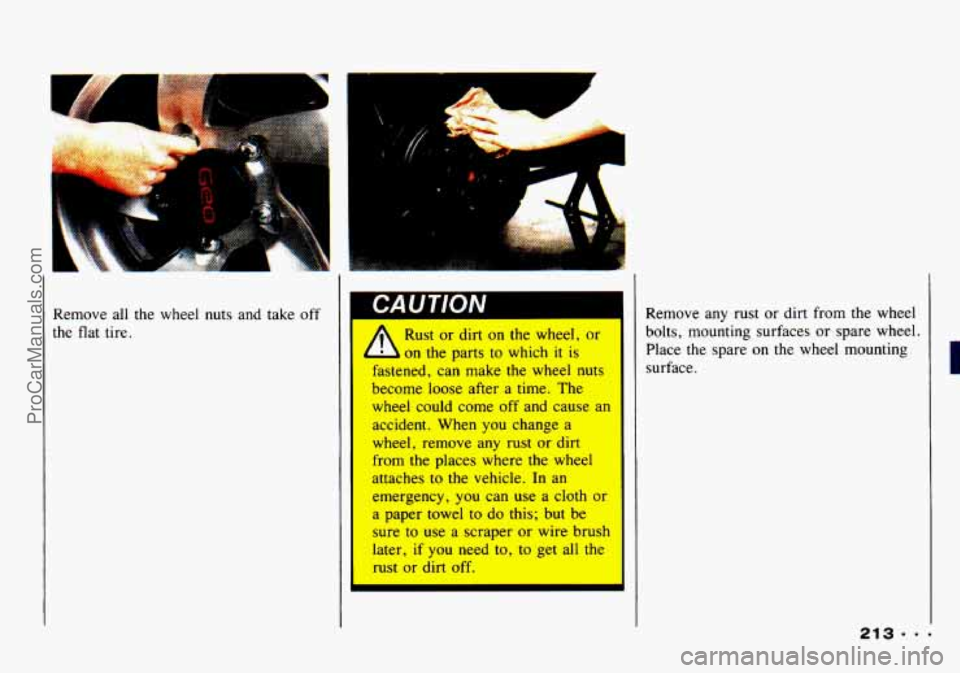
Remove all the wheel nuts and take off
the
flat tire.
r '_ .-
Rust or dirt on the wheel, or
on the parts to which it is
fastened, can make the wheel nuts
become loose after a time. The
wheel could come off and cause an
accident. When you change a
wheel, remove any rust or dirt
from the places where the wheel
attaches
to the vehicle. In an
emergency, you can use a cloth or
a paper towel to do this; but be
sure to use a scraper or wire brush
later, if you need to, to get all the
rust or dirt off.
- =
Remove any rust or dirt from the wheel
bolts, mounting surfaces or spare wheel.
Place the spare on the wheel mounting
surface.
ProCarManuals.com
Page 216 of 339
Problems on the Road
CAUTION
* Never use oil or grease on
1 studs or nuts. If you do, the
nuts might come loose.
Your
wheel could fall off, causing a
serious accident.
I
... 21 4
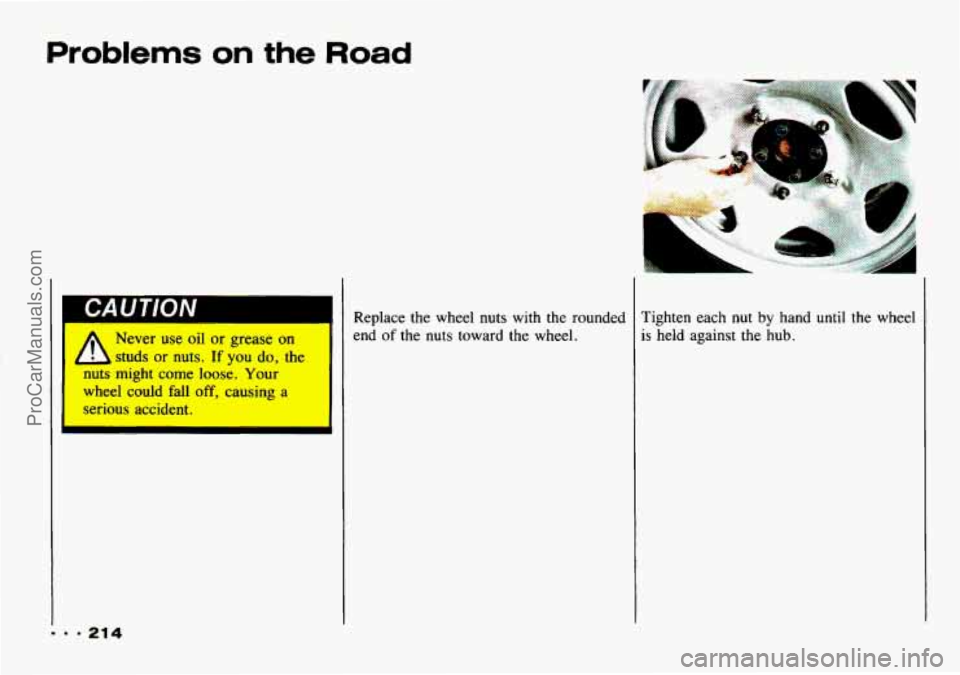
Replace the wheel nuts with the rounded
end
of the nuts toward the wheel. Tighten each nut
by hand until the wheel
is held against the hub.
ProCarManuals.com
Page 220 of 339
Problems on the Road
Rocking your vehicle to get it out:
First, turn your steering wheel left and
right. That will clear the area around
your front wheels. Then shift back and
forth between
R (Reverse) and a
forward gear (or with a manual
transmission, between First
or Second
gear and Reverse), spinning the wheels
as little as possible. Release the
accelerator pedal while you shift, and
press lightly
on the accelerator pedal
when the transmission is
in gear. If that doesn’t get you
out after a few tries,
you may need to be towed out. Or, you
can use your recovery hooks. If you do
need to be towed out,
see ‘‘Towing
Your Vehicle” in the Index.
-- --
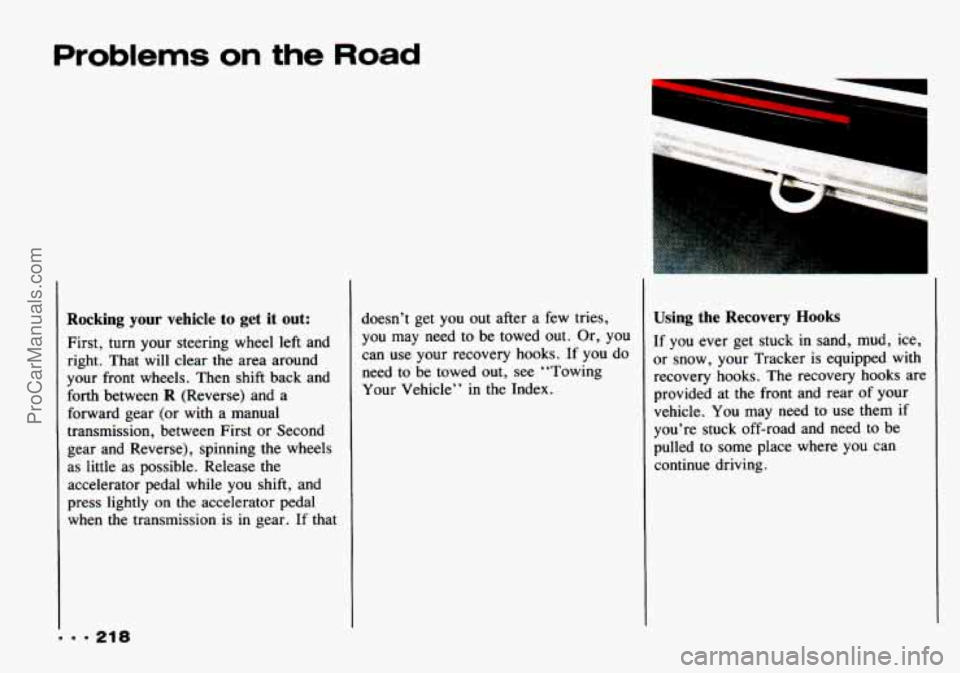
Using the Recovery Hooks
If you ever get stuck in sand, mud, ice,
or snow, your Tracker is equipped with
recovery hooks. The recovery hooks are
provided at the front and rear of your
vehicle. You may need to use them if
you’re stuck off-road and need to be
pulled to some place where you can
continue driving.
ProCarManuals.com
Page 221 of 339
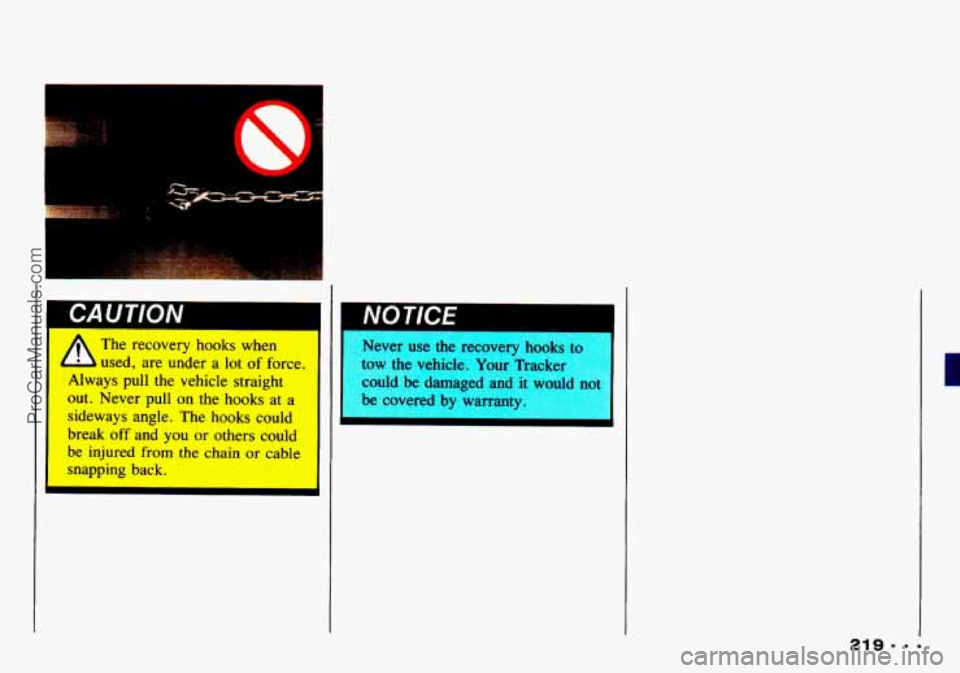
The recovery hooks when
used, are under a lot of force.
Always pull the vehicle straight
out. Never
pull on the hooks at a
sideways angle. The hooks could
break off and you or others could
be injured from the chain
or cable
snapping back.
I Never use the recovery hooks to
tow the vehicle.
Your Tracker
could be damaged and
it would no1
be covered by warrant]
ProCarManuals.com
Page 231 of 339
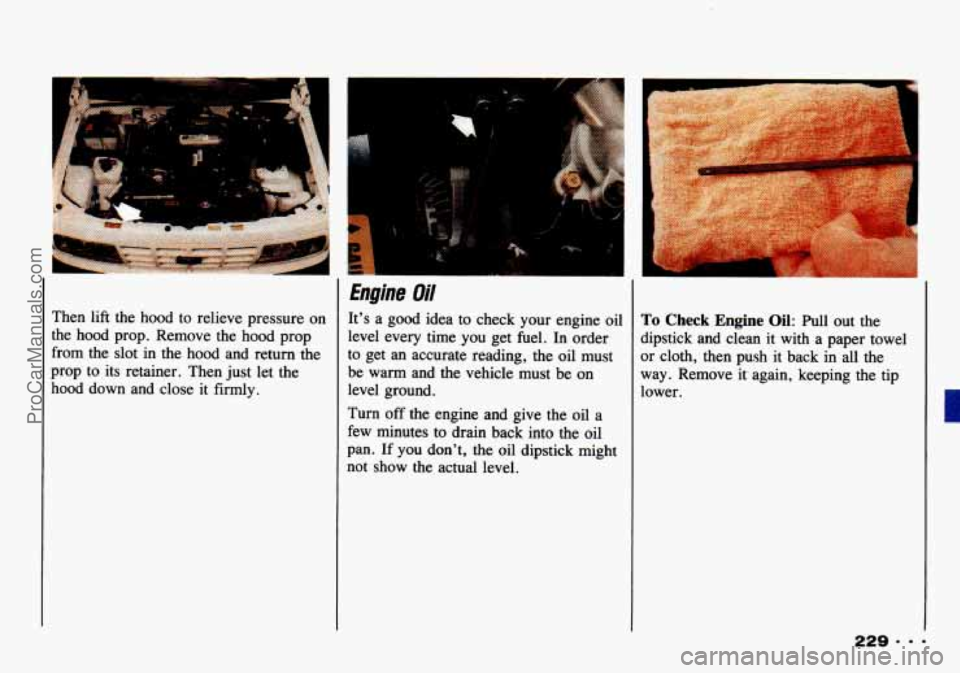
Then lift the hood to relieve pressure on
the hood prop. Remove the hood prop
from the slot in the hood and return the
prop to its retainer. Then just let the
hood down and close it firmly.
Engine Oil
It’s a good idea to check your engine oil
level every time you get fuel.
In order
to get an accurate reading, the oil must
be warm and the vehicle must be on
level ground.
Turn
off the engine and give the oil a
few minutes to drain back into the oil
pan.
If you don’t, the oil dipstick might
not show the actual level.
To Check Engine Oil: Pull out the
dipstick and clean it with a paper towel
or cloth, then push it back
in all the
way. Remove
it again, keeping the tip
lower.
ProCarManuals.com
Page 234 of 339
Service & Appearance Care
This doughnut-shaped logo (symbol) is
used on most oil containers to help you
select the correct oil.
You should look for this
on the oil
container, and use
only those oils that
display the logo.
GM Goodwrench@ oil (in Canada, GM
‘
Engine Oil) meets all the requirements
for your vehicle.
Engine Oil Additives: Don’t add
anything to
your oil. Your Geo dealer is
ready to advise if you think something
should be added.
When to Change Engine Oil: See if
any
one of these is true for you:
Most trips are less than 4 miles
(6 km).
It’s below freezing outside and most
trips are less than
10 miles (16 km).
The engine is at low speed most of
the time (as in door-to-door delivery,
or
in stop-and-go traffic).
You tow a trailer often.
Most trips are through dusty places.
The vehicle is frequently operated
off-road.
If any one of these is true for your
vehicle, you
need to change your oil
and filter
every 3,000 miles (5 000 km)
or 3 months - whichever comes first.
If none of them is true, change oil and
filter every
7,500 miles (12 500 km) or
7.5 months - whichever comes first.
ProCarManuals.com
Page 238 of 339

Service & Appearance Care
... 236
Let the engine run at idle for three
minutes or more.
To check the fluid hot or cold:
Park your vehicle on a level place.
Place the shift lever in P (Park) with
the parking brake applied.
With your foot on the brake pedal,
move the shift lever through each gear
range, pausing for about three seconds
in each range. Then, position the shift
lever in
P (Park).
Then, without shutting off the engine,
follow these steps:
1. Pull out the dipstick and wipe it with
2. Push it back in all the way, wait
a clean rag
or paper towel.
three seconds and then pull
it back
out again.
3. Check both sides of the dipstick, and
read the lower level. The fluid level
must be
in the COLD (A) area for a
cold check or in the
HOT (B) or
cross-hatched area for a hot check.
4. If the fluid level is where it should
be, push the dipstick back
in all the
way.
How to Add Fluid:
Refer to the Maintenance Schedule to
determine what kind of transmission fluid to use.
See “Recommended Fluids
and Lubricants”
in the Index.
If the fluid level is low, add only
enough of the proper fluid to bring the
level up into the COLD area for a cold
check or the
HOT area for a hot check.
It doesn’t take much fluid, generally less
than a pint. Don’t overfill. We
recommend you use only fluid labeled
DEXRON@-11, because fluids with that
label are made especially for our
automatic transmission. Damage caused
by fluid other than DEXRON@-I1 is not
covered by your new vehicle warranty.
ProCarManuals.com
Page 252 of 339
Service & Appearance Care
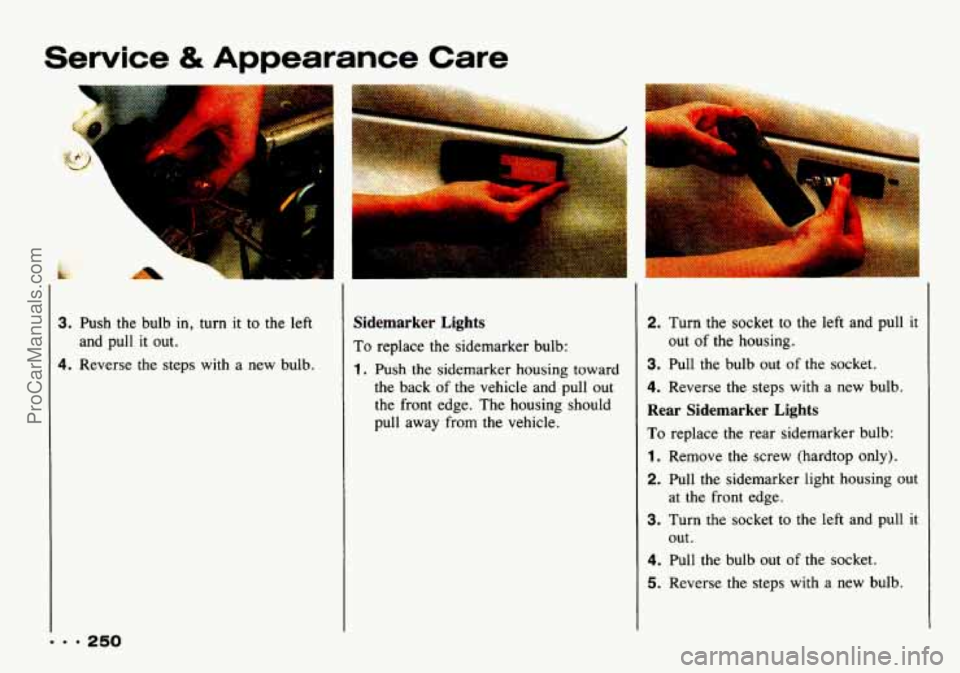
3. Push the bulb in, turn it to the left
4. Reverse the steps with a new bulb.
and
pull it out.
Sidemarker Lights
To replace
the sidemarker bulb:
1. Push the sidemarker housing toward
the back
of the vehicle and pull out
the front edge. The housing should
pull away from
the vehicle.
,
i
2. Turn the socket to the left and pull it
3. Pull the bulb out of the socket.
4. Reverse the steps with a new bulb.
Rear Sidemarker Lights
To replace the rear sidemarker bulb:
1. Remove the screw (hardtop only).
2. Pull the sidemarker light housing out
3. Turn the socket to the left and pull it
4. Pull the bulb out of the socket.
5. Reverse the steps with a new bulb.
out
of the
housing.
at the front edge.
out.
ProCarManuals.com
Page 258 of 339
Service & Appearance Care
I
- 256
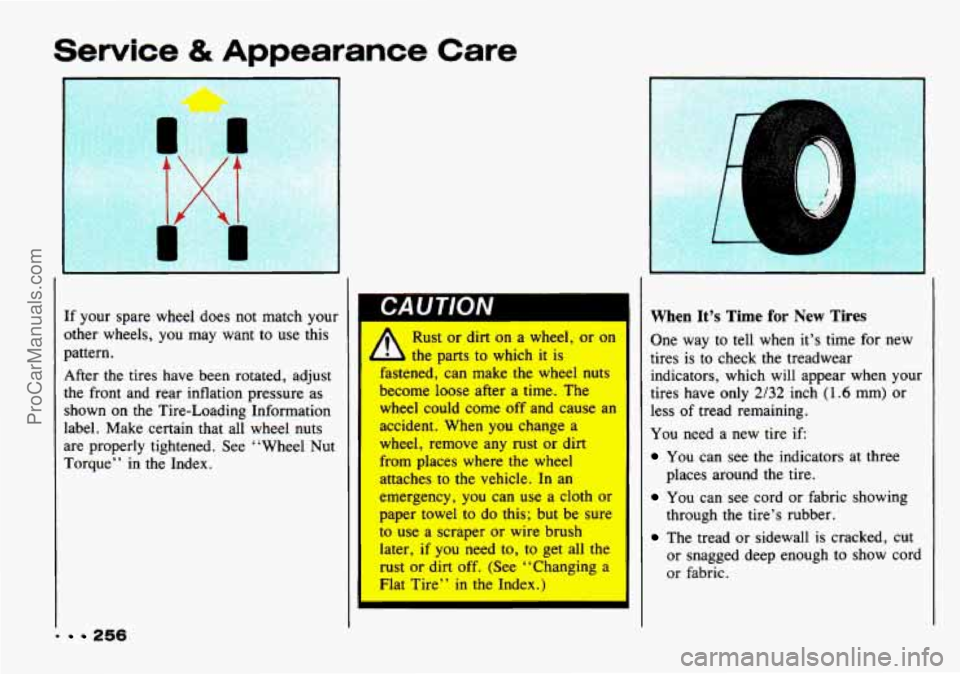
If your spare wheel does not match your
other wheels, you may want to use this
pattern.
After the tires have been rotated, adjust
the front and rear inflation pressure as
shown
on the Tire-Loading Information
label. Make certain that all wheel nuts
are properly tightened. See “Wheel Nut
Torque’’ in the Index.
CA U TION
A
Rust or dirt on a wheel, or on
the parts
to which it is
fastened, can make the wheel nuts
become loose after a time. The
wheel could come off and cause an
accident. When you change a
wheel, remove any rust or dirt
from places where the wheel
attaches to the vehicle. In an
emergency, you can use
a cloth or
paper towel to
do this; but be sure
to use a scraper or wire brush
later,
if you need to, to get all the
rust or dirt
off. (See “Changing a
Flat Tire” in the Index.)
I
When It’s Time for New Tires
One way to tell when it’s time for new
tires is to check the treadwear
indicators, which will appear when your
tires have only
2/32 inch (1.6 mm) or
less of tread remaining.
You need a new tire if
You can see the indicators at three
You can see cord or fabric showing
The tread or sidewall is cracked, cut
places around
the tire.
through the tire’s rubber.
or snagged deep enough to show cord
or fabric.
ProCarManuals.com