lock CHEVROLET TRACKER 1993 Service Manual
[x] Cancel search | Manufacturer: CHEVROLET, Model Year: 1993, Model line: TRACKER, Model: CHEVROLET TRACKER 1993Pages: 339, PDF Size: 15.75 MB
Page 136 of 339
Your Driving and the Road
When you drive into a curve at night,
it’s harder to see the road ahead of you
because it bends away from the straight
beams of your lights. This is one good
reason to drive slower.
134
Steering in Emergencies
There are times when steering can be
more effective than braking. For
example, you come over a hill and
find
a truck stopped in your lane, or a car
suddenly pulls out from nowhere, or a
child darts out from between parked cars
and stops right in front of you.
You can
avoid these problems by braking
- if
you can stop in time. But sometimes you
can’t; there isn’t room. That’s the time
for evasive action
- steering around the
problem.
Your Geo can perform very well in
emergencies like these. First apply your brakes,
but not enough to lock your
front wheels. It is better to remove as
much speed as you can from a possible
collision. Then steer around the
problem, to the left or right depending
on the space available.
An emergency like this requires close
attention and a quick decision.
If you
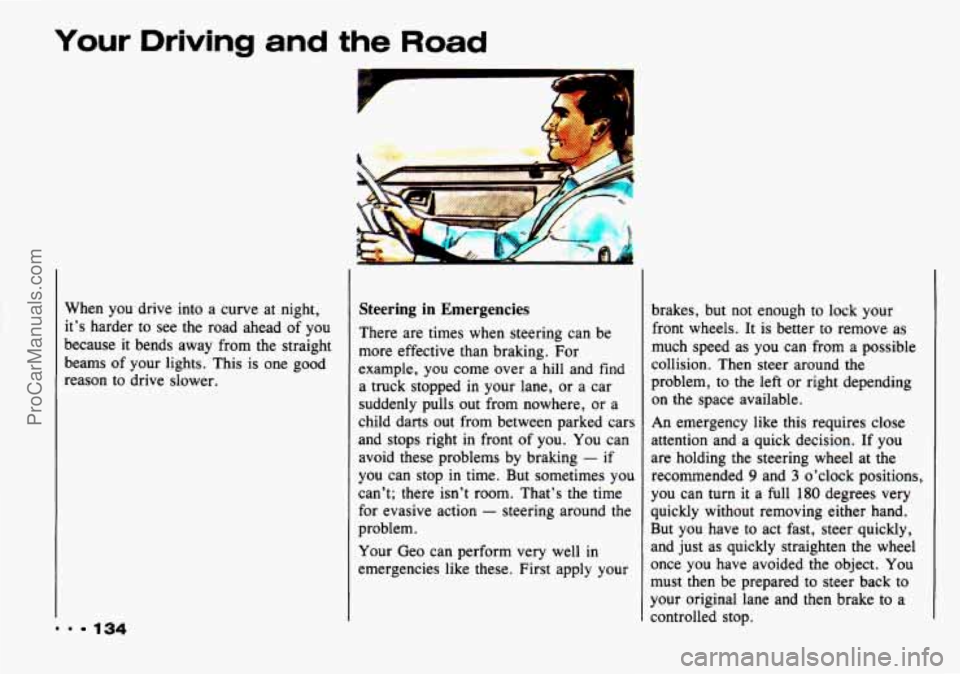
are holding the steering wheel at the
recommended
9 and 3 o’clock positions,
you can turn it a full
180 degrees very
quickly without removing either hand.
But
you have to act fast, steer quickly,
and just as quickly straighten the wheel
once you have avoided the object.
You
must then be prepared to steer back to
your original lane and then brake to a
controlled stop.
ProCarManuals.com
Page 141 of 339
pedal as soon as you feel the vehicle
start to slide. Quickly steer the way you
want the vehicle to go. If you start
steering quickly enough, your vehicle
will straighten out. As
it does, straighten
the front wheels.
Of course, traction is reduced when
water, snow, ice, gravel, or other
material is
on the road. For safety,
you’ll want to slow down and adjust
your driving to these conditions. It is
important to slow down
on slippery
surfaces because stopping distance
will
be longer and vehicle control more
limited. While
driving on a surface with reduced
traction,
try your best to avoid sudden
steering, acceleration, or braking
(including engine braking by shifting to
a lower gear). Any sudden changes
could cause the tires to slide.
You may
not realize the surface
is slippery until
your vehicle is skidding. Learn to
recognize warning clues
- such as
enough water, ice
or packed snow on
the. road to make a “mirrored surface’’
- and slow down when you have any
doubt. Remember: the
rear wheel anti-lock
braking system (RWAL) helps avoid
only a rear braking skid. In a braking
skid (where the front wheels are no
longer rolling), release enough pressure
on the brakes to get the front wheels
rolling again. This restores steering
control. Push the brake pedal down
steadily when you have to stop
suddenly. As long as the front wheels
are rolling, you will have steering
control. Steer the way you want to go.
ProCarManuals.com
Page 142 of 339
Your Driving and the Road
Driving Guidelines
... 140
This multipurpose passenger vehicle is
defined as a utility vehicle in Consumer
Information Regulations issued by the
National Highway Traffic Safety
Administration (NHTSA) of the United
States Department of Transportation.
Utility vehicles have higher ground
clearance and a narrower track to make
them capable of performing in a wide
variety of off-road applications. Specific
design characteristics give them a higher
center of gravity than ordinary cars. An
advantage
of the higher ground
clearance
is a better view of the road
allowing you to anticipate problems. They
are not designed for cornering at
the same speeds as conventional
two-wheel drive vehicles any more than
low-slung sports cars are designed to
perform satisfactorily under off-road
conditions. If at all possible, avoid sharp
turns or abrupt maneuvers. As with
other vehicles of this type, failure to
operate this vehicle correctly may result
in
loss of control or vehicle rollover.
1 Off-Road Driving with
Your Geo Four-Wheel-
Drive Vehicle
This off-road guide is for vehicles that
have four-wheel drive.
Also, see “Anti-Lock Brakes” in the
Index.
If your vehicle doesn’t have four-wheel
drive, you shouldn’t drive off-road
unless you’re on a level, solid surface.
Off-road driving can be great
fun. But it
does have some definite hazards. The
greatest of these is the terrain itself.
“Off-roading” means you’ve left the
great North American road system
behind. Traffic lanes aren’t marked.
Curves aren’t banked. There are no road
ProCarManuals.com
Page 144 of 339
Your Driving and the Road
A Cargo on the load floor
L piled higher than the
seatbacks can be thrown forwarc
during a sudden stop. You or
your passengers could be
injured. Keep cargo below the
top of the seatbacks.
floor can be tossed about when
driving over rough terrain. You
or your passengers can be strucl
by flying objects. Secure the
cargo properly.
Heavy loads on the roof raise
the vehicle’s center of gravity,
making it more likely to roll
over. You can be seriously or
fatally injured if the vehicle rolls
over. Put heavy loads inside the
cargo area, not on the roof.
Keep cargo
in the cargo area as
far forward and low as possible.
Unsecured cargo on the load
I
You’ll find other important information
in this manual. See “Vehicle Loading,”
and “Tires” in the Index.
Traveling to Remote Areas
It makes sense to plan your trip,
especially when going to a remote area.
Know the terrain and plan your route.
You are much less likely to get bad
surprises. Get accurate maps
of trails
and terrain.
Try to learn of any blocked
or closed roads.
It’s also
a good idea to travel with at
least one other vehicle.
If something
happens to one of them,
the other can
help quickly. Does
your vehicle have a winch? If
so,
be sure to read the winch instructions.
In a remote area, a winch can be handy
if you get stuck. But you’ll want to
know how to use it properly.
... 142
ProCarManuals.com
Page 148 of 339
Your Driving and the load
1 CAUTION
1 Many hills are simply too I
- steep for any vehicle. If you
drive up them,
you will stall. If
you drive down them, you can’t
control your speed. If you drive
across them, you will
roll over.
You could be seriously injured or
killed. If you have any doubt about
the steepness, don’t drive the hill.
Approaching a Hill
When you approach a hill, you need to
decide if it’s one of those hills that’s just
too steep to climb, descend,
or cross.
Steepness can be hard
to judge. On a
very small hill,
for example, there may
be a smooth, constant incline with only
a small change in elevation where you
can easily see all the way to the top. On
a large hill, the incline may get steeper
as
you near the top, but you may not see
this because the crest of the hill is
hidden by bushes,
grass, or shrubs.
Here are some other things to consider
as you approch a hill.
Is there a constant incline, or does the
hill get sharply steeper
in places?
Is there good traction on the hillside,
or will the surface cause tire slipping?
Is there a straight path up or down the
hill
so you won’t have to make
turning maneuvers?
Are there obstructions on the hill that
can block your path (boulders, trees,
logs
or ruts)?
What’s beyond the hill? Is there a
cliff, an embankment, a drop-off, a
fence? Get out and walk the hill if
you don’t know. It’s the smart way to
find out.
ProCarManuals.com
Page 151 of 339
If your engine has stopped running,
you’ll need to restart
it. With the
brake pedal depressed and the
parking brake still applied, shift the
transmission
to P (Park) (or, shift to
Neutral if your vehicle has a
manual transmission) and restart the
engine. Then, shift to reverse,
release the parking brake, and
slowly back down the hill in
reverse.
As you are backing down the hill,
put your
left hand on the steering
wheel at the
12 o’clock position.
This way, you’ll be able
to tell if
your wheels are straight or turned to
the left or right as you back down. Here
are some things you
must not do
if you stall, or are about to stall, when
going up
a hill.
Never attempt to prevent a stall by
shifting into
N (Neutral) (or
depressing the clutch, if you have a
manual transmission)
to “rev-up” the
engine and regain forward
momentum. This won’t work. Your
vehicle will roll backwards very
quickly and you could go out of
control.
Instead, apply the regular brake to stop
the vehicle. Then apply the parking
brake. Shift into reverse, release the
parking brake, and slowly back down.
Never attempt to turn around if you
are about to stall when going up a
hill.
If the hill is steep enough to
stall your vehicle, it’s steep enough
to cause you to roll over if you turn
around. If you can’t make it up the
hill, you must back down the hill.
Q: Suppose, after stalling, I try to
back down the hill and decide
I
just can’t do it. What should I do?
A: Set the parking brake, put your
transmission
in P (Park) (or the
ProCarManuals.com
Page 154 of 339
Your Driving and the Road
e
“free-wheeling. ” Your brakes will
have to do all the work and could
overheat and fade.
Avoid braking
so hard that you lock
the wheels when going downhill. If
your front wheels are locked, you
can’t steer your vehicle. If your
wheels lock up during downhill
braking, you may feel the vehicle
starting to slide sideways.
To regain
your direction, just ease off the
brakes and steer to keep the front of
the vehicle pointing straight
downhill.
Q: Am I likely to stall when going
A:
0
e
downhill?
It’s much more likely to happen
going uphill. But if
it happens going
downhill, here’s what to do.
Stop your vehicle by applying
the
regular brakes. Apply the parking
brake.
Shift to
P (Park) (or to Neutral with
the manual transmission) and, while
still braking, restart the engine.
Shift back to a low gear, release
the
parking brake, and drive straight
down.
If the engine won’t start, get out and
Driving Across an Incline
Sooner or later, an off-road trail will
probably go across
the incline of a hill.
If this happens, you have to decide
whether to try to drive across the
incline. Here are some things to
consider:
A hill that can be driven straight up
or down may be too steep to drive
across. When you go straight up or
down a hill, the length of the wheel
base (the distance from the front
wheels to the rear wheels) reduces
the likelihood the vehicle will get
help.
... 152
ProCarManuals.com
Page 160 of 339
Your Driving and the Road
Night Vision
No one can see as well at night as in the
daytime. But as we get older these
differences increase.
A 50-year-old
driver may require at least twice as
much light to see the same thing at night
as a 20-year-old.
What you do in the daytime can also
affect your night vision. For example, if
you spend the day
in bright sunshine
you are wise to wear sunglasses. Your
eyes will have less trouble adjusting to
night.
= = 158
But if you’re driving, don’t wear
sunglasses at night. They may cut down
on glare from headlights, but
they also
make a lot of things invisible
that should
remain visible - such as parked cars,
obstacles, pedestrians, or even trains
blocking railway crossings.
You may
want to put on your sunglasses after you
have pulled into a brightly-lighted
service or refreshment area. Eyes
shielded from that glare may adjust
more quickly to darkness back on
the
road. But be sure to remove your
sunglasses before you leave the service
area.
You can be temporarily blinded by
approaching lights. It can take a second
or two, or even several seconds, for
your eyes to readjust
to the dark. When
you are faced with severe glare (as from
a driver who doesn’t lower the high
beams, or a vehicle with misaimed
headlights), slow down a little. Avoid
staring directly into the approaching
lights. If there is a line of opposing
traffic, make occasional glances over the
line of headlights to make certain that
one of the vehicles isn’t starting to move
into your lane. Once you are past the
bright lights, give your eyes time to
readjust before resuming speed.
ProCarManuals.com
Page 175 of 339
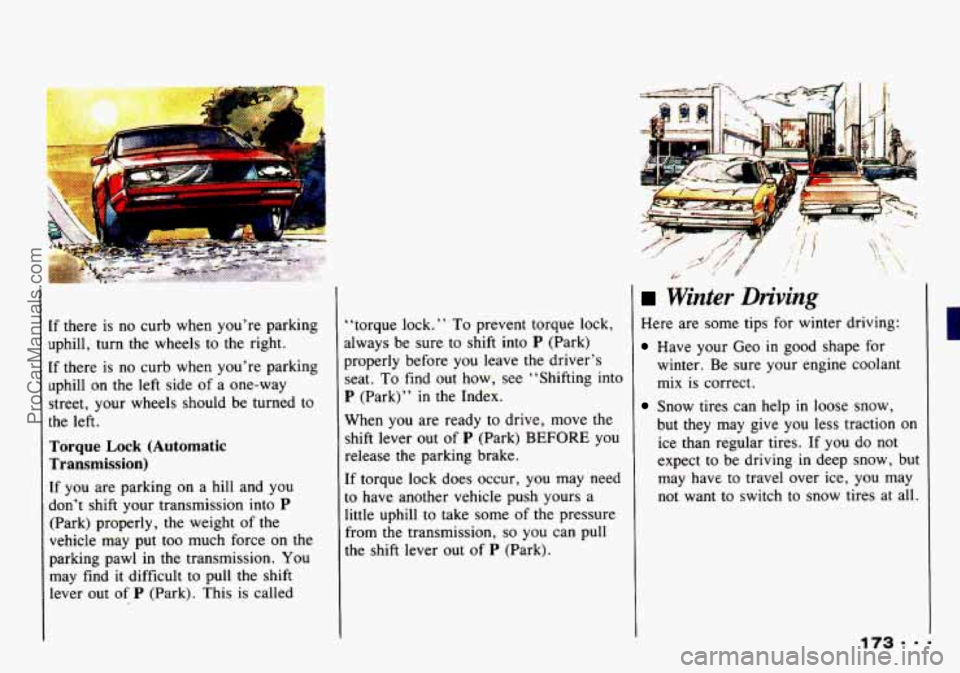
[f there is no curb when you’re parking
uphill, turn the wheels to the right.
[f there is
no curb when you’re parking
uphill on the left side
of a one-way
street, your wheels should be turned
to
the left.
Torque Lock (Automatic
Transmission)
If you are parking on a hill and you
don’t shift your transmission into
P
(Park) properly, the weight of the
vehicle may put too much force on the
parking pawl in the transmission.
You
may find it difficult to pull the shift
lever out of
P (Park). This is called “torque
lock.”
To prevent torque lock,
always be sure to shift into
P (Park)
properly before you leave the driver’s
seat.
To find out how, see ‘‘Shifting into
P (Park)” in the Index.
When you are ready to drive, move the
shift lever out
of P (Park) BEFORE you
release the parking brake.
If torque lock does occur, you may need
to have another vehicle push yours a
little uphill
to take some of the pressure
from the transmission,
so you can pull
the shift lever out
of P (Park).
Winter Driving
Here are some tips for winter driving:
Have your Geo in good shape for
winter. Be sure your engine coolant
mix is correct.
Snow tires can help in loose snow,
but they may give you less traction on
ice than regular tires.
If you do not
expect
to be driving in deep snow, but
may have to travel over ice, you may
not want
to switch to snow tires at all.
I
ProCarManuals.com
Page 177 of 339
Your anti-lock brakes improve your
ability to make a hard stop on a slippery
road. Even though you have the
anti-lock braking system, you’ll want to
begin stopping sooner than you would
on dry pavement. See “Anti-lock” in
the Index.
Allow greater following distance on any
slippery road.
Watch for slippery spots. The road
might be fine until
you hit a spot
that’s covered with ice. On an
otherwise clear road, ice patches may
appear
in shaded areas where the sun
can’t reach: around clumps of trees,
behind buildings, or under bridges. Sometimes the
surface
of a curve or
an overpass may remain icy
when the
surrounding roads are clear. If you
see a patch
of ice ahead of you, brake
before you are on it. Try not to brake
while you’re actually on the ice, and
avoid sudden steering maneuvers.
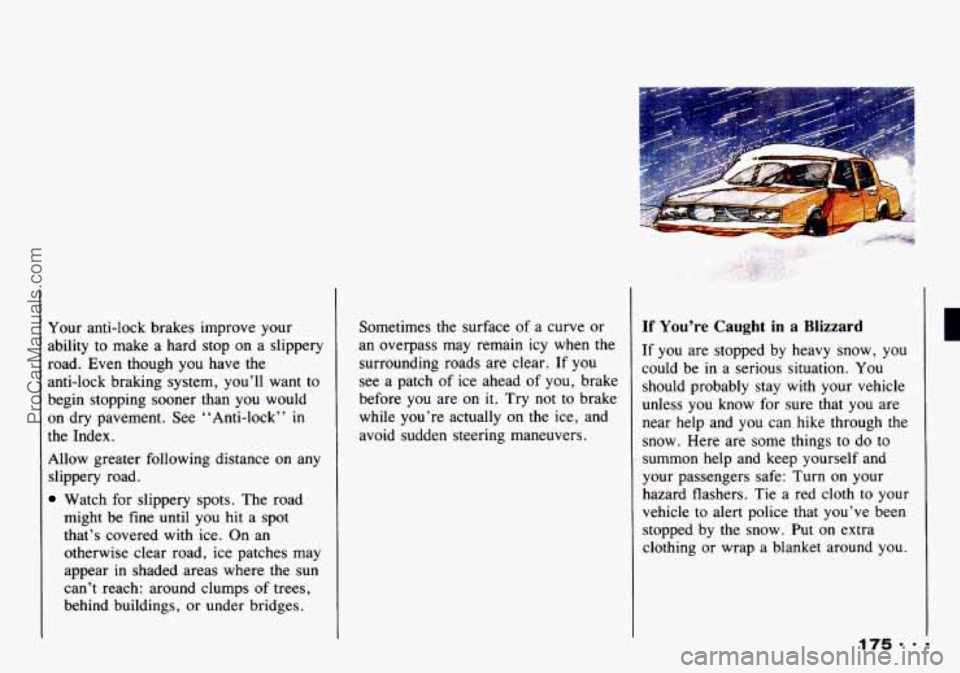
If You’re Caught in a Blizzard
If you are stopped by heavy snow, you
could be
in a serious situation. You
should probably stay with your vehicle
unless you know for sure that you are
near help and you can hike through the
snow. Here are some things to do to
summon help and keep yourself and
your passengers safe: Turn on your
hazard flashers. Tie a red cloth to your
vehicle to alert police that you’ve been
stopped by the snow. Put on extra
clothing or wrap a blanket around you.
ProCarManuals.com