four wheel drive CHEVROLET TRACKER 1994 User Guide
[x] Cancel search | Manufacturer: CHEVROLET, Model Year: 1994, Model line: TRACKER, Model: CHEVROLET TRACKER 1994Pages: 258, PDF Size: 14.43 MB
Page 105 of 258
Your Driving and the Road
that happens, release enough pressure on
the brakes to get the wheels rolling again
so that you can steer.
With the four-wheel drive option, you
won’t have anti-lock braking when you
shift into four-wheel drive. But
you will
have regular braking. When you shift
back into two-wheel drive, you will have
anti-lock again.
Braking in Emergencies
At some time, nearly every driver gets
into a situation that requires hard braking.
You have the rear-wheel anti-lock braking
system. Your front wheels can stop rolling
when you brake
very hard. Once they do,
the vehicle can’t respond to your steering.
Momentum
will carry it in whatever
direction it was headed when the front
wheels stopped rolling. That could be off
the road, into the very thing you were
trying to avoid, or into traffic.
So, use a “squeeze” braking technique.
This will give you maximum braking
while maintaining steering control.
You
do this by pushing on the brake pedal
with steadily increasing pressure. When
you do, it will help maintain steering
control. In many emergencies, steering
can help you more than even the
very best
braking.
. . .lo4
Steering
Power Steering
If you lose power steering assist because
the engine stops or the system is not
functioning, you can steer but
it will take
much more effort.
Steering Tips
Driving on Curves
It’s important to take curves at a
reasonable speed.
A lot of the “driver lost control” accidents
mentioned on the news happen on curves.
Here’s why:
Experienced driver or beginner, each of
us is subject to the same laws of physics
when driving on curves. The traction of
the tires against the road surface makes
it
possible for the vehicle to change its path
when you
turn the front wheels. If there’s
no traction, inertia will keep the vehicle
going
in the same direction. If you’ve
ever tried to steer a vehicle on wet ice,
you’ll understand this.
The traction you can get in a curve
depends on the condition of your tires and
the road surface, the angle at which
the
curve is banked, and your speed. While you’re
in a curve, speed
is the one factor
you can control.
Suppose you’re steering through a sharp
curve. Then
you suddenly apply the
brakes. Both control systems
- steering
and braking
- have to do their work
where the tires meet the road. Adding the
hard braking can demand too much at
those places.
You can lose control.
The same thing can happen if you’re
steering through a sharp curve and you
suddenly accelerate. Those two control
systems
- steering and acceleration -
can overwhelm those places where the
tires meet
the road and make you lose
control.
What should
you do if this ever happens?
Ease up on the brake or accelerator pedal,
steer the vehicle the way you want it to
go, and slow down.
Speed limit signs near curves warn that
you should adjust your speed. Of course,
the posted speeds are based on good
weather and road conditions. Under less
favorable conditions you’ll want to go
slower.
If you need to reduce your speed as you
approach a curve, do
it before you enter
ProCarManuals.com
Page 109 of 258
Your Driving and the Road
As with other vehicles of this type, failure
to operate this vehicle correctly may
result
in loss of control or vehicle
rollover.
Off-Road Driving with
Your Geo Four-wheel
Drive Vehicle
This off-road guide is for vehicles that
have four-wheel drive.
Also, see “Anti-lock Brakes”
in the Index.
If your vehicle doesn’t have four-wheel
drive, you shouldn’t drive off-road unless
you’re
on a level, solid surface.
Off-road driving can be great fun. But
it
does have some definite hazards. The
greatest of these is the terrain itself.
“Off-roading” means
you’ve left the great
North American road system behind.
Traffic lanes aren‘t marked. Curves aren’t
banked. There are no road signs. Surfwes
can be slippery, rough, uphill
or downhill.
In short, you’ve gone right back to nature.
Off-road driving involves
some new
skills. And that’s
why it’s very important
that
you read this guide. You’ll find many
driving tips and suggestions. These
will
help make your off-road driving safer and
more enjoyable.
=. .lo8
Before You Go Off-Roading
There are some things to do before you
go out. For example, be sure to have all
necessary maintenance and service work
done. Be sure you read all the information
about your four-wheel drive vehicle in
this manual. Is there enough fuel? Is the
spare tire
fully inflated‘? Are the fluid
levels up where they should
be‘? What are
the local laws
that apply to off-roacting
where you’ll be driving?
If you don’t
know, you should check with law
enforcement people
in the area. Will you
be on someone’s private land?
If so, be
sure
to get the necessary permission.
Loading Your Vehicle for Off-Road
Driving
There are some important things to
remember
about how to load your
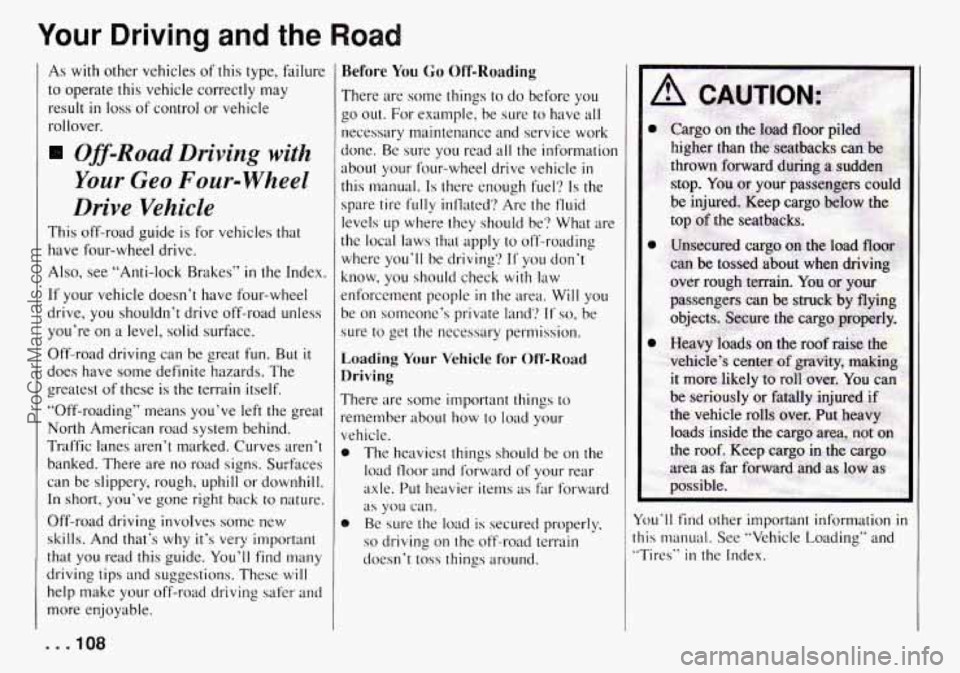
vehicle. The heavies1 things should
be on the
load floor and forward of your rear
axle. Put heavier items
as far forward
as you can.
e Be sure the load is secured properly,
so driving on the off-road terrain
doesn’t
toss things around.
You’ll find other important information in
this manual. See “Vehicle Loading” and
”Tires”
in the Index.
ProCarManuals.com
Page 129 of 258

Your Driving and the Road
passed vehicle before vou can return to
your lane.
Backing Up
Hold the bottom of the steering wheel
with one hand. Then, to move the trailer
to the left, just move that hand to the left.
To move
the trailer to the right, move
your hand to the right. Always back up
slowly and,
if possible, have someone
guide you.
Making Turns
When you’re turning with a trailer, make
wider turns than normal.
Do this so your
trailer won’t strike soft shoulders, curbs,
road signs, trees, or other objects. Avoid
jerky or sudden maneuvers. Signal well
in
advance.
Turn Signals When Towing a Trailer
When you tow a trailer, your vehicle has
to have a different turn signal flasher and
extra wiring. The green arrows on your
instrument panel will flash whenever you
signal a turn or lane change. Properly
hooked up, the trailer lights will also
flash, telling other drivers you’re about to
turn, change lanes or stop. When towing
a trailer, the green arrows
on your instrument panel will flash for
turns even
if the bulbs on the trailer are
burned out. Thus, you may think drivers
behind you are seeing your signal when
they are not. It’s important to check
occasionally to be sure the trailer bulbs
are still working.
Driving on Grades
Reduce speed and shift to a lower gear
before you start down a long or steep
downgrade. If you don’t shift down, you
might have to use your brakes
so much
that they would get hot and no longer
work well.
On a long uphill grade, shift down and
reduce your speed to around
45 mph
(70 km/h) to reduce the possibility of
engine and transmission overheating.
If
you are towing a trailer and you have
a manual transmission with fifth gear,
you may prefer not
to use fifth gear. Just
drive in fourth gear (or, as
you need to,
.a lower gear).
Parking on Hills
You really should not park your vehicle,
with a trailer attached, on a hill. If
something goes wrong, your
rig could start
to move. People can be injured, and
both your vehicle and the trailer can be
damaged.
But if you ever have to park
your rig on a
hill, here’s how to do it:
1. Apply your regular brakes, but don’t
shift into
“F’” (Park) yet, or into gear
for a manual transmission.
2. Have someone place chocks under the
3. When the wheel chocks are in place,
release the regular brakes until the
chocks absorb the load.
trailer wheels.
4. Reapply the regular brakes.
Then
apply your parking brake, and then
shift to
‘T” (Park), or “R” (Reverse)
for a manual transmission.
5. If you have a four-wheel-drive
vehicle, be sure the transfer case is
in
a drive gear - not in “N” (Neutral).
6. Release the regular brakes.
. .-’ . 1 28
ProCarManuals.com
Page 131 of 258

Your Driving and the Road
2. Set the parking brake.
3. If your Geo is a four-wheel-drive
vehicle, set your manual freewheeling
hubs
to ”FREE” or unlock your
automatic I‘reewheeling hubs. See “Four-wheel Drive”
in the Index.
4. Turn the ignilion key to ”ACC’‘ to
unlock the steering wheel.
5. Clamp the steering wheel in a
straight-ahead position, with a
clamping device designed for towing.
6. Release the parking brake.
I NOTICE:
I
Make sure that the towing speed does
not exceed
55 mph (90 km/h), or
your Geo could be badly damaged.
~~
Towing Your Geo from the Front
NOTICE:
If your vehicle has automatic free-
wheeling hubs
or two-wheel drive,
do not tow
it on all four wheels. If
you do, your transmission could be
damaged.
If you have a four-wheel-drive vehicle
with manual freewheeling hubs, it can be
towed from the front with
all four wheels
on the ground. Follow these steps:
1. Set the parking brake.
2. Turn the ignition key to “ACC” to
unlock the steering wheel.
3. Shift your automatic transmission into
“P” (Park), or your manual
transmission into “2” (Second).
4. Shift the transfer case to “N”
(Neutral).
“Four-wheel Drive”
in the Index.
5. Set the hubs to “FREE.” See
6. Reledse the parking brake,
Stop towing every 200 miles
(300 km)
and start the engine. Leave the transfer
case shift lever
in ”N” (Neutral). Shift
your automatic transmission
to “D”
(Drive); leave a manual transmission
in
“2” (Second) and release the clutch. Run
the engine
at medium speed for one
minute to circulate the oil in the transfer
case. Turn the ignition key to
“ACC.”
Now, you can continue towing your Geo.
I
NOTICE:
I
Make sure the towing speed does not
exceed
SO mph (80 km/h), or your
Geo could be badly damaged.
I
. . .130
ProCarManuals.com
Page 137 of 258
Problems on the Road
h I B
2. Remove the cables in reverse order
to prevent electrical shorting. Take
care that they don't touch each other
or any other metal.
A. Heavy Metal Engine Part
B. Good Battery
C. Dead Battery
C
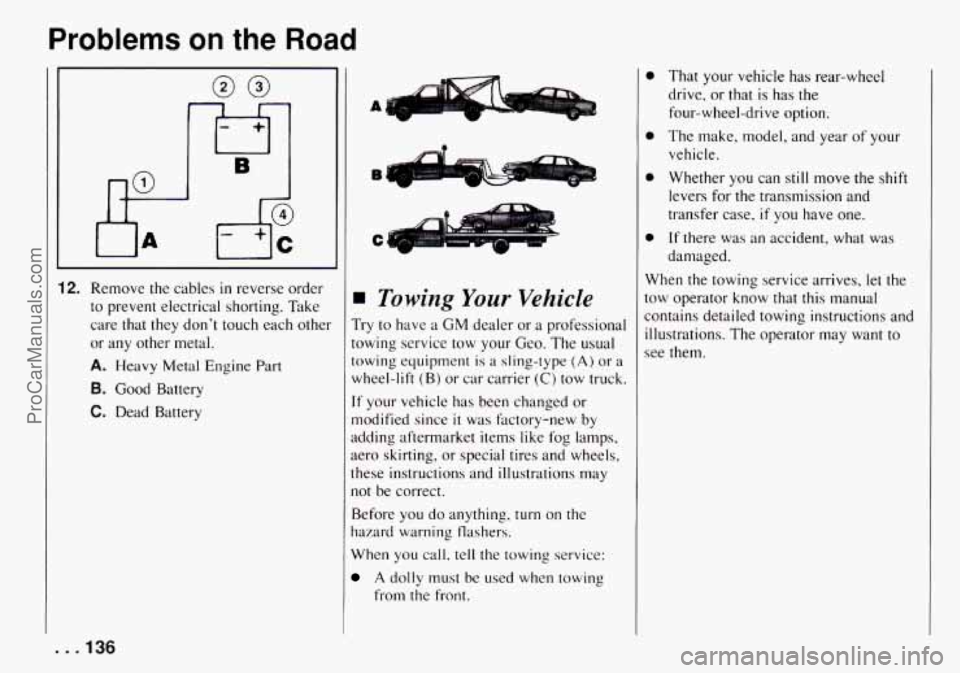
Towing Your Vehicle
Try to have a GM dealer or a professional
towing service tow your Geo. The usual
towing equipment
is a sling-type (A) or a
wheel-lift (B) or car carrier (C) tow truck.
If your vehicle has been changed or
modified since
it was factory-new by
adding aftermarket items like fog lamps,
aero skirting, or special tires and wheels,
these instructions and illustrations may
not be correct.
Before you do anything, turn
on the
hazard warning flashers.
When you
call, tell the towing service:
A dolly must be used when towing
from the front.
0
e
e
That your vehicle has rear-wheel
drive, or that is has the
four-wheel-drive option.
The make, model, and year
of your
vehicle.
Whether you
can still move the shift
levers for the transmission and
transfer case,
if you have one.
If there was an accident, what was
damaged.
When the towing service arrives,
let the
tow operator know that this manual
contains detailed towing instructions and
illustrations. The operator may want to
see them.
. .I36
ProCarManuals.com
Page 138 of 258

G
A CAUTION:
To help avoid injury to you or others:
0
i.
0
0
0
0
Never let passengers ride in a
vehicle that
is being towed.
Never
tow faster than safe or
Never tow with damaged parts
not fully secured.
Never get under
your vehicle
after
it has been lifted by the tow
truck.
Always use seperate safety
chains
on each side when towing
a vehicle.
Never use
T-hooks. Use “J”
hooks instead.
posted speeds.
When your vehicle is being towed, have
the ignition key
off. The steering wheel
should
be clamped in a straight-ahead
position, with a clamping device designed
for towing service.
Do not use the
vehicle’s steering column
lock for this.
The transmi.ssion and transfer case,
if you
have one, should be in “Neutral” and the
parking brake released.
Don’t have
your vehicle towed with the
rear wheels
in contact with the ground. If
a vehicle must be towed from the front
with sling-type or wheel lift equipment,
the rear wheels
must be supported on a
If your vehicle has four-wheel drive,
don’t have
it towed on the front wheels
unless
you must. If a vehicle with
four-wheel drive
must be towed on the
front wheels,
set your tnanual,
freewheeling hubs
to “FREE” or unlock
your automatic freewheeling hubs, and set
your transfer case to two-wheel drive. If
your vehicle must be towed on the front
wheels, don‘t
go more than 55 rnph (90
km/h).
dolly.
131 . . . ProCarManuals.com
Page 148 of 258
... .v ,
A CAUTION:
Changing a tire can cause an injury. The vehicle can slip off the jack and roll
over
you or other people. You and they could be badly injured. Find a level
place to change your tire.
To help prevent the vehicle from moving:
1. Set the parking brake firmly.
2. Put an automatic transmission shift lever in T“ (Park), or shift a manual
3. If you have a four-wheel-drive vehicle, be sure the transfer case is in a drive
4. Turn off the engine.
transmission
to “ 1” (First) or “R” (Reverse).
gear
- not in “N’ (Neutral).
To be even more certain the vehicle won’t move, you can put chocks at the front
and rear
of the tire farthest away from the one being changed. That would be the
tire
on the other side of the vehicle, at the opposite end. The
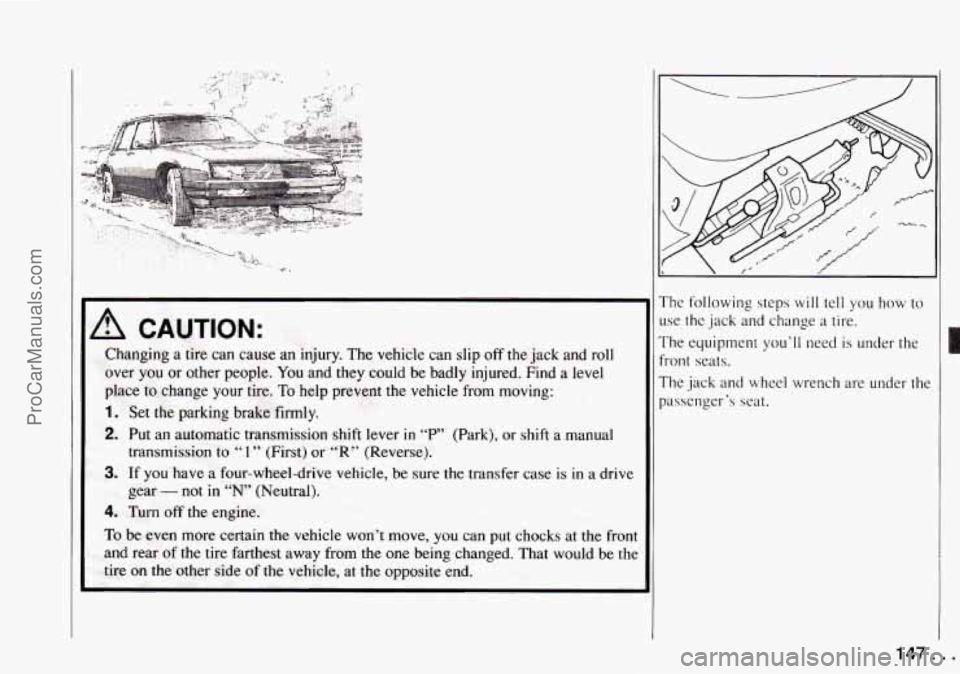
following steps
will tell you how to
.rse the jack and change
a tire.
The equipment you’ll need is under the
ront seats.
rhejack and wheel wrench
are under the
passenger’s
seat.
147 ...
ProCarManuals.com
Page 156 of 258
Here you will find information
about the care of your Geo
. This
part begins with service and fuel
information. and then it shows
how to check important fluid and
lubricant levels
. There is also
technical information about your
vehicle. and a section devoted
to its appearance care
.
Service & Appearance Care
Service ........................................................
Fuel ..........................................................
Checking Things under the Hood ...................................
HoodRelease .................................................
Engineoil ...................................................
Aircleaner ...................................................
Automatic Transmission Fluid ....................................
Manual Transmission Fluid ......................................
Clutch Adjustment .............................................
RearAxle ....................................................
Four-WheelDrive .............................................
Enginecoolant ................................................
Power Steering Fluid ...........................................
Windshield Washer Fluid ........................................
Brake Master Cylinder ..........................................
Bulb Replacement ...............................................
Loading Your Vehicle ..........................................
Tires ........................................................
Appearance Care Materials Chart ...................................
Vehicle Identification Number (VIN) ................................
Service Parts Identification Label ...................................
Add-on Electrical Equipment ......................................
Fuses and Circuit Breakers ........................................
Capacities and Specifications .......................................
Battery ......................................................
Appearancecare ................................................
ReplacementBulbs ..............................................
156
156
159
159
162
165
167
168
169 169
170 170
173
174
174
176 177
181
183
189 195 196
196
196
196
199
200
155 ...
ProCarManuals.com
Page 171 of 258
~~
~~ ~ ~~~~ ~ Service and Appearance Care
Four- Wheel Drive
Most
lubricant checks in this section also
apply to four-wheel-drive vehicles.
However, they have
two additional
systems that need lubricatiog.
Transfer Case
When to Check qnd Change Lubricant
Refer to the Maintenance Schedule to
determine how often to check the
lubricant and when to change
it. See
“Scheduled Maintenance Services”
in the
Index.
How to Check Lubricant
If the level is below the bottom of the
filler plug hole, you’ll need to add some
lubricant. Add enough lubricant to raise
the level to the bottom of the filler plug
hole.
What to Use
Refer to the Maintenance Schedule to
determine what kind of lybricant to use.
See “Recommended Fluids and
Lubricants”
in the Index.
Front Axle
When
to Check and Change Lubricant
Refer to the Maintenance Schedule to a
determine how often to check the
lubricant and when to change it. See
“Periodic Maintenance Inspections” and
“Scheduled Maintenance Services”
in the
Index.
How to Check Lubricant
If the level is below the bottom of the
filler plug hole, you’ll need to add some
lubricant.
If the differential is at operating
temperature (warm), add enough lubricant
to raise the level to the bottom of the filler
plug hole.
If the differential
is cold, add enough
lubricant to raise the level to
1/2 inch (12
mm) below the filler plug hole.
What to Use
Refer to the Maintenance Schedule to
determine
what kind of lubricant to use.
See “Recommended Fluids and
Lubricants”
in the Index.
Engine Coolant
The following explains your cooling
system and how to add coolant when it is
low. If you have a problem with engine
overheating, see “Engine Overheating”
in
the Index.
The proper coolant for your Geo will:
Give freezing protection down to
-20°F (-29”C), or -34°F (-37°C)
in
Canada and for vehicles with the cold
climate option.
Give boiling protection up to 258°F
(125°C).
Protect against rust and corrosion.
Help keep the proper engine
temperature.
Let the warning lights work as they
should.
What to Use:
Use a mixture of one-half clean water
(preferably distilled) and one-half
antifreeze that meets “GM Specification
6038-M,” which won’t damage aluminum
parts.
You can also use a recycled coolant
conforming to
“GM Specification
6038-M”
with a complete coolant flush
. . .I70
ProCarManuals.com
Page 183 of 258

Service and Appearance Care
1
1
a
I
> 7
i
tl
B
tl
F
tl
0
S
T
t
f
r
1
1)
:he other label is the Certification label,
dso found
on the driver’s door lock pillal
t tells you the gross weight capacity of
Tour vehicle, called the
GVWR (Gross
Jehicle Weight Rating). The
GVWR
dudes the weight of the vehicle, all
ccupants, fuel and cargo. Never exceed
ne GVWR for your vehicle, or the Gross
Ytle Weight Rating (GAWR) for either
he front or rear axle.
ind, if you
do have a heavy load, you
hould spread it out. Don’t carry more
han
400 pounds (1 8 1 kilograms) in your
ear area when four people are in your
wo-wheel drive vehicle.
If you have a
our-wheel drive vehicle, don’t carry
nore than
200 pounds (91 kilograms) in
{our rear area when four people are
in
Tour vehicle.
NOTICE:
I
Your warranty does not cover parts or
components that fail because
of over-
loading.
I ~
[f you put things inside your vehicle -
like suitcases, tools, packages, or
anything else
- they will go as fast as the
vehicle goes. If you have to stop or turn
quickly, or if there is a crash, they’ll keep
going.
. .I82
ProCarManuals.com