fuel CHEVROLET TRACKER 1994 User Guide
[x] Cancel search | Manufacturer: CHEVROLET, Model Year: 1994, Model line: TRACKER, Model: CHEVROLET TRACKER 1994Pages: 258, PDF Size: 14.43 MB
Page 117 of 258
Your Driving and the Road
long as your tailpipe is under water, you'll
never be able to
start your engine. When
you go through water, remember that
when your brakes get wet, it may take
you longer to stop.
After Off-Road Driving
Remove any brush or debris that has
collected
on the underbody, chassis or
under the hood. These accumulations can
be a fire hazard.
After operation in mud or sand, have the
brake linings cleaned and checked. These
substances can cause glazing and uneven
braking. Check the body structure,
steering, suspension, wheels, tires, and exhaust system
for damage.
Also, check
the fuel lines and cooling system for any
leakage.
Your vehicle will require more frequent
service due to off-road
use. Refer to the
Maintenance Schedule for additional
information.
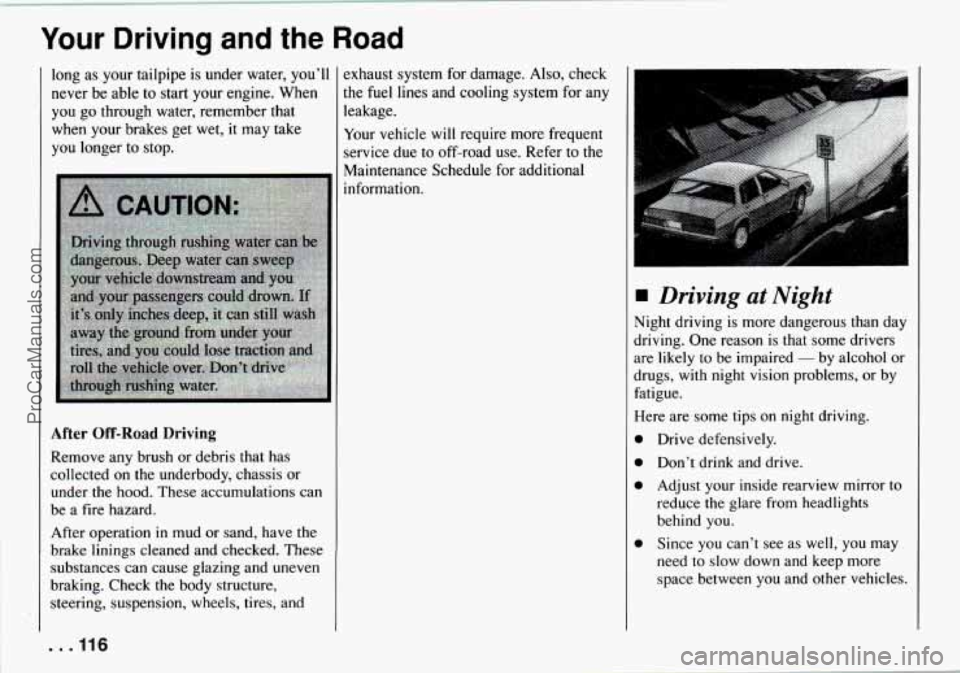
4 Driving at Night
Night driving is more dangerous than day
driving. One reason is that some drivers
are likely
to be impaired - by alcohol or
drugs, with night vision problems, or by
fatigue.
Here are some tips on night driving.
Drive defensively.
Don't drink and drive.
Adjust your inside rearview mirror to
reduce the glare from headlights
behind you.
Since you can't see as well,
you may
need to slow down and keep more space between
you and other vehicles.
. . .116
ProCarManuals.com
Page 122 of 258
0
0
Wiper Blades: Are they in good
shape?
Fuel, Engine Oil, Other Fluids:
Have you checked all levels?
Lights: Are they all working? Are the
lenses clean?
Tires: They are vitally important to a
safe, trouble-free trip. Is the tread
good enough for long-distance
driving? Are the tires all inflated to
the recommended pressure?
Weather Forecasts: What’s the
weather outlook along your route?
Should you delay your trip a short
time to avoid a major storm system?
Maps: Do you have up-to-date
maps?
Highway Hypnosis
Is there actually such a condition as
“highway hypnosis”? Or is it just plain
falling asleep at the wheel? Call
it
highway hypnosis, lack of awareness, or
whatever.
There is something about an easy stretch
of road with
the same scenery, along with
the hum of the tires
on the road, the drone
of the engine, and the rush of the wind
against the vehicle that can make you sleepy. Don’t let it happen
to you! If it
does, your vehicle can leave the road in
less than a second, and
you could crash
and be injured.
What can you do about highway
hypnosis? First, be aware that
it can
happen.
Then here are some tips:
0 Make sure your vehicle is well
ventilated, with a comfortably cool
interior.
0 Keep your eyes moving. Scan the
road ahead and to
the sides. Check
your mirrors and your instruments
frequently.
0 If you get sleepy, pull off the road into
a rest, service, or parking area and
take a nap, get some exercise,
or both.
For safety, treat drowsiness on the
highway as an emergency.
Hill and Mountain
Roads
Driving on steep hills or mountains is
different from driving
in flat or rolling
terrain. If you drive regularly in steep
country, or
if you’re planning to visit
there, here are some tips that can make
your trips safer and more enjoyable.
(See “Off-Road Driving” in the Index
for information about driving off-road.)
Keep your vehicle in good shape.
Check all fluid levels and also the
brakes, tires, cooling system and
transmission. These parts can work
hard
on mountain roads.
ILI . . .
ProCarManuals.com
Page 125 of 258
Your Driving and the Road
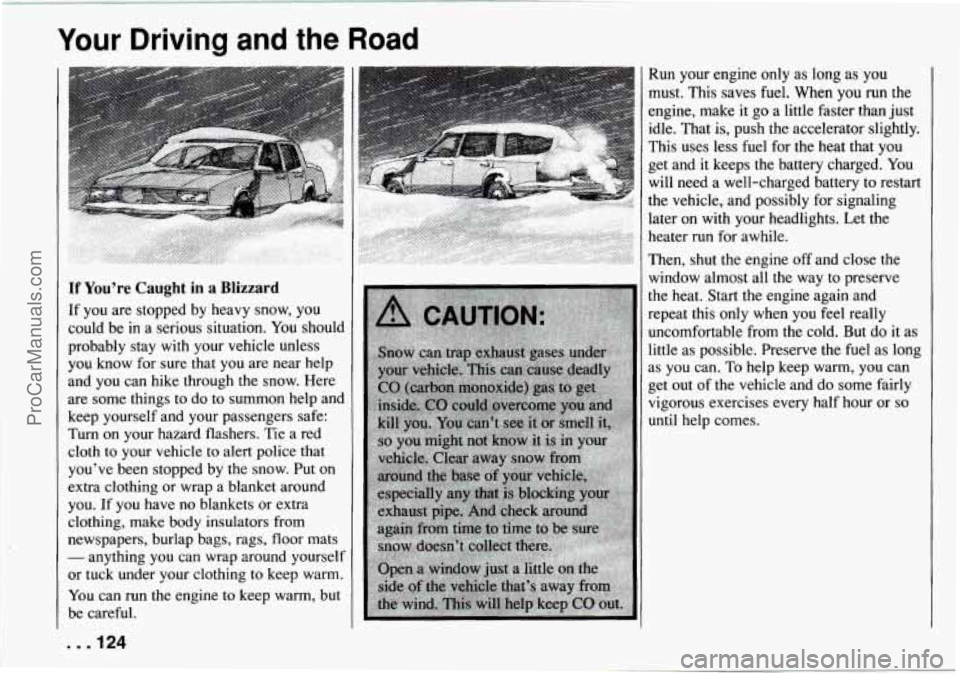
If You’re Caught in a Blizzard
If you are stopped by heavy snow, you
could be in a serious situation. You should
probably stay with your vehicle unless
you know
for sure that you are near help
and you can hike through the snow. Here
are some things to do to summon help and
keep yourself and your passengers safe:
Turn on your hazard flashers. Tie a red
cloth to your vehicle to alert police that
you’ve been stopped by the snow. Put on
extra clothing or wrap
a blanket around
you. If you have no blankets or extra
clothing, make body insulators from
newspapers, burlap bags, rags, floor mats
- anything you can wrap around yourself
or tuck under your clothing to keep warm.
You can
run the engine to keep warm, but
be careful. Run your engine
only as long as
you
must. This saves fuel. When you run the
engine, make it go a little faster than just
idle. That is, push the accelerator slightly.
This uses less fuel for the heat that you
get and it keeps the battery charged. You
will need a well-charged battery to restart
the vehicle, and possibly for signaling
later on with your headlights. Let the
heater run for awhile.
Then, shut the engine off and close the
window almost all the way to preserve
the heat. Start the engine again and
repeat this only when you feel really
uncomfortable from the cold. But
do it as
little as possible. Preserve the fuel as long
3s you can. To help keep warm, you can
get out of the vehicle and do some fairly
vigorous exercises every half hour or
so
until help comes.
. . ,124
ProCarManuals.com
Page 126 of 258

Towing a Trailer
NOTICE:
Pulling a trailer improperly can dam-
age your vehicle and result in costly
repairs not covered by your warranty,
To pull a trailer correctly, follow the
advice in this section, and see your
Geo dealer for important information
about towing a trailer with your
vehicle. Your
vehicle can tow a trailer. To identify
what the vehicle trailering capacity
is for
your vehicle,
you should read the
information in “Weight
of the Trailer” that
appears later in this section.
But trailering
is different than just driving your vehicle
by itself. Trailering means changes in
handling, durability, and fuel economy.
Successful, safe trailering takes correct
equipment, and it has to be used properly.
That’s the reason for this section.
In it are
many time-tested, important trailering
tips and safety rules. Many of these are
important for your safety and that of your
passengers.
So please read this section
carefully before you pull a trailer.
Load-pulling components such as the
engine, transmission, wheel assemblies,
and tires are forced to work harder against
the drag of the added weight. The engine
is required to operate at relatively higher
speeds and under greater loads,
generating extra heat. What’s more, the
trailer adds considerably to wind
resistance, increasing the pulling
requirements.
If You Do Decide to Pull a Trailer
If you do, here are some important points.
There are many different laws having
to do with trailering. Make sure your
rig will be legal, not only where you
live but also where you’ll be driving.
A good source for this information
can be state or provincial police.
Consider using a sway control. You
can ask a hitch dealer about sway
controls.
Don’t tow a trailer at all during the
first
500 miles (800 km) your new
vehicle is driven. Your engine, axle or
other parts could be damaged.
Then, during the first
500 miles (800
km) that you tow a trailer, don’t drive
over
50 mph (80 km/h) and don’t
make starts at
full throttle. This helps
your engine and other parts
of your
vehicle wear in at the heavier loads.
125 ...
ProCarManuals.com
Page 156 of 258
Here you will find information
about the care of your Geo
. This
part begins with service and fuel
information. and then it shows
how to check important fluid and
lubricant levels
. There is also
technical information about your
vehicle. and a section devoted
to its appearance care
.
Service & Appearance Care
Service ........................................................
Fuel ..........................................................
Checking Things under the Hood ...................................
HoodRelease .................................................
Engineoil ...................................................
Aircleaner ...................................................
Automatic Transmission Fluid ....................................
Manual Transmission Fluid ......................................
Clutch Adjustment .............................................
RearAxle ....................................................
Four-WheelDrive .............................................
Enginecoolant ................................................
Power Steering Fluid ...........................................
Windshield Washer Fluid ........................................
Brake Master Cylinder ..........................................
Bulb Replacement ...............................................
Loading Your Vehicle ..........................................
Tires ........................................................
Appearance Care Materials Chart ...................................
Vehicle Identification Number (VIN) ................................
Service Parts Identification Label ...................................
Add-on Electrical Equipment ......................................
Fuses and Circuit Breakers ........................................
Capacities and Specifications .......................................
Battery ......................................................
Appearancecare ................................................
ReplacementBulbs ..............................................
156
156
159
159
162
165
167
168
169 169
170 170
173
174
174
176 177
181
183
189 195 196
196
196
196
199
200
155 ...
ProCarManuals.com
Page 157 of 258
Service and Appearance Care
I Service
lour Geo dealer knows your vehicle best
nd wants you to be happy with it. We
lope you’ll go to your dealer for all your
ervice needs. You’ll
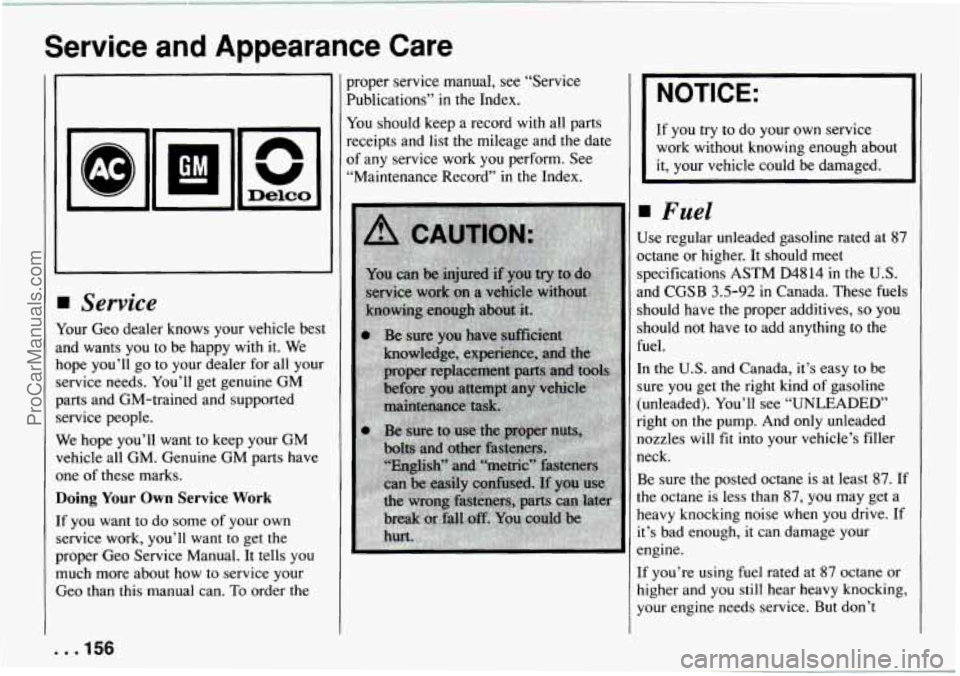
get genuine GM
‘arts and GM-trained and supported
xvice people.
i’e hope you’ll want to keep your GM
ehicle all GM. Genuine GM parts have
ne of these marks.
loing Your Own Service Work
F YOU want to do some of your own
ervice work, you’ll want to get the
lroper Geo Service Manual.
It tells you
mch more about how to service your
;eo than this manual can. To order the
. . .I56
xoper service manual, see “Service
Publications” in the Index.
You should keep a record with all parts
receipts and list the mileage and the date
Df any service work you perform. See
“Maintenance Record” in the Index.
NOTICE:
If you try to do your own service
work without knowing enough about
it, your vehicle could be damaged.
Fuel
Use regular unleaded gasoline rated at 87
octane or higher. It should meet
specifications ASTM D4814
in the U.S.
and CGSB 3.5-92 in Canada. These fuels
should have the proper additives,
so you
should not have to add anything to the
fuel.
In the U.S. and Canada, it’s easy to be
sure you get the right kind of gasoline
(unleaded). You’ll see “UNLEADED”
right on the pump. And only unleaded
nozzles will
fit into your vehicle’s filler
neck.
Be sure
the posted octane is at least 87. If
the octane is less than 87, you may get a
heavy knocking noise when you drive. If
it’s bad enough, it can damage your
engine.
If you’re using fuel rated at 87 octane or
higher and you still hear heavy knocking, your engine needs service.
But don’t
ProCarManuals.com
Page 158 of 258
worry if you hear a little pinging noise
when you’re accelerating or driving up a
hill. That’s normal and you don’t have to
buy a higher octane fuel to get rid of
pinging. It’s the heavy, constant knock
that means you have a problem.
What about gasoline
with blending
materials that contain oxygen
(oxygenates), such as MTBE or alcohol?
MTBE
is “methyl tertiary-butyl ether.”
Fuel that is no more than
15% MTBE is
fine for your vehicle.
Ethanol
is ethyl or grain alcohol.
Properly-blended fuel that
is no more
than
10% ethanol is fine for your vehicle.
Methanol is methyl or wood alcohol.
NOTICE:
Fuel that is more than S% methanol
is bad for your vehicle. Don’t use it.
It can corrode metal parts
in your fuel
system and also damage plastic and
rubber parts. That damage wouldn’t
be covered under your warranty. And
even
at 5% or less, there must be
“cosolvents” and corrosion prevent-
ers
in this fuel to help avoid these
problems.
Gasolines for Cleaner Air
Your use of gasoline with deposit control
additives
will help prevent deposits from
forming
in your engine and fuel system.
That helps keep your engine
in tune and
your emission control system working
properly. It’s good for your vehicle, and
you’ll be doing your part
for cleaner air.
Many gasolines are now blended with
oxygenates. General Motors recommends
that you use gasolines
with these blending
materials, such as MTBE and ethanol. By
doing
so, you can help clean the air,
especially
in those parts of the country
that have high carbon monoxide levels.
In addition, some gasoline suppliers are
now producing reformulated gasolines.
These gasolines are specially designed to
reduce vehicle emissions. General Motors
recommends that you use reformulated
gasoline.
By doing so, you can help clean
the air, especially
in those parts of the
country that have high ozone levels.
You should ask your service station
operators
if their gasolines contain deposit
control additives and oxygenates, and
if
they have been reformulated to reduce
vehicle emissions.
Fuels in Foreign Countries
If you plan on driving in another country
outside the
U.S. or Canada, unleaded fuel
may be hard to find.
Do not use leaded
gasoline. If you use even one tankful,
your emission controls won’t work well
or at all. With continuous use, spark plugs
can get fouled, the exhaust system can
corrode, and your engine oil can
deteriorate quickly. Your vehicle’s oxygen
sensor
will be damaged. All of that means
costly repairs that wouldn’t be covered by
your warranty.
To check on fuel availability, ask an auto
club, or contact a major oil company
that
does business in the country where you’ll
be driving.
You can also write us
at the following
address for advice. Just tell us where
you’re going and give your Vehicle
Identification Number
(VIN).
General Motors Overseas Distribution
North American Export Sales (NAES)
1908 Colonel Sam Drive
Oshawa, Ontario
LlH 8P7
Corporation
157.. ProCarManuals.com
Page 159 of 258
Service and Appearance Care
Filling Your Tank
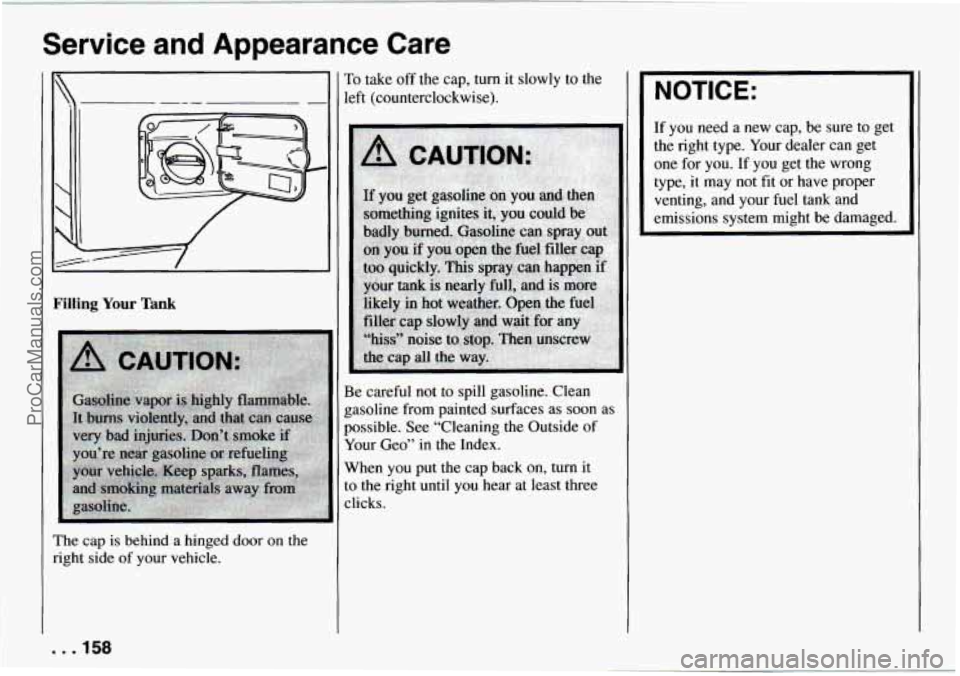
The cap is behind a hinged door on the
right side of your vehicle.
I’o take off the cap, turn it slowly to the
left (counterclockwise).
Be careful not to spill gasoline. Clean
gasoline from painted surfaces as soon as
possible. See “Cleaning
the Outside of
Your Geo” in the Index.
When you put the cap back on,
turn it
to the right until you hear at least three
:licks.
NOTICE:
If you need a new cap, be sure to get
the right type.
Your dealer can get
one for you. If you get the wrong
type, it
may not fit or have proper
venting, and your fuel tank and
emissions system might be damaged.
. . .158
ProCarManuals.com
Page 163 of 258
Service and Appearance Care
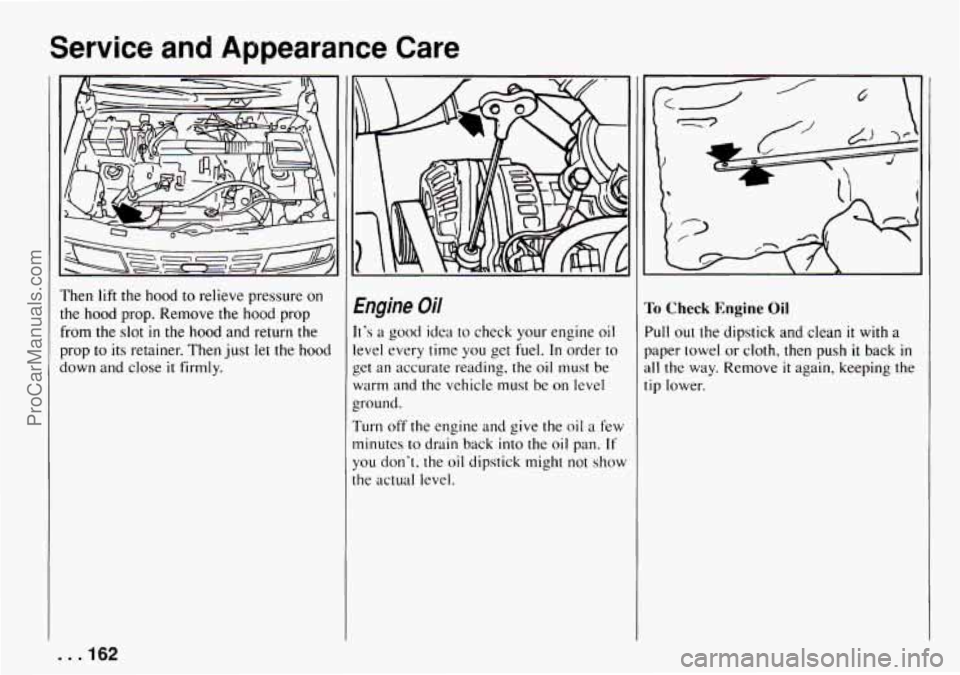
rhen lift the hood to relieve pressure on
he hood prop. Remove the hood prop
rom the slot
in the hood and return the
Jrop
to its retainer. Then just let the hood
[own and close
it firmly.
. .162
Engine Oil
It’s a good idea to check your engine oil
level every time you get fuel. In order to
get an accurate reading,
the oil must be
warm and the vehicle
must be on level
ground.
Turn off the engine and give
the oil a few
minutes
to drain back into the oil pan. If
you don’t, the oil dipstick might not show
the actual level.
To Check Engine Oil
Pull out the dipstick and clean it with a
paper towel or cloth, then push it back in
all the way. Remove it again, keeping the
tip lower.
ProCarManuals.com
Page 165 of 258
Service and Appearance Care
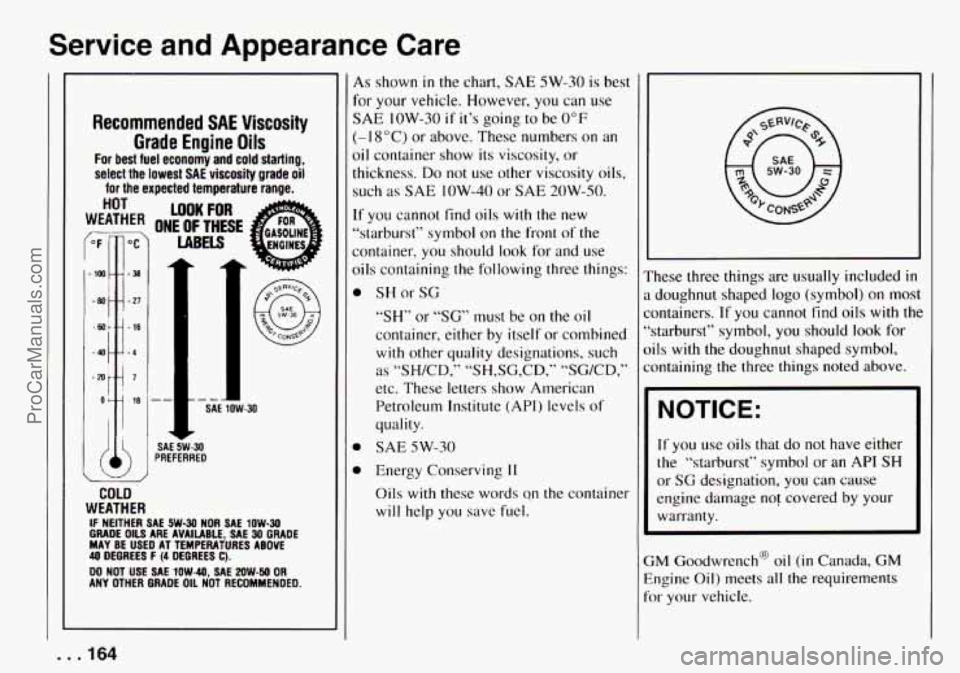
Recommended SAE Viscosity
Grade Engine Oils
For best fuel economy and cold starting,
select the
lowest SAE viscosity grade oil
for the expected temperature range.
HOT
WEATHER
-80 -27
SAE 5W-30 PREFERRED
COLD
WEATHER
IF NEITHER SAE 5W-30 NOR SAE 1OW-30 GRADE OILS ARE AVAILABLE, SAE 30 GRADE
MAY BE USED AT TEMPERATURES ABOVE 40 DEGREES F (4 DEGREES C).
DO NOT USE SAE 1OW-40, SAE 2OW-50 OR ANY OTHER GRAOE OIL NOT RECOMMENDED.
As shown in the chart, SAE SW-30 is best
for your vehicle. However, you can use
SAE IOW-30 if it’s going to be 0°F
(-1 8°C) or above. These numbers on an
oil container show its viscosity, or
thickness.
Do not use other viscosity oils,
such
as SAE IOW-40 or SAE 2OW-SO.
If you cannot find oils with the new
“starburst” symbol on the front of the
container,
you should look for and use
oils containing the following three things:
Ski or SG
“SH” or “SG” must be on the oil
container, either
by itself or combined
with other quality designations, such
as
“SHKD,” “SH,SG,CD,” “SGKD,”
etc. These letters show American
Petroleum Institute (API) levels of
quality.
SAE SW-30
Energy Conserving I1
Oils with these words on the container
will help you save fuel.
These three things are usually included in
1 doughnut shaped logo (symbol) on most
Zontainers.
If you cannot find oils with the
“starburst” symbol, you should
look for
lils with the doughnut shaped symbol,
;.ontaining the three things noted above.
NOTICE:
If you use oils that do not have either
the “starburst” symbol or
an API SH
or SG designation, you can cause
engine damage not covered
by your
warranty.
3M Goodwrench” oil (in Canada, GM
Engine Oil) meets
all the requirements
[or your vehicle.
. . .164 ProCarManuals.com