fuel CHEVROLET TRACKER 1994 Owner's Manual
[x] Cancel search | Manufacturer: CHEVROLET, Model Year: 1994, Model line: TRACKER, Model: CHEVROLET TRACKER 1994Pages: 258, PDF Size: 14.43 MB
Page 183 of 258

Service and Appearance Care
1
1
a
I
> 7
i
tl
B
tl
F
tl
0
S
T
t
f
r
1
1)
:he other label is the Certification label,
dso found
on the driver’s door lock pillal
t tells you the gross weight capacity of
Tour vehicle, called the
GVWR (Gross
Jehicle Weight Rating). The
GVWR
dudes the weight of the vehicle, all
ccupants, fuel and cargo. Never exceed
ne GVWR for your vehicle, or the Gross
Ytle Weight Rating (GAWR) for either
he front or rear axle.
ind, if you
do have a heavy load, you
hould spread it out. Don’t carry more
han
400 pounds (1 8 1 kilograms) in your
ear area when four people are in your
wo-wheel drive vehicle.
If you have a
our-wheel drive vehicle, don’t carry
nore than
200 pounds (91 kilograms) in
{our rear area when four people are
in
Tour vehicle.
NOTICE:
I
Your warranty does not cover parts or
components that fail because
of over-
loading.
I ~
[f you put things inside your vehicle -
like suitcases, tools, packages, or
anything else
- they will go as fast as the
vehicle goes. If you have to stop or turn
quickly, or if there is a crash, they’ll keep
going.
. .I82
ProCarManuals.com
Page 185 of 258
Service and Appearance Care
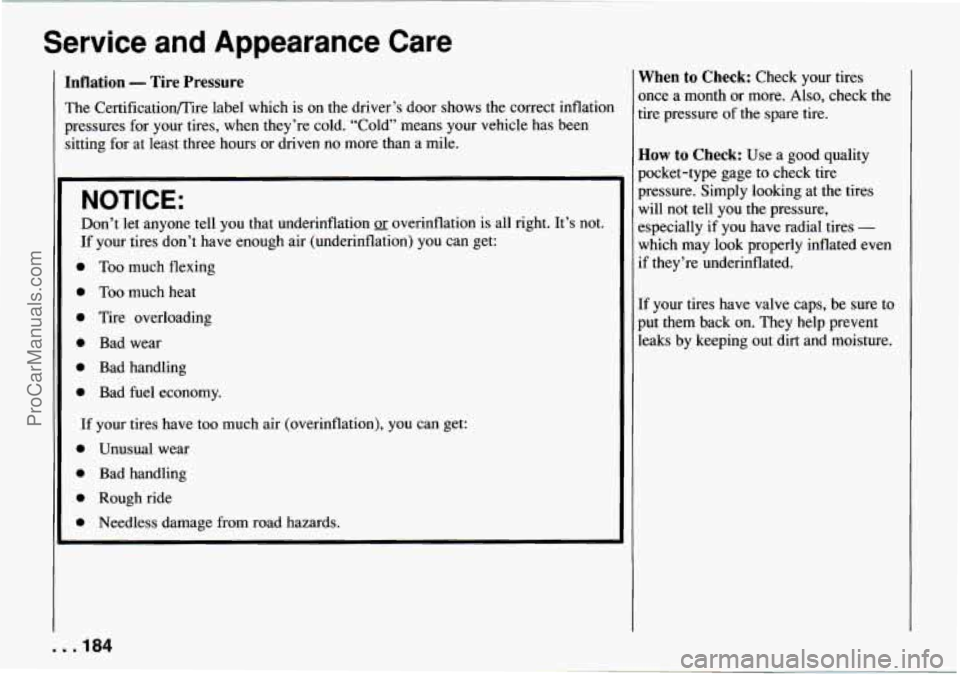
Inflation - Tire Pressure
The Certificatioflire label which is on the driver’s door shows the correct inflation
pressures for your tires, when they’re cold. ‘Told” means your vehicle has been
sitting for at least three hours or driven no more than
a mile.
NOTICE:
Don’t let anyone tell you that underinflation PI: overinflation is all right. It’s not.
If your tires don’t have enough air (underinflation) you can get:
i Too much flexing
0 Too much heat
0 Tire overloading
0 Bad wear
0 Bad handling
0 Bad fuel economy.
If your tires have too much air (overinflation), you can get:
0 Unusual wear
0 Bad handling
0 Rough ride
0 Needless damage from road hazards.
When to Check: Check your tires
once a month or more. Also, check the
tire pressure
of the spare tire.
How to Check: Use a good quality
pocket-type gage to check tire
I
1
t
7
xessure. Simply looking at the tires
will not tell
you the pressure,
:specially if you have radial tires
-
which may look properly inflated even
.f they’re underinflated.
[f your tires have valve caps, be sure to
Jut them back on. They help prevent
leaks by keeping out dirt and moisture.
. . .I84
ProCarManuals.com
Page 195 of 258
Service and Appearance Care
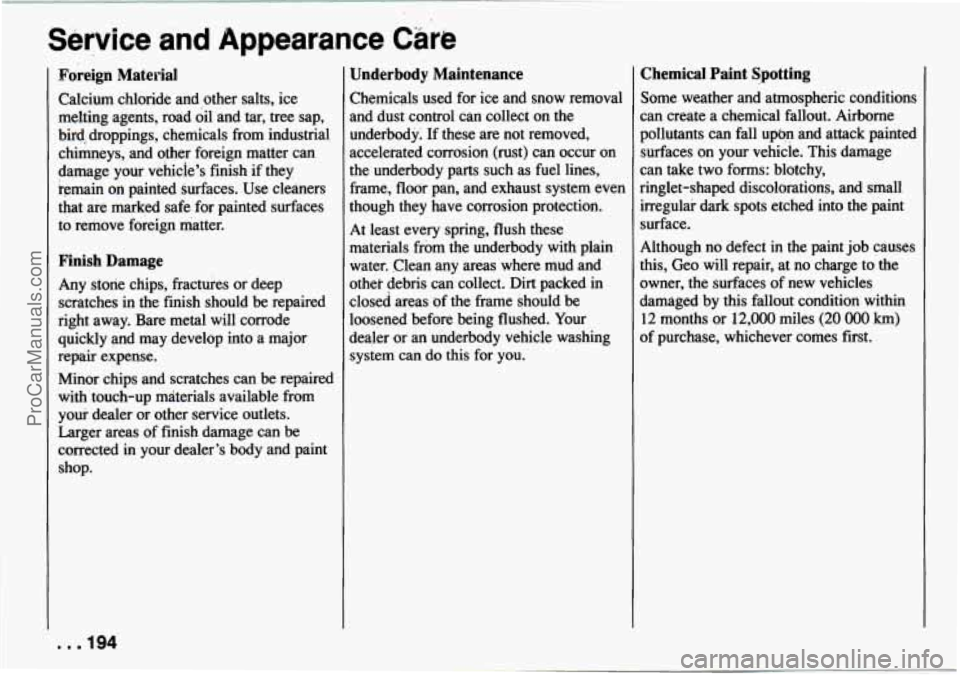
Foreign Material
Calcium chloride and other salts, ice
melting agents, road oil and tar,
tree sap,
bad$ droppings, chemicals from industrial
chimneys, and other foreign matter can
damage your vehicle’s finish if they
remain on painted Surfaces. Use cldners
that
&e marked safe for painted surfaces
to remove foreign matter.
Finish Damage
Any stone chips, fractui-es or deep
scratches in the finish should be repaired
right away. Bare metal will corrode
quickly and may develop into a major
repair expense.
Minor chips and scratches can be repaired
with touch-up materials available from
YOU^ dealer or other service outlets.
Larger areas
of finish damage can be
corrected in your dealer’s body and paint
shop.
Underbody Maintenance
Chemicals used for ice and snow removal
and dust control can collect on the
underbody;
If these are not removed,
accelerated corrosion (rust) can occur on
the underbody parts such as fuel lines,
frame,
floor pan, and exhaust system even
though they have corrosion protection.
At least every spring, flush these
materials
.from the underbody with plain
water. Clean any areas where mud and
othef deb& can collect.
Dirt packed in
closed areas
of the frame should be
loosened before
being flushed. Your
dealer or an underbody vehicle washing
system can do this
for you.
Chemical Paint Spotting
Some weather and atmospheric conditions
can create
a chemical fallout. Airborne
pollutants can fall up~n and attack painted
surfaces on your vehicle.
This damage
can take two forms: blotchy,
ringlet-shaped discolorations, and small
irregulai dark spots etched into the paint
surface.
Although no defect in the paint job causes
this, Geo
will repair, at no charge to the
owner, the surfaces of new vehicles
damaged by this fallout condition within
12 months or 12,000 miles (20
000 km)
of purchase, whichever comes first.
. . .I94
ProCarManuals.com
Page 199 of 258

Service and Appearance Care
Main Fuse Block
1 - Generator to Battery Circuit (60A)
2
- Circuits Only Active When
Ignition Switch is
in “ACC,” “ON”
or “START” (50A)
3
- Circuits Always Active (40A)
4 - Circuits Always Active (30A)
. . .198
nstrument Panel Fuse Block
- Right Headlight (15A)
~ - Left Headlight; High Beam Indicatol
Light
( 1 SA)
I- Taillights; Interior Light; Sidemarker Lights; Instrument Cluster Lights
( 1 SA)
. - Stop Lights; Horn (15A)
~ - Hazard Lights (15A)
I - Door Lock (Option) (20A)
’ - Lighter; Radio (20A)
1 - Ignition System; Warning and
1 - Turn Signal Lights; Back-up Lights
Indicator Lights
( 1 SA)
( 1 SA)
10 - Wiper/Washer ( 15A)
1 1 - Rear Defogger (1 5A)
12 - Heater
(25A)
13
- Rear Wheel Anti-Lock Main Relay
(20A)
14 - Electronic Fuel Injection Main
Relay
( 15A)
ProCarManuals.com
Page 201 of 258
Service and Appearance Care
..........
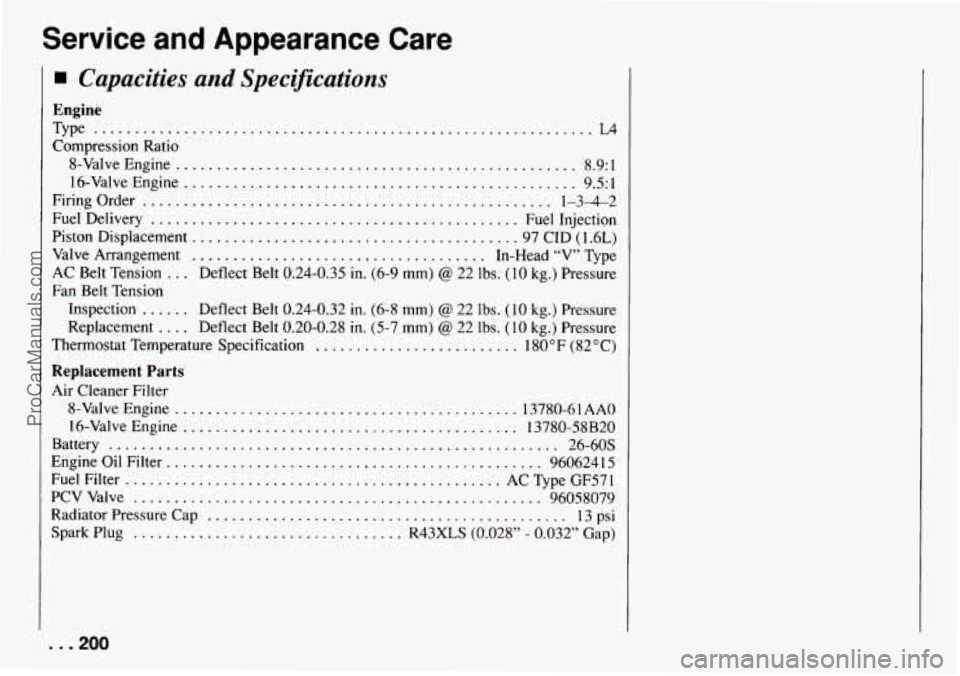
Capacities and Specifications
Engine
Type .......................................... . * L4
Compression Ratio 8-Valve Engine
................................................. 8.9: 1
16-Valve Engine ................................................ 9.5: 1
Fuel Delivery
............................................. Fuel Injection
Piston Displacement
........................................ 97 CID (1.6L)
Valve Arrangement
.................................... In-Head “V” Type
Firingorder
.................................................. 1-342
AC Belt Tension ... Deflect
Belt 0.24-0.35 in. (6-9 mm) @I 22 lbs. (10 kg.) Pressure
Fan Belt Tension
Inspection
...... Deflect Belt 0.24-0.32 in. (6-8 mm) @ 22 lbs. (10 kg.) Pressure
Replacement
.... Deflect Belt 0.20-0.28 in. (5-7 mm) @ 22 lbs. (10 kg.) Pressure
Thermostat Temperature Specification
......................... 180°F (82°C)
Replacement Parts
Air Cleaner Filter
8-Valve Engine
.......................................... 13780-6 1 AAO
16-Valve Engine ......................................... 13780-58B20
Engine
Oil Filter .............................................. 9606241 5
Radiator Pressure Cap ............................................ 13 psi
Spark Plug ................................. R43XLS (0.028” - 0.032” Gap)
Battery
....................................................... 26-60s
Fuel Filter
.............................................. AC Type GF571
PCVValve
.................................................. 96058079
.. .200
ProCarManuals.com
Page 202 of 258
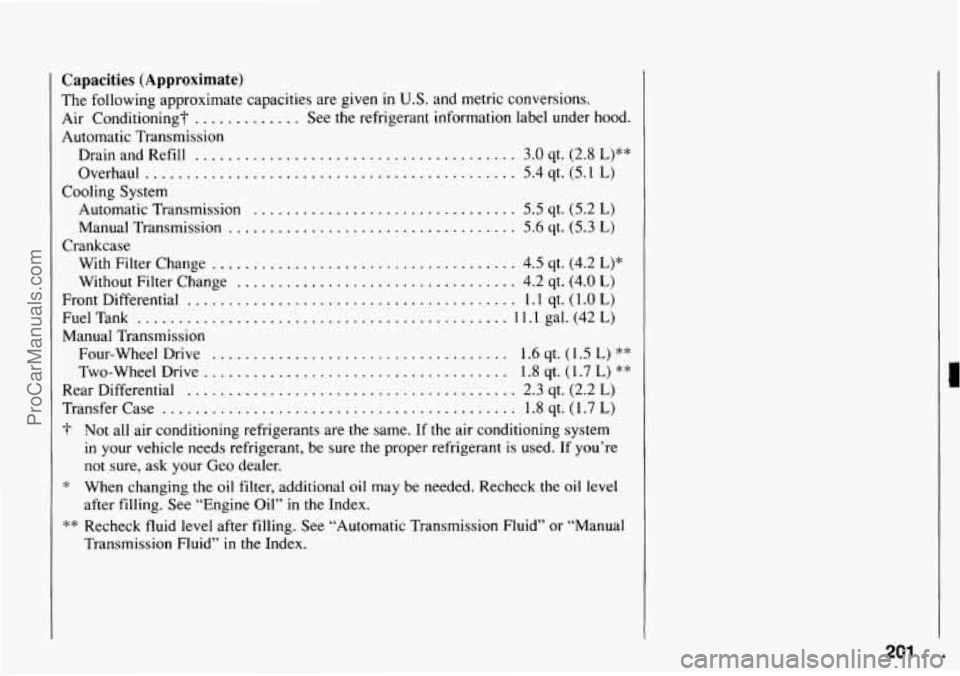
Capacities (Approximate)
The following approximate capacities are given in U.S. and metric conversions.
Air Conditioning”
............. See the refrigerant information label under hood.
Automatic Transmission Drain and Refill
....................................... 3.0 qt. (2.8 L)**
Overhaul ............................................. 5.4 qt. (5.1 L)
Automatic Transmission ................................ 5.5 qt. (5.2 L)
Manual Transmission ................................... 5.6 qt. (5.3 L)
With Filter Change ..................................... 4.5 qt. (4.2 L)*
Without Filter Change .................................. 4.2 qt. (4.0 L)
Front Differential ........................................ 1.1 qt. (1 .O L)
Fuel Tank ............................................. 11.1 gal. (42 L)
Manual Transmission
Cooling System
Crankcase
Four-wheel Drive
.................................... 1.6 qt. ( 1.5 L) **
Two-Wheel Drive ..................................... 1.8 qt. (1.7 L) **
Rear Differential ........................................ 2.3 qt. (2.2 L)
Transfer Case ........................................... 1.8 qt. ( 1.7 L)
T Not all air conditioning refrigerants are the same. If the air conditioning system
in your vehicle needs refrigerant, be sure the proper refrigerant is used. If you’re
not sure, ask your Geo dealer.
* When changing the oil filter, additional oil may be needed. Recheck the oil level
after filling. See “Engine Oil”
in the Index.
** Recheck fluid level after filling. See “Automatic Transmission Fluid” or “Manual
Transmission Fluid”
in the Index.
201 ...
ProCarManuals.com
Page 204 of 258

.
IMPORTANT:
KEEP THE ENGINE OIL
AT THE PROPER
LEVEL AND CHANGE AS
RECOMMENDED
This part covers the
maintenance required
for your
Geo . Your vehicle needs these
services to retain its safety.
dependability and emission
control performance
.
Maintenance Schec
Section
Introduction: A Word about Maintenance ........................
A .
B .
C .
D .
E .
Your Vehicle and the Environment .........................
How This Part Is Organized ............................
Scheduled Maintenance Services ........................
Using Your Maintenance Schedule .......................
Selecting the Right Schedule ............................
Schedule1 .......
Schedule11 ............................................
Owner Checks and Services .........
At Each Fuel Fill .......
At Least Once a Month .................. .......
At Least Twice a Year .........
AtLeastOnceaYear ..................................
Periodic Maintenance Inspections ...........................
Recommended Fluids and Lubricants ........................
MaintenanceRecord ......................................
................................
Explanation of Scheduled Maintenance Services ..............
....................
.........................
...................
ule
Protection
Plan
Have you purchased the GM Protection Plan? The Plan
supplements
your new car warranties .
See your GM dealer for details .
204
204
204
205
205
205
206
210
214
218
218 219
219 220
223
225
228
203 ...
ProCarManuals.com
Page 205 of 258
Maintenance Schedule
Introduction: A Word about Maintenance
We at General Motors want to help you
keep your vehicle
in good working
condition. But
we don’t know exactly
how you’ll drive it. You may drive very
short distances only a few times
a week.
Or you may drive long distances all the
time
in very hot, dusty weather. You may
use your vehicle
in making deliveries. Or
you may drive it to work, to do errands
or
in many other ways.
Because of all the different ways people
use
their GM vehicles, maintenance needs
vary.
You may even need more frequent
checks and replacements than you will
find in the schedules
in this part. So
please read this part and note how you
drive. If you
have any questions on how
to keep your vehicle
in good condition,
see your Geo dealer, the place many
GM
owners choose to have their maintenance
work done. Your dealer can be relied
upon to use proper parts and practices.
Your Vehicle and the
Environment
Proper vehicle maintenance not only
helps to keep your vehicle
in good
working condition, but also helps the
environment. All recommended
maintenance procedures are important.
Improper vehicle maintenance or the
removal of important components can
significantly affect the quality of the air
we breathe. Improper fluid levels or even
the wrong tire inflation can increase the
level of emissions from your vehicle.
To
help protect our environment, and to help
keep
your vehicle in good condition,
please maintain your vehicle properly.
How This Part is Organized
The remainder of this part is divided into
five sections:
“Section
A: Scheduled Maintenance
Services” shows what to have done and
how often. Some of these services can be
complex,
so unless you are technically
qualified and have the necessary equipment,
you should let your
dealer’s
service department or another qualified
service center do these jobs.
f you are skilled enough to do some
work on your vehicle, you will probably
want to get the service information
SM publishes. You will find a list of
wblications and how to get them in this
nanual. See “Service Publications”
in
he Index.
‘Section B: Owner Checks and Services”
ells you what should be checked
whenever you stop for fuel. It also
:xplains what you can easily do to help
:eep your vehicle in good condition.
. . .204
ProCarManuals.com
Page 206 of 258
“Section C: Periodic Maintenance
Inspections” explains important inspections that your Geo dealer’s service
department or another qualified service
center should perform.
“Section
D: Recommended Fluids and
Lubricants” lists some products GM
recommends to help keep your vehicle
properly maintained. These products, or
their equivalents, should be used whether
you do the work yourself or have it done.
“Section
E: Maintenance Record”
provides a place for you to record the
maintenance performed on your vehicle.
Whenever any maintenance is performed,
be sure to write it down in this section.
This will help you determine when your
next maintenance should be done.
In
addition, it is a good idea to keep your
maintenance receipts. They may be
needed to qualify your vehicle for
warranty repairs.
Section A: Scheduled
Maintenance Services
Using Your Maintenance
Schedules
This section tells you the maintenance
services you should have done and when
you should schedule them. Your Geo
dealer knows your vehicle best and wants
you to be happy with
it. If you go to your
dealer for your service needs, you’ll knoN
that GM-trained and supported service
people will perform the work using
genuine GM parts.
These schedules are for vehicles that:
carry passengers and cargo within
recommended limits. You will find
these limits on your vehicle’s
Tire-Loading Information label. See
“Loading Your Vehicle” in the Index.
are driven on reasonable road surfaces
within legal driving limits.
use the recommended unleaded fuel.
See “Fuel” in the Index.
I
Selecting the Right Schedule
First you’ll need to decide which of the
two schedules is right for your vehicle.
Here’s how to decide which schedule to
follow:
Schedule
I
Is any one of these true for your vehicle?
Most trips are less than 4 miles (6 km).
Most trips are less than 10 miles
(1
6 km) when outside temperatures are
below freezing.
The engine is at low speed most of the
time (as in door-to-door delivery, or in
stop-and-go traffic).
You operate your vehicle in dusty
areas or off-road frequently.
D You tow a trailer.
[f any one (or more) of these is true for
your driving, follow Schedule I.
Schedule
I1
Follow Schedule I1 on& if none of the
lbove conditions
is true.
205. . .
ProCarManuals.com
Page 209 of 258

Maintenance Schedule
Section A: Scheduled Maintenance Services (cont.)
Schedule / (Cont.)
* An Emission Control Service.
t The US. Environmental Protection Agency
or the California Air Resources Board has
determined that the failure to perform this
maintenance item will
not nullify the emission
warranty or limit recall liability prior to the
completion
of vehicle useful life. General
Motors, however, urges that all recommended
maintenance services be performed at the
indicated intervals and the maintenance be
recorded in “Section E: Maintenance Record.”
WHAT TO SERVICE
See “Explanation of Scheduled
Schedules
I and 11.
ITEM NO. Maintenance Services” following
WHEN TO PERFORM
Miles (kilometers) or Months
(whichever occurs first).
14
Air Cleaner Filter Replacement* See “Explanation of Scheduled
Maintenance
Services” following Schedules
I and 11.
15 I Fuel Tank, Cap and Lines Inspection*t I
See “Explanation of Scheduled Maintenance
Services” following Schedules
I and 11.
16
Every
80,000 miles (133 000 km). Heated
Oxygen Sensor Replacement*
18 Every
100,000 miles
(166 000 km).
Fuel Injector Inspection”
17 Every
30,000 miles (50 000 km)
or 30 months. Fuel Filter Replacement*
l9 I
Evaporative Emissions Canister
Replacement* I Every 100,000 miles (166 000 km).
Engine Control Module (ECM) and 2o Associated Sensors Inspection* Every 100,000 miles (1 66 000 km).
21 Every
100,000 miles (166 000 kml
Three Wav Catalvtic Converter Inspection* 22
Every 60,000 miles (100 000 km). Emission
System Hoses Inspection*
~~ I - \--- ~~
23 I Engine Timing and Distributor Check* I Every 60,000 miles (100 000 km).
24
Every 60,000 miles (100 000 km). Brake Fluid
Service 28
Every 60,000 miles (100 000 km) or 60 months.
Wiring Harness and Connectors Inspection* 27
Every 7,500 miles (12 500 km) or 7.5 months.
Power Steering System Inspection 26
Every 15,000 miles (25 000 km).
Valve Lash (Clearance) Inspection* 25
Every 15,000 miles (25 000 km).
Engine Idle Speed Check*?
. . ,208
ProCarManuals.com