wheel CHEVROLET TRACKER 1994 Service Manual
[x] Cancel search | Manufacturer: CHEVROLET, Model Year: 1994, Model line: TRACKER, Model: CHEVROLET TRACKER 1994Pages: 258, PDF Size: 14.43 MB
Page 148 of 258
... .v ,
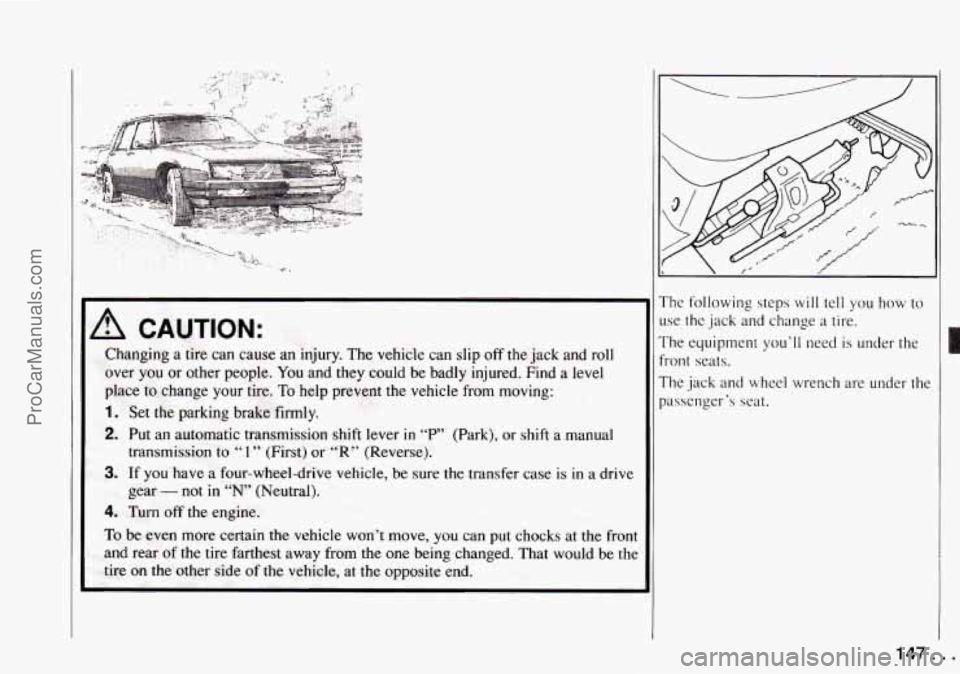
A CAUTION:
Changing a tire can cause an injury. The vehicle can slip off the jack and roll
over
you or other people. You and they could be badly injured. Find a level
place to change your tire.
To help prevent the vehicle from moving:
1. Set the parking brake firmly.
2. Put an automatic transmission shift lever in T“ (Park), or shift a manual
3. If you have a four-wheel-drive vehicle, be sure the transfer case is in a drive
4. Turn off the engine.
transmission
to “ 1” (First) or “R” (Reverse).
gear
- not in “N’ (Neutral).
To be even more certain the vehicle won’t move, you can put chocks at the front
and rear
of the tire farthest away from the one being changed. That would be the
tire
on the other side of the vehicle, at the opposite end. The
following steps
will tell you how to
.rse the jack and change
a tire.
The equipment you’ll need is under the
ront seats.
rhejack and wheel wrench
are under the
passenger’s
seat.
147 ...
ProCarManuals.com
Page 149 of 258
Problems on the Road
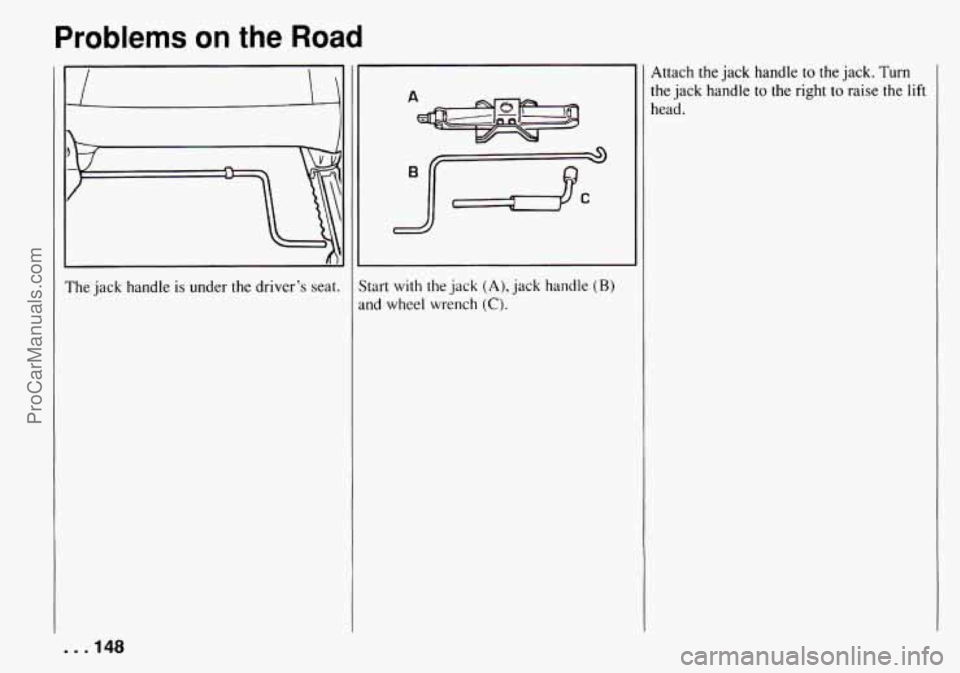
The jack handle is under the driver’s seat. ;tart with Ihe jack (A), jack handle (R)
.nd wheel wrench (C).
Attach the jack handle to the jack. Turn
the jack handle to the right to raise the lift
head.
. . .148
ProCarManuals.com
Page 150 of 258

The spare tire is mounted on your tailgate
Pull the cover off of the spare tire. .nsert your key into the wheel lock on
the
;pare tire and pull the wheel lock off. Remove wheel nuts with the wheel
wrench.
Remove the
spare tire from the mounting
bracket and place
it near your flat tire.
Attach the jack handle
to the jack bolt.
Turn the jack handle clockwise (to the
right). That will raise the lift head a little.
149 ... ProCarManuals.com
Page 151 of 258
Problems on the Road
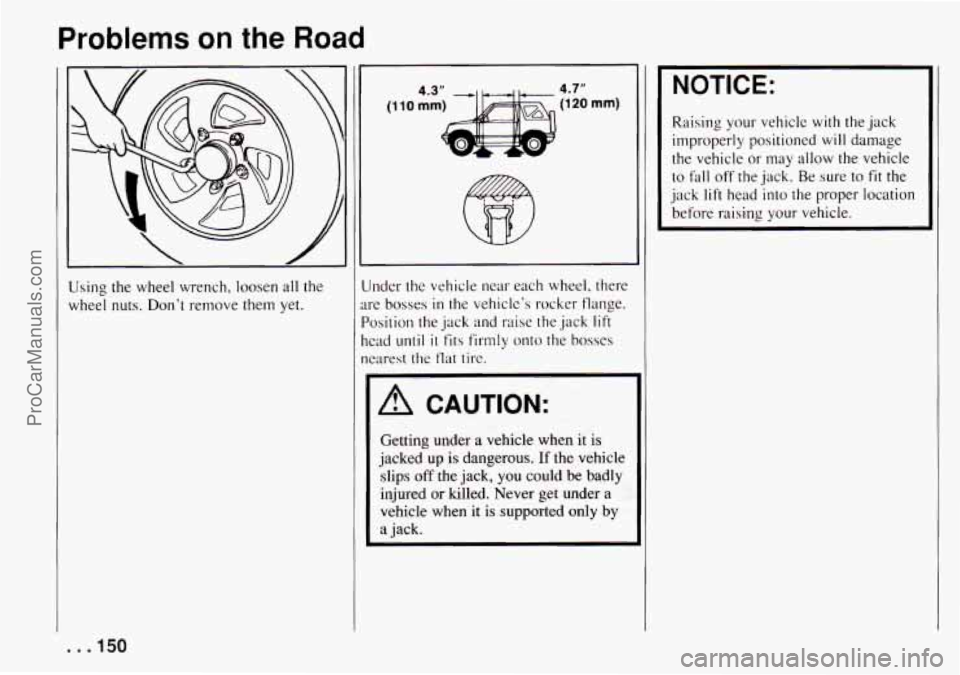
Using the wheel wrench, loosen all the
wheel
nuts. Don't rerrlove them yet.
ut
art
PC
he ne 1der the vehicle near each wheel. there
: bosses in the vehicle's rocker
tlange.
Isition the jack and raise the jack
lift
ad until it fits firmly onto the bosses
arest the tlat tire.
A CAUTION:
Getting under a vehicle when it is
jacked up is dangerous. If the vehicle
slips
off the jack, you could be badly
injured
or killed. Never get under a
vehicIe
when it is supported only by
a jack.
NOTICE:
Raising your vehicle with the jack
improperly positioned
will damage
the vehicle or
may allow the vehicle
to fall off the jack. Be sure to fit the
jack
lift head inlo the proper location
before raising your vehicle.
. . ,150
ProCarManuals.com
Page 152 of 258
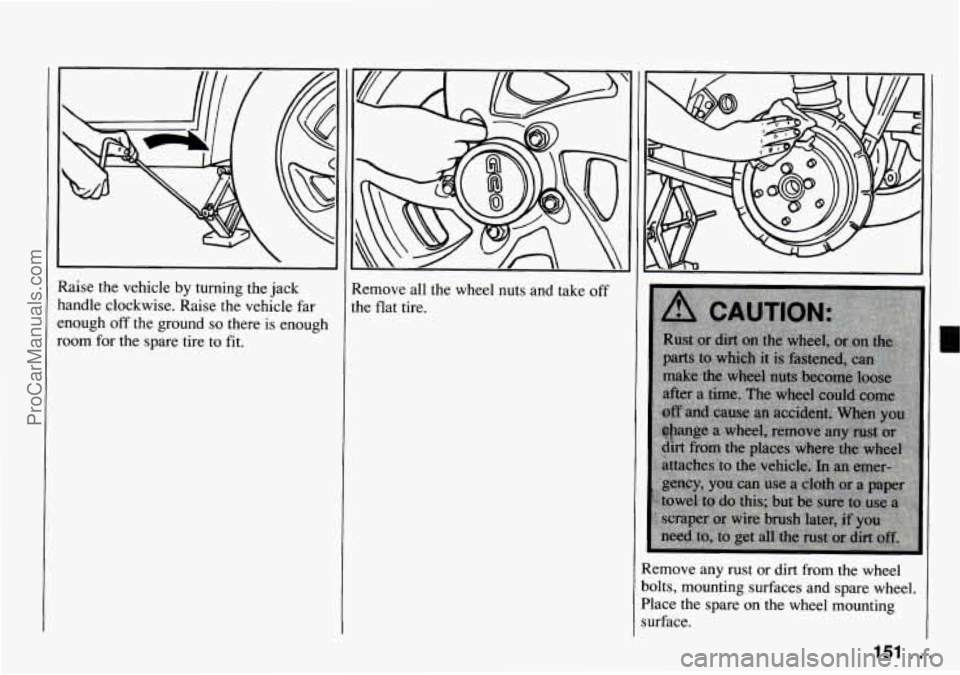
Raise the vehicle by turning the jack
handle clockwise. Raise the vehicle far
enqugh
off the ground so there is enough
room for the spare tire to fit. Remove all
the wheel nuts and take off
the
flat tire.
Remove any
rust or dirt from the wheel
bolts, mounting surfaces and spare wheel.
Place the spare on the wheel mounting
surface.
151 ...
ProCarManuals.com
Page 153 of 258
Problems on the Road
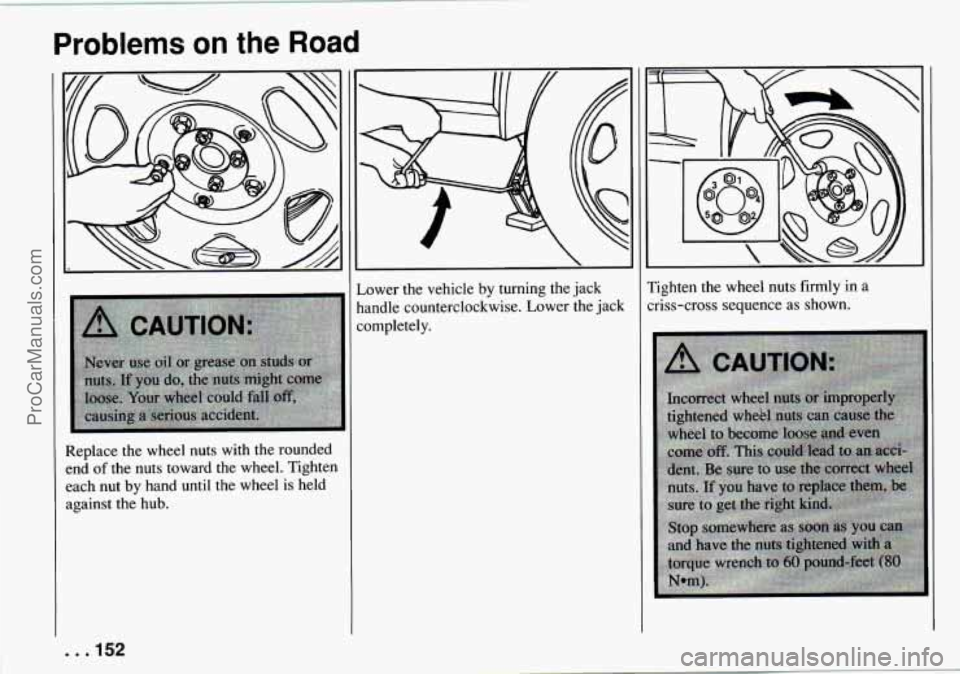
Replace the wheel nuts with the rounded
end
of the nuts toward the wheel. Tighten
each nut
by hand until the wheel is held
against the hub. Lower
the vehicle by turning the jack
handle counterclockwise. Lower the jack
zompletel
y.
3ghten the wheel nuts firmly in a
:riss-cross sequence as shown.
. . .I52
ProCarManuals.com
Page 154 of 258
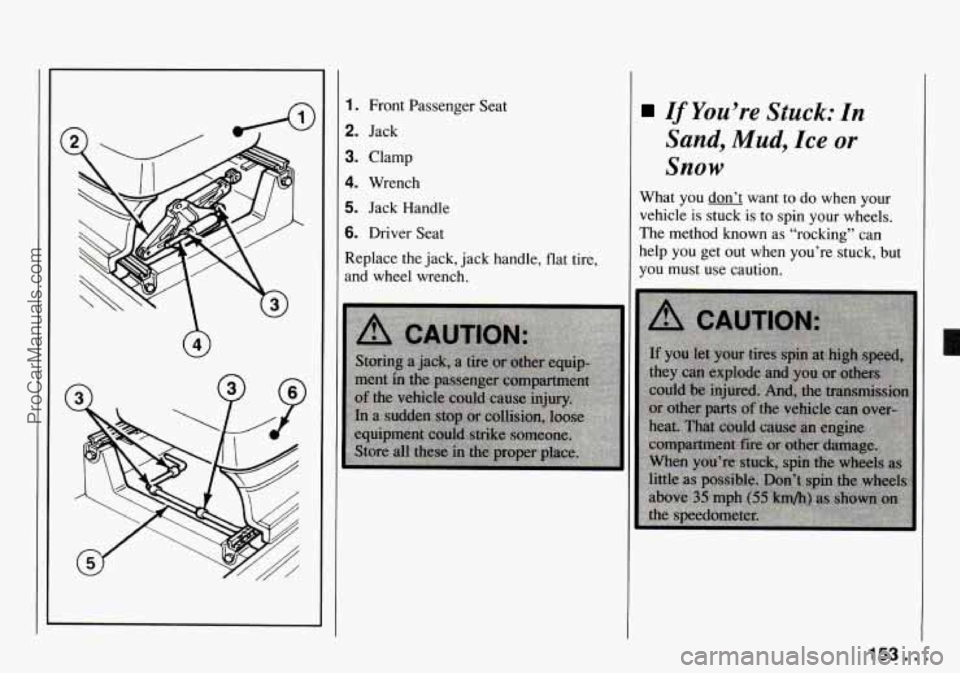
1. Front Passenger Seat
2. Jack
3. Clamp
4. Wrench
5. Jack Handle
6. Driver Seat
Replace the jack, jack handle, flat tire,
and wheel wrench.
If You’re Stuck: In
Sand, Mud, Ice or
Snow
What you don’t want to do when your
vehicle
is stuck is to spin your wheels.
The method known as “rocking” can
help you get out when you’re stuck, but
you must use caution.
153 ... ProCarManuals.com
Page 155 of 258
Problems on the Road
NOTICE:
Spinning your wheels can destroy
parts of your vehicle as well as the
tires. If you spin the wheels too fast
while shifting your transmission back
and forth, you can destroy your trans-
mission.
Rocking your vehicle to get it out:
First, turn your steering wheel left and
right. That
will clear the area around your
front wheels. Then shift back and forth
between
“R” (Reverse) and a forward
gear (or
with a manual transmission,
between First or Second gear and
Reverse), spinning the wheels as little as
possible. Release the accelerator pedal
while you shift, and press lightly on the
accelerator pedal when the transmission is
in gear. If that doesn’t get you out after a
few tries, you may need to be towed out.
Or, you can use your recovery hooks,
if
your vehicle has them. If you do need to
be towed out, see “Towing Your Vehicle”
in the Index.
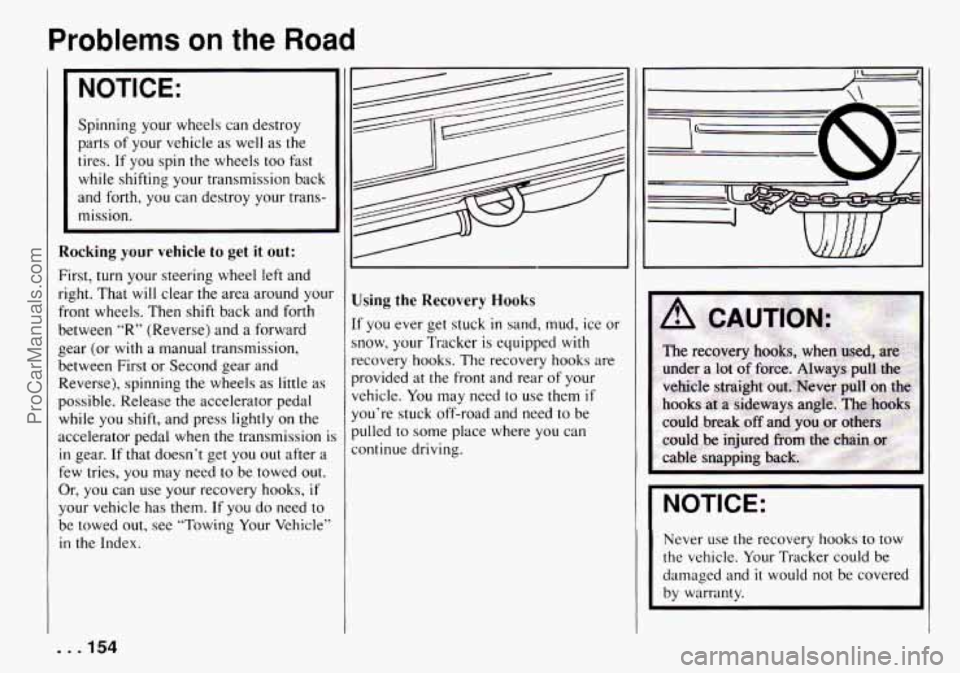
Using the Recovery Hooks
If you ever get stuck in sand, mud, ice or
snow, your Tracker is equipped
with
recovery hooks. The recovery hooks are
provided at the front
and rear of your
vehicle. You
may need to use them if
you’re stuck off-road and need to be
pulled to some place where you can
continue
driving.
NOTICE:
Never use the recovery hooks to tow
the vehicle. Your Tracker could be
darnaged
and it would not be covered
by warranty.
. . I154
ProCarManuals.com
Page 156 of 258
Here you will find information
about the care of your Geo
. This
part begins with service and fuel
information. and then it shows
how to check important fluid and
lubricant levels
. There is also
technical information about your
vehicle. and a section devoted
to its appearance care
.
Service & Appearance Care
Service ........................................................
Fuel ..........................................................
Checking Things under the Hood ...................................
HoodRelease .................................................
Engineoil ...................................................
Aircleaner ...................................................
Automatic Transmission Fluid ....................................
Manual Transmission Fluid ......................................
Clutch Adjustment .............................................
RearAxle ....................................................
Four-WheelDrive .............................................
Enginecoolant ................................................
Power Steering Fluid ...........................................
Windshield Washer Fluid ........................................
Brake Master Cylinder ..........................................
Bulb Replacement ...............................................
Loading Your Vehicle ..........................................
Tires ........................................................
Appearance Care Materials Chart ...................................
Vehicle Identification Number (VIN) ................................
Service Parts Identification Label ...................................
Add-on Electrical Equipment ......................................
Fuses and Circuit Breakers ........................................
Capacities and Specifications .......................................
Battery ......................................................
Appearancecare ................................................
ReplacementBulbs ..............................................
156
156
159
159
162
165
167
168
169 169
170 170
173
174
174
176 177
181
183
189 195 196
196
196
196
199
200
155 ...
ProCarManuals.com
Page 171 of 258
~~
~~ ~ ~~~~ ~ Service and Appearance Care
Four- Wheel Drive
Most
lubricant checks in this section also
apply to four-wheel-drive vehicles.
However, they have
two additional
systems that need lubricatiog.
Transfer Case
When to Check qnd Change Lubricant
Refer to the Maintenance Schedule to
determine how often to check the
lubricant and when to change
it. See
“Scheduled Maintenance Services”
in the
Index.
How to Check Lubricant
If the level is below the bottom of the
filler plug hole, you’ll need to add some
lubricant. Add enough lubricant to raise
the level to the bottom of the filler plug
hole.
What to Use
Refer to the Maintenance Schedule to
determine what kind of lybricant to use.
See “Recommended Fluids and
Lubricants”
in the Index.
Front Axle
When
to Check and Change Lubricant
Refer to the Maintenance Schedule to a
determine how often to check the
lubricant and when to change it. See
“Periodic Maintenance Inspections” and
“Scheduled Maintenance Services”
in the
Index.
How to Check Lubricant
If the level is below the bottom of the
filler plug hole, you’ll need to add some
lubricant.
If the differential is at operating
temperature (warm), add enough lubricant
to raise the level to the bottom of the filler
plug hole.
If the differential
is cold, add enough
lubricant to raise the level to
1/2 inch (12
mm) below the filler plug hole.
What to Use
Refer to the Maintenance Schedule to
determine
what kind of lubricant to use.
See “Recommended Fluids and
Lubricants”
in the Index.
Engine Coolant
The following explains your cooling
system and how to add coolant when it is
low. If you have a problem with engine
overheating, see “Engine Overheating”
in
the Index.
The proper coolant for your Geo will:
Give freezing protection down to
-20°F (-29”C), or -34°F (-37°C)
in
Canada and for vehicles with the cold
climate option.
Give boiling protection up to 258°F
(125°C).
Protect against rust and corrosion.
Help keep the proper engine
temperature.
Let the warning lights work as they
should.
What to Use:
Use a mixture of one-half clean water
(preferably distilled) and one-half
antifreeze that meets “GM Specification
6038-M,” which won’t damage aluminum
parts.
You can also use a recycled coolant
conforming to
“GM Specification
6038-M”
with a complete coolant flush
. . .I70
ProCarManuals.com