wheel CHEVROLET TRACKER 1994 Owner's Guide
[x] Cancel search | Manufacturer: CHEVROLET, Model Year: 1994, Model line: TRACKER, Model: CHEVROLET TRACKER 1994Pages: 258, PDF Size: 14.43 MB
Page 122 of 258
0
0
Wiper Blades: Are they in good
shape?
Fuel, Engine Oil, Other Fluids:
Have you checked all levels?
Lights: Are they all working? Are the
lenses clean?
Tires: They are vitally important to a
safe, trouble-free trip. Is the tread
good enough for long-distance
driving? Are the tires all inflated to
the recommended pressure?
Weather Forecasts: What’s the
weather outlook along your route?
Should you delay your trip a short
time to avoid a major storm system?
Maps: Do you have up-to-date
maps?
Highway Hypnosis
Is there actually such a condition as
“highway hypnosis”? Or is it just plain
falling asleep at the wheel? Call
it
highway hypnosis, lack of awareness, or
whatever.
There is something about an easy stretch
of road with
the same scenery, along with
the hum of the tires
on the road, the drone
of the engine, and the rush of the wind
against the vehicle that can make you sleepy. Don’t let it happen
to you! If it
does, your vehicle can leave the road in
less than a second, and
you could crash
and be injured.
What can you do about highway
hypnosis? First, be aware that
it can
happen.
Then here are some tips:
0 Make sure your vehicle is well
ventilated, with a comfortably cool
interior.
0 Keep your eyes moving. Scan the
road ahead and to
the sides. Check
your mirrors and your instruments
frequently.
0 If you get sleepy, pull off the road into
a rest, service, or parking area and
take a nap, get some exercise,
or both.
For safety, treat drowsiness on the
highway as an emergency.
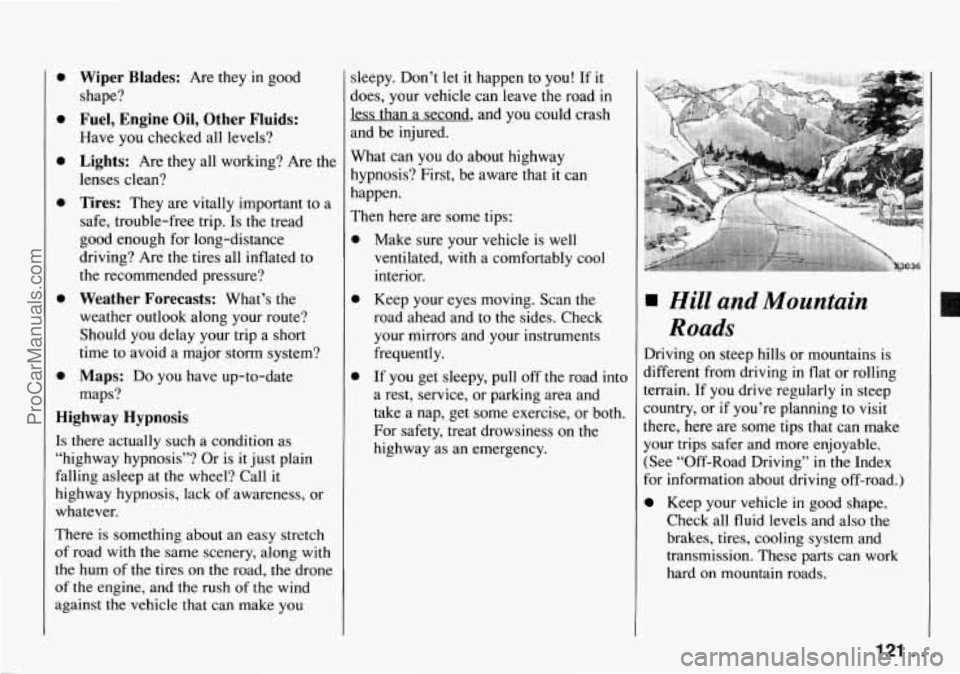
Hill and Mountain
Roads
Driving on steep hills or mountains is
different from driving
in flat or rolling
terrain. If you drive regularly in steep
country, or
if you’re planning to visit
there, here are some tips that can make
your trips safer and more enjoyable.
(See “Off-Road Driving” in the Index
for information about driving off-road.)
Keep your vehicle in good shape.
Check all fluid levels and also the
brakes, tires, cooling system and
transmission. These parts can work
hard
on mountain roads.
ILI . . .
ProCarManuals.com
Page 124 of 258
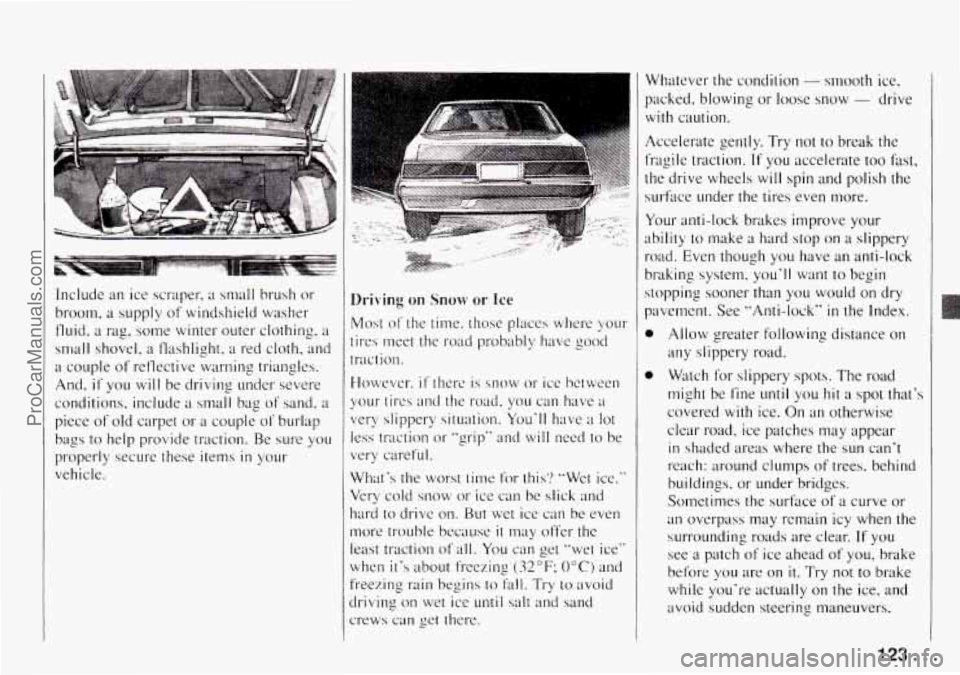
Include an ice scraper7 a small brush or
broom. a supply of windshield washer
fluid,
a rag, some winter outer clothing, a
small shovel, a flashlight, a red cloth, and
a couple of reflective warning triangles.
And,
if you will be driving under severe
conditions, include
:I small bag of sand, ;I
piece of old carpet or a couple of burlap
bags to
help provide traction. Be sure yo11
properl}, secure these item in your
vehicle.
Driving on Snow or Ice
Most of the time. those placcs where your
tires meet the road probably have good
traction.
Howe\w-.
it’ thcrc is snow or ice between
your tires antl the road, you can Iwve ;I
very slippery situation. You‘ll have ;t lot
less traction or “grip“ and will need to be
very careful.
What‘s the worst time
for this’? “Wet ice.”
Very cold snow
or ice can be slick and
hurd to drive on. Rut wet ice can be even
more trouble because
it nlay offer the
least traction
of all. You can get ”wet ice”
when it’s about freezing
(32°F; 0°C) and
freezing rain begins to fall. Try to avoid
hiving on wet ice
until salt and sand
:rews
can get there. Whatever the condition
- smooth ice.
packed. blowing or loose snow
- drive
with caution.
Accelerate gently. Try not
to break the
fragile traction. If you accelerate too fast,
the drive wheels will spin and polish the
surface under the tires even more.
Your anti-lock brakes improve your
ability
to make a hard stop on a slippery
road. Even though you have
an anti-lock
braking system.
you’ll want to begin
stopping sooner than
you would on dry
pavement.
See “Anti-lock” in the Index.
0
0
Allow greater following distance on
any slippery road.
Watch for slippery spots. The road
might be fine
until you hit H spot that’s
covered with ice.
On an otherwise
clear road. ice patches may appear
in shaded areas where the sun can’t
reach: around clumps
of trees. behind
buildings, or under bridges.
Sometimes the surftlce
of a curve or
an overpass may remain icy when the
surrounding roads are clear.
If you
see a patch of ice ahead of you, brake
before you are on
it. Try not to brake
while
you’re actually on the ice, and
avoid sudden steerins maneuvers.
123 ...
ProCarManuals.com
Page 126 of 258

Towing a Trailer
NOTICE:
Pulling a trailer improperly can dam-
age your vehicle and result in costly
repairs not covered by your warranty,
To pull a trailer correctly, follow the
advice in this section, and see your
Geo dealer for important information
about towing a trailer with your
vehicle. Your
vehicle can tow a trailer. To identify
what the vehicle trailering capacity
is for
your vehicle,
you should read the
information in “Weight
of the Trailer” that
appears later in this section.
But trailering
is different than just driving your vehicle
by itself. Trailering means changes in
handling, durability, and fuel economy.
Successful, safe trailering takes correct
equipment, and it has to be used properly.
That’s the reason for this section.
In it are
many time-tested, important trailering
tips and safety rules. Many of these are
important for your safety and that of your
passengers.
So please read this section
carefully before you pull a trailer.
Load-pulling components such as the
engine, transmission, wheel assemblies,
and tires are forced to work harder against
the drag of the added weight. The engine
is required to operate at relatively higher
speeds and under greater loads,
generating extra heat. What’s more, the
trailer adds considerably to wind
resistance, increasing the pulling
requirements.
If You Do Decide to Pull a Trailer
If you do, here are some important points.
There are many different laws having
to do with trailering. Make sure your
rig will be legal, not only where you
live but also where you’ll be driving.
A good source for this information
can be state or provincial police.
Consider using a sway control. You
can ask a hitch dealer about sway
controls.
Don’t tow a trailer at all during the
first
500 miles (800 km) your new
vehicle is driven. Your engine, axle or
other parts could be damaged.
Then, during the first
500 miles (800
km) that you tow a trailer, don’t drive
over
50 mph (80 km/h) and don’t
make starts at
full throttle. This helps
your engine and other parts
of your
vehicle wear in at the heavier loads.
125 ...
ProCarManuals.com
Page 129 of 258

Your Driving and the Road
passed vehicle before vou can return to
your lane.
Backing Up
Hold the bottom of the steering wheel
with one hand. Then, to move the trailer
to the left, just move that hand to the left.
To move
the trailer to the right, move
your hand to the right. Always back up
slowly and,
if possible, have someone
guide you.
Making Turns
When you’re turning with a trailer, make
wider turns than normal.
Do this so your
trailer won’t strike soft shoulders, curbs,
road signs, trees, or other objects. Avoid
jerky or sudden maneuvers. Signal well
in
advance.
Turn Signals When Towing a Trailer
When you tow a trailer, your vehicle has
to have a different turn signal flasher and
extra wiring. The green arrows on your
instrument panel will flash whenever you
signal a turn or lane change. Properly
hooked up, the trailer lights will also
flash, telling other drivers you’re about to
turn, change lanes or stop. When towing
a trailer, the green arrows
on your instrument panel will flash for
turns even
if the bulbs on the trailer are
burned out. Thus, you may think drivers
behind you are seeing your signal when
they are not. It’s important to check
occasionally to be sure the trailer bulbs
are still working.
Driving on Grades
Reduce speed and shift to a lower gear
before you start down a long or steep
downgrade. If you don’t shift down, you
might have to use your brakes
so much
that they would get hot and no longer
work well.
On a long uphill grade, shift down and
reduce your speed to around
45 mph
(70 km/h) to reduce the possibility of
engine and transmission overheating.
If
you are towing a trailer and you have
a manual transmission with fifth gear,
you may prefer not
to use fifth gear. Just
drive in fourth gear (or, as
you need to,
.a lower gear).
Parking on Hills
You really should not park your vehicle,
with a trailer attached, on a hill. If
something goes wrong, your
rig could start
to move. People can be injured, and
both your vehicle and the trailer can be
damaged.
But if you ever have to park
your rig on a
hill, here’s how to do it:
1. Apply your regular brakes, but don’t
shift into
“F’” (Park) yet, or into gear
for a manual transmission.
2. Have someone place chocks under the
3. When the wheel chocks are in place,
release the regular brakes until the
chocks absorb the load.
trailer wheels.
4. Reapply the regular brakes.
Then
apply your parking brake, and then
shift to
‘T” (Park), or “R” (Reverse)
for a manual transmission.
5. If you have a four-wheel-drive
vehicle, be sure the transfer case is
in
a drive gear - not in “N” (Neutral).
6. Release the regular brakes.
. .-’ . 1 28
ProCarManuals.com
Page 130 of 258
When You Are Ready to Leave after
Parking
on a Hill
1. Apply your regular brakes and hold
the pedal down while you:
Start your engine;
Shift into a gear; and
0 Release the parking brake.
2. Let up on the brake pedal.
3. Drive slowly until the trailer is clear
4. Stop and have someone pick up and
of the chocks.
store the chocks.
Maintenance When Trailer Towing
Your vehicle will need service more often
when you're pulling
a trailer. See the
Maintenance Schedule for more
on this.
rhings that are especially important in
:railer operation are automatic
.ransmission lluid (don't overfill), engine
oil? axle lubricant, belts, cooling system,
and brake adjustment. Each of these
is
covered in this manual, and the Index will
help you find them quickly. If you're
trailering, it's a good idea to review these
sections before you start
your trip.
Check periodically
to see that all hitch
nuts and bolts are tight.
I
I
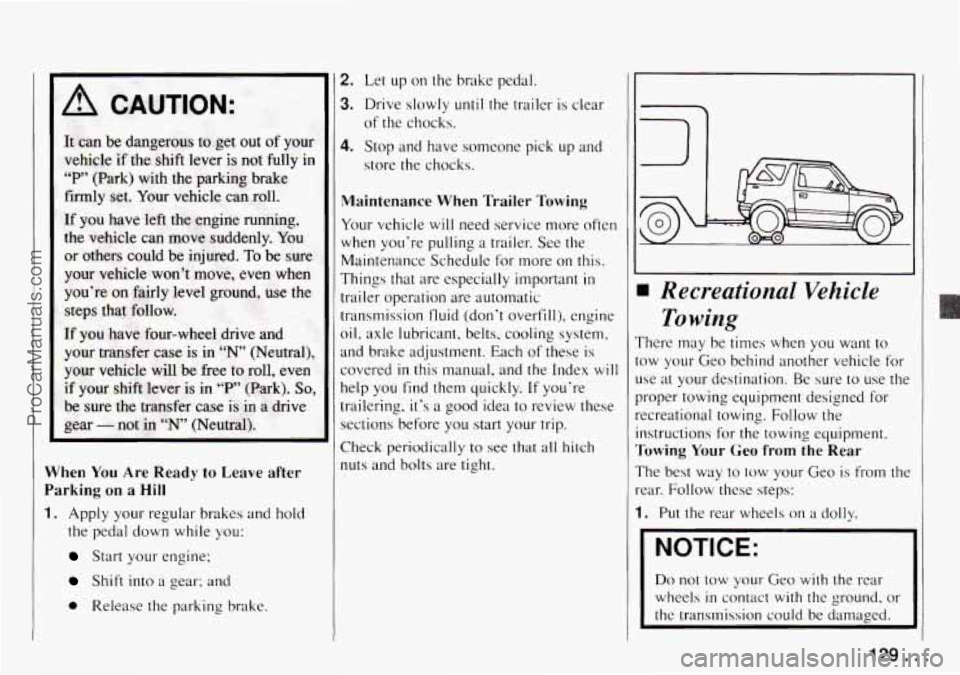
Recreational Vehicle
To wing
There may be times when you want to
:ow your Geo behind another vehicle for
Jse at your destination. Be sure to use the
proper towing equipment designed for
-ecreational towing. Follow the Instructions for the towing equipment.
rowing Your Geo from the Rear
rhe best way to tow your Geo is from the
-ear. Follow these steps:
1. Put the rear wheels on a dolly.
I NOTICE:
I
Do not tow your Geo with the rear
wheels
in contact with the ground. or
the transmission could be damaged. 1
.. 129. ProCarManuals.com
Page 131 of 258

Your Driving and the Road
2. Set the parking brake.
3. If your Geo is a four-wheel-drive
vehicle, set your manual freewheeling
hubs
to ”FREE” or unlock your
automatic I‘reewheeling hubs. See “Four-wheel Drive”
in the Index.
4. Turn the ignilion key to ”ACC’‘ to
unlock the steering wheel.
5. Clamp the steering wheel in a
straight-ahead position, with a
clamping device designed for towing.
6. Release the parking brake.
I NOTICE:
I
Make sure that the towing speed does
not exceed
55 mph (90 km/h), or
your Geo could be badly damaged.
~~
Towing Your Geo from the Front
NOTICE:
If your vehicle has automatic free-
wheeling hubs
or two-wheel drive,
do not tow
it on all four wheels. If
you do, your transmission could be
damaged.
If you have a four-wheel-drive vehicle
with manual freewheeling hubs, it can be
towed from the front with
all four wheels
on the ground. Follow these steps:
1. Set the parking brake.
2. Turn the ignition key to “ACC” to
unlock the steering wheel.
3. Shift your automatic transmission into
“P” (Park), or your manual
transmission into “2” (Second).
4. Shift the transfer case to “N”
(Neutral).
“Four-wheel Drive”
in the Index.
5. Set the hubs to “FREE.” See
6. Reledse the parking brake,
Stop towing every 200 miles
(300 km)
and start the engine. Leave the transfer
case shift lever
in ”N” (Neutral). Shift
your automatic transmission
to “D”
(Drive); leave a manual transmission
in
“2” (Second) and release the clutch. Run
the engine
at medium speed for one
minute to circulate the oil in the transfer
case. Turn the ignition key to
“ACC.”
Now, you can continue towing your Geo.
I
NOTICE:
I
Make sure the towing speed does not
exceed
SO mph (80 km/h), or your
Geo could be badly damaged.
I
. . .130
ProCarManuals.com
Page 137 of 258
Problems on the Road
h I B
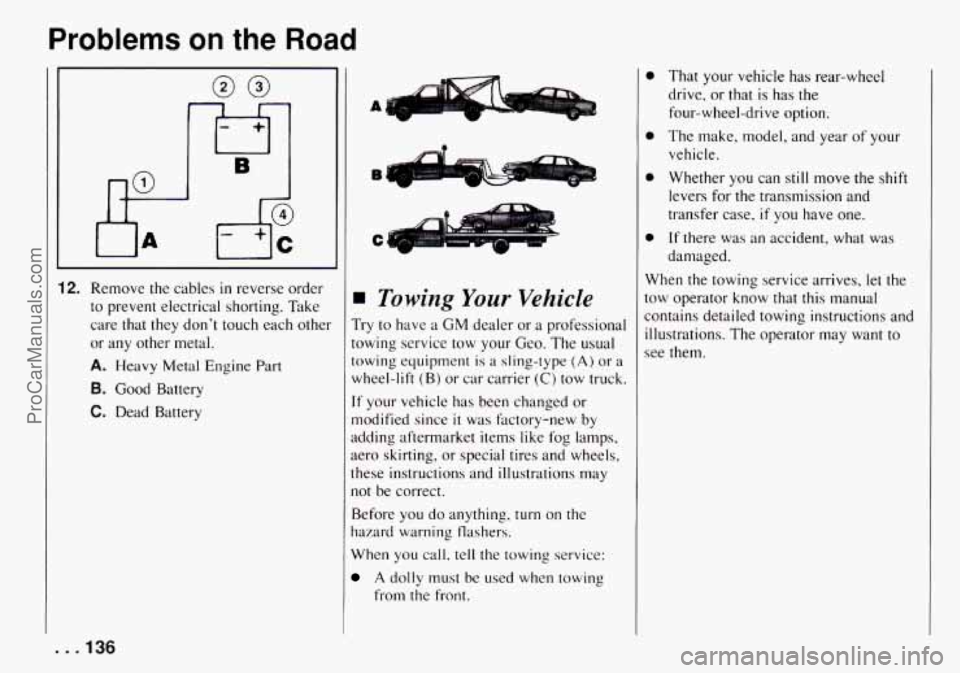
2. Remove the cables in reverse order
to prevent electrical shorting. Take
care that they don't touch each other
or any other metal.
A. Heavy Metal Engine Part
B. Good Battery
C. Dead Battery
C
Towing Your Vehicle
Try to have a GM dealer or a professional
towing service tow your Geo. The usual
towing equipment
is a sling-type (A) or a
wheel-lift (B) or car carrier (C) tow truck.
If your vehicle has been changed or
modified since
it was factory-new by
adding aftermarket items like fog lamps,
aero skirting, or special tires and wheels,
these instructions and illustrations may
not be correct.
Before you do anything, turn
on the
hazard warning flashers.
When you
call, tell the towing service:
A dolly must be used when towing
from the front.
0
e
e
That your vehicle has rear-wheel
drive, or that is has the
four-wheel-drive option.
The make, model, and year
of your
vehicle.
Whether you
can still move the shift
levers for the transmission and
transfer case,
if you have one.
If there was an accident, what was
damaged.
When the towing service arrives,
let the
tow operator know that this manual
contains detailed towing instructions and
illustrations. The operator may want to
see them.
. .I36
ProCarManuals.com
Page 138 of 258

G
A CAUTION:
To help avoid injury to you or others:
0
i.
0
0
0
0
Never let passengers ride in a
vehicle that
is being towed.
Never
tow faster than safe or
Never tow with damaged parts
not fully secured.
Never get under
your vehicle
after
it has been lifted by the tow
truck.
Always use seperate safety
chains
on each side when towing
a vehicle.
Never use
T-hooks. Use “J”
hooks instead.
posted speeds.
When your vehicle is being towed, have
the ignition key
off. The steering wheel
should
be clamped in a straight-ahead
position, with a clamping device designed
for towing service.
Do not use the
vehicle’s steering column
lock for this.
The transmi.ssion and transfer case,
if you
have one, should be in “Neutral” and the
parking brake released.
Don’t have
your vehicle towed with the
rear wheels
in contact with the ground. If
a vehicle must be towed from the front
with sling-type or wheel lift equipment,
the rear wheels
must be supported on a
If your vehicle has four-wheel drive,
don’t have
it towed on the front wheels
unless
you must. If a vehicle with
four-wheel drive
must be towed on the
front wheels,
set your tnanual,
freewheeling hubs
to “FREE” or unlock
your automatic freewheeling hubs, and set
your transfer case to two-wheel drive. If
your vehicle must be towed on the front
wheels, don‘t
go more than 55 rnph (90
km/h).
dolly.
131 . . . ProCarManuals.com
Page 139 of 258
Problems on the Road
I
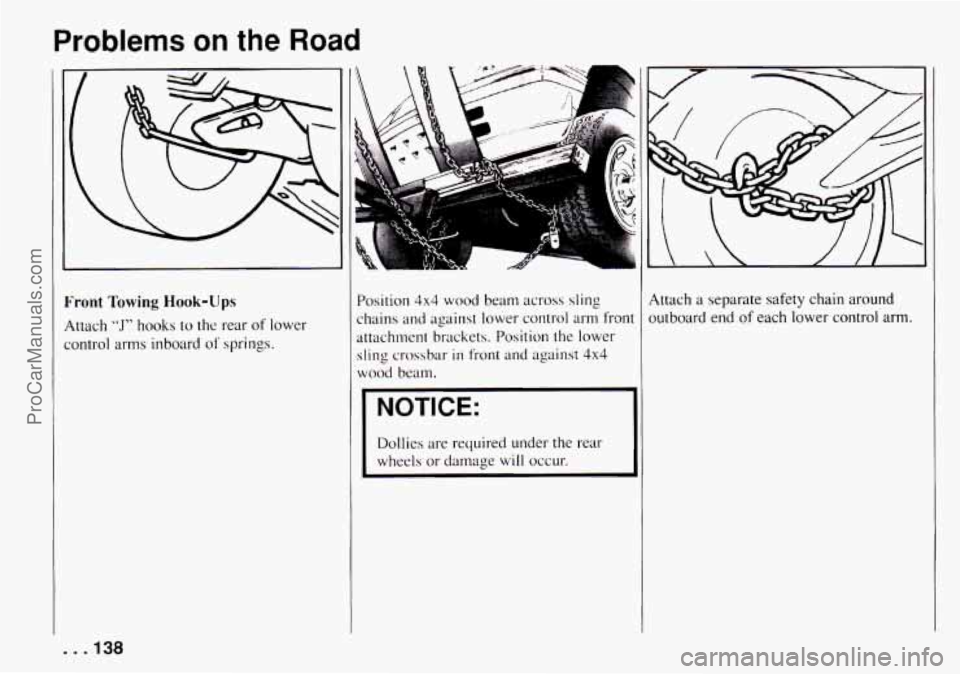
i’ront Towing Hook-ZJps
ittach “J” hooks to the rear of lower
:onlrol arms inboard
of springs. Position
4x4 wood beam across sling
:hains
and against lower control arm fron
machment brackets. Position the lower
wood beam.
I NOTICE:
I
Dollies are required under the rear
wheels or damage will occur.
I/ /
Attach a separate safety chain around
outboard end
of each lower control arm.
. . .I38
ProCarManuals.com
Page 147 of 258
Problems on the Road
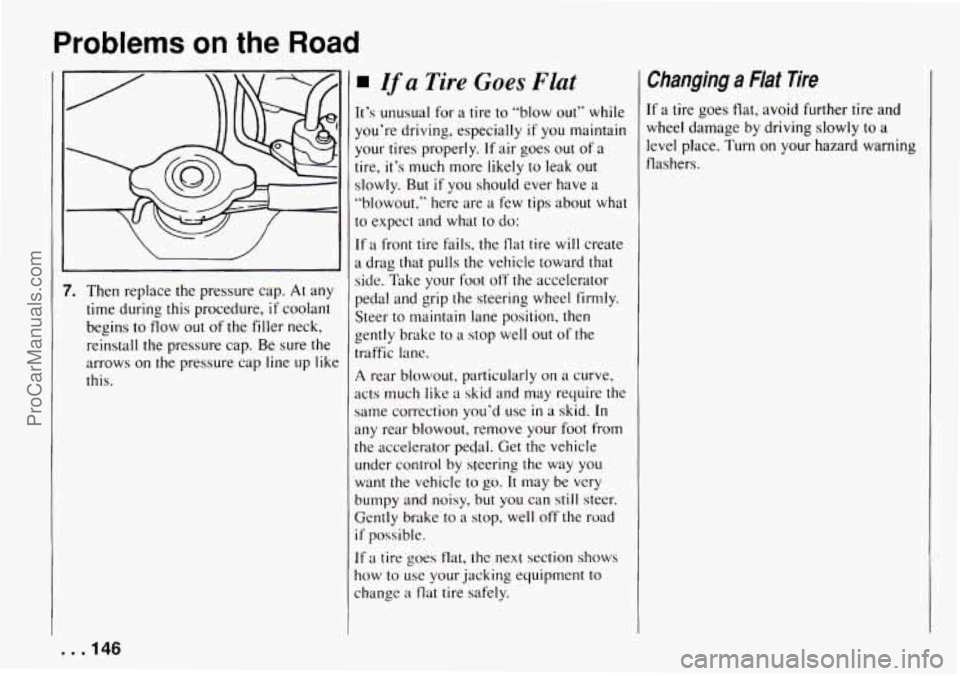
7, Then replace the pressure cap. At any
time during this procedure,
if coolant
begins
to flow out of the filler neck,
reinstall
the pressure cap. Be sure the
arrows on
the pressure cap line up like
this.
. .I46
If a Tire Goes Flat
It’s unusual for a tire to “blow out” while
you’re driving, especially
if you maintain
your tires properly.
If air goes out of a
tire, it’s much more likely to leak out
slowly.
But if you should ever have a
“blowout.” here are a few tips about what
to expect and what to do:
If a front tire Fails, the flat tire will create
a drag that pulls the vehicle toward that
side. Tdke your foot off
the accelerator
pedal and grip the steering wheel firmly.
Steer
to maintain lane position, then
gently brake to a stop well out
of the
traffic lane.
A rear blowout, particularly on a curve,
acts much like
a skid and may require the
same correction you’d use
in a skid. In
any rear blowout, remove your foot from
the accelerator pedal. Get the vehicle under control by steering
the way you
want the vehicle to go. It rnay be very
bumpy and noisy, but
you can still steer.
fently brake to a stop, well off the road
if possible.
If a tire goes tlat, the next section shows
how to use your jacking equipment
to
:hange a tlat tire safely.
Changing a Flat Tire
If a tire goes tlat, avoid further tire and
wheel damage by driving slowly
to a
level place.
Turn on your hazard warning
flashers.
ProCarManuals.com