light CHEVROLET TRACKER 1994 Workshop Manual
[x] Cancel search | Manufacturer: CHEVROLET, Model Year: 1994, Model line: TRACKER, Model: CHEVROLET TRACKER 1994Pages: 258, PDF Size: 14.43 MB
Page 134 of 258

I Jump Starting
If your battery has run down, you may
want to use another vehicle and some
jumper cables to start your Geo. But
please follow
the steps below to do it
safely.
NOTICE:
Ignoring these steps could result in
costly damage to your vehicle that
wouldn’t be covered by your war-
ranty.
Trying to start your Geo by pushing
or pulling it could damage your
vehicle, even if you have
a manual
transmission. And if you have an
automatic transmission,
it won’t start
that way.
To Jump Start Your Geo:
1. Check the other vehicle. It must have
a 12-volt battery with a negative
ground system.
NOTICE:
If the other system isn’t a 12-volt
system with
a negative ground, both
vehicles can be damaged.
2. Get the vehicles close enough so the
jumper cables can reach, but be sure
the vehicles aren’t touching each
other.
If they are, it could cause a
ground connection you don’t want.
You wouldn’t be able to start your
Geo, and
the bad grounding could
damage the electrical systems.
3. Turn off the ignition on both vehicles.
Turn off all lights that aren’t needed,
and radios. This will avoid sparks and
help save both batteries. And it could
save your radio!
I NOTICE:
I
I
If you leave your radio on, it could be
badly damaged. The repairs wouldn’t
be covered by your warranty.
I
133 ...
ProCarManuals.com
Page 155 of 258
Problems on the Road
NOTICE:
Spinning your wheels can destroy
parts of your vehicle as well as the
tires. If you spin the wheels too fast
while shifting your transmission back
and forth, you can destroy your trans-
mission.
Rocking your vehicle to get it out:
First, turn your steering wheel left and
right. That
will clear the area around your
front wheels. Then shift back and forth
between
“R” (Reverse) and a forward
gear (or
with a manual transmission,
between First or Second gear and
Reverse), spinning the wheels as little as
possible. Release the accelerator pedal
while you shift, and press lightly on the
accelerator pedal when the transmission is
in gear. If that doesn’t get you out after a
few tries, you may need to be towed out.
Or, you can use your recovery hooks,
if
your vehicle has them. If you do need to
be towed out, see “Towing Your Vehicle”
in the Index.
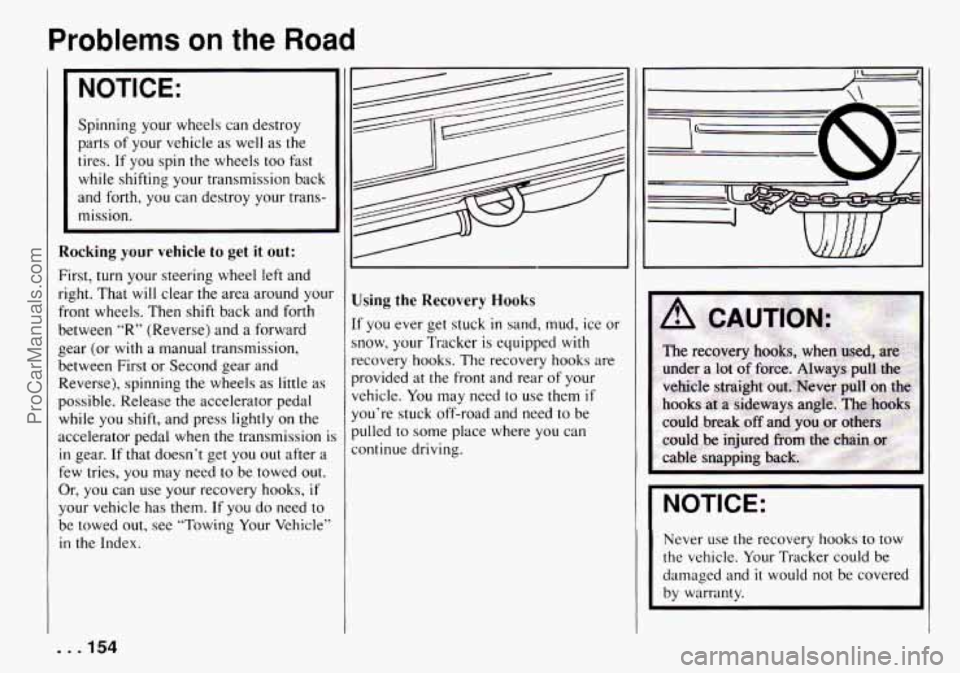
Using the Recovery Hooks
If you ever get stuck in sand, mud, ice or
snow, your Tracker is equipped
with
recovery hooks. The recovery hooks are
provided at the front
and rear of your
vehicle. You
may need to use them if
you’re stuck off-road and need to be
pulled to some place where you can
continue
driving.
NOTICE:
Never use the recovery hooks to tow
the vehicle. Your Tracker could be
darnaged
and it would not be covered
by warranty.
. . I154
ProCarManuals.com
Page 160 of 258
Checking Things under
the Hood
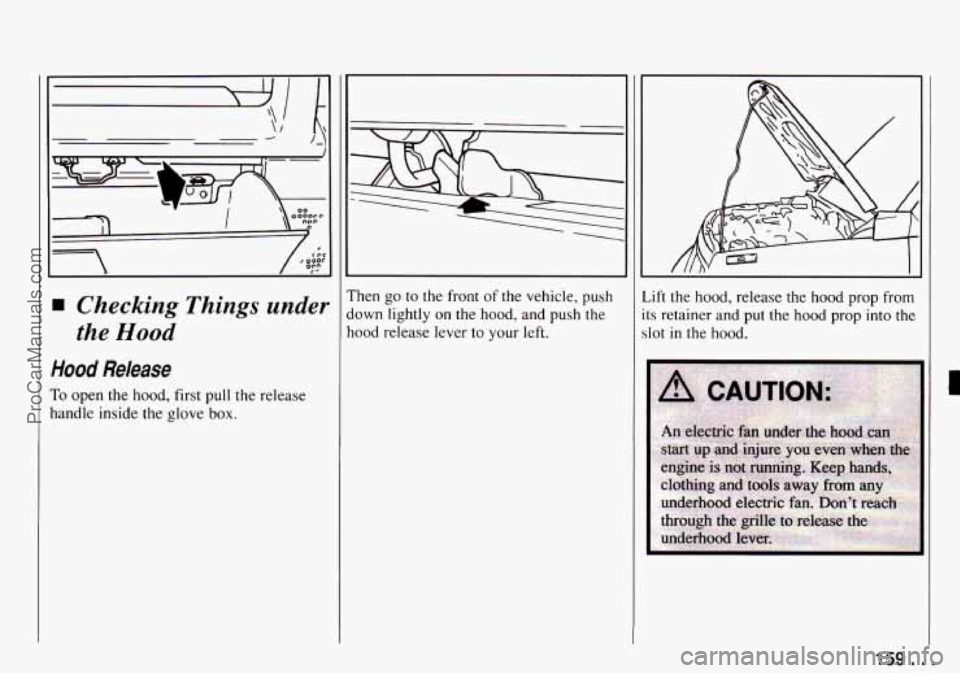
Hood Release
To open the hood, first pull the release
nandle inside the glove
box.
I
rhen go to the front of the vehicle, push
lown lightly on the hood, and push the
lood release lever
to your left.
.ift the hood, release the hood prop from
:s retainer and put the hood prop into the
lot in the hood.
159.. ProCarManuals.com
Page 171 of 258
~~
~~ ~ ~~~~ ~ Service and Appearance Care
Four- Wheel Drive
Most
lubricant checks in this section also
apply to four-wheel-drive vehicles.
However, they have
two additional
systems that need lubricatiog.
Transfer Case
When to Check qnd Change Lubricant
Refer to the Maintenance Schedule to
determine how often to check the
lubricant and when to change
it. See
“Scheduled Maintenance Services”
in the
Index.
How to Check Lubricant
If the level is below the bottom of the
filler plug hole, you’ll need to add some
lubricant. Add enough lubricant to raise
the level to the bottom of the filler plug
hole.
What to Use
Refer to the Maintenance Schedule to
determine what kind of lybricant to use.
See “Recommended Fluids and
Lubricants”
in the Index.
Front Axle
When
to Check and Change Lubricant
Refer to the Maintenance Schedule to a
determine how often to check the
lubricant and when to change it. See
“Periodic Maintenance Inspections” and
“Scheduled Maintenance Services”
in the
Index.
How to Check Lubricant
If the level is below the bottom of the
filler plug hole, you’ll need to add some
lubricant.
If the differential is at operating
temperature (warm), add enough lubricant
to raise the level to the bottom of the filler
plug hole.
If the differential
is cold, add enough
lubricant to raise the level to
1/2 inch (12
mm) below the filler plug hole.
What to Use
Refer to the Maintenance Schedule to
determine
what kind of lubricant to use.
See “Recommended Fluids and
Lubricants”
in the Index.
Engine Coolant
The following explains your cooling
system and how to add coolant when it is
low. If you have a problem with engine
overheating, see “Engine Overheating”
in
the Index.
The proper coolant for your Geo will:
Give freezing protection down to
-20°F (-29”C), or -34°F (-37°C)
in
Canada and for vehicles with the cold
climate option.
Give boiling protection up to 258°F
(125°C).
Protect against rust and corrosion.
Help keep the proper engine
temperature.
Let the warning lights work as they
should.
What to Use:
Use a mixture of one-half clean water
(preferably distilled) and one-half
antifreeze that meets “GM Specification
6038-M,” which won’t damage aluminum
parts.
You can also use a recycled coolant
conforming to
“GM Specification
6038-M”
with a complete coolant flush
. . .I70
ProCarManuals.com
Page 177 of 258
~ Service and Appearance Care
r
NOTICE:
Continuing to drive
with worn-out
brake pads could result in costly
brake repair.
Some driving conditions or climates may
cause a brake squeal when the brakes are
first applied or lightly applied. This does
not mean something is wrong with your
brakes.
Your rear drum brakes don’t have wear
indicators, but if you ever hear a rear
brake rubbing noise, have the rear brake linings inspected. Also, the rear brake
drums should be removed and inspected
each time the tires are removed for
rotation or changing. When you have the front brakes replaced, have
the rear
brakes inspected, too.
Brake linings should always be replaced
as complete axle sets.
Brake Pedal Travel
See your dealer if the brake pedal does
not return to normal height, or if there is a
rapid increase in pedal travel. This could
be a sign
of brake trouble.
Brake Adjustment
Every time you make a brake stop, your
disc brakes adjust for wear.
If your brake pedal goes down farther
than normal, your rear drum brakes may
need adjustment. Adjust them by backing
up and firmly applying the brakes a few
times.
Replacing Brake System Parts
The braking system on a modern vehicle
is complex. Its many parts have to be of
top quality and work well together
if the
vehicle is
to have really good braking.
Vehicles we design and test have
top-quality GM brake parts in them, as
your Geo does when it is new. When you replace parts
of your braking system -
for example,
when your brake linings
wear down and you have to have new
ones put in
- be sure you get new
genuine
GM replacement parts. If you
don’t, your brakes may no longer work
properly. For example, if someone puts in
brake linings that are wrong for your
vehicle, the balance between your front
and rear brakes can change, for the worse.
The braking performance you’ve come to
expect can change in many other ways if
someone puts in the wrong replacement
brake parts.
Battery
Every new Geo has a Delco Freedoms
battery.
You never have to add water to
one
of these. When it’s time for a new
battery, we recommend a Delco
Freedoma battery. Get one that has the
catalog number shown on the original
battery’s label.
Vehicle Storage
If you’re not going to drive your vehicle
for
25 days or more, take off the black,
negative
(-) cable from the battery. This
. . .I76
ProCarManuals.com
Page 178 of 258
will help keep your battery from running
down.
Contact your dealer to learn how to
prepare your vehicle for longer storage
periods. Bulb Replacement
See “Replacement Bulbs” in the Index to
check the size and type of bulb you need
to use.
Halogen Bulbs
Headlights
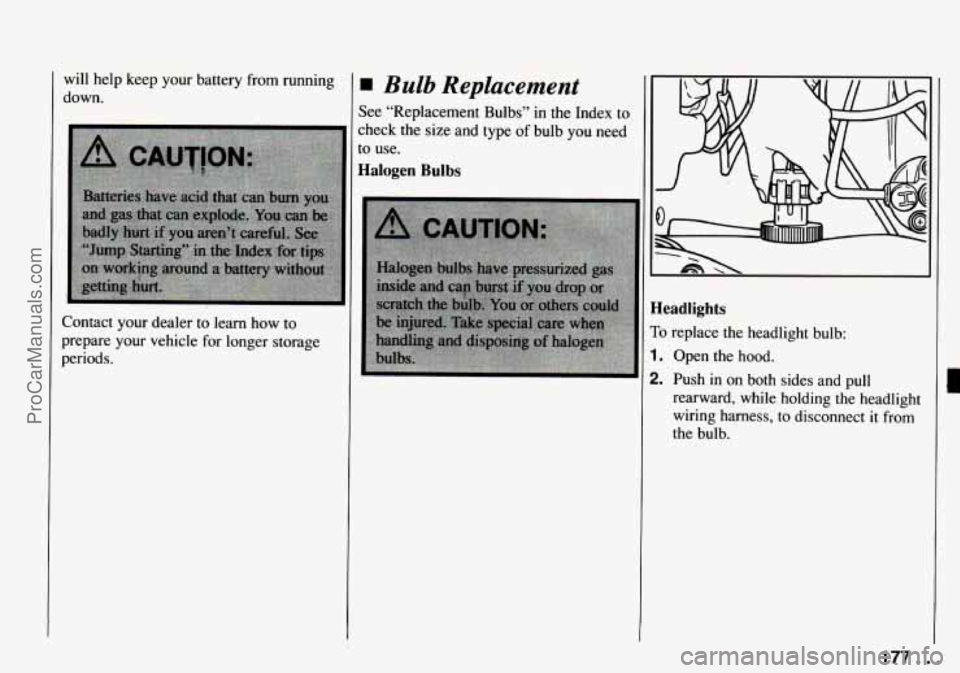
To replace the headlight bulb:
1. Open the hood.
2. Push in on both sides and pull
rearward, while holding the headlight
wiring harness, to disconnect it from
the bulb.
177 ... ProCarManuals.com
Page 179 of 258
Service and Appearance Care
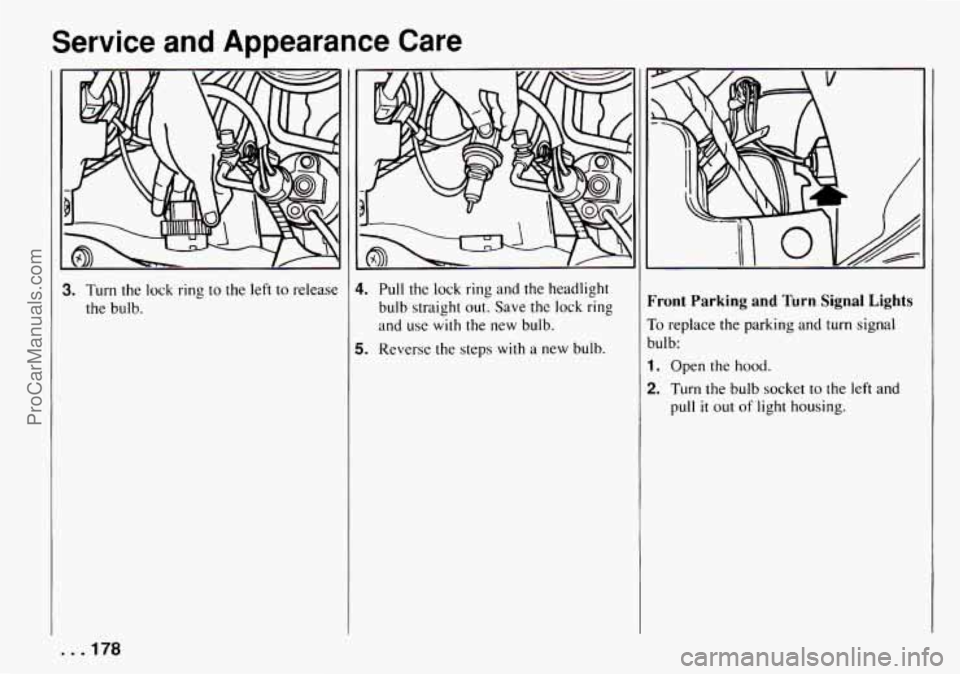
3. Turn the lock ring to the left to release
the bulb. 4. Pull the lock ring and the headlight
bulb straight out. Save the lock ring
and use with
the new bulb.
5. Reverse the steps with a new bulb.
Front Parking and Turn Signal Lights
ro replace the parking and turn signal
mlb:
I. Open the hood.
2. Turn the bulb socket to the left and
pull
it out of light housing.
. . .178
ProCarManuals.com
Page 180 of 258
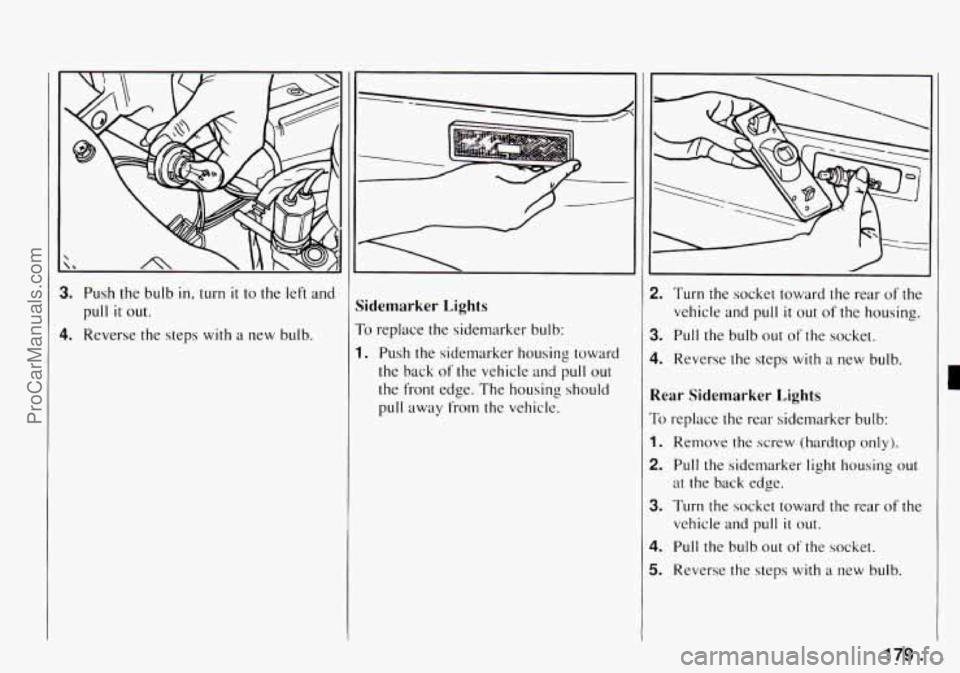
3. Push the bulb in, turn it to the left and
4. Reverse the steps with a new bulb.
pull it out. Sidemarker Lights
ro replace the sidemarker bulb:
I. Push the sidemarker housing toward
the back
of the vehicle and pull out
the front edge. The housing should
pull away from the vehicle.
2. Turn the socket toward the rear of the
vehicle and pull
it out of the housing.
3. Pull the bulb out of the socket.
4. Reverse the steps with a new bulb.
Rear Sidemarker Lights
To replace the rear sidemarker bulb:
1. Remove the screw (hardtop only).
2. Pull the sidemarker light housing out
3. Turn the socket toward the rear of the
at the back edge.
vehicle and pull
it out.
4. Pull the bulb out ofthe socket.
5. Reverse the steps with a new bulb.
179 ... ProCarManuals.com
Page 181 of 258
Service and Appearance Care
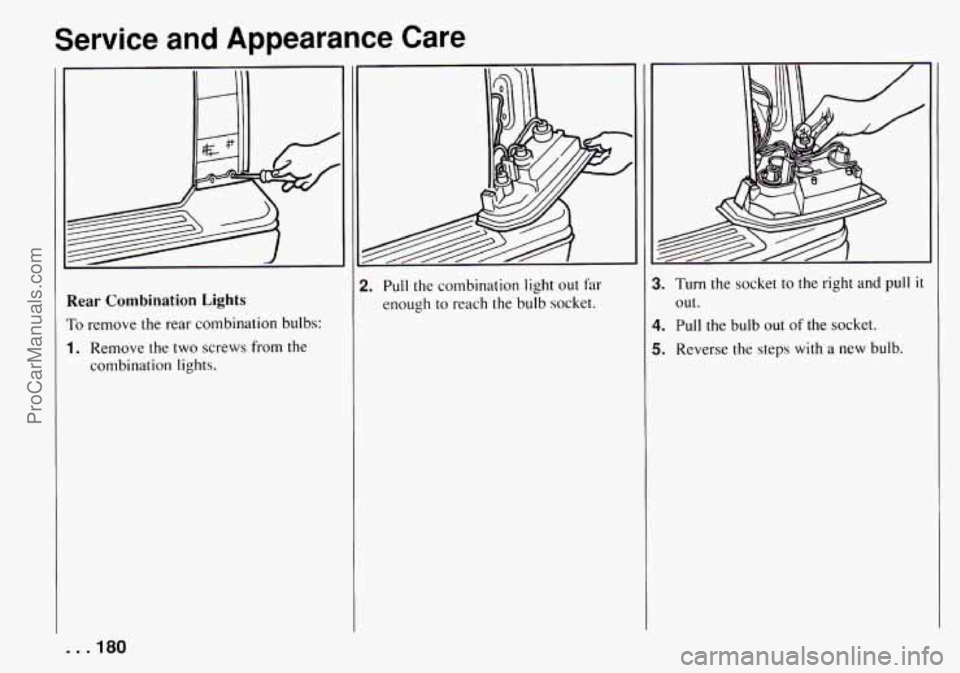
Rear Combination Lights
To remove the rear combination bulbs:
1. Remove the two screws from the
combination lights.
2. Pull the combination light out Fdr
enough to reach the bulb socket. 1. Turn the socket to the right and pull it
1. Pull the bulb out of the socket.
i. Reverse the steps with a new bulb.
out.
. . .I80
ProCarManuals.com
Page 182 of 258

:enter High-Mounted Stoplight
Hardtop)
i, remove the bulb:
. Remove the side pins.
!. Pull the housing forward.
1. Turn the socket counterclockwise and
pull
it out.
I. Pull the bulb out of the socket.
i. Reverse the steps with a new bulb.
ll
GVWR ~GAWR FRT GAWR RR
I TIRES I
I PRESSURE COLD PSl!kPa I
IJ
Center High-Mounted Stoplight
(Convertible)
To remove the bulb:
1, Remove the two screws and the lens
housing.
pull
it out.
2. Turn the socket counterclockwise and
3. Pull the bulb out of the socket.
4. Reverse the steps with a new bulb.
Loading Your Vehicle
Two labels on your vehicle show how
much weight
it may properly carry. The
Tire-Loading Information label found
on
the driver’s door lock pillar tells you the
proper size, speed rating and
recommended inflation pressures for the
tires on your vehicle.
It also gives you
important information about the number
of people that can be
in your vehicle and
the total weight that
you can carry. This
weight is called the Vehicle Capacity
Weight and includes the weight
of all
occupants, cargo, and all
nonfactory-installed options.
181 . . .
ProCarManuals.com