lock CHEVROLET TRACKER 1994 Workshop Manual
[x] Cancel search | Manufacturer: CHEVROLET, Model Year: 1994, Model line: TRACKER, Model: CHEVROLET TRACKER 1994Pages: 258, PDF Size: 14.43 MB
Page 159 of 258
Service and Appearance Care
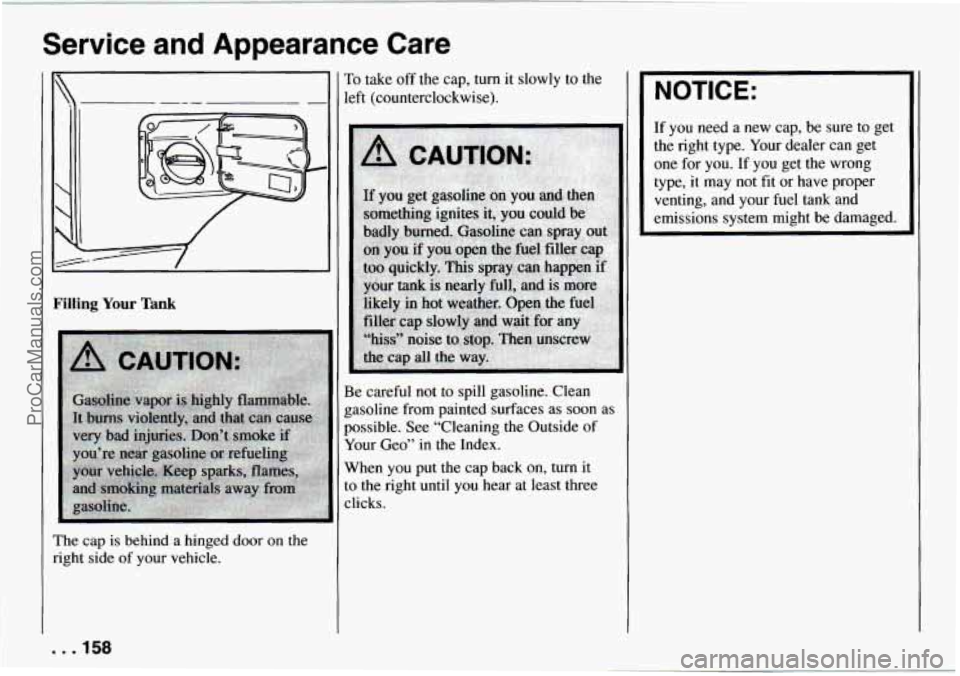
Filling Your Tank
The cap is behind a hinged door on the
right side of your vehicle.
I’o take off the cap, turn it slowly to the
left (counterclockwise).
Be careful not to spill gasoline. Clean
gasoline from painted surfaces as soon as
possible. See “Cleaning
the Outside of
Your Geo” in the Index.
When you put the cap back on,
turn it
to the right until you hear at least three
:licks.
NOTICE:
If you need a new cap, be sure to get
the right type.
Your dealer can get
one for you. If you get the wrong
type, it
may not fit or have proper
venting, and your fuel tank and
emissions system might be damaged.
. . .158
ProCarManuals.com
Page 166 of 258

Engine Oil Additives
Don’t add anything to your oil. Your Geo
dealer is ready to advise
if you think
something should be added.
When to Change Engine Oil
See if any one of these is true for you:
Most trips are less than 4 miles (6 km).
It’s below freezing outside and most
trips are less than 10 miles (1 6 km).
The engine is at low speed most of the
time (as
in door-to-door delivery, or
stop-and-go traffic).
You tow a trailer often.
Most trips are through dusty places.
The vehicle is frequently operated
If any one of these is true for your
vehicle, then you need to change your
and filter every
3,000 miles (5 000 km) or
3 months - whichever comes first.
If none of them is true, change oil and
filter every
7,500 miles (1 2 500 km) or
7.5 months - whichever comes first.
off-road.
Engine
Coolant Heater (Engine Block
Heater)
An engine coolant heater can be a big
help
if you have to park outside in very
cold weather,
0°F (-I 8°C) or colder. If
your vehicle has this option, see “Engine
Coolant Heater”
in the Index.
What to Do with Used Oil
Did you know that used engine oil
contains elements that may be unhealthy
for your skin and could even cause
cancer? Don’t let used oil stay on your
skin for very long. Clean your skin and
nails
with soap and water, or a good hand
cleaner. Wash or properly throw away
clothing or rags containing used engine
oil. (See the manufacturer’s warnings
about
the use and disposal of oil products.)
Used oil can
be a real threat to the
environment.
If you change your own oil,
be sure
to drain all free-tlowing oil from
the filter before disposal. Don’t ever
dispose of oil by putting
it in the trash,
pouring
it on the ground, into sewers, or
into streams or bodies
of water. Instead.
recycle
it by taking it to a place that
collects used
oil. If you have a problem
properly disposing.
of your used oil, ask
your dealer,
a service station or a local
recycling center for help.
Air Cleaner
Refer to the Maintenance Schedule to
detertnine when to replace the
air filter.
See “Scheduled Maintenance Services“
ir
the Index.
A CAUTION:
Operating the engine with the air
cleaner off can cause you or others to
be burned. The air cleaner not only.
cleans the air,
it stops flame if the
engine backfires.
If it isn’t there, and
the engine backfires, you could be
burned. Don’t drive with it
off, and
be careful working
on the engine
with the
air cleaner off.
165.
ProCarManuals.com
Page 179 of 258
Service and Appearance Care
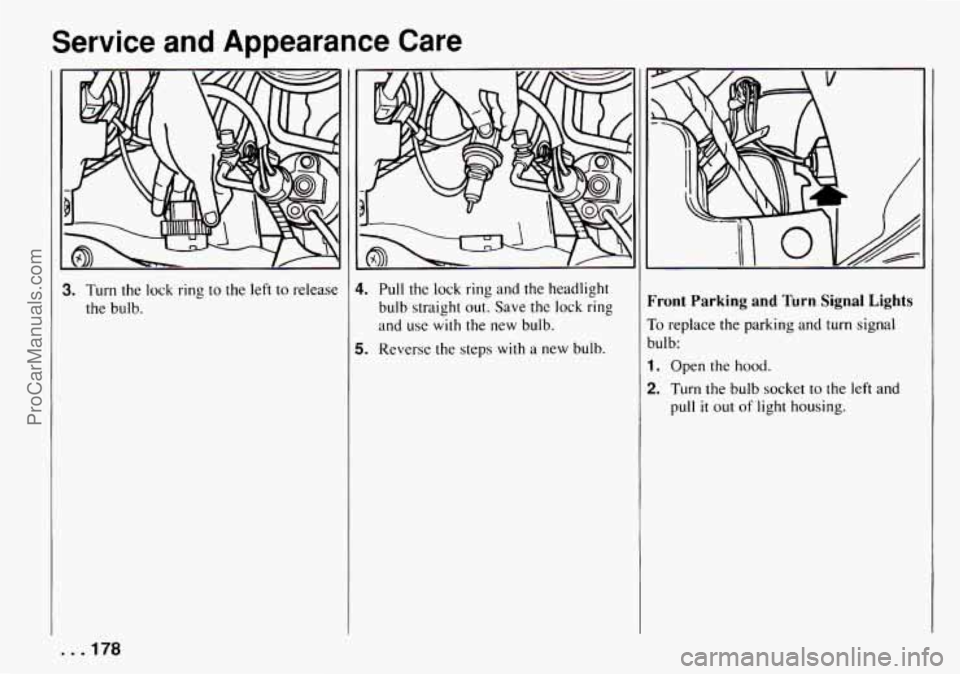
3. Turn the lock ring to the left to release
the bulb. 4. Pull the lock ring and the headlight
bulb straight out. Save the lock ring
and use with
the new bulb.
5. Reverse the steps with a new bulb.
Front Parking and Turn Signal Lights
ro replace the parking and turn signal
mlb:
I. Open the hood.
2. Turn the bulb socket to the left and
pull
it out of light housing.
. . .178
ProCarManuals.com
Page 182 of 258

:enter High-Mounted Stoplight
Hardtop)
i, remove the bulb:
. Remove the side pins.
!. Pull the housing forward.
1. Turn the socket counterclockwise and
pull
it out.
I. Pull the bulb out of the socket.
i. Reverse the steps with a new bulb.
ll
GVWR ~GAWR FRT GAWR RR
I TIRES I
I PRESSURE COLD PSl!kPa I
IJ
Center High-Mounted Stoplight
(Convertible)
To remove the bulb:
1, Remove the two screws and the lens
housing.
pull
it out.
2. Turn the socket counterclockwise and
3. Pull the bulb out of the socket.
4. Reverse the steps with a new bulb.
Loading Your Vehicle
Two labels on your vehicle show how
much weight
it may properly carry. The
Tire-Loading Information label found
on
the driver’s door lock pillar tells you the
proper size, speed rating and
recommended inflation pressures for the
tires on your vehicle.
It also gives you
important information about the number
of people that can be
in your vehicle and
the total weight that
you can carry. This
weight is called the Vehicle Capacity
Weight and includes the weight
of all
occupants, cargo, and all
nonfactory-installed options.
181 . . .
ProCarManuals.com
Page 183 of 258

Service and Appearance Care
1
1
a
I
> 7
i
tl
B
tl
F
tl
0
S
T
t
f
r
1
1)
:he other label is the Certification label,
dso found
on the driver’s door lock pillal
t tells you the gross weight capacity of
Tour vehicle, called the
GVWR (Gross
Jehicle Weight Rating). The
GVWR
dudes the weight of the vehicle, all
ccupants, fuel and cargo. Never exceed
ne GVWR for your vehicle, or the Gross
Ytle Weight Rating (GAWR) for either
he front or rear axle.
ind, if you
do have a heavy load, you
hould spread it out. Don’t carry more
han
400 pounds (1 8 1 kilograms) in your
ear area when four people are in your
wo-wheel drive vehicle.
If you have a
our-wheel drive vehicle, don’t carry
nore than
200 pounds (91 kilograms) in
{our rear area when four people are
in
Tour vehicle.
NOTICE:
I
Your warranty does not cover parts or
components that fail because
of over-
loading.
I ~
[f you put things inside your vehicle -
like suitcases, tools, packages, or
anything else
- they will go as fast as the
vehicle goes. If you have to stop or turn
quickly, or if there is a crash, they’ll keep
going.
. .I82
ProCarManuals.com
Page 199 of 258

Service and Appearance Care
Main Fuse Block
1 - Generator to Battery Circuit (60A)
2
- Circuits Only Active When
Ignition Switch is
in “ACC,” “ON”
or “START” (50A)
3
- Circuits Always Active (40A)
4 - Circuits Always Active (30A)
. . .198
nstrument Panel Fuse Block
- Right Headlight (15A)
~ - Left Headlight; High Beam Indicatol
Light
( 1 SA)
I- Taillights; Interior Light; Sidemarker Lights; Instrument Cluster Lights
( 1 SA)
. - Stop Lights; Horn (15A)
~ - Hazard Lights (15A)
I - Door Lock (Option) (20A)
’ - Lighter; Radio (20A)
1 - Ignition System; Warning and
1 - Turn Signal Lights; Back-up Lights
Indicator Lights
( 1 SA)
( 1 SA)
10 - Wiper/Washer ( 15A)
1 1 - Rear Defogger (1 5A)
12 - Heater
(25A)
13
- Rear Wheel Anti-Lock Main Relay
(20A)
14 - Electronic Fuel Injection Main
Relay
( 15A)
ProCarManuals.com
Page 216 of 258
ITEM
NO. SERVICE
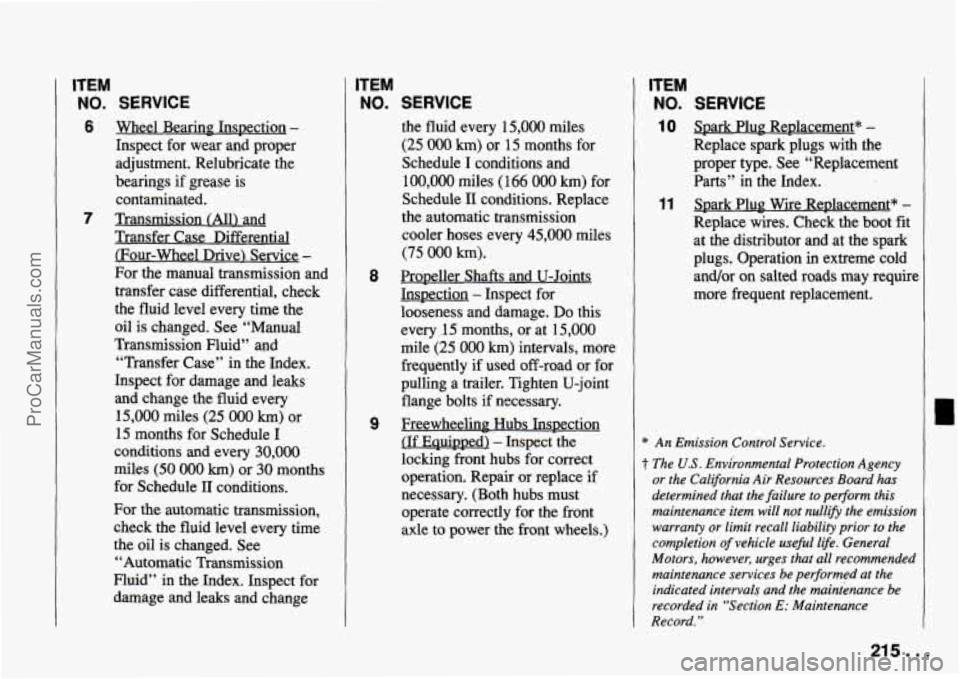
6 Wheel Bearin? InsDection -
Inspect for wear and proper
adjustment. Relubricate the
bearings if grease is
contaminated.
7 Transmission (All) and
Transfer Case Differential
(Four-wheel Drive) Service
-
For the manual transmission and
transfer case differential, check
the fluid level every time the
oil is changed. See “Manual
Transmission Fluid” and
“Transfer Case” in the Index.
Inspect for damage and leaks
and change the fluid every
15,000 miles
(25 000 km) or
15 months for Schedule
I
conditions and every 30,000
miles (50 000 km) or 30 months
for Schedule
II conditions.
For the automatic transmission,
check the fluid level every time
the oil is changed. See
“Automatic Transmission
Fluid” in the Index. Inspect for
damage and leaks and change
ITEM
NO. SERVICE
8
9
the fluid every 15,000 miles
(25 0o0 km) or 15 months for
Schedule
I conditions and
100,000 miles ( 166 000 km) for
Schedule
I1 conditions. Replace
the automatic transmission cooler hoses every
45,000 miles
(75 000 km).
Propeller Shafts and U-Joints
Inspection
- Inspect for
looseness and damage.
Do this
every,.l5 months, or at 15,000
mile
(25 000 km) intervals, more
frequently if used off-road
or for
pulling a trailer. Tighten U-joint
flange bolts if necessary.
Freewheeling Hubs InsDection
/If Equipped) - Inspect the
locking front hubs for correct
operation. Repair or replace if
necessary. (Both hubs must
operate correctly for the front
axle to power the front wheels.)
ITEM
NO. SERVICE
10
11
Spark Plug Replacement” -
Replace spark plugs with the
proper type. See “Replacement Pans” in the Index.
Spark Plup Wire Replacement”
-
Replace wires. Check the boot fit
at the distributor and
at the spark
plugs. Operation in extreme cold
and/or on salted roads may require
more frequent replacement.
* An Emission Control Service.
t The U.S. Environmental Protection Agency
or the California Air Resources Board has
determined that the failure to perform this
maintenance item will not null@ the emission
warranty
or limit recall liability prior to the
completion
of vehicle useful life. General
Motors, however, urges that all recommended
maintenance services be pegormed at the
indicated intervals and the maintenance be
recorded
in “Section E: Maintenance
Record.
’’
215 ...
ProCarManuals.com
Page 220 of 258
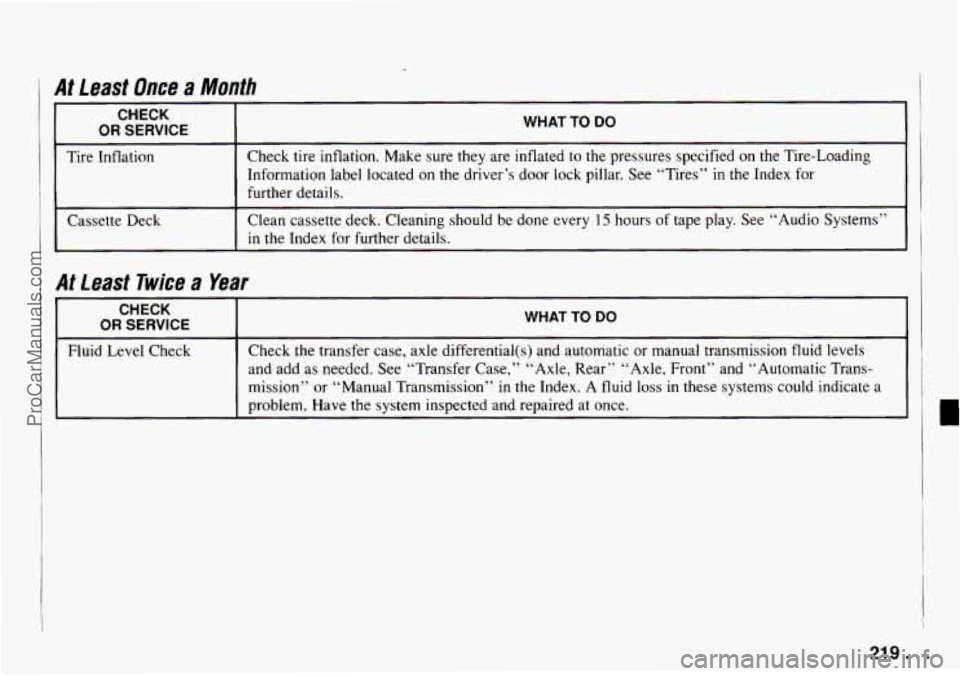
At Least Once a Month
r
CHECK
OR SERVICE I
I
WHAT TO DO
Tire Inflation Check tire inflation. Make sure they are
inflated to the pressures specified on the Tire-Loading
Information label located on
the driver’s door lock pillar. See “Tires” in the Index for
further details.
Cassette Deck Clean cassette
deck. Cleaning should be done every
15 hours of tape play. See “Audio Systems”
in the Index for further details.
I At least Twice a Year
CHECK
OR SERVICE WHAT TO DO
Fluid Level Check Check
the transfer case, axle differential(s) and automatic or manual transmission fluid levels
and. add as needed. See “Transfer Case,” “Axle, Rear” “Axle, Front” and “Automatic Trans-
mission” or “Manual Transmission”
in the Index. A fluid loss in these systems could indicate a
problem. Have the system inspected and repaired
at once.
219 ...
ProCarManuals.com
Page 221 of 258

Maintenance Schedule
Section B: Owner Checks and Services (Cont.)
At Least Once a Year
CHECK
OR SERVICE
Key Lock Cylinders
Body Lubrication
Starter Switch
1
WHAT TO DO
Lubricate the key lock cylinders with the lubricant specified in Section D.
Lubricate all body door hinges. Also lubricate all hinges and latches, including those for the hood,
rear compartment, glove box door, console door and any folding seat hardware. Section D tells
you what to use.
1. Before you start, be sure you have enough room around the vehicle.
2. Firmly apply both the parking brake (see “Parking Brake” in the Index if necessary) and the
NOTE:
Do not use the accelerator pedal, and be ready to turn off the engine immediately if it
starts.
3. On automatic transmission vehicles, try to start the engine in each gear. The starter should
work only in
“P” (Park) or “N” (Neutral). If the starter works in any other position, your
vehicle needs service.
On manual transmission vehicles, put the shift lever in “N” (Neutral), push the clutch down
halfway and try to start the engine. The starter should work only when the clutch is pushed
down all
the way to the floor. If the starter works when the clutch isn’t pushed all the way
down, your vehicle needs service.
regular brake.
- . .220
ProCarManuals.com
Page 222 of 258

At Least Once a Year (CONT.)
CHECK
OR SERVICE
Brake Transmission
Shift Interlock
- BTSI
(Automatic Transmis-
sion)
Steering Column Lock
WHAT TO DO
1. Before you start, be sure you have enough room around the vehicle. It should be parked on a
2. Firmly apply the parking brake. (See “Parking Brake” in the Index if necessary).
NOTE: Be ready to apply the regular brake immediately if the vehicle begins to move.
3. With the engine off, turn the key to the “ON” position, but don’t start the engine. Without
level surface.
applying the regular brake, try
to move the shift lever out of “P” (Park) with normal effort,
If the shift lever moves out
of “P” (Park) , your vehicle’s BTSI needs service.
While parked, and with the parking brake set, try
to turn the key to “LOCK” in each shift lever
position.
0 With an automatic transmission, the key should turn to “LOCK” only when the shift lever is
With a manual transmission, the key will turn to “LOCK” only if you push the key in farther,
On vehicles with
the key release lever, try to turn the key to “LOCK” without pressing the lever.
The key should
turn to “LOCK” only with the key lever depressed. On all vehicles, the key
should come out only
in “LOCK”.
in
“P” (Park).
while turning
it towards “LOCK.”
!
I
I
I’
LLI . . . ProCarManuals.com