lock CHEVROLET TRACKER 1994 Service Manual
[x] Cancel search | Manufacturer: CHEVROLET, Model Year: 1994, Model line: TRACKER, Model: CHEVROLET TRACKER 1994Pages: 258, PDF Size: 14.43 MB
Page 110 of 258

Traveling to Remote Areas
It makes sense to plan your trip,
especially when going to a remote area.
Know the terrain and plan your route. You
are much less likely to get bad surprises.
Get accurate maps of trails and terrain.
Try to learn of any blocked or closed
roads.
It’s also a good idea to travel with at least
one other vehicle.
If something happens
to one of them, the other can help quickly.
Does your vehicle have a winch? If
so, be
sure to read the winch instructions. In a
remote area, a winch can be handy if you
get stuck. But you’ll want to know how to
use it properly.
Getting Familiar with Off-Road
Driving
It’s a good idea to practice in an area
that’s safe and close to home before you
go into the wilderness. Off-road driving
does require some new and different
driving skills. Here’s what we mean.
Tune your senses to different kinds of
signals. Your eyes, for example, need to
constantly sweep the terrain for
unexpected obstacles. Your ears need to
listen for unusual tire or engine sounds. With
your arms, hands, feet, and body
you’ll need to respond to vibrations and
vehicle bounce.
Controlling your vehicle is the key to
successful off-road driving. One
of the
best ways to control your vehicle is to
control your speed. Here are some things
to keep in mind. At higher speeds:
0 you approach things faster and you
have less time to scan the terrain for
obstacles.
0 you have less time to react.
0 you have more vehicle bounce when
you drive over obstacles.
0 you’ll need more distance for braking,
especially since you’re on an unpaved
surface.
Scanning the Terrain
Off-road driving can take you over many
different kinds of terrain. You need to be
familiar with the terrain and its many
different features. Here are some things to
consider.
Surface Conditions. Off-roading can
take you over hard-packed dirt, gravel,
rocks, grass, sand, mud, snow or ice.
Each of these surfaces affects the steering,
acceleration, and braking of your vehicle
in different ways. Depending upon the
kind of surface you are on, you may
experience slipping, sliding, wheel
spinning, delayed acceleration, poor
traction, and longer braking distances.
Surface Obstacles. Unseen or hidden
obstacles can be hazardous.
A rock, log,
hole, rut, or bump can startle you if
you’re not prepared for them. Often these
obstacles are hidden by grass, bushes,
snow or even the rise and fall
of the
terrain itself. Here are some things to
consider:
0 Is the path ahead clear?
0 Will the surface texture change
abruptly up ahead?
109 ...
ProCarManuals.com
Page 111 of 258

Your Driving and the Road
0 Does the travel take you uphill or
downhill? (There’s more discussion of
these subjects later.)
change direction quickly?
0 Will you have to stop suddenly or
When you drive over obstacles or rough
terrain, keep a firm grip
on the steering
wheel.
Ruts, troughs, or other surface
features can jerk the wheel out of your
hands
if you’re not prepared.
When you drive over bumps, rocks, or
other obstacles, your wheels can leave
the
ground. If this happens, even with one or
two wheels, you can’t control the vehicle
as well or at all.
Because you will be on an unpaved
surface,
it’s especially important to avoid
sudden acceleration, sudden turns, or
sudden braking.
In a way, off-road driving requires a
different kind of alertness from driving on
paved roads and highways. There are no
road signs, posted speed limits or signal
lights.
You have to use your own good
judgment about what is safe and what
isn’t.
Drinking and driving can be very
dangerous on any road. And this
is
certainly true for off-road driving. At the
. . .I10
very time you need special alertness and
driving skills, your reflexes, perceptions
and judgment can be affected by even a
small amount of alcohol.
You could have
a serious - or even fatal - accident if
you drink and drive or ride with a driver
who has been drinking. (See “Drunken
Driving”
in the Index.)
Driving On Off-Road Hills
Off-road driving often takes you up,
jown, or across a hill. Driving safely on
hills requires good judgment and an
understanding of what your vehicle can
md can’t do. There are some hills that
;imply can’t be driven, no matter how
well built the vehicle.
Approaching a Hill
When you approach a hill, you need to
decide if
it’s one of those hills that’s just
too steep to climb, descend, or cross.
Steepness can be hard
to judge. On a very
small
hill, for example, there may be a
smooth, constant incline with only a small
change
in elevation where you can easily
see all the way to the top. On a large hill,
the incline may get steeper as you near
the top, but you may not see this because
the crest of
the hill is hidden by bushes,
grass,
or shrubs.
Here are some other things
to consider as
you approach a hill.
Is there a constant incline, or does the
hill get sharply steeper in places?
Is there good traction on the hillside,
or will the surface cause tire slipping?
Is there a straight path up or down the
hill so you won’t have to make turning
maneuvers?
Are there obstructions on the hill that
can block your path (boulders, trees,
logs or ruts)?
What’s beyond the hill?
Is there a cliff,
an embankment, a drop-off, a fence?
Get out and walk the
hill if you don’t
know. It’s the smart way to find out.
ProCarManuals.com
Page 112 of 258
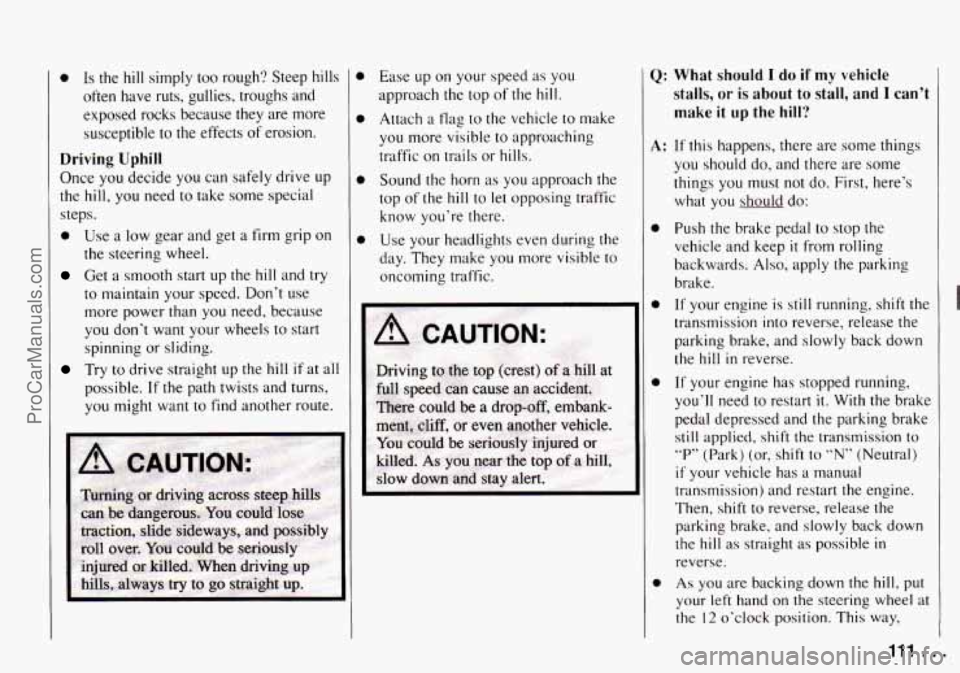
0 Is the hill simply too rough‘? Steep hills
often have ruts, gullies, troughs and
exposed rocks because
they are more
susceptible
to the effects of erosion.
Driving Uphill
Once you decide you can safely drive up
the hill,
you need to take some special
steps.
0 Use a low gear and get a firm grip on
the steering wheel.
Get a smooth start up the hill and try
to maintain your speed. Don’t use
more power than
you need, because
you don’t want your wheels
to start
spinning or sliding.
Try to drive straight up the hill if at a1
possible.
If the path twists and turns,
you might want to find another route.
0
0
0
0
Ease up on your speed as you
approach the top
of the hill.
Attach a flag to the vehicle to tnake
you more visible to approaching
traffic on trails
or hills.
Sound the
horn as you approach the
top
of the hill to let opposing traffic
know you’re there.
Use your headlights even during the
day. They make you more visible
to
oncoming traffic.
Q: What should I do if my vehicle
A:
0
0
0
0
stalls, or is about to stall, and I can’t
make
it up the hill?
If this happens, there are some things
you should do, and there are some
things you must not do. First, here’s
what you should do:
Push the brake pedal
to stop the
vehicle and keep
it from rolling
backwards. Also, apply
the parking
brake.
If your engine is still running, shift the
transmission into reverse, release the
parking brake, and slowly back down
the
hill in reverse.
If your engine has stopped running,
you’ll need to restart it. With the brake
pedal depressed and
the parking brake
still applied,
shift the transmission to
“P” (Park) (or, shift to “N” (Neutral)
if your vehicle has a manual
transmission) and restart
the engine.
Then, shift
to reverse, release the
parking brake, and slowly back down
the
hill as straight as possible in
reverse.
As you are backing down the hill, put
your left hand
on the steering wheel at
the
12 o’clock position. This way,
111 . . .
ProCarManuals.com
Page 114 of 258
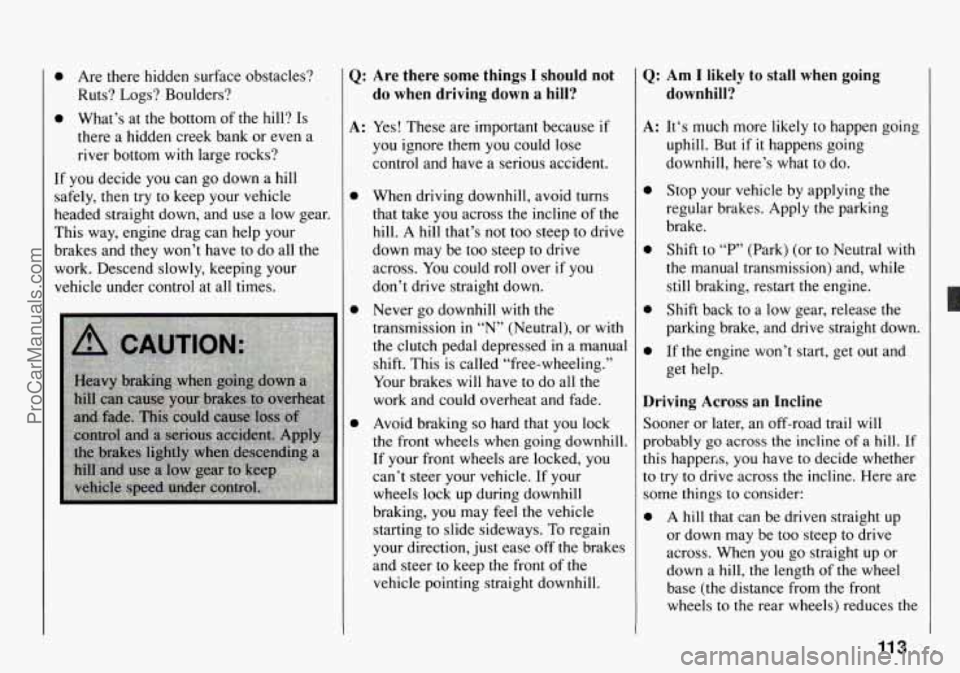
0 Are there hidden surface obstacles?
Ruts? Logs? Boulders?
0 What’s at the bottom of the hill? Is
there a hidden creek bank or even a
river bottom with large rocks?
If you decide you can go down a
hill
safely, then try to keep your vehicle
headed straight down, and use a low gear.
This way, engine drag can help your
brakes and they won’t have to do all the
work. Descend slowly, keeping your
vehicle under control at all times.
Q: Are there some things I should not
do when driving down
a hill?
A: Yes! These are important because if
you ignore them you could lose
control and have a serious accident.
When driving downhill, avoid turns
that take you across the incline
of the
hill.
A hill that’s not too steep to drive
down may be too steep to drive
across. You could roll over if you
don’t drive straight down.
Never go downhill with the
transmission in “N” (Neutral), or with
the clutch pedal depressed in a manual
shift. This is called “free-wheeling.”
Your brakes will have to do all the
work and could overheat and fade.
Avoid braking
so hard that you lock
the front wheels when going downhill.
If your front wheels are locked, you
can’t steer your vehicle. If your
wheels lock up during downhill
braking, you may feel the vehicle
starting to slide sideways.
To regain
your direction, just ease
off the brakes
and steer to keep the front of the
vehicle pointing straight downhill.
Q: Am I likely to stall when going
downhill?
A:
0
0
0
0
It‘s much more likely to happen going
uphill.
But if it happens going
downhill, here’s what to do.
Stop your vehicle by applying the
regular brakes. Apply the parking
brake.
Shift to
“P” (Park) (or to Neutral with
the manual transmission) and, while
still braking, restart the engine.
Shift back to a low gear, release the
parking brake, and drive straight down.
If the engine won’t start, get out and
get help.
Driving Across an Incline
Sooner or later, an off-road trail will
probably go across the incline
of a hill. If
this happeris, you have to decide whether
to try to drive across the incline. Here are
some things to consider:
0 A hill that can be driven straight up
or down may be too steep to drive
across. When you go straight up or
down a hill, the length
of the wheel
base (the distance from the front
wheels to the rear wheels) reduces the
113 :. .
ProCarManuals.com
Page 124 of 258
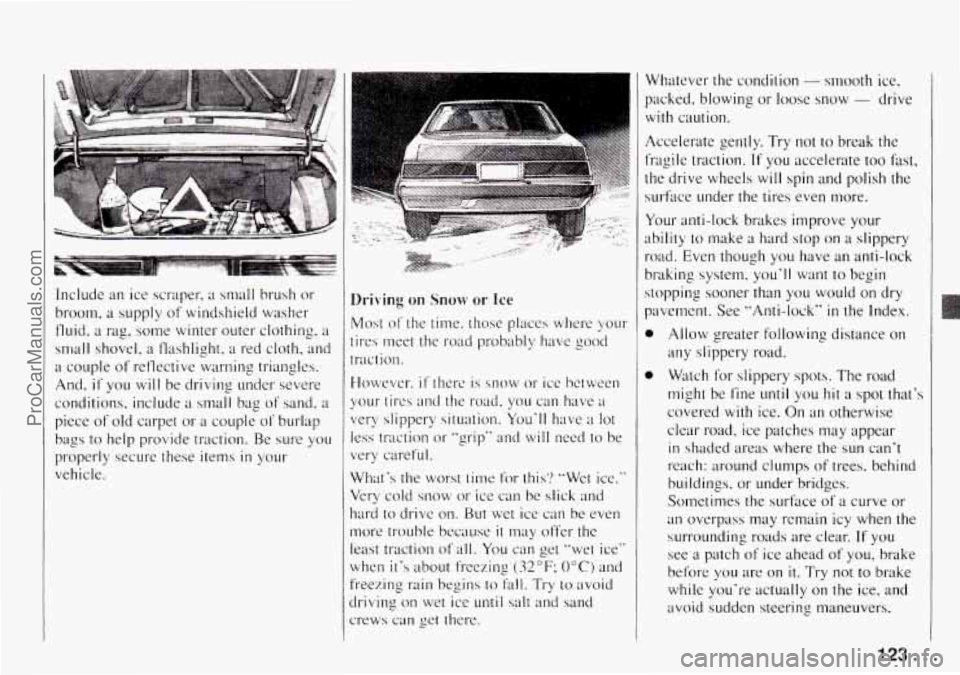
Include an ice scraper7 a small brush or
broom. a supply of windshield washer
fluid,
a rag, some winter outer clothing, a
small shovel, a flashlight, a red cloth, and
a couple of reflective warning triangles.
And,
if you will be driving under severe
conditions, include
:I small bag of sand, ;I
piece of old carpet or a couple of burlap
bags to
help provide traction. Be sure yo11
properl}, secure these item in your
vehicle.
Driving on Snow or Ice
Most of the time. those placcs where your
tires meet the road probably have good
traction.
Howe\w-.
it’ thcrc is snow or ice between
your tires antl the road, you can Iwve ;I
very slippery situation. You‘ll have ;t lot
less traction or “grip“ and will need to be
very careful.
What‘s the worst time
for this’? “Wet ice.”
Very cold snow
or ice can be slick and
hurd to drive on. Rut wet ice can be even
more trouble because
it nlay offer the
least traction
of all. You can get ”wet ice”
when it’s about freezing
(32°F; 0°C) and
freezing rain begins to fall. Try to avoid
hiving on wet ice
until salt and sand
:rews
can get there. Whatever the condition
- smooth ice.
packed. blowing or loose snow
- drive
with caution.
Accelerate gently. Try not
to break the
fragile traction. If you accelerate too fast,
the drive wheels will spin and polish the
surface under the tires even more.
Your anti-lock brakes improve your
ability
to make a hard stop on a slippery
road. Even though you have
an anti-lock
braking system.
you’ll want to begin
stopping sooner than
you would on dry
pavement.
See “Anti-lock” in the Index.
0
0
Allow greater following distance on
any slippery road.
Watch for slippery spots. The road
might be fine
until you hit H spot that’s
covered with ice.
On an otherwise
clear road. ice patches may appear
in shaded areas where the sun can’t
reach: around clumps
of trees. behind
buildings, or under bridges.
Sometimes the surftlce
of a curve or
an overpass may remain icy when the
surrounding roads are clear.
If you
see a patch of ice ahead of you, brake
before you are on
it. Try not to brake
while
you’re actually on the ice, and
avoid sudden steerins maneuvers.
123 ...
ProCarManuals.com
Page 131 of 258

Your Driving and the Road
2. Set the parking brake.
3. If your Geo is a four-wheel-drive
vehicle, set your manual freewheeling
hubs
to ”FREE” or unlock your
automatic I‘reewheeling hubs. See “Four-wheel Drive”
in the Index.
4. Turn the ignilion key to ”ACC’‘ to
unlock the steering wheel.
5. Clamp the steering wheel in a
straight-ahead position, with a
clamping device designed for towing.
6. Release the parking brake.
I NOTICE:
I
Make sure that the towing speed does
not exceed
55 mph (90 km/h), or
your Geo could be badly damaged.
~~
Towing Your Geo from the Front
NOTICE:
If your vehicle has automatic free-
wheeling hubs
or two-wheel drive,
do not tow
it on all four wheels. If
you do, your transmission could be
damaged.
If you have a four-wheel-drive vehicle
with manual freewheeling hubs, it can be
towed from the front with
all four wheels
on the ground. Follow these steps:
1. Set the parking brake.
2. Turn the ignition key to “ACC” to
unlock the steering wheel.
3. Shift your automatic transmission into
“P” (Park), or your manual
transmission into “2” (Second).
4. Shift the transfer case to “N”
(Neutral).
“Four-wheel Drive”
in the Index.
5. Set the hubs to “FREE.” See
6. Reledse the parking brake,
Stop towing every 200 miles
(300 km)
and start the engine. Leave the transfer
case shift lever
in ”N” (Neutral). Shift
your automatic transmission
to “D”
(Drive); leave a manual transmission
in
“2” (Second) and release the clutch. Run
the engine
at medium speed for one
minute to circulate the oil in the transfer
case. Turn the ignition key to
“ACC.”
Now, you can continue towing your Geo.
I
NOTICE:
I
Make sure the towing speed does not
exceed
SO mph (80 km/h), or your
Geo could be badly damaged.
I
. . .130
ProCarManuals.com
Page 138 of 258

G
A CAUTION:
To help avoid injury to you or others:
0
i.
0
0
0
0
Never let passengers ride in a
vehicle that
is being towed.
Never
tow faster than safe or
Never tow with damaged parts
not fully secured.
Never get under
your vehicle
after
it has been lifted by the tow
truck.
Always use seperate safety
chains
on each side when towing
a vehicle.
Never use
T-hooks. Use “J”
hooks instead.
posted speeds.
When your vehicle is being towed, have
the ignition key
off. The steering wheel
should
be clamped in a straight-ahead
position, with a clamping device designed
for towing service.
Do not use the
vehicle’s steering column
lock for this.
The transmi.ssion and transfer case,
if you
have one, should be in “Neutral” and the
parking brake released.
Don’t have
your vehicle towed with the
rear wheels
in contact with the ground. If
a vehicle must be towed from the front
with sling-type or wheel lift equipment,
the rear wheels
must be supported on a
If your vehicle has four-wheel drive,
don’t have
it towed on the front wheels
unless
you must. If a vehicle with
four-wheel drive
must be towed on the
front wheels,
set your tnanual,
freewheeling hubs
to “FREE” or unlock
your automatic freewheeling hubs, and set
your transfer case to two-wheel drive. If
your vehicle must be towed on the front
wheels, don‘t
go more than 55 rnph (90
km/h).
dolly.
131 . . . ProCarManuals.com
Page 150 of 258

The spare tire is mounted on your tailgate
Pull the cover off of the spare tire. .nsert your key into the wheel lock on
the
;pare tire and pull the wheel lock off. Remove wheel nuts with the wheel
wrench.
Remove the
spare tire from the mounting
bracket and place
it near your flat tire.
Attach the jack handle
to the jack bolt.
Turn the jack handle clockwise (to the
right). That will raise the lift head a little.
149 ... ProCarManuals.com
Page 152 of 258
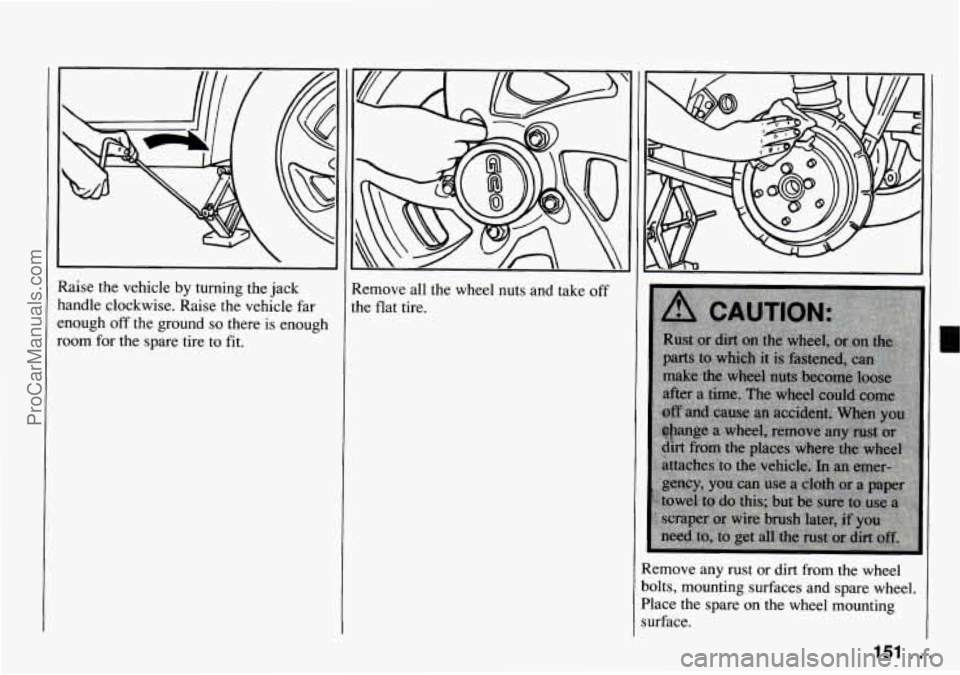
Raise the vehicle by turning the jack
handle clockwise. Raise the vehicle far
enqugh
off the ground so there is enough
room for the spare tire to fit. Remove all
the wheel nuts and take off
the
flat tire.
Remove any
rust or dirt from the wheel
bolts, mounting surfaces and spare wheel.
Place the spare on the wheel mounting
surface.
151 ...
ProCarManuals.com
Page 153 of 258
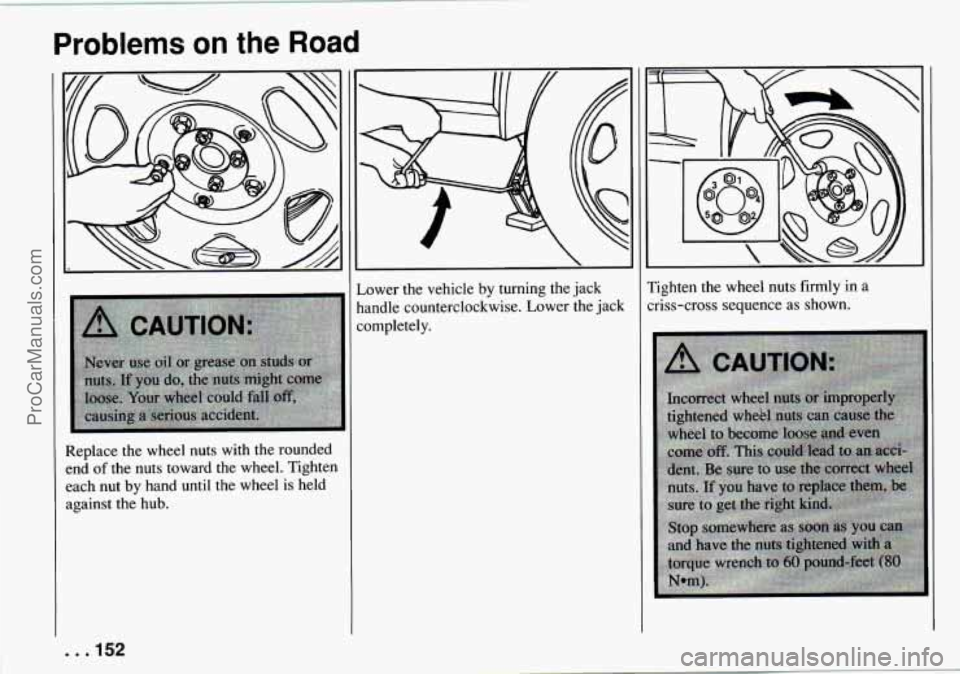
Problems on the Road
Replace the wheel nuts with the rounded
end
of the nuts toward the wheel. Tighten
each nut
by hand until the wheel is held
against the hub. Lower
the vehicle by turning the jack
handle counterclockwise. Lower the jack
zompletel
y.
3ghten the wheel nuts firmly in a
:riss-cross sequence as shown.
. . .I52
ProCarManuals.com