transmission CHEVROLET TRACKER 1995 User Guide
[x] Cancel search | Manufacturer: CHEVROLET, Model Year: 1995, Model line: TRACKER, Model: CHEVROLET TRACKER 1995Pages: 354, PDF Size: 18.24 MB
Page 63 of 354
You can shift from TWO-WHEEL HIGH (2H) to
FOUR-WHEEL HIGH (4H) or from FOUR-WHEEL
HIGH
(4H) to TWO-WHEEL HIGH (2H) at any speed
if your hubs are locked and your wheels are straight
ahead. Your front axle will engage faster if
you take
your foot
off the accelerator pedal for a few seconds as
you shift.
To shift into or out of FOUR-WHEEL LOW (4L):
1. Stop your vehicle and shift your transmission to
2. Shift the
transfer case in one continuous motion.
NEUTRAL (N).
Don’t pause in NEUTRAL (N) as you shift into
FOUR-WHEEL HIGH (4H), or your gears could clash.
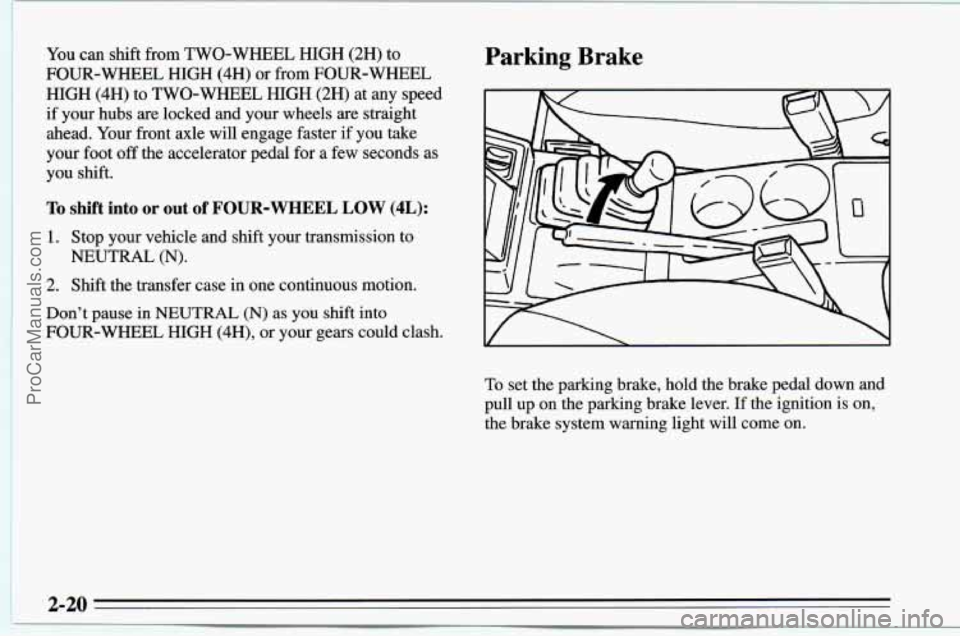
Parking Brake
To set the parking brake, hold the brake pedal down and
pull up on the parking brake lever. If the ignition is on,
the brake system warning light will come
on.
2-20
ProCarManuals.com
Page 64 of 354
Shifting Into PARK (P) (Automatic
Transmission
Models Only)
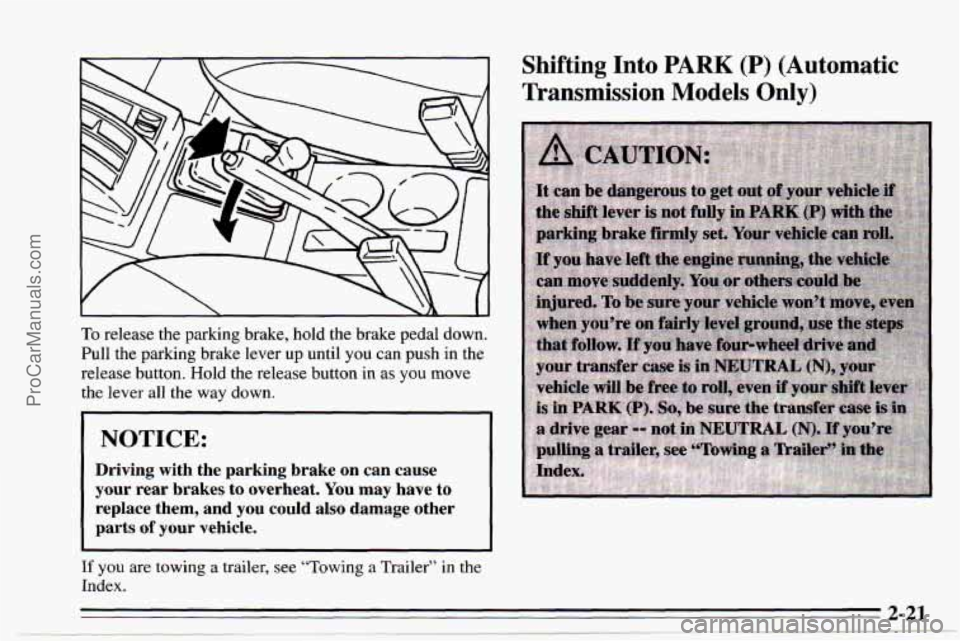
To release the parking brake, hold the brake pedal down.
Pull the parking brake lever up until you can push in the
release button. Hold the release button
in as you move
the lever all the way down.
I 1
I NOTICE: I
Driving with the parking brake on can cause
your rear brakes
to overheat. You may have to
replace them, and you could also damage other
parts
of your vehicle.
If you are towing a trailer, see “Towing a Trailer” in the
Index.
2-21
ProCarManuals.com
Page 65 of 354
1.
2.
3.
4.
5.
Hold the brake pedal down with your right foot and
set the parking brake.
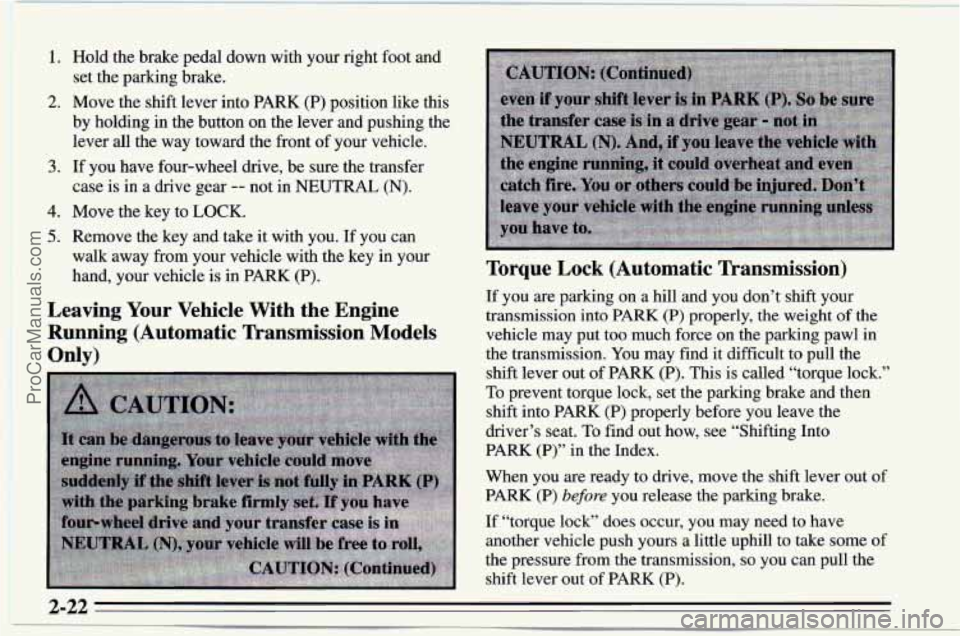
Move the shift lever into PARK
(P) position like this
by holding
in the button on the lever and pushing the
lever all the way toward the front of your vehicle.
If you have four-wheel drive, be sure the transfer
case is in a drive gear
-- not in NEUTRAL (N).
Move the key to LOCK.
Remove the key and take it with you. If you can
walk away
from your vehicle with the key in your
hand, your vehicle is in PARK (P).
Leaving Your Vehicle With the Engine
Running (Automatic Transmission Models
Only) Torque Lock (Automatic Transmission)
If you
are parking on a hill and you don’t shift your
transmission
into PARK (P) properly, the weight of the
vehicle may put too much force
on the parking pawl in
the transmission. You may find it difficult to pull the
shift lever out
of PARK (P). This is called “torque lock.”
To prevent torque lock, set the parking brake and then
shift into PARK (P) properly before you leave the
driver’s seat. To find out how, see “Shifting Into
PARK (P)” in the Index.
When you are ready to drive, move the shift lever out of
PARK (P)
before you release the parking brake.
If “torque lock” does occur, you may need to have
another vehicle push yours a little uphill to take some of
the pressure from the transmission,
so you can pull the
shift lever out of PARK
(P).
2-22
ProCarManuals.com
Page 66 of 354
Shifting Out of PARK (P)
(Automatic Transmission)
Your Geo has a brake-transmission shift interlock. You
have to fully
apply your regular brakes before you can
shift from PARK
(P) when the ignition is in the ON
position. See “Automatic Transmission” in the Index.
If you cannot shift out of
PARK (P), ease pressure on
the shift lever -- push the shift lever all the way into
PARK
(P) and release the shift lever button as you
maintain brake application. Then press the shift lever
button and move the shift lever into the gear you wish. If
you ever hold the brake pedal down but still can’t
shift out of
PARK (P), try this:
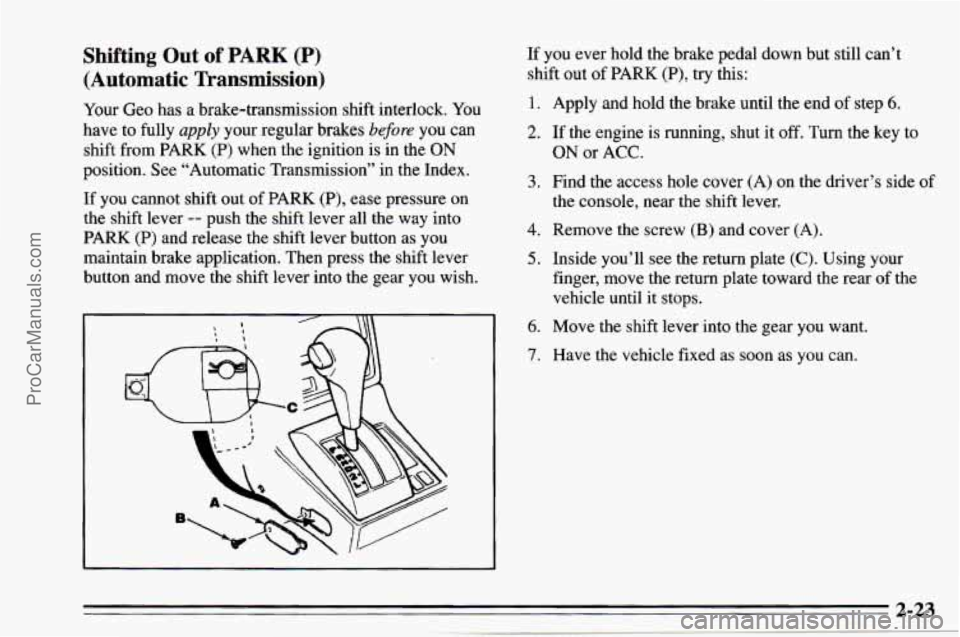
1. Apply and hold the brake until the end of step 6.
2. If the engine is running, shut it off. Turn the key to
3. Find the access hole cover (A) on the driver’s side of
4. Remove the screw (B) and cover (A).
5. Inside you’ll see the return plate (C). Using your
ON or ACC.
the console, near the shift lever.
finger, move the return plate toward the rear of the
vehicle until it stops.
6. Move the shift lever into the gear you want.
7. Have the vehicle fixed as soon as you can.
2-23
ProCarManuals.com
Page 67 of 354
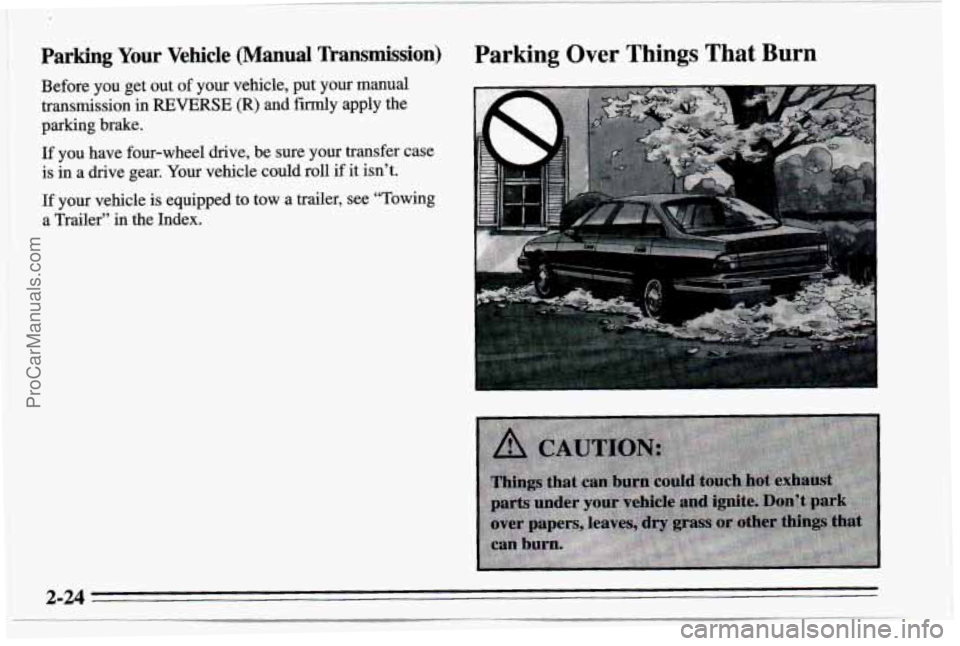
Parking Your Vehicle (Manual mansmission)
Before you get out of your vehicle, put your manual
transmission in
REVERSE (R) and firmly apply the
parking brake.
If you have four-wheel drive, be sure your transfer case
is in a drive gear. Your vehicle could roll
if it isn’t.
If your vehicle is equipped to tow a trailer, see “Towing
a Trailer” in the Index.
Parking Over Things That Burn
2-24
ProCarManuals.com
Page 68 of 354
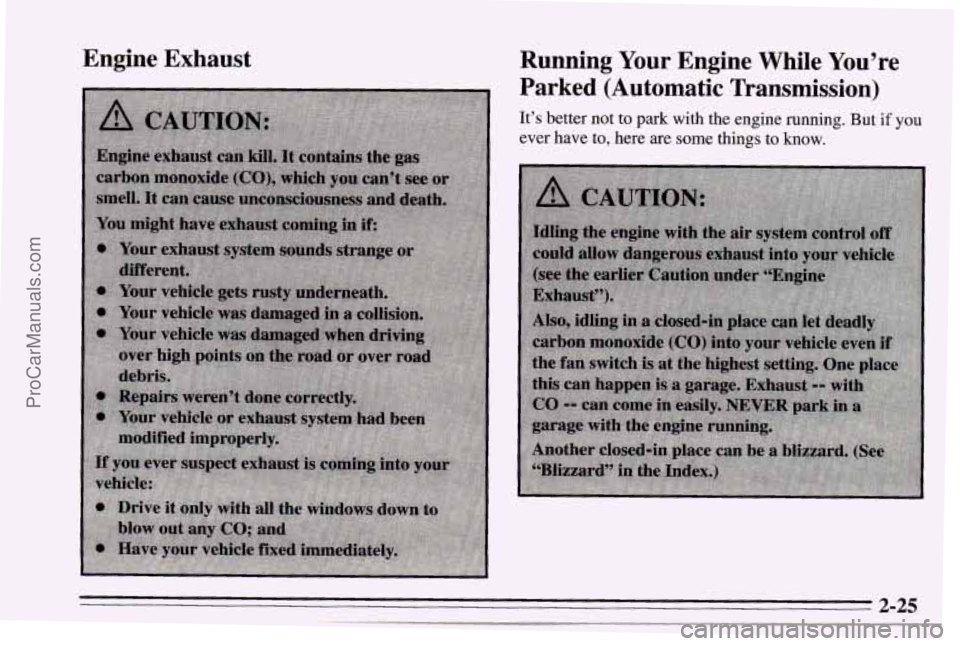
Engine Exhaust Running Your Engine While You’re
Parked (Automatic Transmission)
It’s better not to park with the engine running. But if vou
ever have to, here are some things to know.
2-25
ProCarManuals.com
Page 82 of 354
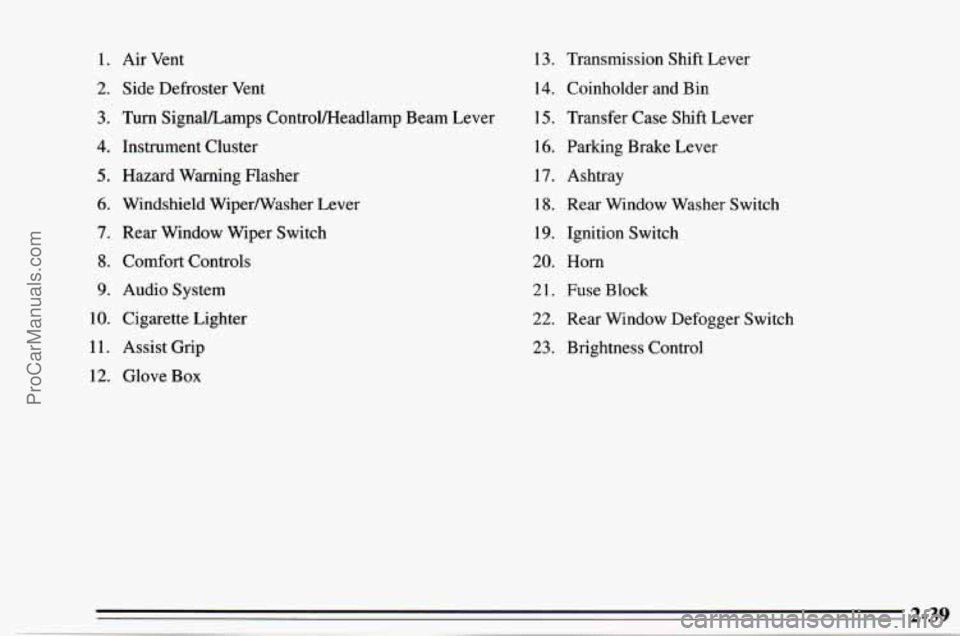
1.
2.
3.
4.
5.
6.
7.
8.
9.
10.
11.
12.
Air Vent
Side Defroster Vent
Turn SignalLamps ControlM[eadlamp Beam Lever
Instrument Cluster
Hazard Warning Flasher
Windshield WiperNasher Lever
Rear Window Wiper Switch
Comfort Controls
Audio System
Cigarette Lighter
Assist Grip Glove Box 13. Transmission
Shift Lever
14. Coinholder and Bin
15. Transfer Case Shift Lever
16. Parking Brake Lever
17. Ashtray
18. Rear Window Washer Switch
19. Ignition Switch
20. Horn
2 1. Fuse Block
22. Rear Window Defogger Switch
23. Brightness Control
ProCarManuals.com
Page 144 of 354
0 Ease up on your speed as you approach the top of the
hill.
Attach a flag to the vehicle to make you more visible
to approaching traffic on trails or hills.
0 Sound the horn as you approach the top of the hill to
let opposing traffic know you’re there.
Use your headlamps even during the day. They make
you more visible to oncoming traffic.
What should I do if my vehicle stalls, or is about
to stall, and
I can’t make it up the hill?
A: If this happens, there are some things you should
0
0
0
0
do, and there are some things you must not do.
First, here’s what you
should do:
Push the brake pedal
to stop the vehicle and keep it
from rolling backwards. Also, apply the parking brake.
If your engine is still running, shift the transmission
into reverse, release the parking brake, and slowly
back down the hill in reverse.
If your engine has stopped running, you’ll need to
restart it. With the brake pedal depressed and the
parking brake still applied, shift the transmission to
PARK
(P) (or, shift to NEUTRAL (N) if your
vehicle has a manual transmission) and restart the
engine. Then, shift to reverse, release the parking
brake, and slowly back down the hill
as straight as
possible in reverse.
As you are backing down the hill, put your left hand
on the steering wheel at the 12 o’clock position. This
way, you’ll be able to tell if your wheels are straight
and maneuver as you back down. It’s best that you
back down the hill with your wheels straight rather
than in the left or right direction. Turning the wheel
too far to the left or right will increase the possibility
of a rollover.
ProCarManuals.com
Page 145 of 354
Here are some things you must not do if you stall, or are
about
to stall, when going up a hill.
Never attempt to prevent a stall by shifting into
NEUTRAL (N) (or depressing the clutch, if you
have a manual transmission) to “rev-up” the engine
and regain forward momentum. This won’t work.
Your vehicle will roll backwards very quickly and
you could go
out of control.
Instead, apply the regular brake to stop the vehicle. Then
apply the parking brake. Shift into reverse, release the
parking brake, and slowly back straight down.
Never attempt to turn around if you are about to stall
when
going up a hill. If the hill is steep enough to
stall your vehicle, it’s steep enough to cause you to
roll over if you turn around. If you can’t make it up
the hill, you must back straight down the
hill.
Suppose, after stalling, I try to back down the hill
and decide I just can’t do it. What should I do?
A: Set the parking brake, put your transmission in
PARK (P) (or the manual transmission in first
gear), and turn off the engine. Leave the vehicle
and go get some help. Exit on the uphill side and
stay clear
of the path the vehicle would take if it
rolled downhill. Do not shift the transfer case to
NEUTRAL (N) when you leave the vehicle. Leave .. it in some gear.
ProCarManuals.com
Page 147 of 354
&: Are there some things I should not do when
A: Yes! These are important because if you ignore
driving down a bill?
0
them you could lose control and have a serious
accident.
When dr.iving downhill, avoid
turns that take you
across the incline of the hill. A hill that’s not too
steep to drive down may be too steep to drive across.
You could roll over if you don’t drive straight down.
Never go downhill with
the transmission in
NEUTRAL, (N), or with the clutch pedal depressed
in a manual shift. This is called “free-wheeling.‘‘
Your brakes
wjll have to do all the work and c&ld
overheat and fade.
Avoid braking
so hard that you lock the front wheels
when going downhill.
Tf your front wheels are
locked,
you can’t steer your vehicle. If your wheels
lock up during downhill braking, you may feel the
vehicle starting
to slide sideways. To regain your
direction, just ease off the
brakes and steer to keep
the front
of the vehicle pointing straight downhill.
@ Am I likely to stall when going downhill?
A: It’s much more likely to happen going uphill. But if
it happens going downhill, here’s what to do.
Stop your vehicle by applying the regular brakes.
Apply the parking brake.
Shift to PARK (P) (or to NEUTRAL (N) with the
manual transmission) and, while still braking, restart
the engine.
Shift back to a low gear, release the parking brake,
and drive straight down.
If the engine won’t start, get out and get help.
ProCarManuals.com