transmission CHEVROLET TRACKER 1995 Owner's Guide
[x] Cancel search | Manufacturer: CHEVROLET, Model Year: 1995, Model line: TRACKER, Model: CHEVROLET TRACKER 1995Pages: 354, PDF Size: 18.24 MB
Page 208 of 354
If You’re Stuck: In Sand, Mud, Ice or
Snow
What you don’t want to do when your vehicle is stuck is
to spin
your wheels too fast. The method known as
“rocking” can help you get out when you’re stuck, but
you must use caution.
I NOTICE:
Spinning your wheels can destroy parts of your
vehicle as well as the tires. If you spin the wheels
too fast while shifting your transmission back
and forth, you can destroy your transmission.
For information about using tire chains on your vehicle,
see
‘“Tire Chains” in the Index.
ProCarManuals.com
Page 209 of 354
Rocking your vehicle to get it out:
First, turn your steering wheel left and right. That will
clear the area around your front wheels. Then shift back
and forth between REVERSE (R) and
a forward gear (or
with a manual transmission, between FIRST (1) or
SECOND (2) and REVERSE (R)), spinning the wheels
as little as possible. Release the accelerator pedal while
you shift, and press lightly on the accelerator pedal
when the transmission is in gear. If that doesn’t get
you
out after a few tries, you may need to be towed out. Or,
you can use your recovery hooks, if your vehicle has
them.
If you do need to be towed out, see “Towing Your
Vehicle” in the
Index.
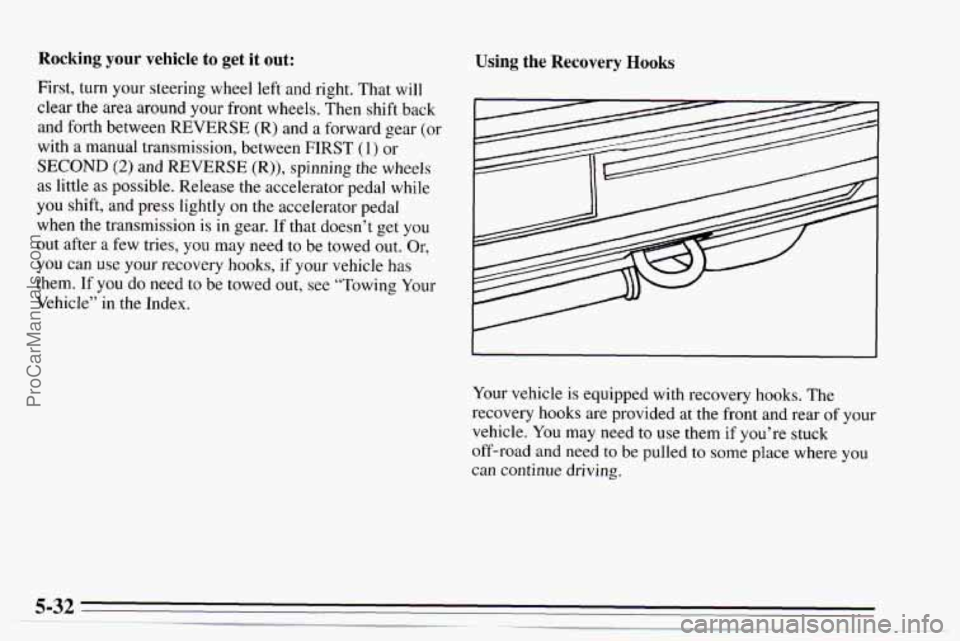
Using the Recovery Hooks
Your vehicle is equipped with recovery hooks. The
recovery hooks are provided at the front and rear of your
vehicle. You may need to use them if you’re stuck
off-road and need to be pulled to some place where
you
can continue driving.
ProCarManuals.com
Page 220 of 354
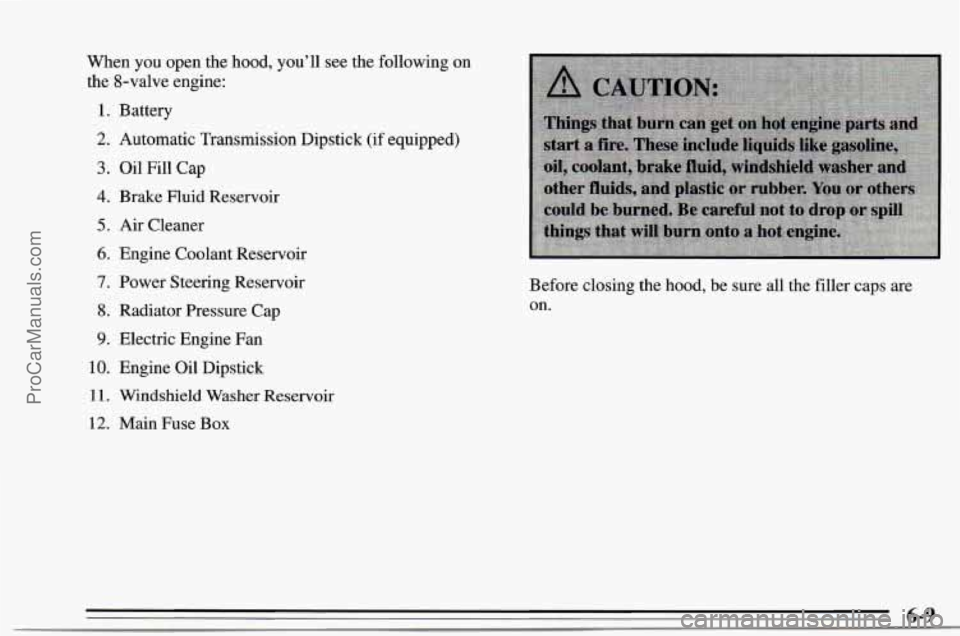
When you open the hood, you’ll see the following on
the 8-valve engine:
1. Battery
2. Automatic Transmission Dipstick (if equipped)
3. Oil Fill Cap
4. Brake Fluid Reservoir
5. Air Cleaner
6. Engine Coolant Reservoir
7. Power Steering Reservoir
8. Radiator Pressure Cap
9. Electric Engine Fan
10. Engine Oil Dipstick
1 1. Windshield Washer Reservoir
12. Main Fuse Box Before
closing the hood, be sure all the filler caps are
on.
6-9
ProCarManuals.com
Page 222 of 354
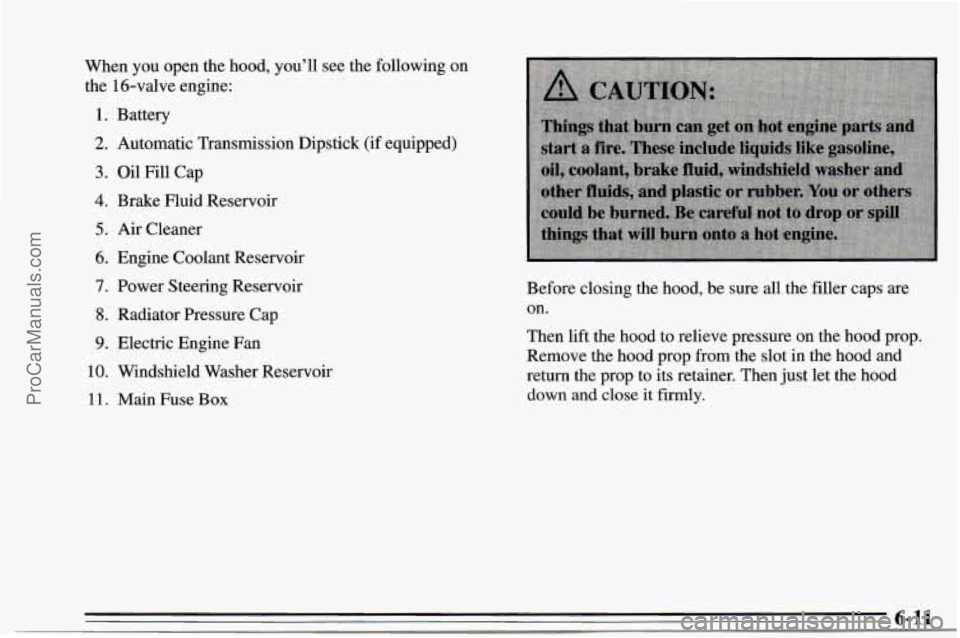
When you open the hood, you’ll see the following on
the 16-valve engine:
1. Battery
2. Automatic Transmission Dipstick (if equipped)
3. Oil Fill Cap
4. Brake muid Reservoir
5. Air Cleaner
6. Engine Coolant Reservoir
7. Power Steering Reservoir
8. Radiator Pressure Cap
9. Electric Engine Fan
10. Windshield Washer Reservoir
11. Main Fuse Box Before
closing the hood, be sure all the filler caps are
on.
Then lift the hood to relieve pressure on the hood prop.
Remove the hood prop from the slot in the hood and
return the prop to its retainer. Then just let the hood
down and close it firmly.
6-11 ProCarManuals.com
Page 230 of 354
Automatic Transmission Fluid
When to Check and Change
A good time to check your automatic transmission fluid
level is when the engine oil is changed. Refer to the
Maintenance Schedule to determine
when to change
your fluid. See “Scheduled Maintenance Services”
in the
Index.
How to Check
Because this operation can be a little difficult, you may
choose to have this done at your Chevrolet/Geo dealer
Service Department.
If you do it yourself, be sure to follow all the
instructions here, or you could get a false reading on the
dipstick.
NOTICE:
Too much or too little fluid can damage your
transmission.
Too much can mean that some of
the fluid could come out and fall on hot engine
parts or exhaust system parts, starting a fire. Be sure to get an accurate reading if you check your
transmission fluid.
Wait at least 30 minutes before checking the
transmission fluid level if you have been driving:
0 When outside temperatures are above 90°F (32°C).
At high speed for quite a while.
0 In heavy traffic -- especially in hot weather.
0 While pulling a trailer.
To get the right reading, the fluid should be at normal
operating temperature, which is
180” F to 200” F
(82°C to 93°C).
ProCarManuals.com
Page 231 of 354
To check transmission fluid hot: Get the vehicle
warmed up by driving about 15 miles
(24 km) when
outside temperatures are above
50°F (10°C). If it's
colder than
50°F ( 10°C), drive the vehicle in
DRIVE (D) until the engine temperature gage moves
and then remains steady for ten minutes. Then follow
the hot check procedures.
To check transmission fluid cold: A cold check is
made after the vehicle has been sitting for eight hours or
more with the engine
off and is used only as a reference.
Let the engine run at idle for five minutes if outside
temperatures are
50 OF ( 10 " C) or more. If it's colder
than
50°F (10°C)' you may have to idle the engine
longer. Should the fluid level
be low during a cold
check,
you must perform a hot check before adding
fluid. This will give you
a more accurate reading of the
fluid
level.
To check the fluid hot or cold:
Park your vehicle on a level place. Keep the engine
With the parking brake applied, place the shift lever
With your foot on the brake pedal, move the shift
lever through each gear range, pausing for about
three seconds in each range. Then, position the shift
lever in
PARK (P).
0 Let the engine run at idle for three minutes or more.
running.
in
PARK (P).
ProCarManuals.com
Page 233 of 354
How to Add Fluid Manual Transmission Fluid
Refer to the Maintenance Schedule to determine what
kind
of transmission fluid to use. See “Recommended
Fluids and Lubricants” in the Index.
Add fluid only after checking the transmission fluid
HOT. (A COLD check is used only as a reference.) If
the fluid level is low, add only enough of the proper
fluid to bring the level up to the
HOT area for a hot
check. It doesn’t take much fluid, generally less than a
pint.
Don ’t ove$ZZ. We recommend you use only fluid
labeled DEXRON@-111, because fluid with that label is
made especially for your automatic transmission.
Damage caused by fluid other than DEXRON@-I11 is
not covered by your new vehicle warranty.
After adding fluid, recheck the fluid level as
described under “How to Check.’’
When the correct fluid level is obtained, push the
dipstick back in all the way.
When to Check and Change
A good time to have it checked is when the engine oil is
changed. Refer to the Maintenance Schedule to
determine when to change
your transmission fluid. See
“Scheduled Maintenance Services” in the Index.
How to Check
Because this operation can be a little difficult, you may
choose
to have this done at your Chevrolet/Geo dealer
Service Department.
If you do it yourself, be sure to follow all the
instructions here, or you could get
a false reading.
ProCarManuals.com
Page 234 of 354
NOTICE:
Too much or too little fluid can damage your
transmission.
Too much can mean that some of
the fluid could come out and
fall on hot engine
parts or exhaust system parts, starting
a fire. Be
sure to get an accurate reading if you check your
transmission fluid.
Check the fluid level only when your engine is off, the
vehicle is parked on a level place and the transmission
is
cool enough for you to rest your fingers on the
transmission case.
Then, follow these steps:
1.
2.
3.
Remove the filler plug.
Check that the lubricant level is up to
the bottom of
the filler plug hole.
If the fluid level
is good, install the plug and be sure
it is fully seated.
If the fluid level is low, add more
fluid as described
in the next steps.
How to Add Fluid
Here’s how to add fluid. Refer to the Maintenance
Schedule to determine what kind
of fluid to use. See
“Recommended Fluids and Lubricants” in the Index.
I. Remove the filler plug.
2. Add fluid at the filler plug hole. Add only enough
fluid to bring the fluid level up to the bottom
of the
filler plug hole.
3. Install the filler plug. Be sure the plug is fully seated.
Clutch Adjustment
The clutch linkage in your vehicle should be checked as
recommended in your Maintenance Schedule.
To check,
push the clutch pedal down with your hand until you
feel some resistance to movement
of the pedal. If the
pedal moves freely up
to an inch (25 mm) or so before
you feel resistance to the travel, adjustment isn’t needed.
If there is
no free travel or very little (less than 5/23 of an
inch
(16 mm)), see your dealer for adjustment.
ProCarManuals.com
Page 276 of 354
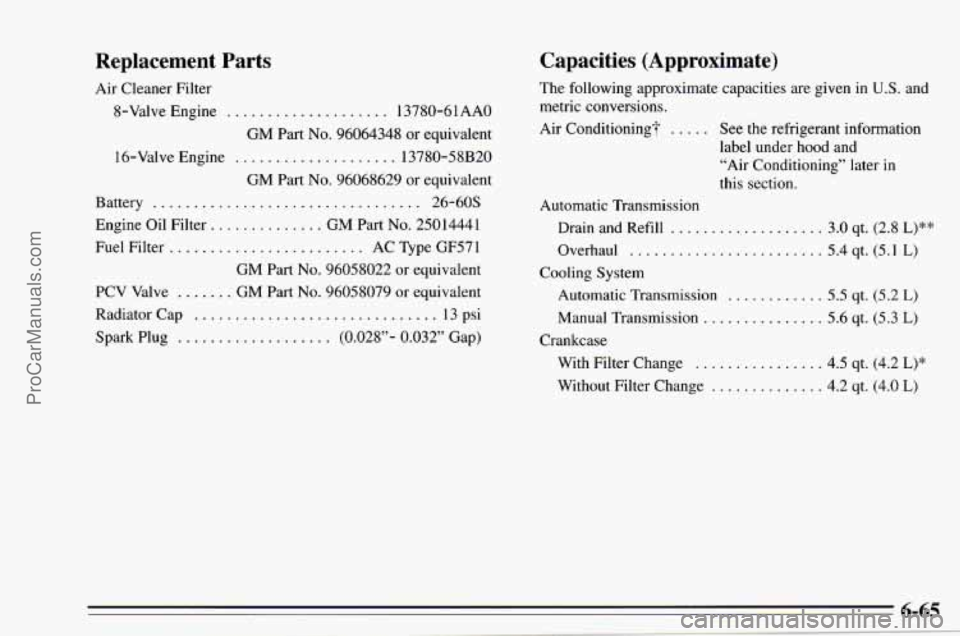
Replacement Parts
Air Cleaner Filter
8-Valve Engine
.................... 13780-61AAO
GM Part
No. 96064348 or equivalent
16-Valve Engine
.................... 13780-58B20
GM Part No. 96068629 or equivalent
Battery
................................. 26-60s
Engine Oil Filter .............. GM Part No. 2501444 1
Fuel Filter ........................ AC Type GF57 1
GM Part No. 96058022 or equivalent
PCV Valve
....... GM Part No. 96058079 or equivalent
Radiator Cap
.............................. 13 psi
Spark Plug
................... (0.028”- 0.032” Gap)
Capacities (Approximate)
The following approximate capacities are given in U.S. and
metric conversions.
Air Conditioning?
..... See the refrigerant information
label under hood and
“Air Conditioning” later in
this section.
Automatic Transmission
Drain and Refill
................... 3.0 qt. (2.8 L)**
Overhaul ........................ 5.4 qt. (5.1 L)
Cooling System
Automatic Transmission
............ 5.5 qt. (5.2 L)
Manual Transmission ............... 5.6 qt. (5.3 L)
Crankcase
With Filter Change
................ 4.5 qt. (4.2 L)*
Without Filter Change .............. 4.2 qt. (4.0 L)
ProCarManuals.com
Page 277 of 354
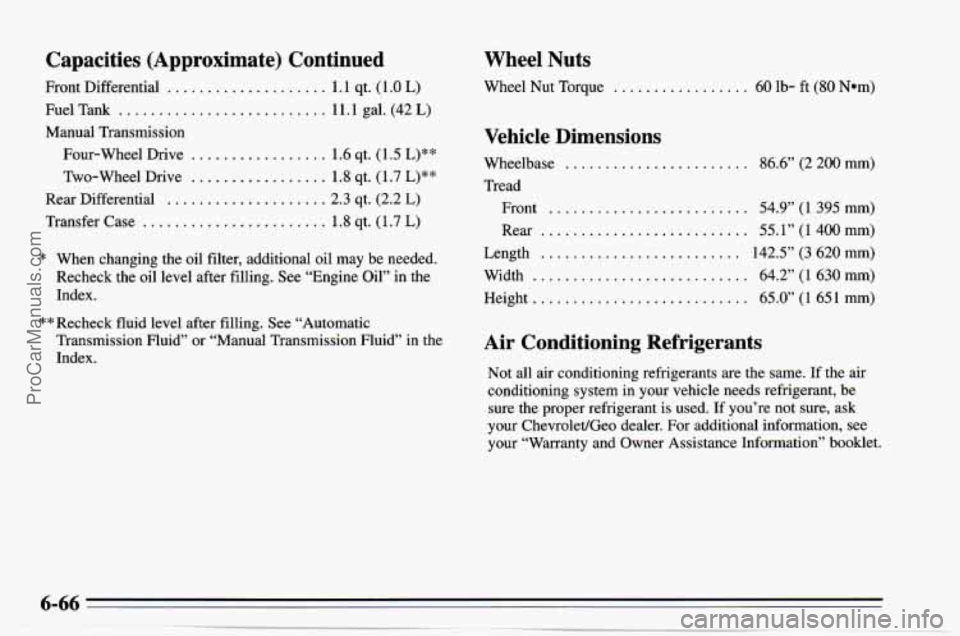
Capacities (Approximate) Continued
Front Differential .................... 1.1 qt. (1 .O L)
Fuel Tank .......................... 11.1 gal. (42 L)
Manual Transmission
Four-wheel Drive
................. 1.6 qt. (1.5 L)**
Two-Wheel Drive ................. 1.8 qt. (1.7 L)**
Rear Differential .................... 2.3 qt. (2.2 L)
Transfer Case ....................... 1.8 qt. (1.7 L)
* When changing the oil filter, additional oil may be needed.
Recheck the oil level after filling. See “Engine Oil” in the
Index.
** Recheck fluid level after filling. See “Automatic
Transmission Fluid” or “Manual Transmission Fluid” in the
Index.
Wheel Nuts
Wheel Nut Torque ................. 60 lb- ft (80 Nom)
Vehicle Dimensions
Wheelbase ....................... 86.6” (2 200 mm)
Tread Front
......................... 54.9” (1 395 mm)
Rear
.......................... 55.1” (1 400 mm)
Length
......................... 142.5” (3 620 mm)
Width
........................... 64.2” (1 630 mm)
Height
........................... 65.0” (1 65 1 mm)
Air Conditioning Refrigerants
Not all air conditioning refrigerants are the same. If the air
conditioning system
in your vehicle needs refrigerant, be
sure the proper refrigerant is used. If you’re not sure, ask
your Chevrolet/Geo dealer.
For additional information, see
your “Warranty and Owner Assistance Information” booklet.
ProCarManuals.com