transmission CHEVROLET TRACKER 1995 Workshop Manual
[x] Cancel search | Manufacturer: CHEVROLET, Model Year: 1995, Model line: TRACKER, Model: CHEVROLET TRACKER 1995Pages: 354, PDF Size: 18.24 MB
Page 309 of 354
1 Maintenance Schedule I I
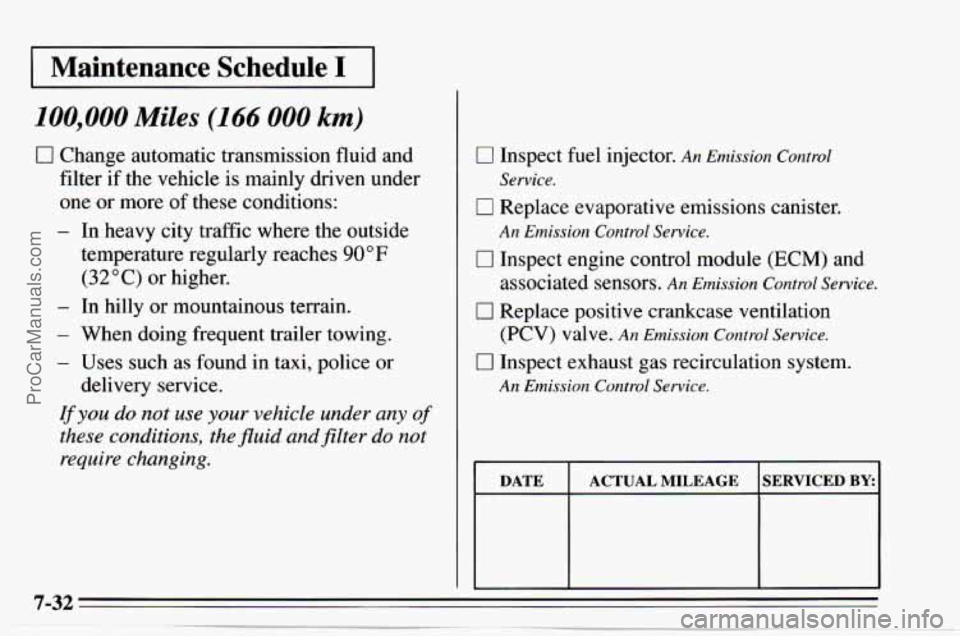
100,000 Miles (166 000 km)
0 Change automatic transmission fluid and
filter if the vehicle is mainly driven under
one or more of these conditions:
- In heavy city traffic where the outside
temperature regularly reaches
90 O F
(32 O C) or higher.
- In hilly or mountainous terrain.
- When doing frequent trailer towing.
- Uses such as found in taxi, police or
If you do not use your vehicle under any of
these conditions, the fluid and filter do not
require
changing.
delivery service.
0 Inspect fuel injector. An Emission Control
0 Replace evaporative emissions canister.
0 Inspect engine control module (ECM) and
Service.
An Emission Control Service.
associated sensors. An Emission Control Service.
0 Replace positive crankcase ventilation
(PCV) valve.
An Emission Control Service.
0 Inspect exhaust gas recirculation system.
An Emission Control Sewice.
DATE ACTUAL MILEAGE SERVICED BY:
ProCarManuals.com
Page 313 of 354
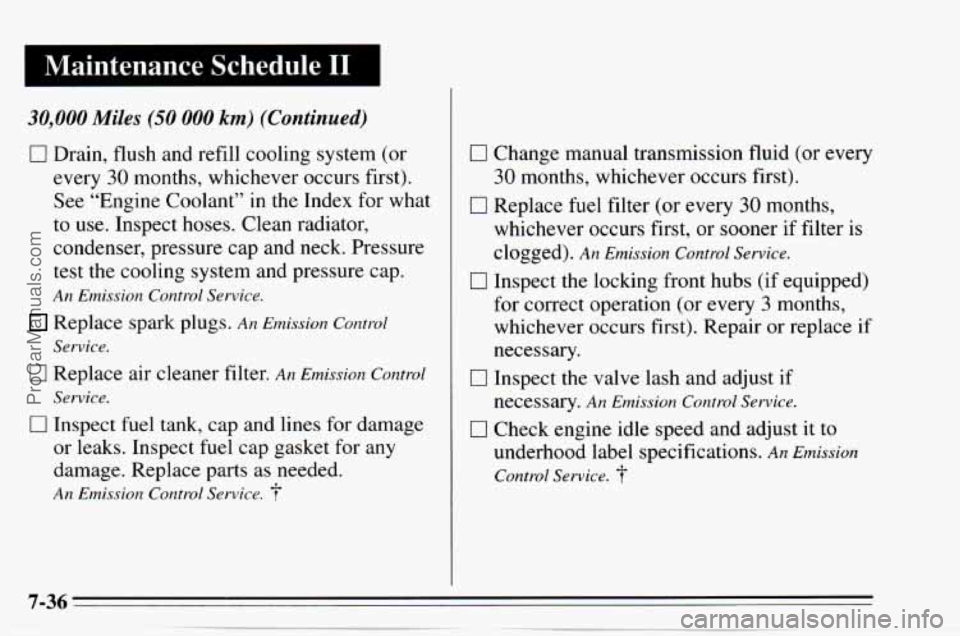
30,000 Miles (50 000 km) (Continued)
0 Drain, flush and refill cooling system (or
every
30 months, whichever occurs first).
See “Engine Coolant”
in the Index for what
to use. Inspect hoses. Clean radiator,
condenser, pressure cap and neck. Pressure
test the cooling system and pressure cap.
An Emission Control Service.
Replace spark plugs. An Emission Control
0 Replace air cleaner filter. An Emission Control
0 Inspect fuel tank, cap and lines for damage
or leaks. Inspect fuel cap gasket for any
damage. Replace parts
as needed.
Service.
Service.
An Elnission
Control Service.
0 Change manual transmission fluid (or every
30 months, whichever occurs first).
0 Replace fuel filter (or every 30 months,
whichever occurs first, or sooner if filter
is
clogged). An Emission Control Service.
0 Inspect the locking front hubs (if equipped)
for correct operation (or every
3 months,
whichever occurs first). Repair or replace
if
necessary.
0 Inspect the valve lash and adjust if
necessary.
An Emission Control Service.
0 Check engine idle speed and adjust it to
underhood label specifications.
An Emission
Control Service.
ProCarManuals.com
Page 316 of 354
1 Maintenance Schedule I1 I
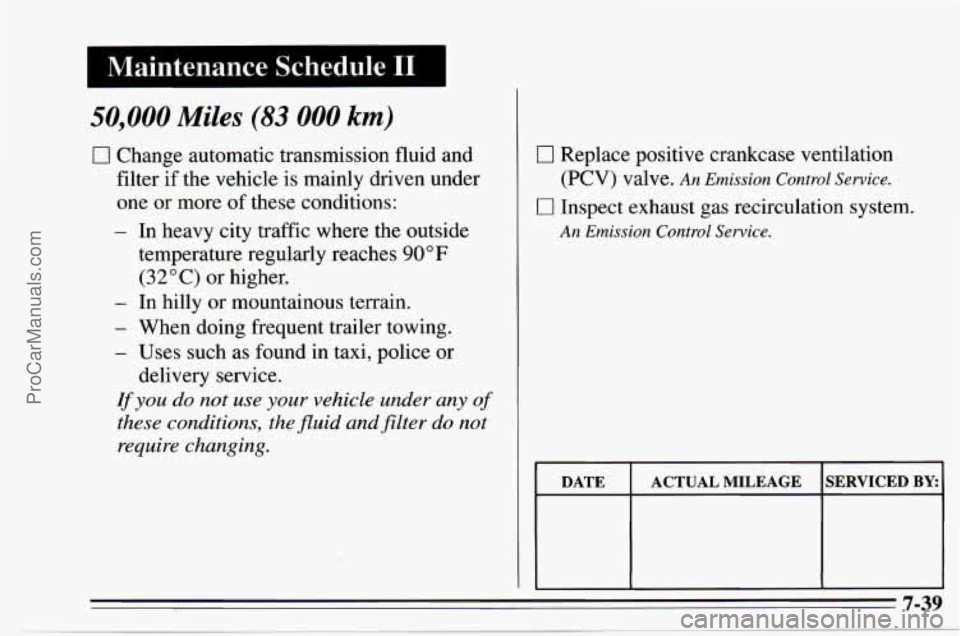
50,000 Miles (83 000 km)
0 Change automatic transmission fluid and
filter if the vehicle is mainly driven under
one
or more of these conditions:
- In heavy city traffic where the outside
temperature regularly reaches
90" F
(32 O C) or higher.
- In hilly or mountainous terrain.
- When doing frequent trailer towing.
- Uses such as found in taxi, police or
If you do not use your vehicle under any of
these conditions, the fluid and filter do not
require changing.
delivery service.
0 Replace positive crankcase ventilation
(Pcv) valve. An Emission Control Service.
0 Inspect exhaust gas recirculation system.
An Emission Control Service.
I DATE I ACTUAL MILEAGE I SERVICED BY
ProCarManuals.com
Page 318 of 354
I Maintenance Schedule I1 I
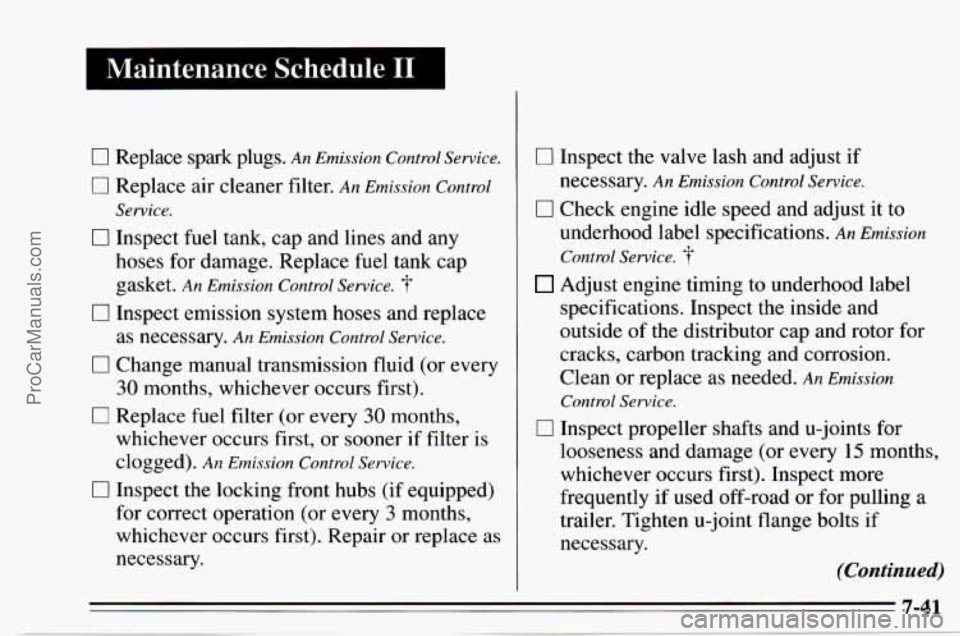
0 Replace spark plugs. An Emission Control Service.
0 Replace air cleaner filter. An Emission Control
0 Inspect fuel tank, cap and lines and any
hoses for damage. Replace fuel tank cap
gasket.
An Emission Control Service. T
0 Inspect emission system hoses and replace
as necessary.
An Emission Control Service.
0 Change manual transmission fluid (or every
30 months, whichever occurs first).
0 Replace fuel filter (or every 30 months,
whichever occurs first, or sooner
if filter is
0 Inspect the locking front hubs (if equipped)
for correct operation (or every
3 months,
whichever occurs first). Repair
or replace as
necessary.
Service.
clogged). An Emission Control Service.
0 Inspect the valve lash and adjust if
necessary.
An Emission Control Service.
0 Check engine idle speed and adjust it to
underhood label specifications.
An Emission
Control Service. i.
Adjust engine timing to underhood label
specifications. Inspect the inside and
outside of the distributor cap and rotor for
cracks, carbon tracking and corrosion.
Clean or replace as needed.
An Emission
Control Service.
0 Inspect propeller shafts and u-joints for
looseness and damage (or every
15 months,
whichever occurs first). Inspect more
frequently if used off-road or for pulling
a
trailer. Tighten u-joint flange bolts if
necessary.
(Continued)
ProCarManuals.com
Page 322 of 354
I Maintenance Schedule I1 I
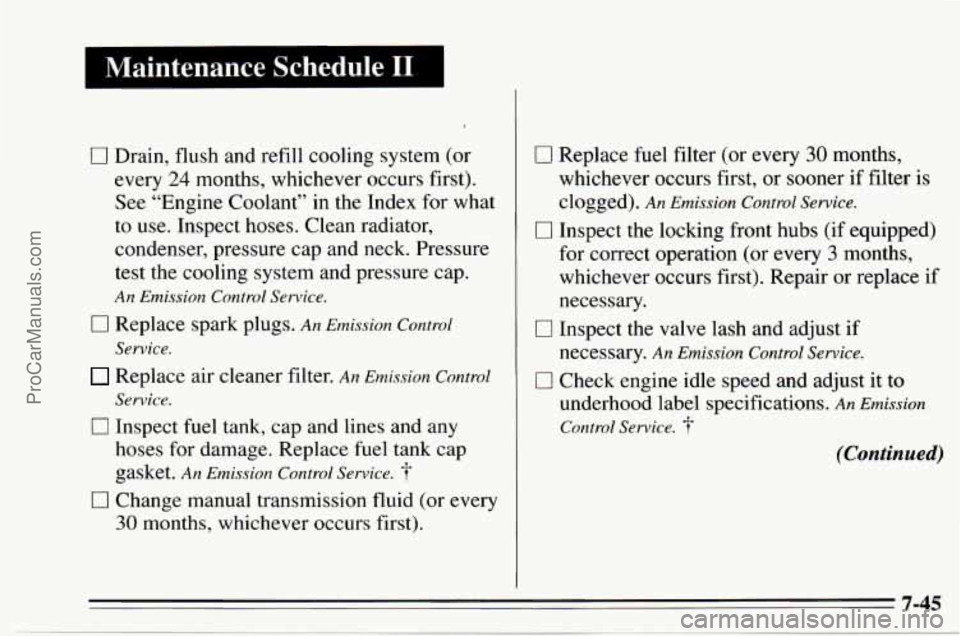
0 Drain, flush and refill cooling system (or
every
24 months, whichever occurs first).
See “Engine Coolant” in the Index for what
to use. Inspect hoses. Clean radiator,
condenser, pressure cap and neck. Pressure
test the cooling system and pressure cap.
An Emission Control Service.
0 Replace spark plugs. An Emission Control
Replace air cleaner filter. An Emission Control
0 Inspect fuel tank, cap and lines and any
Service.
Service.
hoses for damage. Replace fuel tank cap
gasket.
An Emission Control Service.
0 Change manual transmission fluid (or every
30 months, whichever occurs first).
0 Replace fuel filter (or every 30 months,
whichever occurs first,
or sooner if filter is
clogged).
An Emission Control Service.
I7 Inspect the locking front hubs (if equipped)
for correct operation (or every
3 months,
whichever occurs first). Repair or replace if
necessary.
0 Inspect the valve lash and adjust if
necessary.
An Emission Control Service.
0 Check engine idle speed and adjust it to
underhood label specifications. An Emission
Control Service.
T
(Continued)
ProCarManuals.com
Page 324 of 354
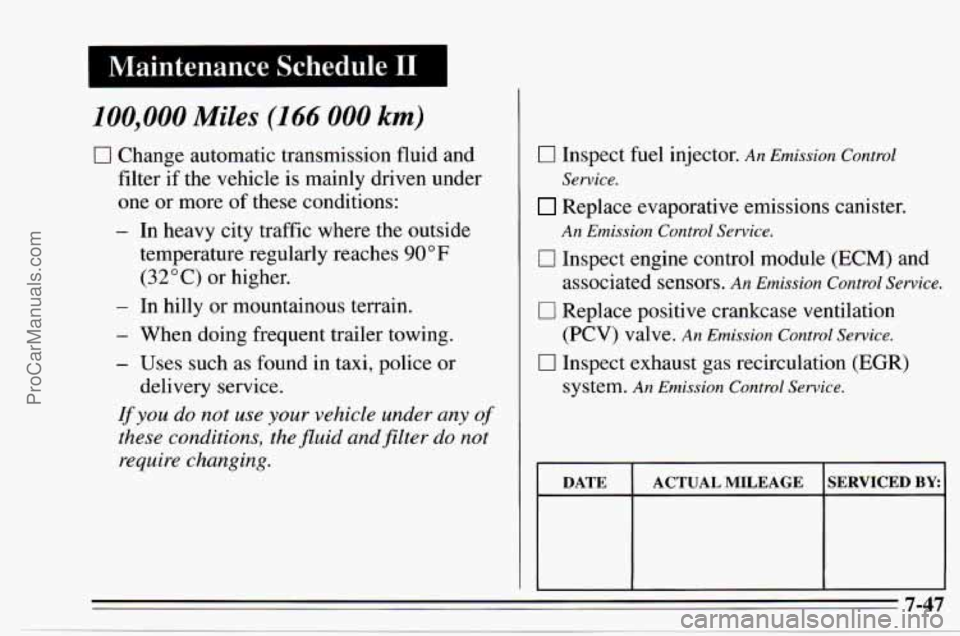
100,000 Miles (1 66 000 km)
17 Change automatic transmission fluid and
filter
if the vehicle is mainly driven under
one or more of these conditions:
- In heavy city traffic where the outside
temperature regularly reaches
90 O F
(32°C) or higher.
- In hilly or mountainous terrain.
- When doing frequent trailer towing.
- Uses such as found in taxi, police or
If you do not use your vehicle under any of
these conditions, ;he fluid and filter do not
require changing.
delivery service.
0 Inspect fu
Service.
el injector. An Emission Control
Replace evaporative emissions canister.
0 Inspect engine control module (ECM) ana
An Emission Control Service.
associated sensors. An Emission Control Service.
0 Replace positive crankcase ventilation
(PCV) valve.
An Emission Control Service.
0 Inspect exhaust gas recirculation (EGR)
system.
An Emission Control Service.
DATE SERVICED BY ACTUAL MILEAGE
7-47
ProCarManuals.com
Page 326 of 354
At Least mice a Year Starter Switch
Fluid Level Check
Check the transfer case, axle differential(s) and
automatic or manual transmission fluid levels and add
as needed.
See “Transfer Case,” “Axle, Rear,” “Axle,
Front” and “Automatic Transmission” or “Manual
Transmission” in the Index.
A fluid loss in these systems
could indicate
a problem. Have the system inspected and
repaired at
once.
At Least Once a Year
Key Lock Cylinders
Lubricate the key lock cylinders with the lubricant
specified
in Part D.
Body Lubrication
Lubricate all body door hinges. Also lubricate all hinges
and latches, including those for the hood, rear
compartment, glove box door, console door and any
folding seat hardware. Part
D tells you what to use.
More frequent lubrication may be required when
exposed
to a corrosive environment.
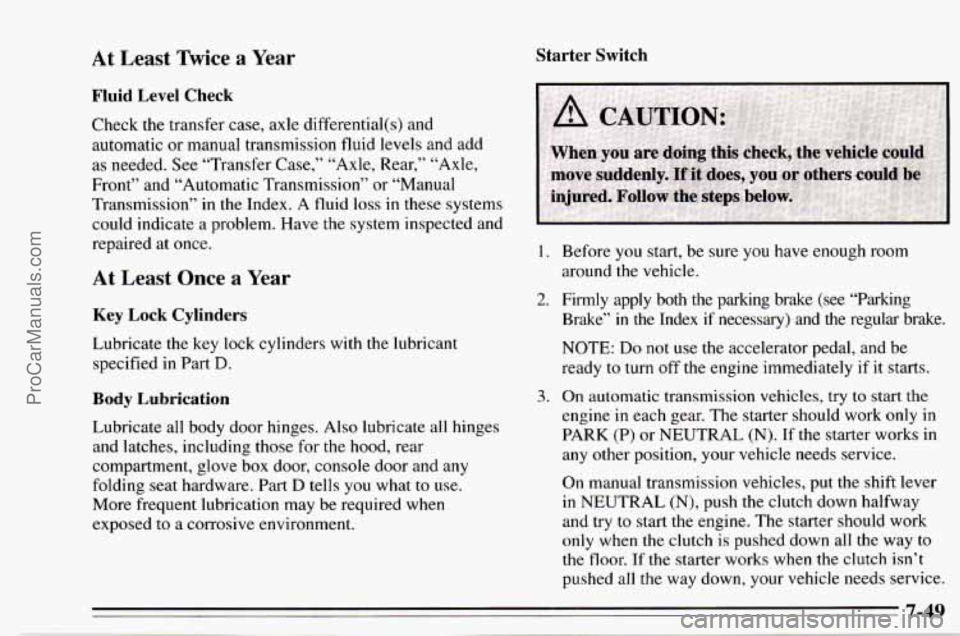
1. Before you start, be sure you have enough room
around the vehicle.
2. Firmly apply both the parking brake (see “Parking
Brake”
in the Index if necessary) and the regular brake.
NOTE:
Do not use the accelerator pedal, and be
ready to turn
off the engine immediately if it starts.
3. On automatic transmission vehicles, try to start the
engine in each gear. The starter should work only in
PARK (P) or NEUTRAL (N). If the starter works in
any other position, your vehicle needs service.
On manual transmission vehicles, put the shift lever
in
NEUTRAL (N), push the clutch down halfway
and try
to start the engine. The starter should work
only when the clutch is pushed down all the way to
the floor. If the starter works when the clutch isn’t
pushed
all the way down, your vehicle needs service.
7-49
ProCarManuals.com
Page 327 of 354
Brake-Transmission Shift Interlock -- BTSI
(Automatic Transmission)
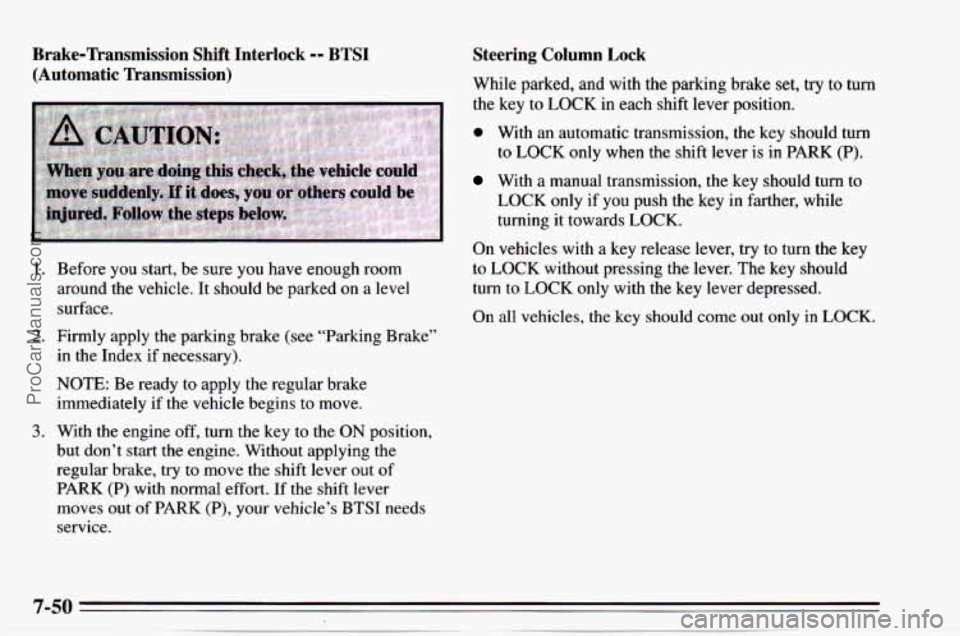
1.
2.
3.
Before you start, be sure you have enough room
around the vehicle. It should be parked on a level
surface.
Firmly apply the parking brake
(see “Parking Brake”
in the Index if necessary).
NOTE: Be ready to apply the regular brake
immediately if the vehicle begins to move.
With the engine off, turn the key
to the ON position,
but don’t start the engine. Without applying the
regular brake, try to move the shift lever out of
PARK
(P) with normal effort. If the shift lever
moves out of PARK (P), your vehicle’s BTSI needs
service.
Steering Column Lock
While parked, and with the parking brake set, try to turn
the key to
LOCK in each shift lever position.
0 With an automatic transmission, the key should turn
to
LOCK only when the shift lever is in PARK (P).
With a manual transmission, the key should turn to
LOCK only if you push the key in farther, while
turning it towards
LOCK.
On vehicles with a key release lever, try to turn the key
to
LOCK without pressing the lever. The key should
turn to
LOCK only with the key lever depressed.
On all vehicles, the key should come out only in LOCK.
ProCarManuals.com
Page 328 of 354
 Mechanism Check At least every spring, use plain water to flush any
corrosive materials from
the underbody. Take")
Parking Brake and Automatic Ikansmission PARK Underbody Flushing \
(P) Mechanism Check At least every spring, use plain water to flush any
corrosive materials from
the underbody. Take care to
clean thoroughly any areas where mud and other debris
can collect.
.-
Park on a fairly steep hill, with the vehicle facing
downhill. Keeping your foot
on the regular brake, set the
parking brake.
0 To check the parking brake: With the engine running
and transmission
in NEUTRAL (N), slowly remove
foot pressure from the regular brake pedal.
Do this
until the vehicle is held by the parking brake only.
0 To check the PARK (P) mechanism's holding ability:
Shift to
PARK (P). Then release all brakes. If your
vehicle is four-wheel drive, be sure the transfer case
is not in NEUTRAL (N).
ProCarManuals.com
Page 331 of 354
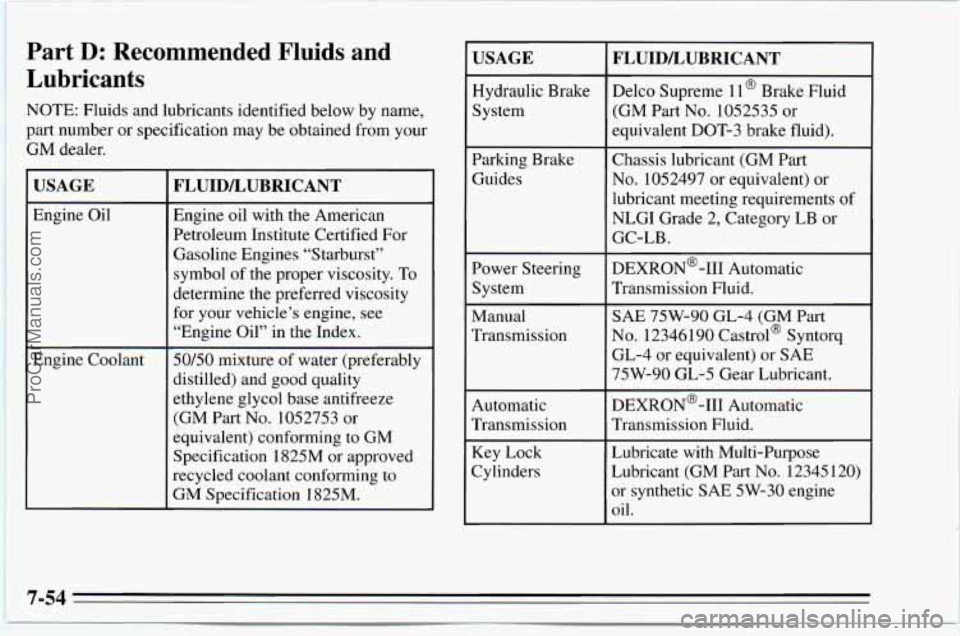
Part D: Recommended Fluids and
Lubricants
NOTE: Fluids and lubricants identified below by name,
part number or specification may be obtained from your
GM dealer.
I USAGE
1 Engine Oil
F Engine Coolant
FLUIDLUBRICANT
Engine oil with the American
Petroleum Institute Certified For
Gasoline Engines “Starburst”
symbol of the proper viscosity.
To
determine the preferred viscosity
for your vehicle’s engine, see
“Engine Oil” in the Index.
50/50 mixture of water (preferably
distilled) and
good quality
ethylene glycol base antifreeze
(GM Part No. 1052753 or
equivalent) conforming to
GM
Specification 1825M or approved
recycled coolant conforming
to
GM Specification 1825M.
USAGE
FLUIDLUBRICANT
Hydraulic Brake Delco Supreme 11 @ Brake Fluid
System (GM
Part No. 1052535 or
equivalent DOT-3 brake fluid).
Parking Brake
Chassis lubricant (GM Part
Guides
No. 1052497 or equivalent) or
lubricant meeting requirements
of
NLGI Grade 2, Category LB or
GC-LB.
Power Steering DEXRON@-111 Automatic
System Transmission Fluid.
Manual
SAE 75W-90 GL-4 (GM Part
Transmission
No. 12346 190 Castrol@ S yntorq
GL-4 or equivalent) or
SAE
75W-90 GL-5 Gear Lubricant.
Automatic DEXRON@-111 Automatic
Transmission Transmission Fluid.
Key Lock Lubricate with Multi-Purpose
Cylinders Lubricant (GM
Part No. 12345120)
or synthetic SAE 5W-30 engine
oil.
7-54
ProCarManuals.com