trailer CHEVROLET TRACKER 1996 User Guide
[x] Cancel search | Manufacturer: CHEVROLET, Model Year: 1996, Model line: TRACKER, Model: CHEVROLET TRACKER 1996Pages: 387, PDF Size: 18.54 MB
Page 197 of 387
Driving with a Trailer Following Distance
Towing a trailer requires a certain amount of experience.
Before setting out for the open road, you’ll want to get
to
know your rig. Acquaint yourself with the feel of
handling and braking with the added weight of the
trailer., And always keep in mind that the vehicle you are
driving is now a good deal longer and not nearly as
responsive as your vehicle is by itself.
Before you start, check the trailer hitch and platform
(and attachments), safety chains, electrical connector,
lamps, tires and mirror adjustment. If the trailer has
electric brakes, start your vehicle and trailer moving and
then apply the trailer brake controller by hand to be sure
the brakes are working. This lets you check your
electrical connection at
the same time.
During your trip, check occasionally to be sure that the
load is secure, and that the lamps and
any trailer brakes
are still working. Stay
at least twice as
far behind the vehicle ahead as you
would when
driving your vehicle without a trailer. This
can help you avoid situations that require heavy braking
and sudden turns.
Passing
You’ll need more passing distance up ahead when
you’re towing a trailer. And, because you’re a
good deal
longer, you’ll need to
go much farther beyond the
passed vehicle before you can return to your lane.
Backing Up
Hold the bottom of the steering wheel with one hand.
Then,
to move the trailer to the left, just move that hand
to the left. To move the trailer to the right, move your
hand to the right. Always back up slowly and, if
possible, have someone guide you.
4-52
ProCarManuals.com
Page 198 of 387
Making Turns
NOTICE:
Making very sharp turns while trailering could
cause the trailer to come in contact with the
vehicle. Your vehicle could be damaged. Avoid
making very sharp turns while trailering.
When you’re turning with a trailer, make wider turns than
normal.
Do this so your trailer won’t strike soft shoulders,
curbs, road signs, trees or other objects. Avoid jerky or
sudden maneuvers. Signal well
in advance.
Turn Signals When Towing a Trailer
When you tow a trailer, your vehicle has to have extra
wiring (included in the optional trailering package).
The green arrows on your instrument panel will
flash
whenever you signal a turn or lane change. Properly
hooked up, the trailer lamps will also flash, telling other
drivers you’re about to turn, change lanes or stop. When towing
a trailer, the green arrow’s on your
instrument panel
will flash for turns even if the bulbs on
the trailer are burned out. Thus, you may thlnk drrvers
behind you are seeing your signal when they
are not. It’s
important to check occasionally to be sure the trailer
bulbs are still working.
Driving On Grades
Reduce speed and shift to a lower gear before you start
down a long or steep downgrade. If you don’t shift
down, you might have to use your brakes
so much that
they would get hot and no longer work well.
On a long uphill grade, shift down and reduce your
speed to around
45 mph (70 km/h) to reduce the
possibility
of engine and transmission overheating.
If you are towing a trailer and you have a manual
transmission with FIFTH
(5) gear, you may prefer not to
use FIFTH
(5). Just drive in FOURTH (4) (or, as you
need
to, a lower gear).
4-53
ProCarManuals.com
Page 199 of 387
Parking on Hills
You really should not park your vehicle, with a trailer
attached,
on a hill. If something goes wrong, your rig
could start
to move. People can be injured, and both
your vehicle and the trailer
can be damaged.
But if you ever have to park your rig on a hill, here’s
how
to do it:
1. Apply ybur regular brakes, but don’t shift into
2. Have someone place chocks under the trailer wheels.
3. When the wheel chocks are in place, release the
regular brakes mtil the chocks absorb the load.
4. Reapply the regular brakes. Then apply your parking
brake, and then shift to PARK (PI, or REVERSE (R)
for a manual transmission.
PARK (P) yet, or into gear for a manual transmission.
5. If you have a four-wheel-drive vehicle, be sure
the transfer case is in a drive gear -- not in
NEUTRAL (N).
6. Release the regular brakes.
CAUTION:
It can be dangerous to get out of your vehicle if
the shift lever is not fully in PARK (P) with the
parking brake firmly set.
Your vehicle can roll,
If you have left the engine running, the vehicle
can move suddenly. You or others could be
injured.
To be sure your vehicle won’t move, even
when you’re on fairly level ground, use the steps
that follow.
If you have four-wheel drive and your transfer
case
is in NEUTRAL (N), your vehicle will be free
to roll,
even if your shift lever is in PARK (P). So,
be sure the transfer case is in a drive gear -- not
in NEUTRAL (N).
4-54
ProCarManuals.com
Page 200 of 387
When You Are Ready to Leave After
Parking on
a Hill
1. Apply your regular brakes and hold the pedal down
while you:
Start your engine;
Shift into a gear; and
0 Release the parking brake.
2. Let up on the brake pedal.
3. Drive slowly until the trailer is clear of the chocks.
4. Stop and have someone pick up and store the chocks.
Maintenance When Trailer Towing
Your vehicle will need service more often when you’re
pulling a trailer. See the Maintenance Schedule for more
on this. Things that are especially important in trailer
operation are automatic transmission fluid (don’t
overfill), engine oil, axle lubricant, belts, cooling system and brake adjustment. Each of these
is covered in this
manual, and the Index will help you find them quickly.
If you’re trailering, it’s a good idea to review these
sections before you start your trip.
Check periodically to see that all hitch nuts and bolts
are tight.
4-55
ProCarManuals.com
Page 214 of 387
If No Steam Is Coming From Your Engine
If you get the overheat warning but see or hear no
steam, the problem may not be too serious. Sometimes
the engine can get a little
too hot when you:
Climb a long hill on a hot day.
0 Stop after high-speed driving.
Idle for long periods in traffic.
0 Tow a trailer.
If you get the overheat warning with no sign of steam,
try this for a minute or
so:
1. If you have an air conditioner, turn it off.
2. Turn on your heater to full hot at the highest fan
speed and open the window
as necessary.
3. If you’re in a traffic jam, shift to NEUTRAL (N);
otherwise, shift to the highest gear while
or
DRIVE (D) for automatic transmissions.
driving
-- AUTOMATIC OVERDRIVE @
If you no longer have the overheat warning, you can dnve.
Just to be safe, drive slower for about
10 minutes. If the
warning doesn’t come back on, you can dnve normally.
If the warning continues, pull over, stop, and park your
vehicle right away.
If there’s still no sign of steam, you can idle the engine
for two or three minutes while you’re parked, to
see if
the warning stops. But then, if you still have the
warning,
turn off the engine and get everyone out of the
vehicle
until it cools down.
You may decide not to lift the hood but to get service
help right away.
5-13
ProCarManuals.com
Page 249 of 387
As shown in the chart, SAE 5W-30 is best for your
vehicle. However, you can use SAE
1OW-30 if it’s going
to be 0°F (-1 8 “C) or above. These numbers on an oil
container
show its viscosity, or thickness. Do not use
other viscosity oils, such
as SAE 20W-50.
NOTICE:
Use only engine oil with the American Petroleum
Institute Certified For Gasoline Engines
“Starburst”
symbol. Failure to use the
recommended oil can result in engine damage
not covered by your warranty.
GM Goodwrench@ oil meets all the requirements for
your vehicle.
Engine Oil Additives
Don’t add anything to your oil. Your Geo dealer is ready
to advise if
you think something should‘be added.
When to Change Engine Oil
See if any one of these is true for you:
0
e
e
0
e
Most trips are less than 5 to 10 miles (8 to 16 km).
This is particularly important when outside
temperatures are below freezing.
Most trips include extensive idling (such as frequent
driving in stop-and-go traffic).
You operate your vehicle in dusty areas or
off-road frequently.
You frequently tow a trailer or use a carrier on top of
your vehicle.
The vehicle is used for delivery service, police, taxi
or other commercial application.
Driving under these conditions causes engine
oil to
break down sooner.
If any one of these is true for your
vehicle, then you need to change your
oil and filter
every
3,000 miles (5 000 km) or 3 months -- whichever
occurs first.
If none of them is true, change oil and filter every
7,500 miles (12 500 km) or 7.5 months -- whichever
occurs first.
Driving a vehicle with a fully warned
engine under highway conditions causes engine oil to
break down slower.
6-12
ProCarManuals.com
Page 252 of 387
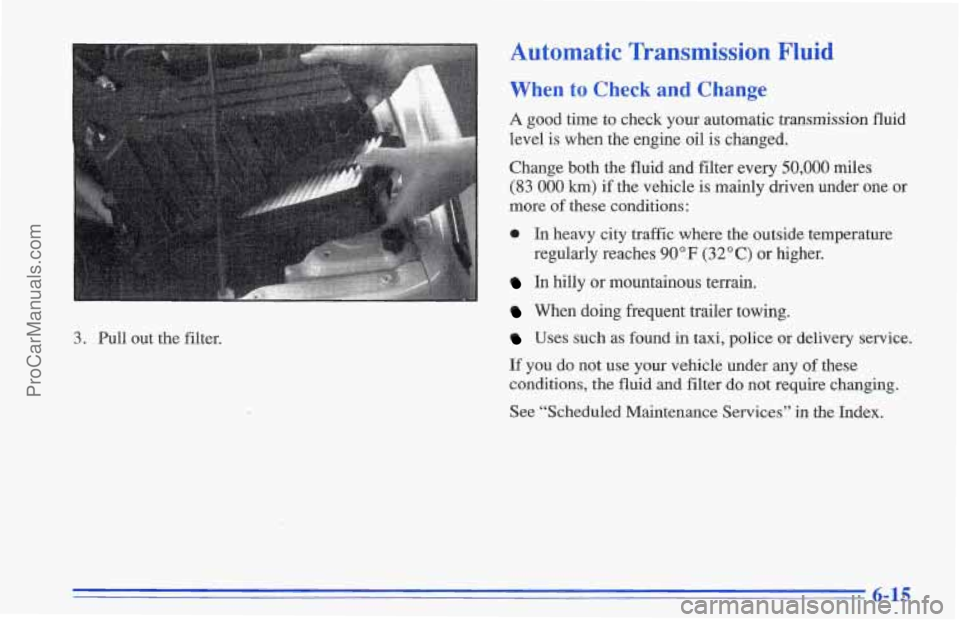
3. Pull out the filter.
Automatic Transmission Fluid
When to Check and Change
A good time to check your automatic transmission fluid
level is when the engine oil is changed.
Change both the fluid and filter every
50,000 miles
(83 000 km) if the vehicle is mainly driven under one or
more of these conditions:
0 In heavy city traffic where the outside temperature
regularly reaches
90°F (32” C) or higher.
In hilly or mountainous terrain.
When doing frequent trailer towing.
Uses such as found in taxi, police or delivery service.
If you do not use your vehicle under any of these
conditions, the fluid and filter do not
require changing.
See “Scheduled Maintenance Services” in the Index.
6-15
ProCarManuals.com
Page 253 of 387
How to Check
Because this operation can be a little difficult, you
may choose to have t,his done at
your Geo dealership
Service Department.
If you do it yourself, be sure to follow all the instructions
here, or
you could get a false reading on the dipstick.
NOTICE:
Too much or too little fluid can damage your
transmission. Too much can mean that some of
the fluid could come out and fall on hot engine
parts
or exhaust system parts, starting a fire. Be
sure to get an accurate reading if you check your
transmission fluid.
Wait at least 30 minutes before checking the
transmission fluid level if you have been driving:
When outside temperatures are above 90°F (32°C).
At high speed for quite a while.
@ In heavy traffic -- especially in hot weather.
While pulling a trailer.
To get the right reading, the fluid should be at normal
operating temperature, which
is 180°F to 200 "F
(82°C to 93°C).
Checking Transmission Fluid Hot
Get the vehicle warmed up by driving about 15 miles
(24 km) when outside temperatures are above 50°F
(10°C). If it's colder than 50°F (lO"C), drive the
vehicle
in DRIVE (D) until the engine temperature gage
moves and then remains steady for
10 minutes. Then
follow the hot check procedures.
Checking Transmission Fluid Cold
A cold check is made after the vehicle has been sitting
for eight hours or more with the engine off and is used
only
as a reference. Let the engine run at idle for five
minutes
if outside temperatures are 50 "F (10" C) or
more.
If it's colder than 50°F (lO°C), you may have to
idle the engine longer. Should the fluid level be low
during
a cold check, you must perform a hot check
before adding fluid. This will give
vou a more accurate
reading of the fluid level.
6-16
ProCarManuals.com
Page 307 of 387
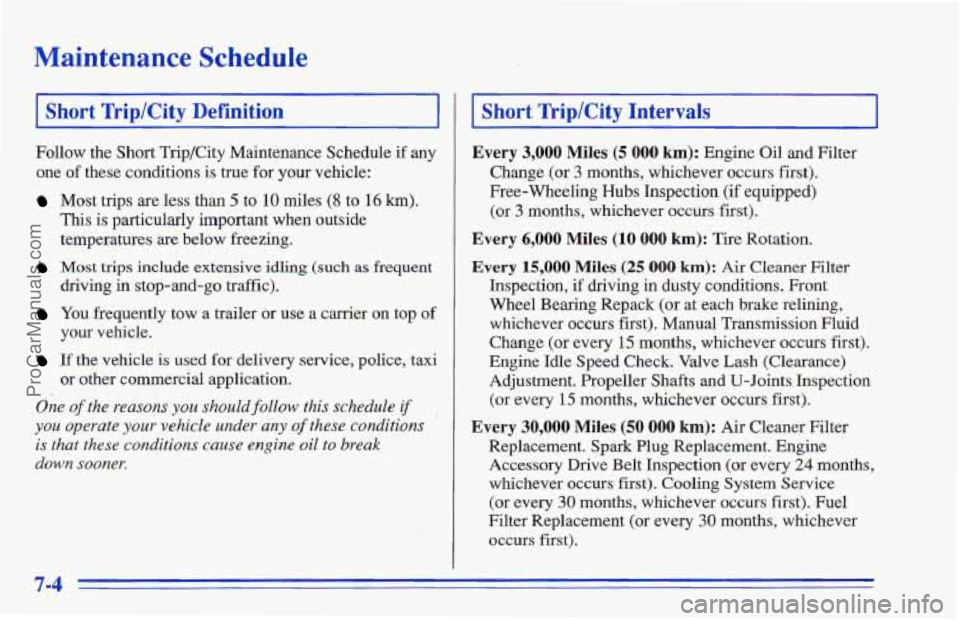
Maintenance Schedule
I Short TriplCity Definition
Follow the Short. Trip/City Maintenance Schedule if any
one of these conditions is true for your vehicle:
Most trips are less than 5 to 10 miles (8 to 16 km).
This is particularly important when outside
temperatures are below freezing.
Most trips include extensive idling (such as frequent
driving in stop-and-go traffic).
your vehicle.
You frequently tow a trailer or use a carrier on top of
If the vehicle is used for delivery service, police, taxi
or other commercial application.
One of the reasons you should follow this schedule if ,
you operate your vehicle under any of these conditions
is that these conditions cause engine oil to break
down sooner.
Short TriplCity Intervals
Every 3,000 Miles (5 000 km): Engine Oil and Filter
Change
(or 3 months, whichever occurs first).
Free-Wheeling
Hubs Inspection (if equipped)
(or
3 months, whichever occurs first).
Every 6,000 Miles (10 000 km): Tire Rotation.
Every 15,000 Miles (25 000 km): Air Cleaner Filter
Inspection, if driving in dusty conditions. Front
Wheel Bearing Repack (or at each brake relining,
whichever occurs first). Manual Transmission Fluid
Change
(or every 15 months, whichever occurs first).
Engine
Idle Speed Check. Valve Lash (Clearance),
Adjustment. Propeller Shafts
and U-Joints Inspection
(or every
15 months, whichever occurs first).
Every 30,000 Miles (50 000 km): Air Cleaner Filter
Replacement. Spark Plug Replacement. Engine
Accessory Drive Belt Inspection (or every
24 months,
whichever occurs
first). C.ooling System Service
(or every 30 months, whichever occurs first). Fuel
Filter Replacement (or every
30 months, whichever
occurs
first).
7-4
ProCarManuals.com
Page 314 of 387
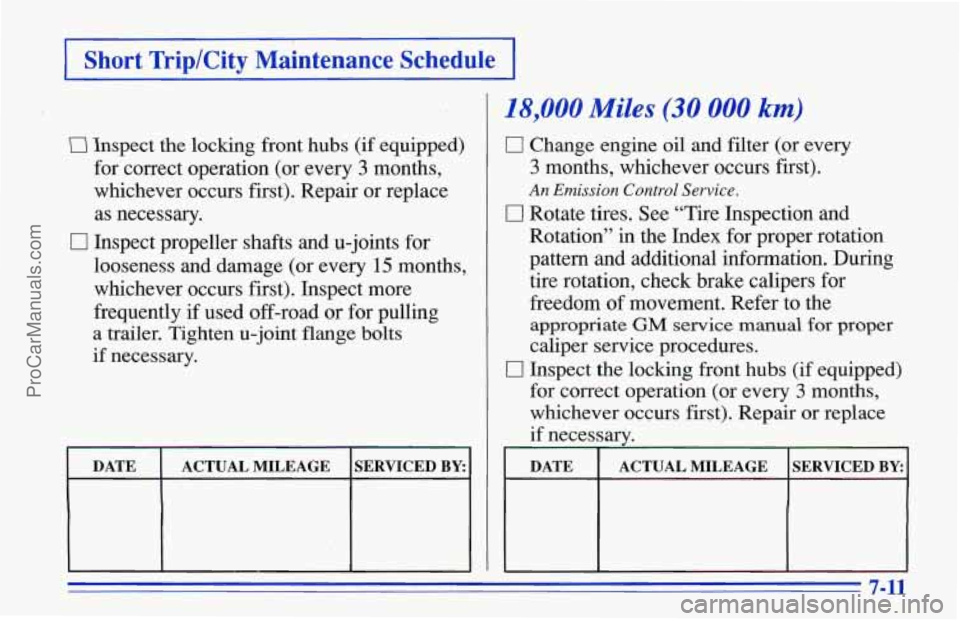
I Short Triplcity Maintenance Schedule I
!i3 Inspect the locking front hubs (if equipped)
for correct operation (or every
3 months,
whichever occurs first). Repair or replace
as necessary.
17 Inspect propeller shafts and u-joints for
looseness and damage (or every
15 months,
whichever occurs first). Inspect more
frequently
if used off-road or for pulling
a trailer. Tighten u-joint flange bolts
if necessary.
18,000 Miles (30 000 km)
0 Change engine oil and filter (or every
3 months, whichever occurs first).
An Emission Control Service.
0 Rotate tires. See “Tire Inspection and
Rotation” in the Index for proper rotation
pattern and additional information. During
tire rotation, check brake calipers for
freedom
of movement. Refer to the
appropriate GM service manual for proper
caliper service procedures.
0 Inspect the locking front hubs (if equipped)
for correct operation (or every
3 months,
whichever occurs first). Repair or replace
if necessary.
DATE
SERVICED BY ACTUAL MILEAGE
DATE
SERVICED BY ACTUAL MILEAGE
7-11
ProCarManuals.com