light CHEVROLET TRACKER 1996 Workshop Manual
[x] Cancel search | Manufacturer: CHEVROLET, Model Year: 1996, Model line: TRACKER, Model: CHEVROLET TRACKER 1996Pages: 387, PDF Size: 18.54 MB
Page 180 of 387
Freeway Driving
Mile for mile, freeways (also called thruways, parkways,
expressways, turnpikes or superhighways) are the safest
of all roads. But they have their own special rules.
The most important advice on freeway driving
is: Keep
up with traffic and keep to the right. Drive at the same
speed most of the other drivers
are driving. Too-fast or
too-slow driving breaks a smooth traffic flow. Treat the
left lane on
a freeway as a passing lane. At
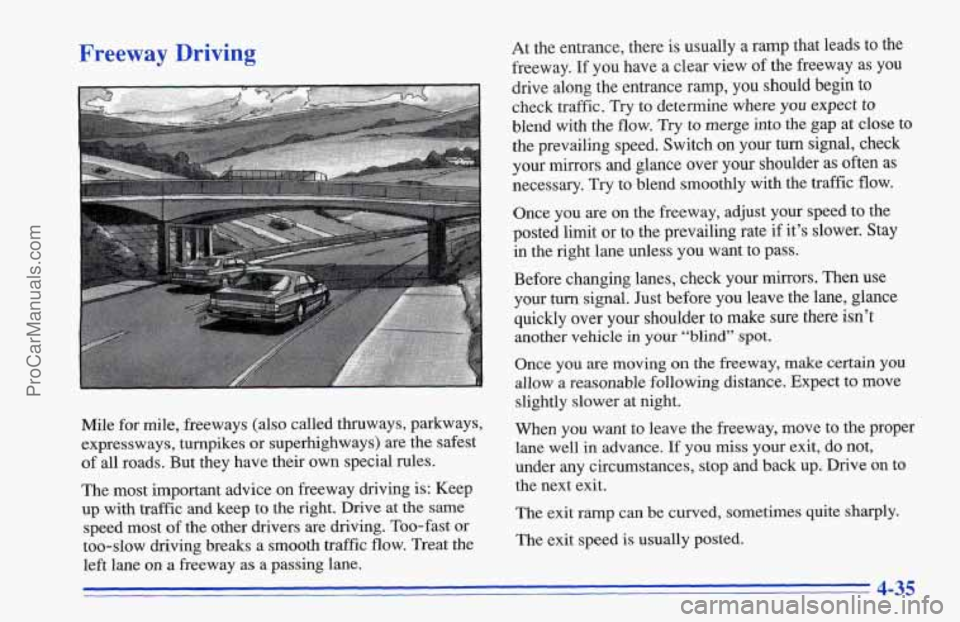
the entrance, there
is usually a ramp that leads to the
freeway.
If you have a clear view of the freeway as you
drive along the entrance ramp,
you should begin to
check traffic. Try to determine where you expect to
blend with the flow. Try to merge into the gap at close to
the prevailing speed. Switch on your turn signal, check
your mirrors and glance over your shoulder as often as
necessary,
Try to blend smoothly with the traffic flow.
Once you
are on the freeway, adjust your speed to the
posted limit or to the prevailing rate
if it’s slower. Stay
in the right
lane unless you want to pass.
Before changing lanes, check your mirrors. Then use
your turn signal. Just before you leave the lane, glance
quickly over your shoulder to make
sure there isn’t
another vehicle
in your “blind” spot.
Once you are moving on the freeway, make certain you
allow a reasonable following distance. Expect to move
slightly slower at night.
When you want to leave the freeway, move to the proper
lane well
in advance. If you miss your exit, do not,
under any circumstances, stop and back up; Drive on to
the next exit.
The exit ramp can
be curved, sometimes quite sharply.
The exit speed
is usually posted.
4-35
ProCarManuals.com
Page 188 of 387
Run your engine only as long as you must. This saves
fuel. When you run the engine, make it
go a little faster
than just idle. That
is, push the accelerator slightly. This
uses less fuel for the heat that you get and it keeps the
battery charged. You will need a well-charged battery
to
restart the vehicle, and possibly for signaling later on
with your headlamps. Let the heater run for awhile.
Then, shut the engine off and close the window almost
all the way to preserve the heat. Start the engine again
and repeat this only when you feel really uncomfortable
from the cold. But do it as little
as possible. Preserve the
fuel as long as you can.
To help keep warm, you can get
out of the vehicle and do some fairly vigorous exercises
every half hour or
so until help comes.
Recreational Vehicle Towing
There may be times when you want to tow your Geo
behind another vehicle for use at your destination. Be
sure to use the proper towing equipment designed for
recreational towing. Follow the instructions for the
towing equipment.
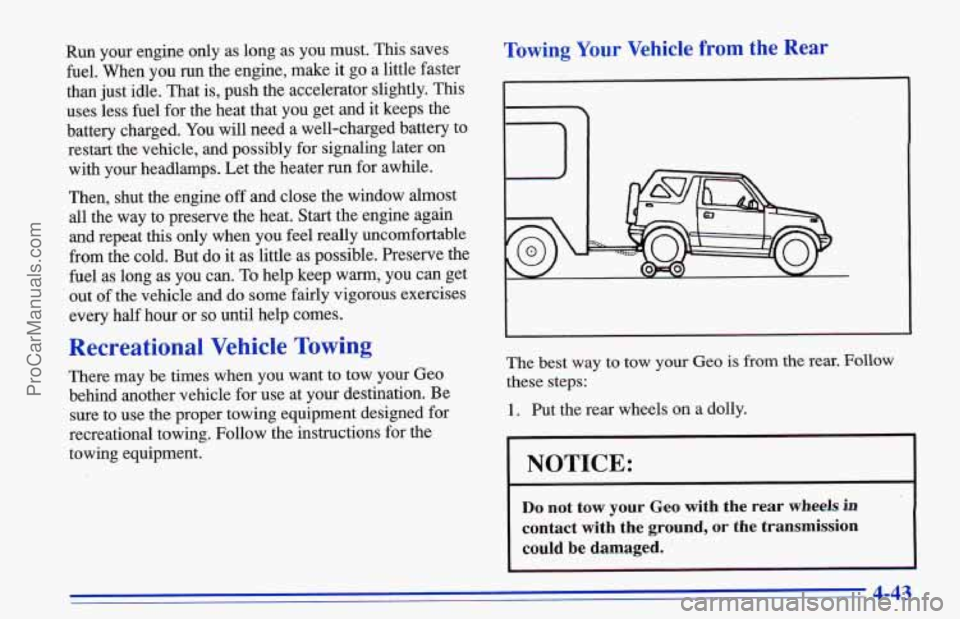
Towing Your Vehicle from the Rear
The best way to tow your Geo is from the rear. Follow
these steps:
1. Put the rear wheels on a dolly.
I I
NOTICE:
Do not tow your Geo with the rear wheels in
contact with the ground, or the transmission
could be damaged.
4-43
ProCarManuals.com
Page 204 of 387
I NOTICE:
If the other system isn’t a 12-volt system with a
negative ground, both vehicles can be damaged.
2. Get the vehicles close enough so the jumper cables
can reach, but be sure the vehicles aren’t touching
each other.
If they are, it could cause a ground
connection you don’t want. You wouldn’t be able to
start your Geo, and the bad grounding could damage
the electrical systems.
3. Turn off the ignition on both vehicles. Unplug
unnecessary
accessories plugged into the cigarette
lighter. Turn
off all lamps that aren’t needed as well
as radios.
This will avoid sparks and help save both
batteries.
In addition, it could save your ra.dio!
I NOTICE:
~~ ~
If you leave your radio on, it could be badly
damaged. The repairs wouldn’t be covered by
your warranty.
4. Open the hoods and locate the batteries. Find the
positive (+) and negative (-) terminals on each battery.
I A CAUTION:
An electric fan can start up even when the engine
is not running and can injure you. Keep hands,
clothing and tools away from any underhood
electric fan.
5-3
ProCarManuals.com
Page 205 of 387

Using a match near a battery can cause battery
gas to explode. People have been hurt doing this,
and some have been blinded. Use-a flashlight if
you need more light.
Be sure the battery has enough water.
You don’t
need to add water to the Delco Freedom@ battery
installed in every new
GM vehicle. But if a battery
has filler caps, be sure the right amount of fluid is
there. If it is low, add water to take care of that
first. If you don’t, explosive gas could be present.
Battery fluid contains acid that can burn
you.
Don’t get it on you. If you accidentally get it in
your eyes or on your skin, flush the place with
water and get medical help immediately.
I 5. Check that the jumper cables don’t have loose or
missing insulatiofi. If they do, you could get a shock.
The vehicles could be damaged, too.
13
Fan or other moving engine parts can injure you
badly. Keep your hands away from moving parts
once the engines are running.
ProCarManuals.com
Page 235 of 387
Rocking your vehicle to.get it out: Using the Recovery Hooks
First,
turn your steering wheel left and right. That will
clear
the area around your front wheels. Then shift back
and forth between
REVERSE (R) and a forward gear
(or with a manual transmission, b’etween FIRST (1) or
SECOND (2) and REVERSE(R)), spinning the wheels
as little as possible. Release the accelerator pedal while
you shift, and press lightly on the accelerator pedal
when the transmission is in gear.
If that doesn’t get you
out after a few tries, you may need to be towed out. Or,
you can use your recovery
hooks if your vehicle has
them. If you do need to be towed out, see “Towing Your
Vehicle” in the Index.
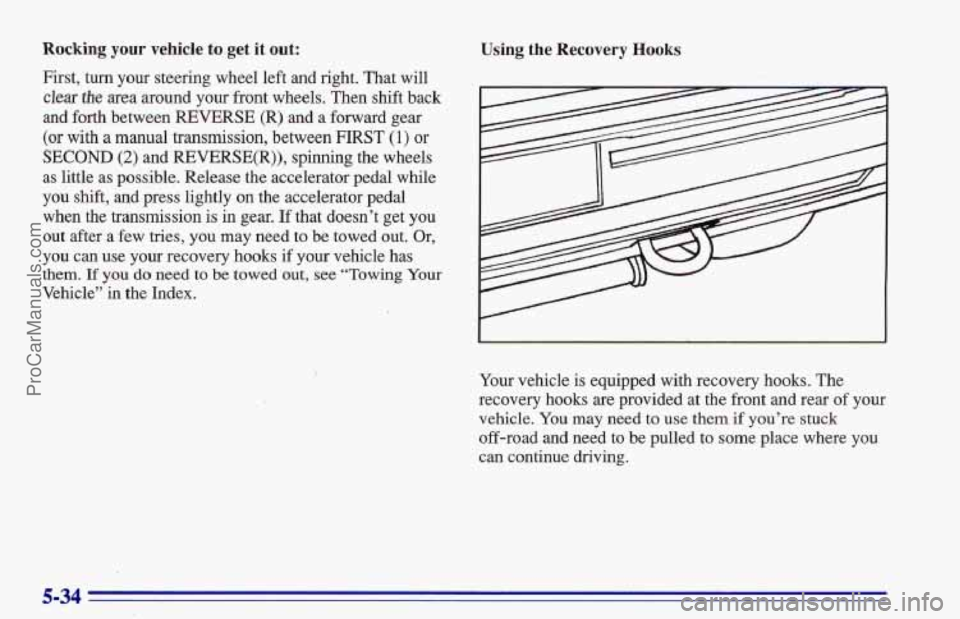
Your vehicle
is equipped with recovery hooks. The
recovery hooks
are provided at the front and rear of your
vehicle. You may need to use them if you’re stuck
off-road and need to be pulled to some place where you
can continue driving.
5-34
ProCarManuals.com
Page 246 of 387
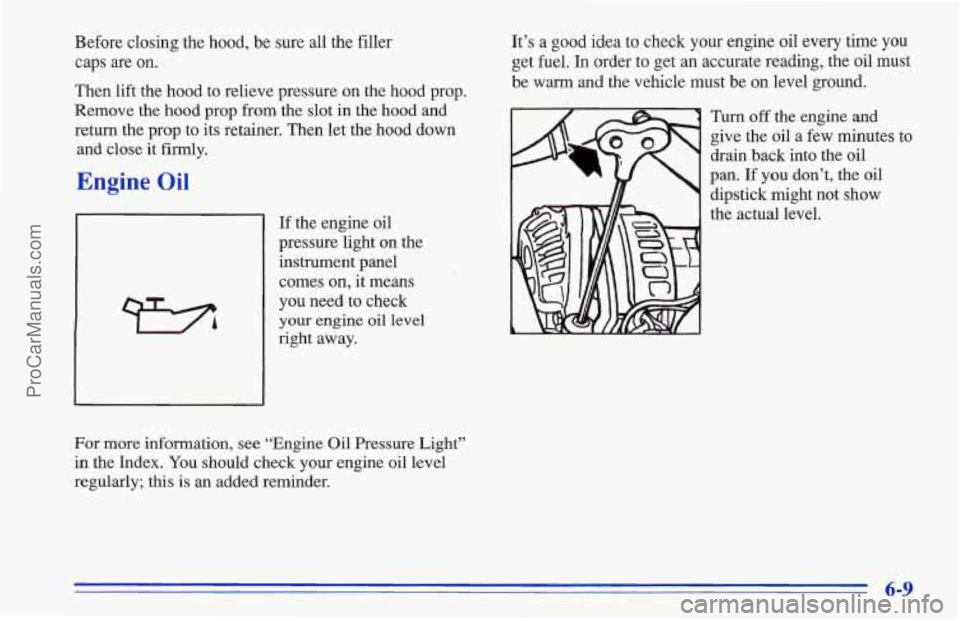
Before closing the hood, be sure all the filler
caps are on.
Then lift the hood to relieve pressure on the hood prop.
Remove the hood prop from the slot in the hood and
return the prop
to its retainer. Then let the hood down
and close
it firmly.
Engine Oil
If the engine oil
pressure light on the
instrument panel comes
on, it means
you need
to check
your engine oil level
right away.
For more information,
see “Engine Oil Pressure Light”
in the Index. You should check your engine oil level
regularly; this is an added reminder. It’s a good
idea
to check your engine oil every time you
get fuel.
In order to get an accurate reading, the oil must
be warm and the vehicle must be on level ground.
Turn off the engine and
give the oil a few minutes
drain back into the oil
pan. If you don’t, the oil
dipstick might not show
the actual level.
to
6-9
ProCarManuals.com
Page 261 of 387
What to Use
Refer to the Maintenance Schedule to determine what
W of lubricant to use. See “Recommended Fluids and
Lubricants”
in the Index.
Engine Coolant
The following explains your cooling system and how
to add coolant when
it is low. If you have a problem
with engine overheating, see “Engine Overheating” in
the Index.
A 50/50 mixture of water and the proper coolant for
your Geo will:
Give freezing protection down to -33 “F (-36°C).
0 Give boiling protection up to 258°F (125°C).
Protect against rust and corrosion.
Help keep the proper engine temperature,
Let the warning lights and gages work as
they should.
What to Use
Use a mixture of one-half clean water (preferably
distilled) and one-half antifreeze that meets
GM
Specification 1825-M, which won’t damage aluminum
parts. You can also use a recycled coolant conforming
to
GM Specification 1825-M with a complete coolant flush
and refill. If you use this mixture, you don’t need to add
anything else.
/i CAUTTON:
Adding only plain water to your cooling system
can be dangerous. Plain water, or some other
liquid like alcohol, can boil before the proper
coolant mix
will. Your vehicle’s coolant warning
system is set for the proper coolant
mix. With
plain water
or the wrong mix, your engine could
get too hot
but you wouldn’t get the overheat
warning. Your engine could catch
fire and you or
others could be burned. Use a 50/50 mix of clean
water and the proper antifreeze.
6-24
ProCarManuals.com
Page 269 of 387
Brake Wear
Your Geo has front disc brakes and rear drum brakes.
Disc brake pads have built-in wear indicators that make a
high-pitched warning sound when the brake pads are
wor~ and new pads are needed.
The sound may come and
go or be heard all the time your vehicle is moving (except
when you are pushing
on the brake pedal firmly).
The brake wear warning sound means that sooner
or later your brakes won’t work
well. That could
lead
to an accident. When you hear the brake
wear warning
sound, have your vehicle serviced.
I NOTICE: I
Continuing to drive with worn-out brake pads
could result
in costly brake repair.
Some driving conditions or climates may cause a brake
squeal when the brakes are first applied or lightly applied.
This does not mean something is wrong with
your brakes,
Free movement of brake calipers and properly torqued
wheel nuts are necessary to help prevent brake pulsation.
When tires are rotated, inspect brake calipers for
movement, brake pads for wear, and evenly torque wheel
nuts
in the proper sequence to GM specifications.
Your rear drum brakes don’t have wear indicators, but
if
you ever hear a rear brake rubbing noise, have the rear
brake
linings inspected. Also, the rear brake drums
should be removed and inspected each time the tires are
removed for rotation or changing. When you have the
front brakes replaced, have the rear brakes inspected,
too.
Brake linings should always be replaced as complete
axle sets.
Brake Pedal Travel
See your dealer if the brake pedal does not return to
normal height,
or if there is a rapid increase in pedal
travel. This could
be a sign of brake trouble.
6-32
ProCarManuals.com
Page 282 of 387
While the tires available on General Motors passenger
cars and light trucks
may vary with respect to these
grades, they must also conform to Federal safety
requirements and additional General Motors Tire
Performance Criteria
(TPC) standards.
Treadwear
The treadwear grade is a comparative rating based on
the wear rate of the tire when tested under controlled
conditions on a specified government test course. For
example, a tire graded
150 would wear one and a half
(1 1/2) times as well on the government course as a tire
graded 100. The relative performance of tires depends
upon the actual conditions of their use, however, and
may depart significantly from the nom due to variations
in driving habits, service practices
and differences in
road characteristics and climate.
Traction -- A, B, C
The traction grades, from highest to lowest, are A, B, and
C, and they represent the tire’s ability to stop on wet
pavement as measured under controlled conditions on
specified government test surfaces of asphalt and concrete.
A tire marked C may have poor traction performance. Warning:
The traction grade assigned to this tire
is based
on braking (straightahead) traction tests and does not
include cornering (turning) traction,
Temperature -- A, B, C
The temperature grades are A (the highest), B, and C,
representing the tire’s resistance to the generation of
heat and its ability to dissipate heat when tested under
controlled conditions on, a specified indoor laboratory
test wheel. Sustained high temperature can cause the
material of the tire to degenerate and reduce tire life, and
excessive temperature can lead to sudden tire failure.
The grade
C corresponds to a level of perfol’mance
which all passenger car tires must meet under the
Federal Motor Vehicle Safety Standard No. 109. Grades
B and
A represent higher levels of performance on the
laboratory test wheel than the minimum required by law.
Warning:
The temperature grade for this tire is
established for a tire that is properly inflated and not
overloaded. Excessive speed, underinflation, or
excessive loading,
either separately or in combination,
can cause heat buildup and possible tire failure.
6-45
ProCarManuals.com
Page 286 of 387
Using Foam-Type Cleaner on Fabric
1. Vacuum and brush the area to remove any
loose dirt.
2. Always clean a whole trim panel or section. Mask
3. Mix Multi-Purpose Powdered Cleaner following
surrounding trim along stitch
or welt lines.
the directions on the container label.
4. Use suds only and apply with a clean sponge.
5. Don’t saturate the material.
6. Don’t rub it roughly.
7. As soon as you’ve cleaned the section, use a sponge
8. Rinse the section with a clean, wet sponge.
9. Wipe off what’s left with a slightly damp paper
to remove the suds.
towel or cloth.
10. Then dry it immediately with a blow dryer.
11. Wipe with a clean cloth.
Using Solvent-Type Cleaner on Fabric
First, see if you have to use solvent-type cleaner at all.
Some spots and stains will clean
off better with just
water and mild soap.
If you need to use a solvent:
Gently scrape excess soil from the trim material with
a clean, dull knife or scraper. Use very little cleaner,
light pressure and clean cloths (preferably
cheesecloth). Cleaning should start at the outside of
the stain, “feathering” toward the center. Keep
changing to a clean section of the cloth.
When you clean a stain from fabric, immediately
dry the area with a blow dryer to help prevent
a
cleaning ring.
Fabric Protection
Your Geo has upholstery that has been treated with
Scotchgard” Fabric Protector, a 3M product.
It protects
fabrics by repelling oil and water, which are the carriers
of most stains. Even with this protection, you still need
to clean your upholstery often to keep it looking new.
Further information on cleaning
is available by calling
1-800-433-3296 (in Minnesota, 1-800-642-6167).
6-49
ProCarManuals.com