lock CHEVROLET TRACKER 1996 Repair Manual
[x] Cancel search | Manufacturer: CHEVROLET, Model Year: 1996, Model line: TRACKER, Model: CHEVROLET TRACKER 1996Pages: 387, PDF Size: 18.54 MB
Page 189 of 387
2.
3.
4.
5,
Set the parking brake.
If your Geo is a four-wheel-drive vehicle, set your
manual free-wheeling hubs
to FliEE or unlock your
automatic freewheeling hubs.
See “Four-wheel
Drive” in the Index.
Turn the ignition key to ACC to unlock the
steering wheel.
Clamp the steering wheel in a straight-ahead
position, with
a clamping device designed
for towing.
Release the parking brake.
NOTICE:
Make sure that the towing speed does not
exceed 55 mph (90 km/h), or your Geo could be
badly damaged.
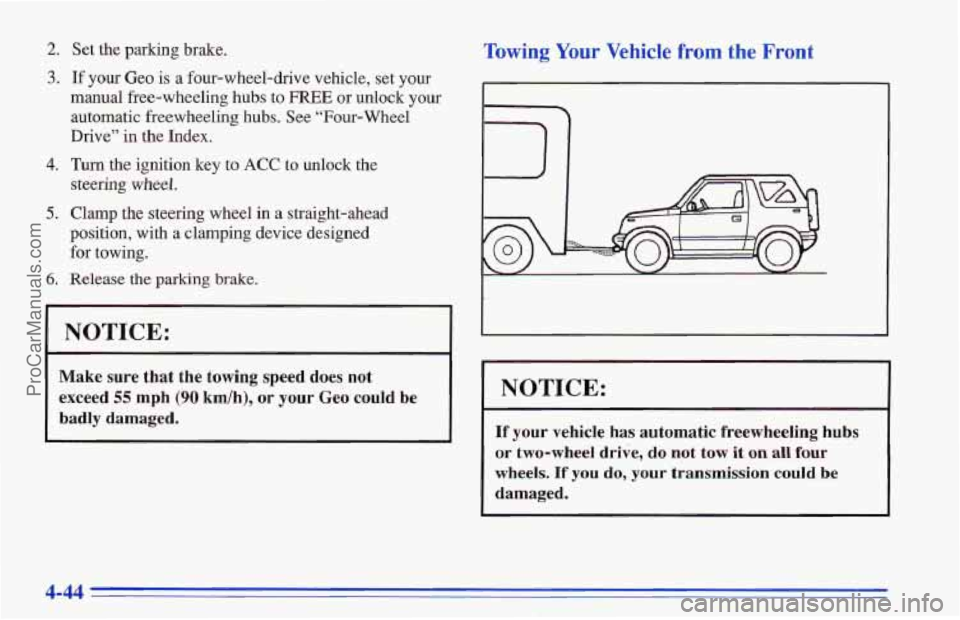
Towing Your Ve- ‘cle from the Front
NOTICE:
If your vehicle has automatic freewheeling hubs
or two-wheel drive, do not tow it on all four
wheels. If you do, your transmission could be
damaged.
4-44
ProCarManuals.com
Page 190 of 387
If you have a four-wheel-drive vehicle with manual
freewheeling
hubs, it can be towed from the front with
all four wheels on the ground. Follow these steps:
1.
2.
3.
4.
5.
6.
Set the parking brake.
Turn the ignition key to ACC to unlock the
steering wheel.
Shift your automatic transmission into
PARK (P), or
your manual transmission into SECOND
(2).
Shift the transfer case to NEUTRAL (N).
Set the hubs to FREE. See “Four-wheel Drive” in
the Index.
Release
the parking brake.
Stop towing every
200 miles (300 km) and start
the engine. Leave the transfer case shift lever
in
NEUTRAL (N). Shift your automatic transmission
to DRIVE (D); leave a manual transmission in
SECOND (2) with the clutch engaged. Run the engine
at medium speed for one minute to circulate the oil in
the transfer case. Turn the ignition key to ACC. Now
you can continue towing your Geo.
NOTICE:
The front wheels transmit shocks during towing.
The steering column may not be strong enough to
withstand the shocks. Always unlock the steering
wheel before towing.
I NOTICE:
Make sure that the towing speed does not exceed
50 mph (80 kdh), or your Geo could be badly
damaged.
4-45
ProCarManuals.com
Page 191 of 387
Loading Your Vehicle
TIRE PLACARD
I GWR IGWR FRTI GAWR RR I I I I I I
LBIKg
~~
TIRES
RIMS
INFLATION
COLD PSl/kPa PRESSURE
MFD BY CAM1 AUTOMOTIVE DATE GVWR GAWR FRT CANADA GAWR RR
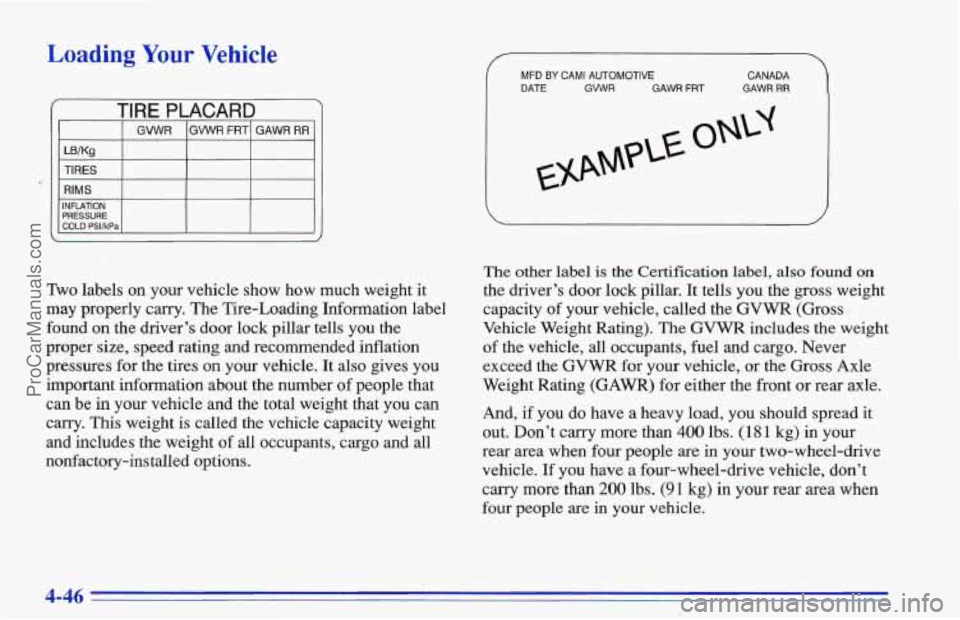
Two labels on your vehicle show how much weight it
may properly carry. The Tire-Loading Information label
found on the driver's door lock pillar tells you the
proper size, speed rating and recommended inflation pressures for the tires on your vehicle. It also gives you
important information about the number
of people that
can be in your vehicle and the total weight that you can
carry. This weight is called the vehicle capacity weight
and includes the weight
of all occupants, cargo and all
nonfactory-installed options. The
other label is the Certification label, also found on
the driver's door
lock pillar. It tells you the gross weight
capacity of your vehicle, called the GVWR (Gross
Vehicle Weight Rating). The GVWR includes th'e weight
of the vehicle, all occupants, fuel and cargo. Never
exceed the
GVWR for your vehicle, or the Gross Axle
Weight Rating
(GAWR) for either the front or rear axle.
And, if you do have a heavy load, you should spread it
out. Don't
carry more than 400 lbs. (1 8 1 kg) in your
rear area when four people
are in your two-wheel-drive
vehicle.
If you have a four-wheel-drive vehicle, don't
carry
more than 200 lbs. (91 kg) in your rear area when
four people are
in your vehicle.
4-46
ProCarManuals.com
Page 195 of 387
Weight of the Trailer Tongue
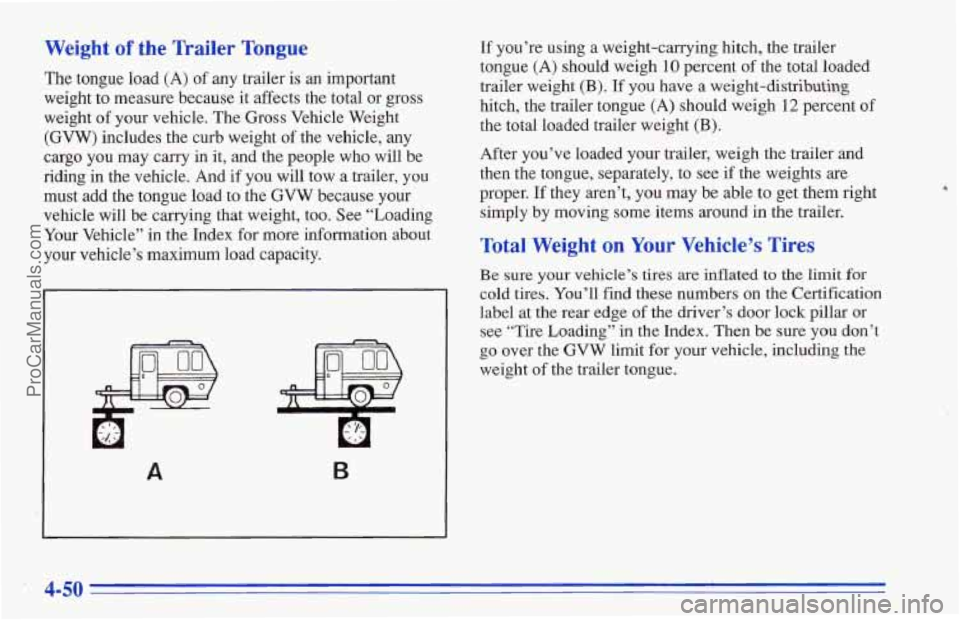
The tongue load (A) of any trailer is an important
weight to measure because it affects the total or gross
weight
of your vehicle. The Gross Vehicle Weight
(GVW) includes the curb weight of the vehicle, any
cargo you may carry in
it, and the people who will be
riding in the vehicle. And if
you will tow a trailer, you
must add the tongue load to the
GVW because your
vehicle will be carrying that weight, too. See “Loading
Your Vehicle”
in the Index for more information about
your vehicle’s maximum load capacity.
A B
If you’re using a weight-carrying hitch, the trailer
tongue
(A) should weigh 10 percent of the total loaded
trailer weight
(B). If you have a weight-distributing
hitch, the trailer tongue
(A) should weigh 12 percent of
the total loaded trailer weight
(B).
After you’ve loaded your trailer, weigh the trailer and
then the tongue, separately, to see
if the weights are
proper.
If they aren’t, you may be able to get them right
simply by moving some items around in the trailer.
Total Weight on Your Vehicle’s Tires
Be sure your vehicle’s tires are inflated to the limit for
cold tires. You’ll find these numbers
on the Certification
label at the rear edge
of the driver’s door lock pillar or
see “Tire Loading” in the Index. Then be sure you don’t
go over the GVW limit for your vehicle, including the
weight
of the trailer tongue.
4-50
ProCarManuals.com
Page 209 of 387
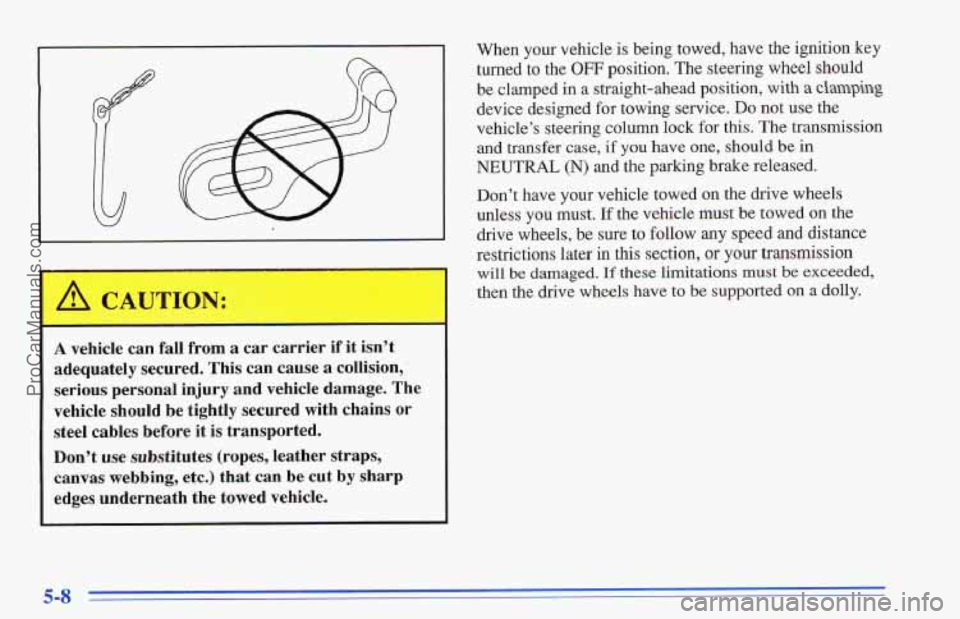
U‘l’lOR’
A vehicle can fall from a car carrier if it isn’t
adequately secured. This can cause
a collision, ‘
serious personal injury and vehicle damage. The
vehicle should be tightly secured with chains or
steel cables before
it is transported.
Don’t
use substitutes (ropes, leather straps,
canvas webbing,
etc.) that can be cut by sharp
edges underneath the towed vehicle.
When your vehicle is being towed, have the ignition key
turned to the OFF position. The steering wheel should
be clamped in a straight-ahead position, with a clamping
device designed for towing service. Do not use the
vehicle’s steering column lock for this.
The transmission
and
transfer case, if you have one, should be in
NEUTRAL (N) and the parking brake released.
Don’t have your vehicle towed
on the drive wheels
unless
you must. If the vehicle &ust be towed on the
drive wheels, be sure to follow any speed and distance
restrictions later
in this section, or your transmission
will be damaged. If these limitations must be exceeded,
then the drive wheels have to be supported on a dolly.
5-8
ProCarManuals.com
Page 211 of 387
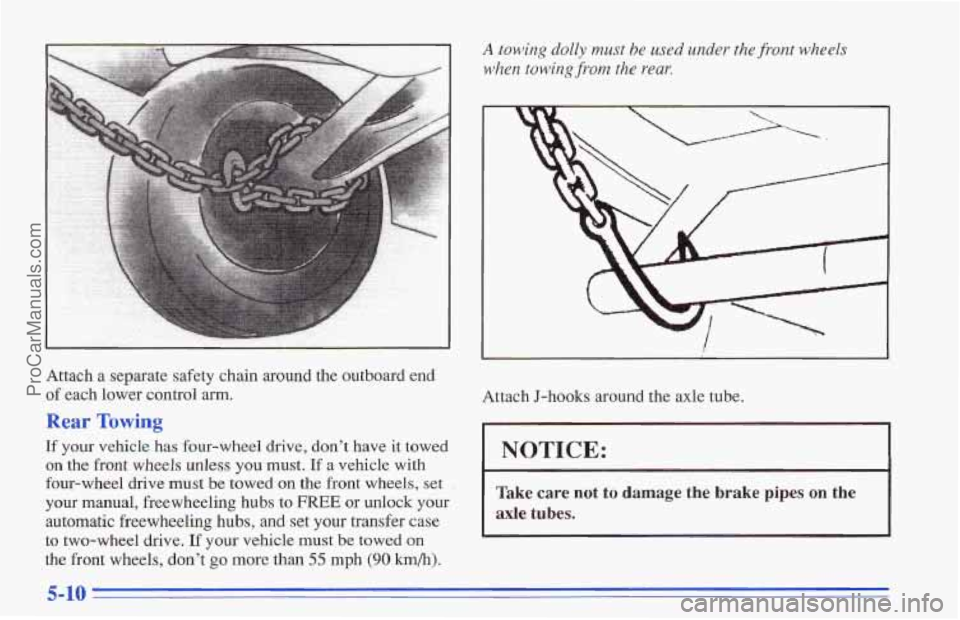
Attach a separate safety chain around the outboard end
of each lower control arm.
Rear Towing
If your vehicle has four-wheel drive, don't have it towed
on the front wheels unless you must. If a vehicle with
four-wheel drive must
be towed on the front wheels, set
your manual, freewheeling
hubs to FREE or unlock your
automatic freewheeling
hubs, and set your transfer case
to two-wheel drive. If your vehicle must be towed on
the-front wheels, don't go more'than 55 mph (90 kmh).
A towing dolly must be used under the front wheels
when towing from the reur.
r
Attach J-hooks around the axle tube.
I NOTICE:
Take care not to damage the brake pipes on the
axle tubes.
5-10
ProCarManuals.com
Page 220 of 387
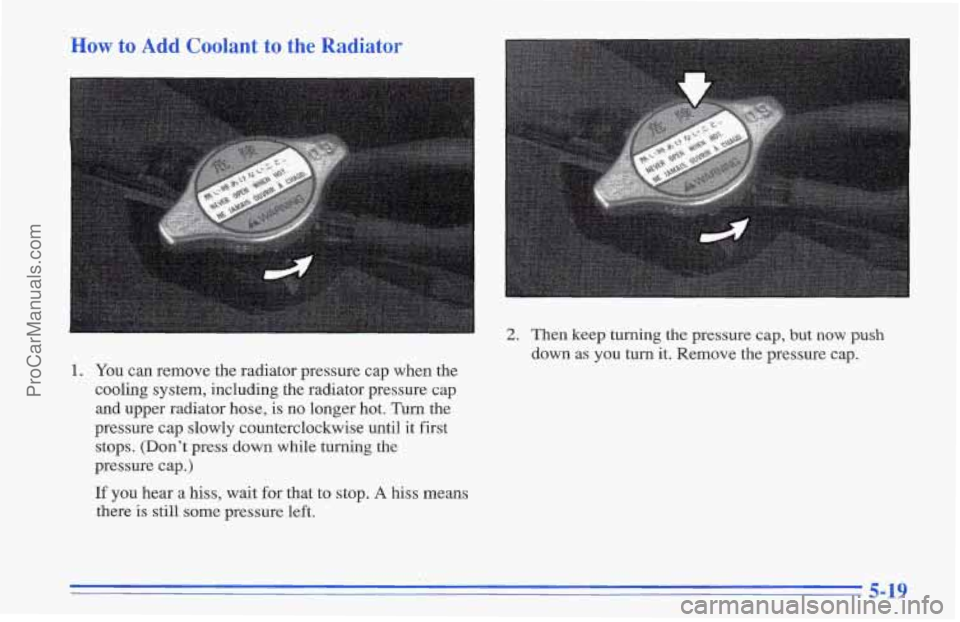
How to Add Coolant to the Rac
2. Then keep turning the pressure cap, but now push
down
as you turn it. Remove the pressure cap.
’ . You can remove the radiator pressure cap when the
cooling system, including the radiator pressure cap
and upper radiator hose, is
no longer hot. Turn the
pressure cap slowly counterclockwise until it first
stops. (Don’t press down while turning the
pressure cap.)
If you hear a hiss, wait for that to stop. A hiss means
there
is still some pressure left.
- 5-19
ProCarManuals.com
Page 223 of 387
If a Tire Goes Plat
It’s unusual for a tire to “blow out” while you’re driving,
especiaIIy
if you maintain your tires properly. If air goes
out
of a tire, it’s much more likely to leak put slowly.
But if you should ever have a “blowout,” here are a few
tips about
what to expect and what to do:
If a front tire fails, the flat tire will create a drag that
pulls the vehicle toward that side. Take your foot
off the
accelerator pedal
and grip the steering wheel firmly.
Steer to maintain lane position, and then gently brake to
a stop well out
of the traffic lane.
A rear blowout, particularly on a curve, acts much like a
skid and may require the same correction you’d use in a
skid. In any rear blowout, remove your foot from the
accelerator pedal. Get the vehicle under control by
steering the way you want the vehicle to go.
It may be
very
bumpy and noisy, but you can still steer. Gently
brake to a stop
-- well off the road if possible.
If a tire goes flat, the next part shows how to use your
jacking equipment to change a flat tire safely.
Changing a Flat Tire
If a tire goes flat, avoid further tire and wheel damage
by driving slowly
to a level place. Turn on your hazard
warning flashers.
I
’ A CAUTION:
Changing a tire can cause an injury. The vehicle
can slip
off the jack and roll over you or other
people.
You and they could be badly injured.
Find
a level place to change your tire. To help
prevent the vehicle
from moving:
1. Set the parking brake firmly.
2. Put an automatic transmission shift
lever in PARK (P) or shift a manual
transmission to FIRST (1) or
REVERSE
(R).
3. If you have a four-wheel-drive vehicle,
be sure the transfer case is in
a drive
gear
-- not in NEUTRAL (N).
4. Turn off the engine.
To be even more certain the vehicle won’t move,
you can put blocks at the front and rear of the
tire farthest away from the one being changed.
That would be the tire on the other side of the
vehicle,
at the opposite end.
~~
5-22
ProCarManuals.com
Page 226 of 387
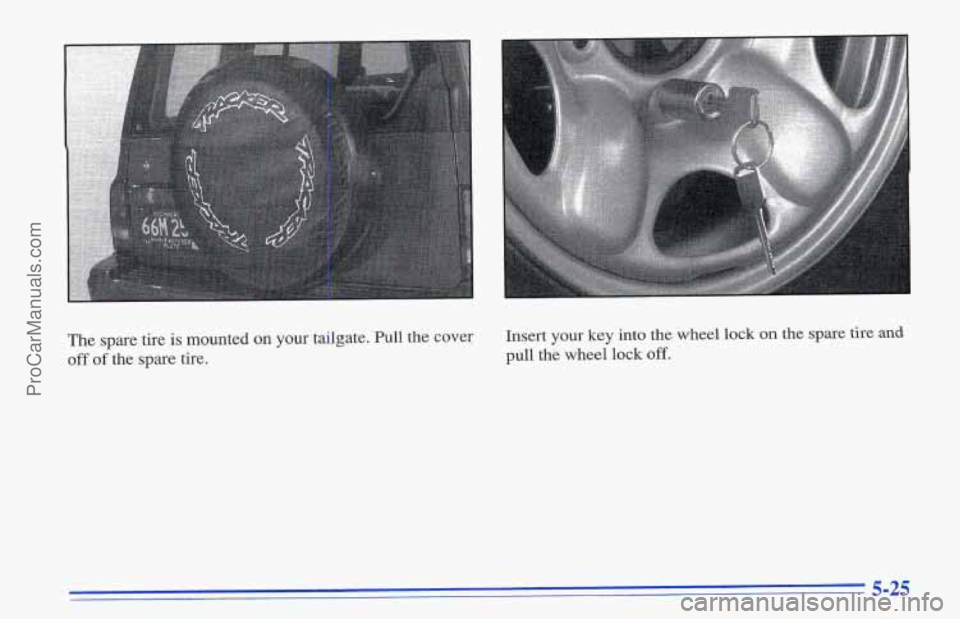
The spare tire is mounted on your tailgate. Pull the cover
off of the spare tire. Insert
your key into
the wheel lock on the spare tire and
pull the wheel lock off.
5-25
ProCarManuals.com
Page 227 of 387
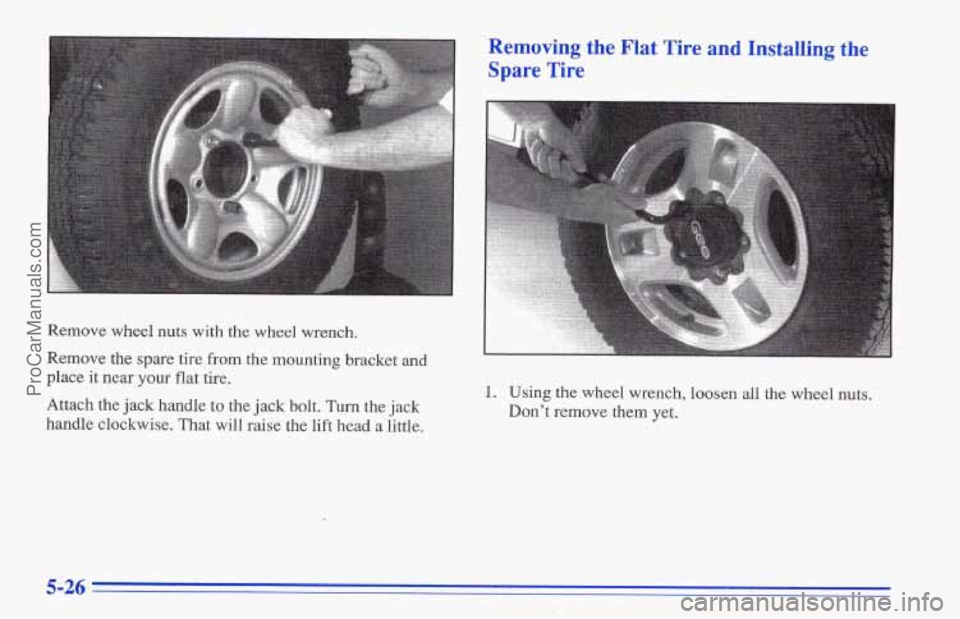
Remove wheel nuts with the wheel wrench.
Remove the spare tire
from the mounting bracket and
place it near your flat tire.
Attach the
jack handle to the jack bolt. Turn the jack
handle clockwise. That will raise the lift head a little.
. Using the wheel wrench, loosen all the wheel nuts.
Don’t remove them yet.
5-26
ProCarManuals.com