lock CHEVROLET TRACKER 1997 User Guide
[x] Cancel search | Manufacturer: CHEVROLET, Model Year: 1997, Model line: TRACKER, Model: CHEVROLET TRACKER 1997Pages: 388, PDF Size: 20.12 MB
Page 20 of 388
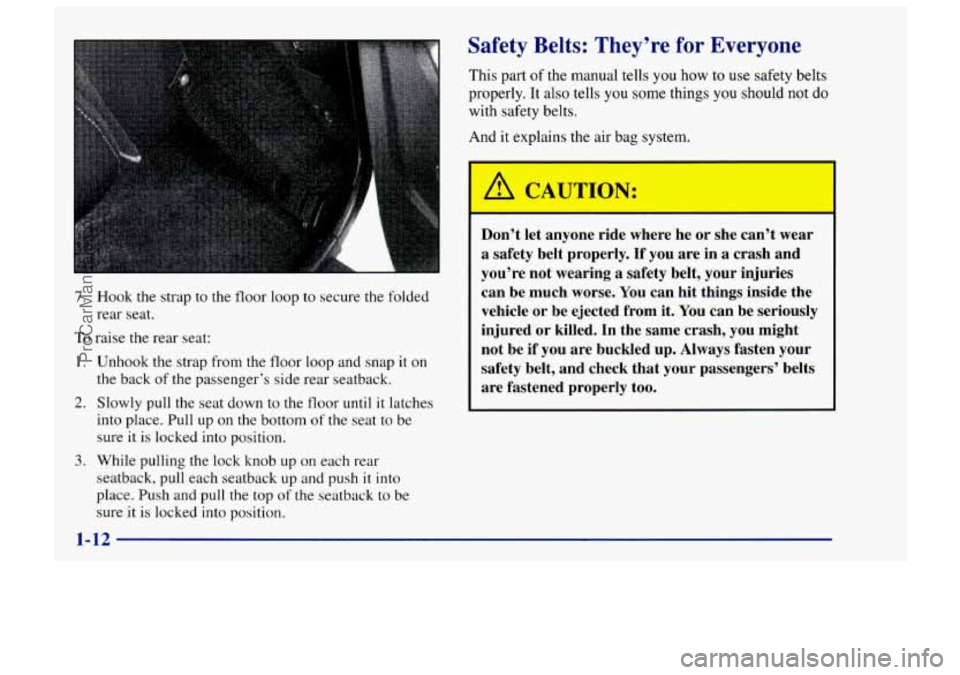
7. Hook the strap to the floor loop to secure the folded
To raise the rear seat: rear
seat.
I. Unhook the strap from the floor loop and snap it on
the back of the passenger’s side rear seatback.
2. Slowly pull the seat down to the floor until it latches
into place. Pull up on the bottom
of the seat to be
sure it is locked into position.
seatback, pull each seatback up
and push it into
place.
Push and pull the top of the seatback to be
sure it
is locked into position.
3. While pulling the lock knob up on each rear
Safety Belts: They’re for Everyone
This part of the manual tells you how to use safety belts
properly. It also tells you some things you should not do
with safety belts.
And it explains the air bag system.
I I
/! ~km- ,,-Lv:
Don’t let anyone ride where he or she can’t wear
a safety belt properly. If you are in a crash and
you’re not wearing
a safety belt, your injuries
can be much worse. You can hit things inside the
vehicle or be ejected from it. You can be seriously
injured or killed. In the same crash, you might
not be if you are buckled up. Always fasten your
safety belt, and check that your passengers’ belts
are fastened properly too.
1-12
ProCarManuals.com
Page 26 of 388
How to Wear Safety Belts Properly
Adults
This part is only for people of adult size.
Be aware that there are special things to know about safety
belts and children. And there are different rules for smaller
chrldren and babies. If a child will be riding
in your Geo,
see the part of this manual called “Children.” Follow tho\
se
rules for everyone’s protection.
First, you’ll want to know which restraint systems your
vehicle has.
We’ll start with the driver position.
Driver Position
This part describes the driver’s restraint system.
Lap-Shoulder Belt
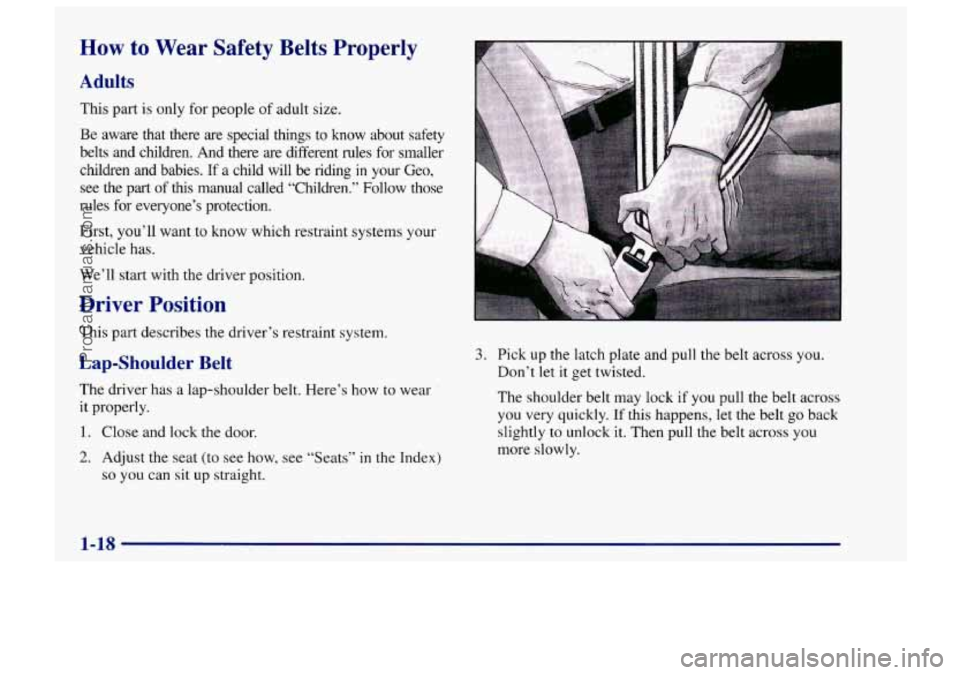
The driver has a lap-shoulder belt. Here’s how to wear
it properly.
1. Close and lock the door.
2. Adjust the seat (to see how, see “Seats” in the Index)
so you can sit up straight.
3. Pick up the latch plate and pull the belt across you.
Don’t let
it get twisted.
The shoulder belt may lock if you pull the belt across
you very quickly.
If this happens, let the belt go back
slightly to unlock it. Then pull the belt across you
more slowly.
1-18
ProCarManuals.com
Page 27 of 388
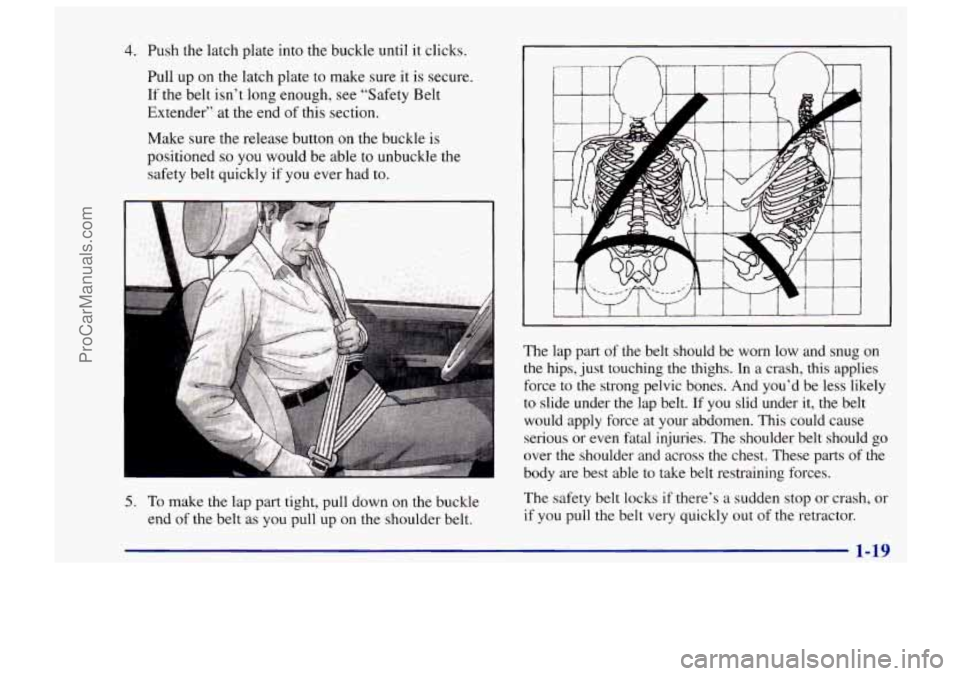
4. Push the latch plate into the buckle until it clicks.
Pull up on the latch plate to make sure it is secure.
If the belt isn’t long enough, see “Safety Belt
Extender’’ at the end of this section.
Make sure
the release button on the buckle is
positioned
so you would be able to unbuckle the
safety belt quickly if you ever had to.
5. To make the lap part tight, pull down on the buckle
end of the belt
as you pull up on the shoulder belt. The lap
part of the belt should be worn low and snug on
the hips, just touching the thighs. In
a crash, this applies
force to the strong pelvic bones. And you’d be less likely
to slide under the lap belt. If you slid under it, the belt
would apply force at your abdomen. This could cause
serious or even fatal injuries. The shoulder belt should go
over the shoulder and across the chest. These parts
of the
body are best able to take belt restraining forces.
The safety belt locks
if there’s a sudden stop or crash, or
if you pull the belt very quickly out of the retractor.
1-19
1
ProCarManuals.com
Page 33 of 388
The best way to protect the fetus is to protect the
mother. When a safety belt
is worn properly, it’s more
likely that the fetus won’t be hurt in a crash. For
pregnant women, as for anyone, the key
to making
safety belts effective is wearing them properly.
Right Front Passenger Position
The right front passenger’s safety belt works the same
way
as the driver’s safety belt. See “Driver Position”
earlier in this section.
When the shoulder belt
is pulled out all the way, it will
lock. If it does, let
it go back all the way and start again.
Air Bag System
This part explains the air bag system.
Your Geo has two air bags
-- one air bag for the driver
and another air bag for the right front passenger.
Here are the most important things to know about the
air bag system:
You can be severely injured or killed in a crash if
you aren’t wearing your safety
belt -- even if you
have air bags. Wearing your safety belt during a
crash helps reduce your chance of hitting things
inside the vehicle or being ejected from it. Air
bags are “supplemental restraints” to the safety
belts. All air bags are designed to work with
safety belts, but don’t replace them. Air bags are
designed to work only in moderate to severe
crashes where the front of your vehicle hits
something. They aren’t designed to inflate at all
in rollover, rear, side or low-speed frontal
crashes. Everyone in your vehicle should wear
a
safety belt properly -- whether or not there’s an
air bag for that person.
1-25
ProCarManuals.com
Page 40 of 388
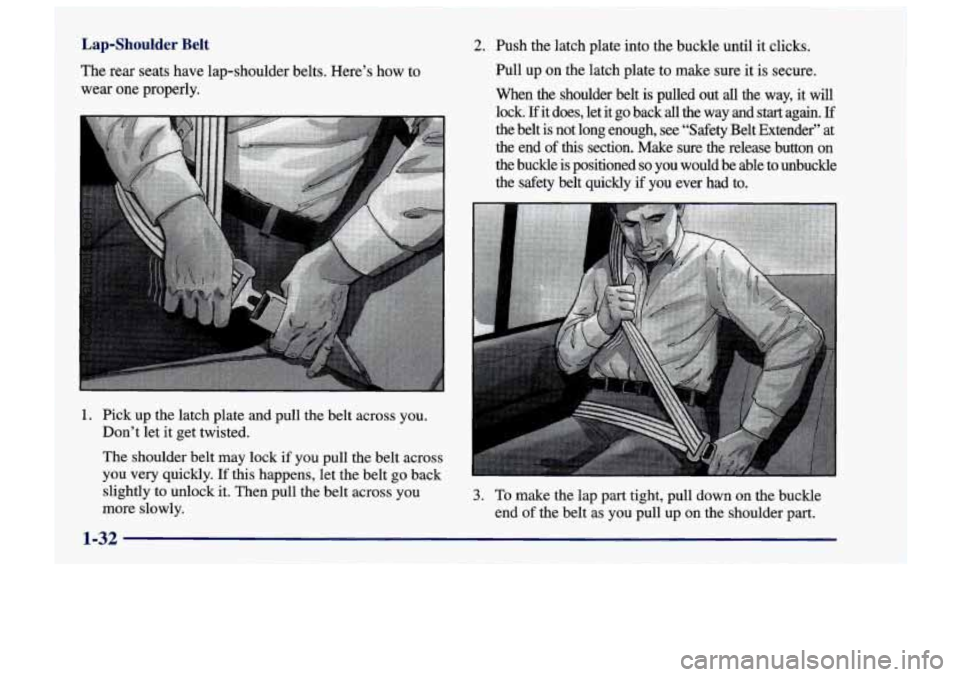
Lap-Shoulder Belt
The rear $&its have lap-shoulder belts. Here’s how to
wear one properly.
1. Pick up the latch plate and pull the belt across you.
Don’t let it get twisted.
The shoulder belt may lock if you pull the belt across
you very quickly.
If this happens, let the belt go back
2. Push the latch plate into the buckle until it clicks.
Pull up on the latch plate to make sure it
is secure.
When the shoulder belt is pulled out
all the way, it will
lock.
If it does, let it go back all the way and start again. If
the belt is not long enough, see “Safety Belt Extender” at
the end
of this section. Make sure the release button on
the buckle is positioned
so you would be able to unbuckle
the safety belt quickly.if you ever had to.
slightly to unlock it. Then pull the belt across you
3. To make the lap part tight, pull down on the buckle
more slowly. end
of the belt as you pull up on the shoulder part.
1-32
ProCarManuals.com
Page 41 of 388
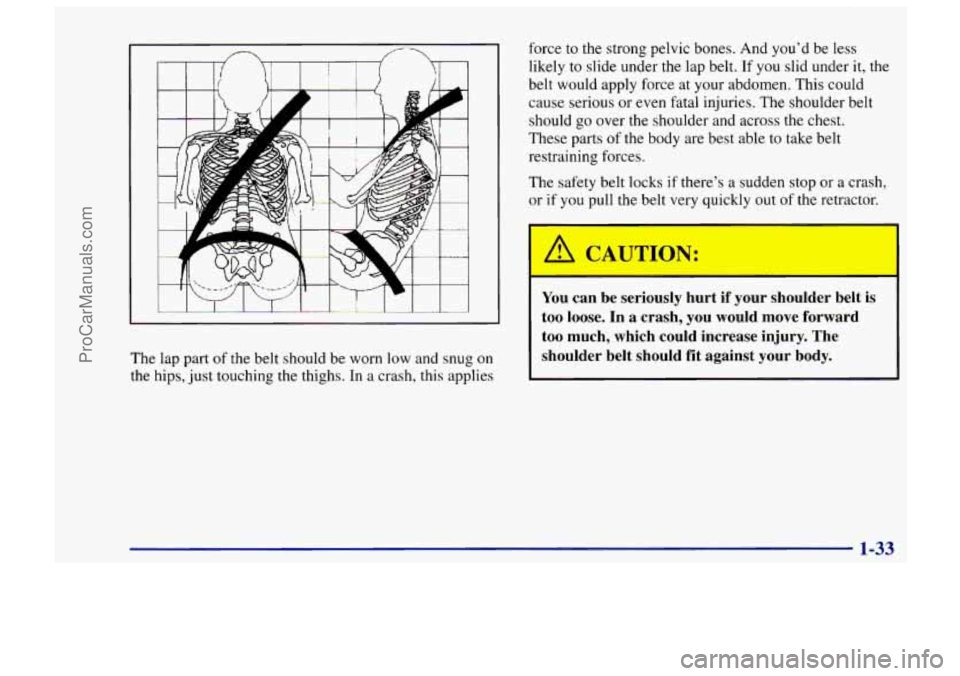
force to the strong pelvic bones. And you’d be less
likely to slide under the lap belt.
If you slid under it, the
belt would apply force at your abdomen. This could
cause serious or even fatal injuries. The shoulder belt
should
go over the shoulder and across the chest.
These parts
of the body are best able to take belt
restraining forces.
The safety belt locks
if there’s a sudden stop or a crash,
or if you pull the belt very quickly out of the retractor.
The lap part
of the belt should be worn low and snug on
the hips, just touching the thighs. In a crash, this applies
You can be seriously hurt if your shoulder belt is
too loose. In a crash, you would move forward
too much, which could increase injury. The
shoulder belt should fit against your body.
1-33
ProCarManuals.com
Page 46 of 388
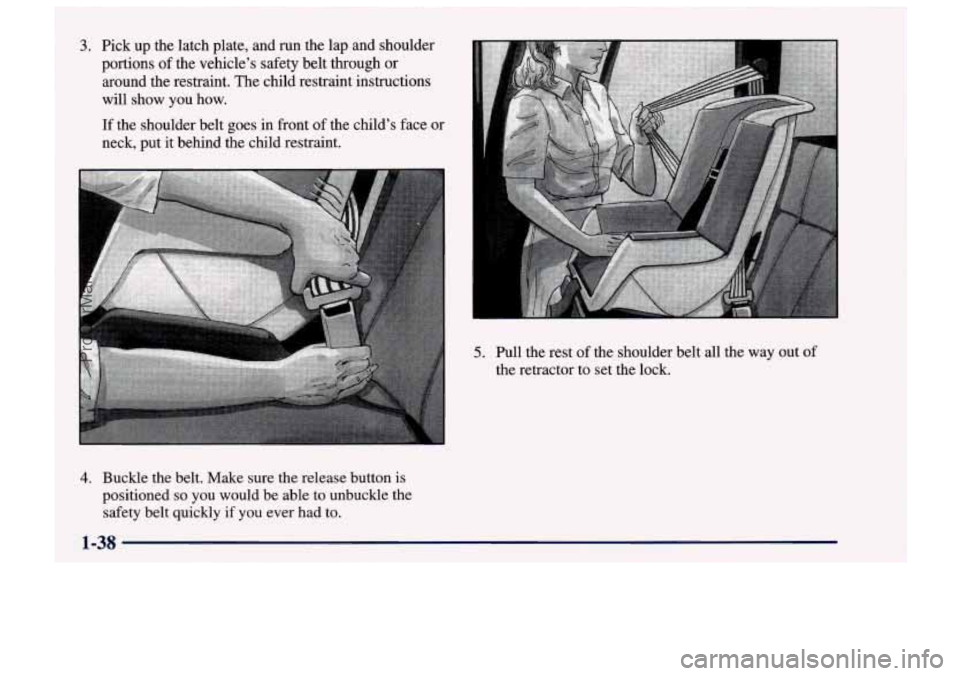
3. Pick up the latch plate, and run the lap and shoulder
portions
of the vehicle’s safety belt through or
around the restraint. The child restraint instructions
will show you how.
If the shoulder belt goes in front of the child’s face or
neck, put it behind the child restraint.
4. Buckle the belt. Make sure the release button is
positioned
so you would be able to unbuckle the
safety belt quickly if
you ever had to.
5. Pull the rest of the shoulder belt all the way out of
the retractor to set the lock.
1-38
ProCarManuals.com
Page 49 of 388
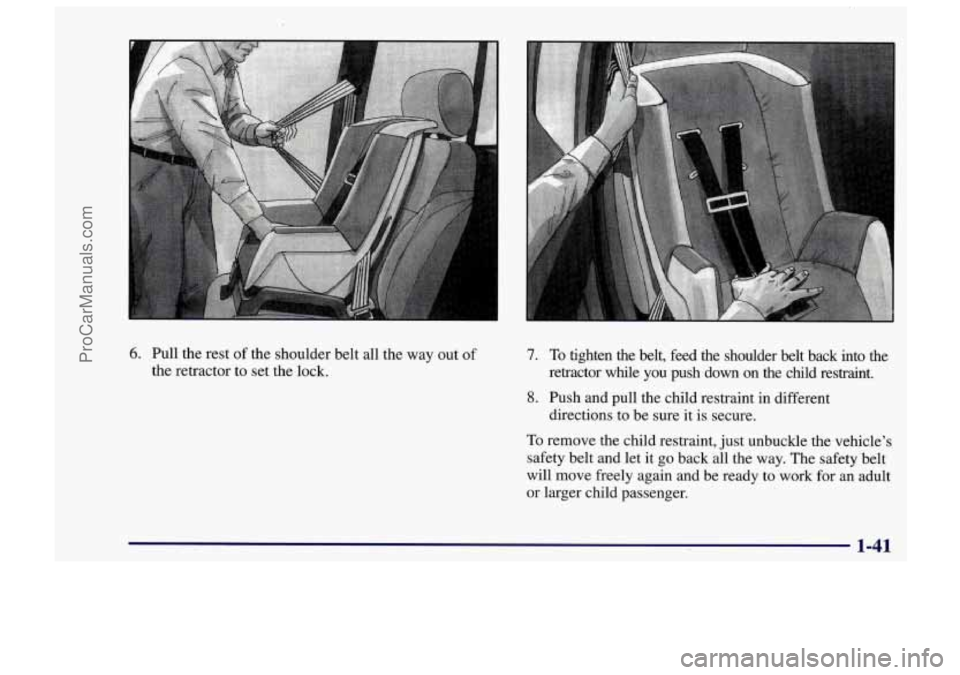
6. Pull the rest of the shoulder belt all the way out of
the retractor to set the lock. 7. To tighten the belt, feed the shoulder belt back into the
retractor while you push down on the child restraint.
8. Push and pull the child restraint in different
directions to be sure it is secure.
To remove the child restraint, just unbuckle the vehicle’s
safety belt and let it go back all the way. The safety belt
will move freely again and be ready to work for an adult
or larger child passenger.
1-41
ProCarManuals.com
Page 55 of 388
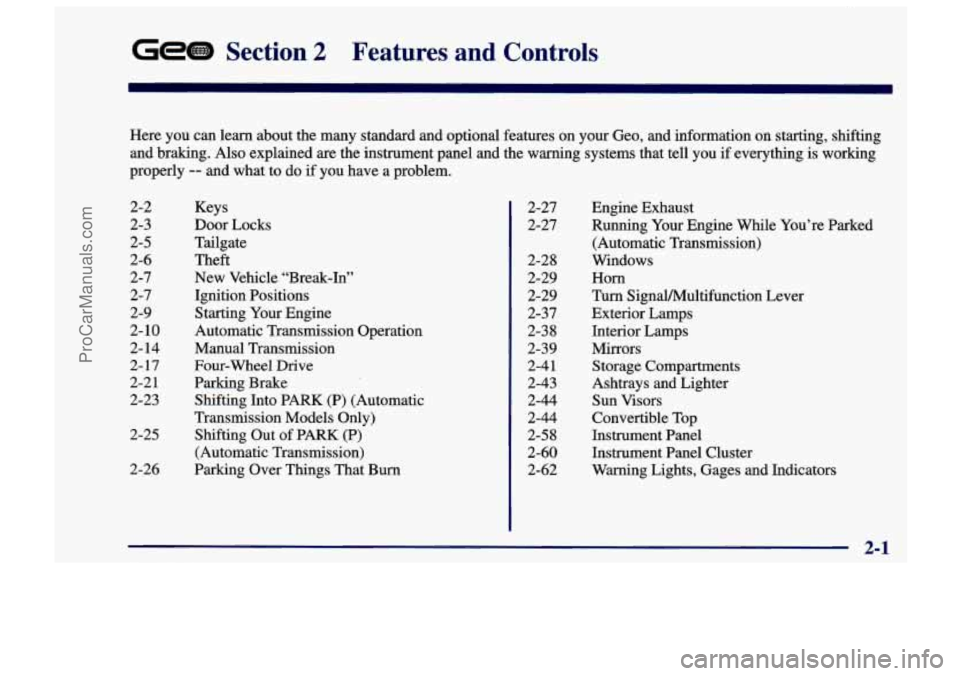
Gem Section 2 Features and Controls
Here you can learn about the many standard and optional features on your Geo, and information on starting, shifting
and braking. Also explained
are the instrument panel and the warning systems that tell you if everything is working
properly
-- and what to do if you have a problem.
2-2
2-3
2-5
2-6
2-7 2-7
2-9
2-10
2- 14
2-
17
2-2 I
2-23
2-25
Keys
Door Locks
Tailgate
Theft
New Vehicle ‘Break-In”
Ignition Positions Starting Your Engine
Automatic Transmission Operation
Manual Transmission
Four-wheel Drive Parking Brake
Shifting Into PARK (P) (Automatic
Transmission Models Only)
Shifting Out of PARK (P)
(Automatic Transmission)
2-26 Parking Over Things That Burn
2-27
2-27
2-28
2-29
2-29
2-37
2-3
8
2-39
2-4 1
2-43
2-44
2-44
2-5
8
2-60 2-62
Engine Exhaust
Running Your Engine While You’re Parked
(Automatic Transmission)
Windows
Horn
Turn SignaVMultifunction Lever
Exterior Lamps
Interior Lamps
Mirrors Storage Compartments
Ashtrays and Lighter
Sun Visors
Convertible Top
Instrument Panel
Instrument Panel Cluster
Warning Lights, Gages and Indicators
2-1
ProCarManuals.com
Page 57 of 388
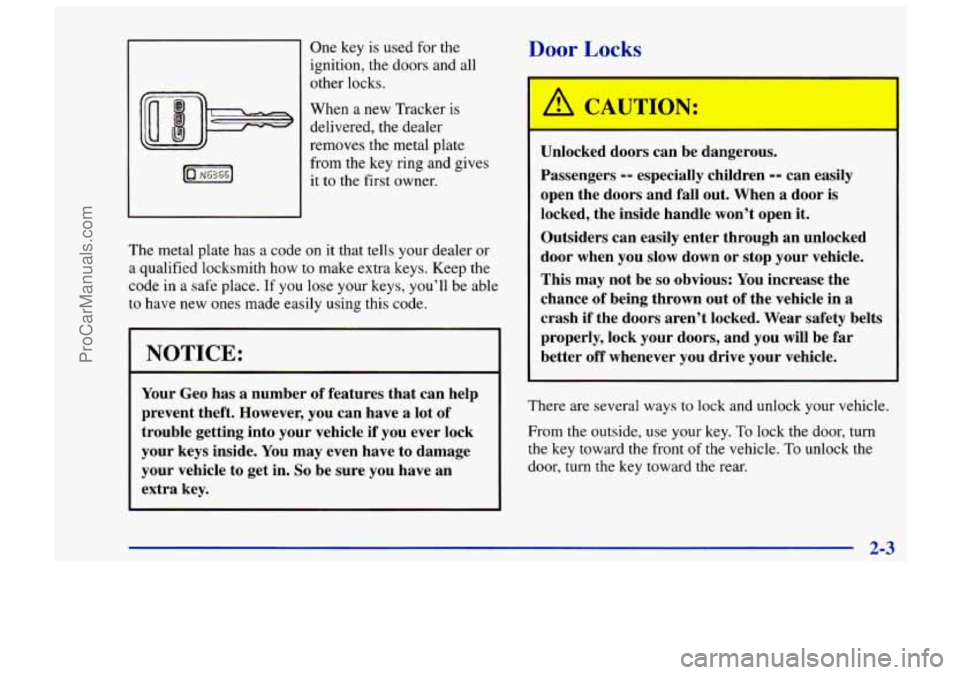
One key is used for the
ignition, the doors and all
other locks.
When
a new Tracker is
delivered, the dealer
removes the metal plate
from the key ring and gives
it
to the first owner.
The metal plate has a code on it that tells your dealer or
a qualified locksmith how to make extra keys. Keep the
code in a safe place. If you lose your keys,
you’ll be able
to have new ones made easily using this code.
NOTICE:
Your Geo has a number of features that can help
prevent theft. However, you can have a lot of
trouble getting into your vehicle if you ever lock
your keys inside. You may even have to damage
your vehicle to get in.
So be sure you have an
extra key.
Door Locks
Unlocked doors can be dangerous.
Passengers
-9 especially children 9- can easily
open the doors and fall out. When a door is
locked, the inside handle won’t open it.
Outsiders can easily enter through an unlocked
door when you slow down or stop your vehicle.
This may not be
so obvious: You increase the
chance of being thrown out of the vehicle in a
crash if the doors aren’t locked. Wear safety belts
properly, lock your doors, and you will be
far
better off whenever you drive your vehicle.
There are several ways to lock and unlock your vehicle.
From the outside,
use your key. To lock the door, turn
the key toward the front
of the vehicle. To unlock the
door, turn the key toward the rear.
2-3
ProCarManuals.com