tow CHEVROLET TRACKER 1997 Owner's Manual
[x] Cancel search | Manufacturer: CHEVROLET, Model Year: 1997, Model line: TRACKER, Model: CHEVROLET TRACKER 1997Pages: 388, PDF Size: 20.12 MB
Page 118 of 388
_-- ~~~~~
Brake System Warning Light
Your Geo’s hydraulic brake system is divided into two
parts.
If one part isn’t working, the other part can still
work and stop you. For good braking, though, you need
both parts working well.
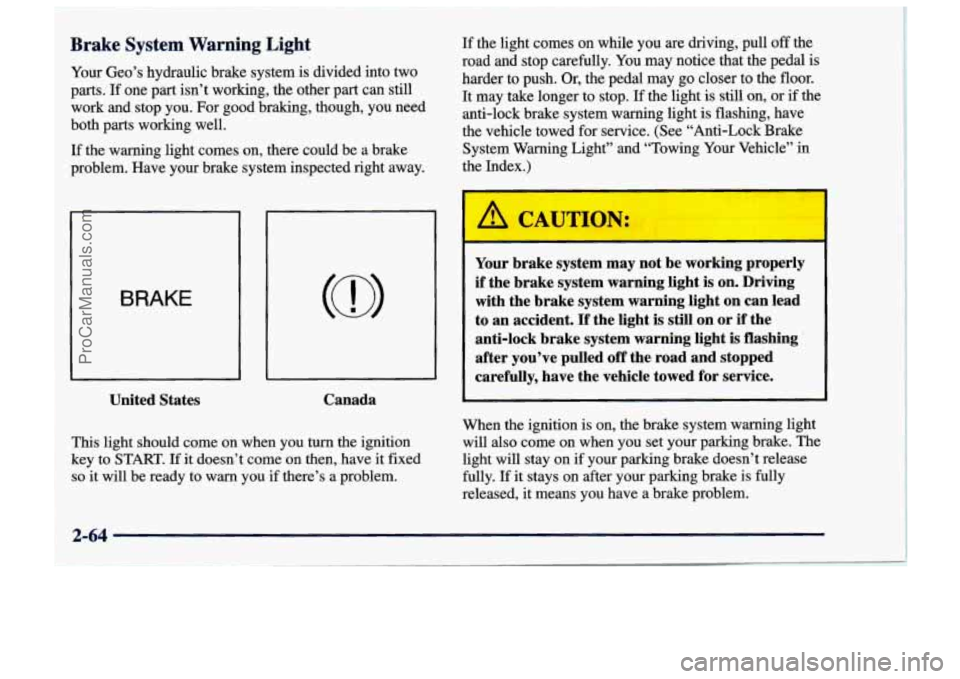
If the warning light comes on, there could be a brake
problem. Have your brake system inspected right away.
If the light comes on while you are driving, pull off the
road and stop carefully. You may notice that the pedal
is
harder to push. Or, the pedal may go closer to the floor.
It may take longer to stop. If the light is still on, or if the
anti-lock brake system warning light is flashing, have
the vehicle towed for service. (See “Anti-Lock Brake
System Warning Light” and “Towing Your Vehicle” in
the Index.)
BRAKE
United States Canada
This light
should come on when you turn the ignition
key to STmT. If it doesn.’t come on then, have it fixed
so it will be ready to warn you if there’s a problem.
Ih
CA -JTION:
Your brake system may not be working properly
if the brake system warning light is on. Driving
with the brake system warning light on can lead
to an accident.
If the light is still on or if the
anti-lock brake system warning light is flashing
after you’ve pulled
off the road and stopped
carefully, have the vehicle towed for service.
When the ignition is on, the brake system warning light
will
also come on when you set your parking brake. The
light will stay on if your parking brake doesn’t release
fully. If it stays on after your parking brake is fully
released, it means you have
a brake problem.
r
2-64
ProCarManuals.com
Page 119 of 388
Anti-Lock Brake System Warning Light
(If Equipped)
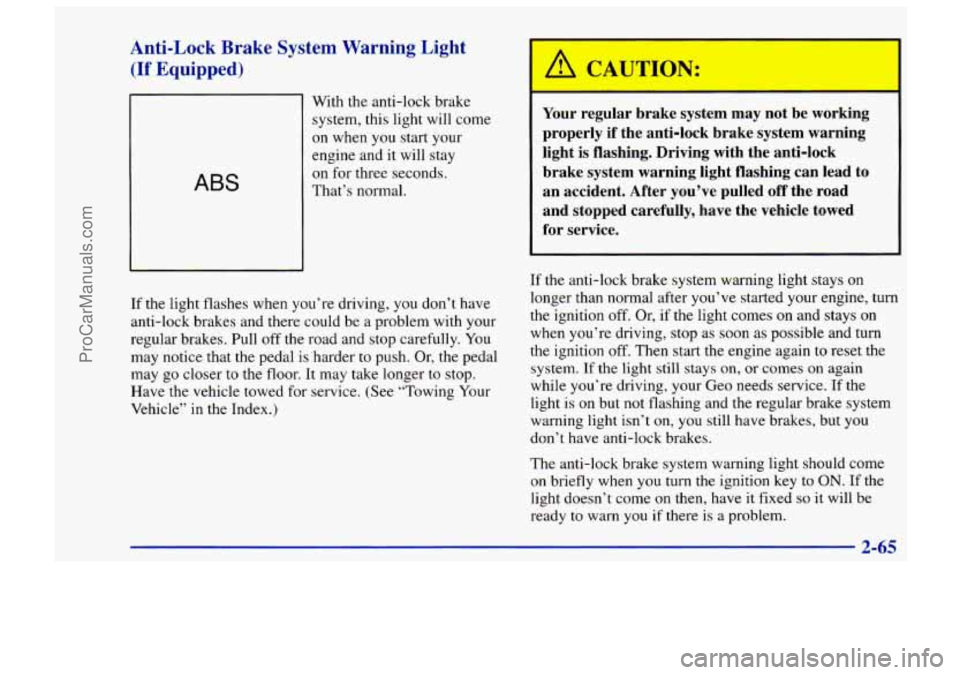
ABS
With the anti-lock brake
system, this light will come
on when you start your
engine and it will stay
on for three seconds.
That’s normal.
If the light flashes when you’re driving, you don’t have
anti-lock brakes and there could be a problem with your
regular brakes. Pull
off the road and stop carefully. You
may notice that the pedal
is harder to push. Or, the pedal
may go closer to the floor.
It may take longer to stop.
Have the vehicle towed for service. (See “Towing Your
Vehicle” in the Index.)
A CAUTION:
Your regular brake system may not be working
properly if the anti-lock brake system warning
light is flashing. Driving with the anti-lock
brake system warning light flashing can lead to an accident. After you’ve pulled off the road
and stopped carefully, have the vehicle towed
for service.
If the anti-lock brake system warning light stays on
longer than normal after you’ve started your engine, turn
the ignition off. Or, if the light comes on and stays on
when you’re driving, stop as
soon as possible and turn
the ignition off. Then
start the engine again to reset the
system.
If the light still stays on, or comes on again
while you’re driving, your Geo needs service. If the
light is on but not flashing and the regular brake system
warning light isn’t on,
you still have brakes, but you
don’t have anti-lock brakes.
The anti-lock brake system warning light should come
on briefly when you turn the ignition key to
ON. If the
light doesn’t come
on then, have it fixed so it will be
ready to warn
you if there is a problem.
2-65
!
ProCarManuals.com
Page 122 of 388
If the Light Is Flashing If the Light Is On Steady
The following may prevent more serious damage to
your vehicle:
Reducing vehicle speed.
Avoiding hard accelerations.
Avoiding steep uphill grades.
If you are towing a trailer, reduce the amount of
cargo being hauled as soon as it is possible.
If the light stops flashing and remains on steady, see
“If
the Light Is On Steady” following.
If the light continues to flash, when it
is safe to do so,
stop
the vehicle. Find a safe place to park your vehicle.
Turn the key off, wait at least
10 seconds and restart the
engine. If the light remains on steady, see “If the Light
Is On Steady” following.
If the light is still flashing,
follow the previous steps, and drive the vehicle to your
dealer
or qualified service center for service. You
may be able to correct the emission system
malfunction by considering the following:
Did you recently put fuel into your vehicle?
If so, reinstall the fL1el cap, making sure to fully install
the cap. The diagnostic system can determine
if the fuel
cap has been left off or improperly installed.
A loose or
missing fuel cap
will allow fuel to evaporate into the
atmosphere. A few driving trips with the cap properly
installed should
turn the light off.
Did you just drive through a deep puddle of water?
If so, your electrical system may be wet. The condition
will usually be corrected when the electrical system
dries out. A few driving trips should
turn the light off.
Are you low on fuel?
As your engine starts to run out of fuel, your engine may
not run
as efficiently as designed since small amounts of
air are sucked into the fuel
line causing a misfire. The
system can detect this. Adding fuel should correct this
condition. Make sure to install the fuel cap properly. It
will take a few driving trips to turn the light off.
ProCarManuals.com
Page 128 of 388
Comfort Controls
With this system, you can control the heating and
ventilation in your Geo.
If you have the air conditioning
option, you can also control cooling.
Your vehicle also has the flow-through ventilation
system described later in this section.
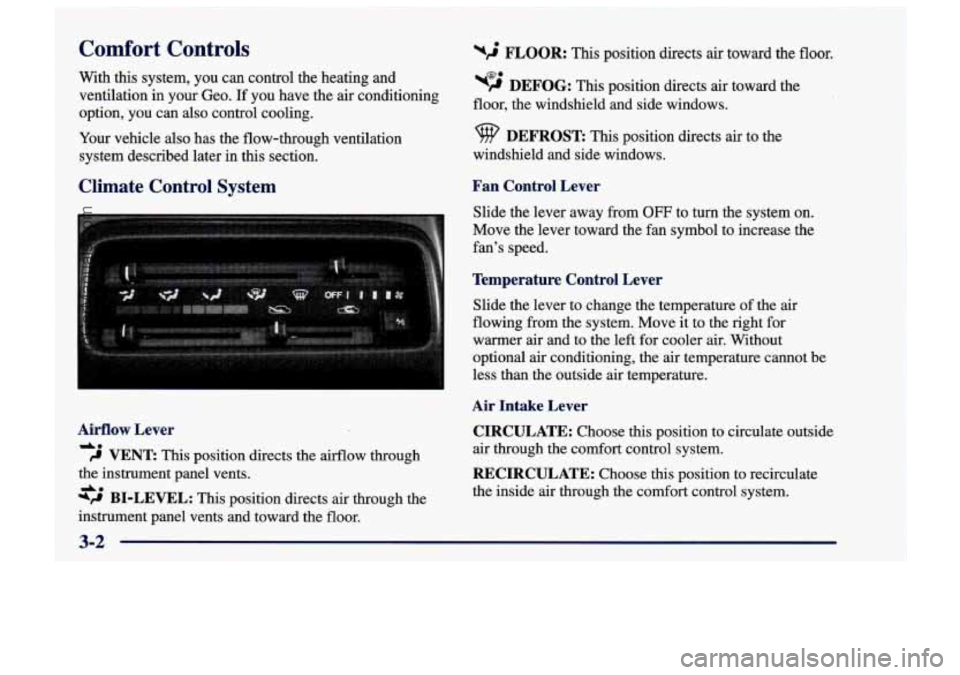
Climate Control System
Airflow Lever
de
9 VENT This position directs the airflow through
the instrument panel vents.
49 BI-LEVEL: This position directs air through the
instrument panel vents and toward the floor.
A.
%$ FLOOR: This position directs air toward the floor.
w> DEFOG: This position directs air toward the
floor, the windshield and side windows.
9 DEFROST This position directs air to the
windshield and side windows.
Fan Control Lever
Slide the lever away from OFF to turn the system on.
Move the lever toward the fan symbol to increase the
fan’s speed.
Temperature Control Lever
Slide the lever to change the temperature of the air
flowing from the system. Move it to the right for
warmer air and to the left for cooler
air. Without
optional air conditioning, the
air temperature cannot be
less than the outside air temperature.
Air Intake Lever
CIRCULATE:
Choose this position to circulate outside
air through the comfort control system.
RECIRCULATE: Choose this position to recirculate
the inside
air through the comfort control system.
3-2
ProCarManuals.com
Page 129 of 388
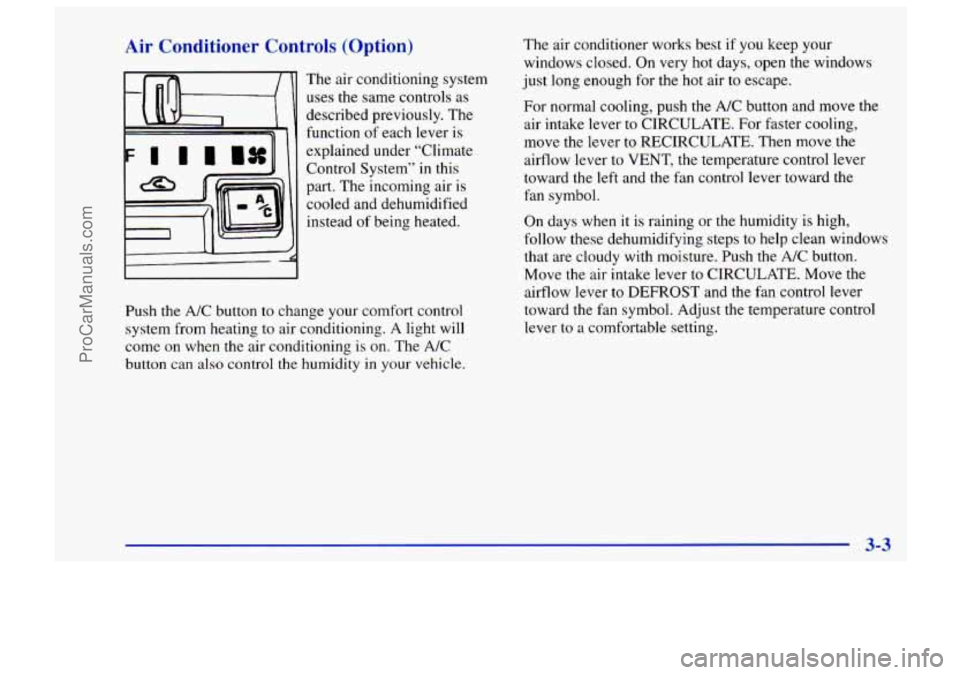
Air Conditioner Controls (Option)
The air conditioning system
uses the same controls as
described previously. The
function
of each lever is
explained under “Climate
Control System” in this
part. The incoming air is
cooled and dehumidified
instead of being heated.
Push the
A/C button to change your comfort control
system from heating to air conditioning.
A light will
come
on when the air conditioning is on. The A/C
button can also control the humidity in your vehicle.
The air conditioner works best if you keep your
windows closed. On very hot days, open the windows
just long enough for the hot air to escape.
For normal cooling, push the
A/C button and move the
air intake lever to CIRCULATE. For faster cooling,
move the lever to RECIRCULATE. Then move the
airflow lever to VENT, the temperature control lever
toward the left and the fan control lever toward the
fan symbol.
On days when
it is raining or the humidity is high,
follow these dehumidifying steps to help clean windows
that are cloudy with moisture. Push the A/C button.
Move the air intake lever to CIRCULATE. Move the
airflow lever to DEFROST and
the fan control lever
toward the fan symbol. Adjust
the temperature control
lever to
a comfortable setting.
3-3
ProCarManuals.com
Page 130 of 388
Heating
For the quickest results, move the air intake lever to
RECIRCULATE. Move the airflow lever to FLOOR,
the temperature control lever toward the right for
warmer air and the
far, control lever toward the fan
symbol.
You should switch to CIRCULATE once in a
while to avoid stale air and cloudy windows.
Ventilation System
For mild outside temperatures, when little heating or
cooling is needed, you can still direct outside air through
ymr vehicle.
Move the air intake lever to CIRCULATE and the
airflow lever
to BI-LEVEL. Adjust the temperature
control lever to
a comfortable setting and move the fan
control lever toward the fan symbol.
Your Geo’s flow-through ventilation system supplies
outside air into the vehicle when
it is moving. Outside
air will also enter the vehicle when the fan is running
and the air intake lever is at CIRCULATE. Your
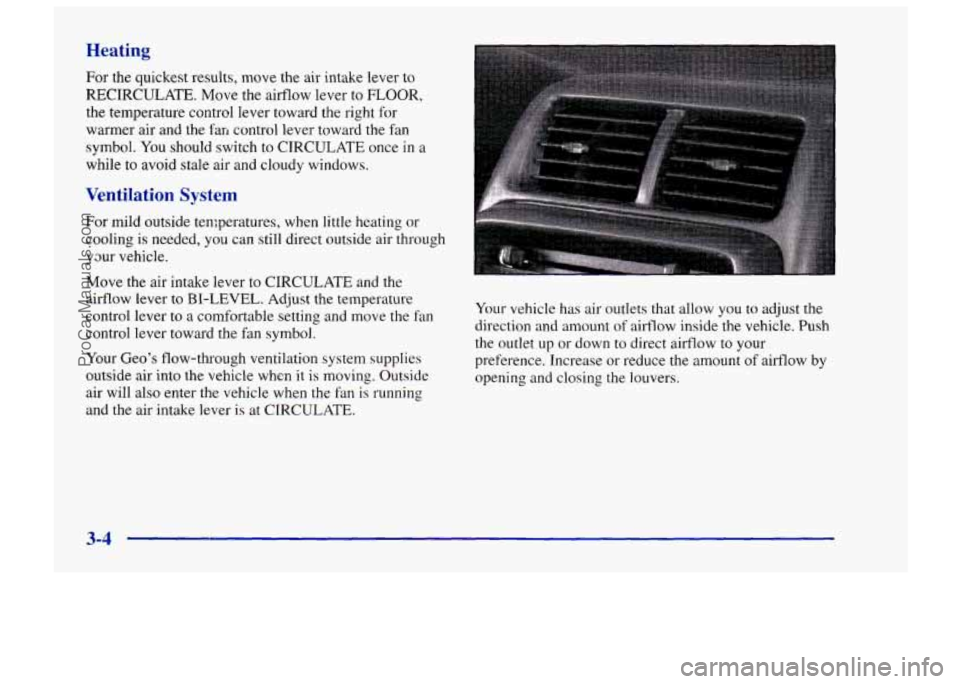
vehicle has air outlets that allow you to adjust the
direction and amount
of airflow inside the vehicle. Push
the outlet
up or down to direct airflow to your
preference. Increase or reduce the amount
of airflow by
opening and closing the louvers.
3-4
ProCarManuals.com
Page 131 of 388
Ventilation Tips
Keep the hood and front air inlet free of ice, snow or any
other obstruction (such as leaves). The heater and
defroster will work far better, reducing the chance of
fogging the inside
of your windows.
When you enter a vehicle in cold weather, move the fan
control lever toward the fan symbol for a few moments
before driving off. This helps clear the intake ducts of
snow and moisture, and reduces the chance
of fogging
the inside of your windows.
Keep the air path under the front seats clear of objects.
This helps air to circulate throughout your vehicle.
Defogging and Defrosting
Slide the air intake lever to CIRCULATE and the
airflow lever to DEFROST to direct air to the
windshield vents.
Then slide the temperature control
lever toward the right and the fan lever toward the fan
symbol. When the windshield
is clear, turn down the
fan speed.
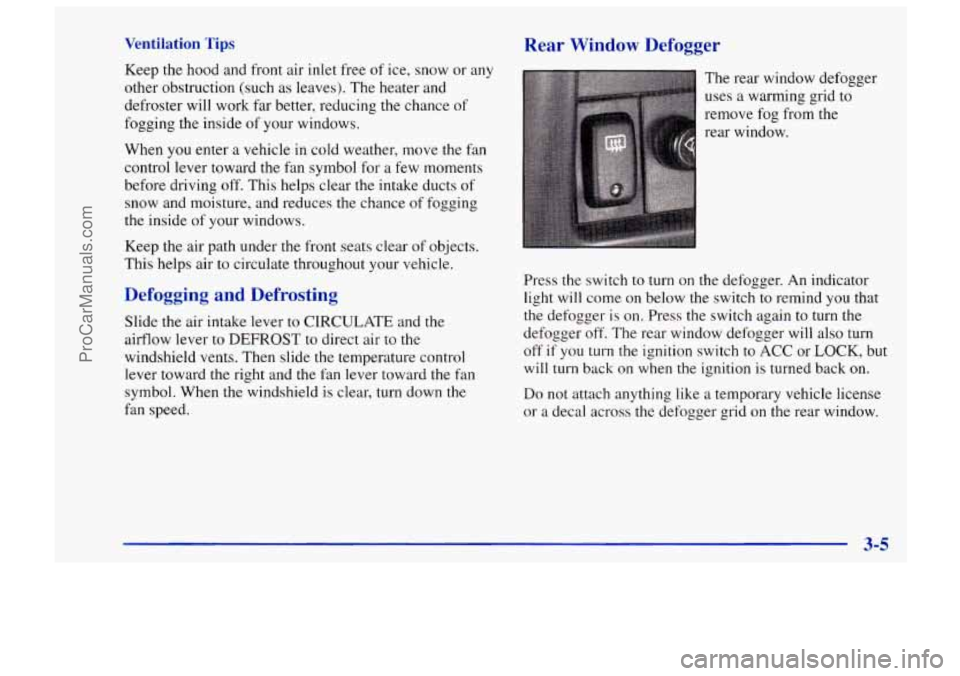
Rear Window Defogger
The rear window defogger uses a warming grid
to
remove fog from the
rear window.
Press the switch to turn
on the defogger. An indicator
light will come on below the switch to remind you that
the defogger is on. Press the switch again to turn the
defogger
off. The rear window defogger will also turn
off
if you turn the ignition switch to ACC or LOCK, but
will turn
back on when the ignition is turned back on.
Do not attach anything like a temporary vehicle license
or
a decal across the defogger grid on the rear window.
3-5
ProCarManuals.com
Page 147 of 388
Gem Section 4 Your Driving and the Road
I
Here you’ll find information about driving on different kinds of roads and in varying weather conditions. We’ve also
included many other useful tips
on driving.
4-2
4-2
4-6
4-6
4- 10 4-12
4-12
4-14
4-15
4-30 Defensive Driving
Drunken Driving
Control
of a Vehicle
Braking Steering
Off-Road Recovery
Passing
Loss of Control
Driving Guidelines
Driving at Night
4-32
4-35
4-36
4-37
4-3s 4-3
s
4-40
4-44 4-47
4-49
Driving in Rain and on Wet Roads
City Driving
Freeway Driving
Before Leaving on a Long Trip
Highway Hypnosis
Hill and Mountain Roads
Winter Driving
Recreational Vehicle Towing
Loading Your Vehicle
Towing a Trailer
4-1
ProCarManuals.com
Page 190 of 388
Run your engine only as long as you must. This saves
fuel. When you run the engine, make it go a little faster
than just idle. That is, push the accelerator slightly. This
uses less fuel for the heat that you get and it keeps the
battery charged. You will need a well-charged battery to
restart the vehicle, and possibly for signaling later on with your headlamps. Let the heater run for awhile.
Then, shut the engine off and close the window almost
all the way to preserve the heat. Start the engine again
and repeat this only when you feel really uncomfortable
from the cold. But
do it as little as possible. Preserve the
fuel as long as you can.
To help keep warm, you can get
out of the vehicle and do some fairly vigorous exercises
every half hour or
so until help comes.
Re - -1tional Vehicle Towing
There may be times when you want to tow your Geo
behind another vehicle for use at your destination. Be
sure to use the proper towing equipment designed
for
recreational towing. Follow the instructions for the
towing equipment.
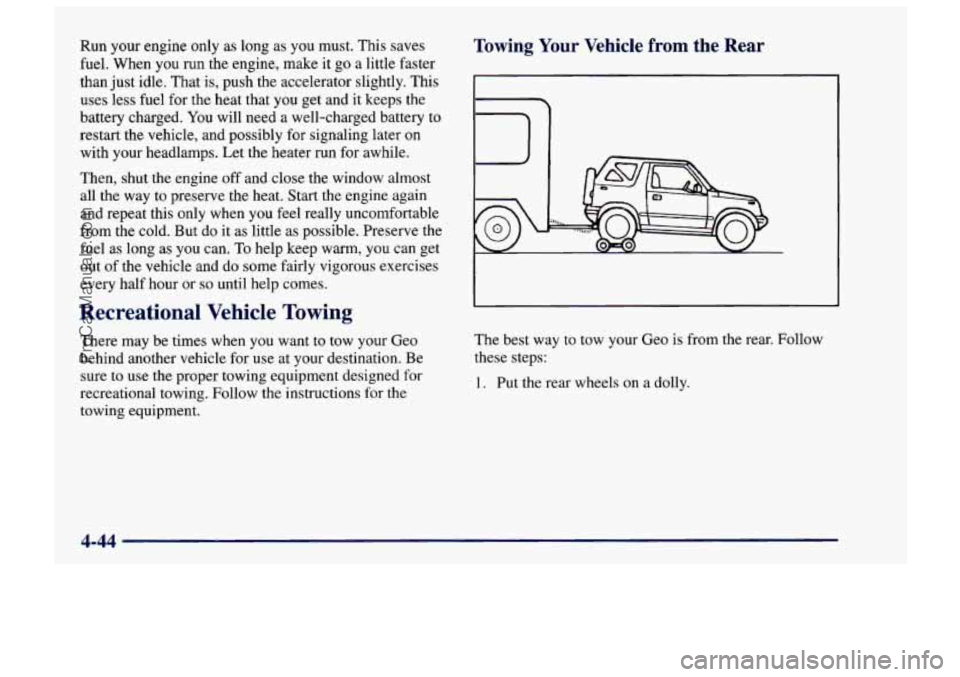
Towing Your Vehicle frc -:: :I: I Rc 1-r
The best way to tow your Geo is from the rear. Follow
these steps:
1. Put the rear wheels on a dolly.
4-44
ProCarManuals.com
Page 191 of 388
I NOTICE:
Do not tow your Geo with the rear wheels in
contact with the ground, or the transmission
could be damaged.
2.
3.
4.
Set the parking brake.
If your Geo is a four-wheel-drive vehicle, set your
manual free-wheeling hubs to
FREE or unlock your
automatic freewheeling hubs. See “Four-wheel
Drive” in the Index.
Turn the ignition key to ACC to unlock the
steering wheel.
I NOTICE:
Make sure that the towing speed does not
exceed
55 mph (90 km/h), or your Geo could be
badly damaged.
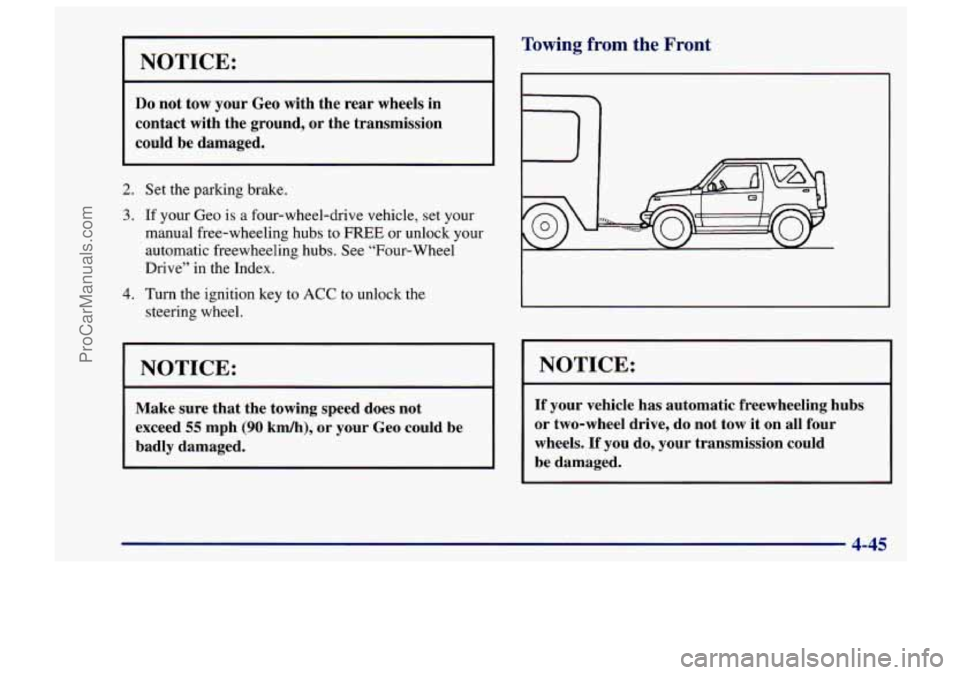
Towing from the Front
h
I1 I
I NOTICE: I
If your vehicle has automatic freewheeling hubs
or two-wheel drive,
do not tow it on all four
wheels.
If you do, your transmission could
be damaged.
4-45
I
ProCarManuals.com