tow CHEVROLET TRACKER 1997 User Guide
[x] Cancel search | Manufacturer: CHEVROLET, Model Year: 1997, Model line: TRACKER, Model: CHEVROLET TRACKER 1997Pages: 388, PDF Size: 20.12 MB
Page 66 of 388
NEUTRAL (N): In this position, your engine
doesn’t connect with the wheels.
To restart when you’re
already moving, use
NEUTRAL (N) only. Also, use
NEUTRAL (N) when your vehicle is being towed.
I
Shifting out of PARK (P) or NEUTRAL (N) while
your engine is “racing” (running
at high speed) is
dangerous. Unless your foot is firmly on the
brake pedal, your vehicle could move very
rapidly. You could lose control and hit people or
objects. Don’t
shift out of PARK (P) or
NEUTRAL (N) while your engine is racing.
NOTICE:
Damage to your transmission caused by shifting
out
of PARK (P) or NEUTRAL (N) with the
engine racing isn’t covered by your warranty.
DRIVE (D): This position is for normal driving.
If you need more power for passing, and you’re:
Going less than about 15 mph (25 km/h), push your
0 Going about 15 mph (25 km/h) or more, push your
accelerator pedal
about halfway down.
accelerator pedal all the way down.
You’ll shift down to the next gear and have
more power.
SECOND (2): This position gives you more power but
lower fuel economy. You can use
SECOND (2) on hills.
It can help control your speed
as you go down steep
mountain roads, but then you would also want
to use
your brakes off and on.
NOTICE:
Don’t shift into SECOND (2) unless you are going
slower than
65 mph (105 km/h) with the transfer
case in
FOUR HIGH (4H), or 35 mph (55 km/h)
with the transfer case in FOUR LOW (4L) or you
can damage your transmission.
ProCarManuals.com
Page 74 of 388
Transfer Case
L
i
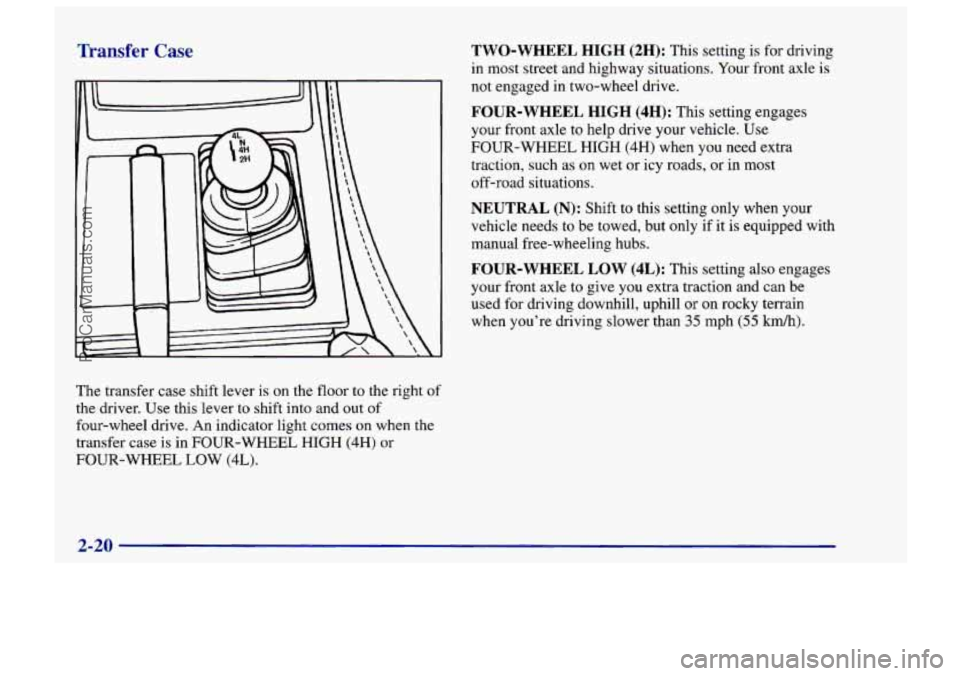
The transfer case shift lever is on the floor to the right of
the driver. Use this lever to shift into and out of
four-wheel drive. An indicator light comes on when
the
transfer case is in FOUR-WHEEL HIGH (4H) or
FOUR--EL
LOW (4L).
TWO-WHEEL HIGH (2H): This setting is for driving
in most street and highway situations. Your front axle is
not engaged in two-wheel drive.
FOUR-WHEEL HIGH (4H): This setting engages
your front axle to help drive your vehicle. Use
FOUR-WHEEL HIGH
(4H) when you need extra
traction, such as on wet or icy roads, or in most
off-road situations.
NEUTRAL (N): Shift to this setting only when your
vehicle needs to be towed, but only
if it is equipped with
manual free-wheeling hubs.
FOUR-WHEEL LOW (4L): This setting also engages
your front axle to give you extra traction and can be
used for driving downhill, uphill or on rocky terrain
when you're driving slower than
35 mph (55 km/h).
2-20
ProCarManuals.com
Page 76 of 388
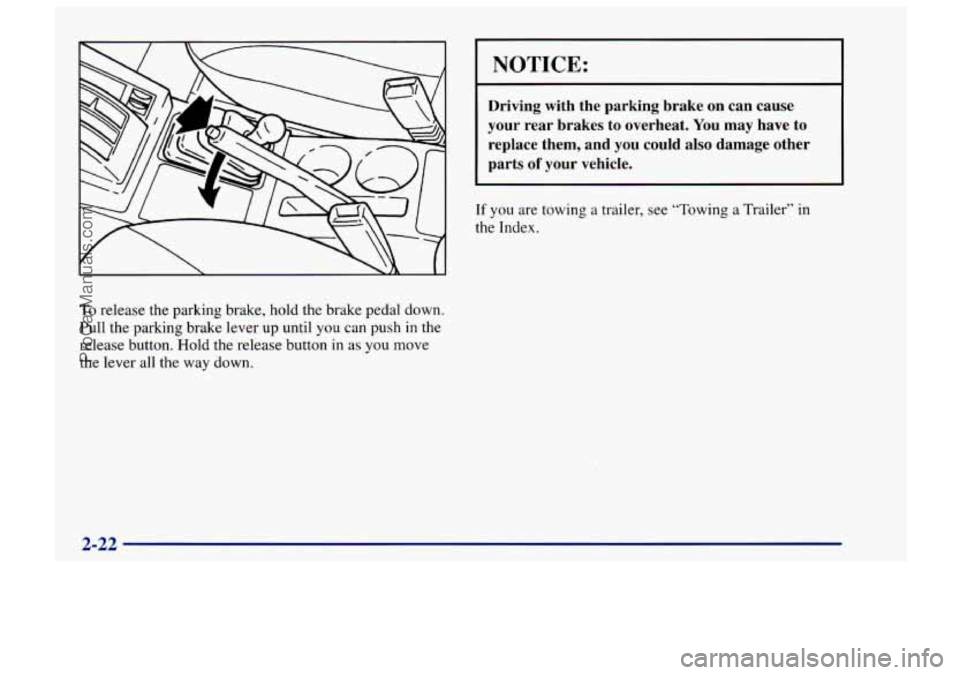
To release the parking brake, hold the brake pedal down.
Pull the parking brake lever up until
you can push in the
release button. Hold the release button in as you move
the lever
all the way down.
NOTICE:
Driving with the parking brake on can cause
your rear brakes to overheat. You
may have to
replace them, and you could also damage other
parts
of your vehicle.
If you are towing a trailer, see “Towing a Trailer” in
the Index.
2-22
ProCarManuals.com
Page 77 of 388
Shifting Into PARK (P) (Automatic
Tran ~ nission Models Only)
It can be dangerous to get out of your vehicle if
the shift lever is not fully in PARK (P) with the
parking brake firmly set. Your vehicle can roll.
If you have left the engine running, the vehicle
can move suddenly. You or others could be
injured.
To be sure your vehicle won’t move, even
when you’re on fairly level ground, use the steps
that follow.
If you have four-wheel drive and
your transfer case is in
NEUTRAL (N), your
vehicle will be free to roll, even
if your shift lever
is in
PARK (P). So, be sure the transfer case is in
a drive gear -- not in NEUTRAL (N). If you’re
pulling a trailer, see “Towing a Trailer” in
the Index.
1. Hold the brake pedal down with your right foot and
2. Move the shift lever into PARK (P) by holding in the
button
on the lever and pushing the lever all the way
toward the front
of your vehicle.
set
the parking brake.
3. If you have four-wheel drive, be sure the transfer
case
is in a drive gear -- not in NEUTRAL (N).
4. Move the key to LOCK.
5. Remove the key and take it with you. If you can
leave your vehicle with the key
in your hand, your
vehicle is in
PARK (P).
2-23
ProCarManuals.com
Page 80 of 388
5. Inside you'll see the return plate (C). Using your
finger, move the return plate toward the rear
of the
vehicle until it stops.
6. Move the shift lever into the gear you want.
7. Have the vehicle fixed as soon as possible.
Parking Your Vehicle
(Manual Transmission)
Before you get out of your vehicle, put your manual
transmission in
REVERSE (R) and firmly apply the
parking brake.
If you have four-wheel drive, be sure your transfer case
is in a drive gear. Your vehicle could roll if it isn't.
If you are towing
a trailer, see "Towing a Trailer" in
the Index.
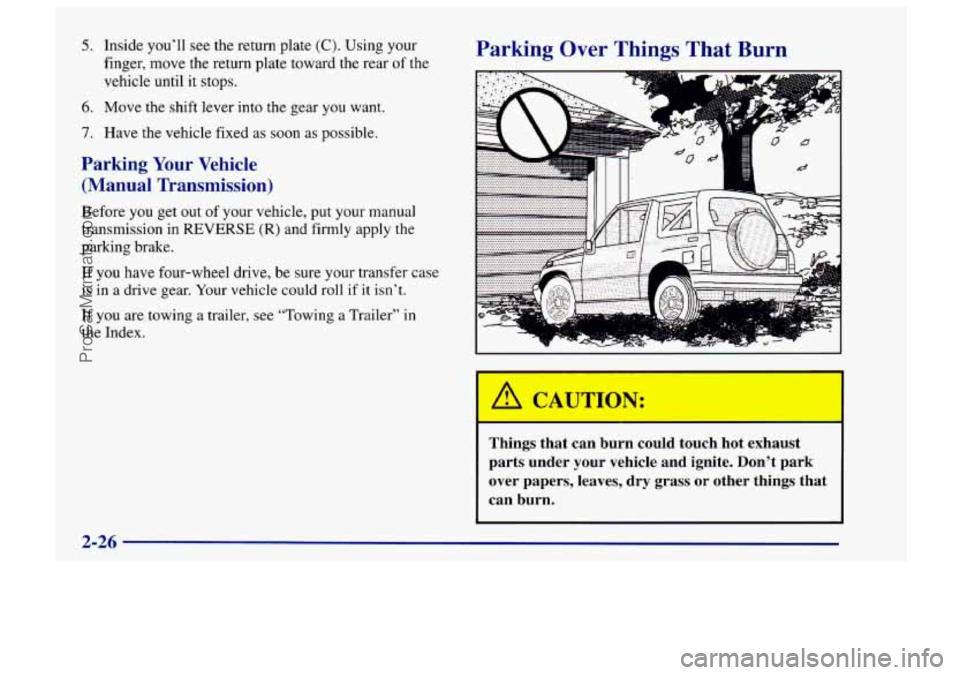
Parking Over Things That Burn
I -w---- I .. . . . . . . . . . u --
A
I
Things that can burn could touch hot exhaust
parts under your vehicle and ignite. Don't park
over papers, leaves, dry grass or other things that
can burn.
2-26
ProCarManuals.com
Page 82 of 388
Windows
Manual Windows
7-
It can be dangerous to get out of your vehicle if
the shift lever is not fully in PARK (P) with the
parking brake firmly set. Your vehicle can roll.
Don’t leave your vehicle when the engine is
running unless you have to. If you’ve left the
engine running, the vehicle can move suddenly.
You or others could be injured.
To be sure your
vehicle won’t move, even when you’re on fairly
level ground, always set your parking brake and
move the shift lever
to PARK (P).
If you have four-wheel drive and your transfer case is in
NEUTRAL (N), your vehicle will be free to roll, even if
your shift lever is in PARK (P). So, be sure the transfer
case is
in a drive gear -- not in NEUTRAL (N). Always
set your parking brake. Follow the proper steps to be
sure your vehicle won’t move. See “Shifting Into
PARK
(P)” in the Index.
If you’re pulling a trailer, see “Towing
a Trailer” in
the Index. Use the
window crank
to open and close each
door window.
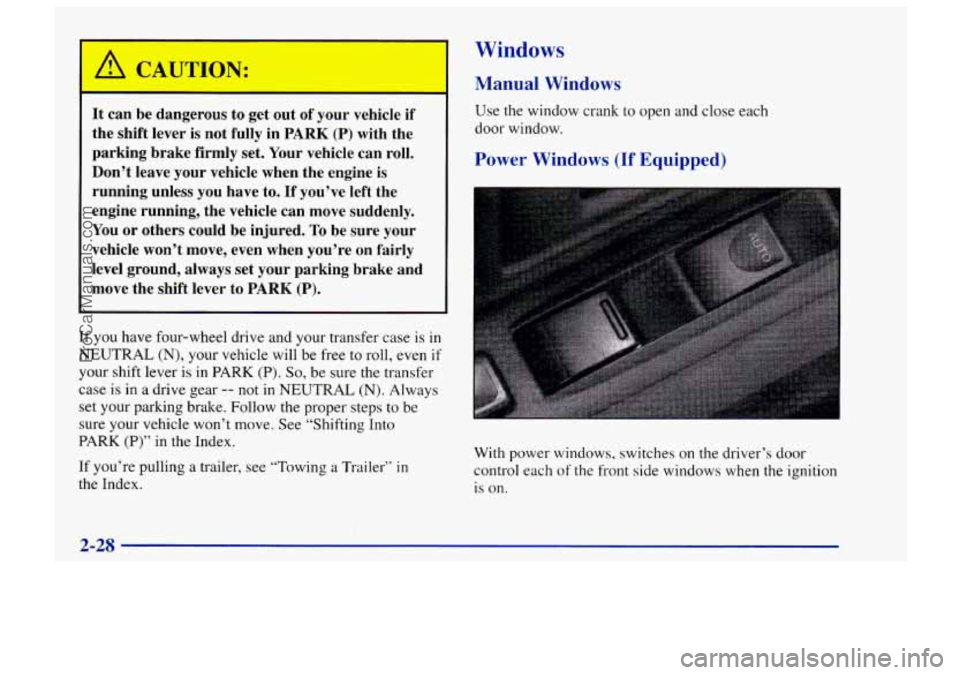
Power Windows (If Equipped)
With power windows, switches on the driver’s door
control each
of the front side windows when the ignition
is on.
2-28
ProCarManuals.com
Page 85 of 388
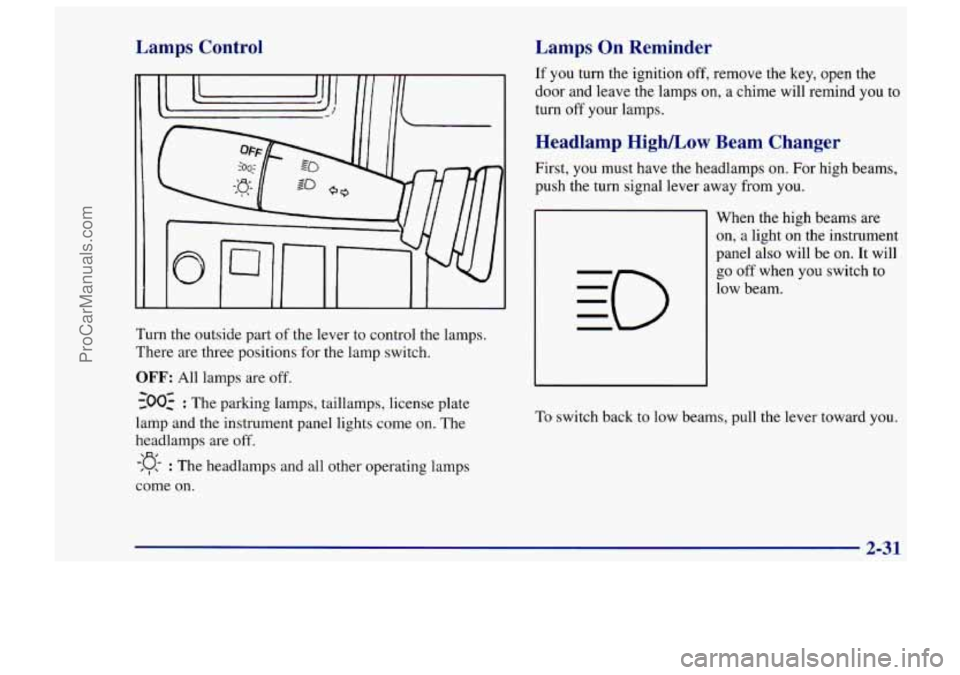
Lamps Control
Turn the outside part of the lever to control the lamps.
There are three positions for the lamp switch.
OFF: All lamps are off.
headlamps are
off.
-:(% : The headlamps and all other operating lamps
come
on.
Lamps On Reminder
If you turn the ignition off, remove the key, open the
door and leave the lamps on,
a chime will remind you to
turn off your lamps.
Headlamp High/Low Beam Changer
First, you must have the headlamps on. For high beams,
push the turn signal lever away from you.
When the high beams are
on, a light on the instrument
panel also will be
on. It will
go off when you switch to
low beam.
To switch back to low beams, pull the lever toward you.
ProCarManuals.com
Page 86 of 388
Flash-to-Pass
With the lever in the low-beam position, pull the lever
toward you to momenrarily switch to high beam (to
signal that
you are going to pass). When you release the
lever, the headlamps will return to low-beam operation.
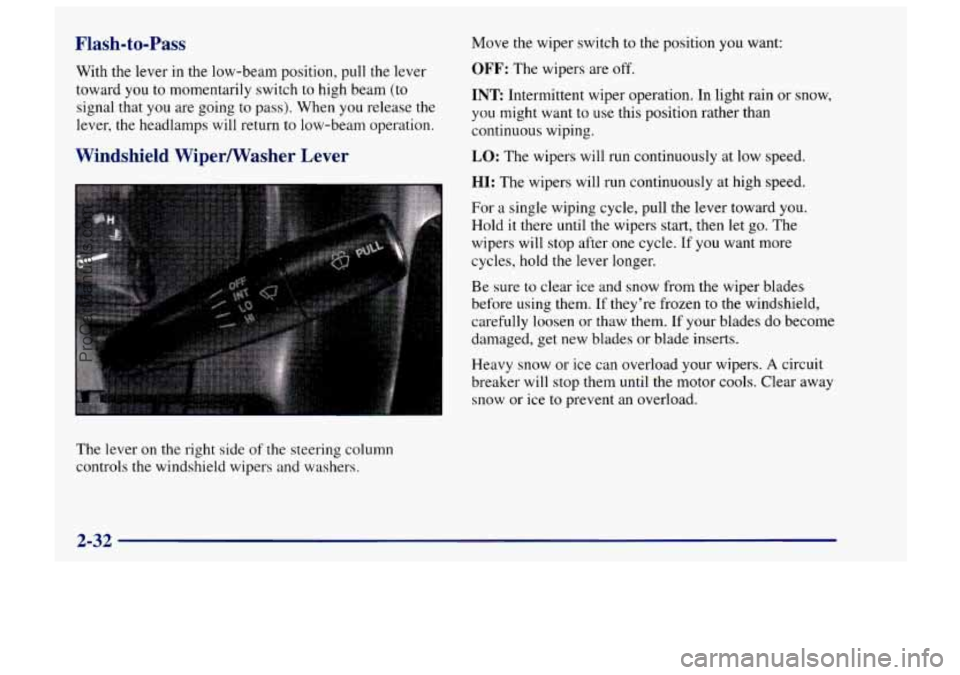
Windshield Wipermasher Lever
The lever on the right side of the steering column
controls the windshield wipers and washers. Move
the wiper switch to the position you want:
OFF: The wipers are off.
INT Intermittent wiper operation. In light rain or snow,
you might want to use this position rather than
continuous wiping.
LO: The wipers will run continuously at low speed.
HI: The wipers will run continuously at high speed.
For
a single wiping cycle, pull the lever toward you.
Hold it there until the wipers start, then let go. The
wipers will stop after one cycle. If you want more
cycles, hold the lever longer.
Be sure to clear ice and snow from the wiper blades
before using them. If they’re frozen to the windshield,
carefully loosen
or thaw them. If your blades do become
damaged, get new blades or blade inserts.
Heavy snow
or ice can overload your wipers. A circuit
breaker will stop them
until the motor cools. Clear away
snow or ice to prevent an overload.
2-32
ProCarManuals.com
Page 87 of 388
Windshield Washer
Pull the wipedwasher lever toward you to spray washer
fluid on the windshield. The spray will continue until
you release the lever. This will also turn on the low
speed wipers. See “Windshield Washer Fluid” in
the Index.
‘ A CAC-ION:
In freezing weather, don’t use your washer until
the windshield
is warmed. Otherwise the washer
fluid can form ice
on the windshield, blocking
your vision. Rear Window
WiperWasher (If Equipped)
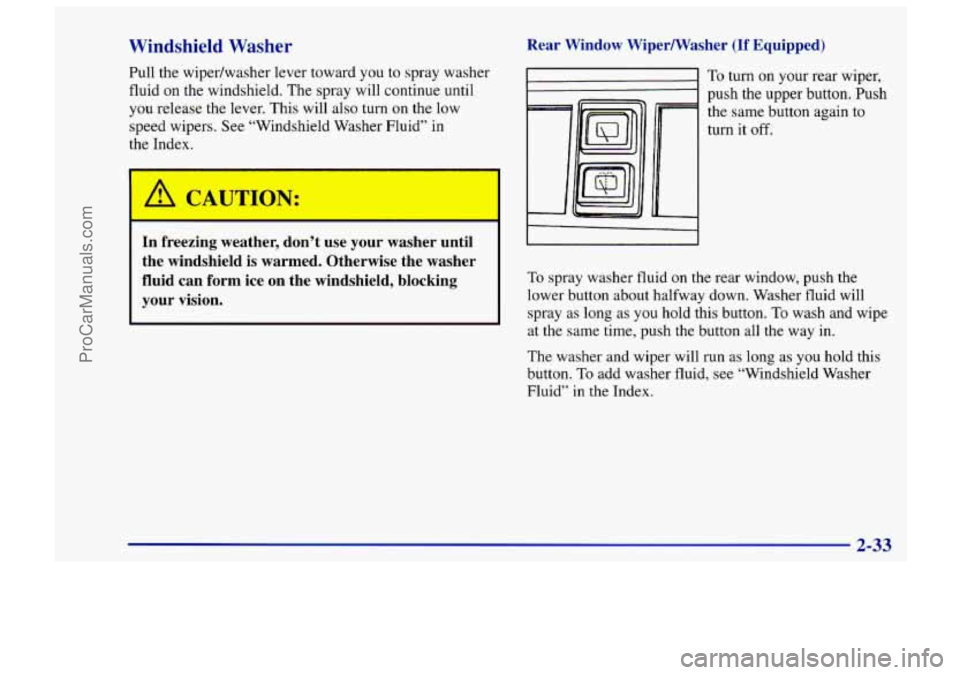
To turn on your rear wiper,
push the upper button. Push
the same button again to
turn it off.
To spray washer fluid on the rear window, push the
lower button about halfway down. Washer fluid will
spray as long as you hold this button.
To wash and wipe
at the same time, push the button all the way
in.
The washer and wiper will run as long as you hold this
button.
To add washer fluid, see “Windshield Washer
Fluid”
in the Index.
2-33
ProCarManuals.com
Page 95 of 388
Convex Outside Mirror
Your passenger’s side mirror is convex. A convex
mirror’s surface is curved so you can see more from the
driver’s seat.
L
A convex mirror can make things (like other
vehicles) look farther away than they really are.
If you cut too sharply into the right lane, you
could hit a vehicle on your right. Check your
inside mirror or glance over your shoulder before changing lanes.
Storage Compartments
Glove Box
To open the glove box, pull the latch toward you. Use
your key to lock and unlock the glove box.
Door Storage
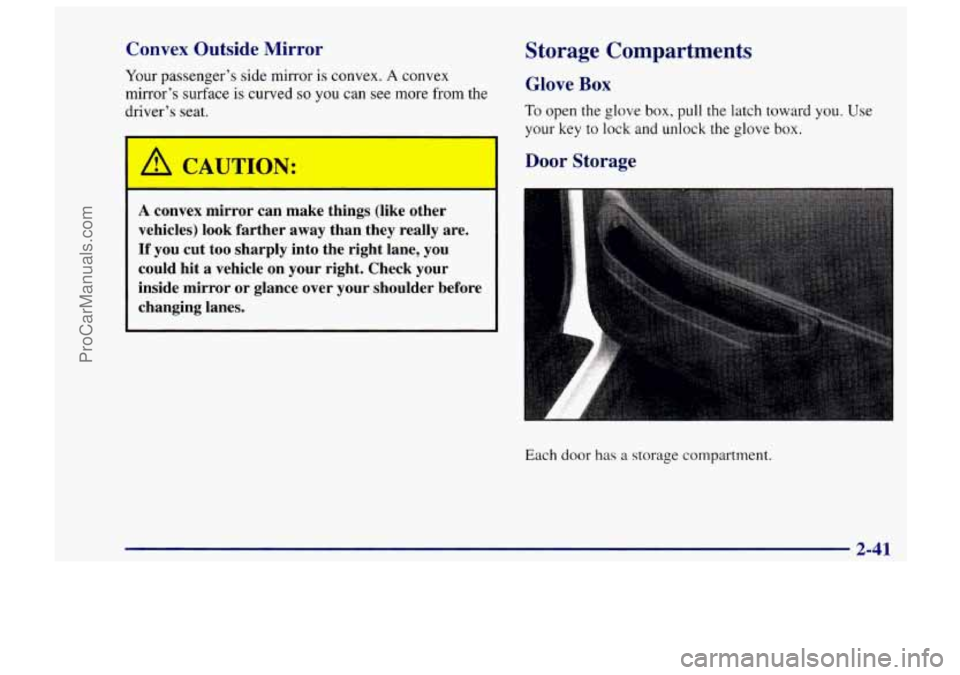
Each door has a storage compartment.
2-41
ProCarManuals.com