maintenance CHEVROLET TRACKER 1997 Owners Manual
[x] Cancel search | Manufacturer: CHEVROLET, Model Year: 1997, Model line: TRACKER, Model: CHEVROLET TRACKER 1997Pages: 388, PDF Size: 20.12 MB
Page 3 of 388
GeGED The 1997 Geo Tracker Owner’s Manual
1-1
291
3- 1
4- 1
5- 1
6-1
7- 1
8-1
9- 1
Seats and Restraint Systems
This section tells you how to use your seats and safety belts properly. It also explains the air bag system.
Features and Controls
This section explains how to start and operate your Geo.
Comfort Controls and Audio Systems
This section tells you how to adjust the ventilation and comfort controls and how to operate your audio system.
Your Driving and the Road
Here you’ll find helpful information and tips about the road and how to drive under different conditions.
Problems on the Road
This section tells what to do if you have a problem while driving, such as a flat tire or overheated engine., etc.
Service and Appearance Care
Here the manual tells you how to keep your Geo running properly and looking good.
Maintenance Schedule
This section tells you when to perform vehicle maintenance and what fluids and lubricants to use.
Customer Assistance Information
This section tells you how to contact ChevroletlGeo for assistance and how to get service and owner
publications. It also gives you information on “Reporting Safety Defects” on page
8-10.
Index
Here’s an alphabetical listing of almost every subject in this manual. You can use it to quickly find
something you want to read.
i
ProCarManuals.com
Page 38 of 388
0 Your vehicle is equipped with a crash sensing and
diagnostic module, which records information about
the air bag system. The module records information about the readiness
of the system, when the sensors are
activated and driver’s safety belt usage at deployment.
0 Let only qualified technicians work on your air bag
system. Improper service can mean that your air bag
system won’t work properly. See your dealer
for service.
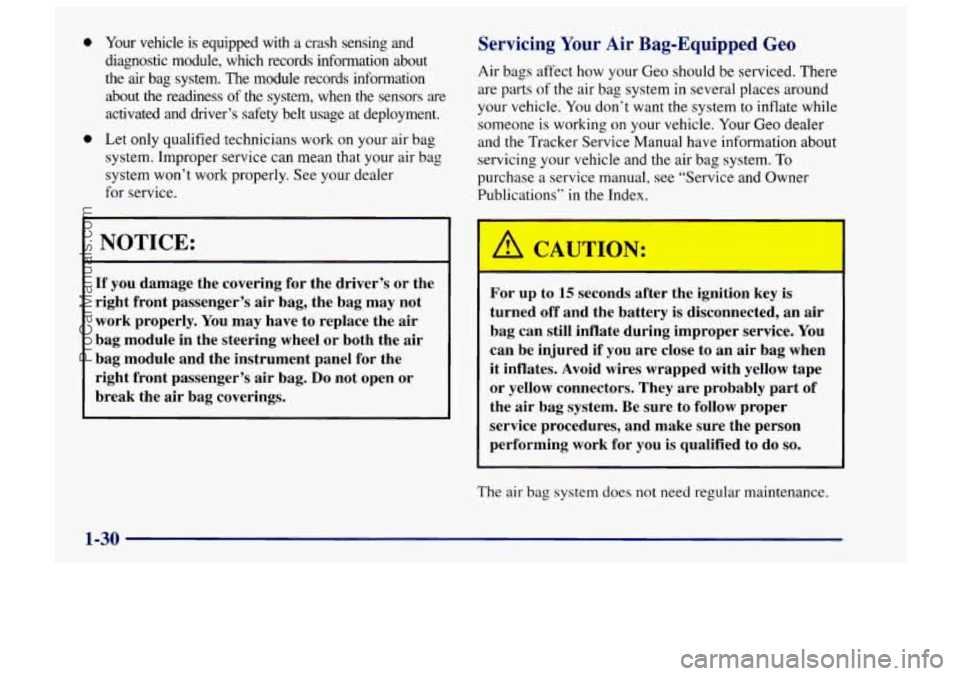
Servicing Your Air Bag-Equipped Geo
Air bags affect how your Geo should be serviced. There
are parts
of the air bag system in several places around
your vehicle. You don’t want the system to inflate while
someone
is working on your vehicle. Your Geo dealer
and the Tracker Service Manual have information about
servicing your vehicle and the air bag system.
To
purchase a service manual, see “Service and Owner
Publications” in the Index.
NOTICE:
If you damage the covering for the driver’s or the
right front passenger’s air bag, the bag may not
work properly. You may have to replace the air
bag module in the steering wheel or both the air
bag module and the instrument panel for the
right front passenger’s air bag.
Do not open or
break the air bag coverings. For up to
15 seconds
after the ignition key is
turned off and the battery is disconnected, an air
bag can still inflate during improper service. You
can be injured if you are close to an air bag when
it inflates. Avoid wires wrapped with yellow tape
or yellow connectors. They are probably part of
the air bag system. Be sure to follow proper
service procedures, and make sure the person
performing work for you is qualified to do
so.
The air bag system does not need regular maintenance.
1-30
ProCarManuals.com
Page 53 of 388
Safety Belt Extender
If the vehicle’s safety belt will fasten around you, you
should use it.
But if
a safety belt isn’t long enough to fasten, your
dealer will order you an extender. It’s free. When you go
in to order it, take the heaviest coat you will wear, so the
extender will be long enough for you. The extender will
be just for you, and just for the seat in your vehicle that
you choose. Don’t let someone else use it, and use
it
only for the seat it is made to fit. To wear it, just attach it
to the regular safety belt.
Checking Your Restraint Systems
Now and then, make sure the safety belt reminder light
and all your belts, buckles, latch plates, retractors and
anchorages are working properly. Look for any other
loose or damaged safety belt system parts. If you see
anything that might keep a safety belt system from
doing its job, have it repaired.
Tom or frayed safety belts may not protect you in a
crash. They can rip apart under impact forces. If a belt is
torn or frayed, get a new
one right away.
Also look for any opened or broken air bag covers, and
have them repaired or replaced. (The air bag system
does not need regular maintenance.)
1-45
ProCarManuals.com
Page 162 of 388
Before You Go Off-Roading
There are some things to do before you go out.
For example, be sure to have all necessary maintenance
and service work done. Check to make sure all
underbody shields (if
so equipped) are properly
attached. Be sure you read all the information about
your four-wheel-drive vehicle in this manual.
Is there
enough fuel?
Is the spare tire fully inflated? Are the
fluid levels up where they should be? What are the local
laws that apply to off-roading where you’ll be driving?
If you don’t know, you should check with law
enforcement people in the area. Will you be on
someone’s private land?
If so, be sure to get the
necessary permission.
Loading Your Vehicle for Off-Road Driving
There are some important things to remember about
how to load your vehicle.
0 The heaviest things should be on the load floor and
forward of your rear axle. Put heavier items as far
forward as you can.
Be sure the load is secured properly, so driving on
the off-road terrain doesn’t toss things around.
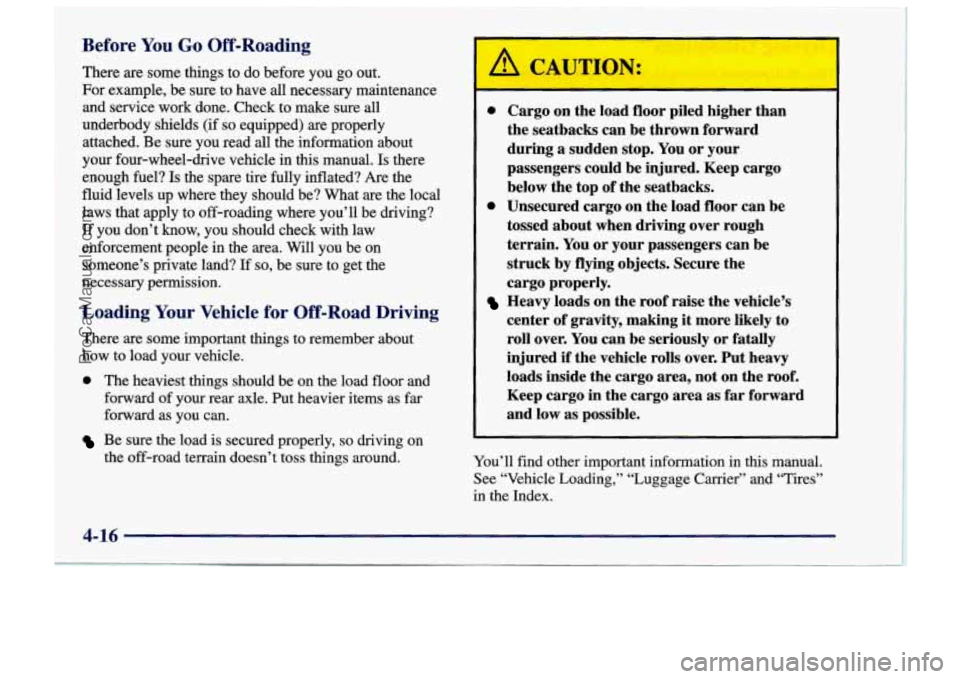
/r CAUTIOI .:
0 Cargo on the load floor piled higher than
the seatbacks can be thrown forward
during
a sudden stop. You or your
passengers could be injured. Keep cargo
below the top of the seatbacks.
0 Unsecured cargo on the load floor can be
tossed about when driving over rough
terrain. You or your passengers can be
struck by flying objects. Secure the
cargo properly.
Heavy loads on the roof raise the vehicle’s
center of gravity, making
it more likely to
roll over. You can be seriously or fatally
injured
if the vehicle rolls over. Put heavy
loads inside the cargo area, not on the roof.
Keep cargo in the cargo area as far forward
and low as possible.
You’ll find other important information in this manual.
See ‘Vehicle Loading,” “Luggage Carrier” and “Tires”
in the Index.
ProCarManuals.com
Page 176 of 388
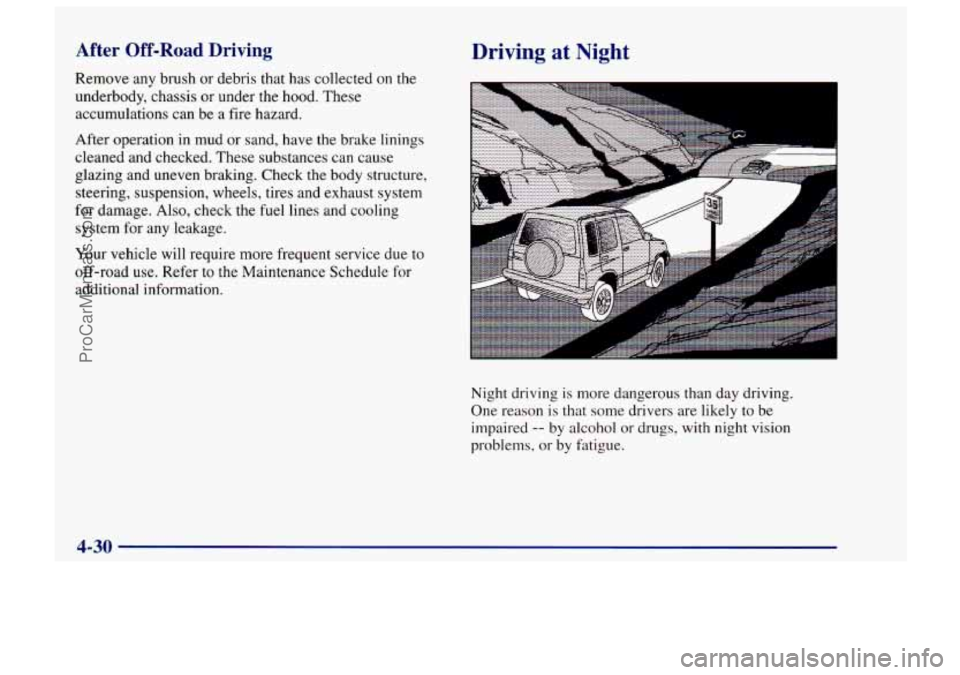
After Off-Road Driving
Remove any brush or debris that has collected on the
underbody, chassis or under the hood. These
accumulations can be a fire hazard.
After operation in mud or sand, have the brake linings
cleaned and checked. These substances can cause
glazing and uneven braking. Check the body structure,
steering, suspension, wheels, tires and exhaust system
for damage. Also, check the
fuel lines and cooling
system for any leakage.
Your vehicle will require more frequent service due to
off-road use. Refer to
the Maintenance Schedule for
additional information.
Driving at Night
Night driving is more dangerous than day driving.
One reason is that some drivers are likely to be
impaired
-- by alcohol or drugs, with night vision
problems,
or by fatigue.
4-30
ProCarManuals.com
Page 202 of 388
’ A CAUTION:
It can be dangerous to get out of your vehicle if
the shift lever is not fully in
PARK (P) with the
parking brake firmly set. Your vehicle can roll.
If you have left the engine running, the vehicle
can move suddenly. You or others could be
injured.
To be sure your vehicle won’t move, even
when you’re on fairly level ground, use the steps
that follow.
If you have four-wheel drive and your transfer
case
is in NEUTRAL (N), your vehicle will be free
to roll, even if your shift lever is in PARK (P). So,
be sure the transfer case is in a drive gear -- not
in
NEUTRAL (N).
When You Are Ready to Leave After
Parking
on a Hill
1. Apply your regular brakes and hold the pedal down
while you:
0 Start your engine;
Shift into a gear; and
Release the parking brake.
2. Let up on the brake pedal.
3. Drive slowly until the trailer is clear of the chocks.
4. Stop and have someone pick up and store the chocks.
Maintenance When Trailer Towing
Your vehicle will need service more often when you’re
pulling
a trailer. See the Maintenance Schedule for more
on this. Things that are especially important in trailer
operation are automatic transmission fluid (don’t
overfill), engine oil, axle lubricant, belts, cooling system
and brake adjustment. Each
of these is covered in this
manual, and the Index will help you find them quickly.
If you’re trailering, it’s
a good idea to review these
sections before you start your trip.
Check periodically to
see that all hitch nuts and bolts
are tight.
4-56
ProCarManuals.com
Page 239 of 388
GE4iB Section 6 Service and Appearance Care
Here you will find information about the care of your Geo. This section begins with service and fuel information, and
then it shows how to check important fluid and lubricant levels. There is also technical information about your
vehicle, and a part devoted to its appearance care.
6-2
6-3
6-7
6-10
6- 14
6- 16
6-19
6-2 1
6-2
1
6-22
6-23
6-26
6-27
6-29
6-33
Service
Fuel
Checking Things Under the
Hood
Engine Oil
Air Cleaner
Automatic Transmission Fluid
Manual Transmission Fluid
Clutch Adjustment
Rear Axle
Four-wheel
Drive
Engine Coolant
Radiator Pressure Cap
Windshield Washer Fluid
Brakes
Battery
6-33
6-3
3
6-40
6-48
6-49
6-53
6-54
6-56
6-56
6-57
6-58
6-58
6-62
6-64
Bulb Replacement
Halogen Bulbs
Tires
'
Appearance Care
Cleaning the Inside of Your Geo
Cleaning the Outside of Your Geo
Special Care for Canvas Top and Plastic
Windows
Underbody Maintenance
Chemical Paint Spotting
Appearance Care Materials Chart
Vehicle Identification Number
(VIN)
Electrical System
Replacement Bulbs
Air Conditioning Refrigerants
6-1
ProCarManuals.com
Page 240 of 388
Service
Your Geo dealer knows your vehicle best and wants you
to be happy with it. We hope you’ll go to your dealer for
all your service needs. You’ll get genuine
GM parts and
GM-trained and supported service people.
We hope you’ll want to keep your GM vehicle all
GM.
Genuine GM parts have one of these marks:
Delco
Doing Your Own Service Work
If you want to do some of your own service work, you’ll
want to use the proper Geo Service Manual. It tells you
much more about how to service your Geo than this
manual can.
To order the proper service manual, see
“Service and Owner Publications” in the Index.
Your vehicle has an air
bag system. Before attempting to
do your own service work,
see “Servicing Your Air
Bag-Equipped Geo” in the Index.
You should keep a record with all parts receipts and list
the mileage and the date
of any service work you
perform. See “Maintenance Record” in the Index.
6-2
ProCarManuals.com
Page 241 of 388
I
A CAUTION:
You can be injured and your vehicle could be
damaged if you
try to do service work on a
vehicle without knowing enough about it.
0
0 Be sure you have sufficient knowledge,
experience, the proper replacement parts
and tools before you attempt any vehicle
maintenance task.
Be sure to use the proper nuts, bolts and
other fasteners. “English” and “metric”
fasteners can be easily confused.
If you use
the wrong fasteners, parts can later break
or fall off. You could be hurt.
Adding Equipment to the Outside of
Your Vehicle
Things you might add to the outside of your vehicle can
affect the airflow around it. This may cause wind noise
and affect windshield washer performance. Check with
your Geo dealer before adding equipment to the outside
of your vehicle.
Fuel
Use regular unleaded gasoline rated at 87 octane or
higher.
At a minimum, it should meet specifications
ASTM
D4814 in the United States and CGSB 3.5-M93
in Canada. Improved gasoline specifications have been
developed by
the American Automobile Manufacturers
Association (AAMA) for better vehicle performance
and engine protection. Gasolines meeting the AAMA
specification could provide improved driveability and
emission control system protection compared to other gasolines.
Be sure the posted octane
is at least 87. If the octane is
less than 87,
you may get a heavy knocking noise when
you drive. If it’s bad enough, it can damage your engine.
If you’re using fuel rated at
87 octane or higher and you
still hear heavy knocking, your engine needs service.
But don’t worry if you hear a little pinging noise when
you’re accelerating or driving up
a hill. That’s normal,
and you don’t have to buy a higher octane fuel to get rid
of pinging. It’s the heavy, constant knock that means
you have a problem.
6-3
ProCarManuals.com
Page 251 of 388
As shown in the chart, SAE 1OW-30 is best for your
vehicle. However, you can use
SAE 5W-30 if it’s going
to be colder than
60°F ( 16°C) before your next oil
change. When it’s very cold, you should use
SAE 5W-30. These numbers on an oil container show
its viscosity, or thickness.
Do not use other viscosity
oils, such as
SAE 20W-50.
NOTICE:
Use only engine oil with the American Petroleum
Institute Certified For Gasoline Engines
“Starburst’’ symbol. Failure to use the
recommended oil can result in engine damage not
covered
by your warranty.
GM Goodwrench’ oil meets all the requirements for
your vehicle.
If you are
in an area where the temperature falls below
-20°F (-29”C), consider using either an SAE 5W-30
synthetic oil or an
SAE OW-30 oil. Both will provide
easier cold starting and better protection for your engine
at extremely low temperatures.
Engine Oil Additives
Don’t add anything to your oil. Your Geo dealer is ready
to advise if you think something
should be added.
When to Change Engine Oil
If any one of these is true for you, use the short tripkity
maintenance schedule:
0
0
0
0
0
Most trips are less than 5 to 10 miles (8 to 16 km).
This is particularly important when outside
temperatures are below freezing.
Most trips include extensive idling (such as frequent
driving
in stop-and-go traffic).
You operate your vehicle in dusty areas or
off-road frequently.
You frequently tow a trailer or
use a carrier on top of
your vehicle.
The vehicle is used for delivery service, police, taxi
or other commercial application.
Driving under these conditions causes engine oil to
break down sooner. If any one
of these is true for your
vehicle, then you need to change your oil and filter
every
3,000 miles (5 000 km) or 3 months -- whichever
occurs first.
If none of them is true, use the long triphighway
maintenance schedule. Change oil and filter every
7,500 miles (12 500 km) or 7.5 months -- whichever
occurs first. Driving a vehicle with a
fully warmed
engine under highway conditions causes engine oil to
break down slower.
6-13
I
ProCarManuals.com