brake CHEVROLET TRACKER 1998 1.G User Guide
[x] Cancel search | Manufacturer: CHEVROLET, Model Year: 1998, Model line: TRACKER, Model: CHEVROLET TRACKER 1998 1.GPages: 386, PDF Size: 21.17 MB
Page 81 of 386
Downloaded from www.Manualslib.com manuals search engine NOTICE:
Driving with the parking brake on can cause
your rear brakes to overheat. You may have
to
replace them, and you could also damage other
parts
of your vehicle.
If you are towing a trailer, see “Towing a Trailer” in
the Index.
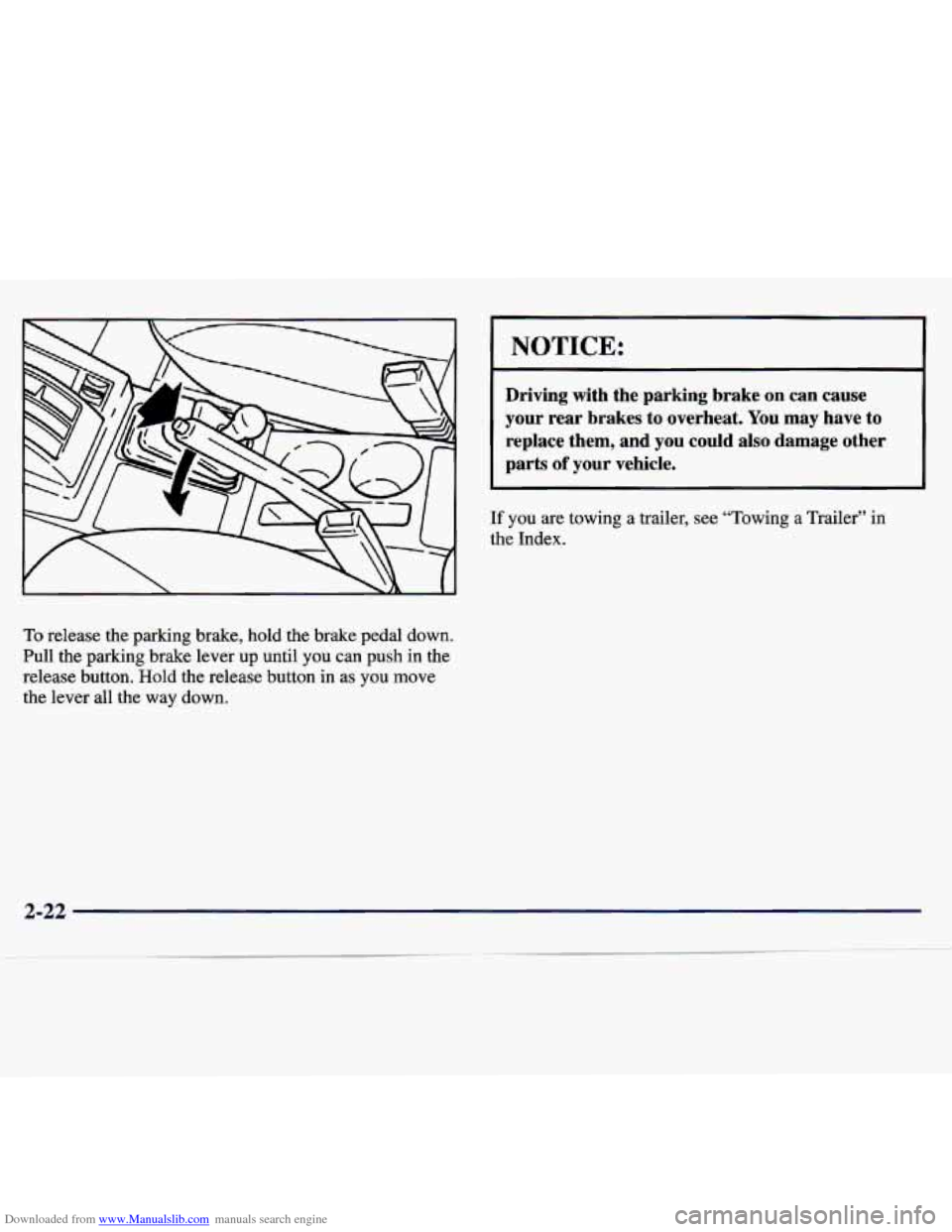
To release the parking brake, hold the brake pedal down.
Pull the parking brake lever up until you can push
in the
release button. Hold the release button in as
you move
the lever all the way down.
2-22
Page 82 of 386
![CHEVROLET TRACKER 1998 1.G User Guide Downloaded from www.Manualslib.com manuals search engine Shifting Into PARK (P)
(Automatic Translnission Only)
It can be dz Jerous to get out of you] ehicle if
the shift lever is not full](/img/24/8351/w960_8351-81.png "CHEVROLET TRACKER 1998 1.G User Guide Downloaded from www.Manualslib.com manuals search engine Shifting Into PARK (P)
(Automatic Translnission Only)
It can be dz Jerous to get out of you] ehicle if
the shift lever is not full")
Downloaded from www.Manualslib.com manuals search engine Shifting Into PARK (P)
(Automatic Translnission Only)
It can be dz Jerous to get out of you] ehicle if
the shift lever is not fully in PARK (P) with the
parking brake firmly set. Your vehicle can roll.
If you have left the engine running, the vehicle
can move suddenly. You
or others could be
injured. To be sure your vehicle won’t move, even
when you’re on fairly level ground, use the steps
that follow.
If you have four-wheel drive and
your transfer case
is in NEUTRAL (N), your
vehicle will be free to roll, even if your shift
lever
is in PARK (P). So, be sure the transfer
case
is in a drive gear -0 not in NEUTRAL (N).
If you’re pulling a trailer, see &‘Towing a Trailer”
in the Index.
1. Hold the brake pedal down with your right foot and
set the parking
brake.
2. Move the shift lever into PARK (P) by holding in the
button
on the lever and pushing the lever all the way
toward the front
of your vehicle.
3. If you have four-wheel drive, be sure the transfer
case is in a drive gear
-- not in NEUTRAL (N).
4. Move the key to LOCK.
5. Remove the key and take it with you. If you can
leave your vehicle with the key in your hand, your
vehicle is in
PARK (P).
2-23
Page 83 of 386
Downloaded from www.Manualslib.com manuals search engine Leaving Your Vehicle With the Engine
Running (Automatic Transmission Only)
I
It can be dangerous to leave yuur vehicle with
the engine running.
Your vehicle could move
suddenly
if the shift lever is not fully in PARK (P)
with the parking brake firmly set. If you have
four-wheel drive and your transfer case is in
NEUTRAL (N), your vehicle will be free to roll,
even
if your shift lever is in PARK (P). So be sure
the transfer case is in
a drive gear -- not in
NEUTRAL (N). And, if you leave the vehicle with
the engine running,
it could overheat and even
catch fire.
You or others could be injured. Don’t
leave your vehicle with the engine running unless
you have to.
Torque Lock (Automatic Transmission)
If you are parking on a hill and you don’t shift your
transmission into PARK (P) properly, the weight of the
vehicle may put too much force on the parking pawl
in
the transmission. You may find it difficult to pull the
shift lever out of PARK (P). This is called “torque lock.”
To prevent torque lock, set the parking brake and then
shift into PARK (P) properly before you leave the
driver’s seat.
To find out how, see “Shifting Into
PARK (P)” in the Index.
When you are ready to
drive, move the shift lever out
of PARK (P) before you release the parking brake.
If torque lock does occur, you may need to have another
vehicle push yours a little uphill
to take some of the
pressure from the parking pawl in the transmission,
so
you can pull the shift lever out of PARK (P).
2-24
Page 84 of 386
Downloaded from www.Manualslib.com manuals search engine Shifting Out of PARK (P)
(Automatic Transmission)
Your vehicle has a brake-transmission shift interlock.
You have to fully apply your regular brakes before you
can shift from
PARK (P) when the ignition is in the ON
position. See “Automatic Transmission” in the Index.
If you cannot shift out of PARK (P), ease pressure on
the shift lever
-- push the shift lever all the way into
PARK
(P) and release the shift lever button as you
maintain brake application. Then press the shift lever
button and move the shift lever into the gear you wish.
If you ever hold the brake pedal down but still can’t
shift out
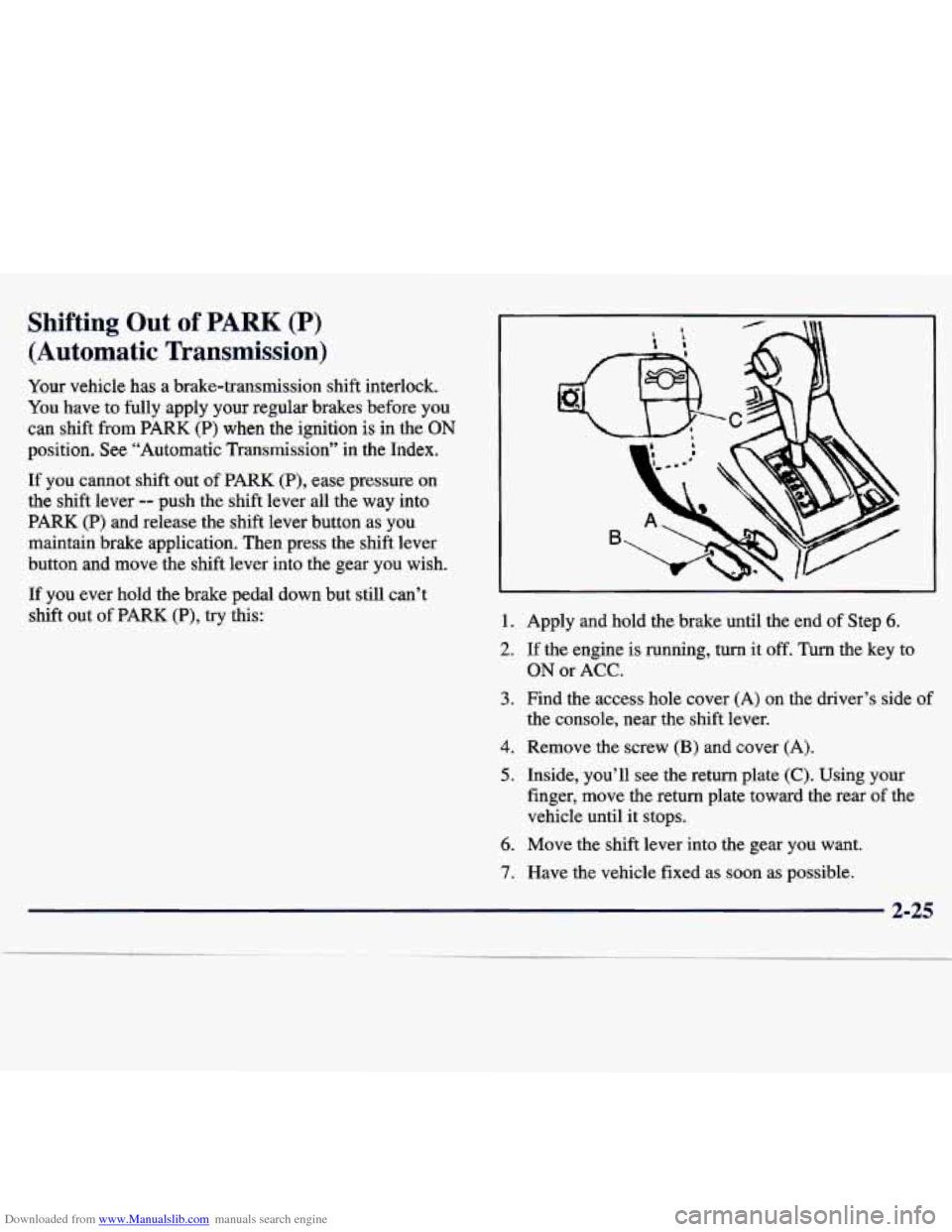
of PARIS (P), try this: 1. Apply and hold the brake until the end of Step 6.
2. If the engine is running, turn it off. Turn the key to
ON or ACC.
3. Find the access hole cover (A) on the driver’s side of
the console, near the shift lever.
4. Remove the screw (B) and cover (A).
5. Inside, you’ll see the return plate (C). Using your
finger, move the return plate toward the rear of the
vehicle until it stops.
6. Move the shift lever into the gear you want.
7. Have the vehicle fixed as soon as possible.
2-25
Page 85 of 386
Downloaded from www.Manualslib.com manuals search engine Parking Your Vehicle
(Manual Transmission)
Before you get out of your vehicle, put your manual
transmission in
REVERSE (R) and firmly apply the
parking brake.
If you have four-wheel drive, be sure your transfer case
is
in a drive gear. Your vehicle could roll if it isn't.
If you are towing a trailer, see "Towing a Trailer" in
the Index.
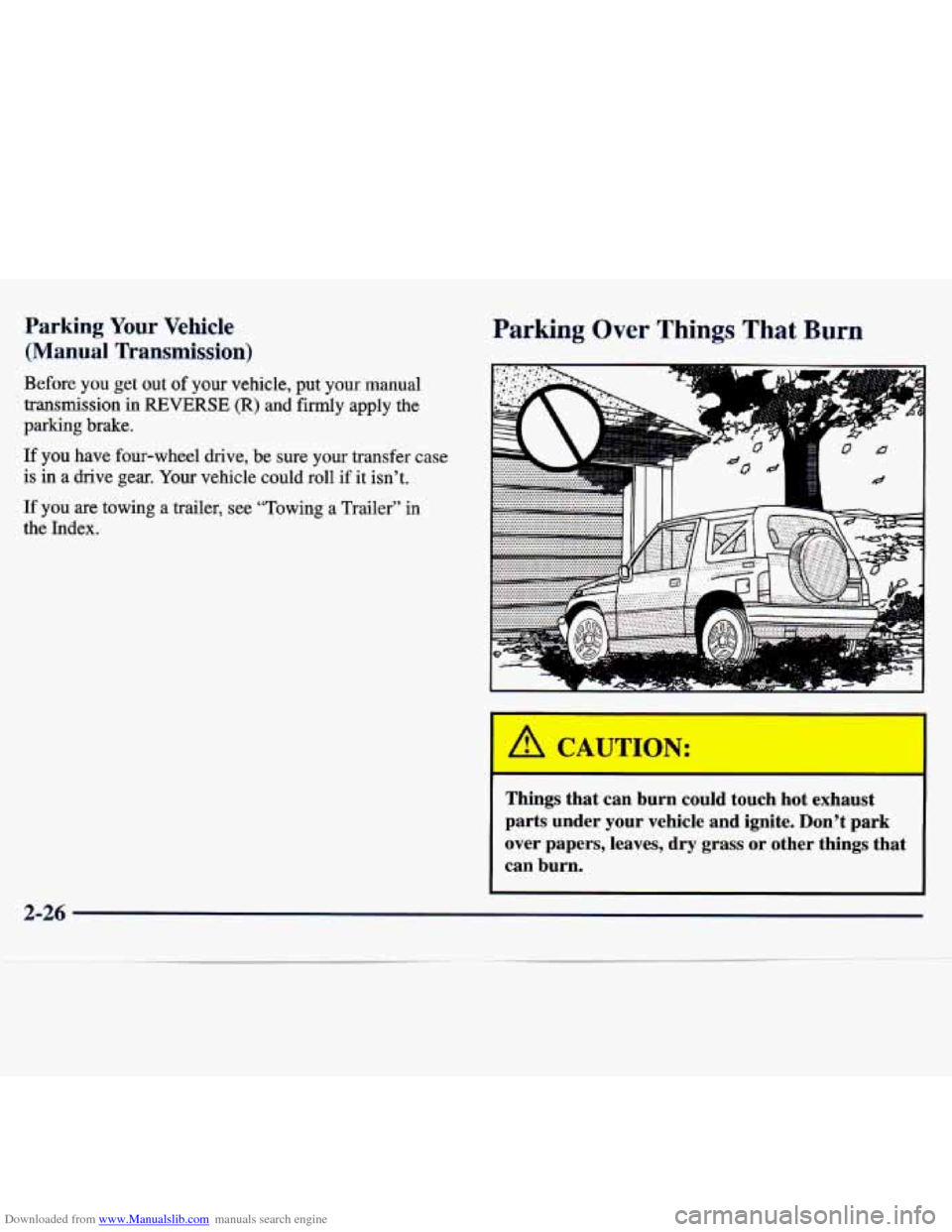
Parking Over Things That Burn
c. .. I
R
Things that can burn could touch hot exhaust
parts under your vehicle and ignite. Don't park
over papers, leaves, dry grass or other things that
can burn.
2-26
Page 87 of 386
Downloaded from www.Manualslib.com manuals search engine It can be dangerous to get out of your vehicle if
the shift lever is not fully in PARK (P) with the
parking brake firmly set. Your vehicle can
roll.
Don’t leave your vehicle when the engine is
running unless you have to. If you’ve left the
engine running, the vehicle can move suddenly.
You or others could be injured.
To be sure your
vehicle won’t move, even when you’re on fairly
level ground, always set your parking brake and
move the shift lever to
PARK (P).
If you have four-wheel drive and your transfer case is
in NEUTRAL
(N), your vehicle will be free to roll,
even if your shift lever is in PARK (P). So, be sure the
transfer case is in
a drive gear -- not in NEUTRAL (N).
Always set your parking brake. Follow the proper steps
to be sure
your vehicle won’t move. See “Shifting Into
PARK (P)” in the Index.
If you’re pulling a trailer, see “Towing a Trailer” in
the Index.
2-28
Page 92 of 386
Downloaded from www.Manualslib.com manuals search engine Rear Window Wiper/Washer (If Equipped)
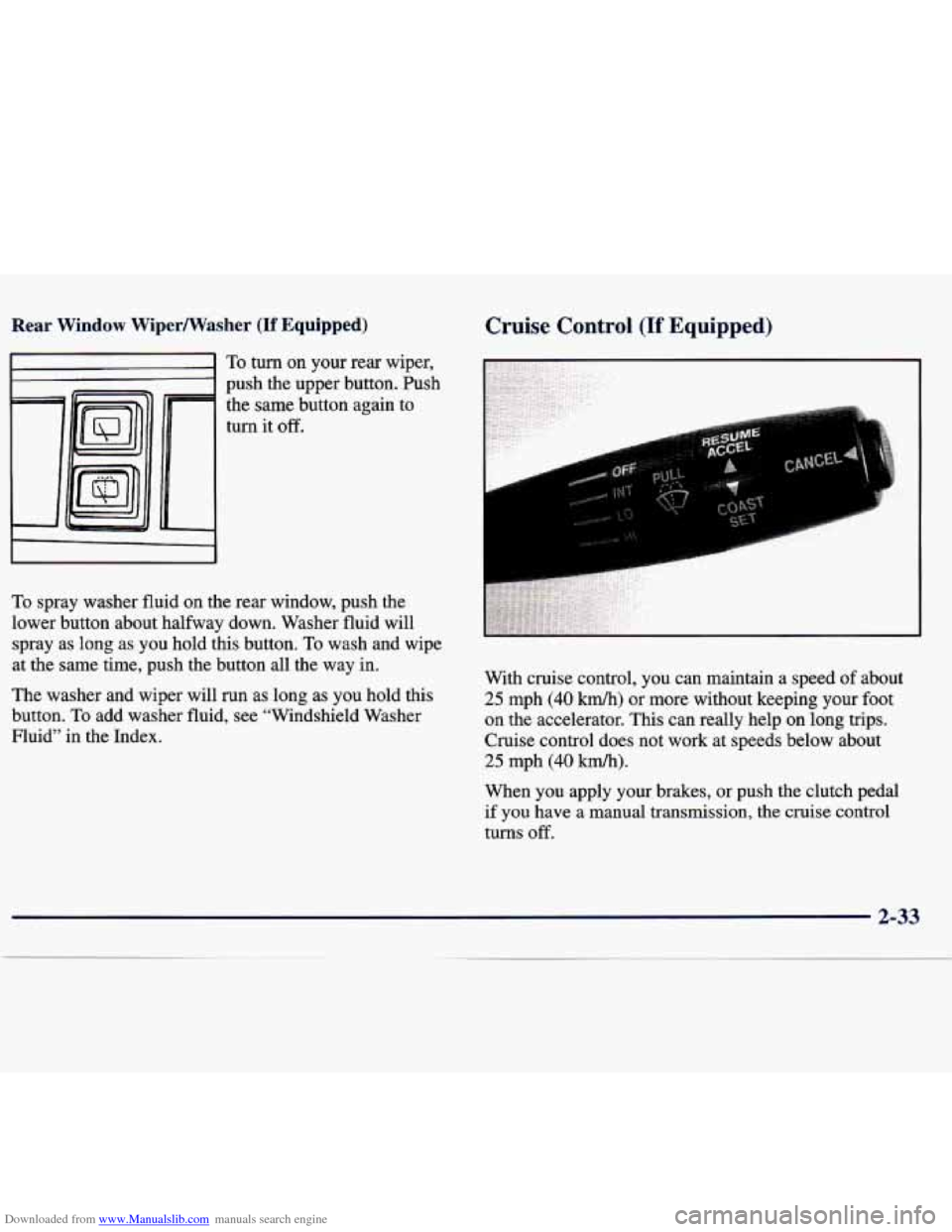
To turn on your rear wiper,
push
the upper button. hsh
the same button again to
turn it
off.
To spray washer fluid on the rear window, push the
lower button about halfway down. Washer fluid will
spray as long as you hold this button. To wash and wipe
at the same time, push the button all the way in.
The washer and wiper will run as long
as you hold this
button.
To add washer fluid, see “Windshield Washer
Fluid” in the Index.
Cruise Control (If Equipped)
With cruise control, you can maintain a speed of about
25 mph (40 kmk) or more without keeping your foot
on the accelerator. This can really help on long trips.
Cruise control does not work at speeds below about
25 mph (40 krn/h).
When you apply your brakes, or push the clutch pedal
if you have a manual transmission, the cruise control
turns off.
2-33
Page 94 of 386
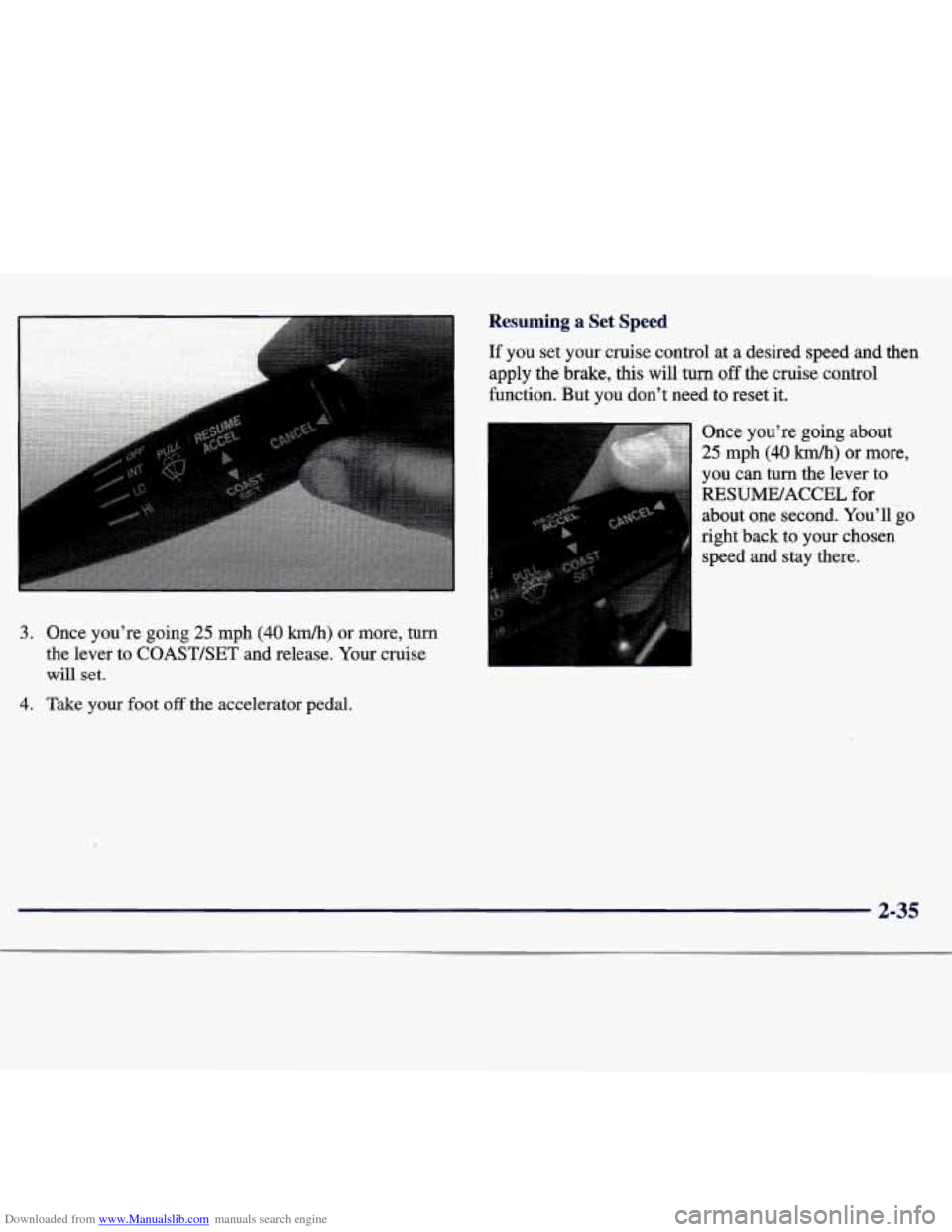
Downloaded from www.Manualslib.com manuals search engine 3. Once you’re going 25 mph (40 km/h) or more, turn
the lever to COAST/SET and release. Your cruise
will set.
4. Take your foot off the accelerator pedal.
Resuming a Set Speed
If you set your cruise control at a desired speed and then
apply the brake,
this will turn off the cruise control
function. But you don’t need to reset it.
Once you’re going about
25 mph (40 km/h) or more,
you can
turn the lever to
RESUME/ACCEL for
about one second. You’ll
go
right back to your chosen
speed and stay there.
2-35
Page 95 of 386
Downloaded from www.Manualslib.com manuals search engine Increasing Speed While Using Cruise Control
There are two ways to go to a higher speed.
Use the accelerator pedal to go to a higher speed.
Turn the lever to COAST/SET and release. Take
your foot
off the accelerator pedal. You’ll now
cruise at the higher speed.
at RESUME/ACCEL until you get up to the speed
you want, then release the lever.
Turn the lever to RESUME/ACCEL. Hold the lever
Reducing Speed While Using Cruise Control
To reduce your speed, turn and hold the lever in the
COASTISET position until you reach the lower speed
you want, then release the lever.
Passing Another Vehicle While Using Cruise Control
Use the accelerator pedal to increase your speed. When
you take your
foot off the pedal, your vehicle will slow
down to the cruise control speed you set earlier.
Using Cruise Control on Hills
How well your cruise control will work on hills depends
upon your speed, load and
the steepness of the hills.
When going up steep hills, you may have to step on the
accelerator pedal
to maintain your speed. When going
downhill, you may have to brake or shift to a lower
gear
to keep your speed down. Of course, applying the brake
takes you out of cruise control. Many drivers find this to
be too much trouble and don’t use cruise control on
steep hills.
Getting Out of Cruise Control
There are three ways to turn off cruise control:
Step lightly on the brake pedal, or push the clutch
pedal if you have a manual transmission.
Push in the CANCEL button on the end of the
cruise control lever.
Press the CRUISE CTlU switch on the
instrument panel.
Erasing Speed Memory
When you turn off the cruise control or the ignition,
your cruise control set speed memory
is erased.
2-36
Page 96 of 386
Downloaded from www.Manualslib.com manuals search engine Exterior Lamps
Daytime Running Lamps
Daytime Running Lamps (DIU) can make it easier
for others to see the front of your vehicle during the
day.
DRL can be helpful in many different driving
conditions, but they can be especially helpful in the
short periods after dawn and before sunset.
The DIU system will make your low-beam headlamps
come on at
a reduced brightness when:
0 The ignition is on,
0 The headlamp switch is off and
The parking brake is released.
When you turn on the headlamp switch, your DRL will
go out, and your headlamps will come on.
The other lamps that come on with your headlamps
will also come on. To
idle your vehicle with the DRL off, set the parking
brake. The
DRL will stay off until you release the
parking brake.
As with any vehicle, you should turn on the regular
headlamp system when you need it.
Interior Lamps
Instrument Panel Brightness Control
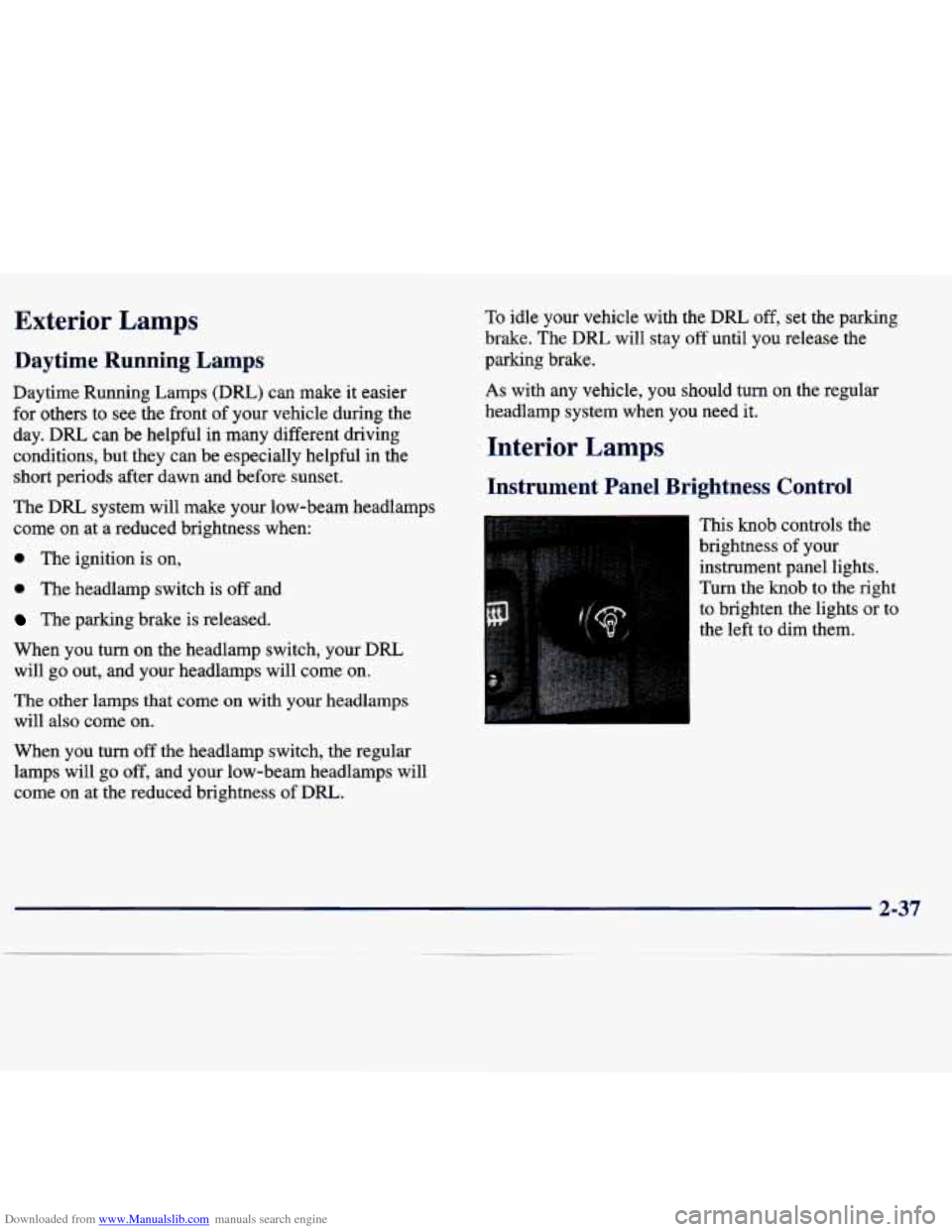
This knob controls the
brightness of your
instrument panel lights.
Turn the knob
to the right
to brighten the lights or to
the left to dim them.
When
you turn off the headlamp switch, the regular
lamps will go off, and your low-beam headlamps will
come on at the reduced brightness of DRL.
2-37